
Micro Injection Molded Plastic Market Trends, Size & Growth by 2034
Micro Injection Molded Plastic Market Size and Forecasts (2021–2034), Global and Regional Share, Trends, and Growth Opportunity Analysis Report Coverage : by Material Type (LCP, PEEK, PC, PE, POM, PMMA, PEI, PBT); Application (Medical, Automotive, Optics, Electronics); and Geography (North America, Europe, Asia Pacific, and South and Central America)
- Status : Data Released
- Report Code : TIPRE00040402
- Category : Chemicals and Materials
- No. of Pages : 150
- Available Report Formats :


- Last update date : August 04, 2026


2025 Market Size
US$ 1.29 Bn
Base year value
2034 Forecast
US$ 3.84 Bn
Projected by 2034
CAGR 2026-2034
12.89 %
Growth rate
Addressable Market
US$ 22.34 Bn
(2026-2034)
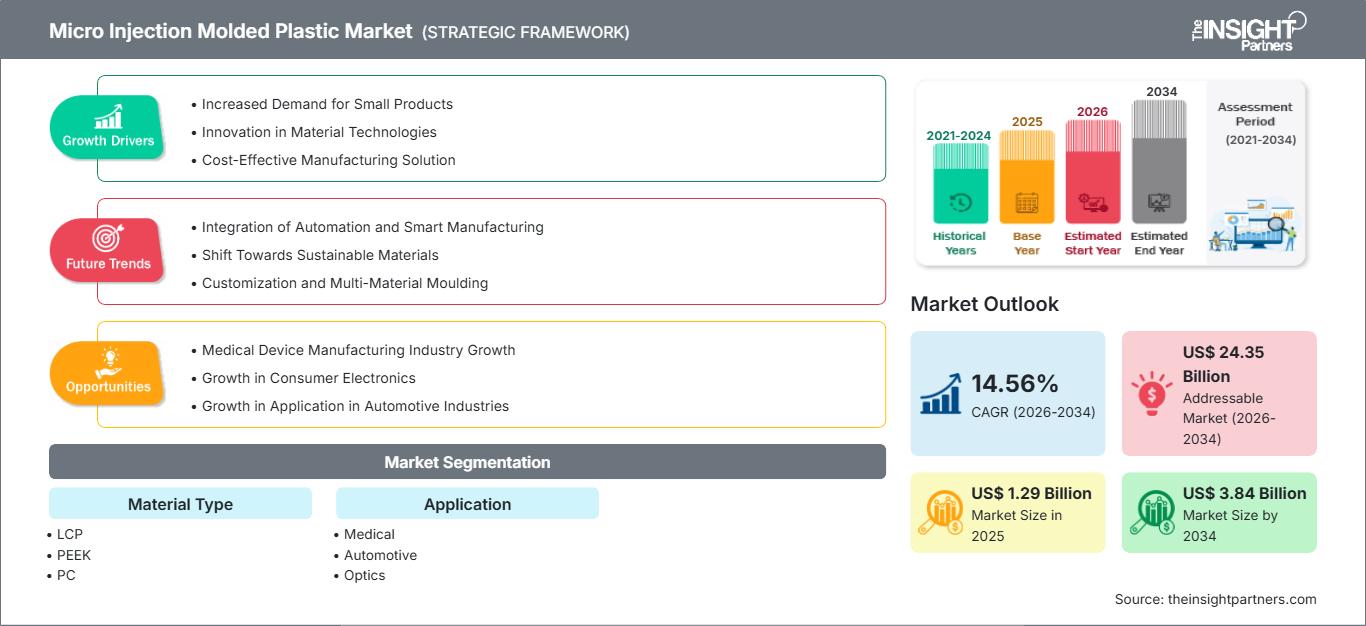
The Micro Injection Molded Plastic market was valued at US$ 1.29 billion in 2025 and is expected to reach US$ 3.84 billion by 2034; it is estimated to record a CAGR of 12.89% during 2026-2034.
Micro Injection Molded Plastic Market Assessment and Insights
- North America: Accounted for 34–37% share in 2025 and is anticipated to register a CAGR of 13.8–14.6% during 2026–2034, supported by strong medical device manufacturing, semiconductor investments, and advanced precision molding capabilities.
- US: Represented nearly 78–82% of North American revenue in 2025 and is projected to expand at a CAGR of 13.9–14.7%, driven by medical technology innovation and increasing demand for miniature electronic components.
- Europe: Held approximately 27–30% share in 2025 and is expected to grow at a CAGR of 13.2–14.0%, with Germany, Switzerland, France, and the UK serving as leading manufacturing and medical technology centers.
- Asia Pacific: Accounted for nearly 28–31% share in 2025 and is forecast to witness the fastest regional expansion with a CAGR of 15.8–16.6%, led by China, Japan, South Korea, and India through electronics and automotive manufacturing growth.
- Largest Segment: Medical accounted for approximately 39–43% of the micro injection molded plastic market share in 2025 and is anticipated to register a CAGR of 14.8–15.6%, supported by increasing production of minimally invasive devices and disposable diagnostic products.
- High Growth Segment: PEEK is expected to demonstrate the strongest growth with an estimated 2025 market share of 9–12% while expanding at a CAGR of 16.5–17.3%, owing to rising adoption in implantable medical devices and high-temperature electronic applications.
- Key companies analyzed in detail: Accumold LLC, Paragon Medical, SMC Ltd., Spectrum Plastics Group, Isometric Micro Molding, Inc., Makuta Micro Molding, Precikam Inc., MTD Micro Molding, Sil-Pro LLC, Micromolding Solutions Inc.
Source: The Insight Partners' analysis based on proprietary research, government publications, company annual reports, investor presentations, industry databases, and expert interviews.
Precision polymer processing has evolved considerably with improvements in mold machining, micro-scale tooling, digital process monitoring, and automated inspection technologies. Growing production of miniature components for minimally invasive surgical devices, hearing aids, wearable electronics, sensors, connectors, and optical assemblies has accelerated commercialization. Material innovations involving PEEK, liquid crystal polymer (LCP), and polyetherimide further improve thermal stability, mechanical strength, and dimensional consistency, enabling manufacturers to satisfy increasingly stringent application requirements across multiple industries.
Over the coming decade, micro injection molded plastic market investments are expected to increase across Asia Pacific manufacturing clusters, while North America and Europe continue strengthening domestic precision manufacturing capabilities. Regulatory emphasis on medical device quality management, expanding semiconductor production, and continuous miniaturization of electronic products are likely to sustain long-term investment opportunities. Manufacturers focusing on automation, cleanroom production, advanced metrology, and sustainable material utilization are expected to improve competitiveness across global supply chains.
Micro Injection Molded Plastic Market Report Scope
| Report Attribute | Details |
|---|---|
| Market size in 2025 | US$ 1.29 Billion |
| Market Size by 2034 | US$ 3.84 Billion |
| Global CAGR (2026 - 2034) | 12.89% |
| Historical Data | 2021-2024 |
| Forecast period | 2026-2034 |
Micro Injection Molded Plastic Market Analysis
Growing demand for miniature precision components continues to transform manufacturing across medical technology, electronics, automotive systems, and optical equipment. The micro injection molded plastic market growth is supported by increasing integration of compact electronic assemblies, minimally invasive medical devices, and sensor-enabled automotive platforms requiring micron-level dimensional accuracy. Industry standards governing medical manufacturing, together with rising investments in semiconductor packaging and advanced consumer electronics, continue strengthening demand for high-performance micro molded plastic components manufactured using engineering-grade polymers.
Material suppliers, mold manufacturers, automation providers, machine builders, and precision molders together form a highly integrated value chain. Engineering polymers such as PEEK, LCP, POM, PEI, and PBT increasingly replace conventional materials where durability, lightweight construction, chemical resistance, and dimensional stability are essential. Automation and in-line inspection technologies further improve production efficiency while minimizing defects and supporting scalable manufacturing.
Competitive intensity continues increasing as specialized manufacturers expand cleanroom molding capabilities, automation infrastructure, and engineering support services. The micro injection molded plastic market analysis indicates that companies increasingly differentiate themselves through proprietary tooling technologies, rapid prototyping capabilities, vertically integrated manufacturing, and regulatory compliance expertise. Accumold LLC, Spectrum Plastics Group, Paragon Medical, Makuta Micro Molding, and Isometric Micro Molding continue investing in advanced production platforms to strengthen customer relationships across highly regulated industries.
Strategic investments increasingly target precision machining, digital quality assurance, AI-enabled process optimization, and sustainable manufacturing practices. Partnerships between medical OEMs, electronics manufacturers, and precision molding specialists continue accelerating commercialization of next-generation miniature devices. Meanwhile, Asia-based manufacturers are expanding production capacity while North American and European firms emphasize engineering services, custom product development, and high-value applications requiring strict dimensional tolerances and comprehensive validation capabilities.
● REPORT CUSTOMIZATION
Tailor This Report To Align With Your Specific Business Requirements
This report can be customized to align precisely with your business objectives, scope, and target markets. Customization options include tailored segmentation, geography, competitive analysis, and strategic insights to support informed decision-making.
Customize This Report →WHAT YOU CAN ADJUST
- ● Segmentations
- ● Geography
- ● Competitive Analysis
- ● Language Preferences
Micro Injection Molded Plastic Market: Strategic Insights
Regional Insights
North America Micro Injection Molded Plastic Market
North America accounted for 34–37% of the global micro injection molded plastic market share in 2025 and is projected to expand at a CAGR of 13.8–14.6% during 2026–2034. The region benefits from a mature medical device ecosystem, advanced polymer processing technologies, and widespread adoption of precision automation. Demand is reinforced by increasing production of minimally invasive surgical instruments, implantable components, and high-density electronic connectors. Regulatory compliance under FDA quality standards and investments in semiconductor manufacturing further strengthen regional competitiveness.
Manufacturers continue expanding cleanroom molding capacity while integrating automated inspection systems and digital process monitoring to improve repeatability. Growth is also supported by aerospace electronics, defense miniaturization programs, and electric vehicle electronics requiring compact, lightweight components. Continued reshoring initiatives and federal investments in advanced manufacturing are expected to encourage capacity expansion among specialized micro molding companies throughout the forecast period.
U.S. Micro Injection Molded Plastic Market
The United States represented approximately 78–82% of North America's revenue in 2025 and is forecast to register a CAGR of 13.9–14.7% through 2034. The country hosts many leading precision molding specialists, medical device OEMs, and engineering polymer suppliers, creating an integrated manufacturing ecosystem. Continuous innovation in catheter systems, diagnostic devices, wearable healthcare equipment, and semiconductor packaging supports sustained demand for highly precise micro-molded plastic components.
Companies including Accumold LLC, Spectrum Plastics Group, Paragon Medical, Makuta Micro Molding, and Isometric Micro Molding continue investing in advanced tooling, cleanroom manufacturing, and automated metrology. Rising adoption of robotics-assisted surgery, laboratory diagnostics, and compact consumer electronics further strengthens production requirements. Government support for domestic semiconductor manufacturing and continued healthcare innovation are expected to sustain long-term market expansion.
Europe Micro Injection Molded Plastic Market
Europe holds around a 27-30% share of the worldwide market as of 2025 and is projected to grow at a CAGR of 13.2-14.0% over 2026-2034. Germany will lead in the region owing to its superior engineering in the automotive industry, medical device manufacturing, and precision machinery. Germany's excellent engineering expertise and use of high-performance polymers will continue to drive demand for intricate miniature plastic parts.
The United Kingdom has been benefiting from increased investments in life sciences, medical devices, and microengineering research at universities, which will help drive the growth of precise molding technology. In France, Italy, and Spain, production of healthcare equipment, industrial electronics, and automobile parts will further improve as industrial development efforts support domestic manufacturing through industrial modernization initiatives. Increasing demand for minimally invasive medical technologies and lightweight electronic assemblies is expected to sustain regional growth throughout the forecast period.
APAC Micro Injection Molded Plastic Market
Asia Pacific accounted for around 28-31% of global revenue in 2025 and is expected to witness the highest regional CAGR of 15.8-16.6% during the forecast period. China remains the largest manufacturing center due to its comprehensive electronics manufacturing ecosystem, while Japan and South Korea continue to advance in precision engineering and semiconductor manufacturing.
India is experiencing a growing trend of investment in medical device manufacturing and electronics manufacturing through industrial development programs, while Australia is contributing through healthcare manufacturing and research activities. Growth in consumer electronics manufacturing and increased automation across manufacturing sectors continue to drive demand in the region.
Middle East & Africa Micro Injection Molded Plastic Market
The Middle East & Africa market is expected to expand at a CAGR of 12.4–13.2% through 2034, supported by increasing industrial diversification and healthcare infrastructure development. Saudi Arabia and the UAE continue investing in advanced manufacturing, medical technologies, and industrial automation as part of long-term economic diversification strategies.
South Africa remains a significant source of medical goods and industrial plastic products in the region, whereas the Rest of MEA will continue to experience slow adoption of advanced polymer processing technology. Increased investments in health care institutions, industrial development, and infrastructure development should facilitate further market growth.
Segmentation Analysis
Material Type
The Material Type segment is expected to experience a CAGR of 14.7%-15.5% from 2026 to 2034. The micro injection molded plastics market scope is steadily expanding due to the use of engineering polymers that exhibit dimensional stability, chemical resistance, and mechanical properties, and that are suitable for medical and electronic applications. The choice of material largely depends on biocompatibility, thermal properties, processability, and regulatory compliance.
- LCP – Widely utilized for ultra-thin electronic connectors, sensors, and miniature electrical components because of exceptional flow characteristics, low shrinkage, and outstanding dimensional stability during high-volume manufacturing.
- PEEK – Increasingly adopted for implantable medical devices, surgical instruments, aerospace parts, and high-temperature electronic applications owing to its excellent mechanical strength, biocompatibility, and chemical resistance.
- PC – Preferred for transparent medical components, optical assemblies, diagnostic equipment, and precision housings requiring high impact resistance, optical clarity, and dimensional consistency.
- PE – Commonly selected for disposable healthcare products and lightweight industrial components because of its cost-effectiveness, chemical resistance, and ease of precision molding.
- POM – Frequently used in miniature gears, precision mechanical assemblies, and automotive components due to its low friction, wear resistance, and excellent dimensional stability.
- PMMA – Extensively utilized in optical devices, microfluidic systems, and transparent medical components because of superior light transmission and excellent surface finish.
- PEI – Suitable for high-temperature medical equipment and electrical insulation applications requiring outstanding thermal stability, flame resistance, and structural integrity.
- PBT – Applied in automotive connectors, electrical housings, and industrial electronics owing to its excellent electrical insulation, moisture resistance, and mechanical durability.
Application
The application segment is expected to expand with a CAGR of 14.9–15.7% from 2026 to 2034. Growing demand for high-precision engineered small parts in the highly regulated healthcare, automotive electronics, optics, and semiconductor sectors is expected to boost market growth. Increasing device miniaturization and greater complexity in electronic systems have been key drivers of demand.
- Medical – Represents the largest application owing to growing production of minimally invasive surgical devices, drug delivery systems, diagnostic cartridges, hearing aids, and implantable medical components requiring exceptional dimensional precision.
- Automotive – Demand continues increasing with the integration of advanced driver assistance systems, electric vehicles, compact sensors, precision connectors, and lightweight electronic assemblies supporting vehicle electrification.
- Optics – Precision molded plastic components enable miniature lenses, fiber optic connectors, imaging devices, laser systems, and optical communication equipment requiring micron-level manufacturing tolerances.
- Electronics – Strong demand originates from semiconductor packaging, wearable electronics, mobile devices, connectors, switches, and miniaturized consumer electronics that require high-volume precision manufacturing.
Opportunity Snapshot
| Application | Revenue Contribution | Trend Tag | Adoption Stage |
| Medical | High | Minimally Invasive | Mature |
| Automotive | Medium | EV Sensors | Scaling |
| Optics | Medium | Micro Optics | Scaling |
| Electronics | High | Chip Packaging | Mature |
Micro Injection Molded Plastic Market Growth Drivers and Impact Analysis
Expanding Demand for Miniaturized Medical Devices
The medical industry is expected to remain one of the biggest drivers of demand for micro-molded plastic parts, with the increasing development of minimally invasive surgical devices, implants, drug-delivery devices, diagnostic test kits, and wearables. There have been indications from organizations like the World Health Organization of a rising burden of chronic diseases among elderly populations, creating a need for technological advancements in the medical field that use smaller, lighter components. With micro injection molding, the manufacturer can produce highly complex geometries while maintaining tight tolerances and material control in the cleanroom. As the healthcare manufacturing sector seeks to minimize product costs, achieve faster production cycles, and ensure compliance, more investment in precision molding technologies will be needed, thereby supporting the growth of the healthcare industry in the future.
Growing Adoption of High-Performance Engineering Polymers
Continuous innovation in engineering polymers is significantly improving the performance capabilities of micro injection molded components across medical, automotive, electronics, and industrial applications. Materials such as PEEK, LCP, PEI, and PBT offer better thermal and mechanical performance, as well as electrical and chemical resistance, than traditional plastics. Such material attributes have made it possible to substitute metals with plastics without losing functional capabilities. Additionally, the development of uniform resins and improved moldability has enabled the production of more complex, miniaturized components with higher efficiency and lower waste. As there is a growing demand for light, strong products, investment in precision micro molding will continue to grow.
Automation and Digital Manufacturing Improve Production Efficiency
Manufacturers are increasingly integrating robotics, machine vision, digital process control, and automated quality control in micro injection molding processes to increase consistency and reduce manufacturing variability. Smart manufacturing technologies enable continuous monitoring of process parameters to ensure micron-level tolerances and reduce defects and downtime. Additionally, automated handling systems reduce contamination risks, particularly in medical manufacturing that requires cleanroom production. All of these technological improvements increase production scalability, lower costs, and expedite product development. The increased adoption of Industry 4.0 manufacturing methods is thus likely to enhance the competitive edge in the precision molding market.
Micro Injection Molded Plastic Market Future Trends
Artificial Intelligence Enhances Precision Manufacturing
Artificial intelligence is increasingly being incorporated into precision molding operations to optimize process parameters, predict equipment maintenance requirements, and improve product consistency. The micro injection molded plastic market trends indicate that companies have invested in machine learning systems to detect deviations before they become defects. This quality assurance approach, which uses digital twins and predictive analytics, increases efficiency, reduces waste, and supports product qualification. Over the next five years, there will be increased use of intelligent manufacturing systems to efficiently produce miniature components across healthcare, electronics, and industrial applications.
Expansion of Sustainable Polymer Processing Technologies
Sustainability is becoming an important consideration across precision plastics manufacturing as customers seek lower environmental impact throughout product life cycles. Processing techniques are being developed that minimize waste, use energy efficiently, and, where appropriate for the application, enhance the recycling of engineering polymers. With the development of more efficient electric molding machines and closed-loop manufacturing processes, production waste is being minimized while maintaining high standards of dimensional accuracy. In response to tougher environmental regulations and customer demands for sustainability, those companies that embrace environmentally friendly production techniques are predicted to gain a competitive advantage over the next decade.
Micro Injection Molded Plastic Market Opportunities
Expansion of Semiconductor and Advanced Electronics Manufacturing
The increasing localization of semiconductor manufacturing presents substantial opportunities for precision micro molding suppliers. Micro injection molded plastic market Forecasts indicate continued investment in semiconductor, packaging, and electronic assembly plants in North America, Europe, and the Asia-Pacific region. Such investments will result in rising demand for micro connectors, sensor housings, insulation materials, optical interfaces, and other precision plastic components manufactured from engineered plastics. Companies that can facilitate large-scale production with very precise dimensional tolerances and quality-control systems are likely to secure long-term supply contracts with semiconductor and electronics manufacturers while expanding their technological capabilities and production capacity.
Emerging Healthcare Manufacturing in Developing Economies
Healthcare manufacturing facility production continues to rise in developing countries due to government encouragement of device and diagnostic manufacturing. Growing investments in hospital construction, laboratories, and local manufacturing of medical technologies will create a favorable environment for precision molding firms seeking to expand their geographic presence. Creating regional manufacturing facilities for clean rooms, engineering services, and product development helps manufacturers meet rising demand in the healthcare industry. Firms with regulatory knowledge, tooling know-how, and local manufacturing capabilities are expected to thrive due to increased purchases of disposable medical products, diagnostics, and minimally invasive medical technologies.
Recent Developments
- July 2026: A Long Island-based custom injection molder and tooling company, Sweet Tooth, expanded into Kentucky through the purchase of sister companies in Shelbyville, Ky.
- March 2026: Technimark, a global leader in the design and manufacturing of custom, highly engineered injection-molded components for medical, consumer, and specialty industrial applications, acquired Rage Custom Plastics ("Rage"), a US-based provider of blow and injection-molded plastic products focused on medical and consumer healthcare markets.
Frequently Asked Questions

- Comprehensive Market Sizing and Forecast Analysis
- Detailed Segmentation Analysis
- In-Depth Market Dynamics Assessment
- Regional and Country-Level Insights
- Competitive Landscape and Company Benchmarking
- Strategic Business Intelligence
Recent Reports
Testimonials

The Insight Partners provided valuable market intelligence that supported our global go-to-market strategy. Their team was professional, responsive, and attentive to our feedback, providing thoughtful analysis and helpful methodological clarifications throughout the project.
Junmo Kim Chief Financial Officer (CFO), Enertech Co., Ltd.
The Insight Partners' SCADA System Market report is comprehensive, with valuable insights on current trends and future forecasts. The team was highly professional, responsive, and supportive throughout. We are very satisfied and highly recommend their services.
RAN KEDEM Partner, Reali Technologies LTDs
I requested a report on a very specific software market and the team produced the report in a few days. The information was very relevant and well presented. I then requested some changes and additions to the report. The team was again very responsive and I got the final report in less than a week.
JEAN-HERVE JENN Chairman, Future Analytica
We worked with The Insight Partners for an important market study and forecast. They gave us clear insights into opportunities and risks, which helped shape our plans. Their research was easy to use and based on solid data. It helped us make smart, confident decisions. We highly recommend them.
PIYUSH NAGPAL Sr. Vice President, High Beam Global
The Insight Partners delivered insightful, well-structured market research with strong domain expertise. Their team was professional and responsive throughout. The user-friendly website made accessing industry reports seamless. We highly recommend them for reliable, high-quality research services
YUKIHIKO ADACHI CEO, Deep Blue, LLC.
This is the first time I have purchased a market report from The Insight Partners.While I was unsure at first, I visited their web site and felt more comfortable to take the risk and purchase a market report.I am completely satisfied with the quality of the report and customer service. I had several questions and comments with the initial report, but after a couple of dialogs over email with their analyst I believe I have a report that I can use as input to our strategic planning process.Thank you so much for taking the extra time and making this a positive experience.I will definitely recommend your service to others and you will be my first call when we need further market data.
JOHN SUZUKI President and Chief Executive Officer, Board Director, BK Technologies
I wish to appreciate your support and the professionalism you displayed in the course of attending to my request for information regarding to infectious disease IVD market in Nigeria. I appreciate your patience, your guidance, and the fact that you were willing to offer a discount, which eventually made it possible for us to close a deal. I look forward to engaging The Insight Partners in the future, all thanks to the impression you have created in me as a result of this first encounter.
DR CHIJIOKE ONYIA MANAGING DIRECTOR, PineCrest Healthcare Ltd.Reason to Buy
- Informed Decision-Making
- Understanding Market Dynamics
- Competitive Analysis
- Identifying Emerging Markets
- Customer Insights
- Market Forecasts
- Risk Mitigation
- Boosting Operational Efficiency
- Strategic Planning
- Investment Justification
- Tracking Industry Innovations
- Aligning with Regulatory Trends





 Get Free Sample for