
Microcellular Polyurethane Foam Market Share, Growth & Forecast by 2034
Coverage: by Type (High Density Foam, Low Density Foam); Application (Automotive, Building and Construction, Electronics, Medical, Aerospace, Others) , and Geography (North America, Europe, Asia Pacific, and South and Central America)
- Status : Data Released
- Report Code : TIPRE00007549
- Category : Chemicals and Materials
- No. of Pages : 150
- Available Report Formats :


- Last update date : August 06, 2026


2025 Market Size
US$ 8.24 Bn
Base year value
2034 Forecast
US$ 11.33 Bn
Projected by 2034
CAGR 2026-2034
3.60 %
Growth rate
Addressable Market
US$ 88.87 Bn
(2026-2034)
The microcellular polyurethane foam market was valued at US$ 8.24 billion in 2025 and is projected to reach US$ 11.33 billion by 2034, registering a CAGR of 3.60% during 2026–2034. Demand is supported by increasing adoption of lightweight, resilient, and energy-efficient polymer foams across automotive, aerospace, medical, and construction industries. Advancements in foam processing technologies and expanding requirements for high-performance cushioning and insulation materials continue to strengthen commercial adoption across developed and emerging manufacturing economies.
Across North America, manufacturers are increasingly investing in advanced polyurethane processing technologies to improve product consistency, reduce material waste, and comply with sustainability regulations. The microcellular polyurethane foam market size continues to benefit from strong aerospace production, electric vehicle manufacturing, and commercial construction activities. Growing replacement of conventional polymer foams with lightweight engineered materials is expected to support a regional CAGR of 3.3–3.8% through the forecast period.
Microcellular Polyurethane Foam Market Assessment and Insights
- North America: The region accounted for a 34–37% share in 2025 and is expected to register a CAGR of 3.3–3.8% during 2026–2034, supported by advanced aerospace manufacturing, automotive production, and strong investments in high-performance polymer technologies.
- U.S.: The country represented 79–83% of the North American market in 2025 and is projected to expand at a CAGR of 3.4–3.9%, driven by technological innovation and robust industrial demand.
- Europe: Europe held a 28–31% share in 2025 and is anticipated to grow at a CAGR of 3.2–3.7%, with Germany, France, the UK, and Italy leading adoption across automotive, industrial, and construction applications.
- Asia Pacific: Asia Pacific accounted for a 24–27% share in 2025 and is forecast to record the fastest regional CAGR of 4.2–4.8%, led by China, Japan, South Korea, and India through expanding manufacturing capabilities.
- Largest Segment: Application – Automotive represented 35–39% microcellular polyurethane foam market share in 2025 and is expected to grow at a CAGR of 3.8–4.2%, supported by lightweight vehicle manufacturing and electric mobility initiatives.
- High Growth Segment: Application – Medical accounted for 12–15% market share in 2025 and is projected to expand at a CAGR of 4.6–5.1%, driven by increasing demand for cushioning materials, prosthetics, wound care, and medical device components.
- Key companies analyzed in detail: BASF SE, ERA Polymers Pty Ltd., General Plastics Manufacturing Company, LLC, Griswold International, LLC, Huntsman Corporation, INOAC Corporation, Rogers Corporation, Rubberlite Inc., Saint-Gobain Performance Plastics, Universal Laser Systems.
Source: The Insight Partners' analysis based on proprietary research, government publications, company annual reports, investor presentations, industry databases, and expert interviews.
Microcellular polyurethane foam has evolved from a specialty engineering material into an essential component across multiple manufacturing industries due to continuous improvements in polymer chemistry and foaming technologies. Modern production processes enable manufacturers to achieve highly uniform cellular structures, enhanced mechanical properties, lower material consumption, and superior dimensional stability. Increased automation, precision molding, and digital process controls have further improved manufacturing efficiency while reducing production waste and operational costs across commercial-scale facilities.
Looking ahead, microcellular polyurethane foam market participants are expected to increase investments in recyclable polyurethane systems, bio-based feedstocks, and energy-efficient manufacturing technologies. Emerging economies are strengthening domestic polymer production capacities while encouraging sustainable industrial development through regulatory initiatives. Growing collaboration among raw material suppliers, equipment manufacturers, and end-use industries is anticipated to accelerate product innovation and expand commercialization opportunities across transportation, healthcare, electronics, and advanced infrastructure applications.
Microcellular Polyurethane Foam Market Report Scope
| Report Attribute | Details |
|---|---|
| Market size in 2025 | US$ 8.24 Billion |
| Market Size by 2034 | US$ 11.33 Billion |
| Global CAGR (2026 - 2034) | 3.60% |
| Historical Data | 2021-2024 |
| Forecast period | 2026-2034 |
Microcellular Polyurethane Foam Market Analysis
Rising demand for lightweight engineering materials across transportation, healthcare, and industrial manufacturing continues to strengthen the microcellular polyurethane foam market growth. Automotive manufacturers increasingly incorporate microcellular polyurethane foam in seating, interior trim, vibration dampening, and acoustic insulation to improve fuel efficiency and passenger comfort while complying with stringent emission standards. Simultaneously, expanding infrastructure development and rising investments in energy-efficient buildings are creating sustained demand for durable insulation materials. Improvements in reactive foaming technologies and precision molding processes further enhance production efficiency, enabling manufacturers to achieve consistent cell structures while reducing raw material consumption.
The value chain begins with petrochemical feedstocks and specialty additives supplied to polyurethane system formulators, followed by foam manufacturers that produce customized components for OEMs and industrial customers. Stable availability of isocyanates, polyols, catalysts, and blowing agents remains essential for maintaining production continuity. Although feedstock price volatility occasionally affects manufacturing costs, long-term supply agreements and regional production expansion help mitigate risks. Growing recycling initiatives and bio-based polyol development are also improving sustainability across the supply ecosystem.
Competitive positioning within the microcellular polyurethane foam market analysis increasingly depends on material innovation, manufacturing flexibility, and application-specific engineering expertise. BASF SE, Huntsman Corporation, Rogers Corporation, Saint-Gobain Performance Plastics, and INOAC Corporation continue investing in advanced polyurethane formulations that improve mechanical strength, thermal insulation, and dimensional stability. Meanwhile, ERA Polymers, General Plastics Manufacturing Company, Griswold International LLC, Rubberlite Inc., and Universal Laser Systems strengthen customer relationships through customized foam processing technologies, rapid prototyping capabilities, and specialized solutions for aerospace, medical, and industrial applications.
Strategic investments increasingly emphasize automation, digital manufacturing, and environmentally responsible production technologies. Companies continue expanding regional manufacturing footprints to reduce logistics costs while improving supply responsiveness for automotive and electronics customers. Partnerships between polyurethane formulators, component manufacturers, and OEMs accelerate commercialization of lightweight structural components. Continuous research into recyclable polyurethane systems, low-emission blowing agents, and high-performance cellular architectures is expected to improve product differentiation while supporting long-term competitiveness throughout the global market.
● REPORT CUSTOMIZATION
Tailor This Report To Align With Your Specific Business Requirements
This report can be customized to align precisely with your business objectives, scope, and target markets. Customization options include tailored segmentation, geography, competitive analysis, and strategic insights to support informed decision-making.
Customize This Report →WHAT YOU CAN ADJUST
- ● Segmentations
- ● Geography
- ● Competitive Analysis
- ● Language Preferences
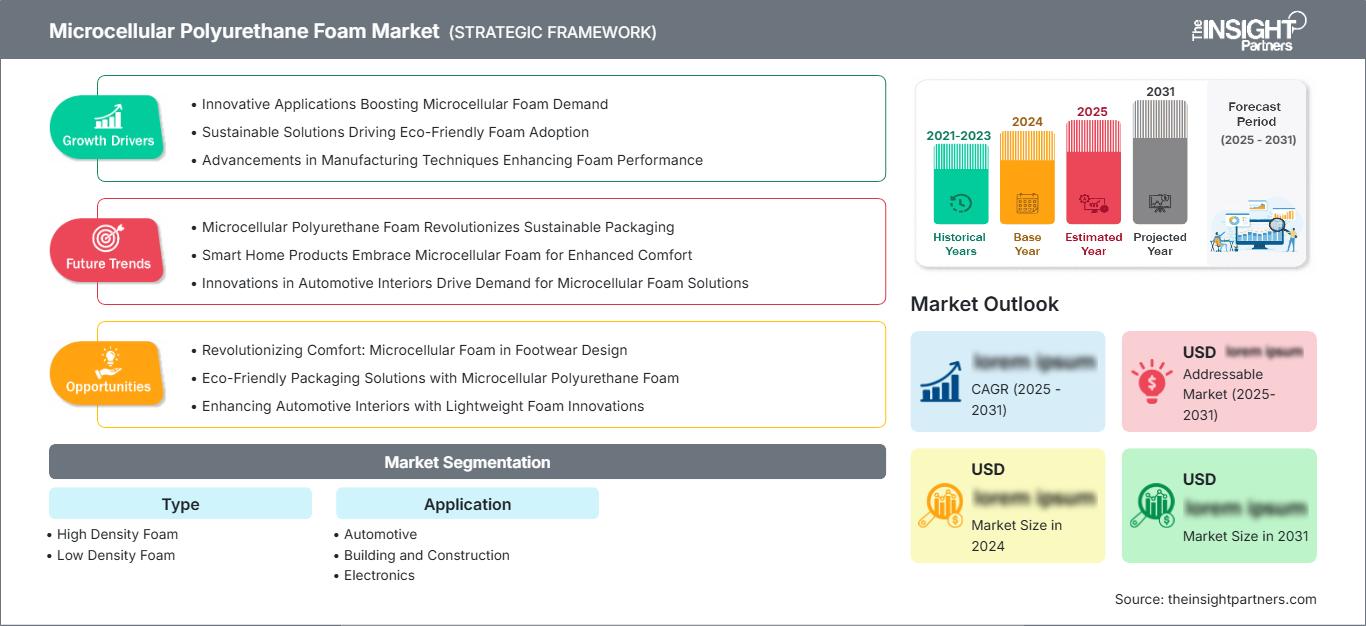
Microcellular Polyurethane Foam Market: Strategic Insights
Regional Insights
North America Microcellular Polyurethane Foam Market
North America accounted for approximately 34–37% of the global market in 2025 and is projected to expand at a CAGR of 3.3–3.7% through 2034. Strong aerospace manufacturing, advanced automotive production, and sustained investment in healthcare equipment continue supporting regional demand. Regulatory emphasis on lightweight materials, improved fuel economy, and sustainable manufacturing encourages wider adoption of engineered polyurethane foam products across multiple industries.
The United States and Canada remain major production hubs supported by integrated chemical manufacturing infrastructure and extensive research capabilities. Growing demand for electric vehicles, aircraft modernization programs, and high-performance insulation products continues creating opportunities for foam manufacturers. Investments in automation and advanced molding technologies further improve manufacturing efficiency while supporting customized solutions for industrial customers.
U.S. Microcellular Polyurethane Foam Market
The United States represented nearly 79–82% of the North American market during 2025 and is anticipated to register a CAGR of 3.4–3.8% through 2034. Extensive automotive manufacturing, aerospace component production, and medical device industries provide a stable customer base for engineered polyurethane foam materials. Strong domestic R&D capabilities further accelerate commercialization of advanced cellular structures.
Major companies including Huntsman Corporation, Rogers Corporation, General Plastics Manufacturing Company, and Rubberlite Inc. maintain substantial manufacturing and engineering operations throughout the country. Growing application of lightweight polyurethane foams in electric vehicles, aircraft interiors, medical cushioning products, and industrial sealing solutions continues strengthening domestic demand while reinforcing technological leadership across the regional market.
Europe Microcellular Polyurethane Foam Market
Europe had approximately 27%-30% market share in 2025 and is expected to see a CAGR of 3.4%-3.8% through 2034. The German region holds a leadership position among other European regions due to the development of the automotive and industrial manufacturing sectors, with the increasing implementation of sustainable policies promoting the recycling of polyurethanes. Continuous investments in mobility solutions will drive future growth.
In the UK, the aerospace, medical technology, and manufacturing industries play an important role in increasing the utilization of high-precision polyurethane foam components. In Germany, ongoing investment in electric mobility, automation, and lightweight engineering drives stable demand for microcellular materials. France, Italy, and Spain work together to create the market by growing the production of transportation equipment, furniture, and building renovations.
APAC Microcelthat requireyurethane Foam Market
Asia Pacific accounts for around 26%-29% of the total revenue in 2025 and is estimated to witness the highest CAGR of 4.8%-5.2% till 2034. China is the leading producer of polyurethane foams, followed by Japan, South Korea, India, and Australia, with production driven by rising output in the automotive, electronics, and infrastructure sectors.
Government policies promoting domestic manufacturing, electric mobility, and industrial modernization are contributing to material consumption. Growing per capita disposable income, increasing healthcare spending, and aircraft manufacturing support demand in the Asia-Pacific region.
Middle East & Africa Microcellular Polyurethane Foam Market
The Middle East & Africa region is projected to grow at a CAGR of 3.7–4.1% until 2034. Saudi Arabia will be the major regional market, owing to integration in petrochemicals and infrastructure development. The UAE will continue developing advanced manufacturing and construction capabilities that require superior-quality insulation products.
South Africa will contribute through its automotive assembly and manufacturing industries, while the rest of the MEA region will experience moderate growth, driven by urbanization and construction. Increased investment in diversified industrial development and energy-efficient infrastructure creates good prospects for foam manufacturers.
Segmentation Analysis
Type
The type segment is essential for determining the product's performance in automotive, aerospace, medical, and industrial applications. Density affects the mechanical strength, cushioning properties, thermal insulation, and durability. The increasing demand for lightweight yet strong materials continues to expand the scope of the microcellular polyurethane foam market, with manufacturers producing products at different density levels to meet various performance needs. The Type segment is expected to have a CAGR of 3.4%–3.8% from 2026 to 2034.
- High Density Foam – High density foam accounts for the larger share of demand owing to its superior compressive strength, dimensional stability, abrasion resistance, and long service life. It is extensively utilized in aerospace components, automotive structural parts, and industrial sealing applications.
- Low Density Foam – Low density foam is increasingly adopted where lightweight construction, enhanced cushioning, vibration damping, and thermal insulation are prioritized. Demand continues rising across medical products, consumer goods, packaging, and decorative applications requiring flexibility and reduced overall component weight.
Application
The Application segment will continue to diversify as more manufacturers develop specialized polyurethane foam blends for use in transportation, electronics, medical applications, and the infrastructure industry. Constant product improvements and technological advancements in manufacturing are helping to ensure the continuous growth of this segment. The application segment is projected to show a CAGR of 3.8–4.2% during the forecast period, making it the fastest-growing primary segment.
- Automotive – Automotive represents the largest application owing to increasing demand for lightweight seating, headliners, armrests, door panels, vibration isolation components, and acoustic insulation that improve passenger comfort while supporting vehicle weight reduction initiatives.
- Building and Construction – Construction applications continue expanding due to increasing use of polyurethane foam for thermal insulation, weather sealing, expansion joints, and energy-efficient building systems that improve structural durability and reduce operating energy consumption.
- Electronics – Electronics manufacturers utilize microcellular polyurethane foam for gasketing, shock absorption, vibration control, thermal management, and protective packaging of sensitive electronic assemblies, supporting equipment reliability and longer operational lifecycles.
- Medical – Medical applications benefit from excellent cushioning, sterilization compatibility, patient comfort, and biocompatibility. The material is increasingly incorporated into prosthetics, orthopedic supports, diagnostic equipment, rehabilitation devices, and protective healthcare products.
- Aerospace – Aerospace manufacturers employ microcellular polyurethane foam in aircraft interiors, insulation systems, seating components, structural fillers, and vibration control solutions to reduce aircraft weight while maintaining stringent safety and durability requirements.
Opportunity Snapshot
| Application | Revenue Contribution | Trend Tag | Adoption Stage |
| Automotive | High | EV Lightweight | Mature |
| Building and Construction | High | Green Buildings | Scaling |
| Electronics | Medium | Device Protection | Scaling |
| Medical | Medium | Medical Cushioning | Emerging |
| Aerospace | Medium | Cabin Weight | Scaling |
Microcellular Polyurethane Foam Market Growth Drivers and Impact Analysis
Expansion of Lightweight Automotive Manufacturing
Automotive manufacturers continue replacing conventional materials with lightweight polyurethane foams to improve fuel efficiency, battery range, passenger comfort, and overall vehicle performance. The production of electric vehicles has further increased the use of engineered foams because each kilogram saved in the manufacturing process improves the driving experience. Microcellular polyurethane foams possess excellent vibration damping, thermal insulation, and toughness, and are flexible and durable. Investment by OEMs worldwide in electric mobility, luxury interiors, and seating technology would continue to drive demand. Thus, companies that can make custom foam solutions stand to gain from this demand. are therefore positioned to benefit from increasing production volumes and long-term supply agreements.
Increasing Demand for High-Performance Aerospace Materials
The aircraft industry remains interested in lightweight materials that enhance efficiency while meeting the high demands of aviation safety. Microcellular polyurethane foam is the best material, offering excellent thermal insulation, flame retardancy, dimensional stability, and vibration damping for use in aircraft. The increased delivery of commercial aircraft, aircraft fleet replacement programs, and growth in the number of air passengers favor greater demand for advanced foams. The aerospace industry is increasingly interested in customized foams with consistent quality and high engineering precision. This stimulates constant investments in foam manufacturing technology and cooperation with foam suppliers.
Growth of Energy-Efficient Building Construction
The growing global focus on sustainable building and reduced energy usage is driving a greater need for superior insulation materials. Microcellular polyurethane foam offers good thermal insulation, water repellency, durability, and compliance with strict building energy codes. Modern commercial and residential buildings, refrigeration units, and industrial structures increasingly use polyurethane foam insulation systems to reduce heating and cooling needs. Government incentives to go green and build according to stringent energy-efficiency codes serve as an added impetus. Urbanization in developing countries is another factor driving demand for insulation products with lightweight, improved insulating properties.
Microcellular Polyurethane Foam Market Future Trends
Advancement of Sustainable Polyurethane Chemistry
Today, polyurethanes use recycled content, bio-based polyols, and low-emission blowing agents to reduce their environmental footprint without compromising functionality. Microcellular polyurethane foam market trends have aligned with current sustainability legislation and consumer demand for sustainable materials. The development of chemical recycling techniques and renewable resources is anticipated to improve the life-cycle performance of these products and reduce reliance on fossil-derived materials. Joint efforts by chemical manufacturers, OEMs, and research institutes accelerate the commercialization of eco-friendly foams.
Integration of Digital Manufacturing and Precision Foaming
Automated dispensing processes, digital process control, and artificial intelligence (AI) in quality control will be widely adopted by industry players to ensure greater manufacturing uniformity and minimize production waste. The precision foaming technology allows manufacturers to create highly uniform cellular structures for aerospace, electronics, and medical uses. In addition, additive manufacturing and simulation software will help develop products faster and tailor components to specific needs. This trend is expected to reduce production time and enhance competitiveness amid growing demand for high-quality, application-specific polyurethane foam solutions with consistent quality.
Microcellular Polyurethane Foam Market Opportunities
Expanding Applications in Electric Mobility
Electrification of the automotive industry is creating major opportunities for companies that manufacture lightweight insulation, vibration-damping, and battery-protection products. Electric cars require foam products that offer enhanced thermal management, reduced cabin noise, and improved passenger comfort, without adding additional weight. Increased investments by automakers in battery production and mobility platforms are forecast to create sustained demand for engineered polyurethane foams. Microcellular polyurethane foam market forecasts indicate further investment in material customization, which will help companies build long-term partnerships with electric vehicle manufacturers and their component suppliers.
Growing Medical Device Manufacturing Across Emerging Economies
Expanding healthcare infrastructure in the Asia-Pacific region, Latin American countries, and parts of the Middle East provides an ideal business climate for leading companies in the polyurethane foam industry. Producers of medical equipment need light, strong, and biocompatible materials for use in various devices, including prostheses, orthopedic devices, rehabilitation devices, and diagnostic devices. Increased spending in the healthcare sector, an aging population, and greater access to healthcare services ensure long-term growth in demand. Companies that focus on regulatory compliance, manufacturing process accuracy, and the development of polyurethane foam tailored for medical applications will gain new sales opportunities while strengthening relationships with global healthcare equipment manufacturers.
Recent Developments
- July 2026: TotalEnergies Corbion launched Luminy FOAM 50F, a high melt strength PLA grade designed for extrusion foamed packaging applications. Developed for trays used in fresh food products, like meat and fish, and food service packaging such as clamshells and bowls, the material delivers the performance of conventional extruded polystyrene (XPS) while providing a lower-carbon, circular alternative.
- February 2025: BASF India Limited has broken ground on a new plant to increase the production capacity of its Cellasto microcellular polyurethane (MCU) in Dahej, India. Under BASF's new "Winning Ways" strategy, the plant will be constructed with state-of-the-art technologies and automation systems to ensure that BASF’s high standards of safety and quality are upheld. The plant, expected to be operational in the second half of 2026, features a new mold line in its first stage and empowers Cellasto to meet the high demands of the rapidly growing local market.
Frequently Asked Questions

- Comprehensive Market Sizing and Forecast Analysis
- Detailed Segmentation Analysis
- In-Depth Market Dynamics Assessment
- Regional and Country-Level Insights
- Competitive Landscape and Company Benchmarking
- Strategic Business Intelligence
Recent Reports
Testimonials

The Insight Partners' SCADA System Market report is comprehensive, with valuable insights on current trends and future forecasts. The team was highly professional, responsive, and supportive throughout. We are very satisfied and highly recommend their services.
RAN KEDEM Partner, Reali Technologies LTDs
I requested a report on a very specific software market and the team produced the report in a few days. The information was very relevant and well presented. I then requested some changes and additions to the report. The team was again very responsive and I got the final report in less than a week.
JEAN-HERVE JENN Chairman, Future Analytica
We worked with The Insight Partners for an important market study and forecast. They gave us clear insights into opportunities and risks, which helped shape our plans. Their research was easy to use and based on solid data. It helped us make smart, confident decisions. We highly recommend them.
PIYUSH NAGPAL Sr. Vice President, High Beam Global
The Insight Partners delivered insightful, well-structured market research with strong domain expertise. Their team was professional and responsive throughout. The user-friendly website made accessing industry reports seamless. We highly recommend them for reliable, high-quality research services
YUKIHIKO ADACHI CEO, Deep Blue, LLC.
This is the first time I have purchased a market report from The Insight Partners.While I was unsure at first, I visited their web site and felt more comfortable to take the risk and purchase a market report.I am completely satisfied with the quality of the report and customer service. I had several questions and comments with the initial report, but after a couple of dialogs over email with their analyst I believe I have a report that I can use as input to our strategic planning process.Thank you so much for taking the extra time and making this a positive experience.I will definitely recommend your service to others and you will be my first call when we need further market data.
JOHN SUZUKI President and Chief Executive Officer, Board Director, BK Technologies
I wish to appreciate your support and the professionalism you displayed in the course of attending to my request for information regarding to infectious disease IVD market in Nigeria. I appreciate your patience, your guidance, and the fact that you were willing to offer a discount, which eventually made it possible for us to close a deal. I look forward to engaging The Insight Partners in the future, all thanks to the impression you have created in me as a result of this first encounter.
DR CHIJIOKE ONYIA MANAGING DIRECTOR, PineCrest Healthcare Ltd.Reason to Buy
- Informed Decision-Making
- Understanding Market Dynamics
- Competitive Analysis
- Identifying Emerging Markets
- Customer Insights
- Market Forecasts
- Risk Mitigation
- Boosting Operational Efficiency
- Strategic Planning
- Investment Justification
- Tracking Industry Innovations
- Aligning with Regulatory Trends





 Get Free Sample for