
Microencapsulated Ingredients Market Size, Share & Growth by 2034
Coverage: by Ingredients (Pigments, Vitamins, UV Filters, Skin Lightening Components, Essential Oils, Antiaging Components, Active Ingredients); Application (Color Cosmetics, Sunscreen Lotions(UV Protection), Whitening and Lightening Creams, Anti-Wrinkle and Antiaging Creams, Other) , and Geography (North America, Europe, Asia Pacific, and South and Central America)
- Status : Data Released
- Report Code : TIPRE00007796
- Category : Chemicals and Materials
- No. of Pages : 150
- Available Report Formats :


- Last update date : August 06, 2026


2025 Market Size
US$ 10.13 Bn
Base year value
2034 Forecast
US$ 20.75 Bn
Projected by 2034
CAGR 2026-2034
8.30 %
Growth rate
Addressable Market
US$ 138.73 Bn
(2026-2034)
The microencapsulated ingredients market is estimated to be worth US$ 10.13 billion in 2025 and is expected to reach US$ 20.75 billion by 2034, posting a CAGR of 8.30% during 2026-2034. The market is expected to thrive, backed by ongoing innovations in the development of encapsulation techniques, which help boost ingredient stability, controlled release, and effectiveness in cosmetic formulations. Increasing preference for premium cosmetic products, extended shelf life, and increased effectiveness of ingredients continue to drive market growth in the coming years.
Within North America, there has been a notable increase in the use of advanced encapsulation techniques by manufacturers to comply with regulatory guidelines and customer preference for high-performance cosmetics. The microencapsulated ingredients market size within North America is likely to grow on the back of growing use of multifunctional skincare products, rising collaboration among ingredient suppliers and cosmetic companies, and growing demand for eco-friendly delivery systems. The market within North America is anticipated to exhibit a CAGR of 7.8% to 8.4%.
Microencapsulated Ingredients Market Assessment and Insights
- North America: North America accounted for 31%–34% share in 2025 and is anticipated to register a CAGR of 7.8%–8.4% during 2026–2034. Strong cosmetic innovation, high consumer spending on premium skincare, and established ingredient manufacturers continue to strengthen regional demand.
- U.S.: The U.S. represented 72%–76% of the North American market in 2025 and is projected to expand at a CAGR of 7.9%–8.5% during 2026–2034, supported by innovation in dermatological formulations and premium beauty products.
- Europe: Europe captured 27%–30% share in 2025 and is expected to grow at a CAGR of 7.6%–8.2% during 2026–2034. Germany, France, Italy, and the UK remain major innovation hubs owing to stringent cosmetic regulations and established ingredient suppliers.
- Asia Pacific: Asia Pacific held 29%–32% share in 2025 and is forecast to register the fastest CAGR of 9.2%–9.8% during 2026–2034. China, Japan, South Korea, and India continue to drive demand through expanding cosmetics manufacturing and rising disposable income.
- Largest Segment: Application – Color Cosmetics accounted for 36%–40% market share in 2025 and is projected to grow at a CAGR of 7.9%–8.5% during 2026–2034, supported by increasing demand for long-lasting pigments and enhanced formulation stability.
- High Growth Segment: Ingredients – Active Ingredients represented 20%–24% share in 2025 and is anticipated to expand at a CAGR of 9.4%–10.0% during 2026–2034, driven by demand for controlled-release skincare formulations.
- Key companies analyzed in detail: Air Liquide, Ashland Inc., BASF SE, BIOGENICS, Chongqing Pellets Techniques Co., Ltd., Croda International Plc, Givaudan SA, International Flavors & Fragrances Inc., Salvona LLC, and Sumitomo Corporation.
Source: The Insight Partners' analysis based on proprietary research, government publications, company annual reports, investor presentations, industry databases, and expert interviews.
There has been a gradual shift from simple protection of flavors and fragrances to complex delivery systems with the ability to increase stability, bioavailability and controlled release. There have been consistent advancements in technologies like spray drying, coacervation, fluidized bed coating, liposomal entrapment and polymer-based delivery. This has helped to widen commercial applications within luxury cosmetics. The use of biodegradable shells, renewable raw materials and sophisticated techniques for encapsulation will help companies meet sustainable objectives without compromising on product quality.
Future growth will rely on the development of multifunctional encapsulation systems with properties such as protection, targeted delivery and sensory enhancement integrated into one formula. There will be increased growth potential due to increasing manufacture of cosmetics in Asia Pacific, increasing regulations regarding ingredient safety and increasing collaboration between ingredient producers and beauty companies.
Microencapsulated Ingredients Market Report Scope
| Report Attribute | Details |
|---|---|
| Market size in 2025 | US$ 10.13 Billion |
| Market Size by 2034 | US$ 20.75 Billion |
| Global CAGR (2026 - 2034) | 8.30% |
| Historical Data | 2021-2024 |
| Forecast period | 2026-2034 |
Microencapsulated Ingredients Market Analysis
The increasing consumer inclination towards high-performing skincare and cosmetic products drives the growing market for micro-encapsulated ingredients in the global beauty and personal care industry. Encapsulation technologies enhance the stability of delicate chemicals like vitamins, essential oils, UV filters, and anti-aging ingredients through protection against oxidative stress, moisture, and photodegradation. Other advantages offered by these technologies include enhanced effectiveness, sustained product performance, better sensory properties, and increased formulating options, hence their growing popularity among product manufacturers.
The value chain involves specialized chemical producers, encapsulation technologies producers, cosmetic ingredients formulators, contract manufacturers, and leading global personal care brands. The cooperation between ingredients formulators and cosmetic products manufacturers has enhanced commercialization and improved formulation efficiency. Increasing investments in biodegradable encapsulation materials are also supporting the value chain.
The competitive intensity in the market analysis of micro-encapsulated ingredients is rising owing to emphasis by key players on their proprietary platform, licensing of technology, and customized application-based products. BASF SE, Croda International Plc, Givaudan SA, Ashland Inc., and International Flavors & Fragrances Inc. keep developing their specialty ingredients range via innovative product launches, partnerships, and sustainability-based product developments. On the other hand, Salvona LLC and BIOGENICS are enhancing their position with customization of encapsulation platforms for premium skin care applications.
Investments are increasingly being made towards technologies that can provide high-loading efficiency, biodegradable shells, and enhanced scale-up. Manufacturers are also increasing their production capacities in the Asia Pacific region and enhancing their R&D facilities in Europe and North America. Digital formulations, ingredient screening using artificial intelligence, and precision manufacturing technologies will help speed up the launch of advanced encapsulated cosmetic ingredients.
● REPORT CUSTOMIZATION
Tailor This Report To Align With Your Specific Business Requirements
This report can be customized to align precisely with your business objectives, scope, and target markets. Customization options include tailored segmentation, geography, competitive analysis, and strategic insights to support informed decision-making.
Customize This Report →WHAT YOU CAN ADJUST
- ● Segmentations
- ● Geography
- ● Competitive Analysis
- ● Language Preferences
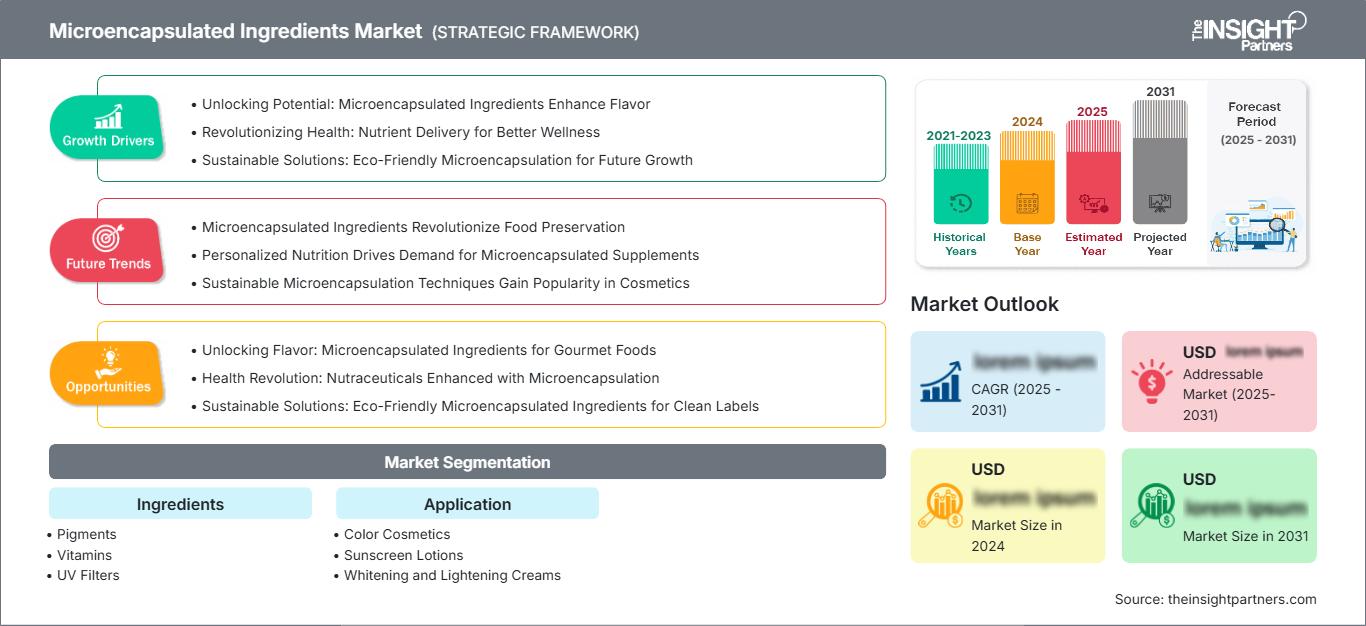
Microencapsulated Ingredients Market: Strategic Insights
Regional Insights
North America Microencapsulated Ingredients Market
North America held 31%–34% market share in 2025 and is expected to demonstrate a CAGR of 7.8%–8.4% through 2026–2034. Favorable factors in North America include the advanced personal care industry, strong research infrastructure, and wide adoption of advanced encapsulation techniques. In addition, the presence of stringent regulatory measures from the U.S. Food and Drug Administration and Health Canada has encouraged players to develop safe and efficient encapsulation products for high-quality cosmetics. The high demand for functional skincare products with extended shelf life and better efficacy of active ingredients is one of the factors driving microencapsulated ingredients market share in developed countries.
The growing trend towards sustainable cosmetics formulation is expected to transform manufacturing strategies in the region. Suppliers of ingredients in North America are focusing on biodegradable encapsulating agents, renewable polymers, and precision release technologies to meet changing consumer preferences. Growing contract manufacturing capacities, partnerships between cosmetics brands and specialty chemicals providers, and increasing demand for clean label formulations are expected to drive stable market growth during the forecast period.
U.S. Microencapsulated Ingredients Market
The share of the U.S. in the North America market was accounted for 72%–76% in 2025 and is expected to grow at a CAGR of 7.9%–8.5% in 2026-2034. The country retains its competitive edge due to the availability of major specialty chemical producers, innovative formulation labs, and international cosmetic brands. The growing consumer spending on high-end skin care, dermatological goods, and multipurpose cosmetics encourages application of microencapsulated vitamins, actives, colors, and sunscreens.
Innovation in the domestic market continues to be driven by numerous research collaborations between universities, biotech companies, and ingredient suppliers. Frequent product introductions, focusing on such features as controlled release, improved sensory properties, and encapsulated ingredient protection, have fostered the use of microencapsulation technology in the commercial cosmetics sector. Cosmetic firms are increasingly exploring sustainable microencapsulation solutions with biodegradable shells and renewable raw materials.
Europe Microencapsulated Ingredients Market
Europe captured 27%–30% of the global market in 2025 and is forecast to register a CAGR of 7.6%–8.2% during 2026–2034. The region remains a global leader in cosmetic ingredient innovation owing to stringent regulatory frameworks under the European Union Cosmetic Products Regulation, strong sustainability initiatives, and continuous investment in specialty ingredient research. Germany continues to represent the largest regional market through its advanced chemical manufacturing base and established cosmetic ingredient suppliers.
In terms of the continued expansion of high-end skincare production, the UK is making more investments in sustainability and the development of ingredients through biotechnology.
Germany is the leader in Europe when it comes to the production of specialty chemical ingredients used in the cosmetics industry. The strong industrial base, large investments in research, as well as the availability of globally known ingredient producers promote the commercialization of encapsulation technology for vitamins, pigments, anti-aging chemicals, and UV filters.
France, Italy, and Spain support the regional demand by their highly developed cosmetics industry, luxury beauty brands, and increased exports. Innovations in fragrances, skin care products, and premium cosmetics continue to stimulate the implementation of controlled-release technology.
APAC Microencapsulated Ingredients Market
In 2025, Asia Pacific held 29%-32% share of the global market and is estimated to witness the fastest CAGR of 9.2%-9.8% from 2026-2034. China continues to dominate the regional market share, whereas innovations in functional skincare ingredients continue in Japan and South Korea. Increasing disposable incomes, urbanization, manufacturing capabilities for cosmetics, and rising demand for luxurious beauty products drive regional growth.
Investments in specialty cosmetic ingredients, contract manufacturing, and biotechnology-based formulation are gaining momentum in India and Australia. Favorable policies for advanced manufacturing, growth of regional beauty brands, and personal care product exports drive regional competitiveness.
Middle East & Africa Microencapsulated Ingredients Market
The Middle East & Africa is expected to record a CAGR of 8.3%–8.9% during 2026–2034, supported by increasing premium beauty consumption and gradual expansion of regional cosmetics manufacturing. Saudi Arabia remains the largest market within the region owing to rising consumer expenditure on luxury personal care products, while the UAE continues strengthening its position as a regional distribution and trading hub.
South Africa supports market development through its established personal care manufacturing sector, whereas the Rest of MEA continues benefiting from improving retail infrastructure and growing urban populations. Investments in industrial diversification, logistics, and specialty chemical distribution are expected to improve the availability of advanced encapsulated cosmetic ingredients across regional markets.
Segmentation Analysis
Ingredients
The Ingredients segment is expected to register a CAGR of 8.7%–9.3% during 2026–2034. Increasing utilization of encapsulated functional ingredients enables cosmetic manufacturers to improve product stability, controlled release, sensory performance, and shelf life. Continuous innovation in biodegradable encapsulation materials and precision delivery technologies is expected to expand adoption across premium skincare and cosmetic formulations. The microencapsulated ingredients market scope continues to broaden as manufacturers integrate advanced delivery systems into multifunctional cosmetic products.
- Pigments - Encapsulated pigments improve color stability, minimize ingredient migration, enhance dispersion, and provide long-lasting cosmetic performance across premium makeup formulations, particularly in foundation, lipstick, and eye cosmetics.
- Vitamins - Microencapsulation protects vitamins from oxidation, moisture, and ultraviolet degradation while improving formulation stability and extending the functional performance of skincare and personal care products.
- UV Filters - Encapsulated UV filters enhance sunscreen efficiency by improving photostability, reducing skin irritation, and enabling controlled release for extended protection in premium sun care formulations.
- Skin Lightening Components - Controlled-release encapsulation improves ingredient stability while minimizing degradation and enhancing delivery efficiency for cosmetic formulations targeting pigmentation control and skin brightening applications.
- Essential Oils - Encapsulation preserves volatile aromatic compounds, minimizes evaporation losses, enhances fragrance longevity, and improves compatibility with complex cosmetic formulations requiring controlled ingredient release.
- Antiaging Components - Microencapsulation protects sensitive antiaging molecules from environmental degradation while enabling gradual release, improving efficacy, formulation stability, and consumer experience in advanced skincare products.
- Active Ingredients - Encapsulated active ingredients improve bioavailability, reduce ingredient interactions, increase formulation flexibility, and support targeted delivery in high-performance cosmetic and dermatological products.
Application
The Application segment is projected to expand at a CAGR of 8.2%–8.8% during 2026–2034. Growing consumer demand for premium cosmetic products with enhanced durability, improved ingredient protection, and better sensory characteristics continues driving adoption across multiple beauty categories. Controlled-release technologies also enable manufacturers to differentiate products while complying with increasingly stringent cosmetic safety and sustainability requirements.
- Color Cosmetics - The largest application segment benefits from increasing demand for long-lasting makeup products featuring enhanced pigment stability, improved wear resistance, and controlled ingredient delivery.
- Sunscreen Lotions - Advanced encapsulation technologies improve UV filter performance, increase photostability, reduce skin sensitivity, and support development of premium sun protection products with prolonged effectiveness.
- Whitening and Lightening Creams - Cosmetic manufacturers increasingly utilize encapsulated brightening ingredients to improve ingredient stability, minimize degradation, and achieve more consistent skin tone enhancement.
- Anti-Wrinkle and Antiaging Creams - Controlled-release technologies improve delivery of peptides, vitamins, antioxidants, and bioactive compounds, enabling longer-lasting efficacy and superior product performance in premium antiaging formulations.
Opportunity Snapshot
| Application | Revenue Contribution | Trend Tag | Adoption Stage |
|---|---|---|---|
| Color Cosmetics | High | Long Wear | Mature |
| Sunscreen Lotions | High | UV Stability | Scaling |
| Whitening and Lightening Creams | Medium | Tone Control | Scaling |
| Anti-Wrinkle and Antiaging Creams | High | Controlled Release | Mature |
Microencapsulated Ingredients Market Growth Drivers and Impact Analysis
Growing demand for high-performance cosmetic formulations
The increasing consumer preference for premium skincare and cosmetic products that deliver superior efficacy, extended performance, and improved sensory characteristics continues to accelerate demand for encapsulated ingredients. Cosmetic manufacturers are increasingly incorporating microencapsulation technologies to protect sensitive compounds such as vitamins, peptides, antioxidants, essential oils, and UV filters from degradation caused by oxygen, moisture, and light exposure. This enables longer product shelf life and sustained ingredient release after application. Growing disposable income, premiumization across beauty categories, and rising consumer awareness regarding scientifically formulated cosmetics further support adoption. The expansion of dermatology-inspired skincare and multifunctional beauty products is expected to strengthen commercialization opportunities for encapsulated ingredients throughout the forecast period, particularly across premium facial care and antiaging formulations.
Advancements in encapsulation technologies improving formulation efficiency
Continuous innovation in encapsulation technologies is enabling ingredient suppliers to develop delivery systems with improved loading efficiency, controlled release profiles, and enhanced compatibility with complex cosmetic formulations. Technologies including spray drying, coacervation, fluidized-bed coating, liposomal encapsulation, and polymer-based microcapsules have significantly expanded formulation possibilities across premium skincare and color cosmetics. Manufacturers are also investing in biodegradable shell materials and renewable polymers to improve sustainability while maintaining ingredient protection. These technological improvements help cosmetic brands reduce formulation instability, improve product consistency, and differentiate premium offerings in increasingly competitive markets. Continued research into smart delivery systems is expected to create additional commercial opportunities during the forecast period.
Expansion of premium beauty markets across emerging economies
Rapid urbanization, increasing disposable income, and evolving consumer lifestyles across Asia Pacific, the Middle East, and Latin America are significantly expanding demand for premium beauty and personal care products. Consumers are increasingly seeking scientifically validated cosmetic formulations that provide measurable performance benefits and improved product safety. This trend encourages regional manufacturers to adopt advanced encapsulation technologies capable of delivering enhanced ingredient stability and controlled release. International cosmetic companies are simultaneously expanding manufacturing facilities and regional research centers to address local market requirements. As domestic beauty brands strengthen their product portfolios through technology partnerships with specialty ingredient suppliers, demand for advanced encapsulated ingredients is expected to continue rising across emerging economies.
Microencapsulated Ingredients Market Future Trends
Increasing adoption of biodegradable encapsulation materials
Growing environmental awareness and tightening sustainability regulations are encouraging manufacturers to replace conventional synthetic encapsulation materials with biodegradable alternatives derived from polysaccharides, proteins, natural lipids, and plant-based polymers. The microencapsulated ingredients market trends increasingly reflect demand for environmentally responsible delivery systems that maintain ingredient stability while reducing environmental impact. Cosmetic companies are incorporating sustainable encapsulation technologies into premium product portfolios to support circular economy initiatives, improve brand positioning, and comply with evolving regulatory requirements. Continued innovation in renewable encapsulating materials is expected to influence future product development strategies across global cosmetic ingredient manufacturers.
Precision delivery systems transforming premium skincare formulations
The next generation of cosmetic formulations is increasingly focused on intelligent delivery systems capable of releasing active ingredients under predefined environmental or physiological conditions. Advanced microcapsules responding to temperature, pH, moisture, or mechanical pressure are improving ingredient utilization while enhancing consumer experience. Integration of biotechnology, nanostructured delivery platforms, computational formulation design, and artificial intelligence is expected to accelerate commercialization of precision encapsulation technologies. These innovations will enable cosmetic manufacturers to develop differentiated products with enhanced efficacy, targeted ingredient delivery, and improved formulation stability throughout the forecast period.
Microencapsulated Ingredients Market Opportunities
Expansion of encapsulated active ingredients for premium dermatological skincare
Increasing consumer preference for clinically supported skincare products presents substantial commercial opportunities for ingredient manufacturers specializing in advanced encapsulation technologies. The microencapsulated ingredients market Forecasts indicate sustained investment in premium dermatological formulations utilizing encapsulated peptides, antioxidants, retinoids, ceramides, and vitamins that improve ingredient stability and controlled release. Companies capable of developing highly efficient biodegradable delivery systems with validated efficacy are expected to strengthen competitive positioning. Strategic collaborations with dermatology brands, biotechnology firms, and contract formulators will further accelerate commercialization of advanced encapsulated ingredients across premium skincare portfolios.
Manufacturing expansion across Asia Pacific through strategic partnerships
Asia Pacific continues to offer attractive investment opportunities owing to expanding cosmetic manufacturing capacity, growing domestic beauty brands, supportive industrial policies, and increasing regional demand for premium formulations. Ingredient manufacturers can strengthen long-term competitiveness by establishing local production facilities, technical service centers, and collaborative innovation laboratories. Partnerships with regional cosmetic companies enable faster product customization while reducing supply chain costs and improving responsiveness to changing consumer preferences. Investments in localized research, sustainable encapsulation technologies, and advanced manufacturing capabilities are expected to generate significant long-term value across emerging Asian markets.
Recent Developments
- July 2026: Lubrizol and SIRIO signed a strategic Memorandum of Understanding (MoU) to jointly advance the development and commercialization of microencapsulated nutritional ingredients, combining their expertise to create innovative, science-backed health and wellness products for global consumers. The collaboration brings together Lubrizol's advanced microencapsulation technologies with SIRIO's strengths in formulation development, dosage-form innovation, manufacturing, and commercialization. Together, the companies aim to accelerate the launch of next-generation nutritional products that offer improved bioavailability, stability, and enhanced consumer experience.
- December 2025: Global manufacturer of specialty ingredients for human nutrition, Balchem, developed a new, high-capacity manufacturing facility for its advanced microencapsulated technologies for food ingredients. Located in New York, US, the facility is slated to open in 2027. It will increase the production capacity of Balchem’s microencapsulation solutions, BakeShure, ConfecShure, and MeatShure, which are used across bakery, confectionery, and meat applications.
Frequently Asked Questions

- Comprehensive Market Sizing and Forecast Analysis
- Detailed Segmentation Analysis
- In-Depth Market Dynamics Assessment
- Regional and Country-Level Insights
- Competitive Landscape and Company Benchmarking
- Strategic Business Intelligence
Recent Reports
Testimonials

The Insight Partners provided valuable market intelligence that supported our global go-to-market strategy. Their team was professional, responsive, and attentive to our feedback, providing thoughtful analysis and helpful methodological clarifications throughout the project.
Junmo Kim Chief Financial Officer (CFO), Enertech Co., Ltd.
The Insight Partners' SCADA System Market report is comprehensive, with valuable insights on current trends and future forecasts. The team was highly professional, responsive, and supportive throughout. We are very satisfied and highly recommend their services.
RAN KEDEM Partner, Reali Technologies LTDs
I requested a report on a very specific software market and the team produced the report in a few days. The information was very relevant and well presented. I then requested some changes and additions to the report. The team was again very responsive and I got the final report in less than a week.
JEAN-HERVE JENN Chairman, Future Analytica
We worked with The Insight Partners for an important market study and forecast. They gave us clear insights into opportunities and risks, which helped shape our plans. Their research was easy to use and based on solid data. It helped us make smart, confident decisions. We highly recommend them.
PIYUSH NAGPAL Sr. Vice President, High Beam Global
The Insight Partners delivered insightful, well-structured market research with strong domain expertise. Their team was professional and responsive throughout. The user-friendly website made accessing industry reports seamless. We highly recommend them for reliable, high-quality research services
YUKIHIKO ADACHI CEO, Deep Blue, LLC.
This is the first time I have purchased a market report from The Insight Partners.While I was unsure at first, I visited their web site and felt more comfortable to take the risk and purchase a market report.I am completely satisfied with the quality of the report and customer service. I had several questions and comments with the initial report, but after a couple of dialogs over email with their analyst I believe I have a report that I can use as input to our strategic planning process.Thank you so much for taking the extra time and making this a positive experience.I will definitely recommend your service to others and you will be my first call when we need further market data.
JOHN SUZUKI President and Chief Executive Officer, Board Director, BK Technologies
I wish to appreciate your support and the professionalism you displayed in the course of attending to my request for information regarding to infectious disease IVD market in Nigeria. I appreciate your patience, your guidance, and the fact that you were willing to offer a discount, which eventually made it possible for us to close a deal. I look forward to engaging The Insight Partners in the future, all thanks to the impression you have created in me as a result of this first encounter.
DR CHIJIOKE ONYIA MANAGING DIRECTOR, PineCrest Healthcare Ltd.Reason to Buy
- Informed Decision-Making
- Understanding Market Dynamics
- Competitive Analysis
- Identifying Emerging Markets
- Customer Insights
- Market Forecasts
- Risk Mitigation
- Boosting Operational Efficiency
- Strategic Planning
- Investment Justification
- Tracking Industry Innovations
- Aligning with Regulatory Trends





 Get Free Sample for