
Non-Phthalate Plasticizers Market Size, Share & Forecast by 2034
Coverage: by Type (Adipates, Trimellitates, Epoxies, Benzoates, Others); Application (Flooring and Wall Coverings, Coated Fabric, Consumer Goods, Film and Sheet, Others) , and Geography (North America, Europe, Asia Pacific, and South and Central America)
- Status : Data Released
- Report Code : TIPRE00004680
- Category : Chemicals and Materials
- No. of Pages : 150
- Available Report Formats :


- Last update date : September 17, 2026


2025 Market Size
US$ 3.66 Bn
Base year value
2034 Forecast
US$ 6.39 Bn
Projected by 2034
CAGR 2026-2034
6.39 %
Growth rate
Addressable Market
US$ 45.47 Bn
(2026-2034)
The non-phthalate plasticizers market is valued at US$ 3.66 billion in 2025 and is projected to reach US$ 6.39 billion by 2034, registering a 6.39% CAGR during 2026–2034. Growth is aided by the replacement of traditional phthalates in flexible PVC, increased regulation of endocrine disrupting chemicals, and increasing demands for safer materials in flooring, films, coated textiles, consumer goods, and other flexible and durable applications.
The non-phthalate plasticizers market size in North America will continue to grow at a mid-single digit CAGR until 2034, as manufacturers formulate new flexible PVC products that meet consumer safety criteria and customer specifications. Flooring, coated textiles, packaging films, and consumer goods will continue to be important applications, with market differentiation driven by low migration, food contact, durability, and lower carbon feedstock.
Non-Phthalate Plasticizers Market Assessment and Insights
- North America: North America is estimated to account for 18–22% share in 2025, expanding at a 5.8–6.4% CAGR between 2026–2034. Demand is supported by regulatory compliance, established flexible-PVC conversion capacity, and replacement of legacy phthalate formulations.
- US: The US represents approximately 14–17% share in 2025, with a projected 5.7–6.3% CAGR between 2026–2034. Flooring, consumer products, coated fabrics, and packaging applications support sustained conversion activity.
- Europe: Europe holds approximately 20–24% share in 2025 and is expected to grow at 5.6–6.2% CAGR between 2026–2034, led by Germany, Italy, France, the UK, and Spain, where regulatory and sustainability requirements encourage non-phthalate formulations.
- Asia Pacific: Asia Pacific represents approximately 53–57% share in 2025 and is projected to expand at 7.0–7.7% CAGR between 2026–2034. China, Japan, South Korea, and India lead demand through PVC processing, construction materials, consumer products, and manufacturing expansion.
- Largest Segment: Adipates hold approximately 46–50% market share in 2025 and are expected to grow at 5.8–6.3% CAGR from 2026–2034, supported by flexibility, low-temperature performance, and broad formulation compatibility.
- High Growth Segment: Epoxies account for approximately 12–16% market share in 2025 and are projected to register 7.0–7.8% CAGR from 2026–2034, benefiting from durability, stabilization, and compatibility with demanding PVC formulations.
- Key companies analyzed in detail: BASF SE, DIC Corporation, Eastman Chemical Company, Evonik Industries AG, Exxon Mobil Corporation, LG Chem Ltd., Nan Ya Plastics Corporation, OQ Chemicals GmbH, Avient Corporation, and UPC Technology Corporation.
Source: The Insight Partners' analysis based on proprietary research, government publications, company annual reports, investor presentations, industry databases, and expert interviews.
The non-phthalate plasticizers market has moved from being a regulation-led substitution opportunity to being a performance-led material group. The development of the product has increasingly involved not only flexibility but also low migration, thermal stability, extractability, and food contact compatibility. Established product ranges include those based on adipates, cyclohexane dicarboxylates, polyesters, and other types.
Over the forecast period, commercial adoption is set to increase in Asia Pacific and other manufacturing regions, driven by the desire for drop-in plasticizers that reduce processing modifications. Sustainable products are likely to play a role in buying decisions in terms of mass balance, recycled, and renewable feedstocks. BASF and Eastman have sustainable plasticizers available, while Perstorp's Pevalen technology demonstrates the move towards renewables and recycled feedstocks.
Non-Phthalate Plasticizers Market Report Scope
| Report Attribute | Details |
|---|---|
| Market size in 2025 | US$ 3.66 Billion |
| Market Size by 2034 | US$ 6.39 Billion |
| Global CAGR (2026 - 2034) | 6.39% |
| Historical Data | 2021-2024 |
| Forecast period | 2026-2034 |
Non-Phthalate Plasticizers Market Analysis
The demand drivers include the flexibility of converting PVC in the construction industry, consumer goods, films, coated fabrics, and other industries. The value chain begins with alcohols, acids, anhydrides, and their derivatives, either through esterification or synthesis and moves to purification, formulation, distribution, and compounding. The competitivity of manufacturers will depend on the availability of raw materials, quality of products, documentation, support, and supply.
The dynamics of the supply side will still be influenced by the costs of raw materials and energy since some plasticizers are dependent on oxo alcohols, acids, and special intermediates. Those companies that have an integrated position on the upstream side can better cope with price volatility, whereas the converters look for more than one qualified supplier.
As per the non-phthalate plasticizers market report, positioning is becoming more and more application-oriented rather than just providing a phthalate-free alternative. BASF positions itself with Hexamoll DINCH as a safe alternative for applications requiring high safety standards. Eastman with Eastman 168 provides a solution for flexible PVC as well as food contact applications. DIC is providing a range of alternative materials such as polyester, adipate, trimellitate, benzoate, and epoxy ester.
There is a trend towards investments into low carbon production process and certified feedstocks as well as materials that do not require any modifications in current formulations and equipment. Established players with technical support and wide distribution network are favored in this environment. New capacities are expected to focus on Asia-Pacific region and application-oriented grades, while strategic alliances and portfolio extension will continue to be relevant tools.
● REPORT CUSTOMIZATION
Tailor This Report To Align With Your Specific Business Requirements
This report can be customized to align precisely with your business objectives, scope, and target markets. Customization options include tailored segmentation, geography, competitive analysis, and strategic insights to support informed decision-making.
Customize This Report →WHAT YOU CAN ADJUST
- ● Segmentations
- ● Geography
- ● Competitive Analysis
- ● Language Preferences
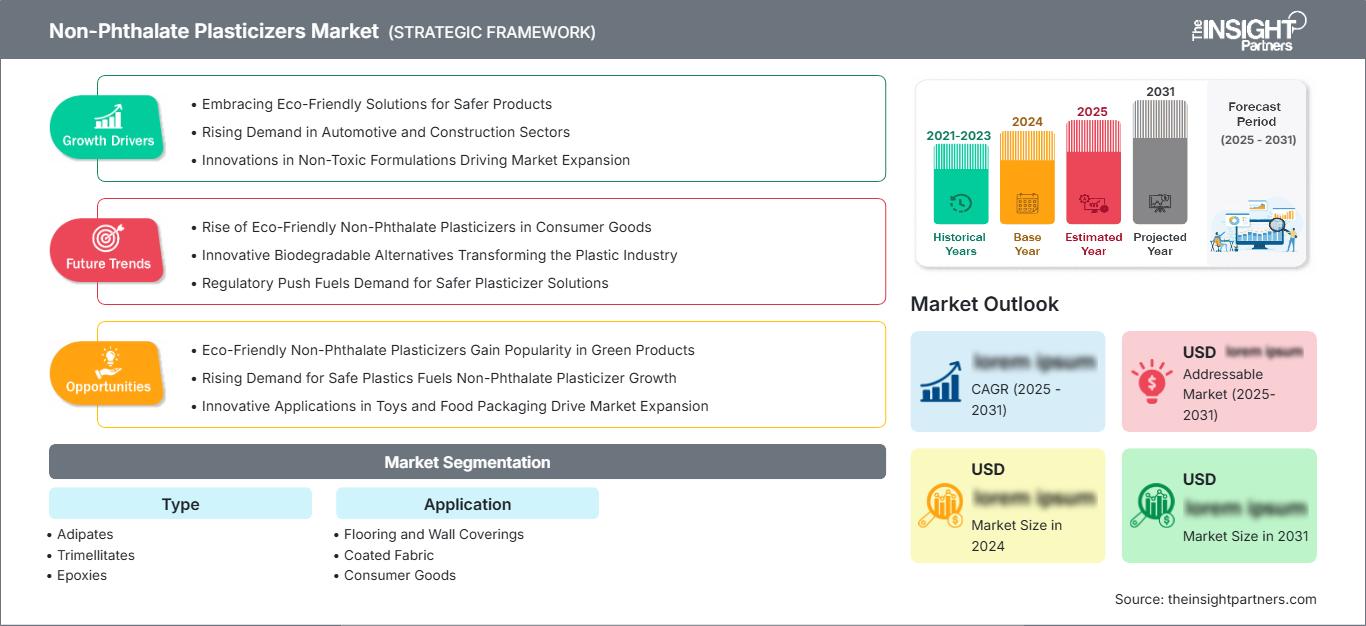
Non-Phthalate Plasticizers Market: Strategic Insights
Regional Insights
North America Non-phthalate plasticizers market
North America is estimated at 18–22% non-phthalate plasticizers market share in 2025, with growth of 5.8–6.4% CAGR during 2026–2034. The US dominates regional consumption because of its large PVC-processing base and extensive use of flexible materials in flooring, coated fabrics, consumer goods, films, and industrial products. Regulatory scrutiny and customer specifications continue encouraging replacement of traditional phthalates with alternatives that demonstrate lower migration and improved toxicological profiles.
The competitive environment for the region consists of BASF, Eastman, Avient, Exxon Mobil Corporation, among others, which are specialty suppliers to compounders and converters. The demand is being driven by food contact compliance, children’s products, healthcare applications, and sustainability. Eastman 168 caters to flexible PVC, flooring, toys, automotive, packaging, and wire and cable applications, whereas BASF provides Hexamoll DINCH.
U.S. Non-phthalate plasticizers Market
The US accounts for 14-17% of the global market in 2025 and will be growing at 5.7-6.3% CAGR up to 2034. The established applications such as conversion of PVC, construction renovation, consumer products, and packaging drive adoption.
Product qualification becomes more focused on regulatory compliance, migration resistance, low volatility, and performance in application-specific uses. Eastman has continuously changed the prices for plastics because of the change in price of input materials, including Eastman 168 non-phthalate plasticizer in March 2026.
Europe Non-phthalate plasticizers Market
Europe will have around 20%-24% share in 2025, and growth is expected to grow at a rate of 5.6%-6.2% CAGR up to 2034. Germany will be one of the biggest manufacturing bases due to its automotive, construction, specialty chemicals, and flexible PVC converting industries. The UK and France will also make contributions from the consumer goods, packaging, construction, and industrial sectors. Italy and Spain will contribute significantly in terms of floorings, coated fabrics, and PVC processing.
The availability of specialty chemicals manufacturers like BASF gives Germany a competitive edge. Carbon footprint reduction and use of sustainable raw materials are differentiating factors for European suppliers. Pevalen Pro of Perstorp and sustainable Mesamoll of LANXESS are examples of low-carbon non-phthalate technology available in Europe. LANXESS stated that its improved Mesamoll would help cut down the carbon footprint by around 20%.
APAC Non-phthalate plasticizers Market
Asia Pacific is estimated to constitute about 53-57% share by 2025 and is anticipated to grow at 7.0-7.7% CAGR, thus becoming the largest regional market. Leading regional demand is in China, whereas Japan, South Korea, and India follow. Australia makes small but consistent demands for both construction and consumer applications.
Expanding PVC processing, infrastructure construction, manufacturing of consumer goods and packaging is an advantage of China and India, while Japan and South Korea concentrate on better-performing grades and regulation compliance. BASF, DIC, Nan Ya Plastics Corporation, LG Chem Ltd. and UPC Technology Corporation are the manufacturers in the region.
Middle East & Africa Non-phthalate plasticizers Market
Middle East and Africa is estimated to expand at 5.0–5.8% CAGR during 2026–2034. Saudi Arabia and the UAE benefit from construction, infrastructure, packaging, and industrial diversification, while South Africa remains an important consumer market for flexible materials and manufactured goods.
This regional opportunity is related to construction expenditure, PVC flooring, coated fabrics, cables, and consumer goods. Availability of raw materials and closeness to petrochemical facilities may be used as advantages in terms of manufacturing costs, although downstream processing capacity is still insufficient. That is why both regional and international companies are expected to use distributors and compounders.
Segmentation Analysis
Type
The Type segment is projected to grow at 5.9–6.5% CAGR from 2026–2034. Demand is increasingly differentiated according to flexibility, temperature resistance, migration characteristics, durability, processing efficiency, and regulatory suitability. Adipates remain the broadest-volume chemistry, while epoxies are gaining attention where stabilization and durability are important.
- Adipates: Adipates represent the largest type category because they provide strong low-temperature flexibility and efficient plasticization. They remain widely used in flexible PVC formulations requiring softness and processing consistency.
- Trimellitates: Trimellitates serve applications requiring improved heat resistance, low volatility, and long-term permanence. Their importance increases in demanding industrial formulations where conventional general-purpose plasticizers cannot satisfy service-life requirements.
- Epoxies: Epoxy plasticizers combine plasticization with stabilization benefits, supporting PVC formulations requiring durability, aging resistance, and improved processing. Their performance profile creates opportunities in construction, coatings, and specialized consumer applications.
- Benzoates: Benzoates provide strong solvating and gelling characteristics and are valued in flooring, coatings, adhesives, and plastisol formulations. Their formulation efficiency supports substitution where processing behavior is a critical purchasing criterion.
Application
The Application segment is forecast to grow at 6.1–6.7% CAGR from 2026–2034. Flooring and wall coverings remain important because flexible PVC provides durability and design flexibility, while films, coated fabrics, and consumer goods benefit from increasing requirements for safer and lower-migration plasticizer systems.
- Flooring and Wall Coverings: This application remains a major consumption center because flexible PVC flooring and wall coverings require softness, durability, dimensional stability, and resistance to extraction during extended service.
- Coated Fabric: Coated fabrics use plasticizers to balance flexibility, abrasion resistance, durability, and surface characteristics. Demand spans upholstery, artificial leather, industrial fabrics, and consumer-oriented textile applications.
- Consumer Goods: Consumer goods increasingly favor non-phthalate formulations where products involve prolonged skin contact or heightened safety expectations. Toys, childcare products, household articles, and lifestyle goods represent important demand areas.
- Film and Sheet: Films and sheets require controlled flexibility, low migration, processing efficiency, and compatibility with packaging systems. Food-contact requirements and increasingly stringent material specifications support substitution with non-phthalate alternatives.
Opportunity Snapshot
| Application | Revenue Contribution (High/Medium/Low) | Trend Tag | Adoption Stage |
|---|---|---|---|
| Flooring and Wall Coverings | High | PVC Reformulation | Mature |
| Coated Fabric | Medium | Safer Leather | Scaling |
| Consumer Goods | Medium | Safety Compliance | Scaling |
| Film and Sheet | High | Food Contact | Scaling |
Non-Phthalate Plasticizers Market Growth Drivers and Impact Analysis
Regulatory pressure accelerating substitution of conventional phthalates
Further regulation of selected phthalates will continue to influence formulation decisions in consumer products, toys, food contact materials, and sensitive applications. More and more suppliers are assessing alternative options based on migration characteristics, toxicological profiles, resistance to extraction, and documentation needs in addition to price. Opportunities for alternative chemistries such as adipates, benzoates, trimellitates, epoxies, and specialty non-phthalate chemistries have been widened through such changes. In particular, DIC has formulated its range to address the regulatory restrictions around endocrine disruptors, food utensils, packaging, toys, and gloves. The business impact will be broader than the restricted products as manufacturers adopt similar material standards for their non-regulated products.
Expansion of flexible PVC applications across construction and consumer sectors
Flexible PVC continues to be one of the main platforms for demand because the inclusion of plasticizers provides softness, flexibility, processability, and durability in many different manufactured goods. The result is a continuous source of demand from flooring, wall coverings, coated fabrics, films, consumer goods, and other similar applications. Construction represents an important sector of demand due to the requirement for resilient floor and wall coverings with a long life and good performance properties. Consumer goods represent another substitution source of demand as companies look for substances that fit into safety and sustainability considerations. The result is that there is a differentiated demand according to chemistries where adipates have flexibility and cold tolerance and trimellitates and epoxies have tough durability properties.
Growing availability of sustainable and certified feedstock options
Sustainability is becoming an increasingly important purchasing criterion as chemical producers and downstream manufacturers establish carbon-reduction targets. BASF has expanded biomass-balanced and Ccycled plasticizer offerings under ISCC PLUS certification, while Perstorp's Pevalen Pro uses renewable and/or recycled mass-balanced content. These developments create a pathway for customers to reduce fossil-resource dependence without necessarily redesigning existing processing systems. The commercial impact is particularly significant for global consumer brands that require documented sustainability attributes throughout their supply chains. Mass-balance approaches also allow producers to use existing manufacturing infrastructure while allocating certified feedstock attributes to specified products. As procurement standards become more sophisticated, verified carbon footprint, chain-of-custody documentation, and renewable-content credentials are likely to influence supplier selection alongside conventional performance parameters.
Non-Phthalate Plasticizers Market Future Trends
Mass-balanced and circular plasticizer portfolios will become mainstream
The next stage of market development will increasingly connect non-phthalate chemistry with circularity rather than treating regulatory compliance as the sole differentiation point. Producers are developing biomass-balanced, recycled-feedstock, and mass-balance grades that allow converters to reduce fossil-resource dependence while retaining familiar processing behavior. BASF's Ccycled and biomass-balanced portfolio and Eastman's Renew plasticizer platform demonstrate this direction. Over time, purchasing decisions are likely to incorporate product carbon footprint, certified feedstock content, traceability, and end-product recyclability alongside migration and performance characteristics. Suppliers capable of providing credible lifecycle data will therefore gain an advantage in multinational customer qualification programs. The transition should be gradual because price premiums, feedstock availability, certification costs, and regional regulatory differences will influence adoption.
Application-specific formulations will replace generic substitution strategies
Future product development in the non-phthalate plasticizers market trends will increasingly target precise performance requirements instead of offering one universal replacement for conventional phthalates. Flooring formulations may prioritize low migration and durability, films may emphasize food-contact suitability and extraction resistance, while coated fabrics can require softness, UV stability, and long service life. BASF, DIC, Eastman, and Avient already demonstrate application-specific approaches across flexible PVC and plastisol technologies. As qualification standards become more demanding, manufacturers will increasingly collaborate with compounders and converters during formulation development. This favors suppliers with application laboratories, technical service networks, regulatory expertise, and broad product portfolios. The result will be greater segmentation by performance envelope, with specialized grades commanding stronger strategic importance than undifferentiated commodity offerings.
Non-Phthalate Plasticizers Market Opportunities
Localized production and distribution in high-growth Asian markets
Asia Pacific provides the strongest opportunity for capacity expansion and localized supply because China, India, Japan, and South Korea combine large PVC-processing industries with growing consumer-product manufacturing. Producers can capture additional value by establishing regional inventories, technical centers, and customer qualification programs rather than relying exclusively on exports. India is particularly attractive because its non-phthalate plasticizers market forecast is estimated to have reached US$342 million in 2025, with adipates identified as the largest type and epoxies as the fastest-growing type. Localized supply can reduce freight exposure, improve responsiveness to converter requirements, and support customized formulations. Strategic partnerships with PVC compounders, flooring manufacturers, film producers, and coated-fabric converters can accelerate adoption.
Premium sustainable grades for regulated consumer applications
A second opportunity lies in premium formulations that combine non-phthalate chemistry with verified renewable or recycled content, low migration, and documented regulatory compliance. Consumer goods, food-contact films, medical-related applications, toys, and childcare products can support higher-value products because material safety and traceability influence purchasing decisions. Eastman's Renew products use ISCC-certified circular content through mass-balance allocation, while BASF has introduced certified biomass-balanced and Ccycled plasticizers. Producers can therefore differentiate through measurable sustainability attributes rather than simply labeling products phthalate-free. Investment in certification, lifecycle assessment, technical documentation, and customer education can strengthen premium positioning. Suppliers able to combine performance parity with credible environmental credentials should be well placed to capture multinational brand-owner programs.
Recent Developments
- April 28, 2026: Perstorp Oxo AB announced global price increases for selected Oxo chemicals and plasticizers effective May 1, 2026, citing continued increases in raw material and utility costs. The action included Emoltene 100, illustrating continued cost pressure across upstream inputs relevant to plasticizer production and formulation economics.
- February 12, 2026: Eastman Chemical Company announced a USD 0.05/lb price increase in North America for Eastman 168 non-phthalate plasticizer, DOP, DOA, and VersaMax Plus effective March 1, 2026. The announcement highlights continuing raw-material and supply-chain pricing dynamics affecting plasticizer markets.
Frequently Asked Questions

- Comprehensive Market Sizing and Forecast Analysis
- Detailed Segmentation Analysis
- In-Depth Market Dynamics Assessment
- Regional and Country-Level Insights
- Competitive Landscape and Company Benchmarking
- Strategic Business Intelligence
Recent Reports
Testimonials

The Insight Partners provided valuable market intelligence that supported our global go-to-market strategy. Their team was professional, responsive, and attentive to our feedback, providing thoughtful analysis and helpful methodological clarifications throughout the project.
Junmo Kim Chief Financial Officer (CFO), Enertech Co., Ltd.
The Insight Partners' SCADA System Market report is comprehensive, with valuable insights on current trends and future forecasts. The team was highly professional, responsive, and supportive throughout. We are very satisfied and highly recommend their services.
RAN KEDEM Partner, Reali Technologies LTDs
I requested a report on a very specific software market and the team produced the report in a few days. The information was very relevant and well presented. I then requested some changes and additions to the report. The team was again very responsive and I got the final report in less than a week.
JEAN-HERVE JENN Chairman, Future Analytica
We worked with The Insight Partners for an important market study and forecast. They gave us clear insights into opportunities and risks, which helped shape our plans. Their research was easy to use and based on solid data. It helped us make smart, confident decisions. We highly recommend them.
PIYUSH NAGPAL Sr. Vice President, High Beam Global
The Insight Partners delivered insightful, well-structured market research with strong domain expertise. Their team was professional and responsive throughout. The user-friendly website made accessing industry reports seamless. We highly recommend them for reliable, high-quality research services
YUKIHIKO ADACHI CEO, Deep Blue, LLC.
This is the first time I have purchased a market report from The Insight Partners.While I was unsure at first, I visited their web site and felt more comfortable to take the risk and purchase a market report.I am completely satisfied with the quality of the report and customer service. I had several questions and comments with the initial report, but after a couple of dialogs over email with their analyst I believe I have a report that I can use as input to our strategic planning process.Thank you so much for taking the extra time and making this a positive experience.I will definitely recommend your service to others and you will be my first call when we need further market data.
JOHN SUZUKI President and Chief Executive Officer, Board Director, BK Technologies
I wish to appreciate your support and the professionalism you displayed in the course of attending to my request for information regarding to infectious disease IVD market in Nigeria. I appreciate your patience, your guidance, and the fact that you were willing to offer a discount, which eventually made it possible for us to close a deal. I look forward to engaging The Insight Partners in the future, all thanks to the impression you have created in me as a result of this first encounter.
DR CHIJIOKE ONYIA MANAGING DIRECTOR, PineCrest Healthcare Ltd.Reason to Buy
- Informed Decision-Making
- Understanding Market Dynamics
- Competitive Analysis
- Identifying Emerging Markets
- Customer Insights
- Market Forecasts
- Risk Mitigation
- Boosting Operational Efficiency
- Strategic Planning
- Investment Justification
- Tracking Industry Innovations
- Aligning with Regulatory Trends





 Get Free Sample for