
North America Continuous Glucose Monitoring Device (CGMD) Market Analysis and Forecast by Size, Share, Growth, Trends 2031
Coverage: By Product (Sensors, Transmitters, and Receivers), Application (Type 1 Diabetes and Type 2 Diabetes), Testing Sites (Fingertip Testing and Alternate Site Testing), and End User (Hospitals and Clinics and Self or Homecare)
- Status : Published
- Report Code : TIPRE00041815
- Category : Life Sciences
- No. of Pages : 201
- Available Report Formats :


- Last update date : March 09, 2026


2024 Market Size
US$ 4,522.1 Mn
Base year value
2031 Forecast
US$ 11,898.8 Mn
Projected by 2031
CAGR 2025-2031
15.0 %
Growth rate
Addressable Market
US$ 57,551.95 Mn
(2025-2031)
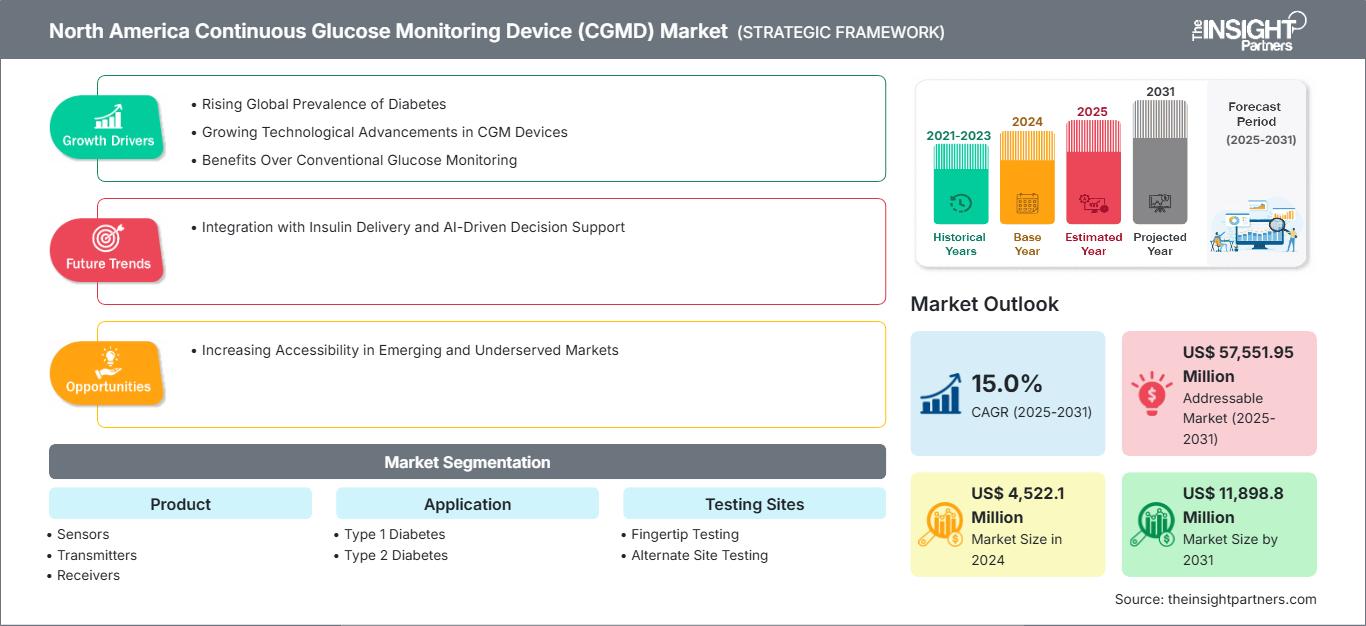
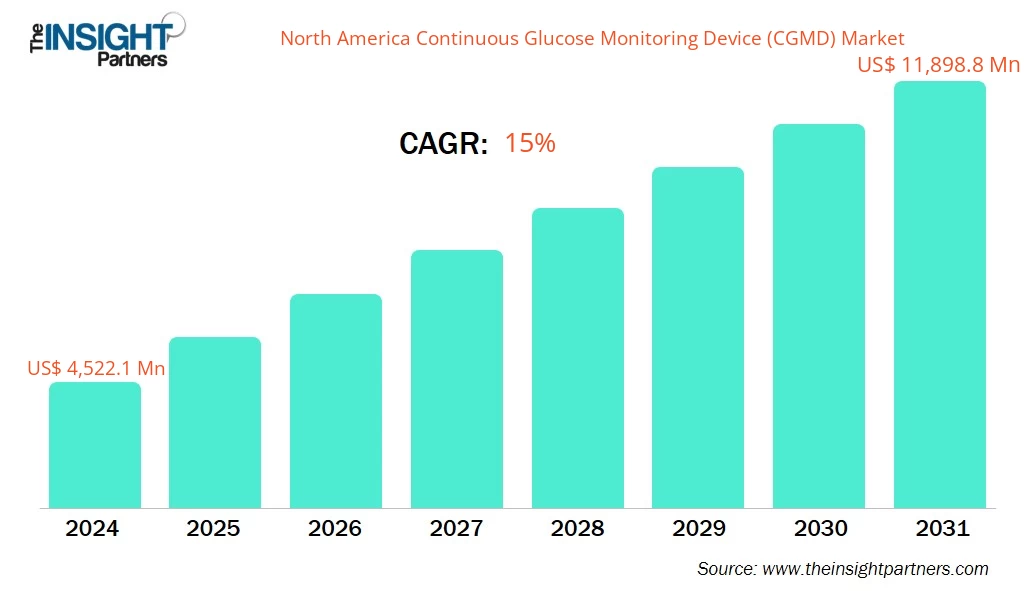
The North America Continuous Glucose Monitoring Device (CGMD) Market size is expected to reach US$ 11,898.8 Million by 2031 from US$ 4,522.1 Million in 2024. The market is estimated to record a CAGR of 15.0% from 2025 to 2031.
Executive Summary and North America Continuous Glucose Monitoring Device (CGMD) Market Analysis:
The continuous glucose monitoring devices market in North America is segmented into the US, Canada, and Mexico. North America will lead the continuous glucose monitoring devices market throughout the forecast period. North America held the most significant market share for continuous glucose monitoring devices. The market growth in this region is fueled by an increasing number of product launches from leading companies and the presence of key market players.
The US is the most significant contributor to North America's market. The increasing prevalence of diabetes is an essential factor driving the demand for continuous glucose monitoring devices in the US. Also, access to modern technology-enabled products favors this country's continuous glucose monitoring devices market growth. According to statistics released in the American Diabetes Association report in 2021, 38.4 million Americans (11.6%) of the total population had diabetes, including 29.7 million diagnosed and 8.7 million undiagnosed cases. Abbott's FreeStyle Libre 2 is an example of an advanced technology-based continuous glucose monitoring device. It is the longest-lasting integrated continuous glucose monitoring (iCGM) system on the market; it provides glucose readings to the patient every minute. Also, FreeStyle Libre 2 is the only integrated iCGM system available in the US for patients from two age groups, i.e., adults and children aged four or more. North America dominated the continuous glucose monitoring (CGM) devices market due to technological advancements in healthcare infrastructure and awareness regarding optimizing government and private insurance policies. The advanced infrastructure provides individuals with the topmost clinical facilities that help prevent diseases such as diabetes and cancer.
Early detection assists in identifying and prescribing medication for rare diseases, and CGM devices significantly improve disease prevention. They offer real-time tracking of blood sugar levels and continuously monitor glucose levels in the interstitial fluid. In addition, Canada also plays a crucial role in providing patients with government initiatives and promoting awareness regarding the advantages of glucose monitoring.
● REPORT CUSTOMIZATION
Tailor This Report To Align With Your Specific Business Requirements
This report can be customized to align precisely with your business objectives, scope, and target markets. Customization options include tailored segmentation, geography, competitive analysis, and strategic insights to support informed decision-making.
Customize This Report →WHAT YOU CAN ADJUST
- ● Segmentations
- ● Geography
- ● Competitive Analysis
- ● Language Preferences
North America Continuous Glucose Monitoring Device (CGMD) Market: Strategic Insights
-
Get Top Key Market Trends of this report.This FREE sample will include data analysis, ranging from market trends to estimates and forecasts.
North America Continuous Glucose Monitoring Device (CGMD) Market Segmentation Analysis:
- By Product, the North America Continuous Glucose Monitoring Device (CGMD) Market is segmented into Sensors, Transmitters, and Receivers. Sensors held the largest share of the market in 2024.
- By Application, the North America Continuous Glucose Monitoring Device (CGMD) Market is segmented into Type 1 Diabetes and Type 2 Diabetes. Type 2 Diabetes held the largest share of the market in 2024.
- By Testing Sites, the North America Continuous Glucose Monitoring Device (CGMD) Market is segmented into Fingertip Testing and Alternate Site Testing. Fingertip Testing held the largest share of the market in 2024.
- By End User, the North America Continuous Glucose Monitoring Device (CGMD) Market is segmented into Hospitals and Clinics and Self or Homecare. Self or Homecare held the largest share of the market in 2024.
North America Continuous Glucose Monitoring Device (CGMD) Market Report Scope
| Report Attribute | Details |
|---|---|
| Market size in 2024 | US$ 4,522.1 Million |
| Market Size by 2031 | US$ 11,898.8 Million |
| CAGR (2025 - 2031) | 15.0% |
| Historical Data | 2021-2023 |
| Forecast period | 2025-2031 |
| Segments Covered |
By Product
|
| Regions and Countries Covered |
North America
|
| Market leaders and key company profiles |
|
North America Continuous Glucose Monitoring Device (CGMD) Market Players Density: Understanding Its Impact on Business Dynamics
The North America Continuous Glucose Monitoring Device (CGMD) Market is growing rapidly, driven by increasing end-user demand due to factors such as evolving consumer preferences, technological advancements, and greater awareness of the product's benefits. As demand rises, businesses are expanding their offerings, innovating to meet consumer needs, and capitalizing on emerging trends, which further fuels market growth.
North America Continuous Glucose Monitoring Device (CGMD) Market Outlook
A defining trend in the continuous glucose monitoring (CGM) devices market is the increasing integration of CGM systems with insulin delivery technologies and artificial intelligence (AI)-based decision support tools, fundamentally transforming how diabetes is managed. This convergence marks a shift from passive glucose monitoring toward proactive, semi-automated, and eventually closed-loop diabetes care systems. The most notable developments have been hybrid closed-loop insulin delivery systems, where CGMs communicate in real time with insulin pumps to regulate basal insulin delivery automatically. Leading platforms such as Tandem Diabetes Care's Control-IQ, Insulet's Omnipod 5, and Medtronic's MiniMed 780G now rely on CGM data from devices such as the Dexcom G6/G7 or Guardian 4 to calculate insulin dosing every few minutes based on predicted glucose trends. These systems have been shown to significantly improve glycemic control, reduce HbA1c levels, and increase "time-in-range" with studies showing an average increase of 10-15% in time-in-range and a reduction in hypoglycemia episodes, particularly overnight.
In 2024, Dexcom's G7 was fully integrated into both Tandem and Omnipod systems, further streamlining the user experience with more straightforward sensor insertion, shorter warm-up times, and direct smartphone connectivity. The interoperability between CGMs and insulin pumps is improving rapidly with Bluetooth Low Energy (BLE) standards and secure APIs, enabling broader ecosystem compatibility. Beyond pump integration, smart pens are also joining the ecosystem. Companies such as Novo Nordisk and Medtronic have launched connected insulin pens that sync with CGM apps, automatically logging doses and timing. This helps algorithms accurately model insulin-on-board (IOB) and deliver better dosing recommendations.
AI is increasingly embedded in hardware and mobile apps, enhancing decision-making for users and clinicians. For instance, apps such as Dexcom Clarity, Sugarmate, and Tandem's : connect analyze historical glucose patterns to provide personalized alerts, trend forecasts, and behavioral nudges. Many users now rely on AI-generated predictive alerts for hyperglycemia or hypoglycemia events up to 20 minutes before, allowing for preemptive interventions. Some platforms also integrate machine learning algorithms that adjust insulin delivery parameters based on user behavior, exercise, meals, and even menstrual cycles, bringing personalization to new heights.
This digital integration is also transforming clinical decision-making. Healthcare providers can now review CGM data remotely via cloud-based dashboards, enabling telehealth consultations, faster therapy adjustments, and improved outcomes with fewer in-person visits. In the US, remote glucose monitoring is reimbursed under many Medicare and private insurance plans, supporting a broader shift to virtual diabetes management. Clinicians can set algorithmic parameters, review automatic insulin suspension logs, and optimize insulin-to-carb ratios based on real-world data, not just snapshot lab results.
Closed-loop research and development are accelerating, with the eventual goal of a fully autonomous artificial pancreas. Companies are testing dual-hormone systems that deliver insulin and glucagon, while others explore adaptive algorithms that continuously learn from user responses. AI is also being applied in patient coaching platforms: some apps now generate meal recommendations, stress management tips, and exercise adjustments based on CGM trends and insulin data. These virtual care companions represent a growing niche in diabetes care, combining biometric feedback with real-time coaching.
The fusion of CGM devices with insulin delivery systems and AI-driven analytics is a cornerstone trend shaping the next generation of diabetes management. These integrated solutions improve clinical outcomes and reduce users' cognitive and emotional burdens by automating insulin adjustments and supporting real-time, personalized decision-making. This movement toward intelligent, closed-loop systems sets the stage for a more seamless, efficient, and responsive approach to living with diabetes. It offers immense promise for the millions who manage the condition daily.
North America Continuous Glucose Monitoring Device (CGMD) Market Country Insights
By country, the North America Continuous Glucose Monitoring Device (CGMD) Market is segmented into the United States, Canada, and Mexico. The United States held the largest share in 2024.
The continuous glucose monitoring devices market in the US continues to evolve rapidly, driven by clinical innovation, expanding applications beyond traditional diabetes care, and growing attention to metabolic health. According to the Centers for Disease Control and Prevention (CDC), 2024, roughly 1 in 10 Americans live with diagnosed or undiagnosed diabetes. At the same time, prediabetes impacts over 100 million adults, factors that underpin sustained interest in CGM for managing glycemic control and guiding lifestyle interventions. CGMs are well established as the standard of care for Type 1 diabetes, with ~40-50% of individuals using them. Emerging evidence shows that CGM use among Type 2 diabetes patients, especially those not on intensive insulin, can help lower HbA1c, improve quality of life, and extend time-in-range, prompting discussions around broader adoption in primary care. Real-world usage data from Vanderbilt Medical Center (2021) reveal that most CGM users were under endocrinology care, had intensive insulin regimens, and had higher HbA1c values. However, a small but notable proportion, including ~12% not on any insulin, also use CGMs, highlighting shifting use patterns. Regulatory developments have broadened CGM access. In April 2025, the US Food and Drug Administration approved the Dexcom G7 15?Day system for adults, a more accurate device enabling up to 15.5 days of wear, with a grace period and automated correction bolus features expected to launch in the US in the latter half of 2025. Earlier, Dexcom's Stelo, the first over-the-counter CGM usable without a prescription and aimed at people with type 2 diabetes, garnered significant attention partly for democratizing glucose insights. Abbott followed suit with FDA clearances for two new CGM devices, Libre Rio for non?insulin?using Type 2 diabetics, and Lingo, targeting wellness and metabolism tracking, which offers both OTC, challenging the traditional prescription-only approach.
North America Continuous Glucose Monitoring Device (CGMD) Market Company Profiles
Some of the key players operating in the market include Abbott Laboratories, Medtronic Plc, F. Hoffmann-La Roche Ltd, Tandem Diabetes Care Inc, Ypsomed Holding AG, Dexcom Inc, i-SENS Inc, Senseonics Holdings Inc, A. Menarini Diagnostics s.r.l, and Medtrum Technologies Inc.
These players are adopting various strategies such as expansion, product innovation, and mergers and acquisitions to provide innovative products to their consumers and increase their market share.
North America Continuous Glucose Monitoring Device (CGMD) Market Research Methodology
The following methodology has been followed for the collection and analysis of data presented in this report:
Secondary Research
The research process begins with comprehensive secondary research, utilizing internal and external sources to gather qualitative and quantitative data for each market. Commonly referenced secondary research sources include, but are not limited to:
- Company websites, annual reports, financial statements, broker analyses, and investor presentations
- Industry trade journals and other relevant publications
- Government documents, statistical databases, and market reports
- News articles, press releases, and webcasts specific to companies operating in the market
Note:
All financial data included in the Company Profiles section has been standardized to US$. For companies reporting in other currencies, figures have been converted to US$ using the relevant exchange rates for the corresponding year.Primary Research
The Insight Partners conducts a significant number of primary interviews each year with industry stakeholders and experts to validate its data analysis and gain valuable insights. These research interviews are designed to:
- Validate and refine findings from secondary research
- Enhance the expertise and market understanding of the analysis team
- Gain insights into market size, trends, growth patterns, competitive dynamics, and future prospects
Primary research is conducted via email interactions and telephone interviews, encompassing various markets, categories, segments, and sub-segments across different regions. Participants typically include:
- Industry stakeholders: Vice Presidents, Business Development Managers, Market Intelligence Managers, and National Sales Managers
- External experts: Valuation specialists, research analysts, and key opinion leaders with industry-specific expertise

- Comprehensive Market Sizing and Forecast Analysis
- Detailed Segmentation Analysis
- In-Depth Market Dynamics Assessment
- Regional and Country-Level Insights
- Competitive Landscape and Company Benchmarking
- Strategic Business Intelligence
Recent Reports
Testimonials

The Insight Partners' SCADA System Market report is comprehensive, with valuable insights on current trends and future forecasts. The team was highly professional, responsive, and supportive throughout. We are very satisfied and highly recommend their services.
RAN KEDEM Partner, Reali Technologies LTDs
I requested a report on a very specific software market and the team produced the report in a few days. The information was very relevant and well presented. I then requested some changes and additions to the report. The team was again very responsive and I got the final report in less than a week.
JEAN-HERVE JENN Chairman, Future Analytica
We worked with The Insight Partners for an important market study and forecast. They gave us clear insights into opportunities and risks, which helped shape our plans. Their research was easy to use and based on solid data. It helped us make smart, confident decisions. We highly recommend them.
PIYUSH NAGPAL Sr. Vice President, High Beam Global
The Insight Partners delivered insightful, well-structured market research with strong domain expertise. Their team was professional and responsive throughout. The user-friendly website made accessing industry reports seamless. We highly recommend them for reliable, high-quality research services
YUKIHIKO ADACHI CEO, Deep Blue, LLC.
This is the first time I have purchased a market report from The Insight Partners.While I was unsure at first, I visited their web site and felt more comfortable to take the risk and purchase a market report.I am completely satisfied with the quality of the report and customer service. I had several questions and comments with the initial report, but after a couple of dialogs over email with their analyst I believe I have a report that I can use as input to our strategic planning process.Thank you so much for taking the extra time and making this a positive experience.I will definitely recommend your service to others and you will be my first call when we need further market data.
JOHN SUZUKI President and Chief Executive Officer, Board Director, BK Technologies
I wish to appreciate your support and the professionalism you displayed in the course of attending to my request for information regarding to infectious disease IVD market in Nigeria. I appreciate your patience, your guidance, and the fact that you were willing to offer a discount, which eventually made it possible for us to close a deal. I look forward to engaging The Insight Partners in the future, all thanks to the impression you have created in me as a result of this first encounter.
DR CHIJIOKE ONYIA MANAGING DIRECTOR, PineCrest Healthcare Ltd.Reason to Buy
- Informed Decision-Making
- Understanding Market Dynamics
- Competitive Analysis
- Identifying Emerging Markets
- Customer Insights
- Market Forecasts
- Risk Mitigation
- Boosting Operational Efficiency
- Strategic Planning
- Investment Justification
- Tracking Industry Innovations
- Aligning with Regulatory Trends





 Get Free Sample for