
Nuclear Zirconium Alloy Market Growth, Demand & Size by 2034
Coverage: by Occurrence (Primary Producing Countries, Hafnium Occurrence); General Uses (Zirconium Metal); Application (New Nuclear Zirconium Alloys Under Development) , and Geography (North America, Europe, Asia Pacific, and South and Central America)
- Status : Data Released
- Report Code : TIPRE00012859
- Category : Chemicals and Materials
- No. of Pages : 150
- Available Report Formats :


- Last update date : September 22, 2026


2025 Market Size
US$ 756.72 Mn
Base year value
2034 Forecast
US$ 995. Mn
Projected by 2034
CAGR 2026-2034
3.09 %
Growth rate
Addressable Market
US$ 7,954.27 Mn
(2026-2034)
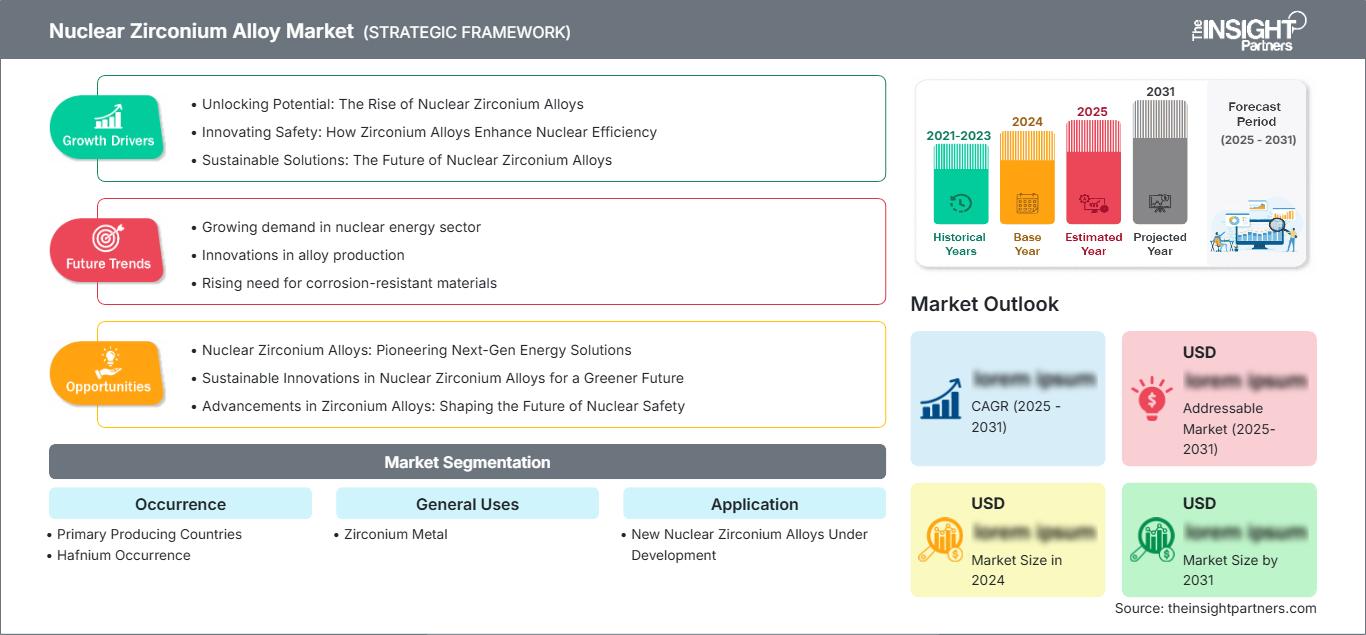
The global Nuclear Zirconium Alloy market was valued at US$ 756.72 million in 2025 and is expected to reach US$ 995 million by 2034; it is estimated to record a CAGR of 3.09% during 2026-2034.
Nuclear Zirconium Alloy Market Assessment and Insights
- North America: The region represented a 28–32% share in 2025 and is expected to grow at a 3.1–3.7% CAGR between 2026–2034, supported by established reactor fleets, fuel manufacturing infrastructure, and advanced cladding qualification programs.
- US: The US accounted for 70–74% of North American demand in 2025 and is projected to grow at a 3.0–3.6% CAGR through 2034, driven by fuel innovation and reactor life extension.
- Europe: Europe held a 23–27% share in 2025 and is projected to expand at a 3.0–3.6% CAGR between 2026–2034. France, Germany, the UK, Spain, and Sweden provide established fuel engineering and zirconium-component capabilities.
- Asia Pacific: Asia Pacific represented a 31–35% share in 2025 and is expected to record a 4.0–4.6% CAGR through 2034. China, Japan, South Korea, and India support demand through reactor construction, fuel manufacturing, and localization programs.
- Largest Segment: Zirconium Metal under General Uses accounted for a 60–64% market share in 2025 and is expected to grow at a 3.2–3.8% CAGR during 2026–2034.
- High Growth Segment: New Nuclear Zirconium Alloys Under Development represented a 7–11% share in 2025 and is projected to advance at a 5.0–5.8% CAGR during 2026–2034.
- Key companies analyzed in detail: Cameco Fuel Manufacturing Inc.; Chepetsky Mechanical Plant; CNNC-AREVA Shanghai Tubing Co.; Fine Tubes Ltd.; Framatome; Global Nuclear Fuel-Americas, LLC; Guangdong Orient Zirconic Industry Science and Technology Co., Ltd.; Jiangxi Kingan Hi-Tech Co., Ltd.; KEPCO Nuclear Fuel Co., Ltd.; Mitsubishi Nuclear Fuel Co., Ltd.; Westinghouse Electric Company LLC; Alleima AB.
Source: The Insight Partners' analysis based on proprietary research, government publications, company annual reports, investor presentations, industry databases, and expert interviews.
The nuclear zirconium alloy market will be progressing from regular Zircaloy to more sophisticated alloys designed specifically for high burnup, long cycle time, and corrosion/hydrogen control performance. According to Framatome, zirconium is one of the materials essential for nuclear fuel manufacturing; the company integrates all the necessary technologies related to production of zirconium sponge, alloying, and manufacturing of tubes, bars, and flat products.
The qualification of accident tolerant fuels in the future might bring about some modifications in terms of alloy composition, coating technology, and process technology. The chromium-coated options can be considered close ones, whereas the silicon carbide and FeCrAl can be regarded far away from this. This creates opportunities to create new zirconium alloys which would maintain the same production system but perform well under higher temperatures.
Nuclear Zirconium Alloy Market Report Scope
| Report Attribute | Details |
|---|---|
| Market size in 2025 | US$ 756.72 Million |
| Market Size by 2034 | US$ 995. Million |
| Global CAGR (2026 - 2034) | 3.09% |
| Historical Data | 2021-2024 |
| Forecast period | 2026-2034 |
Nuclear Zirconium Alloy Market Analysis
TThe nuclear grade zirconium alloy industry is built on a unique supply chain involving extraction from zirconium ores, manufacture of chemical compounds, zirconium sponge, alloys, melting, rolling or extruding, fabrication of tubes, annealing, pilgering, inspections, and fuel assembly. There are stringent standards regarding the content of hafnium, purity, size, microstructure, corrosion resistance and traceability that make qualifications important for suppliers.
The market is dependent on demand from the nuclear fuel industry instead of the demand for zirconium. Nuclear Fuel Complex says that zirconium alloys serve as a barrier around the uranium dioxide fuel and cites the low neutron absorption and corrosion resistance as the key factors behind their use. Consequently, the supply of this industry is limited to few qualified suppliers due to long qualification periods.
The competitive environment of the Nuclear Zirconium Alloy Market Report features a combination of vertically-integrated fuel providers, specialized tube producers, zirconium producers, and regional nuclear materials producers. Framatome manages zirconium production via alloy fabrication and components production, and Cameco Fuel Manufacturing produces zirconium tubes as a part of its CANDU fuel bundle production process. Westinghouse offers a more technologically advanced ZIRLO-based AXIOM alloy solution for high duty fuel applications.
More investments have been allocated to advanced materials development, coating solutions, automation of production, and testing infrastructure. Westinghouse informed about manufacturing equipment production for chromium-coated zirconium alloy cladding and forecasted operability by 2026, showing how the zirconium alloy suppliers and fuel providers are ready for the commercialization of advanced cladding. In 2026, Alleima opened its new tube mill with an investment of about SEK 330 million.
● REPORT CUSTOMIZATION
Tailor This Report To Align With Your Specific Business Requirements
This report can be customized to align precisely with your business objectives, scope, and target markets. Customization options include tailored segmentation, geography, competitive analysis, and strategic insights to support informed decision-making.
Customize This Report →WHAT YOU CAN ADJUST
- ● Segmentations
- ● Geography
- ● Competitive Analysis
- ● Language Preferences
Nuclear Zirconium Alloy Market: Strategic Insights
Regional Insights
North America nuclear zirconium alloy market
The Nuclear Zirconium Alloy Market share of North America was estimated to be 28–32% in 2025 and the region is expected to witness a 3.1–3.7% CAGR between 2026 and 2034. The US is at the forefront of regional consumption owing to the presence of high numbers of operating reactors, fuel suppliers, and infrastructure for qualification.
Regionally, the prospects will be shaped by factors such as the development of high burn-up fuel programs, accident tolerant fuels initiatives, and investment in extended reactor life cycles. There are CANDU fuel makers in Canada using zirconium alloy tubes and US fuel vendors that are working on coated zirconium and new generation alloys. The NRC work on accident tolerant fuels is also paving the way for regulatory approval of coated zirconium fuel and other cladding technologies.
U.S. nuclear zirconium alloy Market
The US was estimated to constitute 70-74% of North American demand in 2025 and is expected to grow at a 3.0-3.6% CAGR. This is due to the country's mature reactor fleet, fuel fabrication facilities, and investments made in advanced fuel licensing and qualification.
Westinghouse, Global Nuclear Fuel-Americas, and Framatome have significant application exposure in the US PWR and BWR reactor fleets. AXIOM zirconium alloy will be licensed by Westinghouse and Combustion Engineering PWRs, whereas chromium-coated zirconium will be used for accident tolerant fuel development. This will mean increased demand for zirconium alloys and coatings suitable for high burnup, corrosion resistance, and fuel cycles.
Europe nuclear zirconium alloy Market
Europe accounted for 23-27% shares in 2025 and is expected to grow at a CAGR of 3.0-3.6% until 2034. France represents the major market within the region owing to its nuclear fleet and engineering capabilities for fuel and zirconium materials. The United Kingdom and Germany represent important regions within their strengths in fuel fabrication, engineering, and reactor services.
France represents the important market due to its vertical integration of zirconium manufacturing through Framatome and its application of M5 alloy within the nuclear industry. The German region is essential within the advanced fuel demonstration through Framatome's Gösgen-based E-ATF program and the United Kingdom within its nuclear engineering and fuel cycle experience. Italy and Spain represent relatively minor markets in their respective alloy products markets but are important within reactor and fuel services.
APAC nuclear zirconium alloy Market
APAC had an estimated market share of 31–35%, and was expected to grow by a CAGR of 4.0–4.6%. It accounted for the highest regional growth in the market. China was dominant followed by Japan, South Korea, India, and Australia. Demand in the region was driven by increasing reactor construction and in-country material production capabilities.
China and South Korea were engaged in the construction of reactors alongside fuel production while Japan had high-end fuel engineering capabilities. India was improving domestic capabilities to produce zirconium and fuel components through Nuclear Fuel Complexes in zirconium sponge, alloy tubes, and fuel assembly plants.
Middle East & Africa nuclear zirconium alloy Market
However, regarding the rest of 9-13%, the two important regions are the Middle East and Africa, which experienced a growth of 2.4-3.0% CAGR in the year 2025. Saudi Arabia and UAE are the emerging countries in the field of nuclear industry, whereas South Africa is popular for nuclear reactors and nuclear engineering skills.
In case of the UAE, the current fleet of reactors already in operation implies higher fuel cycle demand, while the aspirations of Saudi Arabia may imply long-term demand for qualified nuclear materials. South Africa represents technical capabilities through its nuclear industry, while the rest of MEA is mostly project-related.
Segmentation Analysis
Occurrence
Occurrence is projected to grow at a 2.8–3.4% CAGR during 2026–2034. The segment reflects the geographic availability of zirconium-bearing resources and the distribution of hafnium alongside zirconium. Primary producing countries influence upstream security, while hafnium occurrence affects purification complexity and nuclear-grade material economics.
- Primary Producing Countries: Resource availability in Australia, South Africa, China, Indonesia, and other zircon-producing economies influences upstream zirconium supply. Their strategic importance is reinforced by mineral concentration and processing capacity.
- Hafnium Occurrence: Hafnium occurs naturally with zirconium and must be separated to achieve nuclear-grade specifications. Efficient separation technology is therefore essential because hafnium’s neutron-absorption characteristics restrict its acceptable concentration.
General Uses
General Uses is forecast to grow at a 3.2–3.8% CAGR during 2026–2034. Nuclear applications prioritize zirconium metal because of its neutron transparency, corrosion resistance, and compatibility with water-cooled reactor environments. Demand remains closely connected to fuel-cladding requirements and component replacement cycles.
- Zirconium Metal: Zirconium metal forms the material foundation for nuclear fuel cladding and related reactor components. Established processing routes, stringent purity requirements, and long qualification histories support its dominant position in nuclear applications.
Application
Application is expected to register a 5.0–5.8% CAGR during 2026–2034, led by development programs seeking improved corrosion, hydrogen uptake, high-temperature oxidation resistance, and higher-burnup performance. New alloy concepts can extend the utility of established zirconium manufacturing infrastructure.
- New Nuclear Zirconium Alloys Under Development: Emerging alloys and coated zirconium systems target higher duty, longer cycles, and enhanced accident margins. Their strategic importance is increasing as utilities seek performance gains without immediately abandoning zirconium-based fuel architectures.
Opportunity Snapshot
| Application | Revenue Contribution | Trend Tag | Adoption Stage |
|---|---|---|---|
| New Nuclear Zirconium Alloys Under Development | Medium | High Burnup | Scaling |
Nuclear Zirconium Alloy Market Growth Drivers and Impact Analysis
Expansion of Nuclear Generation and Reactor Life Extension
Nuclear expansion means an increase in the existing inventory of fuel assemblies, replacement parts, and clad material. In addition, the already existing nuclear power plants have extended lifetimes, and thus the demand for more replacement fuel is increased, and there is a need for operators to maximize the use of fuel. The zirconium alloy is favored because it has remained in use in light water reactor designs and qualification schemes. Framatome says that the use of zirconium as a fuel cladding in light water reactors is widespread due to its resistance to corrosion and desirable neutron properties. Life extension projects also require materials able to withstand higher burnups.
Higher Burnup and Longer Fuel Cycles Increase Material Performance Requirements
High burnup is driving material properties across the fuel cycle to be reconsidered. The aim is to extract more energy from each assembly, since longer cycles allow a reduced number of outages, which would be a way to optimize utilization and fuel management costs. As a consequence, the requirement for cladding material that resists corrosion, hydrogen pick up, creep, wear, and dimensional variations becomes even stricter over long periods of irradiation. For instance, Westinghouse's AXIOM alloy is designed for high-performing fuel and higher burnup levels, showing better behavior in terms of corrosion and hydrogen pick up than the previous zirconium alloys. The economic impact is therefore both qualitative and quantitative.
Accident-Tolerant Fuel Programs Extend the Advanced Zirconium Opportunity
The research and development of accident-tolerant fuel is opening a parallel path for zirconium alloys, rather than replacing them. A chromium-coated zirconium clad will allow the use of existing zirconium cladding material while increasing the ability of the material to resist oxidation, hydrogen generation, and wear. The NRC considers coated zirconium to be one of the near-term ATF solutions currently undergoing regulatory development, including FeCrAl and others. Thus, the introduction of such a technology lowers the level of technological disconnection that comes with introducing novel cladding materials, as existing reactor geometries and zirconium fabrication knowledge may continue to be applied. In this way, developments related to advanced zirconium are moving in the direction of coatings, surface modification, inspection, and quality assurance.
Nuclear Zirconium Alloy Market Future Trends
Computational Materials Design Will Accelerate Alloy Optimization
Computational materials engineering is expected to become more influential in zirconium-alloy development as manufacturers seek to shorten experimental iteration cycles. Digital models can evaluate alloy chemistry, microstructure, irradiation behavior, corrosion mechanisms, and thermomechanical performance before extensive physical testing. Research on computational design highlights the historically long development pathway of zirconium cladding and the difficulty of qualifying incremental chemistry changes. Over time, integrated modeling, machine-learning-assisted materials screening, and improved irradiation databases could help prioritize compositions with stronger performance potential. The commercial implication is a shift from empirical optimization toward data-supported development, although regulatory qualification will remain essential. Suppliers with validated databases and manufacturing feedback loops should gain an advantage in developing differentiated grades.
Hybrid Zirconium-Based Cladding Architectures Will Gain Importance
Future fuel systems of the Nuclear Zirconium Alloy Market trends are likely to combine conventional zirconium substrates with engineered coatings, modified surfaces, and advanced fuel pellets. This hybrid approach can improve accident performance while retaining the dimensional characteristics and manufacturing compatibility of established cladding. Framatome’s PROtect program uses chromium-coated M5 zirconium alloy as a near-term pathway, while longer-term work considers silicon-carbide-based solutions. Westinghouse similarly combines chromium-coated zirconium cladding with advanced ADOPT fuel within its EnCore platform. Such architectures may become increasingly important because utilities can pursue incremental performance improvements without immediately redesigning entire fuel assemblies. The trend should therefore stimulate demand for surface treatment, coating inspection, and high-integrity zirconium substrates.
Nuclear Zirconium Alloy Market Opportunities
Localized Nuclear-Grade Zirconium Supply Chains
Localization of nuclear-material supply chains offers an opportunity for producers in countries expanding reactor capacity or seeking greater fuel independence. India provides a useful example, with Nuclear Fuel Complex operating zirconium oxide, zirconium sponge, zircaloy fabrication, scrap reclamation, and fuel-assembly capabilities within an integrated ecosystem. Similar localization efforts can emerge in Asia and other nuclear-growth markets as governments seek security of supply and greater domestic manufacturing depth. Investment opportunities include sponge purification, alloy melting, tube production, nondestructive inspection, and recycling of manufacturing scrap. Strategic partnerships with established fuel vendors can reduce qualification barriers and transfer process knowledge. The strongest opportunities are likely to involve certified component production rather than commodity zirconium, because nuclear applications require extensive quality documentation and reactor-specific qualification.
Advanced Alloy and Coating Manufacturing Platforms
Investment in flexible manufacturing platforms capable of producing conventional and advanced zirconium products can create differentiated revenue opportunities. Suppliers can combine alloy melting, extrusion, pilgering, heat treatment, surface coating, and automated inspection to support both established fuel designs and emerging accident-tolerant concepts. Westinghouse’s development of equipment for chromium-coated zirconium cladding illustrates the transition toward dedicated manufacturing infrastructure for advanced fuel technologies. The opportunity in the Nuclear Zirconium Alloy Market Forecast extends beyond alloy composition to process control and qualification services. Manufacturers able to demonstrate repeatable coating thickness, adhesion, dimensional stability, and irradiation-relevant performance can become strategic partners for fuel vendors. Over time, integrated platforms may reduce commercialization bottlenecks as advanced fuel designs progress from lead-test assemblies toward broader fleet deployment.
Recent Developments
- April 8, 2026: Rosatom began testing innovative VVER fuel assemblies incorporating chromium-coated zirconium-alloy cladding at the Balakovo nuclear power plant. The assemblies contain fuel rods with chromium coatings over conventional zirconium-alloy cladding, providing a current commercial-scale example of how modified zirconium systems are being introduced to improve accident tolerance while retaining the established zirconium substrate.
- November 20, 2025: Lightbridge Corporation began irradiation testing of enriched uranium-zirconium alloy fuel material samples in Idaho National Laboratory’s Advanced Test Reactor. The campaign is intended to generate material-performance data supporting fuel modeling, qualification, licensing, and eventual commercialization of the company’s metallic fuel concept for existing reactors and future advanced applications.
Frequently Asked Questions

- Comprehensive Market Sizing and Forecast Analysis
- Detailed Segmentation Analysis
- In-Depth Market Dynamics Assessment
- Regional and Country-Level Insights
- Competitive Landscape and Company Benchmarking
- Strategic Business Intelligence
Recent Reports
Testimonials

The Insight Partners' SCADA System Market report is comprehensive, with valuable insights on current trends and future forecasts. The team was highly professional, responsive, and supportive throughout. We are very satisfied and highly recommend their services.
RAN KEDEM Partner, Reali Technologies LTDs
I requested a report on a very specific software market and the team produced the report in a few days. The information was very relevant and well presented. I then requested some changes and additions to the report. The team was again very responsive and I got the final report in less than a week.
JEAN-HERVE JENN Chairman, Future Analytica
We worked with The Insight Partners for an important market study and forecast. They gave us clear insights into opportunities and risks, which helped shape our plans. Their research was easy to use and based on solid data. It helped us make smart, confident decisions. We highly recommend them.
PIYUSH NAGPAL Sr. Vice President, High Beam Global
The Insight Partners delivered insightful, well-structured market research with strong domain expertise. Their team was professional and responsive throughout. The user-friendly website made accessing industry reports seamless. We highly recommend them for reliable, high-quality research services
YUKIHIKO ADACHI CEO, Deep Blue, LLC.
This is the first time I have purchased a market report from The Insight Partners.While I was unsure at first, I visited their web site and felt more comfortable to take the risk and purchase a market report.I am completely satisfied with the quality of the report and customer service. I had several questions and comments with the initial report, but after a couple of dialogs over email with their analyst I believe I have a report that I can use as input to our strategic planning process.Thank you so much for taking the extra time and making this a positive experience.I will definitely recommend your service to others and you will be my first call when we need further market data.
JOHN SUZUKI President and Chief Executive Officer, Board Director, BK Technologies
I wish to appreciate your support and the professionalism you displayed in the course of attending to my request for information regarding to infectious disease IVD market in Nigeria. I appreciate your patience, your guidance, and the fact that you were willing to offer a discount, which eventually made it possible for us to close a deal. I look forward to engaging The Insight Partners in the future, all thanks to the impression you have created in me as a result of this first encounter.
DR CHIJIOKE ONYIA MANAGING DIRECTOR, PineCrest Healthcare Ltd.Reason to Buy
- Informed Decision-Making
- Understanding Market Dynamics
- Competitive Analysis
- Identifying Emerging Markets
- Customer Insights
- Market Forecasts
- Risk Mitigation
- Boosting Operational Efficiency
- Strategic Planning
- Investment Justification
- Tracking Industry Innovations
- Aligning with Regulatory Trends





 Get Free Sample for