
Offshore Wind Cable Market Size, Growth & Trends by 2034
Coverage: By Type (Export Cable, Inter-array Cable); Conductor Material (Copper, Aluminum), and Geography (North America, Europe, Asia Pacific, and South and Central America)
- Status : Data Released
- Report Code : TIPRE00013153
- Category : Electronics and Semiconductor
- No. of Pages : 150
- Available Report Formats :


- Last update date : June 12, 2026


2025 Market Size
US$ 4.54 Bn
Base year value
2034 Forecast
US$ 40.9 Bn
Projected by 2034
CAGR 2026-2034
27.7 %
Growth rate
Addressable Market
US$ 168.08 Bn
(2026-2034)
The global offshore wind cable market size is projected to reach US$ 40.9 billion by 2034 from US$ 4.54 billion in 2025. The market is anticipated to register a CAGR of 27.7% during the forecast period 2026–2034.
Key market dynamics include an accelerating global focus on renewable energy transitions, rising capital expenditures regarding the establishment of large-scale marine energy networks, and a significant shift toward high-capacity electrical grids. Additionally, the market is expected to benefit from the growing popularity of deep-water wind farms, expansion in subsea grid interconnections across emerging economies, and the increasing inclusion of specialized dynamic systems in high-value coastal infrastructure projects.
Offshore Wind Cable Market Analysis
The offshore wind cable market analysis shows a shift toward high-value subsea transmission as energy developers prioritize transmission efficiency and long-term durability. The market is moving into traditional fixed-bottom European installation and high-growth deep-water export markets in Asia-Pacific region. Strategic opportunities are emerging in specialty deep-sea and high-voltage applications, where advanced insulation and thermal efficiency offer a clear competitive advantage over older legacy grid equipment. The analysis also notes that market expansion depends on specialized cable-laying vessel availability for deployment and manufacturing capacity for extra-high-voltage units. Competitive differentiation now stands out depending on engineering execution that guarantees marine structural safety, minimizes operational power loss, and allows end-to-end tracking of component manufacturing. This approach helps top-tier engineering firms secure massive commercial contracts in a market with distinct technical barriers.
Offshore Wind Cable Market Overview
Subsea power delivery networks have evolved from localized coastal grid connections to mainstream infrastructure pillars. The market includes dynamic array links, long-distance transmission corridors, and multi-gigawatt export systems. Both international industrial conglomerates and engineering contractors compete in this market, using structural metals like copper and aluminum. Growing demand for reliable green power baseloads among energy-conscious economies in Europe and North America has increased the popularity of offshore wind cables as a vital energy transmission solution. Europe leads in revenue due to its established offshore installations and mature supply chain, while Asia-Pacific is advancing in technical output capacity and cross-border project adoption. The United States market is developing quickly, driven by clean-energy state mandates along the Atlantic coastline and the increasing availability of deep-water exploration leases. Competition among primary manufacturing entities is fueling greater structural variety and the inclusion of advanced features like real-time fiber-optic monitoring and integrated synthetic armor wrap.
Market Assessment and Insights
- Global market for Offshore Wind Cable was valued at US$ 4.54 Billion in 2025
- Annual market size is expected to reach US$ 40.90 Billion by 2034
- Total addressable market (TAM) during 2026-2034 is projected to reach approximately US$ 168.08 Billion
- Market is anticipated to register a CAGR of 27.7% during the forecast period
- The United States represents a key market, supported by Investment in Offshore Wind Farms, Technological Advancements in Cable Design, Regulatory Incentives and Government Initiatives, as well as evolving industry dynamics
- Market analysis covers North America, Europe, Asia-Pacific, South and Central America, Middle East and Africa, with growth evaluated across the forecast period
- Market opportunities such as Government Incentives in Europe and North America, Technological Innovations in Cable Materials, Asia-Pacific Growth Potential are expected to influence market dynamics and addressable market
- Report profiles industry participants, including Fujikura Ltd., Hellenic Cables S.A., JDR Cable Systems Ltd., LS Cable and System Ltd., Nexans S.A., NKT A/S, Parker-Hannifin Corporation, Prysmian Group, Sumitomo Electric Industries, Ltd., ZTT International Limited, while analyzing competitive strategies and innovation developments
-
Source: The Insight Partners' analysis based on proprietary research, government publications, company annual reports, investor presentations, industry databases, and expert interviews.
● REPORT CUSTOMIZATION
Tailor This Report To Align With Your Specific Business Requirements
This report can be customized to align precisely with your business objectives, scope, and target markets. Customization options include tailored segmentation, geography, competitive analysis, and strategic insights to support informed decision-making.
Customize This Report →WHAT YOU CAN ADJUST
- ● Segmentations
- ● Geography
- ● Competitive Analysis
- ● Language Preferences
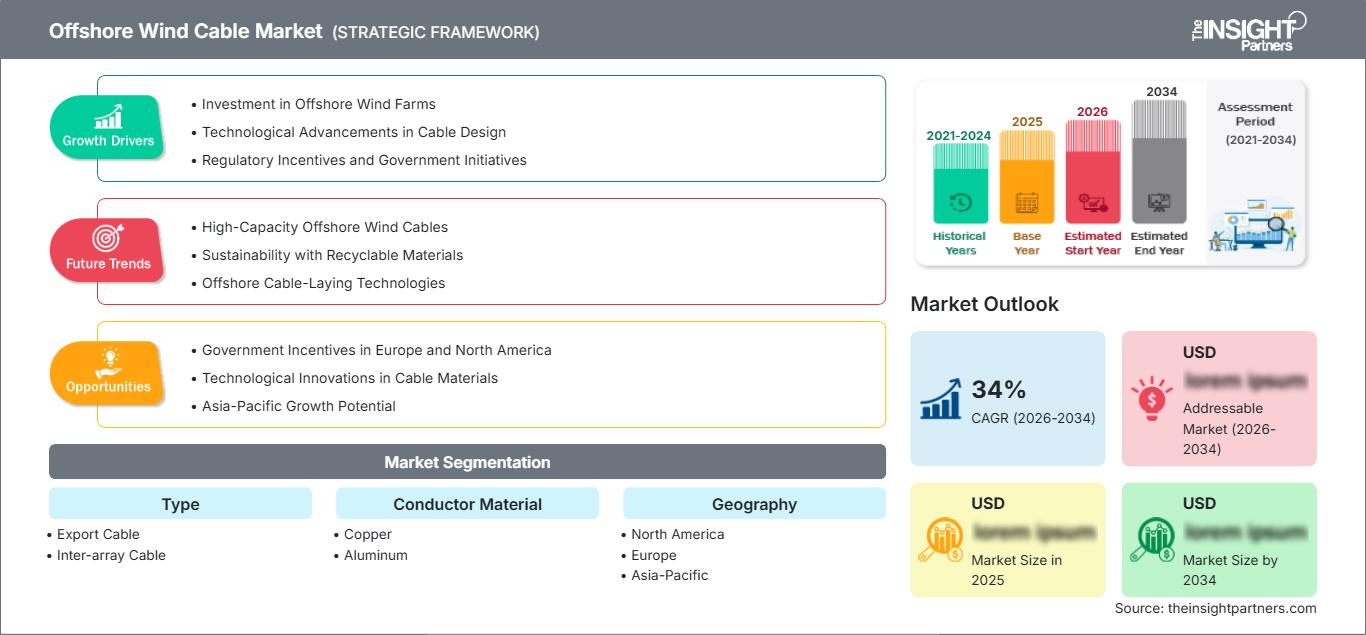
Offshore Wind Cable Market: Strategic Insights
-
Get Top Key Market Trends of this report.This FREE sample will include data analysis, ranging from market trends to estimates and forecasts.
Offshore Wind Cable Market Drivers and Opportunities
Market Drivers:
- Superior Structural Capacity and Efficiency: Modern offshore wind cables feature highly optimized conductor layouts and advanced insulation materials, which make it easier to transmit large blocks of power across vast ocean basins without massive thermal dissipation. This technical advantage, along with growing industrial interest in lowering the levelized cost of energy, is driving market popularity.
- Expansion of the Global Megawatt Category: The deployment of larger wind turbines exceeding fifteen-megawatt individual capacities has sustained high demand for robust subsea collection infrastructure. As developers build larger generation footprints, specialized high-voltage arrays continue to see stable volume gains.
- Rapid Expansion of Cross-Border Grid Interconnections: Multi-national regional planning initiatives have removed traditional regulatory barriers for subsea power transfer. This is particularly evident in the rapid adoption of long-distance subsea export links in regions like Northern Europe and East Asia.
Market Opportunities:
- Expansion into Floating Offshore Basins: Beyond traditional fixed-bottom ocean foundations, deeper waters offer significant opportunities for advanced cabling designs that can flex continuously under the influence of harsh marine waves and tidal actions.
- Growth in Emerging Asia-Pacific Corridors: Forming strategic partnerships between coastal asset developers and regional engineering groups can facilitate access to high-margin infrastructure networks in nations like Japan, South Korea, and Taiwan, where clean energy implementation plans are accelerating.
- Diversification into Specialized Testing Certifications: There is a growing opportunity for manufacturing organizations to target key state projects through specialized quality benchmarks, such as anti-corrosion ratings, extreme depth certifications, and high-load capacity approvals.
Offshore Wind Cable Market Report Segmentation Analysis
The Offshore Wind Cable Market share is analyzed across various segments to provide a clearer understanding of its structure, growth potential, and emerging trends. Below is the standard segmentation approach used in most industry reports:
By Type:
- Export Cable: The dominant revenue driver, engineered to safely transmit massive volumes of generated electricity from offshore collector hubs back to mainland shore networks over extensive geographical distances.
- Inter-array Cable: A high-volume segment that connects individual turbine units into structured circuits within the boundaries of the offshore facility.
By Conductor Material:
- Copper: The leading volume choice, preferred due to its superior electrical conductivity, high thermal durability, and reliable physical characteristics in harsh underwater installations.
- Aluminum: A rapidly rising material option, chosen primarily for its lighter physical weight and cost advantages, which helps lower top-side weight on floating collection structures.
By Geography:
- North America
- Europe
- Asia Pacific
- South & Central America
- Middle East & Africa
Offshore Wind Cable Market Report Scope
| Report Attribute | Details |
|---|---|
| Market size in 2025 | US$ 4.54 Billion |
| Market Size by 2034 | US$ 40.9 Billion |
| Global CAGR (2026 - 2034) | 27.7% |
| Historical Data | 2021-2024 |
| Forecast period | 2026-2034 |
| Segments Covered |
By Type
|
| Regions and Countries Covered |
North America
|
| Market leaders and key company profiles |
|
Offshore Wind Cable Market Players Density: Understanding Its Impact on Business Dynamics
The Offshore Wind Cable Market is growing rapidly, driven by increasing end-user demand due to factors such as evolving consumer preferences, technological advancements, and greater awareness of the product's benefits. As demand rises, businesses are expanding their offerings, innovating to meet consumer needs, and capitalizing on emerging trends, which further fuels market growth.
Offshore Wind Cable Market Share Analysis by Geography
Asia-Pacific is expected to grow fastest in the coming years. Emerging markets in South & Central America, the Middle East, and Africa also have many untapped opportunities for premium subsea deployment groups and heavy power infrastructure producers to expand.
The offshore wind cable market is undergoing a significant transformation, moving from a regional European engineering market to a global high-value infrastructure baseline. Growth is driven by the rising execution of maritime climate commitments, a surge in alternative power demand, and the expansion of the global marine wind sector. Below is a summary of market share and trends by region:
1. North America
- Market Share: A highly prospective but developing segment experiencing an approximate twenty-three percent growth trajectory, heavily centered around state-backed construction pipelines along the eastern coast.
- Key Drivers:
- Binding clean-energy mandates from state governments requiring independent marine generation assets.
- Federal environmental approvals are clearing major backlogs for multi-gigawatt ocean infrastructure arrays.
- Expanding localized supply chain investments to establish domestic manufacturing footprints.
- Trends: Initial reliance on transatlantic maritime partnerships moving toward fully domestic production pipelines that comply with local coastal trade regulations.
2. Europe
- Market Share: Holds the largest historical share globally, anchored by mature, decade-old subsea power networks across the North Sea and Baltic Sea regions.
- Key Drivers:
- Broad implementation of high-capacity projects in established markets like the United Kingdom, Germany, and Denmark.
- Integrated cross-border regional grid infrastructure supported by advanced manufacturing centers.
- Clear regulatory standards and sustained institutional capital backing for offshore energy programs.
- Trends: A clear engineering pivot toward extra-high-voltage export technology to connect massive far-shore clusters directly to central industrial hubs.
3. Asia-Pacific
- Market Share: The fastest-growing region across the global map, characterized by massive domestic installation targets in mainland China and rapid adjacent supply chain localization.
- Key Drivers:
- Large coastal load centers needing massive injections of non-fossil baseload power.
- National target frameworks in Taiwan, Japan, and South Korea aimed at securing independent green energy assets.
- Declining levelized costs of offshore infrastructure are making oceanic arrays economically competitive.
- Trends: Heavy expansion of regional cable production yards to satisfy both massive domestic demand and export requirements to surrounding oceanic territories.
4. South and Central America
- Market Share: An emerging market with exploratory projects moving forward along high-wind coastal corridors in Brazil and Chile.
- Key Drivers:
- Initial environmental scoping assessments conducted by international developers looking for prime open-water space.
- Strategic plans to couple offshore energy installations with new coastal green hydrogen export facilities.
- Industrial efforts to reduce dependency on traditional weather-impacted hydroelectric dams.
- Trends: Early-stage strategic agreements with overseas technology leaders to analyze localized marine seabed conditions.
5. Middle East and Africa
- Market Share: A long-term developmental market focused on early grid integration studies and specialized coastal infrastructure links.
- Key Drivers:
- National economic transformation initiatives exploring deep-water alternative power viability.
- Coastal industrial diversification goals requiring direct subsea power delivery to new economic zones.
- Rising regional investments in maritime engineering and shipbuilding capabilities.
- Trends: Engineering studies focusing on nearshore pilot arrays alongside multi-purpose subsea transmission links to maximize coastal grid resilience.
High Market Density and Competition
Competition is intensifying due to the presence of established leaders such as Prysmian Group, Nexans S.A., and NKT A/S. Top-tier global suppliers like Sumitomo Electric Industries and LS Cable & System, which together with the top players held a combined sixty-five percent of market volume in 2024, compete alongside specialized regional entities like Taihan Electric Wire Co., Southwire Company LLC, and TFKable Group to capture major international infrastructure tenders.
This competitive environment pushes vendors to differentiate through:
- Advanced Volumetric Capacity: Engineering modern insulation systems that allow subsea cable arrays to operate at higher voltage ratings without risking electrical insulation breakdown.
- Turnkey Delivery Models: Combining engineering, cable production, vessel transport, and underwater excavation into a single bundled contract to mitigate project alignment issues for asset owners.
- Supply Chain Independence: Maintaining in-house ownership of critical asset steps, from copper and aluminum processing lines to dedicated deep-sea installation ship fleets.
- Specialized Product Customization: Developing heavy-duty armoring methods and dynamic bend stiffeners designed to protect the internal electrical cores from ocean currents and shifting marine sediment.
Opportunities and Strategic Moves
- Form long-term booking agreements with maritime transport operators to protect project installation timelines from global vessel shortage risks.
- Establish dedicated production facilities close to high-demand development regions to bypass transoceanic shipping challenges and satisfy local sourcing criteria.
Major Companies operating in the Offshore Wind Cable Market are:
- Fujikura Ltd.
- Hellenic Cables S.A.
- JDR Cable Systems Ltd.
- LS Cable and System Ltd.
- Nexans S.A.
- NKT A/S
- Parker-Hannifin Corporation
- Prysmian Group
- Sumitomo Electric Industries, Ltd.
- ZTT International Limited
Disclaimer: The companies listed above are not ranked in any particular order.
Offshore Wind Cable Market News and Recent Developments
- In May 2026, Royal Boskalis B.V. (Boskalis) announced its decision to invest in a state-of-the-art high-capacity Cable Lay Vessel (CLV), further strengthening its position in the offshore energy market and in support of the global transition to renewable energy. The vessel will be launched to meet the growing demand for long-distance cable installation in the interconnector and offshore wind markets, particularly for high-voltage direct current cables.
- In March 2025, Prysmian made a significant breakthrough to accelerate the roll-out of floating offshore wind projects. Floating offshore wind, a technology that opens wind-power generation to previously unreachable areas due to the deep seabed, will be significantly boosted by this breakthrough, as Prysmian can provide high-voltage dynamic cable systems that have been tailor-made for such conditions. The new 245 kV HVAC dynamic cable system will ensure that offshore wind projects will benefit from superior resistance, high mechanical performance, and above all, boosted reliability to overcome the extremely challenging conditions at sea caused by the constant stress due to water currents and harsh conditions at sea.
Offshore Wind Cable Market Report Coverage and Deliverables
The Offshore Wind Cable Market Size and Forecast (2021–2034) report provides a detailed analysis of the market covering the below areas:
- Offshore Wind Cable Market size and forecast at global, regional, and country levels for all the key market segments covered under the scope
- Offshore Wind Cable Market trends, as well as market dynamics such as drivers, restraints, and key opportunities
- Detailed PEST and SWOT analysis
- Offshore Wind Cable Market analysis covering key market trends, global and regional framework, major players, regulations, and recent market developments
- Industry landscape and competition analysis covering market concentration, heat map analysis, prominent players, and recent developments in the Offshore Wind Cable Market.
- Detailed company profiles
Frequently Asked Questions

- Comprehensive Market Sizing and Forecast Analysis
- Detailed Segmentation Analysis
- In-Depth Market Dynamics Assessment
- Regional and Country-Level Insights
- Competitive Landscape and Company Benchmarking
- Strategic Business Intelligence
Recent Reports
Testimonials

The Insight Partners' SCADA System Market report is comprehensive, with valuable insights on current trends and future forecasts. The team was highly professional, responsive, and supportive throughout. We are very satisfied and highly recommend their services.
RAN KEDEM Partner, Reali Technologies LTDs
I requested a report on a very specific software market and the team produced the report in a few days. The information was very relevant and well presented. I then requested some changes and additions to the report. The team was again very responsive and I got the final report in less than a week.
JEAN-HERVE JENN Chairman, Future Analytica
We worked with The Insight Partners for an important market study and forecast. They gave us clear insights into opportunities and risks, which helped shape our plans. Their research was easy to use and based on solid data. It helped us make smart, confident decisions. We highly recommend them.
PIYUSH NAGPAL Sr. Vice President, High Beam Global
The Insight Partners delivered insightful, well-structured market research with strong domain expertise. Their team was professional and responsive throughout. The user-friendly website made accessing industry reports seamless. We highly recommend them for reliable, high-quality research services
YUKIHIKO ADACHI CEO, Deep Blue, LLC.
This is the first time I have purchased a market report from The Insight Partners.While I was unsure at first, I visited their web site and felt more comfortable to take the risk and purchase a market report.I am completely satisfied with the quality of the report and customer service. I had several questions and comments with the initial report, but after a couple of dialogs over email with their analyst I believe I have a report that I can use as input to our strategic planning process.Thank you so much for taking the extra time and making this a positive experience.I will definitely recommend your service to others and you will be my first call when we need further market data.
JOHN SUZUKI President and Chief Executive Officer, Board Director, BK Technologies
I wish to appreciate your support and the professionalism you displayed in the course of attending to my request for information regarding to infectious disease IVD market in Nigeria. I appreciate your patience, your guidance, and the fact that you were willing to offer a discount, which eventually made it possible for us to close a deal. I look forward to engaging The Insight Partners in the future, all thanks to the impression you have created in me as a result of this first encounter.
DR CHIJIOKE ONYIA MANAGING DIRECTOR, PineCrest Healthcare Ltd.Reason to Buy
- Informed Decision-Making
- Understanding Market Dynamics
- Competitive Analysis
- Identifying Emerging Markets
- Customer Insights
- Market Forecasts
- Risk Mitigation
- Boosting Operational Efficiency
- Strategic Planning
- Investment Justification
- Tracking Industry Innovations
- Aligning with Regulatory Trends





 Get Free Sample for