
Oleic Acid Market Share, Size & Demand by 2034
Coverage: By Origin (Plant, Animal); End User (Food and beverages, Textiles and leather, Pharmaceuticals, Automotive, Others) , and Geography (North America, Europe, Asia Pacific, and South and Central America)
- Status : Data Released
- Report Code : TIPRE00019922
- Category : Chemicals and Materials
- No. of Pages : 150
- Available Report Formats :


- Last update date : September 28, 2026


2025 Market Size
US$ 733.64 Mn
Base year value
2034 Forecast
US$ 1,334.51 Mn
Projected by 2034
CAGR 2026-2034
6.87 %
Growth rate
Addressable Market
US$ 9,340.63 Mn
(2026-2034)
The oleic acid market size is projected to expand from US$ 733.64 Million in 2025 to US$ 1,334.51 Million by 2034, registering a CAGR of 6.87% during 2026–2034. Growth is supported by increasing utilization of plant-derived fatty acids in food formulations, pharmaceutical excipients, personal and industrial products, and specialty chemical applications. The market is also benefiting from oleochemical producers' efforts to improve feedstock traceability, purification efficiency, and application-specific product grades.
Across North America, oleic acid market development is expected to remain steady, with a modelled CAGR of 6.2–6.6% through 2034. Demand is supported by pharmaceutical formulation activity, specialty food ingredients, lubricant applications, and increasing procurement preferences for renewable feedstocks. The region also benefits from established oleochemical distribution networks and stringent product-quality requirements that encourage higher-value grades.
Oleic Acid Market Assessment and Insights
- North America: The region is expected to represent 24–27% of global oleic acid market share in 2025, supported by pharmaceutical, food, lubricant, and specialty chemical demand, with a CAGR of 6.2–6.6% between 2026–2034.
- US: The US is estimated to account for 19–22% of global revenue and 78–82% of North American demand in 2025, expanding at a CAGR of 6.1–6.5% through 2034.
- Europe: Europe is estimated at 24–27% share in 2025, with Germany, France, Italy, Spain, and the UK forming important downstream markets, while the region grows at 6.4–6.8% CAGR.
- Asia Pacific: Asia Pacific is estimated to hold 37–40% share in 2025 and record the fastest regional expansion at 7.4–7.9% CAGR, led by China, India, Japan, South Korea, and Southeast Asia.
- Largest Segment: Plant origin is estimated at 68–72% share in 2025, reflecting abundant vegetable-oil feedstocks and sustainability preferences, with a 7.1–7.5% CAGR.
- High Growth Segment: Pharmaceuticals are estimated at 12–16% share in 2025 and are expected to expand at 7.8–8.3% CAGR, supported by excipient and formulation applications.
- Key companies analyzed in detail: Berg + Schmidt GmbH, Eastman Chemical Company, Emery Oleochemicals (M) Sdn Bhd, Godrej Industries Limited, KLK OLEO Sdn. Bhd., Kraton Corporation, Oleon NV, VVF L.L.C., White Group Public Co., Ltd., and Wilmar International Limited.
Source: The Insight Partners' analysis based on proprietary research, government publications, company annual reports, investor presentations, industry databases, and expert interviews.
Oleic acid market expansion trends have moved from a predominantly commodity fatty acid supply towards specialized grades with improved purity, oxidation, color, and traceability. Oleic acid manufacturers have been incorporating refining, fractionation, hydrogenation, distillation, and formulations expertise. Vegetable sources are critical raw material inputs for production; however, animal derived sources still have relevance depending on cost and performance considerations. The economics of oleic acid production continue to revolve around feedstock costs, yields, energy usage, and logistics.
According to oleic acid market research report, during the forecast period there is expected to be significant investment in Asia Pacific and selected European specialty chemical facilities. The regulatory focus on ethical sourcing, renewable chemistry, food safety, pharmaceutical quality and carbon accounting will play in favor of those oleic acid manufacturers that can prove provenance and control in the process of manufacturing.
Oleic Acid Market Report Scope
| Report Attribute | Details |
|---|---|
| Market size in 2025 | US$ 733.64 Million |
| Market Size by 2034 | US$ 1,334.51 Million |
| Global CAGR (2026 - 2034) | 6.87% |
| Historical Data | 2021-2024 |
| Forecast period | 2026-2034 |
Oleic Acid Market Analysis
Market growth for oleic acid stems from an extensive value chain that starts from vegetable oils and fats, animal fat, and intermediates, then undergoes hydrolysis, separation, distillation, purification, and formulation depending on the particular grades. The demand for oleic acid is seen in applications like food ingredients, pharmaceuticals, textile auxiliary agents, leather, lubricants, paints, rubber-related applications, and specialty chemicals. There is increasing influence of plant-based raw materials in purchase considerations due to their functional properties.
The supply situation in the oleic acid market still has issues related to agricultural cycle, seed crop yield, availability of palm and other vegetable oils, energy prices, and refinery capacity. This risk may be partially mitigated by integrated oleochemicla companies through feedstock and processing diversification. Logistics in certain regions also become important since the fatty acid based products are marketed through traditional bulk chemicals and specialty ingredients markets.
The oleic acid market report reveals an oligopoly consisting of vertically integrated oleochemical clusters, specialist ingredients companies, and diversified chemical companies. Wilmar International Limited, KLK OLEO Sdn. Bhd., Godrej Industries Limited, and Oleon NV have advantages due to a diversified range of oleochemical products and existing feedstock networks. Special formulation offerings are the strengths of Berg + Schmidt GmbH and Emery Oleochemicals (M) Sdn Bhd, whereas local production and distribution services characterize VVF L.L.C. and White Group Public Co., Ltd.
Feedstock reliability, flexibility, purification process, certification, and technical expertise specific to each client will be increasingly important for the competitive position within the oleic acid market. Eastman Chemical Company and Kraton Corporation are active participants in the oleic acid market via a more diverse range of specialty-chemical products in which fatty acid derivatives play specific roles. Investments will be made now more in high-value product processing, sustainability, applications, and supply chain management rather than in capacity.
● REPORT CUSTOMIZATION
Tailor This Report To Align With Your Specific Business Requirements
This report can be customized to align precisely with your business objectives, scope, and target markets. Customization options include tailored segmentation, geography, competitive analysis, and strategic insights to support informed decision-making.
Customize This Report →WHAT YOU CAN ADJUST
- ● Segmentations
- ● Geography
- ● Competitive Analysis
- ● Language Preferences
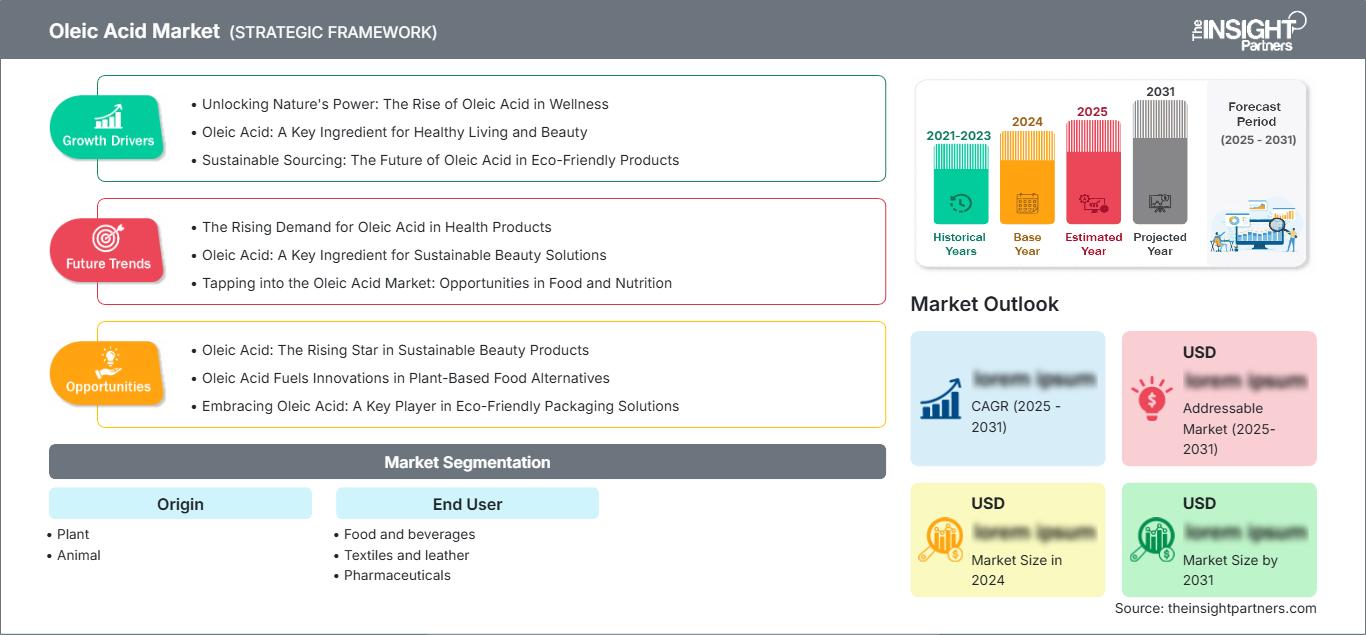
Oleic Acid Market: Strategic Insights
Regional Insights
North America oleic acid market
According to the oleic acid market forecast, North America is estimated to represent 24–27% of global revenue in 2025 and is expected to expand at a CAGR of 6.2–6.6% during 2026–2034. The area already has an established ecosystem for specialty chemicals, backed by pharmaceutical production, processed foods, industrial lubricants, coatings, and personal care formulations. The growing preference is for purity and traceability.
The US consumes the bulk of regional volume, with Canada making its contribution via food processing, specialty chemicals, and industrial applications. Competitiveness among regional players includes formulation assistance, reliable logistics, and custom grading. Regulation of ingredients for food, pharmaceuticals, and chemicals promotes specification and traceability on the part of suppliers. Expansion will be wide-ranging but stronger demand growth will come from pharmaceutical and specialty industrial applications rather than commodity applications.
U.S. oleic acid Market
The US is estimated to account for 78–82% of North American revenue in 2025 and is projected to grow at a CAGR of 6.1–6.5% through 2034. Its demand base includes food ingredients, pharmaceuticals, lubricants, cosmetics, coatings, and industrial processing, supported by a sophisticated specialty-chemical distribution network.
There are also big chemical players and formulating firms that need the same consistency in fatty acids specifications. The pharmaceutical sector is more concerned about the quality control system, whereas the food sector prioritizes purity, functionality, and supply. The growing interest in renewable sources of carbon increases the chances of using vegetable-based fatty acid grades. There is a trend toward sourcing from those who can provide documentation, consistency, and packaging options.
Europe oleic acid Market
Europe is estimated to hold 24–27% of global revenue in 2025 and is forecast to grow at 6.4–6.8% CAGR. Germany remains a leading industrial market, while the UK, France, Italy, and Spain provide important food, pharmaceutical, textile, leather, and specialty-chemical demand.
Germany has advantage due to its sophisticated chemical processing and manufacturing facilities. The UK continues to have needs for products used in pharmaceuticals, food ingredients, and specialty chemicals. Countries like France, Italy, and Spain provide support through industries such as food processing, cosmetics, textiles, leather, and manufacturing sectors. Sustainability concerns, renewable feedstocks preference, and compliance requirements of Europe’s chemicals sector would drive producers to provide better and pure grades. Specialty applications would thus perform better than commodity applications in the forecast period.
APAC oleic acid Market
APAC is estimated to command 37–40% share in 2025 and grow at 7.4–7.9% CAGR, making it the leading regional market. However, China continues to be the biggest country market, while India, Japan, South Korea, and Australia participate via food, pharma, chemicals, and industrial uses.
The presence of well-developed facilities for vegetable oil processing, growing facilities for the manufacture of pharmaceutical products and industrialization drive regional demand. India has its own strengths in the area of oleochemicals production, while China brings its strength in terms of scale in manufacturing operations. Japan and South Korea focus on the production of high-quality specialty uses.
Middle East & Africa oleic acid Market
Middle East & Africa is projected to expand at a CAGR of 5.8–6.3% through 2034. Saudi Arabia and the UAE benefit from chemical and industrial investment, while South Africa supports food processing, pharmaceuticals, and industrial formulations.
The Saudi Arabian downstream facilities for chemicals and the UAE’s logistical base would help with regional distribution while South Africa will remain a diversified market. The region's investments in energy and infrastructure could help enhance the capabilities in chemical manufacturing and logistics of imports to the region. However, lack of feedstock and reliance on imports of specialty chemicals continue to pose challenges. Thus, the areas with growth potential would include regions with strong distribution and producer customer relations.
Segmentation Analysis
Origin
The Origin segment is expected to register a CAGR of 6.8–7.2% during 2026–2034. Plant-derived oleic acid remains structurally advantaged because vegetable oils provide scalable feedstocks and align with renewable-carbon strategies. Animal-derived material retains importance in cost-sensitive and performance-driven applications where sourcing requirements permit its use. Product selection increasingly depends on purity, feedstock consistency, certifications, and downstream processing requirements.
- Plant: Plant-derived oleic acid maintains a strong market position because palm, soybean, sunflower, rapeseed, and other vegetable-oil feedstocks provide scalable supply. Sustainability credentials strengthen its relevance across food, pharmaceutical, and industrial applications.
- Animal: Animal-derived grades serve selected industrial and technical applications where performance and economics are prioritized. Their demand remains influenced by regional feedstock availability, processing requirements, and customer-specific sourcing policies.
End User
The End User segment is projected to grow at a CAGR of 6.7–7.1% during 2026–2034. Demand is diversified across food and beverages, textiles and leather, pharmaceuticals, and automotive applications. Pharmaceutical and food uses generally require tighter quality controls, while industrial customers place greater emphasis on functionality, cost efficiency, processing performance, and consistent availability.
- Food and beverages: Demand is supported by oleic acid's functionality in food formulations and ingredient systems. Buyers prioritize purity, regulatory compliance, oxidation stability, and consistent performance across large-scale processing environments.
- Textiles and leather: Textile and leather processors use fatty-acid derivatives and formulations for lubrication, softening, finishing, and processing support. Demand is closely linked to manufacturing output and requirements for improved processing efficiency.
- Pharmaceuticals: Pharmaceutical applications emphasize high purity, controlled specifications, and dependable documentation. Oleic acid's formulation versatility supports its use in selected delivery systems, excipient applications, and specialized pharmaceutical manufacturing processes.
- Automotive: Automotive demand is associated with lubricants, greases, rubber-related formulations, coatings, and specialty materials. Buyers increasingly seek bio-based or renewable components that can maintain performance while supporting lower fossil-resource dependence.
Opportunity Snapshot
| End User | Revenue Contribution | Trend Tag | Adoption Stage |
|---|---|---|---|
| Food and beverages | High | Functional Lipids | Mature |
| Textiles and leather | Medium | Process Lubrication | Mature |
| Pharmaceuticals | Medium | Excipient Demand | Scaling |
| Automotive | Medium | Bio-Lubricants | Scaling |
Oleic Acid Market Growth Drivers and Impact Analysis
Expansion of Plant-Based Oleochemical Feedstock Use
Greater adoption of renewable chemical feedstocks is strengthening the commercial position of plant-derived oleic acid across food, pharmaceutical, industrial, and specialty applications. Vegetable oils provide established agricultural supply chains and can be processed into fatty-acid grades through mature refining technologies. For producers, plant-based sourcing can support customer sustainability requirements while reducing dependence on fossil-derived intermediates. The impact extends beyond product positioning because integrated suppliers can combine plantations, oil refining, fatty-acid production, and downstream specialty chemicals. This integration can improve feedstock visibility and reduce exposure to spot-market disruptions. Producers that combine traceability with consistent purity are likely to capture more specification-sensitive demand, particularly from multinational food, pharmaceutical, and specialty-chemical customers seeking renewable raw-material options.
Rising Pharmaceutical and High-Purity Ingredient Requirements
Pharmaceutical manufacturing is creating opportunities for higher-value fatty-acid grades that meet demanding purity, consistency, documentation, and manufacturing-control requirements. Oleic acid can serve specialized roles in formulations and excipient systems, creating demand that is less dependent on commodity industrial cycles. Pharmaceutical buyers typically evaluate suppliers on quality systems, batch consistency, regulatory documentation, and change-control procedures, increasing the importance of specialized production capabilities. This environment favors manufacturers capable of separating commodity-grade volumes from controlled specialty production. As pharmaceutical manufacturing capacity expands across Asia Pacific and remains substantial in North America and Europe, suppliers can pursue higher-margin applications through technical collaboration with formulators. The resulting demand mix can gradually improve market value growth even when overall volume expansion remains moderate.
Increasing Use of Bio-Based Inputs in Industrial Formulations
Industrial formulators are increasingly assessing renewable fatty acids for lubricants, coatings, rubber processing, textile auxiliaries, and other applications where bio-based content can complement technical performance. Oleic acid offers a useful combination of fatty-chain functionality and processing versatility, enabling formulation developers to evaluate it as a component of specialty products rather than solely as a commodity raw material. Automotive and industrial manufacturers are also examining renewable inputs as part of broader resource-efficiency strategies. The commercial effect is likely to be strongest where performance requirements can be met without substantial formulation redesign. Suppliers with application laboratories, technical support, and differentiated purity grades can therefore move customers from trial quantities toward recurring procurement, creating opportunities for value-added sales.
Oleic Acid Market Future Trends
Greater Traceability of Renewable Feedstocks
The oleic acid Market trends show that future procurement is expected to place greater emphasis on documenting the origin, processing pathway, and sustainability attributes of vegetable-derived fatty acids. Digital supply-chain systems, certification schemes, mass-balance approaches, and supplier audits can increasingly become part of purchasing specifications for multinational customers. This shift will favor producers able to connect feedstock sourcing with batch-level documentation and sustainability reporting. Traceability can also become a differentiating factor in pharmaceutical and food applications, where quality documentation is already central to supplier qualification. Over time, purchasing decisions may therefore move beyond price and basic purity toward a broader assessment covering origin, carbon intensity, certification, and supply continuity. Producers investing in data systems and transparent sourcing structures should gain stronger access to premium customer segments.
Shift Toward Application-Specific Fatty-Acid Grades
Product development is likely to move toward grades designed around specific downstream requirements rather than broad commodity specifications. Customers in pharmaceuticals, food, lubricants, coatings, and specialty chemicals increasingly require controlled impurity profiles, color, odor, oxidation characteristics, and consistency. Producers can respond through improved fractionation, distillation, purification, blending, and analytical controls. This approach allows manufacturers to capture higher-value applications without relying solely on additional commodity capacity. Technical collaboration between producers and formulators should become more important as customers optimize formulations for performance, sustainability, and regulatory compliance. The resulting portfolio evolution may increase the share of customized products and reduce reliance on undifferentiated bulk supply, particularly among vertically integrated producers with access to multiple feedstocks and downstream processing capabilities.
Oleic Acid Market Opportunities
Investment in Integrated Specialty Production
Investment opportunities are emerging in facilities that combine feedstock processing, fatty-acid purification, fractionation, and downstream specialty conversion. Integrated production can improve raw-material utilization while allowing suppliers to shift output toward applications offering stronger margins and more stable customer relationships. Asia Pacific provides particularly attractive conditions because of its large vegetable-oil processing base, growing pharmaceutical manufacturing, and expanding specialty-chemical industries. Investors can also consider brownfield modernization projects that improve energy efficiency, purification yields, analytical capabilities, and production flexibility rather than relying exclusively on greenfield capacity. Companies able to serve multiple industries from common production platforms may achieve better asset utilization. Such investments can also improve resilience against feedstock volatility by enabling flexible sourcing and production across different oleochemical grades.
Expansion of Local Supply Networks in Emerging Markets
Emerging markets offer opportunities for suppliers to strengthen local distribution, technical service, and application-development capabilities. India, Southeast Asia, selected Middle Eastern markets, and parts of Latin America are developing larger food, pharmaceutical, textile, automotive, and chemical-processing ecosystems that require dependable specialty-ingredient supply. Local warehouses, distributor partnerships, technical centers, and regional customer-service teams can shorten delivery times and reduce procurement friction. Suppliers can further differentiate through customized packaging, certification support, formulation assistance, and small-batch availability for customers developing new applications. A localized model may be particularly effective for pharmaceutical and specialty industrial customers that require technical interaction before commercial adoption. Strategic regional presence can therefore complement manufacturing scale while improving customer retention and supporting penetration into fragmented end-use markets.
Recent Developments
- July 3, 2025: Godrej Industries Limited — The chemicals business announced more than INR 750 crore of planned capacity investment, including expansions in fatty alcohols, erucic acid, specialty chemicals, glycerine, fermentation, and primary surfactants. The program also includes greater renewable-energy utilization, reinforcing the company's strategy around oleochemical and specialty-chemical growth.
- November 21, 2025: Kraton Corporation announced a 10% or higher price increase for all Tall Oil Fatty Acids products in EMEA, effective January 1, 2026, subject to applicable contracts. The announcement highlights continued pricing pressure and supply-cost management within renewable fatty-acid markets and related specialty chemical chains.
Frequently Asked Questions

- Comprehensive Market Sizing and Forecast Analysis
- Detailed Segmentation Analysis
- In-Depth Market Dynamics Assessment
- Regional and Country-Level Insights
- Competitive Landscape and Company Benchmarking
- Strategic Business Intelligence
Recent Reports
Testimonials

The Insight Partners' SCADA System Market report is comprehensive, with valuable insights on current trends and future forecasts. The team was highly professional, responsive, and supportive throughout. We are very satisfied and highly recommend their services.
RAN KEDEM Partner, Reali Technologies LTDs
I requested a report on a very specific software market and the team produced the report in a few days. The information was very relevant and well presented. I then requested some changes and additions to the report. The team was again very responsive and I got the final report in less than a week.
JEAN-HERVE JENN Chairman, Future Analytica
We worked with The Insight Partners for an important market study and forecast. They gave us clear insights into opportunities and risks, which helped shape our plans. Their research was easy to use and based on solid data. It helped us make smart, confident decisions. We highly recommend them.
PIYUSH NAGPAL Sr. Vice President, High Beam Global
The Insight Partners delivered insightful, well-structured market research with strong domain expertise. Their team was professional and responsive throughout. The user-friendly website made accessing industry reports seamless. We highly recommend them for reliable, high-quality research services
YUKIHIKO ADACHI CEO, Deep Blue, LLC.
This is the first time I have purchased a market report from The Insight Partners.While I was unsure at first, I visited their web site and felt more comfortable to take the risk and purchase a market report.I am completely satisfied with the quality of the report and customer service. I had several questions and comments with the initial report, but after a couple of dialogs over email with their analyst I believe I have a report that I can use as input to our strategic planning process.Thank you so much for taking the extra time and making this a positive experience.I will definitely recommend your service to others and you will be my first call when we need further market data.
JOHN SUZUKI President and Chief Executive Officer, Board Director, BK Technologies
I wish to appreciate your support and the professionalism you displayed in the course of attending to my request for information regarding to infectious disease IVD market in Nigeria. I appreciate your patience, your guidance, and the fact that you were willing to offer a discount, which eventually made it possible for us to close a deal. I look forward to engaging The Insight Partners in the future, all thanks to the impression you have created in me as a result of this first encounter.
DR CHIJIOKE ONYIA MANAGING DIRECTOR, PineCrest Healthcare Ltd.Reason to Buy
- Informed Decision-Making
- Understanding Market Dynamics
- Competitive Analysis
- Identifying Emerging Markets
- Customer Insights
- Market Forecasts
- Risk Mitigation
- Boosting Operational Efficiency
- Strategic Planning
- Investment Justification
- Tracking Industry Innovations
- Aligning with Regulatory Trends





 Get Free Sample for