
Organic Dispersants Market Demand, Trends & Forecast by 2034
Coverage: By Type (Oligomer, Polymer Or Polyelectrolyte); End Use (Construction, Pulp and Paper, Oil and Gas, Detergents, Other End-User Industries); Application (Decorative Market, Industrial Market, Can And Coil Coatings, Industrial Maintenance, Others) , and Geography (North America, Europe, Asia Pacific, and South and Central America)
- Status : Data Released
- Report Code : TIPRE00018451
- Category : Chemicals and Materials
- No. of Pages : 150
- Available Report Formats :


- Last update date : September 28, 2026


2025 Market Size
US$ 4.36 Bn
Base year value
2034 Forecast
US$ 5.86 Bn
Projected by 2034
CAGR 2026-2034
3.34 %
Growth rate
Addressable Market
US$ 46.41 Bn
(2026-2034)
The organic dispersants market was valued at US$ 4.36 Billion in 2025 and is projected to reach US$ 5.86 Billion by 2034, registering a CAGR of 3.34% during 2026-2034. The market comprises oligomeric and polymeric or polyelectrolyte dispersants used to stabilize particles, pigments, fillers, and other dispersed phases across construction, pulp and paper, oil and gas, detergents, and other end-user industries. Its application base includes decorative market, industrial market, can and coil coatings, and industrial maintenance. The market is increasingly shaped by the shift toward waterborne formulations, higher pigment loading, lower volatile organic compound emissions, improved storage stability, and dispersant chemistries compatible with more demanding formulation requirements.
North America remains an important demand center because sophisticated coatings formulation, industrial maintenance, construction activity, and oil and gas operations require additives that improve dispersion stability and processing efficiency. The region accounted for ~31% of global organic dispersants market size in 2025 and is expected to expand at a ~3.0% CAGR during 2026-2034. The market size in North America is supported by established paint and coatings manufacturing, infrastructure maintenance, specialty chemical production, and continued formulation development around low-VOC and high-solids systems. Dow's TAMOL and OROTAN portfolios illustrate the importance of polymeric dispersants in architectural and industrial coatings, including formulations requiring low odor and low-VOC characteristics.
Organic Dispersants Market Assessment and Insights
- North America: The region represented ~31% of the global market in 2025 and is projected to grow at a ~3.0% CAGR. Mature coatings production, industrial maintenance, construction refurbishment, and oil and gas applications sustain demand. The implication is a stable market characterized more by formulation upgrades and specialty chemistry than by first-time adoption.
- U.S.: The U.S. represented ~78% of North America's market in 2025 and is projected to expand at a ~2.9% CAGR. Demand is supported by architectural coatings, industrial coatings, oilfield chemicals, and detergents. Product development increasingly emphasizes low-VOC, low-odor, APEO-free, and higher-efficiency dispersants, with Dow offering multiple OROTAN and TAMOL products for waterborne coating systems.
- Europe: Europe represented ~28% of global market share in 2025 and is projected to grow at a ~3.1% CAGR. Germany, France, the UK, Italy, and the Netherlands are important markets because of advanced coatings production, specialty chemicals manufacturing, and stringent environmental requirements. The principal differentiator is the rapid formulation transition toward lower-emission, safer, and more resource-efficient additive systems.
- Asia Pacific: Asia Pacific represented ~26% of global market share in 2025 and is expected to expand at a ~3.8% CAGR. China, Japan, South Korea, and India provide a broad manufacturing base for construction materials, paints and coatings, detergents, paper, and industrial products. Expansion of waterborne coatings and increasing domestic specialty-chemical production support demand.
- Largest Segment: Polymer or Polyelectrolyte is the largest type segment and is projected to grow at a ~3.6% CAGR during 2026-2034. These chemistries provide strong steric or electrosteric stabilization and are suited to high-solids pigment systems, waterborne coatings, and formulations where viscosity control and storage stability are important.
- High Growth Segment: Oil and Gas is the fastest-growing end-use segment, with a projected ~3.9% CAGR. Drilling fluids, production chemicals, lubricants, and specialty formulations require effective particle stabilization under demanding temperature, salinity, and shear conditions.
- Key companies analyzed in detail: ALTANA AG, Arkema Group, Ashland Inc., BASF SE, Cera Chem Pvt. Ltd., Clariant AG, Evonik Industries AG, Harmony Additives Private Limited, The Dow Chemical Company, and The Lubrizol Corporation.
Source: The Insight Partners' analysis based on proprietary research, government publications, company annual reports, investor presentations, industry databases, and expert interviews.
There have been developments within the category of organic dispersants from basic wetting and stabilization agents to those which control the interactions of pigments and fillers, viscosity, color formation, sedimentation, and overall stability of the system. The increased importance of polymer and polyelectrolyte dispersants is due to their superior particle stabilization abilities compared to low molecular weight dispersants. Within coatings, dispersant selection is more likely to be dependent on the surface chemistry of the pigments, compatibility with the binder, solids concentration, amount of water and desired rheology.
Product news in recent times have illustrated the trend. For instance, BASF introduced Sokalan CP 301 in 2025 as a dispersant which is readily biodegradable for agricultural formulations, but also useful in the preparation of dispersions of pigments for coating and adhesive applications.
The prospects of the organic dispersants market are becoming ever more dependent on the development of water-based and high-solids formulations. Manufacturers are concentrating on polymer structures, pigment affinity segments, bio-sourced raw materials, and the creation of technologies that limit VOC and toxic auxiliary substances.
Regulatory factors will continue to be a decisive factor. Regulations from Europe and elsewhere will be affecting the choice of additives due to the ban on persistent substances, VOCs, APEOs, and other formulation ingredients. Those manufacturers who are able to preserve dispersion properties at the same time as lowering regulation costs have a good chance of winning formulations and customers.
Organic Dispersants Market Report Scope
| Report Attribute | Details |
|---|---|
| Market size in 2025 | US$ 4.36 Billion |
| Market Size by 2034 | US$ 5.86 Billion |
| Global CAGR (2026 - 2034) | 3.34% |
| Historical Data | 2021-2024 |
| Forecast period | 2026-2034 |
Organic Dispersants Market Analysis
Organic dispersant market growth depends to a great extent on increasing sophistication of formulations. Pigments and fillers have a tendency to agglomerate due to mutual inter-particle attraction that results in higher viscosity, decreased color strength, poor glossing, and sedimentation. In order to overcome these difficulties, organic dispersants adsorb on the particle surface, stabilizing particles electrostatically, sterically, or electrosterically. As a result, any changes in downstream formulation needs affect the choice of dispersant chemistry.
Demand moves from formulation performance needs to additive selection and finally to consumption of specialty chemicals. Coatings companies require, for instance, high pigment loading and low viscosity, while industrial consumers may be interested in properties such as corrosion protection, appearance, stability, or multi-binder systems compatibility. In other words, dispersants are chosen specifically for each formulation, and not as commodity additives. Solsperse line of Lubrizol serves as a good example of product differentiation for waterborne, non-aqueous, high-solids, pigment, and composite formulations.
According to the Organic Dispersants Market Report, the structure of suppliers involves multinational specialty chemical firms as well as regional additive manufacturers. The BYK segment of ALTANA, the Coatex division of Arkema, Clariant, Evonik, Lubrizol, and Dow have differentiating dispersant products in the segments of decorative coatings, industrial coatings, inks, plastics, among others. ALTANA describes its wetting and dispersing additives as one of the main BYK product groups, whereas Arkema offers polycarboxylate dispersants for water-based industrial coatings through the Coatex portfolio.
Hence, competition will be based on performance differentials. Competition involves polymer design, pigment compatibility, low VOC formulations, sustainable or mass-balanced ingredients, specialized grades, support services, and regional presence. The development of the TEGO Dispers 695 for radiation-curing and solventborne polyurethane inks by Evonik in 2026 represents an example of the upper end of such competition.
● REPORT CUSTOMIZATION
Tailor This Report To Align With Your Specific Business Requirements
This report can be customized to align precisely with your business objectives, scope, and target markets. Customization options include tailored segmentation, geography, competitive analysis, and strategic insights to support informed decision-making.
Customize This Report →WHAT YOU CAN ADJUST
- ● Segmentations
- ● Geography
- ● Competitive Analysis
- ● Language Preferences
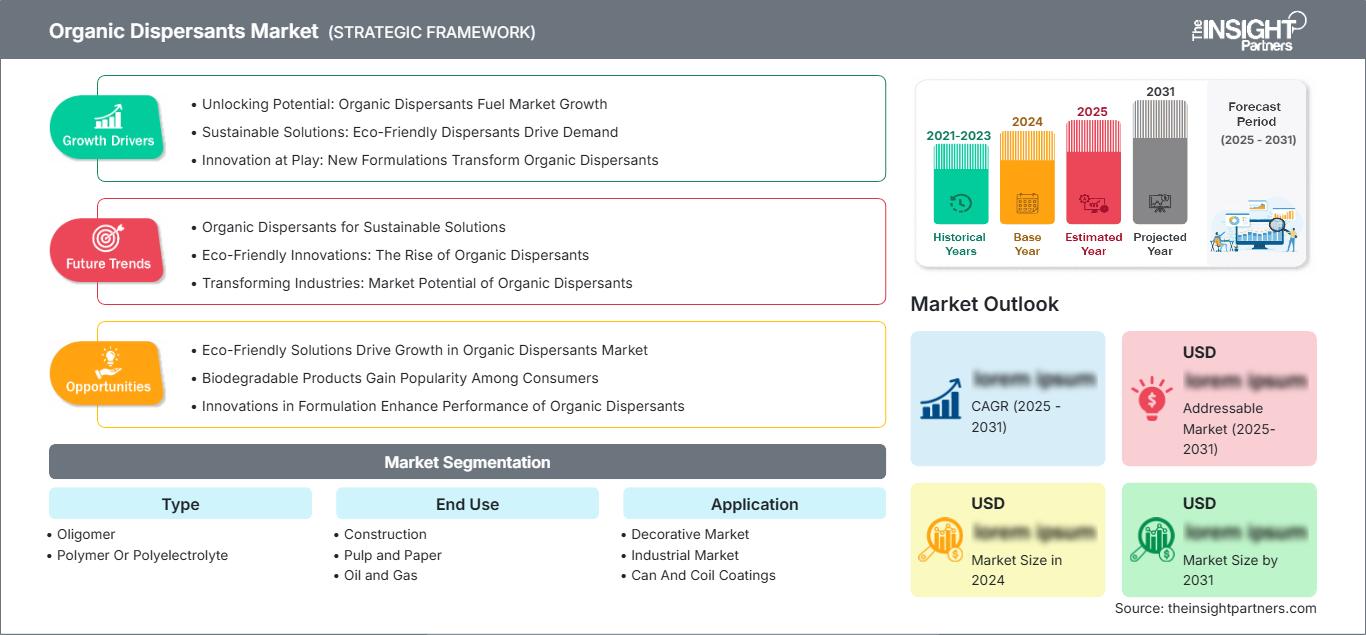
Organic Dispersants Market: Strategic Insights
Regional Insights
North America Organic Dispersants Market
North America accounted for around 31% of the global organic dispersants market share in 2025 and is estimated to grow at a ~3.0% CAGR over the forecast period. The region is supported by a developed industry of architectural and industrial coatings, widespread maintenance of infrastructure, well-established detergent industry, and oil & gas industry activities.
The United States dominates the regional demand due to the presence of large manufacturing industry of coatings and chemicals, along with the widespread consumption downstream. Canada provides demand through construction products, pulp & paper, industrial coatings, and energy applications. Regional manufacturers increasingly offer water-based and low emission technologies, while established companies have developed extensive technical support network for formulators.
U.S. Organic Dispersants Market
Approximately 78% of North America's organic dispersants market is held by the United States in 2025, and the market growth rate is expected to be ~2.9% CAGR. While architectural coatings constitute an important end use segment for the product, its applications also extend into sectors like industrial maintenance, transportation coatings, ink, detergents, and oil field products.
Dow's OROTAN 2028C, for example, is designed for waterborne coatings, inks, and adhesives and provides pigment dispersion and stabilization. Lubrizol similarly supplies aqueous and non-aqueous dispersants for coatings, inks, plastics, and composites.
Europe Organic Dispersants Market
Europe represents ~28% of the total market in 2025 and is expected to grow at a ~3.1% CAGR. Germany is an important specialty chemicals and coatings region, and France is a key region for industrial and architectural coatings chemicals. Other regions include UK, Italy, and the Netherlands, which are important owing to their coatings and construction materials production, as well as chemicals and industrial processing.
Environmental performance of Europe is very important in terms of its demand. Products of Clariant's Dispersogen range includes dispersants for waterborne and solventborne systems, some of which feature low VOC and APEO-free features. New Dispersogen products by Clariant cater to industrial and decorative coatings applications.
APAC Organic Dispersants Market
APAC represented ~26% of global market share in 2025 and is expected to register a ~3.8% CAGR. China is the leading regional manufacturing and consumption center because of its large construction materials, coatings, paper, detergent, and industrial manufacturing base. Japan maintains demand for higher-performance specialty additives in coatings, electronics-related materials, and advanced manufacturing. India is expanding through construction, infrastructure development, coatings, detergents, and domestic specialty chemical production.
The regional advantage is becoming increasingly linked with localization. Formulators in Asia require dispersants that can be sourced locally but which have the capability to perform globally without dependency on the supply chain. One of such manufacturers is Harmony Additives, which produces wetting and dispersing agents for paints, inks, coatings, and other industrial uses.
Middle East & Africa Organic Dispersants Market
Middle East & Africa constitutes a smaller, yet strategically important market through products such as oils and gases, paints, protective coatings, detergents, construction, and maintenance of infrastructures. Gulf Markets create the need for additives that function well under difficult conditions, while African Markets are affected by the construction sector and imported coatings. Growth in this region can be capitalized upon to the extent that formulation and production of oil field chemicals is local.
South & Central America Organic Dispersants Market
Construction, architectural finishes, maintenance of industrial plants, detergents, paper, and energy sectors sustain South and Central America. Brazil emerges as the main demand hub on account of diversified manufacturing activities and large presence of coatings and construction industries in the region. Another important source for industrial coatings and manufacturing is Mexico. The need is becoming more for dispersants that increase stability and reduce emissions of coating formulations.
Segmentation Analysis
Type
The type segmentation comprises Oligomer and Polymer Or Polyelectrolyte. Polymer Or Polyelectrolyte is the leading main segment, supported by its ability to provide steric or electrosteric stabilization in demanding pigment and filler systems. It is projected to grow at a ~3.6% CAGR through 2034. Oligomer is projected to expand at a ~2.9% CAGR, supported by applications where formulation simplicity, compatibility, and cost remain important.
- Oligomer: Provides wetting and stabilization with relatively compact molecular structures and remains relevant where moderate dispersion requirements and formulation economics influence purchasing.
- Polymer Or Polyelectrolyte: Provides stronger particle stabilization and is increasingly selected for high-solids, waterborne, industrial, and performance-oriented formulations.
End Use
The end-use segmentation includes Construction, Pulp and Paper, Oil and Gas, Detergents, and Other End-User Industries. Construction is the largest main segment and is projected to grow at a ~3.5% CAGR, reflecting demand for paints, coatings, cementitious systems, and construction chemicals. Oil and Gas is the high-growth segment at a ~3.9% CAGR, supported by technically demanding dispersant applications in energy-related formulations. Pulp and Paper is projected to grow at a ~2.8% CAGR, while Detergents is expected to expand at a ~3.2% CAGR.
- Construction: Dispersants improve pigment distribution, filler dispersion, rheology, and formulation stability in coatings and construction chemicals.
- Pulp and Paper: Supports pigment and filler dispersion, coating uniformity, and process consistency.
- Oil and Gas: Used where stable particle dispersion and formulation performance are required under challenging operating conditions.
- Detergents: Supports soil suspension, anti-redeposition, scale control, and formulation stability.
- Other End-User Industries: Includes specialized manufacturing sectors requiring particle stabilization, wetting, or controlled dispersion.
Application
The application segmentation comprises Decorative Market, Industrial Market, Can And Coil Coatings, and Industrial Maintenance. Industrial Market is projected to grow at a ~3.5% CAGR, reflecting demand for coatings that combine dispersion efficiency with corrosion, chemical, and mechanical performance. Decorative Market is projected to grow at a ~3.2% CAGR, Can And Coil Coatings at a ~3.0% CAGR, and Industrial Maintenance at a ~3.8% CAGR.
- Decorative Market: Dispersants support color development, pigment stability, gloss, tinting consistency, and application quality in architectural coatings.
- Industrial Market: Requires dispersants compatible with high-performance binders, pigments, fillers, and waterborne systems.
- Can And Coil Coatings: Formulation consistency and compatibility with metal substrates are critical, particularly where coating appearance and protection must be maintained.
- Industrial Maintenance: Benefits from additives that support protective coatings designed for corrosion resistance, durability, and demanding application environments.
Opportunity Snapshot
| Application | Revenue Contribution | Trend Tag | Adoption Stage |
|---|---|---|---|
| Decorative Market | High | Low-VOC | Mature |
| Industrial Market | High | High-solids | Mature |
| Can And Coil Coatings | Medium | Metal protection | Scaling |
| Industrial Maintenance | Medium | Longer-life | Scaling |
Organic Dispersants Market Growth Drivers and Impact Analysis
Expansion of waterborne and low-VOC coating systems
The shift from solvent-intensive formulations toward waterborne and lower-emission systems is a major growth driver. Water changes pigment wetting, particle interaction, rheology, and formulation stability, increasing the importance of appropriately designed dispersants. Products such as Clariant's Dispersogen Flex 100 are specifically positioned for waterborne paint systems while emphasizing APEO-free and solvent-free characteristics.
This transition increases demand for dispersants that can maintain pigment loading and color development without compromising viscosity or storage stability. The market implication is a gradual shift from generic additives toward application-specific polymer and surfactant architectures.
Higher pigment and filler loading requirements
Coatings producers seek higher solids loading to improve productivity, reduce formulation costs, and limit solvent or water handling. However, higher particle concentration can increase viscosity and promote agglomeration. Efficient dispersants reduce interparticle attraction and enable formulators to achieve targeted rheology while retaining pigment and filler performance.
The effect is particularly relevant to industrial coatings, construction formulations, and pigment concentrates, where mill efficiency and final appearance directly influence production economics.
Environmental and regulatory pressure on additive chemistry
Regulatory scrutiny is encouraging formulators to reassess dispersants containing substances associated with persistence, VOC emissions, or other environmental concerns. This creates a replacement cycle for incumbent chemistries and favors suppliers able to demonstrate equivalent or improved performance with lower regulatory exposure.
BASF's readily biodegradable Sokalan CP 301 and the increasing availability of APEO-free and low-VOC dispersants illustrate how sustainability requirements are becoming integrated into product development rather than treated solely as downstream compliance issues.
Organic Dispersants Market Future Trends
Shift toward biodegradable and bio-attributed dispersants
The organic dispersants market trends increasingly center on reducing environmental persistence while maintaining formulation stability. BASF's biodegradable dispersant development and Arkema's ECODIS P 90 MB, described as a bio-attributed dispersing agent for water-based systems, demonstrate the movement toward alternative feedstocks and improved environmental profiles.
This trend affects both chemical suppliers and formulators because sustainability claims increasingly need to be incorporated without sacrificing pigment compatibility, rheological performance, or production efficiency. Products that combine verified environmental characteristics with equivalent technical performance are likely to gain greater formulation acceptance.
Growth of application-specific hyperdispersants
Dispersant technology is moving toward more targeted products rather than universal grades. Hyperdispersants are designed around pigment surface chemistry, binder compatibility, solvent environment, and processing conditions. Evonik's TEGO Dispers 695, launched for radiation-curing and solventborne polyurethane inks, demonstrates how suppliers are targeting specific difficult-to-disperse pigment and ink systems.
This trend is likely to expand across industrial coatings, digital and conventional inks, plastics, and specialty pigment concentrates. Customers increasingly value formulation efficiency and reproducibility alongside additive cost.
PFAS-free and lower-hazard additive portfolios
Chemical regulation and customer sustainability requirements are driving portfolio screening beyond traditional VOC considerations. ALTANA reported that BYK discontinued the supply of PFAS-containing additives at the end of 2025 and expanded PFAS-free dispersing solutions for plastics.
This development indicates that regulatory differentiation is becoming a competitive factor. Suppliers capable of redesigning additive portfolios before restrictions become commercially disruptive can reduce reformulation risks for customers and strengthen long-term product acceptance.
Organic Dispersants Market Opportunities
Specialty dispersants for high-performance industrial coatings
A significant opportunity exists in dispersants designed for industrial coatings that require high pigment loading, corrosion protection, stable viscosity, and compatibility with waterborne binders. Customers in protective coatings, machinery, infrastructure, and industrial maintenance increasingly require performance consistency while reducing VOCs. Suppliers can address this opportunity through polymer architectures optimized for difficult inorganic pigments, carbon black, and high-PVC systems, supported by formulation-specific technical services.
The opportunity in the Organic Dispersants Market Forecast is particularly relevant in Europe and North America, where regulatory requirements encourage substitution toward lower-emission formulations, and in APAC, where industrial coating production is expanding. Clariant, Arkema, Dow, and Lubrizol demonstrate the commercial value of application-specific dispersant portfolios in these systems.
Localized dispersant production in emerging manufacturing hubs
Another opportunity lies in regional production and technical support for formulators in India, China, Southeast Asia, and other expanding manufacturing centers. Local production can shorten lead times, reduce exposure to international logistics disruptions, and enable customized grades for regional pigments, fillers, binders, and process conditions.
Regional specialty additive producers can compete effectively where they combine manufacturing flexibility with application knowledge. Harmony Additives, for example, manufactures dispersing agents for epoxy, solvent-based systems, inorganic pigments, titanium dioxide, and water-based formulations, illustrating the scope for regional specialization.
Recent Developments
- May 21, 2026: Evonik Industries AG’s TEGO Foamex 8051 received a coating-industry innovation award for sustainable waterborne coating technology. Although the product is a defoamer rather than a dispersant, the development reinforces the broader shift in coating additives toward low-VOC, PFAS-free and high-efficiency formulations, which directly influences the performance requirements placed on complementary dispersing additives.
- March 17, 2026: Clariant advanced formulation stability and biological compatibility for agricultural applications at CAC 2026, highlighting solutions designed to improve the performance and stability of crop protection formulations. The developments address formulation challenges and support more effective, sustainable agricultural products, strengthening demand for specialized dispersants and formulation additives.
Frequently Asked Questions

- Comprehensive Market Sizing and Forecast Analysis
- Detailed Segmentation Analysis
- In-Depth Market Dynamics Assessment
- Regional and Country-Level Insights
- Competitive Landscape and Company Benchmarking
- Strategic Business Intelligence
Recent Reports
Testimonials

The Insight Partners' SCADA System Market report is comprehensive, with valuable insights on current trends and future forecasts. The team was highly professional, responsive, and supportive throughout. We are very satisfied and highly recommend their services.
RAN KEDEM Partner, Reali Technologies LTDs
I requested a report on a very specific software market and the team produced the report in a few days. The information was very relevant and well presented. I then requested some changes and additions to the report. The team was again very responsive and I got the final report in less than a week.
JEAN-HERVE JENN Chairman, Future Analytica
We worked with The Insight Partners for an important market study and forecast. They gave us clear insights into opportunities and risks, which helped shape our plans. Their research was easy to use and based on solid data. It helped us make smart, confident decisions. We highly recommend them.
PIYUSH NAGPAL Sr. Vice President, High Beam Global
The Insight Partners delivered insightful, well-structured market research with strong domain expertise. Their team was professional and responsive throughout. The user-friendly website made accessing industry reports seamless. We highly recommend them for reliable, high-quality research services
YUKIHIKO ADACHI CEO, Deep Blue, LLC.
This is the first time I have purchased a market report from The Insight Partners.While I was unsure at first, I visited their web site and felt more comfortable to take the risk and purchase a market report.I am completely satisfied with the quality of the report and customer service. I had several questions and comments with the initial report, but after a couple of dialogs over email with their analyst I believe I have a report that I can use as input to our strategic planning process.Thank you so much for taking the extra time and making this a positive experience.I will definitely recommend your service to others and you will be my first call when we need further market data.
JOHN SUZUKI President and Chief Executive Officer, Board Director, BK Technologies
I wish to appreciate your support and the professionalism you displayed in the course of attending to my request for information regarding to infectious disease IVD market in Nigeria. I appreciate your patience, your guidance, and the fact that you were willing to offer a discount, which eventually made it possible for us to close a deal. I look forward to engaging The Insight Partners in the future, all thanks to the impression you have created in me as a result of this first encounter.
DR CHIJIOKE ONYIA MANAGING DIRECTOR, PineCrest Healthcare Ltd.Reason to Buy
- Informed Decision-Making
- Understanding Market Dynamics
- Competitive Analysis
- Identifying Emerging Markets
- Customer Insights
- Market Forecasts
- Risk Mitigation
- Boosting Operational Efficiency
- Strategic Planning
- Investment Justification
- Tracking Industry Innovations
- Aligning with Regulatory Trends





 Get Free Sample for