
Painting Robots Market Size, Trends & Demand by 2034
Coverage: by Type (Wall Mounted Painting Robot, Floor Mounted Painting Robot, Rail Mounted Painting Robot, and Others); Application (Exterior Painting and Interior Painting); and End User (Aerospace, Automotive, Construction, and Others), and Geography (North America, Europe, Asia Pacific, and South and Central America)
- Status : Data Released
- Report Code : TIPMC00002708
- Category : Electronics and Semiconductor
- No. of Pages : 150
- Available Report Formats :


- Last update date : October 13, 2026


2025 Market Size
US$ 2.97 Bn
Base year value
2034 Forecast
US$ 7.17 Bn
Projected by 2034
CAGR 2026-2034
10.29 %
Growth rate
Addressable Market
US$ 45.03 Bn
(2026-2034)
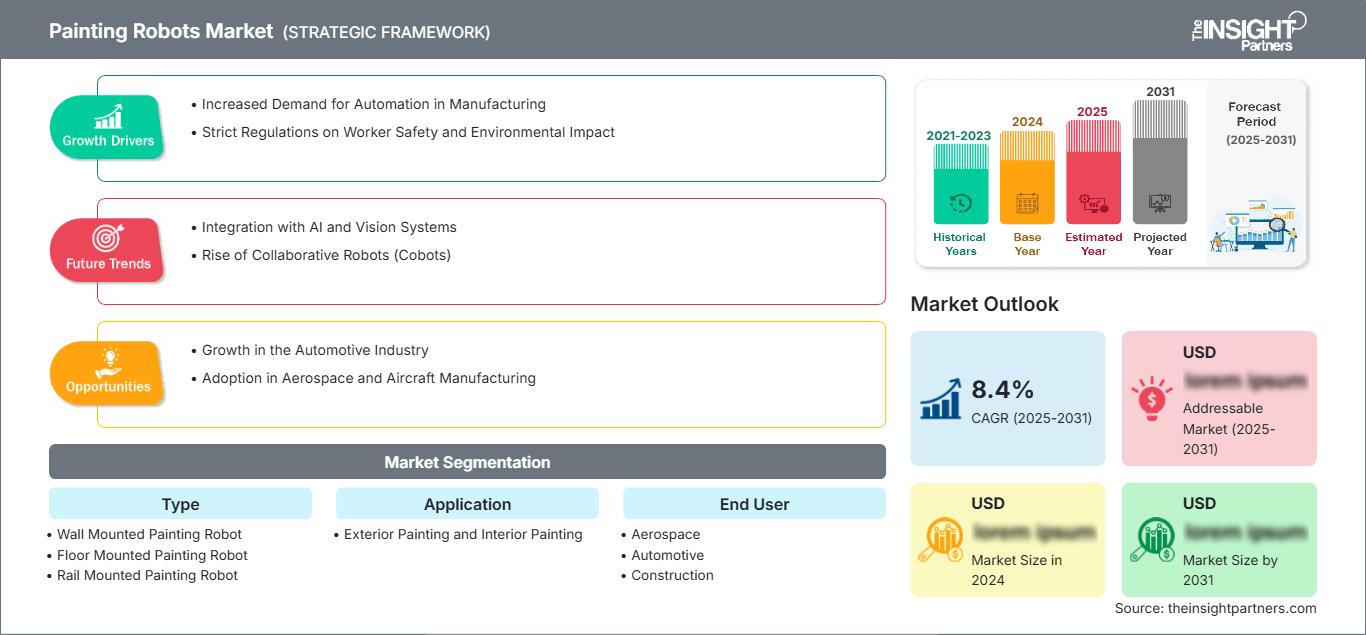
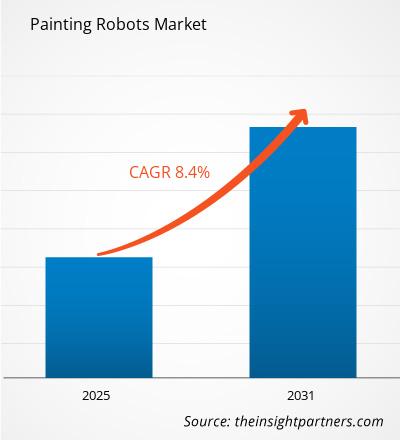
Global manufacturing floors are steadily replacing manual spray booths with automated arms, and the Painting Robots Market stands at the center of this shift. Valued at US$ 2.97 Billion in 2025, the market is projected to reach US$ 7.17 Billion by 2034, expanding at a CAGR of 10.29% between 2026 and 2034 as automotive, aerospace, and construction sectors accelerate coating automation adoption.
North America's automation base is expanding on the back of reshored automotive assembly and stringent volatile organic compound emission norms enforced by the Environmental Protection Agency. Regional Painting Robots Market size gains are supported by labor shortages in skilled coating operations, prompting OEMs and Tier-1 suppliers to prioritize robotic finishing lines across the United States, Canada, and Mexico through 2034.
Painting Robots Market Assessment and Insights
- North America: The region commands an established automation base, supported by reshoring initiatives and emission compliance mandates, holding a 27–31% share in 2025 and advancing at a CAGR of 9.4–10.1% through 2034.
- US: The United States leads regional deployment through automotive retooling and aerospace coating upgrades, contributing 26–30% share in 2025 and growing at 9.5–10.2% CAGR between 2026 and 2034.
- Europe: Germany, Italy, and Sweden anchor a mature automotive and machinery base, giving Europe a 24–28% share in 2025 while growing at 9.0–9.8% CAGR through 2034, led by Germany's engineering density.
- Asia Pacific: China, Japan, and South Korea drive volume-led automotive and electronics manufacturing, giving the region a 30–34% share in 2025 and the fastest CAGR of 11.5–12.4% through 2034.
- Largest Segment: Wall Mounted Painting Robot systems dominate installations with a 38–42% share in 2025, expanding at 9.8–10.6% CAGR through 2034 owing to space efficiency and retrofit compatibility.
- High Growth Segment: Rail Mounted Painting Robot systems post the fastest expansion, holding an 18–22% share in 2025 and growing at 12.0–12.9% CAGR through 2034 on large-format vehicle coating demand.
- Key companies analyzed in detail: CMA Robotics S.p.A., ABB Ltd., Epistolio S.r.l., Dürr Systems AG, FANUC Corporation, Krautzberger GmbH, Kawasaki Heavy Industries Ltd., KUKA AG, Yaskawa Electric Corporation, and Stäubli International AG.
Source: The Insight Partners' analysis based on proprietary research, government publications, company annual reports, investor presentations, industry databases, and expert interviews.
The history of automated coating began with inflexible single-axis arms connected to stationary automobile painting machines, yet production environments have moved on to flexible multi-axis robotized arms that can work with odd shapes on aerospace fuselage, construction machinery, and modular furniture. Vision-guided calibration, electrostatic spraying, and over-spray recycling have together cut down waste of coating material, ensured a consistent finish, and reduced changeover time, making it possible for producers to invest capital in semi-scale production environments where traditional manual spraying held sway.
Moving forward, use is becoming more widespread among new manufacturing centers that emerge in Southeast Asia and Eastern Europe where component manufacturers are shifting production facilities to diversify their supply chains. Favorable regulations regarding permissible levels of workplace exposure and emissions caps, alongside an increased interest from private equity funds in robotics and automation solutions, promise to keep the capital flowing and widen the addressable market for robotic finishing equipment.
Painting Robots Market Report Scope
| Report Attribute | Details |
|---|---|
| Market size in 2025 | US$ 2.97 Billion |
| Market Size by 2034 | US$ 7.17 Billion |
| Global CAGR (2026 - 2034) | 10.29% |
| Historical Data | 2021-2024 |
| Forecast period | 2026-2034 |
Painting Robots Market Analysis
Automated coating systems demand is highly dependent on how fast new platforms are being developed for vehicles, aircraft deliveries, and construction machinery, which demand repeatable performance from a coating process at large volumes. The Paint Robots Market is being driven by escalating labor costs in skilled spray booths, along with rising concerns on limiting human exposure to solvents during painting.
The supply chain includes robotic arm makers, spray gun, and atomization components suppliers, system integrators, and coating materials manufacturers, with systems integration becoming more of an issue that dictates project schedules rather than the costs of individual components alone. The supply side remains highly dependent on servo-motors and precision bearing supply, while the system integrators increasingly rely on integrating software, vision sensors, and service arrangements to distinguish themselves from competitors in a commodity-driven market.
The competitive rivalry in the analysis of the Painting Robots Market will be determined by the presence of diverse conglomerates of industrial robots manufacturing companies as well as coating technologies providers. The companies like ABB Ltd., FANUC Corporation, KUKA AG, Yaskawa Electric Corporation, Kawasaki Heavy Industries Ltd., and Stäubli International AG will compete on their products' multi-axis accuracy and software capabilities, while Dürr Systems AG, Krautzberger GmbH, CMA Robotics S.p.A., and Epistolio S.r.l. will be competing in turnkey coating booths and specific spray technologies.
The investments will be made in vision-guided software for calibration of painting equipment, low-overspray electrostatic guns and prediction maintenance software in order to decrease downtime on automated production lines. The strategic position will rely on aftersales network and capability to integrate into regional markets since the manufacturers prefer the suppliers capable of fast line commissioning and operators' training.
● REPORT CUSTOMIZATION
Tailor This Report To Align With Your Specific Business Requirements
This report can be customized to align precisely with your business objectives, scope, and target markets. Customization options include tailored segmentation, geography, competitive analysis, and strategic insights to support informed decision-making.
Customize This Report →WHAT YOU CAN ADJUST
- ● Segmentations
- ● Geography
- ● Competitive Analysis
- ● Language Preferences
Painting Robots Market: Strategic Insights
Regional Insights
North America Painting Robots Market
North America held a 27–31% share of the Painting Robots Market in 2025 and is projected to expand at a CAGR of 9.4–10.1% through 2034. Growth is anchored in automotive reshoring, stringent volatile organic compound regulations enforced across multiple states, and sustained capital spending on aerospace manufacturing modernization across Boeing and its extensive supplier network throughout the region.
Persistent skilled-labor shortages in spray-finishing trades are accelerating robotic adoption among Tier-1 automotive suppliers and heavy equipment manufacturers. Canada's automotive parts sector and Mexico's expanding maquiladora base are also contributing incremental demand, as regional supply chains prioritize nearshoring and manufacturers seek consistent, code-compliant finishing capacity across cross-border production networks through the coming decade.
U.S. Painting Robots Market
The United States accounts for 26–30% of North America's Painting Robots Market share in 2025 and is expected to post a CAGR of 9.5–10.2% between 2026 and 2034. The automotive assembly plants in the Midwest and Southern parts of the United States still form the biggest customer base due to the need for electric vehicle manufacturing, which involves unique coating operations in battery enclosure and body coating.
The aerospace industry is seeing more use of robotic coating due to the backlog of orders of commercial planes and thus extended manufacturing periods of the primary and secondary aircraft producers. There are also applications in the construction equipment industry where heavy equipment is coated using robots.
Europe Painting Robots Market
Europe held a 24–28% share of the market in 2025 and is projected to grow at a CAGR of 9.0–9.8% through 2034, with Germany positioned as the leading contributor given its dense automotive and machine-building base. The local demand is supported by solvent restrictions resulting from the REACH initiative that prefer robotically controlled coating plants.
The leading regional contribution is Germany, thanks to investments made by high quality automotive producers and machinery exporters into precision finishing lines. In the United Kingdom, aerospace component coating and automotive retread programs are promoting the adoption of the products. Italian industrial machinery industry, French automotive assembling and Spanish component manufacturing are completing the list.
APAC Painting Robots Market
Asia Pacific led global demand with a 30–34% share in 2025 and is forecast to expand at the fastest CAGR of 11.5–12.4% through 2034. The large volumes of this region are secured by China, which is based on large automotive and electronics manufacturing capacity and the industrial automation policy that encourages robotics use at export production facilities.
Japan and South Korea add high-tech applications of precision coating in automotive and electronics assembly, while increased demand for automotive components from India and mining equipment from Australia also add to regional growth. The growing labor costs and the development of smart manufacturing programs continue encouraging automation in the region.
Middle East & Africa Painting Robots Market
The Middle East and Africa region is projected to grow at a CAGR of 8.6–9.3% through 2034, led by Saudi Arabia's industrial diversification agenda under Vision 2030, which is expanding automotive assembly and heavy equipment manufacturing capacity requiring automated finishing infrastructure across newly established industrial zones.
The United Arab Emirates is advancing adoption through aerospace maintenance and construction equipment coating applications tied to infrastructure expansion. South Africa's automotive export sector remains the continent's most established demand base, while the Rest of MEA region shows early-stage uptake linked to energy-sector infrastructure and equipment manufacturing investment.
Segmentation Analysis
Type
Type segmentation shapes the Painting Robots Market scope by aligning robot configuration with facility layout and production volume, with the segment projected to expand at a 9.8–11.2% CAGR from 2026 to 2034. Wall mounted systems dominate due to space efficiency, while rail mounted platforms are gaining traction for large-format applications, reflecting a broader shift toward flexible, footprint-optimized automation across automotive and heavy equipment production environments globally.
- Wall Mounted Painting Robot: The leading configuration for compact production lines, favored for minimal floor footprint, straightforward retrofit installation, and compatibility with existing conveyor-based automotive and general industrial coating booths.
- Floor Mounted Painting Robot: Preferred for heavy-duty applications requiring extended reach and payload capacity, commonly deployed across construction equipment and large industrial component finishing operations.
- Rail Mounted Painting Robot: Increasingly adopted for elongated production lines and oversized workpieces, enabling continuous multi-station coverage across aerospace fuselage and commercial vehicle coating processes.
Application
Exterior painting retains dominance, with the segment expected to grow at a 9.9–10.8% CAGR from 2026 to 2034, given its direct link to automotive body finishing and corrosion protection standards. Meanwhile, interior painting is expanding steadily as manufacturers automate cabin, cockpit, and enclosure coating processes requiring finer atomization control and lower emission tolerances within confined workspaces.
- Exterior Painting: The primary application driving robotic adoption, encompassing automotive body shells, aircraft fuselages, and construction equipment exteriors requiring durable, weather-resistant, and uniform finish quality.
- Interior Painting: A growing application segment covering cabin interiors, control panels, and enclosed component surfaces where precision atomization and reduced overspray are critical for compliance.
End User
Automotive remains the largest end-user category, with the segment anticipated to register a 10.1–11.0% CAGR from 2026 to 2034, given high-volume production requirements and strict finish-quality standards. Aerospace and construction are expanding steadily as manufacturers pursue coating consistency, regulatory compliance, and labor-cost reduction across increasingly automated final-assembly and component-finishing operations worldwide.
- Aerospace: Demands high-precision robotic coating for fuselage panels and structural components, driven by stringent corrosion-resistance and weight-consistency requirements across commercial and defense aircraft programs.
- Automotive: The largest end-user base, leveraging robotic painting for body-in-white finishing, electric vehicle battery enclosures, and high-throughput assembly line consistency requirements.
- Construction: Adopts robotic coating for heavy equipment corrosion protection and structural component finishing, supported by rising infrastructure investment and equipment manufacturing automation.
Opportunity Snapshot
| End User | Revenue Contribution | Trend Tag | Adoption Stage |
|---|---|---|---|
| Automotive | High | EV Enclosure Coating | Mature |
| Aerospace | Medium | Fuselage Precision | Scaling |
| Construction | Medium | Equipment Corrosion Protection | Scaling |
Painting Robots Market Growth Drivers and Impact Analysis
Stringent Emission and Workplace Exposure Regulations
The Painting Robots Market forecast shows that various regulatory agencies in North America and Europe continue to reduce the permitted exposure levels for solvent-based coatings, thus forcing the industry to move their spray painting process within enclosed booths that are part of automated processes and incorporate proper ventilation systems. The robotic application processes reduce the direct exposure of the workers to the volatile organic compounds while improving the amount of overspray captured. Such a factor is especially important for the automotive body shops because of the high volume and frequency of monitoring. Failure to comply can result in the shutdown of production lines, thus making the use of robots not only efficient but also necessary. With the expansion of regulations to new regions, this driver is expected to drive equipment demand until 2034.
Persistent Skilled Labor Shortages in Coating Operations
Manual spray finishing continues to be an arduous, health-conscious profession experiencing diminishing labor force participation in advanced manufacturing economies. Manufacturers of automobiles, aircrafts, and construction machinery have reported prolonged vacancies for trained spray technicians that limit manufacturing productivity when order levels are high. Painting robots help overcome this limitation through the provision of consistently high-quality finishes regardless of manpower availability, while at the same time cutting down costs of recruiting and training new spray operators. This trend is especially evident in those areas that suffer from an older industrial labor force, which cannot be replaced in a timely manner. As demand levels recover in cyclical industries, manufacturers are focusing on automation in order to mitigate their finishing capacity risk from manpower availability issues.
Rising Coating Material and Waste Reduction Pressure
Volatile raw material costs for paints and coatings are prompting manufacturers to prioritize application precision that minimizes overspray and rework. Robotic systems equipped with electrostatic atomization and closed-loop material delivery consistently outperform manual application in transfer efficiency, directly reducing per-unit coating consumption. This economic driver compounds with sustainability commitments, as manufacturers increasingly report material waste metrics to institutional investors and regulatory bodies. Facilities transitioning to robotic finishing report measurable reductions in solvent disposal volumes and associated hazardous waste handling costs. As coating formulations shift toward higher-value, lower-VOC alternatives with steeper price points, the economic case for precision robotic application strengthens further, reinforcing adoption across cost-sensitive mid-volume manufacturing segments through the forecast period.
Painting Robots Market Future Trends
Integration of Vision-Guided Adaptive Coating Systems
Emerging Painting Robots Market trends point toward broader integration of machine vision and adaptive path-planning software that allows robotic arms to recalibrate spray trajectories in real time based on part geometry variation. This reduces reliance on rigid, pre-programmed paths and shortens changeover times when production lines handle multiple product variants. Manufacturers piloting these systems report improved finish consistency across mixed-model assembly lines, particularly in automotive and construction equipment segments where part variation is common. As sensor costs decline and software platforms mature, adaptive coating capability is expected to shift from a premium feature toward a standard specification across mid-range robotic finishing systems by the early 2030s.
Expansion of Predictive Maintenance and Remote Monitoring
Coating equipment manufacturers are increasingly embedding condition-monitoring sensors and cloud connectivity into robotic finishing cells, enabling predictive maintenance scheduling that reduces unplanned downtime on high-throughput lines. This shift is particularly valuable in continuous production environments where a single line stoppage can disrupt downstream assembly operations. Remote diagnostics also allow integrators to support multiple facility locations from centralized service hubs, reducing on-site technician travel requirements. As industrial connectivity standards mature and cybersecurity protocols strengthen, predictive maintenance adoption is expected to become a standard procurement requirement for new robotic coating installations across automotive, aerospace, and heavy equipment manufacturing facilities globally.
Painting Robots Market Opportunities
Modular Retrofit Systems for Mid-Volume Manufacturers
Mid-volume manufacturers in construction equipment and specialty vehicle segments represent an underpenetrated opportunity, as many still rely on manual finishing due to the perceived capital intensity of full robotic line installations. Modular, pre-engineered robotic cells designed for rapid deployment within existing facility footprints lower the investment threshold and installation timeline considerably. Integrators offering standardized, application-specific modules rather than fully customized systems can capture this segment more efficiently. As financing structures such as equipment-as-a-service gain traction across industrial automation, smaller manufacturers gain a viable pathway to robotic adoption without committing to large upfront capital outlays, expanding the addressable customer base beyond traditional high-volume automotive and aerospace accounts.
Regional Manufacturing Diversification Across Emerging Hubs
Supply chain diversification strategies are relocating component and vehicle assembly capacity toward Southeast Asia, Eastern Europe, and select Latin American manufacturing hubs, creating greenfield opportunities for robotic coating system integrators. These regions often lack established manual spray-finishing workforce infrastructure, making robotic installation a first-choice rather than a replacement decision. Equipment suppliers establishing early regional service and training partnerships stand to capture disproportionate share as these manufacturing bases scale production volumes. Government-backed industrial incentive programs in several emerging hubs further reduce effective capital costs for automation investment, strengthening the near-term business case for integrators willing to establish localized support infrastructure ahead of broader regional manufacturing capacity expansion.
Frequently Asked Questions

- Comprehensive Market Sizing and Forecast Analysis
- Detailed Segmentation Analysis
- In-Depth Market Dynamics Assessment
- Regional and Country-Level Insights
- Competitive Landscape and Company Benchmarking
- Strategic Business Intelligence
Recent Reports
Testimonials

The Insight Partners provided valuable market intelligence that supported our global go-to-market strategy. Their team was professional, responsive, and attentive to our feedback, providing thoughtful analysis and helpful methodological clarifications throughout the project.
Junmo Kim Chief Financial Officer (CFO), Enertech Co., Ltd.
The Insight Partners' SCADA System Market report is comprehensive, with valuable insights on current trends and future forecasts. The team was highly professional, responsive, and supportive throughout. We are very satisfied and highly recommend their services.
RAN KEDEM Partner, Reali Technologies LTDs
I requested a report on a very specific software market and the team produced the report in a few days. The information was very relevant and well presented. I then requested some changes and additions to the report. The team was again very responsive and I got the final report in less than a week.
JEAN-HERVE JENN Chairman, Future Analytica
We worked with The Insight Partners for an important market study and forecast. They gave us clear insights into opportunities and risks, which helped shape our plans. Their research was easy to use and based on solid data. It helped us make smart, confident decisions. We highly recommend them.
PIYUSH NAGPAL Sr. Vice President, High Beam Global
The Insight Partners delivered insightful, well-structured market research with strong domain expertise. Their team was professional and responsive throughout. The user-friendly website made accessing industry reports seamless. We highly recommend them for reliable, high-quality research services
YUKIHIKO ADACHI CEO, Deep Blue, LLC.
This is the first time I have purchased a market report from The Insight Partners.While I was unsure at first, I visited their web site and felt more comfortable to take the risk and purchase a market report.I am completely satisfied with the quality of the report and customer service. I had several questions and comments with the initial report, but after a couple of dialogs over email with their analyst I believe I have a report that I can use as input to our strategic planning process.Thank you so much for taking the extra time and making this a positive experience.I will definitely recommend your service to others and you will be my first call when we need further market data.
JOHN SUZUKI President and Chief Executive Officer, Board Director, BK Technologies
I wish to appreciate your support and the professionalism you displayed in the course of attending to my request for information regarding to infectious disease IVD market in Nigeria. I appreciate your patience, your guidance, and the fact that you were willing to offer a discount, which eventually made it possible for us to close a deal. I look forward to engaging The Insight Partners in the future, all thanks to the impression you have created in me as a result of this first encounter.
DR CHIJIOKE ONYIA MANAGING DIRECTOR, PineCrest Healthcare Ltd.Reason to Buy
- Informed Decision-Making
- Understanding Market Dynamics
- Competitive Analysis
- Identifying Emerging Markets
- Customer Insights
- Market Forecasts
- Risk Mitigation
- Boosting Operational Efficiency
- Strategic Planning
- Investment Justification
- Tracking Industry Innovations
- Aligning with Regulatory Trends





 Get Free Sample for