
Paper Honeycomb Market Size, Growth & Trends by 2034
Coverage: By Type (Continuous Unexpanded, Slices Unexpanded, and Others), End-Use Industry (Automotive, Building and Construction, Packaging, Furniture, Aerospace, and Others), and Geography
- Status : Data Released
- Report Code : TIPRE00039024
- Category : Chemicals and Materials
- No. of Pages : 150
- Available Report Formats :


- Last update date : September 17, 2026


2025 Market Size
US$ 4.62 Bn
Base year value
2034 Forecast
US$ 7.04 Bn
Projected by 2034
CAGR 2026-2034
4.79 %
Growth rate
Addressable Market
US$ 52.92 Bn
(2026-2034)
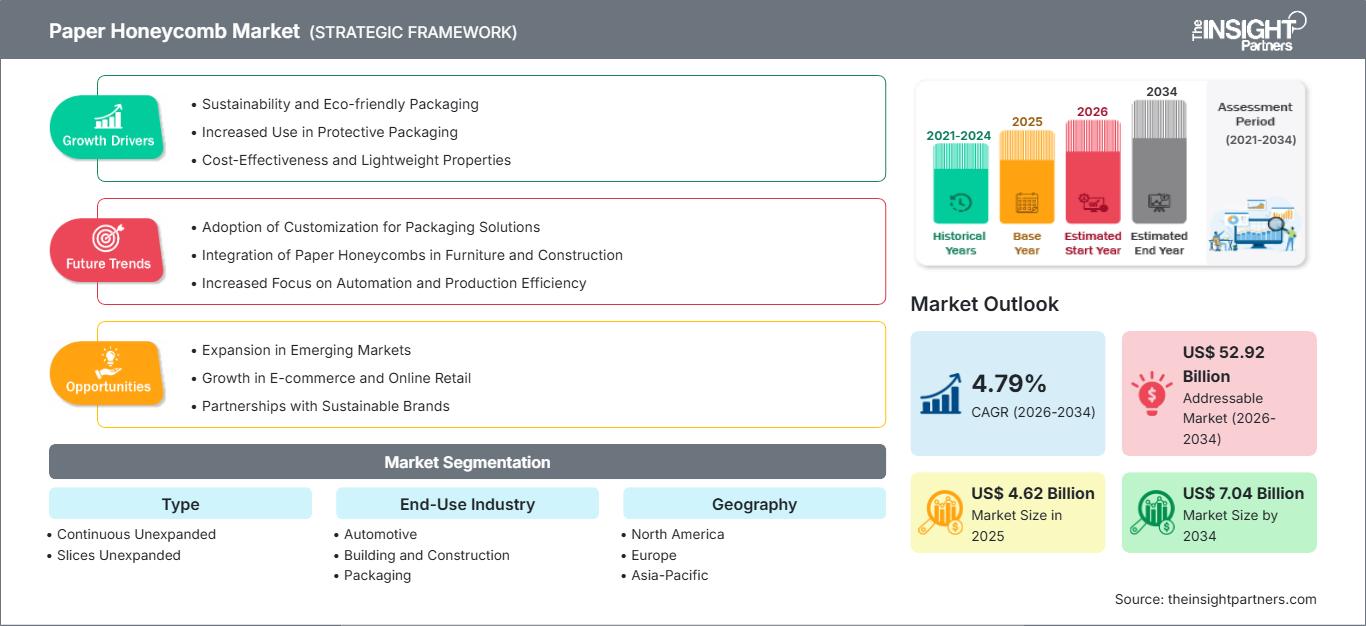
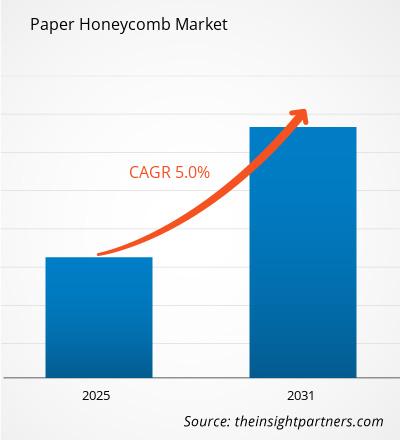
The Paper Honeycomb market was valued at US$ 4.62 Billion in 2025 and is projected to reach US$ 7.04 Billion by 2034, registering a CAGR of 4.79% during 2026–2034. The demand is bolstered through packaging optimization, furniture protection, automotive lightweighting, industrial logistics, and increased usage of recyclable paper-based materials. The market is gaining significance in cases where there is a need for lightweight structures, shock absorption, rigid material, and fiber-based solutions.
North America region is likely to continue its dominance in terms of being a significant regional market due to its already existing packaging, furniture, automotive, and e-commerce supply chains. The Paper Honeycomb Market Size will depend on increasing substitution of plastic-based protective materials, need for lightweight logistics, and investments in converting processes. Regional demand is anticipated to grow at a CAGR of 4.2-4.8% during 2026-2034.
Paper Honeycomb Market Assessment and Insights
- North America: North America is estimated to hold a 28–32% share in 2025 and expand at a 4.2–4.8% CAGR between 2026 and 2034. Demand benefits from furniture logistics, automotive applications, industrial packaging, e-commerce fulfillment, and recyclable protective-material requirements.
- U.S.: The U.S. is estimated to represent 82–86% of North American demand in 2025 and grow at a 4.3–4.9% CAGR between 2026–2034, supported by e-commerce, furniture distribution, and industrial packaging.
- Europe: Europe is estimated to account for a 27–31% share in 2025 and grow at a 4.0–4.6% CAGR between 2026 and 2034. Germany, the UK, France, Italy, and Spain benefit from established packaging, automotive, furniture, and recycling ecosystems.
- Asia Pacific: Asia Pacific is estimated to capture a 24–28% share in 2025 and register a 5.0–5.7% CAGR between 2026 and 2034. China, Japan, India, South Korea, and Australia provide manufacturing, export packaging, automotive, and logistics demand.
- Largest Segment: Packaging is estimated to hold a 30–34% market share in 2025 and expand at a 5.0–5.6% CAGR during 2026–2034, supported by high-volume protective applications.
- High Growth Segment: Automotive is estimated to represent a 13–17% market share in 2025 and grow at a 5.8–6.5% CAGR during 2026–2034, reflecting lightweighting requirements.
- Key companies analyzed in detail: Smurfit Westrock plc, Honeycomb Cellpack AG, CorruPack, Papeteries de Gennevilliers, Röhrig GmbH, Viva Paper, G. H. M. (Goudsmit Handling Systems), Nordson Corporation, DS Smith Limited, Honicel Nederland B.V.
Source: The Insight Partners' analysis based on proprietary research, government publications, company annual reports, investor presentations, industry databases, and expert interviews.
The production technologies are developing towards faster core forming, automation of the expansion process, control of the glue application, cutting and inspections on the line. Companies are optimizing their cells' geometries and grammages to balance rigidity, compressibility and consumption of materials. All that helps not only decrease waste during conversions but also maintain uniform sizes. Integrated companies are able to coordinate the production of paper, conversion and further processing.
Further developments should be directed at creation of production centers close to growing manufacturing and logistics centers. The investments should be made into automated production lines, recyclable barrier technologies, digital inspection systems and flexible converters. Packaging waste regulations may support fiber-based products where the system of collection exists. Regional capacity of suppliers together with the engineering products will help respond to customers better and save costs related to transportation of bulky products.
Paper Honeycomb Market Report Scope
| Report Attribute | Details |
|---|---|
| Market size in 2025 | US$ 4.62 Billion |
| Market Size by 2034 | US$ 7.04 Billion |
| Global CAGR (2026 - 2034) | 4.79% |
| Historical Data | 2021-2024 |
| Forecast period | 2026-2034 |
Paper Honeycomb Market Analysis
Growth of the Paper Honeycomb Market has been enabled through demand for light and protective materials for use in packaging, furniture, automotive, industrial logistics, and certain aerospace sectors. The supply chain starts with raw material suppliers such as kraft paper and recycled fibers, and continues through the formulation of adhesives, core production, expansion, cutting, laminating, and component manufacture. The supply chain will influence the cost, quality, and performance of each stage of production.
Supply factors continue to be driven by pulp availability, recycled fiber quality, energy costs, adhesive costs, and geographic availability of manufacturing capabilities. Integrated manufacturers with their own paper mills may find it easier to shield themselves from fluctuations in input costs, while independent converters have the advantage of being able to source flexibly. The introduction of automation helps to enhance labor efficiency and consistency, especially in large-scale packaging programs. Optimization of the material allows manufacturers to save paper usage without sacrificing performance.
The competitive analysis in the Paper Honeycomb market report shows that the environment consists of integrated packaging companies, specialized honeycomb firms, paper converters, and machinery suppliers. Smurfit Westrock plc has the ability to make fiber-based packaging products. DS Smith Limited has expertise in packaging since it is part of the International Paper’s platform for integrated packaging. The following are specialized or regional firms: Honeycomb Cellpack AG, Röhrig GmbH, Honicel Nederland B.V., Papeteries de Gennevilliers, CorruPack, and Viva Paper.
The competitive environment increasingly favors customization, manufacturing reliability, environmental sustainability, and geographical proximity to important clients. Nordson Corporation serves as a supporting element of the industry providing technologies for precision adhesive application. G. H. M. (Goudsmit Handling Systems) and other equipment companies may find automation an opportunity for growth. Investment capital should be allocated to high-productivity machinery, specialized products, coating for recyclability, and regional capacity. Large organizations enjoy economies of scale in purchasing and a wide client base, while specialists enjoy advantages of engineering and flexibility.
● REPORT CUSTOMIZATION
Tailor This Report To Align With Your Specific Business Requirements
This report can be customized to align precisely with your business objectives, scope, and target markets. Customization options include tailored segmentation, geography, competitive analysis, and strategic insights to support informed decision-making.
Customize This Report →WHAT YOU CAN ADJUST
- ● Segmentations
- ● Geography
- ● Competitive Analysis
- ● Language Preferences
Paper Honeycomb Market: Strategic Insights
Regional Insights
North America Paper Honeycomb Market
Demand in North America is expected to account for 28-32% of the world’s demand by 2025 and grow at a 4.2-4.8% CAGR till 2034. There is presence of well-established furniture, automotive, appliance, industrial packaging, and e-commerce distribution networks in the region. Growing demand is witnessed as retailers and producers look out for recyclable protective materials which can replace polymer foams or be used for lightening the packaging. Big warehouse operations prefer lightweight structures as this reduces the weight of packages.
United States accounts for most of the regional demand due to its vast retail and logistics operations. Canada is driving demand through its furniture, industrial packaging, and resource-based manufacturing industry. Regional converters are upgrading their machinery for cutting automation and controlled expansion and structure engineering. Packaging redesign programs have been leading to use of recyclable fibers, while automobile makers are evaluating lightweight structures for parts protection and logistics needs. Such scenarios will lead to sustained regional demand with suppliers developing custom formats for industries.
U.S. Paper Honeycomb Market
The United States is predicted to contribute between 82% and 86% of North American consumption in 2025 and maintain a 4.3% to 4.9% CAGR till 2034. Some of the applications include furniture, appliance, automobile component, industrial machinery, and e-commerce fulfillment. There is increasing need for protective packaging that is capable of reducing plastic consumption without compromising on product protection during transit and warehousing.
Smurfit Westrock plc and similar packaging companies have the advantage of strong customer ties in both industrial and consumer sectors. The demand is further driven by increased automation in warehouses that needs predictable dimensions and consistent compression properties. The auto manufacturers are exploring the use of lightweight fiber constructions for component logistics and some interior uses. In the context of increasing recycled fiber sourcing, there will be emphasis on material savings, adhesive properties, and special cell construction in U.S. converters.
Europe Paper Honeycomb Market
Europe is predicted to account for 27–31% by 2025, with Paper Honeycomb market share of 4.0–4.6% CAGR to 2034, where Germany is seen as the largest national market. Europe has a high level of developed recycling infrastructure, packaging legislation, and automotive, furniture, and industrial manufacturing sectors.
The UK satisfies its demand through online shopping, furniture logistics, and packaging design. Germany unites the automotive industry with industrial packaging needs. France, Italy, and Spain are contributing through furniture, consumer goods, automotive, and export manufacturing. The emphasis of European converters on sustainability issues such as recyclability, low material intensity, and recyclability at the end of life is growing. The well-developed processing infrastructure for paper in Europe enables the development of honeycomb packaging.
APAC Paper Honeycomb Market
The Asia Pacific region will account for 24–28% in 2025, expanding at a CAGR of 5.0–5.7% from 2025 to 2034. The top regional markets include China, Japan, India, South Korea, and Australia, with manufacturing growth, export logistics, furniture manufacturing, automotive manufacturing, and e-commerce driving adoption.
China is aided by its extensive packaging and manufacturing ecosystems, while India is helped by its industrial growth and logistics development. Precision applications and automotive manufacturing are key applications in Japan and South Korea. Furniture manufacturing and distribution contribute in Australia. Programs for resource-efficiency and sustainable packaging favor paper-based solutions. Asia Pacific producers are making investments in automation and localized production to serve local and export markets. This makes Asia Pacific the fastest-growing regional market.
Middle East & Africa Paper Honeycomb Market
MEA demand is growing from a lower base, with Saudi Arabia, UAE, and South Africa constituting significant commercial hubs in the region. Packaging, construction related material handling, furniture logistics and infrastructure will constitute significant avenues for demand.
MEA demand will benefit from investments in infrastructure and logistics growth in Saudi Arabia and UAE, while packaging and manufacturing presence in South Africa provides established manufacturing infrastructure. Other MEA demand will still be tied up to imported consumer goods and industrial projects. MEA region is projected to grow at a rate of 3.5-4.2% CAGR until 2034. Warehouse construction, industrial diversification and infrastructure investments could provide an impetus for packaging investments in MEA region.
Segmentation Analysis
Type
The Paper Honeycomb Market scope by type reflects different production formats according to how cellular structures are supplied and subsequently converted. Continuous Unexpanded formats support efficient downstream expansion and automated processing, while Slices Unexpanded formats provide flexibility for customized dimensions. The segment is projected to grow at a 4.4–5.0% CAGR during 2026–2034 as converters seek material efficiency, production consistency, and application-specific performance.
- Continuous Unexpanded: Continuous unexpanded structures support high-throughput conversion and consistent expansion. Their compatibility with automated processing makes them strategically important for large-volume packaging and standardized industrial applications requiring predictable dimensions.
- Slices Unexpanded: Slices unexpanded formats provide flexibility for customized component sizes and shorter production batches. They are useful where converters require application-specific shapes, localized reinforcement, or varied structural configurations.
End-Use Industry
End-Use Industry demand reflects the ability of cellular paper structures to replace heavier materials while retaining stiffness and protective performance. The segment is projected to grow at a 4.9–5.5% CAGR during 2026–2034. Packaging remains strategically important because of high-volume transit requirements, while automotive and aerospace provide higher-value opportunities. Building, construction, and furniture applications benefit from lightweight structural characteristics and easier handling.
- Automotive: Automotive applications use honeycomb structures where weight reduction, stiffness, and component protection are important. Growth is supported by lightweight vehicle design, parts logistics, interior structures, and pressure to improve material efficiency.
- Building and Construction: Construction applications use cellular paper structures for temporary protection, lightweight panels, and material handling. Adoption depends on moisture management, structural requirements, fire considerations, and compatibility with project-specific systems.
- Packaging: Packaging represents a major demand center because honeycomb structures provide cushioning, separation, edge protection, and reinforcement. E-commerce, furniture shipping, industrial logistics, and recyclable packaging programs strengthen commercial adoption.
- Furniture: Furniture manufacturers use honeycomb structures for protective packaging and lightweight component construction. Low weight can simplify handling and transportation, while customized dimensions support efficient protection of large and irregular products.
- Aerospace: Aerospace applications emphasize low weight, dimensional stability, and engineered strength. Honeycomb structures can support interior and packaging requirements where material efficiency is important, although qualification and performance specifications create higher entry barriers.
Opportunity Snapshot
| End-Use Industry | Revenue Contribution | Trend Tag | Adoption Stage |
|---|---|---|---|
| Automotive | Medium | Lightweighting | Scaling |
| Building and Construction | Medium | Panel Protection | Emerging |
| Packaging | High | Plastic Replacement | Mature |
| Furniture | High | Transit Cushioning | Scaling |
| Aerospace | Low | Weight Reduction | Emerging |
Paper Honeycomb Market Growth Drivers and Impact Analysis
Replacement of Plastic-Based Protective Materials
The trend that buyers for packaging are now considering fiber-based cushioning solutions rather than plastic cushioning solutions is growing for products shipped via retail and ecommerce routes. Honeycomb of paper can be used as a cushioning, separation, and edge protection solution while also being compatible with current paper recycling process. The commercial viability is at its best in cases where companies want to cut down on plastic but also do not wish to increase the weight of their packaging. Companies can design honeycombs along with kraft liners, corrugated boards, and moldable fibers to create complete protection solutions. This means that the scope of application is not limited to void fillings. Buyers for packaging are increasingly considering factors such as recyclability and efficient use of material. Suppliers who can demonstrate consistent performance capabilities will have large orders placed with them.
Growth of Lightweight Logistics and E-Commerce
E-commerce and omnichannel distribution require protective packaging capable of withstanding repeated handling, stacking, vibration, and long-distance transportation. Honeycomb structures address these requirements by combining low weight with directional stiffness and cushioning characteristics. Their use can reduce unnecessary material mass while providing reinforcement around furniture, appliances, industrial products, and consumer goods. The impact extends through fulfillment centers because lightweight packaging can simplify handling and support automated packing processes. Large retailers increasingly seek standardized packaging formats that move efficiently through warehouses and parcel networks. This favors continuous production formats and digitally controlled cutting systems capable of producing repeatable dimensions. As logistics networks become more automated, suppliers combining material engineering with manufacturing precision should gain access to high-volume contracts and standardized packaging programs.
Automotive and Industrial Lightweighting Requirements
Automotive and industrial manufacturers continue evaluating lightweight materials as part of broader efficiency and resource-management strategies. Paper honeycomb structures can contribute to weight reduction in selected interior components, transport packaging, separators, and protective assemblies. Their value is particularly relevant when designers require stiffness without adding substantial mass. Automotive supply chains also generate demand for recyclable part-protection systems during movement between suppliers and assembly plants. Industrial manufacturers similarly require packaging that protects large components while minimizing handling burdens. The commercial effect is a gradual shift from basic packaging uses toward engineered structures with controlled cell dimensions, surface treatments, and bonding characteristics. Suppliers that meet tighter tolerances and application-specific specifications can participate in higher-value programs. This creates opportunities for technical differentiation beyond conventional packaging formats.
Paper Honeycomb Market Future Trends
Engineered Recyclable Structures and Barrier Technologies
Future Paper Honeycomb Market trends will increasingly center on engineered structures that combine recyclability with higher functional performance. Manufacturers are likely to develop improved moisture resistance, surface treatments, and bio-based barrier technologies while maintaining compatibility with fiber recovery systems. Cell geometry will become more application-specific, allowing producers to tune compression, flexibility, and cushioning according to product requirements. Digital design tools can accelerate prototyping and reduce material consumption by optimizing structures before production. Another direction is hybrid construction using honeycomb cores with paperboard skins, molded fiber components, or recyclable coatings. These configurations can expand adoption into applications previously dominated by polymer foams or composite materials. As customers evaluate packaging on performance and end-of-life characteristics, product development will increasingly prioritize measurable fiber content, recyclability, material efficiency, and simplified component separation.
Automation and Digitally Controlled Converting
Automation is expected to reshape manufacturing economics by improving expansion accuracy, adhesive control, cutting precision, and production monitoring. Future systems will increasingly integrate sensors and machine-vision technologies to identify dimensional deviations, bonding inconsistencies, and material defects during production. Digitally controlled converting can also support shorter production runs without sacrificing throughput, benefiting customers who require customized packaging dimensions. Predictive maintenance should reduce unplanned downtime and improve asset utilization, while production data can help manufacturers identify waste sources and optimize paper consumption. These capabilities are particularly valuable in regions facing skilled-labor constraints or rising conversion costs. Equipment suppliers and honeycomb manufacturers are likely to develop integrated production platforms combining forming, expansion, cutting, inspection, and packaging. This transition should improve consistency while enabling suppliers to serve technically demanding end-use applications.
Paper Honeycomb Market Opportunities
Regional Production Hubs Near Emerging Manufacturing Centers
The Paper Honeycomb Market Forecasts indicate opportunities for regional production hubs close to fast-growing packaging, automotive, furniture, and industrial manufacturing clusters. Establishing localized converting capacity can reduce transportation costs because expanded honeycomb structures occupy significant volume relative to their weight. Producers can improve economics by shipping unexpanded material and completing expansion near customers. China, India, Southeast Asia, Eastern Europe, and selected Middle Eastern logistics centers offer potential locations where manufacturing growth is creating new packaging demand. Investors should prioritize sites with access to kraft paper, recovered fiber, adhesives, skilled technical labor, and efficient logistics. Partnerships with packaging converters can accelerate market entry by securing anchor demand before full-scale investment. Regional hubs can also provide customized formats, faster lead times, and technical support, strengthening customer retention while reducing dependence on distant production facilities.
High-Value Engineered Components for Automotive and Aerospace
Automotive and aerospace applications provide an attractive opportunity to move beyond commodity protective packaging toward higher-value engineered structures. Suppliers can develop application-specific honeycomb cores with controlled density, cell geometry, surface treatments, and bonding characteristics. These products can address lightweighting, stiffness, energy absorption, and component protection requirements. Entry barriers are higher because customers require testing, dimensional consistency, traceability, and qualification against technical specifications. However, successful suppliers can establish longer-term relationships and benefit from greater product differentiation than standard packaging applications. Investment should focus on materials engineering, testing capabilities, automated inspection, and collaboration with OEMs and tier suppliers. Aerospace opportunities may develop gradually because qualification cycles are longer, while automotive programs can provide a nearer-term pathway through logistics packaging, interior structures, and lightweight component systems.
Recent Developments
- February 2026: Cascades Inc. announced its exit from the honeycomb paperboard and partition packaging sectors and the closure of three facilities in Pennsylvania and Quebec, affecting 114 employees. LM Packaging agreed to acquire selected assets from Cascades' Berthierville honeycomb packaging plant for US$9 million. The move reflects portfolio optimization and consolidation in specialized honeycomb packaging production.
- November 2025: Procter & Gamble highlighted its Versafill paper-based honeycomb structure for e-commerce packaging as a 100% recyclable solution. The design adapts to product shapes by pressing the product against the packaging structure, providing protective cushioning while supporting recyclable paper-based packaging objectives. The development demonstrates continued innovation in honeycomb structures for sustainable e-commerce applications.
Frequently Asked Questions

- Comprehensive Market Sizing and Forecast Analysis
- Detailed Segmentation Analysis
- In-Depth Market Dynamics Assessment
- Regional and Country-Level Insights
- Competitive Landscape and Company Benchmarking
- Strategic Business Intelligence
Recent Reports
Testimonials

The Insight Partners' SCADA System Market report is comprehensive, with valuable insights on current trends and future forecasts. The team was highly professional, responsive, and supportive throughout. We are very satisfied and highly recommend their services.
RAN KEDEM Partner, Reali Technologies LTDs
I requested a report on a very specific software market and the team produced the report in a few days. The information was very relevant and well presented. I then requested some changes and additions to the report. The team was again very responsive and I got the final report in less than a week.
JEAN-HERVE JENN Chairman, Future Analytica
We worked with The Insight Partners for an important market study and forecast. They gave us clear insights into opportunities and risks, which helped shape our plans. Their research was easy to use and based on solid data. It helped us make smart, confident decisions. We highly recommend them.
PIYUSH NAGPAL Sr. Vice President, High Beam Global
The Insight Partners delivered insightful, well-structured market research with strong domain expertise. Their team was professional and responsive throughout. The user-friendly website made accessing industry reports seamless. We highly recommend them for reliable, high-quality research services
YUKIHIKO ADACHI CEO, Deep Blue, LLC.
This is the first time I have purchased a market report from The Insight Partners.While I was unsure at first, I visited their web site and felt more comfortable to take the risk and purchase a market report.I am completely satisfied with the quality of the report and customer service. I had several questions and comments with the initial report, but after a couple of dialogs over email with their analyst I believe I have a report that I can use as input to our strategic planning process.Thank you so much for taking the extra time and making this a positive experience.I will definitely recommend your service to others and you will be my first call when we need further market data.
JOHN SUZUKI President and Chief Executive Officer, Board Director, BK Technologies
I wish to appreciate your support and the professionalism you displayed in the course of attending to my request for information regarding to infectious disease IVD market in Nigeria. I appreciate your patience, your guidance, and the fact that you were willing to offer a discount, which eventually made it possible for us to close a deal. I look forward to engaging The Insight Partners in the future, all thanks to the impression you have created in me as a result of this first encounter.
DR CHIJIOKE ONYIA MANAGING DIRECTOR, PineCrest Healthcare Ltd.Reason to Buy
- Informed Decision-Making
- Understanding Market Dynamics
- Competitive Analysis
- Identifying Emerging Markets
- Customer Insights
- Market Forecasts
- Risk Mitigation
- Boosting Operational Efficiency
- Strategic Planning
- Investment Justification
- Tracking Industry Innovations
- Aligning with Regulatory Trends





 Get Free Sample for