
Polyolefin Pipes Market Size, Share & Demand by 2034
Polyolefin Pipes Market Size and Forecasts (2021–2034), Global and Regional Share, Trends, and Growth Opportunity Analysis Report Coverage : by Type (PE, PP, Plastomer); Application (Irrigation, Potable & Plumbing, Wastewater Drainage, Power & Communication, Industrial Application, Chemical Transportation); and Geography (North America, Europe, Asia Pacific, and South and Central America)
- Status : Data Released
- Report Code : TIPRE00040297
- Category : Chemicals and Materials
- No. of Pages : 150
- Available Report Formats :


- Last update date : July 03, 2026


2025 Market Size
US$ 25.82 Bn
Base year value
2034 Forecast
US$ 41.45 Bn
Projected by 2034
CAGR 2026-2034
5.4 %
Growth rate
Addressable Market
US$ 305.07 Bn
(2026-2034)
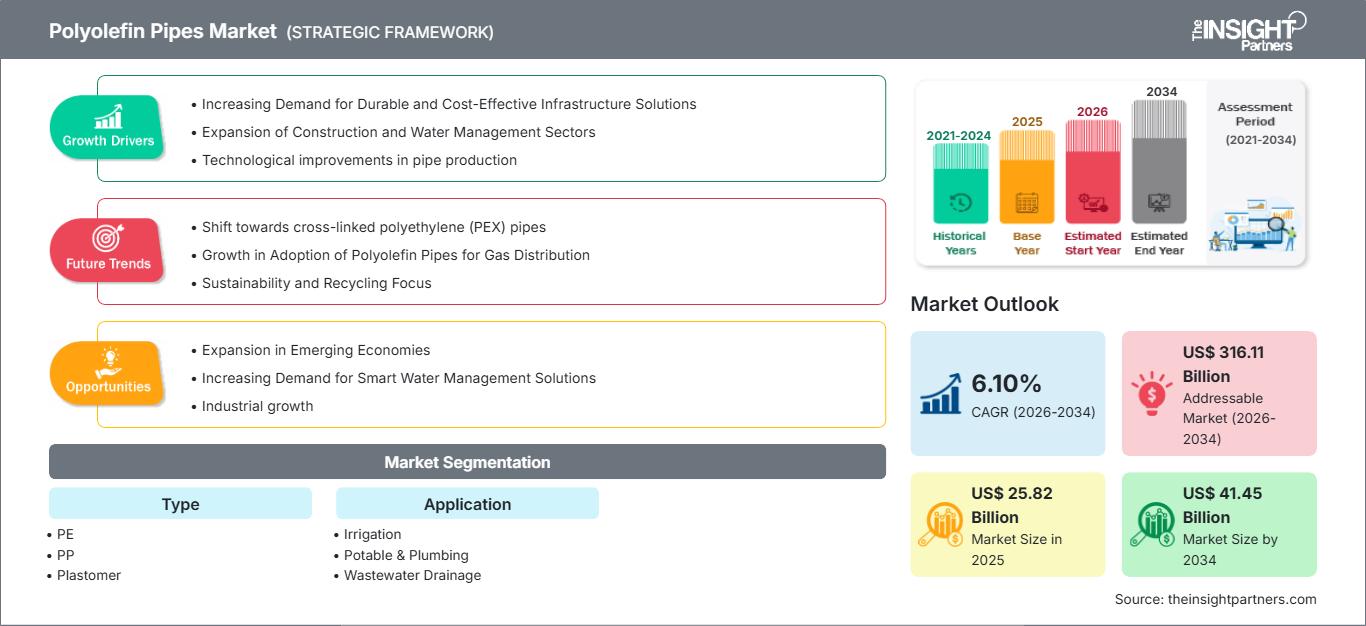
The Polyolefin Pipes market was valued at US$ 25.82 billion in 2025 and is expected to reach US$ 41.45 billion by 2034; it is estimated to record a CAGR of 5.4% during 2026-2034.
Polyolefin Pipes Market Assessment and Insights
- North America: North America accounted for 31–35% of the market share in 2025 and is anticipated to expand at a CAGR of 5.5–6.0% during 2026–2034. Water infrastructure upgrades, increasing energy pipeline investments, and growing demand for high-performance polyolefin piping systems continue to support steady regional growth of the polyolefin pipes market.
- U.S.: The U.S. represented 82–86% of the North American market in 2025 and is projected to register a CAGR of 5.7–6.2% during 2026–2034, driven by expanding water and wastewater infrastructure projects, pipeline modernization, and increasing adoption of durable polymer piping solutions.
- Europe: Europe held 25–29% polyolefin pipes market share in 2025 and is expected to grow at a CAGR of 5.2–5.8% during 2026–2034. Germany, France, and the United Kingdom remain leading markets, supported by sustainable infrastructure modernization, utility replacement programs, and growing investment in resilient piping networks.
- Asia Pacific: Asia Pacific accounted for 30–34% market share in 2025 and is forecast to expand at a CAGR of 6.8–7.4% during 2026–2034. China, India, and Japan continue to lead regional demand, driven by rapid industrialization, urban infrastructure development, and expanding irrigation and water management projects.
- Largest Segment: PE represented the largest market segment and is expected to record a CAGR of 6.2–6.7% during 2026–2034, reflecting its superior corrosion resistance, flexibility, and suitability for pressure piping applications across municipal, industrial, and agricultural sectors.
- High Growth Segment: Chemical Transportation is projected to grow at a CAGR of 7.1–7.8% during 2026–2034, driven by industrial process modernization and increasing demand for chemically resistant piping systems in manufacturing and processing industries.
- Key companies analyzed in detail: AGRU Kunststofftechnik GmbH; Georg Fischer AG (GF Piping Systems); Advanced Drainage Systems, Inc.; Chevron Phillips Chemical Company LLC; JM Eagle, Inc.; Aliaxis SA; Radius Systems Ltd.; Prinsco, Inc.; Polyplastic Group; Nan Ya Plastics Corporation.
Source: The Insight Partners' analysis based on proprietary research, government publications, company annual reports, investor presentations, industry databases, and expert interviews.
Polyolefin pipe manufacturing has evolved to meet not only the basic needs of utility sectors but also the needs of high-tech systems, where more durable, pressure-resistant, and efficient life-cycle pipe solutions are required. Improvements in materials used for polyethylene and polypropylene pipe production, advances in extrusion techniques, and increased quality requirements allow manufacturers to provide corrosion and chemical resistance, as well as better protection against environmental stress cracking.
The polyolefin pipes market forecast looks positive as governments invest in resilient infrastructure development and utilities increase spending to improve water security and the transportation of water and energy. Developing countries continue investing in urban infrastructure development and irrigation system modernization; at the same time, pipe producers invest in expanding production capacity and in using recycled materials. Sustainable infrastructure development and pipeline construction are key regulatory priorities in the industry.
Polyolefin Pipes Market Report Scope
| Report Attribute | Details |
|---|---|
| Market size in 2025 | US$ 25.82 Billion |
| Market Size by 2034 | US$ 41.45 Billion |
| Global CAGR (2026 - 2034) | 5.4% |
| Historical Data | 2021-2024 |
| Forecast period | 2026-2034 |
Polyolefin Pipes Market Analysis
There will be an ongoing rise in demand for polyolefin piping as governments and utilities adopt new lightweight, corrosion-resistant pipelines that offer reduced lifecycle costs, replacing existing infrastructure. Irrigation systems, urban water projects, fluid transport in industry, and utility installations will continue to drive steady demand for the product worldwide.
The value chain is becoming increasingly integrated, with collaboration among resin makers, pipe producers, technology providers, distributors, engineering contractors, and infrastructure developers contributing to improved product effectiveness and project efficiency. Sufficient raw materials and continuous innovation in polymers and extrusion technology help manufacturers meet changing application needs.
Competition within the polyolefin pipes market is characterized by continuous product innovation, manufacturing expansion, strategic partnerships, and investments in sustainable production technologies. Leading companies including Georg Fischer AG (GF Piping Systems), Aliaxis SA, JM Eagle, Inc., Advanced Drainage Systems, Inc., and AGRU Kunststofftechnik GmbH continue strengthening their portfolios through advanced piping solutions designed for municipal, industrial, and specialized infrastructure applications.
Strategic investments increasingly focus on production automation, high-performance polyethylene materials, circular economy initiatives, and regional manufacturing capacity expansion. Companies such as Chevron Phillips Chemical Company LLC support upstream resin innovation, while Radius Systems Ltd., Prinsco, Inc., Polyplastic Group, and Nan Ya Plastics Corporation enhance competitiveness in the polyolefin pipes market through application-specific product development, distribution network expansion, and customer-focused engineering capabilities, reinforcing long-term positioning across global infrastructure markets.
● REPORT CUSTOMIZATION
Tailor This Report To Align With Your Specific Business Requirements
This report can be customized to align precisely with your business objectives, scope, and target markets. Customization options include tailored segmentation, geography, competitive analysis, and strategic insights to support informed decision-making.
Customize This Report →WHAT YOU CAN ADJUST
- ● Segmentations
- ● Geography
- ● Competitive Analysis
- ● Language Preferences
Polyolefin Pipes Market: Strategic Insights
Regional Insights
North America Polyolefin Pipes Market
North America accounted for 31–35% of the global polyolefin pipes market in 2025 and is projected to register a CAGR of 5.5–6.0% through 2034. Ongoing investments in water infrastructure rehabilitation and utility modernization continue to stimulate demand for high-performance piping systems.
The region also benefits from expanding oil and gas transportation, residential construction, and municipal wastewater projects. Strong regulatory emphasis on durable, leak-resistant pipeline materials encourages the replacement of conventional piping with polyethylene and polypropylene solutions, supporting sustained long-term expansion of the polyolefin pipes market.
U.S. Polyolefin Pipes Market
The United States represented 82–86% of North American demand in 2025 and is expected to expand at a CAGR of 5.7–6.2% during the forecast period. Federal infrastructure funding and replacement of aging underground utilities remain major growth contributors.
Major manufacturers, including JM Eagle, Inc., Chevron Phillips Chemical Company LLC, Advanced Drainage Systems, Inc., and Prinsco, Inc., maintain strong production and distribution capabilities across the country. Demand continues to increase in potable water systems, wastewater drainage, irrigation projects, and industrial processing applications.
Europe Polyolefin Pipes Market
Europe captured 25–29% of the global market in 2025 and is anticipated to grow at a CAGR of 5.2–5.8% through 2034. Investments in sustainable infrastructure and pipeline modernization continue supporting regional demand, with Germany remaining the leading national market.
The UK is making more investments in utility replacement services and also improving investments in water conservation and pipeline systems. The increasing use of modern polyethylene systems ensures future operational efficiency.
Germany retains its leadership in the polyolefin pipes market due to its developed manufacturing industry, strict engineering regulations, and ongoing improvements in water distribution and industrial pipeline systems. High adoption of high-quality polymer systems ensures more market demand.
France, Italy, and Spain together contribute significantly to market revenue by investing in municipal, agricultural irrigation, and wastewater systems. Increasing sustainability measures and infrastructure renovation projects will drive the adoption of corrosion-resistant polyolefin systems.
APAC Polyolefin Pipes Market
Asia Pacific accounted for 30–34% of the global market in 2025 and is forecast to register the fastest regional expansion at a CAGR of 6.8–7.4%. China remains the largest market owing to extensive infrastructure development and manufacturing capacity expansion.
Japan and South Korea continue emphasizing advanced industrial piping applications and utility modernization, while India records rapid demand growth through irrigation expansion, smart city projects, and urban water infrastructure. Australia further supports regional growth through mining, wastewater treatment, and municipal infrastructure investments backed by long-term sustainability policies.
Middle East & Africa Polyolefin Pipes Market
The polyolefin pipes market in Middle East & Africa is projected to expand at a CAGR of 5.9–6.4% through 2034, supported by rising investments in water security, industrial infrastructure, and energy transportation projects. Saudi Arabia represents the leading national market across the region.
The United Arab Emirates continues investing in advanced utility networks and desalination infrastructure requiring durable piping materials. South Africa benefits from municipal rehabilitation projects, while the Rest of Middle East & Africa increasingly adopts polyolefin pipes for irrigation, mining, and industrial fluid transportation as infrastructure investment accelerates.
Segmentation Analysis
Type
The PE segment accounted for the largest share of the polyolefin pipes market and is expected to register a CAGR of 6.2–6.7% during 2026–2034. High flexibility, excellent chemical resistance, superior pressure performance, and long operational life continue making polyethylene the preferred material across municipal, industrial, and agricultural piping applications.
- PE: Widely deployed across potable water, wastewater, gas distribution, and irrigation systems because of outstanding durability, corrosion resistance, low maintenance requirements, and compatibility with modern trenchless installation technologies.
- PP: Increasingly adopted in industrial processing, hot water transport, and chemical handling applications owing to high temperature tolerance, excellent mechanical strength, and superior resistance to aggressive chemicals.
- Plastomer: Gains traction in specialized applications requiring enhanced flexibility, improved impact resistance, and customized polymer performance, particularly for demanding industrial installations and engineered pipeline solutions.
Application
- Irrigation: Demand continues increasing through modernization of agricultural infrastructure, precision farming practices, and water conservation initiatives supporting efficient fluid distribution across large cultivation areas.
- Potable & Plumbing: Residential, commercial, and municipal construction projects drive consistent consumption as utilities prioritize leak-resistant, hygienic, and durable piping systems for long-term water distribution reliability.
- Wastewater Drainage: Municipal sewer upgrades, stormwater management programs, and expanding urban populations continue strengthening demand for corrosion-resistant drainage pipe systems with extended operational lifecycles.
- Power & Communication: Expanding underground electrical transmission and fiber-optic network deployment increase utilization of protective conduit systems manufactured from lightweight and durable polyolefin materials.
- Industrial Application: Manufacturing, mining, energy, and processing industries increasingly specify polyolefin piping because of chemical resistance, operational reliability, and reduced maintenance costs in demanding operating environments.
- Chemical Transportation: Rapid expansion of chemical manufacturing and specialty processing facilities accelerates adoption of advanced piping systems engineered to safely transport corrosive and high-purity process fluids.
Opportunity Snapshot
| Application Segment | Revenue Contribution | Trend Tag | Adoption Stage |
| Irrigation | High | Precision Farming | Mature |
| Potable & Plumbing | High | Smart Utilities | Mature |
| Wastewater Drainage | High | Sewer Renewal | Scaling |
| Power & Communication | Medium | Fiber Expansion | Scaling |
| Industrial Application | Medium | Process Automation | Scaling |
| Chemical Transportation | Low | Chemical Processing | Emerging |
Polyolefin Pipes Market Growth Drivers and Impact Analysis
Expansion of Water and Wastewater Infrastructure Modernization
There is considerable funding from governments and local bodies to rebuild old systems of water distribution and sewerage collection to increase efficiency and reduce wastage. Polyolefin pipes are non-corrosive, have long lifespans, are leak-proof, and have lower installation costs than traditional materials. These factors make them ideal for infrastructure improvement projects where lifecycle performance is an essential consideration in procurement. With an increasing urban population and growing emphasis on water conservation, utility firms are opting for polyethylene and polypropylene pipe networks. Such changes in the construction industry will ensure consistent demand for products in developed and developing countries, while motivating manufacturers to increase their production.
Growing Industrial Demand for Chemical-Resistant Piping Systems
Industrial facilities require piping materials capable of handling corrosive chemicals, process water, slurry, and other aggressive media without frequent maintenance or premature failure. Polyolefin pipes satisfy these requirements through excellent chemical compatibility, lightweight construction, and ease of installation. Expanding investments in chemical processing, mining, manufacturing, food processing, and energy industries continue increasing procurement of advanced polymer piping systems. Industrial operators are also prioritizing solutions that reduce downtime and maintenance costs while improving operational safety. These purchasing priorities strengthen long-term demand for high-performance polyolefin pipes and encourage continuous innovation in polymer formulations and engineered piping solutions.
Increasing Adoption of Efficient Agricultural Irrigation Networks
Pipelines are used extensively in agriculture, especially in areas with limited water resources and increased demand for agricultural production. Polyolefin pipelines provide effective irrigation due to low water loss rates, high environmental resistance, and ease of installation. Governments are actively implementing programs to increase the use of microirrigation and precision farming, and to improve the effective management of water resources. Farmers replace conventional irrigation systems with more advanced polyethylene-based ones due to their strength and lower maintenance costs.
Polyolefin Pipes Market Future Trends
Greater Integration of Circular Economy Materials into Pipe Manufacturing
Manufacturers are increasingly investing in technologies that incorporate recycled polymers into selected pipe applications while maintaining mechanical performance and compliance with regulatory standards. Advances in material sorting, resin purification, and extrusion technologies are improving the commercial viability of recycled-content products. Companies are also developing traceability systems that verify recycled material quality throughout production. As sustainability objectives become more prominent across infrastructure procurement, customers are expected to favor suppliers capable of combining environmental performance with long service life. This transition is likely to reshape product development strategies and strengthen investments in circular manufacturing capabilities across the industry.
Digital Manufacturing and Smart Quality Control Across Production Facilities
Pipe production is being carried out using digitized processes that incorporate automation, sensors, and monitoring. This enhances efficiency and consistency in manufacturing. The use of predictive maintenance, automation of dimensional inspection, and process analytics helps minimize waste and adhere to increasing performance requirements. These technologies facilitate production planning and supply chain responsiveness, thereby ensuring timely deliveries for infrastructure projects. To gain a competitive advantage, firms that use intelligent manufacturing processes are likely to perform better in terms of productivity and customer responsiveness.
Polyolefin Pipes Market Opportunities
Expansion into High-Growth Emerging Infrastructure Markets
Urbanization is on the rise in Asia, the Middle East, Africa, and certain Latin American countries, thereby creating immense business opportunities for manufacturers of polyolefin piping systems. The authorities are investing huge amounts of money into water distribution systems, sewage management, irrigation schemes, industrial estates, and utility upgrades. Manufacturers that establish operations within regions through manufacturing plants, distribution channels, and technical service providers can enhance the reach of polyolefin pipes market and minimize logistical expenses. In addition, alliances with engineering contractors and infrastructure organizations will enable companies to expand their business prospects.
Development of Advanced High-Performance Specialty Pipe Solutions
Rising industrial applications requiring high performance give manufacturers an opportunity to create customized polyolefin pipes with increased pressure tolerance, high-temperature performance, and improved chemical resistance. Through investment in polymer technology, multilayer pipes, and customized engineering services, suppliers can move beyond generic products to provide more valuable offerings to customers. Industries such as chemicals, mining, hydrogen, renewables, and advanced manufacturing need customized pipelines that can withstand extreme environments. Manufacturers who increase their R&D efforts and provide technical consulting services can create premium products and maximize the value of their offerings.
Recent Developments
- In June 2025: JM Eagle, Inc. updated the technical specifications and product documentation for its HDPE Water & Sewer pipe portfolio, including IPS, DIPS, and CTS product lines. The refresh supports evolving municipal infrastructure requirements, improves engineering reference materials for project planning, and aligns product information with current water and wastewater installation practices.
- In 2025, AGRU Kunststofftechnik GmbH continued expanding production capabilities at its XXL HDPE pipe manufacturing facility in Charleston, South Carolina. The facility is designed to manufacture some of the world's largest solid-wall HDPE pressure pipes, strengthening AGRU's ability to serve large-scale marine, industrial, water transmission, and offshore infrastructure projects.
- In January 2025: AGRU America announced multiple executive leadership promotions and organizational expansion initiatives aimed at strengthening operational management and supporting continued growth across engineered plastics and piping system businesses in North America. The changes are intended to improve customer support, manufacturing coordination, and long-term business development.
Frequently Asked Questions

- Comprehensive Market Sizing and Forecast Analysis
- Detailed Segmentation Analysis
- In-Depth Market Dynamics Assessment
- Regional and Country-Level Insights
- Competitive Landscape and Company Benchmarking
- Strategic Business Intelligence
Recent Reports
Testimonials

The Insight Partners provided valuable market intelligence that supported our global go-to-market strategy. Their team was professional, responsive, and attentive to our feedback, providing thoughtful analysis and helpful methodological clarifications throughout the project.
Junmo Kim Chief Financial Officer (CFO), Enertech Co., Ltd.
The Insight Partners' SCADA System Market report is comprehensive, with valuable insights on current trends and future forecasts. The team was highly professional, responsive, and supportive throughout. We are very satisfied and highly recommend their services.
RAN KEDEM Partner, Reali Technologies LTDs
I requested a report on a very specific software market and the team produced the report in a few days. The information was very relevant and well presented. I then requested some changes and additions to the report. The team was again very responsive and I got the final report in less than a week.
JEAN-HERVE JENN Chairman, Future Analytica
We worked with The Insight Partners for an important market study and forecast. They gave us clear insights into opportunities and risks, which helped shape our plans. Their research was easy to use and based on solid data. It helped us make smart, confident decisions. We highly recommend them.
PIYUSH NAGPAL Sr. Vice President, High Beam Global
The Insight Partners delivered insightful, well-structured market research with strong domain expertise. Their team was professional and responsive throughout. The user-friendly website made accessing industry reports seamless. We highly recommend them for reliable, high-quality research services
YUKIHIKO ADACHI CEO, Deep Blue, LLC.
This is the first time I have purchased a market report from The Insight Partners.While I was unsure at first, I visited their web site and felt more comfortable to take the risk and purchase a market report.I am completely satisfied with the quality of the report and customer service. I had several questions and comments with the initial report, but after a couple of dialogs over email with their analyst I believe I have a report that I can use as input to our strategic planning process.Thank you so much for taking the extra time and making this a positive experience.I will definitely recommend your service to others and you will be my first call when we need further market data.
JOHN SUZUKI President and Chief Executive Officer, Board Director, BK Technologies
I wish to appreciate your support and the professionalism you displayed in the course of attending to my request for information regarding to infectious disease IVD market in Nigeria. I appreciate your patience, your guidance, and the fact that you were willing to offer a discount, which eventually made it possible for us to close a deal. I look forward to engaging The Insight Partners in the future, all thanks to the impression you have created in me as a result of this first encounter.
DR CHIJIOKE ONYIA MANAGING DIRECTOR, PineCrest Healthcare Ltd.Reason to Buy
- Informed Decision-Making
- Understanding Market Dynamics
- Competitive Analysis
- Identifying Emerging Markets
- Customer Insights
- Market Forecasts
- Risk Mitigation
- Boosting Operational Efficiency
- Strategic Planning
- Investment Justification
- Tracking Industry Innovations
- Aligning with Regulatory Trends





 Get Free Sample for