
Progressing Cavity Pump Market Growth, Trends & Demand by 2034
Coverage: by Power Rating (Up to 50 HP, 51 HP-150 HP, Above 150 HP); End-user (Oil and Gas, Water and Wastewater Management, Food and Beverage, Chemical and Petrochemical, Others) , and Geography (North America, Europe, Asia Pacific, and South and Central America)
- Status : Data Released
- Report Code : TIPRE00005340
- Category : Manufacturing and Construction
- No. of Pages : 150
- Available Report Formats :


- Last update date : September 07, 2026


2025 Market Size
US$ 2.56 Bn
Base year value
2034 Forecast
US$ 4.03 Bn
Projected by 2034
CAGR 2026-2034
5.18 %
Growth rate
Addressable Market
US$ 29.91 Bn
(2026-2034)
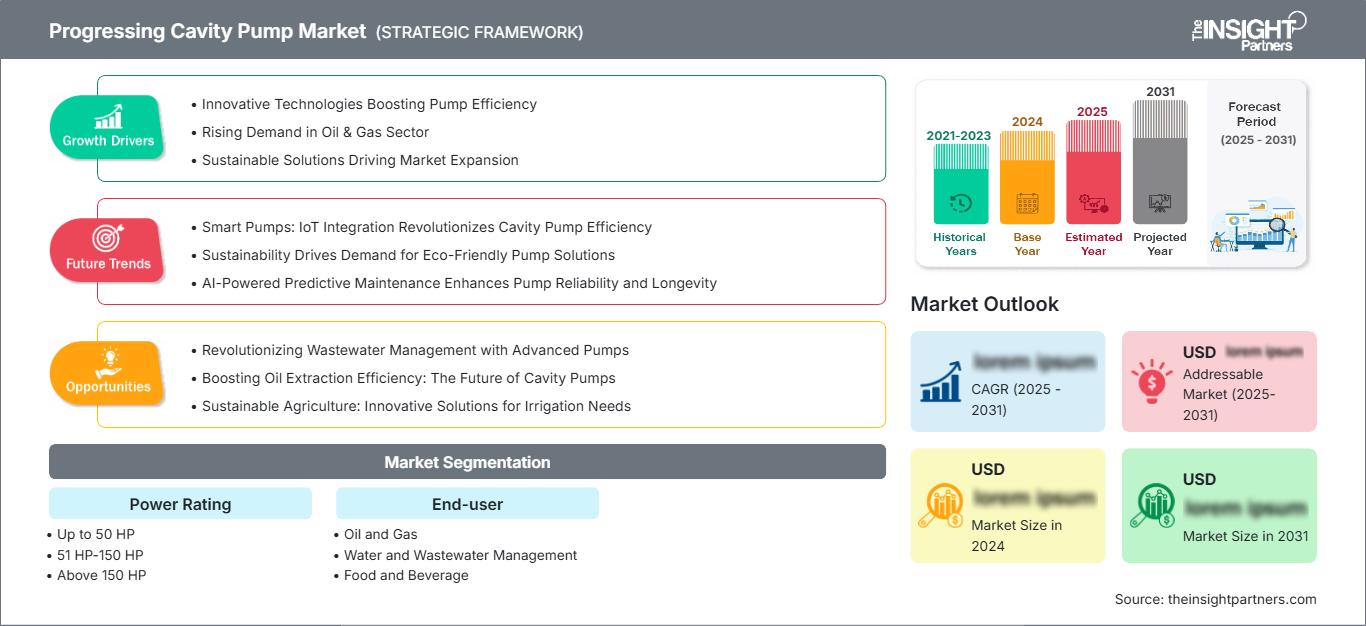
The progressing cavity pump market is valued at US$ 2.56 Billion in 2025 and is projected to reach US$ 4.03 Billion by 2034, advancing at a CAGR of 5.18% during 2026–2034. Expansion is supported by demand for controlled positive-displacement pumping across artificial lift, wastewater, chemical processing, and food applications, where viscosity, solids, shear sensitivity, and variable pressure make conventional pumping approaches less suitable.
Across North America, the progressing cavity pump market size is expected to expand at an estimated 4.7–5.3% CAGR between 2026–2034, supported by mature oil and gas production infrastructure, increasing artificial-lift optimization, and municipal wastewater investment. Demand is also strengthened by replacement requirements in aging pumping installations and the need for reliable handling of viscous, abrasive, and solids-laden fluids.
Progressing Cavity Pump Market Assessment and Insights
- North America: North America is estimated to account for 29–33% share in 2025, growing at a 4.7–5.3% CAGR between 2026–2034, supported by oilfield artificial-lift applications, wastewater infrastructure, and replacement demand across established industrial facilities.
- US: The US represents approximately 75–80% of North America's 2025 share, expanding at a 4.8–5.4% CAGR between 2026–2034, driven by mature oilfields and industrial wastewater applications.
- Europe: Europe is estimated at 22–26% share in 2025, with a 4.5–5.1% CAGR between 2026–2034. Germany, the UK, France, Italy, and Spain support demand through process industries, environmental infrastructure, and specialized fluid handling.
- Asia Pacific: Asia Pacific holds an estimated 25–29% share in 2025, advancing at a 5.8–6.5% CAGR between 2026–2034. China, India, Japan, and South Korea provide the principal industrial and infrastructure demand base.
- Largest Segment: Oil and Gas is estimated to hold a 34–38% market share in 2025, expanding at a 4.9–5.5% CAGR between 2026–2034, reflecting extensive artificial-lift and difficult-fluid applications.
- High Growth Segment: Water and Wastewater Management is estimated at 25–29% market share in 2025, growing at a 6.0–6.7% CAGR between 2026–2034, supported by sludge and solids-handling requirements.
- Key companies analyzed in detail: CIRCOR International, Inc.; Dover Corporation; Erich Netzsch GmbH & Co. Holding KG; Halliburton Company; National Oilwell Varco; PCM Inc.; PK Borets OOO; Schlumberger Limited; Weatherford International plc; Xylem Inc.
Source: The Insight Partners' analysis based on proprietary research, government publications, company annual reports, investor presentations, industry databases, and expert interviews.
There have been changes in the technology base towards more efficient designs, better elastomers, variable speeds, remote monitoring capabilities, and combinations of rotors and stators specific to applications. Production has moved in favor of modular design and easier servicing since the performance of a pump is highly dependent on such factors as fluid viscosity, solids concentration, temperature, pressure, and speed.
Future growth will increasingly involve industrial reuse of water, aging wastewater facilities, enhanced oil recovery, and specific chemical applications. The suppliers are also well positioned to benefit from the replacement cycle, with life-cycle costs, ease of maintenance, and energy efficiency determining the equipment selection. Increasing regulatory focus on wastewater treatment and efficiencies should help drive investments in positive-displacement pumps that can handle variable operating conditions.
Progressing Cavity Pump Market Report Scope
| Report Attribute | Details |
|---|---|
| Market size in 2025 | US$ 2.56 Billion |
| Market Size by 2034 | US$ 4.03 Billion |
| Global CAGR (2026 - 2034) | 5.18% |
| Historical Data | 2021-2024 |
| Forecast period | 2026-2034 |
Progressing Cavity Pump Market Analysis
The progressing cavity pump market growth is closely linked to applications requiring continuous, low-pulsation flow under difficult media conditions. Oil & Gas operators employ PCP technology for viscous oils, high solids operations, gas dewatering, and artificial lift, whereas the industrial sector employs PCPs in slurries, sludges, polymers, emulsions, and shear-sensitive media. According to NETZSCH, there are established applications in the oil and gas, chemical, food, environmental, paper, and building material industries.
The value chain involves suppliers of elastomers and metal components, rotor and stator manufacturers, drive systems providers, pump assemblers, distributors, field service providers, and end users. Supply factors include machining capabilities, elastomer compatibility, corrosion resistance, and application engineering capabilities. Customization plays a significant role because the selection of pumps should depend not only on capacity but also on fluid properties and operation parameters.
The positioning within the progressing cavity pump market analysis relies increasingly on lifecycle economics, engineering, serviceability, and automation. CIRCOR International, Inc., Dover Corporation, Erich Netzsch GmbH & Co. Holding KG, Halliburton Company, National Oilwell Varco, PCM Inc., PK Borets OOO, Schlumberger Limited, Weatherford International plc, and Xylem Inc. cater to various combinations of industrial, municipal, and oilfield needs.
There is an increased emphasis on investments in equipment that will minimize intervention and ensure greater operational visibility. For instance, in Scion technology by NOV, there is a greater focus on reduced weight and increased serviceability, whereas Weatherford provides PCPs in various geometries and with the capability for automatic flow control. Similarly, Schlumberger’s KUDU systems have automated monitoring and speed control features.
● REPORT CUSTOMIZATION
Tailor This Report To Align With Your Specific Business Requirements
This report can be customized to align precisely with your business objectives, scope, and target markets. Customization options include tailored segmentation, geography, competitive analysis, and strategic insights to support informed decision-making.
Customize This Report →WHAT YOU CAN ADJUST
- ● Segmentations
- ● Geography
- ● Competitive Analysis
- ● Language Preferences
Progressing Cavity Pump Market: Strategic Insights
Regional Insights
North America progressing cavity pump market
North America's progressing cavity pump market is estimated to hold 29–33% share in 2025 and expand at a 4.7–5.3% CAGR during 2026–2034. The area enjoys the advantage of an existing oilfield infrastructure, a well-developed lifting technique, a need for industrial wastewater, and a significant demand for replacements. US oilfields, where high viscosity and high solids need to be handled, have been among the key application areas of PCP technology.
Another advantage of the local suppliers lies in the highly developed service network and application engineering. The use of PCPs is observed in heavy oil, light oil, gas dewatering, thermals, and difficult well conditions. The digital monitoring system, variable speed capability, and special elastomers facilitate optimization of performance.
U.S. progressing cavity pump Market
The US is estimated to represent 75–80% of North America's 2025 market, with a 4.8–5.4% CAGR during 2026–2034. Artificial lift for oilfields continues to be an important application, along with wastewater, chemicals, food processing, and industrial liquid transfer. There is an increasing preference for pumps that can withstand solid content, varying viscosity, and production rate fluctuations.
The market in the US is well served by leading suppliers such as CIRCOR International, Inc., Dover Corporation, Halliburton Company, National Oilwell Varco, Schlumberger Limited, Weatherford International plc, and Xylem Inc. Important applications include automated pump control, maintain-in-place solutions, and special elastomers. According to Weatherford, PCP systems are tailored according to varied reservoir characteristics.
Europe progressing cavity pump market
Europe is estimated at 22–26% of the progressing cavity pump market share in 2025, with a 4.5–5.1% CAGR during 2026–2034. Germany is at the forefront of the equipment ecosystem within the region, followed by the UK, France, Italy, and Spain. The market dynamics include wastewater treatment, chemical processes, food production, and special fluid processing.
The UK combines urban and process industry needs, along with pump replacement. Germany profits from its engineering expertise and the presence of specialized manufacturers like Erich Netzsch GmbH & Co. Holding KG. Food production, chemicals, environment and industrial processing form additional demand for France, Italy, and Spain.
APAC progressing cavity pump market
APAC is estimated to hold 25–29% share in 2025, growing at a 5.8–6.5% CAGR during 2026–2034. China leads the region, followed by Japan, South Korea, India, and Australia. Industrial expansion, wastewater infrastructure, chemical processing, and oilfield activity support adoption.
China and India provide significant process-industry opportunities, while Japan and South Korea emphasize engineered applications. Australia contributes through mining, water management, and resource operations. Regional suppliers and international manufacturers increasingly emphasize compact systems, application-specific elastomers, and service support for harsh media and changing process conditions.
Middle East & Africa progressing cavity pump Market
The Middle East and Africa progressing cavity pump market demand is expected to expand at a 4.2–4.9% CAGR during 2026–2034. Saudi Arabia leads the regional opportunity, followed by the UAE and South Africa. Oilfield production, produced-water management, wastewater treatment, and infrastructure development remain central application areas.
Saudi Arabia and the UAE support demand through energy infrastructure and industrial diversification, while South Africa contributes through mining, municipal water, and industrial processing. The rest of MEA provides opportunities where high solids, viscosity, and limited infrastructure make robust positive-displacement pumping advantageous for resource and environmental applications.
Segmentation Analysis
Power Rating
Power Rating remains an important procurement criterion because pump duty varies substantially across artificial lift, wastewater, chemical, and industrial applications. As highlighted in the progressing cavity pump market report, the overall segment is estimated to expand at a 4.9–5.5% CAGR during 2026–2034. Selection increasingly considers torque, viscosity, solids loading, pressure, speed control, and lifecycle maintenance rather than horsepower alone.
- Up to 50 HP: This category serves lower-capacity industrial, municipal, dosing, and selected artificial-lift applications. Compact equipment and manageable installation requirements support adoption where operating loads and throughput remain moderate.
- 51 HP-150 HP: This range addresses a broad set of industrial and oilfield duties requiring higher flow or pressure. Its versatility makes it relevant for wastewater, process transfer, and medium-duty production systems.
- Above 150 HP: High-power equipment targets demanding production and process environments requiring substantial torque and continuous operation. Buyers typically emphasize mechanical robustness, thermal capability, and reliability under severe loading.
End-user
End-user demand is shaped by fluid complexity, operating pressure, solids content, and required flow stability. The segment is estimated to grow at a 5.2–5.8% CAGR during 2026–2034. Oil and gas remain strategically important, while environmental infrastructure and process industries broaden the addressable application base.
- Oil and Gas: Artificial lift, multiphase transfer, produced-water handling, and heavy-oil production create sustained demand. PCP systems are particularly suitable where viscosity, sand, gas, and changing reservoir conditions complicate conventional pumping.
- Water and Wastewater Management: Sludge, thickened solids, and variable-media applications require controlled movement with limited pulsation. Municipal and industrial treatment facilities value maintainability and dependable transfer performance.
- Food and Beverage: Hygienic processing increasingly requires gentle, accurately controlled movement of viscous and shear-sensitive products. Pump selection centers on cleanability, dosing consistency, material compatibility, and process protection.
- Chemical and Petrochemical: Corrosive, viscous, abrasive, and temperature-sensitive fluids create demand for engineered pump configurations. Material selection and elastomer compatibility are central to operational reliability.
Opportunity Snapshot
| End-user | Revenue Contribution | Trend Tag | Adoption Stage |
| Oil and Gas | High | Artificial Lift | Mature |
| Water and Wastewater Management | High | Sludge Transfer | Scaling |
| Food and Beverage | Medium | Hygienic Dosing | Scaling |
| Chemical and Petrochemical | Medium | Viscous Transfer | Scaling |
Progressing Cavity Pump Market Growth Drivers and Impact Analysis
Increasing artificial-lift requirements in mature oilfields
Increasingly, mature reservoirs will need to rely on artificial lift methods, which can sustain production when reservoir pressure declines and the properties of the fluid become challenging. PCP systems are well equipped to handle viscous crude oil, high sand cut, and varying inflow conditions. This allows the product to differentiate itself from other available options. In modern systems, one can integrate variable speed drives, torque measurement, and special elastomers designed for particular applications. According to Schlumberger, its PCP system takes care of viscous fluids and high sand cuts. On the other hand, Weatherford provides geometry designs to meet the requirements of various reservoirs.
Expansion of solids-handling wastewater infrastructure
Wastewater treatment plants are required to use reliable equipment that can handle sludge, thickened solids, and media with variable rheology. Progressing cavity pumps offer continuous flow and reduced pulsation capabilities, as well as the capability to handle solids-loaded media, and thus are ideal for challenging processing applications. Another factor to consider when purchasing pumps by municipal treatment plant owners is the availability of maintenance services, since downtime of the pump can affect the treatment process and thus the cost of operation. Maintenance features, such as maintain-in-place design by NOV's EZstrip systems, show how maintenance features have become an acquisition criterion, along with hydraulic design.
Greater process control requirements for difficult industrial fluids
Chemical, food, environmental, and industrial manufacturers increasingly require accurate flow control when handling viscous, abrasive, shear-sensitive, or solids-laden media. Positive-displacement operation allows flow to remain closely associated with pump speed, supporting controlled dosing and stable transfer. NETZSCH highlights low-pulsation pumping, dosing accuracy, and suitability for complex media across multiple industries. This capability can reduce process variability and improve equipment utilization where centrifugal alternatives become less predictable as viscosity or solids concentration changes. The commercial effect is a broader application base for engineered PCP systems, particularly where process consistency and material compatibility justify higher specification equipment.
Progressing Cavity Pump Market Future Trends
Condition-based PCP control and predictive maintenance
The progressing cavity pump market trends are moving toward condition-based operation in which torque, speed, pressure, temperature, and flow information are used to identify abnormal conditions before mechanical failure. Future systems are likely to integrate sensors directly with variable-frequency drives and supervisory software, allowing operators to adjust speed according to changing inflow and viscosity. Artificial intelligence can eventually support anomaly detection by comparing operating signatures with historical pump behavior. Remote diagnostics should become particularly valuable in dispersed oilfield installations and wastewater plants with limited technical staffing. The commercial priority will shift from selling a pump as an isolated mechanical asset toward providing a monitored pumping system with measurable uptime, intervention, and energy outcomes.
Advanced elastomers and application-specific pump geometries
Future product development will increasingly focus on elastomers, rotor profiles, and stator geometries tailored to temperature, chemical exposure, abrasive loading, and fluid composition. Manufacturers are likely to expand material libraries that accommodate aggressive chemicals, hydrocarbons, high sand content, and food-processing requirements while maintaining dimensional stability. This direction can reduce premature wear caused by swelling, thermal stress, or incompatibility between elastomer compounds and process fluids. Schlumberger's uniform-elastomer design illustrates how thermal distribution and swelling behavior can be addressed through component engineering. Over time, application-specific configurations should improve reliability and create higher-value opportunities for suppliers with strong engineering and materials capabilities.
Progressing Cavity Pump Market Opportunities
Integrated pump packages for produced-water and multiphase services
The progressing cavity pump market Forecasts indicate an opportunity for suppliers to package pumps with drives, controls, monitoring, and fluid-management equipment rather than selling individual mechanical units. Produced-water treatment, multiphase transfer, and difficult oilfield services can benefit from integrated packages that reduce engineering complexity and simplify commissioning. Suppliers with field-service capabilities can differentiate through application assessment, installation support, spare-parts planning, and remote monitoring. PCM already positions PCP systems across produced-water management, multiphase boosting, well services, and downstream processing. Investment in standardized modular packages could reduce lead times while retaining application-specific configuration, creating a scalable route into brownfield projects and remote production environments.
Aftermarket platforms for retrofit and maintenance optimization
The progressing cavity pump market scope extends beyond original equipment because installed pumps require elastomer replacement, rotor refurbishment, joint maintenance, drive servicing, and performance optimization. Suppliers can develop aftermarket platforms combining condition assessment, planned maintenance, compatible components, and rapid field replacement. Maintain-in-place designs are particularly attractive where removing suction and discharge pipework would create extended downtime. NOV's Scion technology demonstrates the commercial emphasis on lighter equipment and simpler maintenance. A stronger aftermarket model can create recurring revenue while improving customer retention, especially in wastewater facilities and mature oilfields where equipment replacement decisions are driven by total lifecycle cost rather than initial purchase price.
Frequently Asked Questions

- Comprehensive Market Sizing and Forecast Analysis
- Detailed Segmentation Analysis
- In-Depth Market Dynamics Assessment
- Regional and Country-Level Insights
- Competitive Landscape and Company Benchmarking
- Strategic Business Intelligence
Recent Reports
Testimonials

The Insight Partners' SCADA System Market report is comprehensive, with valuable insights on current trends and future forecasts. The team was highly professional, responsive, and supportive throughout. We are very satisfied and highly recommend their services.
RAN KEDEM Partner, Reali Technologies LTDs
I requested a report on a very specific software market and the team produced the report in a few days. The information was very relevant and well presented. I then requested some changes and additions to the report. The team was again very responsive and I got the final report in less than a week.
JEAN-HERVE JENN Chairman, Future Analytica
We worked with The Insight Partners for an important market study and forecast. They gave us clear insights into opportunities and risks, which helped shape our plans. Their research was easy to use and based on solid data. It helped us make smart, confident decisions. We highly recommend them.
PIYUSH NAGPAL Sr. Vice President, High Beam Global
The Insight Partners delivered insightful, well-structured market research with strong domain expertise. Their team was professional and responsive throughout. The user-friendly website made accessing industry reports seamless. We highly recommend them for reliable, high-quality research services
YUKIHIKO ADACHI CEO, Deep Blue, LLC.
This is the first time I have purchased a market report from The Insight Partners.While I was unsure at first, I visited their web site and felt more comfortable to take the risk and purchase a market report.I am completely satisfied with the quality of the report and customer service. I had several questions and comments with the initial report, but after a couple of dialogs over email with their analyst I believe I have a report that I can use as input to our strategic planning process.Thank you so much for taking the extra time and making this a positive experience.I will definitely recommend your service to others and you will be my first call when we need further market data.
JOHN SUZUKI President and Chief Executive Officer, Board Director, BK Technologies
I wish to appreciate your support and the professionalism you displayed in the course of attending to my request for information regarding to infectious disease IVD market in Nigeria. I appreciate your patience, your guidance, and the fact that you were willing to offer a discount, which eventually made it possible for us to close a deal. I look forward to engaging The Insight Partners in the future, all thanks to the impression you have created in me as a result of this first encounter.
DR CHIJIOKE ONYIA MANAGING DIRECTOR, PineCrest Healthcare Ltd.Reason to Buy
- Informed Decision-Making
- Understanding Market Dynamics
- Competitive Analysis
- Identifying Emerging Markets
- Customer Insights
- Market Forecasts
- Risk Mitigation
- Boosting Operational Efficiency
- Strategic Planning
- Investment Justification
- Tracking Industry Innovations
- Aligning with Regulatory Trends





 Get Free Sample for