
Real-time Rendering Solution Market Demand, Trends & Forecast by 2034
Coverage: By Component (Solution, Service); Deployment (Cloud-Based, On-Premise); Organization Size (Large Enterprise, SMEs); End User (Manufacturing and Automotive, Construction, Healthcare and Pharmaceuticals, Retail and E-commerce, Aerospace and Defense, Media and Entertainment, Others) , and Geography (North America, Europe, Asia Pacific, and South and Central America)
- Status : Data Released
- Report Code : TIPRE00021411
- Category : Technology, Media and Telecommunications
- No. of Pages : 150
- Available Report Formats :


- Last update date : July 31, 2026


2025 Market Size
US$ 4.81 Bn
Base year value
2034 Forecast
US$ 15.18 Bn
Projected by 2034
CAGR 2026-2034
13.61 %
Growth rate
Addressable Market
US$ 86.45 Bn
(2026-2034)
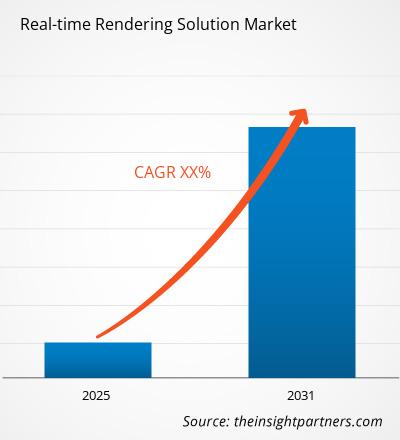
The global real-time rendering solution market was valued at US$ 4.81 Billion in 2025 and is projected to reach US$ 15.18 Billion by 2034, expanding at a CAGR of 13.61% between 2026 and 2034. This trajectory reflects accelerating adoption of interactive visualization technologies across design, entertainment, manufacturing, and healthcare industries worldwide.
North America is estimated to grow at a CAGR of 12.8-14.2% through the forecast period, supported by the real-time rendering solution market size expanding on the back of a dense concentration of gaming studios, film production hubs, and early enterprise adoption of digital twin technologies. Sustained investment in cloud infrastructure and GPU computing capacity further strengthens the region's growth foundation across industrial and creative applications alike.
Real-time Rendering Solution Market Assessment and Insights
- North America: The region commands an estimated 30-34% share in 2025, growing at a CAGR of 12.8-14.2% between 2026-2034, driven by the deep integration of real-time rendering solution market technologies across media production, gaming, and automotive design workflows.
- US: The United States holds 85-90% share within North America in 2025 and is projected to grow at a CAGR of 12.9-14.3% between 2026-2034, anchored by Hollywood, Silicon Valley, and enterprise design ecosystems.
- Europe: Europe accounts for an estimated 24-27% share in 2025, expanding at a CAGR of 12.5-13.8% between 2026-2034, with Germany, the United Kingdom, and France leading regional adoption across automotive and architectural visualization.
- Asia Pacific: Asia Pacific holds a 26-29% share in 2025 and is forecast to grow at the fastest CAGR of 15.2-16.6% between 2026-2034, led by China, Japan, and South Korea's expanding gaming and manufacturing sectors.
- Largest Segment: The Solution segment under Component leads with a 62-66% market share in 2025, growing at a CAGR of 13.2-14.4% between 2026-2034, owing to widespread licensing of rendering engines and visualization platforms.
- High Growth Segment: Cloud-Based deployment is the fastest-expanding segment with a 34-37% share in 2025, projected to grow at a CAGR of 15.8-17.1% between 2026-2034, propelled by remote collaboration needs.
- Key companies analyzed in detail: Autodesk Inc., Avid Technology Inc., Epic Games, Inc., ACCA software, Easy Render, Idex Solutions Inc., Lumiscaphe, Nanopixel, Promotheus, Silicon Studio Corp.
Source: The Insight Partners' analysis based on proprietary research, government publications, company annual reports, investor presentations, industry databases, and expert interviews.
The Real-Time Rendering Solution Market has evolved significantly as real-time rendering technology progresses from specialized offline pre-visualization tools used primarily in film post-production toward interactive, GPU-accelerated engines capable of rendering photorealistic environments instantaneously. Rasterization-based pipelines have increasingly incorporated hybrid ray tracing, allowing designers, architects, and game developers to preview lighting, materials, and physics with production-grade fidelity during the creation process rather than after final output, fundamentally compressing iteration cycles across creative and industrial workflows.
Looking ahead, adoption is expected to broaden into emerging economies across Southeast Asia and Latin America as GPU hardware becomes more affordable and cloud rendering subscriptions lower entry barriers. Government-backed digital twin initiatives in smart manufacturing and infrastructure planning, combined with rising venture investment in immersive technology startups, are anticipated to create durable regulatory and capital tailwinds supporting broader enterprise deployment through 2034.
Real-time Rendering Solution Market Report Scope
| Report Attribute | Details |
|---|---|
| Market size in 2025 | US$ 4.81 Billion |
| Market Size by 2034 | US$ 15.18 Billion |
| Global CAGR (2026 - 2034) | 13.61% |
| Historical Data | 2021-2024 |
| Forecast period | 2026-2034 |
Real-time Rendering Solution Market Analysis
Demand for real-time rendering solution market growth is being driven primarily by industries seeking to compress design-to-market timelines, including automotive manufacturers previewing vehicle configurations digitally and construction firms visualizing projects before groundbreaking. The value chain spans GPU and hardware vendors, engine developers offering both proprietary and licensable platforms, systems integrators, and end-user enterprises deploying these tools within existing production and design software ecosystems.
Supply-side dynamics remain shaped by GPU availability and computational cost, though continued semiconductor innovation and expanding cloud GPU instances from major hyperscalers have gradually eased earlier capacity bottlenecks. Vendors increasingly bundle rendering engines with asset libraries, physics simulation, and collaboration tools, creating integrated ecosystems that raise switching costs and deepen customer retention across enterprise accounts globally.
Competitive intensity in the real-time rendering solution market analysis reveals a landscape split between broad platform providers and specialized visualization firms. Unreal Engine by Epic Games, Inc., is continuing to venture into areas other than gaming, such as automotive, architecture, and virtual production, while Autodesk Inc. is taking advantage of its design software ecosystem to sell its rendering capabilities into building information modeling and manufacturing through cloud partnerships.
The investments being made are centered on cloud-native rendering and AI-enabled content generation technology, where Avid Technology Inc. is investing in media integration services, while niche players like Lumiscaphe, Nanopixel, and Silicon Studio Corp. are distinguishing themselves through domain-specific solutions for automotive configurators, games, and architecture visualization.
● REPORT CUSTOMIZATION
Tailor This Report To Align With Your Specific Business Requirements
This report can be customized to align precisely with your business objectives, scope, and target markets. Customization options include tailored segmentation, geography, competitive analysis, and strategic insights to support informed decision-making.
Customize This Report →WHAT YOU CAN ADJUST
- ● Segmentations
- ● Geography
- ● Competitive Analysis
- ● Language Preferences
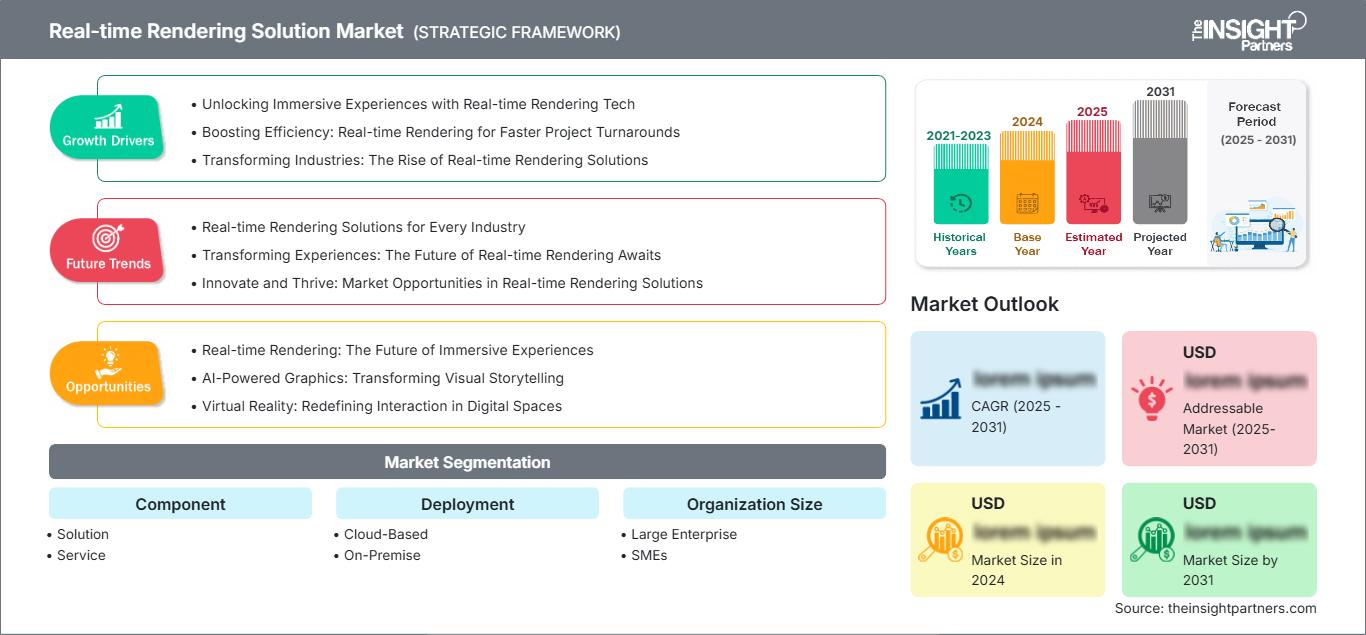
Real-time Rendering Solution Market: Strategic Insights
Regional Insights
North America real-time rendering solution market
North America held an estimated 30-34% share of the global real-time rendering solution market in 2025 and is projected to expand at a CAGR of 12.8-14.2% through 2034. The growth is driven by intense demand in gaming studios, film and television production studios, and automobile design hubs through early enterprise investment in GPU-powered visualization technology infrastructure.
Some structural factors that drive demand include mature cloud computing infrastructure offered by regional hyperscalers, good protection of intellectual property, and a rich talent pool in visual effects and simulation engineering. The digitization of manufacturing and military simulations adds more diversification to demand beyond the conventional uses of visualization technologies in media.
U.S. real-time rendering solution market
The United States represents approximately 85-90% share of North America's real-time rendering solution market in 2025, growing at a CAGR of 12.9-14.3% between 2026-2034. Concentrated presence of leading engine developers, major studios, and design software vendors sustains the country's dominant regional position across creative and industrial applications.
Application trends show accelerating adoption within automotive configurators, architectural visualization firms, and healthcare simulation training programs alongside established gaming and film production use cases. Company presence remains strong, with Autodesk Inc. and Epic Games, Inc. headquartered domestically, while Avid Technology Inc. maintains deep integration within broadcast and post-production workflows, collectively reinforcing sustained domestic platform innovation and enterprise deployment.
Europe real-time rendering solution market
Europe accounted for an estimated 24-27% of the global real-time rendering solution market share in 2025, expanding at a CAGR of 12.5-13.8% through 2034, with Germany identified as the leading country given its automotive engineering base and strong architectural visualization demand across major manufacturing hubs.
Germany’s automotive industry is responsible for significant adoption of design previsualization and virtual prototyping, enabling stable business engine licensing for manufacturers as well as their supplier network in the region.
The United Kingdom maintains demand due to its traditional film, television, and video game production infrastructure, where studios start adopting virtual production technology requiring real-time engines for rendering backgrounds on set and previsualization.
Together, France, Italy, and Spain provide increasing demand in the areas of architectural modeling, luxury goods design, and video game development, with France’s animation and visual effects industry and Italy’s design-centric manufacturing driving adoption in the region.
APAC real-time rendering solution market
Asia Pacific held an estimated 26-29% share of the global real-time rendering solution market in 2025 and is projected to register the fastest regional CAGR of 15.2-16.6% through 2034, with China identified as the leading country supported by its expansive gaming industry and rapid manufacturing digitization.
Japan and South Korea contribute strong demand from established gaming and animation studios, while India and Australia show accelerating adoption within construction visualization and mining simulation. Government-backed smart manufacturing policies across the region continue to support industrial digital twin deployment, reinforcing sustained platform investment.
Middle East & Africa real-time rendering solution market
The Middle East and Africa Real-Time Rendering Solution Market is projected to expand at a CAGR of 13.9–15.3% between 2026 and 2034, with Saudi Arabia identified as the leading market given its giga-project construction pipeline requiring extensive architectural and infrastructure visualization capabilities across urban development initiatives.
The UAE contributes to growing demand through media production and real estate visualization sectors, while South Africa and the Rest of MEA show emerging adoption tied to energy infrastructure planning and mining simulation projects, supported by gradual cloud infrastructure expansion across the broader region.
Segmentation Analysis
Component
The Component segment is projected to grow at a CAGR of 13.2-14.4% between 2026-2034. The Solution sub-segment dominates given widespread deployment of rendering engines, visualization platforms, and design software across enterprises, while the Service sub-segment continues expanding steadily as organizations increasingly seek implementation, integration, and technical support to maximize platform value.
- Solution: Software platforms and rendering engines form the core revenue base, favored for enabling direct visualization capabilities across design, gaming, and industrial applications with continuous feature updates.
- Service: Implementation, training, and consulting support demand is rising as enterprises integrate rendering platforms into complex existing digital design and production infrastructure.
Deployment
The Deployment segment is projected to grow at a CAGR of 14.6-15.9% between 2026-2034. The Cloud-Based sub-segment is scaling rapidly as remote collaboration needs and reduced hardware dependency drive migration, while the On-Premise sub-segment retains relevance among enterprises prioritizing data security and low-latency rendering performance for sensitive design work.
- Cloud-Based: Subscription-based rendering access enables distributed teams to collaborate without heavy local GPU investment, appealing strongly to small and mid-sized design studios.
- On-Premise: Dedicated infrastructure remains preferred among defense, aerospace, and large manufacturing clients requiring strict data control and consistent rendering performance.
Organization Size
The Organization Size segment is projected to grow at a CAGR of 13.0-14.1% between 2026-2034. Large Enterprises maintain the dominant revenue base through extensive licensing and infrastructure investment, while SMEs represent a rising adoption curve as cloud-based pricing models lower barriers to accessing professional-grade rendering capabilities previously limited to larger organizations.
- Large Enterprise: Extensive multi-seat licensing and dedicated infrastructure investment support complex, high-volume visualization projects across global design and production teams.
- SMEs: Flexible subscription pricing and cloud accessibility enable smaller studios and design firms to adopt professional rendering tools without substantial upfront capital.
End User
The End User segment is projected to grow at a CAGR of 13.5-14.8% between 2026-2034. Manufacturing and Automotive leads end-user demand given extensive use of digital prototyping and configurator tools, while Media and Entertainment sustains strong adoption through gaming and virtual production applications, together anchoring diversified demand across the broader end-user landscape.
- Manufacturing and Automotive: Digital prototyping and virtual configurators reduce physical mockup costs while accelerating design validation cycles across vehicle and industrial equipment development.
- Construction: Building information modeling integration with real-time rendering supports client presentations and design iteration before construction commencement.
- Healthcare and Pharmaceuticals: Surgical simulation and medical device visualization tools increasingly rely on real-time engines for training and product design validation.
- Retail and E-commerce: Virtual product configurators and augmented reality previews enhance online shopping experiences and reduce return rates for furniture and apparel retailers.
- Aerospace and Defense: Flight simulation and equipment visualization applications demand high-fidelity, low-latency rendering for training and design validation purposes.
- Media and Entertainment: Virtual production, game development, and animation studios represent foundational demand, leveraging engines for both content creation and live broadcast graphics.
Opportunity Snapshot
| End User | Revenue Contribution | Trend Tag | Adoption Stage |
| Manufacturing and Automotive | High | Digital Prototyping | Scaling |
| Construction | Medium | BIM Integration | Scaling |
| Healthcare and Pharmaceuticals | Medium | Surgical Simulation | Emerging |
| Retail and E-commerce | Medium | Virtual Configurators | Emerging |
| Aerospace and Defense | Low | Flight Simulation | Mature |
| Media and Entertainment | High | Virtual Production | Mature |
Real-time Rendering Solution Market Growth Drivers and Impact Analysis
Rising Demand for Virtual Production in Film and Broadcast
LED volume virtual production technology involves using LED displays to render backgrounds in real-time as the scenes are shot. The move of this technology from experimentation into practical applications in television and movies has helped cut down on costs and reduced the time needed in post-production as well as giving the director instant creative feedback on set. Virtual studios have been developed in major studios in both North America and Europe. As camera tracking, LED panel resolution, and engine optimization continue improving, adoption is extending beyond major studios into mid-tier production houses and educational institutions, creating sustained demand for licensing, integration services, and specialized hardware configurations that directly support real-time rendering solution market expansion across the media and entertainment value chain.
Accelerating Digital Twin Adoption Across Manufacturing
In the Real-Time Rendering Solution Market, manufacturers are increasingly deploying digital twins—virtual replicas of physical assets and production lines—to simulate performance, test configurations, and train operators before physical implementation. Real-time rendering engines offer sufficient graphical and physical accuracy so that these simulations provide actual insight instead of approximations. These are employed by automotive and aerospace firms to validate any changes in their assembly lines without stopping production, while industrial machinery manufacturers can see various options of their products and get feedback from customers. All this results in lowering the costs of prototyping and accelerating the development process, as more and more standardization organizations are using simulations for validation as a basis for the digital twins.
Expansion of Cloud Gaming and Interactive Entertainment
Cloud gaming systems rely on the ability to offer real-time rendering through remote systems with extremely low latency levels, making it important for engine providers to enhance their compression and streaming technologies. With improved infrastructure of the internet worldwide and increased 5G connectivity, more users are able to engage in high-definition interactive experiences without the need for costly equipment on their end. This opens up the market for many more gamers to enjoy games, thus raising license sales for engines. At the same time, the increasing popularity of esports and live interactive broadcasts makes a need for real-time graphics rendering during such events, which prompts further investments by vendors into low-latency rendering pipelines and cloud systems collaborations.
Real-time Rendering Solution Market Future Trends
Convergence of AI-Assisted Content Generation with Rendering Pipelines
Market trends in the real-time rendering solutions are becoming more and more oriented towards increased convergence of AI-based technologies and rendering software, thus enabling asset generation, environmental scene generation and automatic scene optimization. Developers of the engines are introducing machine learning models to the engines to help artists with such routine tasks as texture generation, animation and lighting improvements, which reduces the time needed to produce assets manually. It can be anticipated that such a trend will shorten the process of content development in the next few years dramatically, especially for smaller studios without big artist teams. With the development of AI-assisted workflows, it will become possible to turn rendering platforms into a creative collaboration environment where humans define higher-level creative processes, and automatic processes take care of the rest.
Rise of Spatial Computing and Extended Reality Applications
Consumer and enterprise adoption of MR headsets is expected to spur requirements for specialized rendering engines designed for use in the context of spatial computing, where content needs to be adaptable to changing environments and movements of the users. The use of spatial applications implies high demands regarding low latency and accuracy of depth perception, which are necessary for ensuring an optimal experience for users, making it important for the rendering engines developers to apply particular optimization techniques. Spatial applications are being tested by such industries as retail, healthcare, education, and industrial maintenance. With the reduction of weight and cost of headsets' hardware, along with the ability of enterprise solutions to demonstrate increased productivity, spatial computing can emerge as an important area of growth for vendors of rendering platforms towards the end of the forecasted period.
Real-time Rendering Solution Market Opportunities
Untapped Potential Across Emerging Manufacturing Economies
According to forecasts of the market for real-time rendering solutions, there is plenty of room to grow in emerging manufacturing economies such as Southeast Asian nations and Latin American countries, where the digitization of industry is growing at a fast pace, but the usage of rendering platforms is still relatively low. Companies that develop partnerships within these regions, operate regional data centers and adopt flexible pricing schemes designed to work well with small manufacturing businesses will be able to achieve first-mover advantage in these emerging markets. Government-supported Industry 4.0 programs in countries like Vietnam, Indonesia and Mexico provide an attractive environment for digital twin and virtual prototyping to take root.
Vertical-Specific Platform Development for Healthcare Simulation
There is an underexploited area of potential application for real-time rendering systems tailored for surgical training, medical device design, and patient education in healthcare organizations. The current platforms mostly come from generic gaming or design engines that have been modified for use in the healthcare field, leaving the opportunity open for vendors to create customized, compliant rendering solutions to fill specific anatomical requirements and haptic integration for clinical training settings. Collaboration between real-time rendering technology firms and medical device makers or teaching hospitals will speed up the product development process validation. As healthcare systems all over the world raise budgets for simulation-based training due to a shortage of clinical staff, vendors of specialized healthcare visualization platforms have a lot to gain.
Frequently Asked Questions

- Comprehensive Market Sizing and Forecast Analysis
- Detailed Segmentation Analysis
- In-Depth Market Dynamics Assessment
- Regional and Country-Level Insights
- Competitive Landscape and Company Benchmarking
- Strategic Business Intelligence
Recent Reports
Testimonials

The Insight Partners' SCADA System Market report is comprehensive, with valuable insights on current trends and future forecasts. The team was highly professional, responsive, and supportive throughout. We are very satisfied and highly recommend their services.
RAN KEDEM Partner, Reali Technologies LTDs
I requested a report on a very specific software market and the team produced the report in a few days. The information was very relevant and well presented. I then requested some changes and additions to the report. The team was again very responsive and I got the final report in less than a week.
JEAN-HERVE JENN Chairman, Future Analytica
We worked with The Insight Partners for an important market study and forecast. They gave us clear insights into opportunities and risks, which helped shape our plans. Their research was easy to use and based on solid data. It helped us make smart, confident decisions. We highly recommend them.
PIYUSH NAGPAL Sr. Vice President, High Beam Global
The Insight Partners delivered insightful, well-structured market research with strong domain expertise. Their team was professional and responsive throughout. The user-friendly website made accessing industry reports seamless. We highly recommend them for reliable, high-quality research services
YUKIHIKO ADACHI CEO, Deep Blue, LLC.
This is the first time I have purchased a market report from The Insight Partners.While I was unsure at first, I visited their web site and felt more comfortable to take the risk and purchase a market report.I am completely satisfied with the quality of the report and customer service. I had several questions and comments with the initial report, but after a couple of dialogs over email with their analyst I believe I have a report that I can use as input to our strategic planning process.Thank you so much for taking the extra time and making this a positive experience.I will definitely recommend your service to others and you will be my first call when we need further market data.
JOHN SUZUKI President and Chief Executive Officer, Board Director, BK Technologies
I wish to appreciate your support and the professionalism you displayed in the course of attending to my request for information regarding to infectious disease IVD market in Nigeria. I appreciate your patience, your guidance, and the fact that you were willing to offer a discount, which eventually made it possible for us to close a deal. I look forward to engaging The Insight Partners in the future, all thanks to the impression you have created in me as a result of this first encounter.
DR CHIJIOKE ONYIA MANAGING DIRECTOR, PineCrest Healthcare Ltd.Reason to Buy
- Informed Decision-Making
- Understanding Market Dynamics
- Competitive Analysis
- Identifying Emerging Markets
- Customer Insights
- Market Forecasts
- Risk Mitigation
- Boosting Operational Efficiency
- Strategic Planning
- Investment Justification
- Tracking Industry Innovations
- Aligning with Regulatory Trends





 Get Free Sample for