
Generative AI in Agriculture Market Growth & Key Opportunities by 2031
Generative AI in Agriculture Market Size and Forecast (2021 - 2031), Global and Regional Share, Trend, and Growth Opportunity Analysis Report Report Coverage : by Technology (Machine Learning, Natural Language Processing, Computer Vision, Generative Adversarial Networks (GANs), Application (Precision Farming, Livestock Management, Agricultural Robotics & Automation, Weather Forecasting), and Geography
- Status : Data Released
- Report Code : TIPRE00042077
- Category : Technology, Media and Telecommunications
- No. of Pages : 150
- Available Report Formats :


- Last update date : December 04, 2025


2024 Market Size
US$ 212.4 Mn
Base year value
2031 Forecast
US$ 1,262.5 Mn
Projected by 2031
CAGR 2025-2031
27.25 %
Growth rate
Addressable Market
US$ 4,366.74 Mn
(2025-2031)
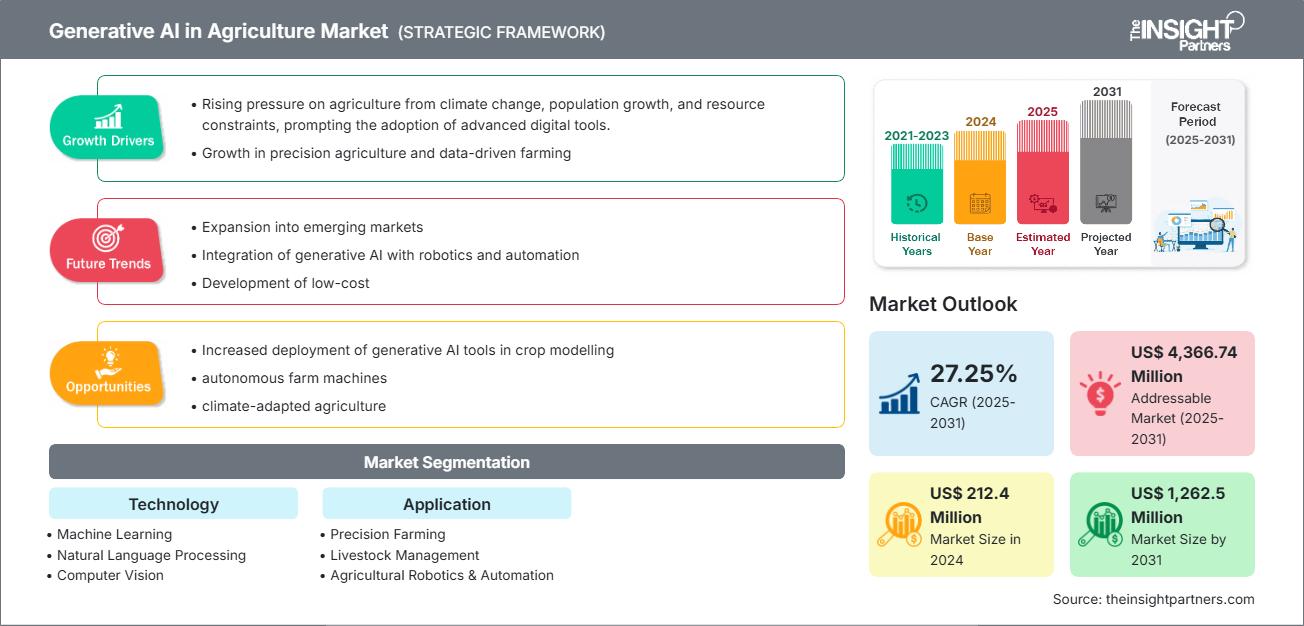
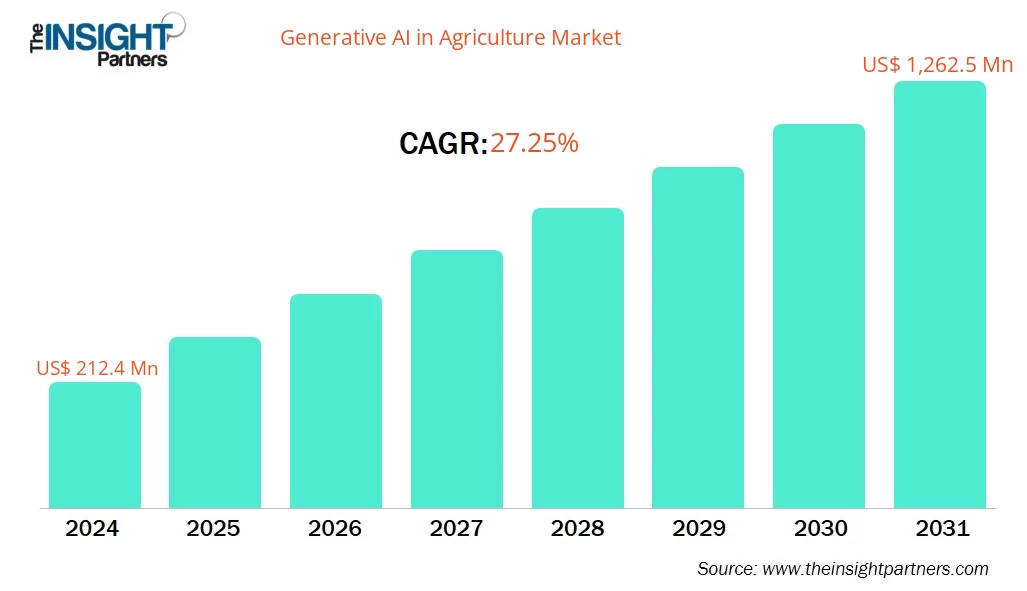
The Generative AI in Agriculture Market size is expected to reach US$1,262.5 million by 2031 from US$ 212.4 million in 2024. The market is anticipated to register a CAGR of 27.25% during 2025–2031.
Generative AI in Agriculture Market Analysis
The generative AI in agriculture market is gaining traction as agricultural stakeholders adopt advanced AI models to address challenges such as yield stagnation, climate variability, labour shortages, and inefficient resource use. These systems incorporate technologies such as machine learning, computer vision, and generative adversarial networks (GANs) to create synthetic data, simulate crop scenarios, and support precision farming workflows.
Generative AI use-cases in agriculture include synthetic imagery for training crop monitoring systems, generative modelling for breeding new crop varieties, predictive climate and yield modelling, and autonomous robotics for resource optimisation.
The growing demand for sustainable agriculture, digital farming infrastructure, and data-driven decision-making is fuelling the adoption of generative AI solutions across farms, agri-enterprises, and agritech platforms.
Generative AI in Agriculture Market Overview
Generative AI in agriculture refers to software and platforms that utilize generative modelling techniques (including GANs, diffusion models, synthetic data generation, etc.) in agricultural settings. They enable the creation of new data, scenarios, and insights that complement traditional analytics to drive crop management, livestock monitoring, irrigation scheduling, pest/disease detection, and more.
These solutions help farmers and agri-businesses to streamline operations, reduce resource waste, predict crop outcomes, and support sustainable farming practices. They span from cloud-based AI platforms, edge-AI devices (e.g., drones, sensors), to robotics and autonomous systems.
Market Assessment and Insights
- Global market for Generative AI in Agriculture was valued at US$ 212.40 Million in 2024
- Annual market size is expected to reach US$ 1,262.50 Million by 2031
- Total addressable market (TAM) during 2025-2031 is projected to reach approximately US$ 4,366.74 Million
- Market is anticipated to register a CAGR of 27.25% during the forecast period
- The United States represents a key market, supported by Rising pressure on agriculture from climate change, population growth, and resource constraints, prompting the adoption of advanced digital tools., Growth in precision agriculture and data-driven farming, as well as evolving industry dynamics
- Market analysis covers North America, Europe, Asia-Pacific, South and Central America, Middle East and Africa, with growth evaluated across the forecast period
- Market opportunities such as Increased deployment of generative AI tools in crop modelling, autonomous farm machines, climate-adapted agriculture are expected to influence market dynamics and addressable market
- Report profiles industry participants, including Bayer AG, John Deere & Company, IBM Corporation, KissAN AI, Agmatix, DeepAgro, Syngenta Group, AgroScout, Carbon Robotics, Microsoft Corporation, while analyzing competitive strategies and innovation developments
-
Source: The Insight Partners' analysis based on proprietary research, government publications, company annual reports, investor presentations, industry databases, and expert interviews.
● REPORT CUSTOMIZATION
Tailor This Report To Align With Your Specific Business Requirements
This report can be customized to align precisely with your business objectives, scope, and target markets. Customization options include tailored segmentation, geography, competitive analysis, and strategic insights to support informed decision-making.
Customize This Report →WHAT YOU CAN ADJUST
- ● Segmentations
- ● Geography
- ● Competitive Analysis
- ● Language Preferences
Generative AI in Agriculture Market: Strategic Insights
-
Get Top Key Market Trends of this report.This FREE sample will include data analysis, ranging from market trends to estimates and forecasts.
Generative AI in Agriculture Market Drivers and Opportunities
Market Drivers:
- Rising pressure on agriculture from climate change, population growth, and resource constraints, prompting the adoption of advanced digital tools.
- Growth in precision agriculture and data-driven farming: generative AI enables scenario simulation, synthetic data generation, and improved decision-making.
- Increasing adoption of drones, sensor networks, satellite imagery, and IoT in farming, creating rich data ecosystems that generative AI models can exploit.
Market Opportunities:
- Expansion into emerging markets (Asia Pacific, Latin America, Africa), where agricultural digitization is still nascent, offering high growth potential.
- Integration of generative AI with robotics and automation: autonomous agribots, drones, and machinery that use AI-generated scenarios for operations.
- Development of low-cost, localized generative AI models tailored for smallholder farmers in different geographies, languages, and crop types.
Generative AI in Agriculture Market Report Segmentation Analysis
The generative AI in the agriculture market share is analysed across various segments to provide a clearer understanding of its structure, growth potential, and emerging trends. Below is the standard segmentation approach used in most industry reports:
By Technology:
- Machine Learning
- Computer Vision
- Predictive Analytics
- Generative Adversarial Networks (GANs) & Diffusion Models
By Application:
- Precision Farming
- Agricultural Robotics & Automation
- Livestock Monitoring
- Drone Analytics & Remote Sensing
- Weather Forecasting & Climate Modelling
- Soil/Health Monitoring & Pest Management
By Geography:
- North America
- Europe
- Asia Pacific
- South & Central America
- Middle East & Africa
Generative AI in Agriculture Market Report Scope
| Report Attribute | Details |
|---|---|
| Market size in 2024 | US$ 212.4 Million |
| Market Size by 2031 | US$ 1,262.5 Million |
| Global CAGR (2025 - 2031) | 27.25% |
| Historical Data | 2021-2023 |
| Forecast period | 2025-2031 |
| Segments Covered |
By Technology
|
| Regions and Countries Covered |
North America
|
| Market leaders and key company profiles |
|
Generative AI in Agriculture Market Players Density: Understanding Its Impact on Business Dynamics
The Generative AI in Agriculture Market is growing rapidly, driven by increasing end-user demand due to factors such as evolving consumer preferences, technological advancements, and greater awareness of the product's benefits. As demand rises, businesses are expanding their offerings, innovating to meet consumer needs, and capitalizing on emerging trends, which further fuels market growth.
Generative AI in Agriculture Market Share Analysis by Geography
The generative AI in agriculture market shows differing growth trajectories across regions due to variations in agriculture infrastructure, digital connectivity, regulatory frameworks, and technology adoption.
North America
- Market Share: Largest share in 2024, aided by strong agritech adoption, precision farming practices, and robust R&D in AI.
- Key Drivers: High investment in smart farming, advanced IoT/sensor networks, and favourable regulatory frameworks.
- Trends: Increased deployment of generative AI tools in crop modelling, autonomous farm machines, and climate-adapted agriculture.
Europe
- Market Share: Significant share driven by agritech initiatives, EU digital farming policies, and sustainable agriculture emphasis.
- Key Drivers: Government incentives for digital agriculture, regulatory push for climate-smart farming.
- Trends: Growing interoperability of agricultural data platforms and cross-country generative AI services for farming.
Asia Pacific
- Market Share: Fastest-growing region due to rising digital agriculture investments, large farm populations, and government support.
- Key Drivers: Rapid digitization of agriculture, large growth in IoT/remote sensing in countries such as China, India, and Southeast Asia.
- Trends: Tailored generative AI solutions for smallholder farmers, language/local-crop modelling, mobile-based agritech adoption.
South & Central America
- Market Share: Emerging region with moderate share but high potential due to increasing investments in digital agriculture.
- Key Drivers: Growing crop production, need for yield enhancement, and sustainable practices.
- Trends: Cloud-based, cost-effective generative AI tools are gaining traction among medium-scale farms and agri-enterprises.
Middle East & Africa
- Market Share: Smaller current share but noteworthy growth potential. For example, the region is expected to reach US$102.3 million by 2033 with a CAGR of ~22.9%.
- Key Drivers: Government initiatives for e-agriculture, increased connectivity, drive for food security in arid regions.
- Trends: Use of generative AI in irrigation scheduling, climate resilient crop modelling, and smallholder agritech in Africa.
Market Players Density: Understanding Its Impact on Business Dynamics
The generative AI in agriculture market is characterized by increasing competition due to a mix of large technology firms, ag-tech specialists, start-ups, and regional players. This competitive environment pushes vendors to differentiate through:
- Domain-specific generative AI capabilities, such as crop modelling, synthetic imagery generation, and scenario simulation.
- Platform partnerships combining agriculture domain knowledge, sensor/IoT data, and generative AI frameworks.
- Scalable cloud-based and edge-AI solutions to serve both large farms and smallholder segments.
- Localization and service layers – region-specific crop data, language support, farmer interfaces, and regional agronomic advisory integrations.
Opportunities and Strategic Moves:
- Collaborate with agribusinesses, sensor/IoT providers, drone companies, and agronomic advisory services to build integrated generative AI ecosystems.
- Develop low-cost SaaS models for emerging markets, enabling generative AI adoption among small- and medium-scale farms.
- Leverage generative AI to create new revenue streams: synthetic-data services, simulation-based decision-making, and modelling-as-a-service for agritech providers.
- Invest in R&D of ofnext-generationn generative techniques (diffusion models, GANs, large language models adapted to agriculture) and enhance explainability, trust, and farmer-interface usability.
Major Companies operating in the Generative AI in Agriculture Market are:
- Bayer AG
- John Deere & Company
- IBM Corporation
- KissAN AI
- Agmatix
- DeepAgro
- Syngenta Group
- AgroScout
- Carbon Robotics
- Microsoft Corporation
Other Companies Analysed During the Course of Research:
- Cropin Technology Solutions Pvt. Ltd.
- AGCO Corporation
- Raven Industries Inc.
- Trimble Inc.
- Granular Inc.
- Gamaya SA
- Valmont Industries Inc.
- Blue River Technology
- Coverfields
- Plantix
Market News and Recent Developments
- Google LLC expanded its India-built agricultural AI tools (ALU & AMED APIs) to Malaysia, Vietnam, Indonesia, and Japan, highlighting generative AI & data-driven agriculture adoption in the Asia-Pacific.
- In Kenya, small-scale farmers using AI-powered agronomic chatbots (e.g., Virtual Agronomist) and generative-data-based pest/yield tools achieved significantly higher yields and reduced waste.
- The government of Maharashtra (India) approved a Rs 500 crore initiative (‘MahaAgri-AI Policy 2025-2029’) to integrate AI and generative analytics into agriculture, including drone/sensor data, smart advisory chatbots, and blockchain traceability.
Generative AI In Agriculture Market Report Coverage and Deliverables
The "Generative AI In Agriculture Market Size and Forecast (2021–2031)" report provides a detailed analysis of the market covering below areas:
- Generative AI in Agriculture Market size and forecast at the global, regional, and country level for all the key market segments covered under the scope
- Generative AI in the Agriculture Market trends, as well as market dynamics such as drivers, restraints, and key opportunities
- Detailed PEST and SWOT analysis
- Generative AI in Agriculture Market analysis covering key market trends, global and regional framework, major players, regulations, and recent market developments
- Industry landscape and competition analysis covering market concentration, heat map analysis, prominent players, and recent developments in the Generative AI in Agriculture Market
- Detailed company profile
Frequently Asked Questions
2. High initial investment and digital infrastructure constraints (connectivity, IoT deployment).
3. Integration difficulties: bridging generative AI models with farm hardware, agronomic advisor, and legacy systems.
4. Data privacy, trust, and farmer acceptability of AI-driven advisory.
2. Asia Pacific: Fastest-growing region, due to digitisation, large farm base, and investment in smart agriculture.
3. Middle East & Africa: Growing, though smaller base, with high growth potential (CAGR ~22.9% in the MEA region).
1. Precision farming (yield forecasting, irrigation optimisation)
2. Agricultural robotics & automation (autonomous tractors/drones guided by generative models)
3. Livestock monitoring (health, feed optimisation)
2. Growth of precision agriculture and digital farming infrastructure (sensor/IoT networks, drones, satellite imagery).
3. Demand for synthetic data, scenario-modelling, and generative intelligence to improve decision-making in agriculture.

- Comprehensive Market Sizing and Forecast Analysis
- Detailed Segmentation Analysis
- In-Depth Market Dynamics Assessment
- Regional and Country-Level Insights
- Competitive Landscape and Company Benchmarking
- Strategic Business Intelligence
Recent Reports
Testimonials

The Insight Partners provided valuable market intelligence that supported our global go-to-market strategy. Their team was professional, responsive, and attentive to our feedback, providing thoughtful analysis and helpful methodological clarifications throughout the project.
Junmo Kim Chief Financial Officer (CFO), Enertech Co., Ltd.
The Insight Partners' SCADA System Market report is comprehensive, with valuable insights on current trends and future forecasts. The team was highly professional, responsive, and supportive throughout. We are very satisfied and highly recommend their services.
RAN KEDEM Partner, Reali Technologies LTDs
I requested a report on a very specific software market and the team produced the report in a few days. The information was very relevant and well presented. I then requested some changes and additions to the report. The team was again very responsive and I got the final report in less than a week.
JEAN-HERVE JENN Chairman, Future Analytica
We worked with The Insight Partners for an important market study and forecast. They gave us clear insights into opportunities and risks, which helped shape our plans. Their research was easy to use and based on solid data. It helped us make smart, confident decisions. We highly recommend them.
PIYUSH NAGPAL Sr. Vice President, High Beam Global
The Insight Partners delivered insightful, well-structured market research with strong domain expertise. Their team was professional and responsive throughout. The user-friendly website made accessing industry reports seamless. We highly recommend them for reliable, high-quality research services
YUKIHIKO ADACHI CEO, Deep Blue, LLC.
This is the first time I have purchased a market report from The Insight Partners.While I was unsure at first, I visited their web site and felt more comfortable to take the risk and purchase a market report.I am completely satisfied with the quality of the report and customer service. I had several questions and comments with the initial report, but after a couple of dialogs over email with their analyst I believe I have a report that I can use as input to our strategic planning process.Thank you so much for taking the extra time and making this a positive experience.I will definitely recommend your service to others and you will be my first call when we need further market data.
JOHN SUZUKI President and Chief Executive Officer, Board Director, BK Technologies
I wish to appreciate your support and the professionalism you displayed in the course of attending to my request for information regarding to infectious disease IVD market in Nigeria. I appreciate your patience, your guidance, and the fact that you were willing to offer a discount, which eventually made it possible for us to close a deal. I look forward to engaging The Insight Partners in the future, all thanks to the impression you have created in me as a result of this first encounter.
DR CHIJIOKE ONYIA MANAGING DIRECTOR, PineCrest Healthcare Ltd.Reason to Buy
- Informed Decision-Making
- Understanding Market Dynamics
- Competitive Analysis
- Identifying Emerging Markets
- Customer Insights
- Market Forecasts
- Risk Mitigation
- Boosting Operational Efficiency
- Strategic Planning
- Investment Justification
- Tracking Industry Innovations
- Aligning with Regulatory Trends





 Get Free Sample for