
Redispersible Polymer Powder Market Share, Demand & Growth by 2034
Coverage: by Type (Acrylic Redispersible Polymer Powder, Vae Redispersible Polymer Powders, Veova Redispersible Polymer Powder, SB Redispersible Polymer Powder); Application (Tiling and Flooring, Mortars, Plastering, Insulation Systems, Others); End-Use Industry (Residential Construction, Commercial Construction, Industrial Construction) , and Geography (North America, Europe, Asia Pacific, and South and Central America)
- Status : Data Released
- Report Code : TIPRE00010040
- Category : Chemicals and Materials
- No. of Pages : 150
- Available Report Formats :


- Last update date : November 13, 2026


2025 Market Size
US$ 2.24 Bn
Base year value
2034 Forecast
US$ 4.78 Bn
Projected by 2034
CAGR 2026-2034
8.79 %
Growth rate
Addressable Market
US$ 31.45 Bn
(2026-2034)
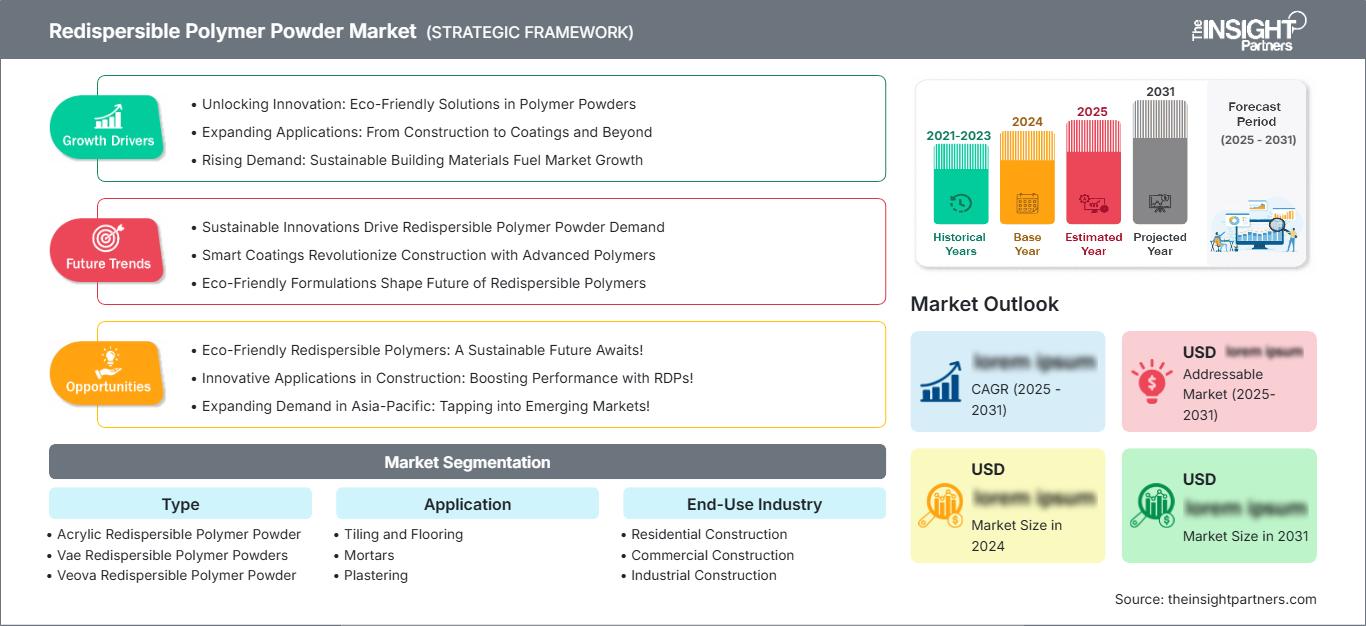
The Redispersible Polymer Powder Market was valued at US$ 2.24 Billion in 2025 and is projected to reach US$ 4.78 Billion by 2034, expanding at a CAGR of 8.79% during 2026–2034. Demand is supported by the use of polymer-modified dry-mix mortars, tile adhesives, flooring compounds, plastering materials, and building insulation systems. Construction quality requirements, renovation activity, and demand for improved adhesion, flexibility, and water resistance are shaping product development and purchasing decisions across regional construction markets.
The North American Redispersible Polymer Powder Market is positioned for sustained expansion, with a modeled CAGR of ~8% through 2034. Demand is supported by building renovation, energy-efficiency improvements, and the adoption of higher-performance construction chemicals in commercial and residential projects. Manufacturers supplying this market must balance formulation performance with raw-material costs, dependable delivery, and compatibility with locally preferred cementitious systems. Opportunities are strongest where contractors and building-material producers prioritize durable installations, consistent application characteristics, and reduced maintenance requirements over initial material cost alone.
Redispersible Polymer Powder Market Assessment and Insights
Regional Outlook
- North America: ~24% of the global market in 2025 | ~8% CAGR through 2034. Market position: North America represents a mature market supported by renovation, premium construction materials, and established specialty-chemical supply chains. Technical specifications and demand for reliable performance support adoption, while construction cycles influence purchasing volumes.
- US: ~78% of North American market revenue in 2025 | ~8% CAGR through 2034. Market position: The United States is the largest national market in North America, supported by a broad building-materials industry, commercial construction, and residential refurbishment. Established distribution channels and technical formulation capabilities favor suppliers offering consistent quality and dependable supply.
- Europe: ~28% of the global market in 2025 | ~7% CAGR through 2034. Market position: Europe is a mature market with established dry-mix mortar production and strong technical requirements. Germany leads the region, while France, Italy, Spain, and the UK contribute through renovation, flooring, insulation, and specialist construction applications.
- Asia Pacific: ~40% of the global market in 2025 | ~11% CAGR through 2034. Market position: Asia Pacific is the largest and fastest-growing regional market in this modeled outlook. Construction activity, urbanization, domestic manufacturing, and broader adoption of factory-produced mortars support demand, particularly in China and India.
Segment Outlook
- Tiling and Flooring: ~34% share in 2025 | ~9% CAGR through 2034. Market position: This application is modeled as the largest application segment because polymer modification supports adhesion, workability, and durability in tile adhesives and flooring compounds. Demand is supported by new installations and refurbishment.
- Residential Construction: ~48% share in 2025 | ~10% CAGR through 2034. Market position: Residential construction is the largest modeled end-use industry and a high-growth demand pool, supported by housing development, renovation, and rising use of performance-oriented building materials. Growth depends on project execution and material affordability.
Competitive Coverage
BASF SE, Benson Polymers Ltd., Hexion Inc., Synthomer plc, The Dow Chemical Company, The Nippon Synthetic Chemical Industry Co., Ltd., Wacker Chemie AG, Celanese Corporation, VINAVIL S.p.A., Dairen Chemical Corporation.
Methodology
The Insight Partners follows Data Collection & Secondary Research, Primary Research, Data Analysis, and Data Triangulation & Final Review to validate market estimates and insights.
Source: The Insight Partners' analysis based on proprietary research, government publications, company annual reports, investor presentations, industry databases, and expert interviews.
The market has developed along with the trend towards moving away from on-site mixing of building materials to pre-mixed dry forms in the factory. Redispersible powders make it possible for manufacturers to integrate polymer properties into dry mixes which can be shipped, stored, and mixed with water on-site. The development of powder processing, polymer technology, and formulation capability has expanded the use of redispersible powders in cement-based adhesives, repair mortars, plastering mixes, and insulating systems. Competition is no longer only based on the cost of the binder but also on formulation capability.
The future is contingent upon the dynamics between investments in construction and change in favor of high-performance materials. Growing Asian markets have potential due to the increase in urban housing, commercial buildings, and construction activities linked to infrastructures. The renovation and energy efficiency programs in Europe can promote the use of polymer modified insulating and repairing products, whereas North America requires durable flooring and tiles for renovation activities. Building efficiency and indoor environmental performance are gaining attention from regulatory bodies, which may prompt development of new materials; however, this will depend on the region and type of project.
Redispersible Polymer Powder Market Report Scope
| Report Attribute | Details |
|---|---|
| Market size in 2025 | US$ 2.24 Billion |
| Market Size by 2034 | US$ 4.78 Billion |
| Global CAGR (2026 - 2034) | 8.79% |
| Historical Data | 2021-2024 |
| Forecast period | 2026-2034 |
Redispersible Polymer Powder Market Analysis
The development of the Redispersible Polymer Powder Market depends on the performance needs of current cement-based construction materials. Performance aspects that can be enhanced with the help of polymer addition include adhesion to the substrate, flexibility, cohesion, workability, and water resistance. All these parameters are vital for tile laying, floor preparation, repair mortar, plastering, and insulation processes. The demand for these products depends not only on the volume of constructions being done, but also on how many of them use factory-produced materials, which have certain parameters to be met. Renovation can serve as an independent source of demand in case of outdated surfaces.
The value chain includes polymer feedstocks and dispersions, spray drying and powder formulation, packaging, distribution, and inclusion in construction product formulations. Dry mix mortar and adhesive producers evaluate the performance of the powders together with other ingredients such as cement, fillers, cellulose ethers, defoamers, etc. Stability of dispersion and redispersion properties, storage stability, and compatibility are necessary as alterations in one raw material may influence the product as a whole. Availability of supply depends on feedstock availability, energy and drying cost, production capacity utilization, logistics, and regional stocks. Technical assistance and formulation testing allow suppliers to secure customers and avoid product substitution.
Competitive Landscape in Redispersible Polymer Powder Industry involves both global chemicals companies, as well as specialized polymer manufacturers and regional producers. BASF SE and Wacker Chemie AG benefit from wide polymer know-how and established customer base for construction materials. Relevant vinyl acetate and polymer technology is offered by Celanese Corporation and Dairen Chemical Corporation. Synthomer plc and VINAVIL S.p.A. compete in adjacent polymer dispersions and specialized binders markets. Competitive importance of each company depends on product range, regional availability, technical assistance, and involvement in construction markets.
Priorities in investments would be reliable manufacture, production flexibility, product development, and greater technical cooperation with manufacturers of dry-mix mortars. Manufacturers could consider localized production or logistics arrangements in case of higher transport prices, longer lead times, and other barriers for importing goods. In sustainability terms, this could consist of more effective production, better quality feedstock materials, and formulations that promote durable construction or energy saving insulating materials. The business report of Wacker Corporation includes dispersible polymer powders among their key polymer business operations and development of functionalized powder and construction binders.
● REPORT CUSTOMIZATION
Tailor This Report To Align With Your Specific Business Requirements
This report can be customized to align precisely with your business objectives, scope, and target markets. Customization options include tailored segmentation, geography, competitive analysis, and strategic insights to support informed decision-making.
Customize This Report →WHAT YOU CAN ADJUST
- ● Segmentations
- ● Geography
- ● Competitive Analysis
- ● Language Preferences
Redispersible Polymer Powder Market: Strategic Insights
Regional Insights
North America Redispersible Polymer Powder Market
North America is estimated to account for ~24% of global revenue in 2025, with a modeled CAGR of ~8% through 2034. Distribution in the region is facilitated by a well-developed distribution network of construction chemicals, maturity of the renovation market, and the need for specialized building materials. This includes polymer-based tile adhesives, self-leveling floor materials, repair mortars, and insulating materials among others. Product choice depends on substrate compatibility, environmental conditions during application, and the demands of the resulting finished system. Commercial buyers consider technical support, product availability, and batch-to-batch consistency.
The U.S. represents the lion’s share of regional demand, with Canada contributing via residential construction, renovation, and building envelope applications. Mexico provides further opportunities as construction logistics and building materials manufacturing evolve. The market’s performance will be subject to fluctuations in interest rates, housing affordability, commercial investment, and costs of construction materials. Suppliers which have a reliable distribution network and can help manufacturers in making formulations changes will be able to cater for regional differences in climatic conditions and consumer demands more effectively. Growth will depend on both project activity and market penetration of high-performance dry mix products.
U.S. Redispersible Polymer Powder Market
The United States is estimated to represent ~78% of North American revenue in 2025, with a modeled CAGR of ~8% through 2034. This placement is influenced by the size of the domestic market for building materials, existing supply chains for specialty chemicals, and the need for formulations that are appropriate for tiling and flooring purposes. Repeat business will result from commercial refurbishments and residential remodeling as preparation, reapplication, and repair of surfaces often require formulations of specific adhesives and mortars. Also, implementation relies on contractor experience and manufacturer’s ability to maintain consistent quality of their products.
Suppliers such as BASF SE, Wacker Chemie AG, and Celanese Corporation among others participate in the wider North American market of polymers and construction chemicals. Nevertheless, company-level activities should not be regarded as sales market shares. Customers appreciate technical expertise in maintaining stability, workability, open time, adhesion, and durability of products under service conditions. Local production and delivery can reduce lead times, although imported products may still be important in certain grades. Competitive advantage results from product performance qualifications, pricing stability, and service provision to mortar and adhesive producers.
Europe Redispersible Polymer Powder Market
Europe is modeled at ~28% of global revenue in 2025, with a CAGR of ~7% through 2034. It comprises an established construction chemicals sector along with demand arising from building renovation activities, insulation, floorings, and special dry mixes. Germany stands out as the largest market within the scope of this model, being facilitated by an advanced building materials industry and capabilities in specialty chemicals. Matureness of the market restricts dependence on construction growth to some extent, as renovation, upgrade, and other performance requirements have a role to play in demand.
Germany represents a homebase for major chemical companies and formulation expertise. France comes into account owing to refurbishment of residential buildings, floorings, and building envelope upgrade activities. Italy has well-established tile, ceramics, and associated materials industries. Spain represents construction activities that drive demand for adhesives and mortars depending on housing and investment cycles. UK market is driven by the requirements of refurbishment, building envelope performance, and specifications of commercial and residential builders. There are differences in construction techniques and purchasing habits in each of the countries.
Growth within the region will also be influenced by energy efficiency considerations, financing for renovations, and the rate at which building projects go from planning to construction. Certain insulation and repair materials will need polymer-modified formulations, where adhesion and flexibility play an important role, but the specific formulation needs vary depending on the use. The manufacturer must take into account energy costs, the cost of chemicals, environmental concerns, and the manufacturing economics of operating in Europe. Formulated products and regional logistical advantages could be key factors in maintaining customer relations amidst fluctuating demand trends.
APAC Redispersible Polymer Powder Market
Asia Pacific is modeled to hold ~40% of global revenue in 2025 and record a CAGR of ~11% through 2034, making it the largest and fastest-growing region in this outlook. China is the leading country in Asia Pacific, reflecting its extensive construction-materials manufacturing base and large market for dry-mix products. India offers additional growth potential through housing, urban development, commercial construction, and increasing use of formulated tile adhesives and mortars. Demand varies with construction investment, local production capacity, and material affordability.
Japan and South Korea contribute through technically developed construction markets where consistency and application performance are important. Australia has demand linked to residential building, renovation, and professional installation materials. Across the region, domestic manufacturing and distribution can support wider adoption by reducing supply lead times and matching products to local formulations. Policy-driven infrastructure and urban development can expand the addressable market, but construction slowdowns, price competition, and uneven adoption of factory-produced materials may moderate growth in individual countries.
Middle East & Africa Redispersible Polymer Powder Market
The Middle East and Africa market is expected to develop through urban expansion, commercial construction, residential projects, and investment in building infrastructure. Its modeled CAGR is ~9% through 2034. Saudi Arabia is the leading country in the Middle East and Africa in this assessment, supported by large construction programs and investment in new urban developments. The United Arab Emirates contributes through commercial buildings, hospitality, residential construction, and refurbishment, with demand influenced by project schedules and imported material availability.
South Africa represents an important market in the African construction-materials landscape, although economic conditions and uneven building investment can affect purchasing. Other markets across the region vary widely in their dependence on imports, distribution capacity, and access to specialty chemicals. Heat, dust, water exposure, and substrate conditions can increase the importance of choosing suitable adhesive and mortar formulations. Energy costs, freight, currency movements, and project procurement practices remain important supply considerations. Suppliers with regional distribution partners and application guidance can address customer needs more effectively than businesses relying exclusively on distant shipment networks.
Segmentation Analysis
Type
Type influences the performance profile, formulation compatibility, and suitability of polymer powder for different construction materials. Buyers evaluate adhesion, flexibility, water resistance, workability, and compatibility with cement and other additives when selecting a binder. Adoption depends on the balance between required performance and total formulation cost, with manufacturers qualifying materials against application-specific specifications. The outlook remains favorable as dry-mix producers develop differentiated products for installation, repair, and building protection. Within this category, the VAE Redispersible Polymer Powders sub-segment is modeled to record a CAGR of ~9% during 2026–2034, supported by established construction applications and broad supplier experience.
- Acrylic Redispersible Polymer Powder: Acrylic chemistry can provide useful weathering and water-resistance characteristics in selected formulations. Its commercial relevance depends on the specific polymer composition, substrate, and performance specification. Product qualification and cost-performance trade-offs shape its adoption in specialty construction materials.
- Vae Redispersible Polymer Powders: VAE-based powders are established binders for cementitious dry-mix products, offering adhesion and flexibility in appropriately designed formulations. Their established manufacturing base and suitability for tile adhesives, mortars, and insulation applications support broad use by construction-material producers.
- Veova Redispersible Polymer Powder: VeoVa-modified polymer systems can be selected where formulation designers require particular hydrophobicity, flexibility, or weathering characteristics. Their role depends on the chemistry of the copolymer and the demands of the finished product rather than a universal performance advantage.
- SB Redispersible Polymer Powder: Styrene-butadiene-based powders offer formulation options where adhesion, flexibility, and resistance to mechanical stress are important. Adoption depends on product compatibility, required durability, and cost, with the final selection determined by the performance needs of the mortar or coating system.
Application
Application is a key determinant of powder selection because the finished material must perform under specific installation and service conditions. Demand reflects the mix of construction methods, repair requirements, product specifications, and adoption of factory-formulated building materials. Manufacturers seek predictable workability, adhesion, and durability while managing raw-material costs and consistency. The application category benefits from both new construction and renovation, although purchasing volumes remain sensitive to project execution and the broader construction cycle. Within the category, Tiling and Flooring is modeled to expand at a CAGR of ~9% during 2026–2034, reflecting the continued need for reliable installation materials.
- Tiling and Flooring: Polymer-modified tile adhesives and flooring compounds are used where bonding performance, workability, and resistance to service stresses matter. Demand is linked to residential refurbishment, commercial fit-outs, ceramic tile installations, and the use of formulated products that meet project-specific application requirements.
- Mortars: Polymer powders can enhance the performance of dry-mix mortars used for masonry, repair, and related construction work. Producers consider adhesion, cohesion, flexibility, and compatibility with the cementitious matrix when designing formulations for different substrates and site conditions.
- Plastering: Plastering materials may use polymer modification to support adhesion, application behavior, and resistance to cracking under appropriate conditions. Demand depends on construction practices, surface requirements, contractor preferences, and the availability of commercially formulated products for interior and exterior use.
- Insulation Systems: Polymer-modified materials help bind and protect components in building insulation systems. Their use is associated with system durability, substrate adhesion, and the performance requirements of external thermal insulation assemblies, with adoption shaped by energy-efficiency objectives and installation standards.
- Others: Other applications include specialized construction formulations and niche building-material products that do not fit the principal application categories. Their importance varies by supplier portfolio and regional construction practice, with demand influenced by technical qualification and specific end-user requirements.
End-Use Industry
End-use industry determines the project environment, procurement approach, and performance expectations influencing powder consumption. Residential, commercial, and industrial projects differ in installation scale, specification requirements, contractor practices, and exposure to construction cycles. Demand is supported by the use of formulated adhesives, mortars, plastering compounds, and insulation materials across new-build and refurbishment activity. Buyers evaluate product consistency, supplier reliability, and installation performance alongside purchase price. Within this category, Residential Construction is modeled to record a CAGR of ~10% during 2026–2034, reflecting housing-related material demand and renovation requirements.
- Residential Construction: Housing construction and home renovation use polymer-modified materials in tile installation, flooring, plastering, repairs, and insulation. Demand depends on housing completions, refurbishment spending, construction affordability, and the extent to which builders and homeowners select factory-formulated materials.
- Commercial Construction: Offices, retail properties, hospitality buildings, and other commercial projects require materials suited to installation schedules, substrate conditions, and durability specifications. Purchasing is influenced by contractor qualification, project design, procurement requirements, and the need to maintain consistent performance across larger installations.
- Industrial Construction: Industrial facilities may use specialized mortars, flooring systems, repairs, and protective building materials suited to demanding service environments. Adoption depends on operational requirements, exposure conditions, maintenance schedules, and technical specifications established by facility owners and engineering contractors.
Opportunity Snapshot
| Application | Revenue Contribution | Trend Tag | Adoption Stage |
| Tiling and Flooring | High | Installation Performance | Mature |
| Mortars | High | Dry-Mix Formulation | Mature |
| Plastering | Medium | Surface Durability | Scaling |
| Insulation Systems | Medium | Thermal Retrofit | Scaling |
| Others | Low | Specialty Formulations | Emerging |
Redispersible Polymer Powder Market Growth Drivers and Impact Analysis
Rising Use of Factory-Formulated Dry-Mix Construction Materials
The shift toward factory-produced dry-mix materials supports powder demand because manufacturers can incorporate a controlled binder package into products before they reach the construction site. This approach simplifies on-site handling and enables producers to develop differentiated formulations for specific substrates and installation conditions. Polymer powders contribute to the performance profile of tile adhesives, mortars, and repair products when appropriately matched with cement, fillers, and additives. For manufacturers, the commercial benefit comes from offering products with repeatable application behavior and defined technical characteristics. For suppliers, the opportunity is to work with formulation teams to optimize binder selection and reduce variability. However, adoption remains sensitive to price, local construction practices, and the ability of customers to justify higher formulation costs.
Performance Requirements for Durable Adhesives and Mortars
Demand is supported by the need for construction materials that adhere reliably to substrates and withstand the mechanical and environmental stresses associated with service. Tile installations, repair mortars, and flooring compounds may require a balance of adhesion, flexibility, cohesion, and water resistance that depends on their intended use. Polymer modification gives formulation developers another tool for achieving these characteristics, although performance depends on the complete recipe and application conditions. The market impact is a greater role for technical qualification and application support in supplier selection. Construction-material producers need to test products against substrate types, curing conditions, and installation methods. Suppliers that help customers solve formulation problems can build durable business relationships, while inconsistent quality or poor compatibility can result in requalification costs and customer losses.
Renovation and Building-Envelope Improvement
Refurbishment creates demand that is distinct from new construction because existing buildings require repairs, replacement finishes, substrate preparation, and improvements to building envelopes. Polymer-modified products can be relevant when renovation projects require dependable bonding or improved performance from repair and insulation systems. Building owners may also seek materials that support longer service life and lower maintenance requirements, provided the initial cost fits the project budget. This driver favors suppliers that can provide product guidance for older substrates and varied site conditions. Demand is not automatic: financing, contractor availability, building regulations, and the timing of renovation programs influence project execution. The strongest commercial response is to align formulations and technical service with the actual installation challenges encountered by building-material manufacturers and contractors.
Redispersible Polymer Powder Market Future Trends
Formulation Optimization for Lower-Impact Construction Materials
Redispersible Polymer Powder Market trends are likely to include greater attention to formulation efficiency, raw-material selection, and the environmental profile of construction products. Dry-mix manufacturers are under pressure to maintain technical performance while managing production costs and responding to customer expectations for more sustainable building materials. Suppliers may investigate alternative feedstocks, manufacturing-efficiency improvements, and polymer designs that deliver required performance at optimized dosage levels. These developments require careful testing because changing a binder can affect workability, adhesion, storage stability, and the behavior of the complete formulation. Commercial adoption will depend on demonstrated technical equivalence, supply consistency, and transparent product information. Suppliers able to support customers through formulation trials may be better positioned to convert sustainability objectives into commercially viable products.
Greater Regionalization of Production and Technical Service
Manufacturers may increasingly adapt supply networks to regional demand patterns and customer-specific formulation requirements. Construction products are sensitive to freight costs, delivery reliability, climate, local raw materials, and installation practices, making a uniform global product strategy insufficient for every market. Regional production and distribution can shorten replenishment cycles and improve collaboration between powder suppliers and mortar manufacturers. Technical centers can support product qualification, troubleshooting, and adaptation to locally available cement and additives. This approach can be particularly relevant in expanding Asian markets and import-dependent construction economies. Investment decisions will nevertheless depend on achievable plant utilization, access to feedstocks, regulatory requirements, and the economics of local versus imported supply. Regionalization is therefore more likely to develop selectively than through indiscriminate capacity expansion.
Redispersible Polymer Powder Market Opportunities
Developing Specialized Grades for Insulation and Renovation Systems
Suppliers can pursue opportunities by developing grades tailored to the requirements of building-envelope renovation, insulation assemblies, and repair mortars. Such products may need to deliver reliable adhesion, flexibility, and resistance to the service conditions specified by the complete construction system. Investment should begin with identifying unmet formulation needs among dry-mix producers, followed by laboratory testing, field validation, and collaboration with system designers. Commercial success depends on demonstrating performance under relevant conditions rather than relying on general product claims. Suppliers can strengthen differentiation through application guidance, consistent batch quality, and technical documentation that supports customer qualification. The opportunity is particularly relevant where building owners and contractors seek durable refurbishment solutions, although demand depends on project funding, installation capability, and the economics of upgrading existing structures.
Building Partnerships in High-Potential Regional Markets
A second opportunity lies in closer collaboration with regional mortar manufacturers, distributors, and construction-system suppliers. Partnerships can improve access to customers, reveal local formulation requirements, and reduce the time needed to qualify a product for commercial use. Before committing capital, suppliers should assess the concentration of dry-mix producers, existing supply routes, customer credit risk, feedstock access, and likely plant utilization. In markets where imports dominate, local technical support or distribution arrangements may offer a lower-risk entry route than building new production facilities. In larger markets, selective capacity investment may become attractive when customer commitments and demand visibility justify it. The most resilient strategies combine market-specific products with reliable logistics and disciplined investment rather than relying solely on forecasts of construction expansion.
Recent Developments
- October 7, 2025: BASF SE started a new production line for dispersions used in architectural coatings and construction materials at its Dilovası facility in Türkiye. The investment increased local production capacity and expanded the site's portfolio, including low-VOC and lower-CO₂ dispersion solutions. BASF stated that the expansion was intended to strengthen supply reliability for customers in Türkiye, the Middle East, and Northwest Africa.
- April 7, 2025: Wacker Chemie AG announced price increases of up to 5% for dispersions and dispersible polymer powders supplied from its European and US production sites, effective May 1, 2025, subject to customer contracts. The company cited higher raw-material and logistics costs and stated that the adjustment would support continued product quality, innovation, and technical service.
Frequently Asked Questions

- Comprehensive Market Sizing and Forecast Analysis
- Detailed Segmentation Analysis
- In-Depth Market Dynamics Assessment
- Regional and Country-Level Insights
- Competitive Landscape and Company Benchmarking
- Strategic Business Intelligence
Recent Reports
Testimonials

The Insight Partners provided valuable market intelligence that supported our global go-to-market strategy. Their team was professional, responsive, and attentive to our feedback, providing thoughtful analysis and helpful methodological clarifications throughout the project.
Junmo Kim Chief Financial Officer (CFO), Enertech Co., Ltd.
The Insight Partners' SCADA System Market report is comprehensive, with valuable insights on current trends and future forecasts. The team was highly professional, responsive, and supportive throughout. We are very satisfied and highly recommend their services.
RAN KEDEM Partner, Reali Technologies LTDs
I requested a report on a very specific software market and the team produced the report in a few days. The information was very relevant and well presented. I then requested some changes and additions to the report. The team was again very responsive and I got the final report in less than a week.
JEAN-HERVE JENN Chairman, Future Analytica
We worked with The Insight Partners for an important market study and forecast. They gave us clear insights into opportunities and risks, which helped shape our plans. Their research was easy to use and based on solid data. It helped us make smart, confident decisions. We highly recommend them.
PIYUSH NAGPAL Sr. Vice President, High Beam Global
The Insight Partners delivered insightful, well-structured market research with strong domain expertise. Their team was professional and responsive throughout. The user-friendly website made accessing industry reports seamless. We highly recommend them for reliable, high-quality research services
YUKIHIKO ADACHI CEO, Deep Blue, LLC.
This is the first time I have purchased a market report from The Insight Partners.While I was unsure at first, I visited their web site and felt more comfortable to take the risk and purchase a market report.I am completely satisfied with the quality of the report and customer service. I had several questions and comments with the initial report, but after a couple of dialogs over email with their analyst I believe I have a report that I can use as input to our strategic planning process.Thank you so much for taking the extra time and making this a positive experience.I will definitely recommend your service to others and you will be my first call when we need further market data.
JOHN SUZUKI President and Chief Executive Officer, Board Director, BK Technologies
I wish to appreciate your support and the professionalism you displayed in the course of attending to my request for information regarding to infectious disease IVD market in Nigeria. I appreciate your patience, your guidance, and the fact that you were willing to offer a discount, which eventually made it possible for us to close a deal. I look forward to engaging The Insight Partners in the future, all thanks to the impression you have created in me as a result of this first encounter.
DR CHIJIOKE ONYIA MANAGING DIRECTOR, PineCrest Healthcare Ltd.Reason to Buy
- Informed Decision-Making
- Understanding Market Dynamics
- Competitive Analysis
- Identifying Emerging Markets
- Customer Insights
- Market Forecasts
- Risk Mitigation
- Boosting Operational Efficiency
- Strategic Planning
- Investment Justification
- Tracking Industry Innovations
- Aligning with Regulatory Trends





 Get Free Sample for