
Reinforced Thermoplastic Pipes Market Growth, Trends & Forecast by 2034
Coverage: By Inner Layer Material (Polyamide, Polyethylene (PE), Other); Reinforced Material Type (Aramid, Steel, Other); Application (Oil and Gas, Irrigation, Other) , and Geography (North America, Europe, Asia Pacific, and South and Central America)
- Status : Data Released
- Report Code : TIPRE00021342
- Category : Manufacturing and Construction
- No. of Pages : 150
- Available Report Formats :


- Last update date : September 01, 2026


2025 Market Size
US$ 7.82 Bn
Base year value
2034 Forecast
US$ 12.98 Bn
Projected by 2034
CAGR 2026-2034
5.80 %
Growth rate
Addressable Market
US$ 94.29 Bn
(2026-2034)
The reinforced thermoplastic pipes market is valued at US$ 7.82 Billion in 2025 and is projected to reach US$ 12.98 Billion by 2034, advancing at a CAGR of 5.80% during 2026–2034. The market reflects increasing use of lightweight, corrosion-resistant piping systems across energy and water applications, with material engineering improving pressure performance, installation flexibility, and lifecycle economics for demanding infrastructure.
North American demand is supported by pipeline replacement, offshore activity, and industrial investment, placing the regional CAGR in a modeled 5.5–6.0% range through 2034. The reinforced thermoplastic pipes market size is also shaped by wider adoption of nonmetallic systems where corrosion mitigation, reduced installation time, and lower maintenance requirements influence project economics.
Reinforced Thermoplastic Pipes Market Assessment and Insights
- North America: The region is estimated at a 30–34% share in 2025 and is modeled to grow at a 5.5–6.0% CAGR between 2026–2034, supported by pipeline modernization, offshore projects, and industrial fluid transport.
- US: The US represents a modeled 60–65% share of North America in 2025 and is expected to expand at a 5.6–6.1% CAGR between 2026–2034 as operators prioritize flexible, corrosion-resistant systems.
- Europe: Europe holds a 25–29% share in 2025 and is modeled at a 4.9–5.4% CAGR between 2026–2034, led by the UK, Germany, Norway, France, Italy, and Spain, with offshore engineering supporting advanced pipe deployment.
- Asia Pacific: Asia Pacific accounts for a 27–31% share in 2025 and is modeled at a 6.1–6.6% CAGR between 2026–2034, led by China, India, Japan, South Korea, and Australia through energy and water infrastructure investment.
- Largest Segment: Oil and Gas holds a modeled 58–62% market share in 2025, with a 5.7–6.1% CAGR between 2026–2034, reflecting strong offshore and flowline requirements.
- High Growth Segment: Irrigation represents a modeled 20–24% market share in 2025 and is expected to post a 6.2–6.6% CAGR between 2026–2034 as water efficiency investments broaden.
- Key companies analyzed in detail: Wienerberger AG, Bekaert, TechnipFMC plc, Amiantit Group, Cosmoplast Industrial Company LLC, Magma Global Limited, PES.TEC GmbH, Wellstream Flexibles, Aerosun Corporation, and Strohm B.V.
Source: The Insight Partners' analysis based on proprietary research, government publications, company annual reports, investor presentations, industry databases, and expert interviews.
The reinforced thermoplastic pipes market has evolved from conventional polymer pressure piping toward engineered multilayer systems combining thermoplastic liners with fiber or metallic reinforcement. The combination of automation in the winding process, more efficient polymer materials, and enhanced connection technology is driving up pressure capacity while maintaining flexibility. The economics of manufacture will favor standardization, reduced weight, and field installations that require less equipment than rigid metal counterparts.
Future research should focus on offshore energy, water utility, and corrosion-resistant, pressure-resistant pipe system applications. Composite manufacturing, digital certification, and standardized joining technologies can help gain acceptance from project owners and engineering firms. Leakage mitigation, asset integrity, emission reduction, and lifecycle costs may be factors in regulatory oversight.
Reinforced Thermoplastic Pipes Market Report Scope
| Report Attribute | Details |
|---|---|
| Market size in 2025 | US$ 7.82 Billion |
| Market Size by 2034 | US$ 12.98 Billion |
| Global CAGR (2026 - 2034) | 5.80% |
| Historical Data | 2021-2024 |
| Forecast period | 2026-2034 |
Reinforced Thermoplastic Pipes Market Analysis
Demand is being shaped by the reinforced thermoplastic pipes market growth across oil and gas, irrigation, and infrastructure projects, where corrosion, installation time, and weight influence total project cost. Value chain includes polymer providers, fiber providers, pipe makers, connectors specialists, engineering firms, distribution channel and consumers. Polyamides and polyethylene lining serve as the protective layers of the system, while aramids and steel fibers define the structure of the pipes. Supply chain is based on the availability of qualified polymers, reinforcement fibers, winding machines and testing facilities. Integrated engineering capabilities allow manufacturers to fine-tune the thickness and structure of reinforcement layers and connections depending on particular application conditions in terms of pressure and temperature. Thus, demand visibility is highly correlated with the process of project approval.
The competition is comprised of diverse pipe and infrastructure groups as well as specialized composite manufacturing companies. TechnipFMC plc offers flexible pipe engineering technology for deep-water applications, whereas Magma Global Limited concentrates on high-performance construction of thermoplastic composites. Strohm B.V. specializes in thermoplastic composite pipes, whereas PES.TEC GmbH offers reinforced and polymer pressure solutions. Bekaert is involved in reinforcement manufacturing; Wienerberger AG and Amiantit Group offer broader pipe and infrastructure capabilities.
Positioning increasingly shifts from material substitution towards qualification for applications, repeatable manufacturing, and reduced installed cost. Cosmoplast Industrial Company LLC targets regional pipe requirements, Aerosun Corporation provides composite pipes manufacturing capabilities, and Wellstream Flexibles specializes in flexible subsea applications. Strategic investments include manufacturing automation, qualification testing, joint integrity, and digital engineering. Those companies that are able to combine material and project capabilities are better positioned to handle long qualification times and complicated technical tendering processes.
● REPORT CUSTOMIZATION
Tailor This Report To Align With Your Specific Business Requirements
This report can be customized to align precisely with your business objectives, scope, and target markets. Customization options include tailored segmentation, geography, competitive analysis, and strategic insights to support informed decision-making.
Customize This Report →WHAT YOU CAN ADJUST
- ● Segmentations
- ● Geography
- ● Competitive Analysis
- ● Language Preferences
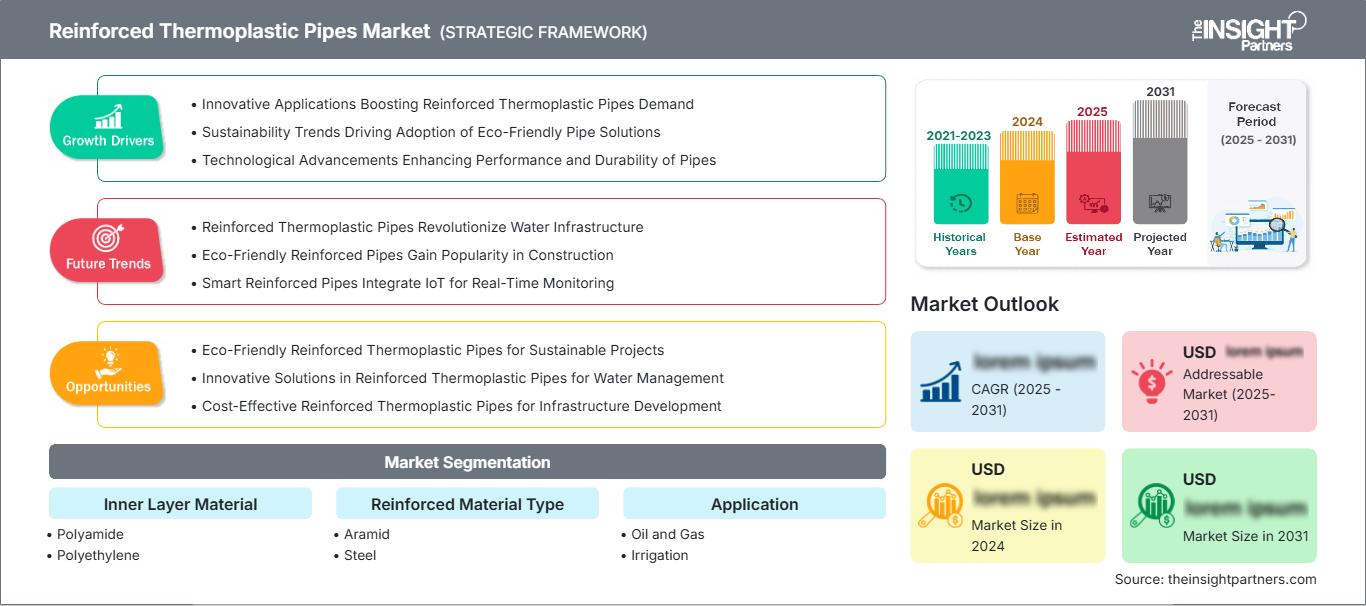
Reinforced Thermoplastic Pipes Market: Strategic Insights
Regional Insights
North America reinforced thermoplastic pipes market
North America is modeled at 30–34% of the global reinforced thermoplastic pipes market revenue in 2025 and a 5.5–6.0% CAGR through 2034. The US is still the primary demand hub, enabled by oil and gas infrastructure, offshore exploration, processing, and refurbishment of existing metallic pipelines. Canada plays its part by supplying energy transmission services and remote infrastructure where light-weight installation could enhance the logistical process.
The economics of the project will benefit from the system that is not susceptible to any form of corrosion and also requires little handling in the field. Flexible and composite materials have been gaining ground as operators are considering these products in gathering, flowline, water injection and many other applications where steel material is relatively expensive in terms of coating and maintenance. Regional reinforced thermoplastic pipes market share should therefore remain concentrated in technically qualified applications.
U.S. reinforced thermoplastic pipes Market
The US is modeled to represent 60–65% of North American reinforced thermoplastic pipes market revenue in 2025 and to grow at 5.6–6.1% through 2034. Demand focuses on oil and gas, industrial water, chemical processing, and replacement of infrastructure, with specific suppliers and engineering contractors being there for the process of qualifying.
More and more, application focus becomes more inclined towards the use of lighter pipe systems for difficult terrain, offshore connections, and installation processes where dealing with risks of corrosion is expensive. Firms like TechnipFMC plc, Magma Global Limited, Wellstream Flexibles, et al, are exposed to the technology, while regional firms try to gain the upper hand through engineering knowledge and flexibility.
Europe reinforced thermoplastic pipes Market
Europe is modeled at 25–29% share OF THE reinforced thermoplastic pipes market in 2025 and 4.9–5.4% CAGR through 2034, with the UK and Norway prominent in offshore applications. Germany, France, Italy, and Spain pose requirements related to industries, water, construction, and energy applications. The technical standards and the principles of sustainability in this region support the adoption of corrosion-resistant materials, although qualification procedures may prolong the process of purchase.
The UK is relevant in terms of North Sea cases, where flexible and composite systems will make the installation of subsea structures simpler. Germany provides industrial capacities together with the engineering expertise and knowledge of materials. France, Italy, and Spain make their requirements known through industrial capacity, water sources, energy generation, and special constructions.
APAC reinforced thermoplastic pipes Market
APAC is modeled at 27–31% share in 2025 and 6.1–6.6% CAGR through 2034. China dominates the regional market, followed by India, Japan, South Korea, and Australia. Industrial development, offshore resources, water infrastructures, and irrigation facilities provide various application avenues for reinforced solutions.
China brings together industrial scale and big infrastructural needs, while India is looking to develop its water and industrial capacities. Japan and South Korea focus on engineering reliability, and Australia offers prospects in mining, water, and energy projects. The policy priority of infrastructural resiliency and resource effectiveness encourages the implementation of reinforced solutions.
Middle East & Africa reinforced thermoplastic pipes Market
Middle East and Africa reinforced thermoplastic pipes market demand is modeled at a 5.2–5.7% CAGR through 2034, led by Saudi Arabia, with the UAE and South Africa also significant. Energy projects, water scarcity, desalination, irrigation, and industrial infrastructure create requirements for corrosion-resistant piping under demanding operating conditions.
Saudi Arabia and the UAE provide strong project pipelines linked to energy and water infrastructure, while South Africa adds mining and municipal applications. The rest of MEA remains project-specific, with adoption influenced by financing, local content, logistics, and technical support. Lightweight pipe systems can be valuable where installation access is constrained or corrosion exposure increases maintenance requirements.
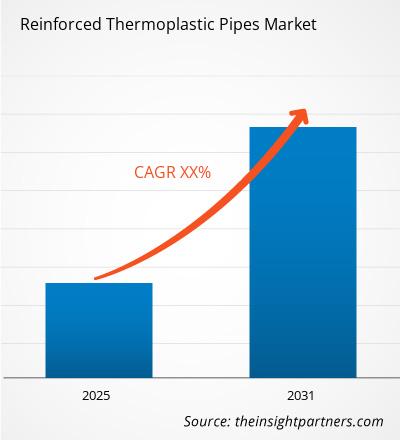
Segmentation Analysis
Inner Layer Material
The Inner Layer Material segment is modeled at a 5.3–5.7% CAGR from 2026–2034. Material selection is governed by chemical compatibility, pressure, temperature, permeation resistance, and joining behavior. Polyamide is positioned for demanding hydrocarbon service, while polyethylene supports broader cost-sensitive applications and established installation practices. This segment defines much of the pipe's fluid-contact performance and influences qualification requirements.
- Polyamide: Polyamide supports applications requiring strong chemical resistance and dimensional stability. Its strategic value increases where pressure, temperature, and hydrocarbon exposure create performance requirements beyond conventional polyethylene capability.
- Polyethylene: Polyethylene benefits from established processing, welding familiarity, chemical resistance, and broad availability. It remains important for water, irrigation, and selected energy applications requiring practical installation economics.
Reinforced Material Type
The Reinforced Material Type segment is modeled at a 5.7–6.1% CAGR from 2026–2034. Reinforcement determines pressure capacity, axial strength, fatigue behavior, and flexibility. Aramid supports lightweight high-performance designs, while steel remains relevant where established mechanical strength, qualification pathways, and cost structures favor metallic reinforcement. The reinforced thermoplastic pipes market scope is therefore strongly linked to reinforcement selection.
- Aramid: Aramid enables high strength with low weight and strong flexibility. Its strategic importance is increasing in offshore and difficult-access projects where reduced handling loads can improve installation efficiency.
- Steel: Steel reinforcement remains relevant where high mechanical strength, established qualification procedures, and familiar engineering practices dominate procurement decisions. It is particularly suited to demanding pressure applications requiring proven structural behavior.
Capacity
The Capacity segment is modeled at a 5.1–5.5% CAGR from 2026–2034. Capacity selection follows flow requirements, pressure conditions, project geometry, and end-use economics. Smaller configurations address specialized transfer duties, while larger systems are associated with higher-volume industrial and energy applications.
- Below 1 GPM: Small-capacity systems address specialized fluid handling requirements where compact dimensions, flexibility, and precise flow control are more important than large-volume conveyance.
- 1 - 3 GPM: This range serves moderate-flow requirements and can support compact industrial, water, and process applications where installation flexibility and material durability influence specification.
- 3 - 6 GPM: Mid-range capacity supports broader industrial and infrastructure duties, balancing flow requirements with manageable pipe dimensions, reinforcement needs, and installation economics.
- Above 6 GPM: Higher-capacity systems are strategically relevant for demanding fluid-transfer applications where structural performance, pressure management, and reliable long-distance conveyance influence project design.
Application
The Application segment is modeled at a 5.6–6.0% CAGR from 2026–2034. Oil and gas remain the largest demand base, while irrigation provides an important expansion pathway. Industrial and water projects broaden the addressable market as owners evaluate corrosion resistance and installation economics.
- Oil and Gas: Oil and gas remain the principal application because offshore flowlines, risers, gathering systems, and injection services can benefit from flexibility, corrosion resistance, and reduced installation complexity.
- Irrigation: Irrigation demand is supported by water-efficiency programs and infrastructure modernization. Flexible, lightweight systems can simplify installation across agricultural areas and reduce exposure to corrosion in challenging soil and water conditions.
Opportunity Snapshot
| Application | Revenue Contribution | Trend Tag | Adoption Stage |
| Oil and Gas | High | Offshore Flowlines | Mature |
| Irrigation | Medium | Water Efficiency | Scaling |
Reinforced Thermoplastic Pipes Market Growth Drivers and Impact Analysis
Corrosion avoidance in demanding fluid-service environments
Corrosion avoidance directly affects pipeline availability, inspection frequency, and maintenance expenditure, especially in offshore, saline, chemically aggressive, and water-intensive environments. Reinforced thermoplastic systems can separate conveyed fluids from structural reinforcement through engineered barrier layers, reducing exposure to corrosion mechanisms associated with metallic pipe. The impact is strongest where coating degradation, cathodic protection, or replacement access creates substantial operating complexity. For project developers, the economic benefit is evaluated through total installed and lifecycle cost rather than material price alone. This encourages suppliers to demonstrate validated pressure performance, fatigue resistance, chemical compatibility, and connection integrity. As asset owners increasingly prioritize reliability and predictable maintenance, nonmetallic solutions can gain consideration in applications previously dominated by steel.
Lower installation weight and improved project logistics
Weight reduction can materially change project execution in remote, offshore, and constrained locations because lighter pipe requires less lifting capacity, transportation effort, and handling infrastructure. Reinforced thermoplastic designs can be manufactured in long lengths or flexible configurations, potentially reducing field joints and associated installation activities. The resulting impact is not uniform because project savings depend on diameter, pressure class, terrain, water depth, and installation method. Nevertheless, engineering contractors increasingly evaluate pipe systems using complete installation scenarios rather than component prices. Suppliers that provide qualified reels, connectors, handling procedures, and installation engineering can capture more project value. This driver also supports applications where construction windows are short and rapid deployment is important.
Expansion of nonmetallic infrastructure for water and irrigation
Water scarcity, agricultural productivity requirements, and infrastructure renewal are expanding the need for durable fluid conveyance systems. Irrigation networks can face corrosion, sediment, difficult terrain, and repeated maintenance, making material selection important for operating continuity. Reinforced thermoplastic pipes can offer flexibility, chemical resistance, and relatively low handling weight that suits selected irrigation and water-transfer projects. The market impact is strongest where installation labor and access represent meaningful portions of total project expenditure. Public infrastructure programs, agricultural modernization, and private water investment can therefore create a broader demand base beyond hydrocarbons. Suppliers with established joining methods, local service networks, and compatible fittings can improve adoption by reducing technical uncertainty for contractors and asset owners.
Reinforced Thermoplastic Pipes Market Future Trends
Digital qualification and performance-based pipe design
Reinforced thermoplastic pipes market trends are likely to move toward digital qualification, integrated simulation, and performance-based design. More often than not, manufacturers will be able to incorporate finite element analysis, fatigue analysis, materials characterization, and field data to design the best reinforcement configurations prior to physical qualification. With the use of digital engineering, development cycles of customized pipe systems will be shortened for applications, allowing comparison of scenarios relating to pressure, temperature, fatigue, and installation on the basis of uniform datasets. In the long run, digital twins and sensor-based condition monitoring can provide condition assessment for select high-value installations. This has implications for the move away from standard products to defined performance envelopes.
Higher-performance polymer and hybrid reinforcement architectures
Material advancements in the future will focus on increased temperatures for polymers, better barriers, hybrid reinforcement, and flexible manufacturing. The polyamides and polyethylenes will both continue to be utilized for different needs of performance and cost, whereas advanced composites can increase the operational range for the more demanding energy applications. Hybrid reinforcement can combine the high strength of metals with the lighter weight of fibers, although there is an issue of difficulty in qualifying this composite. It is also possible that manufacturers will design the thickness of the materials and winding patterns in order to decrease the usage of materials without decreasing fatigue performance. This material can be used for offshore flow lines, water injections, industrial fluid handling, and irrigation.
Reinforced Thermoplastic Pipes Market Opportunities
Localized manufacturing for emerging energy and water projects
Localization manufacturing provides an investment avenue where transport costs, local content regulations, and implementation time periods limit the use of imported pipe systems. Local manufacturing has the potential to cut down on implementation time while providing flexibility to tailor reinforcement, lining materials, connection techniques, and installation services to the local environment. The best areas to target are probably the Middle East, Asia-Pacific regions, and certain parts of Africa where construction of energy, irrigation, and industrial facilities projects generate continuous demand. It is important for the investor to consider how close they are to polymer and reinforcement manufacturers, qualification laboratories, qualified manpower, and large engineering firms.
Engineering-led solutions for difficult-access applications
The reinforced thermoplastic pipes market Forecasts indicate opportunity for engineering-led solutions in projects where installation access, corrosion, or weight materially affects economics. A supplier can gain an advantage by offering a complete package that involves the design of the pipe, its connections, installation tools, field supervision, testing, and life cycle services. Such a strategy is especially applicable for offshore and subsea applications, industrial and mining applications, and water transfer where the selection of pipes cannot be divorced from the installation methodology. Companies that invest in qualification databases and application engineering can help reduce the customer decision-making time cycle and provide evidence of benefits to their projects. Building strategic alliances with EPCs, operators, and infrastructure developers could help influence specifications even before the procurement process begins.
Frequently Asked Questions

- Comprehensive Market Sizing and Forecast Analysis
- Detailed Segmentation Analysis
- In-Depth Market Dynamics Assessment
- Regional and Country-Level Insights
- Competitive Landscape and Company Benchmarking
- Strategic Business Intelligence
Recent Reports
Testimonials

The Insight Partners' SCADA System Market report is comprehensive, with valuable insights on current trends and future forecasts. The team was highly professional, responsive, and supportive throughout. We are very satisfied and highly recommend their services.
RAN KEDEM Partner, Reali Technologies LTDs
I requested a report on a very specific software market and the team produced the report in a few days. The information was very relevant and well presented. I then requested some changes and additions to the report. The team was again very responsive and I got the final report in less than a week.
JEAN-HERVE JENN Chairman, Future Analytica
We worked with The Insight Partners for an important market study and forecast. They gave us clear insights into opportunities and risks, which helped shape our plans. Their research was easy to use and based on solid data. It helped us make smart, confident decisions. We highly recommend them.
PIYUSH NAGPAL Sr. Vice President, High Beam Global
The Insight Partners delivered insightful, well-structured market research with strong domain expertise. Their team was professional and responsive throughout. The user-friendly website made accessing industry reports seamless. We highly recommend them for reliable, high-quality research services
YUKIHIKO ADACHI CEO, Deep Blue, LLC.
This is the first time I have purchased a market report from The Insight Partners.While I was unsure at first, I visited their web site and felt more comfortable to take the risk and purchase a market report.I am completely satisfied with the quality of the report and customer service. I had several questions and comments with the initial report, but after a couple of dialogs over email with their analyst I believe I have a report that I can use as input to our strategic planning process.Thank you so much for taking the extra time and making this a positive experience.I will definitely recommend your service to others and you will be my first call when we need further market data.
JOHN SUZUKI President and Chief Executive Officer, Board Director, BK Technologies
I wish to appreciate your support and the professionalism you displayed in the course of attending to my request for information regarding to infectious disease IVD market in Nigeria. I appreciate your patience, your guidance, and the fact that you were willing to offer a discount, which eventually made it possible for us to close a deal. I look forward to engaging The Insight Partners in the future, all thanks to the impression you have created in me as a result of this first encounter.
DR CHIJIOKE ONYIA MANAGING DIRECTOR, PineCrest Healthcare Ltd.Reason to Buy
- Informed Decision-Making
- Understanding Market Dynamics
- Competitive Analysis
- Identifying Emerging Markets
- Customer Insights
- Market Forecasts
- Risk Mitigation
- Boosting Operational Efficiency
- Strategic Planning
- Investment Justification
- Tracking Industry Innovations
- Aligning with Regulatory Trends





 Get Free Sample for