
Rice Polishers Market Size, Demand & Growth by 2034
Coverage: By Type (Vertical, Horizontal); Capacity (Low, Medium, High) , and Geography (North America, Europe, Asia Pacific, and South and Central America)
- Status : Data Released
- Report Code : TIPRE00018750
- Category : Manufacturing and Construction
- No. of Pages : 150
- Available Report Formats :


- Last update date : September 17, 2026


2025 Market Size
US$ 1.4 Bn
Base year value
2034 Forecast
US$ 2.25 Bn
Projected by 2034
CAGR 2026-2034
5.44 %
Growth rate
Addressable Market
US$ 16.57 Bn
(2026-2034)
The rice polishers market is positioned as a specialized equipment category within the broader grain-processing machinery ecosystem. The market is valued at US$ 1.4 Billion in 2025 and is projected to reach US$ 2.25 Billion by 2034, expanding at a CAGR of 5.44% from 2026 to 2034. Demand is supported by the modernization of rice mills, rising quality requirements, throughput optimization, and investment in automated post-harvest processing infrastructure across major rice-producing economies.
North American demand is shaped by premium rice consumption, automated food-processing facilities, replacement of aging milling equipment, and tighter requirements for consistency and process efficiency. The rice polishers market size is expected to expand at an estimated 3.8–4.6% CAGR between 2026 and 2034 in the region, supported by modernization projects, specialty rice processing, and investments in integrated milling systems.
Rice Polishers Market Assessment and Insights
- North America: North America is expected to hold a 10–14% share in 2025 and expand at a 3.8–4.6% CAGR between 2026–2034, supported by automated rice processing, specialty varieties, replacement demand, and quality-focused milling operations.
- US: The US is estimated to represent 72–78% of North America's 2025 share and grow at a 3.7–4.5% CAGR between 2026–2034, driven by premium rice processing and equipment modernization.
- Europe: Europe is projected to account for a 12–16% share in 2025 and advance at a 4.0–4.8% CAGR between 2026–2034, with Italy, Germany, France, Spain, and the UK supporting demand through food-processing automation.
- Asia Pacific: Asia Pacific is estimated to command a 52–58% share in 2025 and register a 5.8–6.6% CAGR between 2026–2034, led by India, China, Japan, Vietnam, Indonesia, and Thailand.
- Largest Segment: Horizontal equipment is estimated to hold a 58–64% market share in 2025, with a 5.1–5.8% CAGR from 2026–2034, reflecting suitability for continuous, high-throughput milling.
- High Growth Segment: High-capacity equipment is projected to represent 31–37% share in 2025 and expand at a 6.0–6.8% CAGR from 2026–2034, supported by commercial mill expansion.
- Key companies analyzed in detail: AGI (Ag Growth International Inc.), Bühler Holding AG, F.H. SCHULE Mühlenbau GmbH, FOCUS CO., LTD, IROM Italia, Lee-Hwa Industry Co., Lianyungang Huantai Machinery Co., Ltd., Marco Technologies Corporation, SATAKE CORPORATION, and TW Grandeur Machinery Co., Ltd.
Source: The Insight Partners' analysis based on proprietary research, government publications, company annual reports, investor presentations, industry databases, and expert interviews.
The technology used in rice polishing has shifted from highly mechanically intensive systems to those with more emphasis on pressure control, grain temperature regulation, increased head rice extraction, and systems that incorporate optical sorting with conveyance. The rice polishing equipment manufacturers have been designing their equipment according to the particular rice variety and output capacity required. These trends are likely to affect the specification of equipment, facility layout, maintenance considerations, and purchasing considerations in commercial/export rice mills.
Investments in the future are expected to be in systems that will combine polishing, grading, sorting, weighing, and process monitoring. The new rice processing capacity being established in the South and Southeast Asia region is likely to continue to be significant, while Africa and the Middle East represent regions with selective opportunities due to food security policies for milling rice locally.
Rice Polishers Market Report Scope
| Report Attribute | Details |
|---|---|
| Market size in 2025 | US$ 1.4 Billion |
| Market Size by 2034 | US$ 2.25 Billion |
| Global CAGR (2026 - 2034) | 5.44% |
| Historical Data | 2021-2024 |
| Forecast period | 2026-2034 |
Rice Polishers Market Analysis
The rice polishers market growth is closely connected with global rice-processing volumes, mill modernization, and the need to increase the commercial value of milled grain. USDA data for 2024/25 places global milled rice production at more than 537 million metric tons, with India and China accounting for the largest individual production volumes. There is an enormous equipment inventory to replace, upgrade, and expand capacity.
The value chain consists of paddy growers, collectors, rice mills, machinery makers, engineering firms, equipment distributors, equipment maintainers, and equipment exporters. The polishers' sales are therefore impacted not by rice production but by rice mills' use. Machinery suppliers are therefore competing not on price but on product quality, durability, low breakage rate, easy parts access, automation capabilities, and service.
Competitive positioning is increasingly determined by engineering depth, complete-line integration, process know-how, and after-sales support. The rice polishers market analysis indicates that established suppliers can differentiate through compatibility with huskers, whiteners, graders, optical sorters, and computerized plant controls. SATAKE CORPORATION and Bühler Holding AG maintain broad grain-processing capabilities, while F.H. SCHULE Mühlenbau GmbH and specialist manufacturers address specific milling configurations and customer requirements.
Investment is also shifting toward digital monitoring and efficiency improvements rather than capacity alone. AGI (Ag Growth International Inc.) benefits from its wider grain-handling ecosystem, while Lee-Hwa Industry Co., IROM Italia, Lianyungang Huantai Machinery Co., Ltd., and TW Grandeur Machinery Co., Ltd. compete through specialized equipment and regional relationships. FOCUS CO., LTD, Marco Technologies Corporation, and other suppliers can strengthen positioning through customization, service responsiveness, and smaller-scale mill solutions.
● REPORT CUSTOMIZATION
Tailor This Report To Align With Your Specific Business Requirements
This report can be customized to align precisely with your business objectives, scope, and target markets. Customization options include tailored segmentation, geography, competitive analysis, and strategic insights to support informed decision-making.
Customize This Report →WHAT YOU CAN ADJUST
- ● Segmentations
- ● Geography
- ● Competitive Analysis
- ● Language Preferences
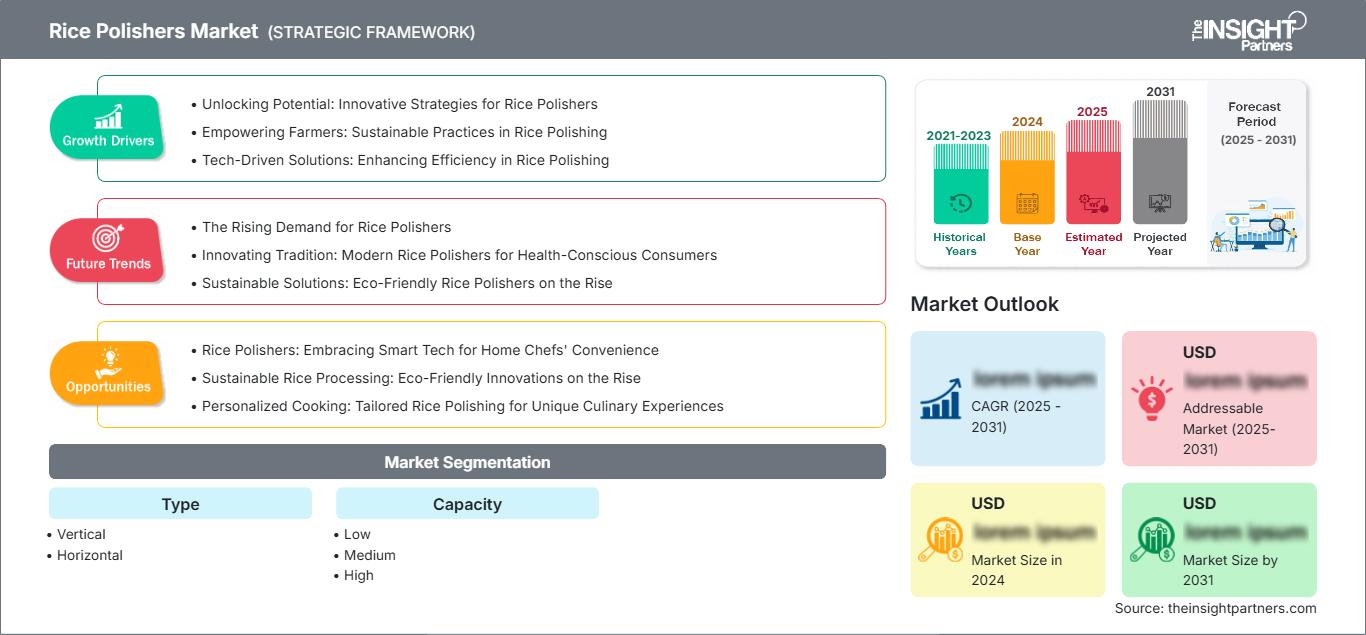
Rice Polishers Market: Strategic Insights
Regional Insights
North America rice polishers market
North America is estimated to represent 10–14% of the 2025 global rice polishers market share and expand at a 3.8–4.6% CAGR through 2034. The United States dominates regional demand because of its commercial rice industry, automated milling infrastructure, and established processing base. Canada contributes smaller volumes through specialty food processing and imported rice handling. Replacement cycles and modernization remain important purchasing factors.
Regional mills increasingly prioritize equipment that improves consistency, reduces grain damage, and integrates with automated sorting and grading. Demand is also supported by premium and specialty rice categories, where appearance and milling quality directly influence selling prices. Suppliers with North American service capabilities can benefit from retrofit projects, spare parts requirements, and equipment upgrades. Mexico provides an additional opportunity as food-processing investments increase and domestic rice handling infrastructure develops.
U.S. rice polishers Market
The US is estimated to account for 72–78% of North America's 2025 share and grow at a 3.7–4.5% CAGR through 2034. In general, commercial rice processors prefer to use automation machinery that has the capability of producing uniform quality even for long periods of production. The market requirement involves large rice mills and processing units for both domestic and export purposes.
Trends in application involve efficient polishing capabilities, controlled grain handling, reduced breakage and integration with optical sorting technology. Leading companies worldwide have established their presence in the market through distributors, design partners and direct customers. Rice processing machinery acquisition is now based on total cost of ownership, maintenance, energy consumption and integration with process controls.
Europe rice polishers Market
Europe is estimated to hold 12–16% of the global 2025 share and expand at a 4.0–4.8% CAGR through 2034, with Italy representing a leading equipment and rice-processing center. Germany, France, Spain, and the UK are involved in food processing, machinery production, the consumption of specialty rice, and technological milling processes.
The UK and Germany focus on food-processing facilities automation, machine efficiency, hygiene, and compatibility with the digital plant management system. The benefit of Italy is the presence of rice cultivation and processing industry in Italy, especially in the Po Valley region, providing opportunities for the demand for special milling machinery. France, Spain, and the UK provide more selective opportunities related to processors, distributors, and specialty products.
APAC rice polishers Market
APAC is estimated to command 52–58% of the global 2025 share and grow at a 5.8–6.6% CAGR through 2034, with India and China leading. Japan, South Korea, Vietnam, Thailand, Indonesia, and the Philippines also contribute substantial processing activity.
India benefits from high rice production and export-oriented milling, while China combines large domestic consumption with extensive processing capacity. Japan emphasizes quality and precision, whereas Southeast Asian markets prioritize throughput and modernization. Government initiatives supporting food security, post-harvest efficiency, export quality, and agricultural infrastructure provide additional demand catalysts. The region is expected to remain the leading geographic market throughout the forecast period.
Middle East & Africa rice polishers Market
The Middle East and Africa represent a smaller but developing equipment opportunity, with demand concentrated in Saudi Arabia, the UAE, South Africa, Egypt, Nigeria, and other importing or processing economies. The region is estimated to expand at a 4.6–5.5% CAGR through 2034, led by Saudi Arabia and selected African markets.
Food-security strategies, grain-storage investments, and expansion of local processing can encourage equipment procurement. Gulf countries primarily support modern food-processing infrastructure and re-export activity, while African markets present opportunities for compact and scalable milling systems. Suppliers that combine equipment with training, installation support, spare parts, and process optimization can address the operational constraints associated with emerging milling infrastructure.
Segmentation Analysis
Type
Type segmentation is shaped by plant configuration, throughput, floor-space availability, grain characteristics, and automation requirements. Horizontal configurations generally suit continuous commercial operations, while vertical designs can address space-constrained facilities and specific process arrangements. The rice polishers market scope across type categories is expected to expand as mills replace older machinery and seek improved recovery, process stability, and integration. The estimated CAGR for the Type segment is 5.1–5.8% from 2026–2034.
- Vertical: Vertical polishers are suited to installations where compact layouts and controlled material flow are important. They can support flexible plant configurations, particularly in smaller or specialized mills requiring efficient use of available floor space.
- Horizontal: Horizontal polishers remain important for continuous processing environments because their configuration supports high throughput, integration with conveying systems, and straightforward incorporation into larger automated milling lines.
Capacity
Capacity is a major purchasing criterion because mills balance throughput requirements against investment cost, utilization rates, facility size, and expected rice volumes. High-capacity systems are increasingly relevant to export-oriented and commercial mills, while lower-capacity machines remain important for decentralized and specialty operations. The estimated CAGR for Capacity is 5.3–6.1% from 2026–2034.
- Low: Low-capacity machines address smaller processors, decentralized mills, and specialty operations where moderate throughput, lower capital expenditure, and operational simplicity are more important than maximum production volume.
- Medium: Medium-capacity equipment serves regional mills requiring scalable output and reliable operation. This category offers a practical balance between investment requirements, production flexibility, maintenance accessibility, and integration with upstream and downstream machinery.
- High: High-capacity systems target large commercial mills and export-oriented facilities. Their strategic importance comes from continuous operation, high utilization, reduced processing bottlenecks, and improved economics when large paddy volumes must be handled consistently.
Opportunity Snapshot
| Capacity | Revenue Contribution | Trend Tag | Adoption Stage |
| Low | Medium | Compact Milling | Mature |
| Medium | High | Modular Throughput | Scaling |
| High | High | Export Milling | Scaling |
Rice Polishers Market Growth Drivers and Impact Analysis
Rising rice production and commercial milling volumes
More rice means an increased number of potential customers for polishing equipment, upgrading equipment, and replacement equipment. Based on the USDA forecasts, India would produce around 150 million metric tons of milled rice during the 2024/25 season, while China would produce more than 145 million metric tons of milled rice. High production levels do not guarantee high equipment sales automatically, but such levels raise the need for good processing of higher levels of installed capacity. Increased export volumes make the requirement for uniformity of grain color and recovery more urgent. For equipment producers, this situation helps to promote sales of replacement equipment, equipment capacity increases, and milling line modernization. The highest commercial effect could be obtained by equipment providers in Asia, where it is necessary to process high quantities of rice and control energy consumption, breakage, and quality variations.
Higher quality requirements and export-grade processing
The growing differentiation of products is made on account of the grain appearance, whiteness, quality, and the head-rice yield of the product. They play their role in determining the acceptability of the product for export and positioning, which becomes a motivation to improve the quality of the polishing process even without increasing the milling capacity. India provides evidence of how large this market is since its rice export amounts exceeded 20 million metric tons already by 2025. The effect does not apply exclusively to polishing machines because better performance is achieved via coordination with whiteners, graders, optical sorters, and conveyors. Companies that would be able to provide an optimal combination of equipment will have a greater impact on customers' decisions than mere suppliers of single machines.
Automation and lifecycle efficiency in milling facilities
Labor availability, maintenance costs, energy usage, and output uniformity are driving processors to automate their routine milling operations. Automated digital weighing, process instrumentation, controls, and sortation help operators identify issues and ensure a consistent output flow. Equipment suppliers are providing machines that are specifically engineered for ease of incorporation within automation frameworks. The practical implications are especially applicable to larger installations where small savings in yield or downtime can have significant annual production consequences. Automating enables opportunities in the after-market since existing equipment can be upgraded with sensors, controls, drives, and instrumentation without replacing entire production lines. Processors becoming increasingly concerned with total cost of ownership means that buyers will place greater emphasis on parts availability, service, energy efficiency, operator need, and existing infrastructure compatibility when making purchase decisions.
Rice Polishers Market Future Trends
AI-assisted process optimization and quality control
The rice polishers market trends are expected to increasingly incorporate data-driven process optimization as sensors, machine controls, and optical inspection systems become more connected. The future will include real-time data regarding temperature, moisture content, throughput, pressure, and milling efficiency that will provide recommendations on how to adjust the operation of systems. Integration with optical sorting and lab results might make it possible for processors to link machine setup with head rice yield and quality. This development will allow moving polishing from set operating parameters into adaptive processing. Manufacturers will find differentiating themselves in software solutions, connectivity, predictive maintenance, and performance reporting. The advantage of the change for processors will include lower variations in production batches and a better understanding of the performance of the equipment. Initially, this technology adoption might start in large commercial mills before entering the medium-scale processors.
Energy-aware and low-breakage equipment architectures
Future machine development is likely to emphasize lower energy intensity, controlled grain temperature, reduced mechanical stress, and improved recovery. Manufacturers will increasingly evaluate equipment performance using total process efficiency rather than nominal throughput alone. This approach could encourage redesign of friction surfaces, airflow arrangements, drives, bearings, pressure controls, and material-handling pathways. The rice polishers market will therefore become more closely linked with broader sustainability objectives within food processing. Processors may also seek machines capable of handling multiple varieties without lengthy changeovers, particularly where export portfolios contain several grain types. Vendors able to document performance under different operating conditions may gain an advantage during capital-equipment procurement. Over time, service contracts could incorporate energy monitoring, yield optimization, and remote diagnostics, creating recurring revenue opportunities alongside traditional equipment sales.
Rice Polishers Market Opportunities
Modernization of Asian commercial milling infrastructure
Asia offers the strongest investment opportunity because of its concentration of rice production, processing capacity, exports, and ongoing modernization requirements. India, China, Vietnam, Indonesia, Thailand, and the Philippines contain diverse mill populations ranging from small processors to highly automated export facilities. The rice polishers market Forecasts indicate that replacement demand should coexist with new capacity investment as processors seek higher recovery and consistent quality. Equipment suppliers can target this opportunity through modular machines that allow gradual expansion instead of requiring complete plant replacement. Local technical support, financing partnerships, standardized spare-parts inventories, and operator training can improve adoption. Manufacturers can also develop configurations tailored to basmati, long-grain, japonica, and other varieties. Such localization would help suppliers address differences in grain characteristics, mill size, operating practices, and capital availability across individual Asian markets.
Integrated retrofit solutions for established rice mills
There is a definite advantage in upgrading the plant itself as compared to competing only for greenfield operations. There are many mills where performance can be improved by replacing polishing units one at a time, adding automation to the control system, improving weigh-in/weigh-out systems, or linking the polishing with an optical sorter. The above will reduce the capital cost burden on the customer while enabling equipment manufacturers to build up a service relationship. The vendors must define retrofit programs to overcome various limiting factors. Rice polishers market opportunities can therefore extend beyond machine sales into engineering assessment, installation, commissioning, maintenance, and performance optimization. Suppliers with broad portfolios can bundle complementary equipment, while specialized manufacturers can partner with local integrators. The most attractive retrofit markets are likely to be established rice-processing clusters where existing facilities have sufficient throughput to justify incremental investment.
Frequently Asked Questions

- Comprehensive Market Sizing and Forecast Analysis
- Detailed Segmentation Analysis
- In-Depth Market Dynamics Assessment
- Regional and Country-Level Insights
- Competitive Landscape and Company Benchmarking
- Strategic Business Intelligence
Recent Reports
Testimonials

The Insight Partners provided valuable market intelligence that supported our global go-to-market strategy. Their team was professional, responsive, and attentive to our feedback, providing thoughtful analysis and helpful methodological clarifications throughout the project.
Junmo Kim Chief Financial Officer (CFO), Enertech Co., Ltd.
The Insight Partners' SCADA System Market report is comprehensive, with valuable insights on current trends and future forecasts. The team was highly professional, responsive, and supportive throughout. We are very satisfied and highly recommend their services.
RAN KEDEM Partner, Reali Technologies LTDs
I requested a report on a very specific software market and the team produced the report in a few days. The information was very relevant and well presented. I then requested some changes and additions to the report. The team was again very responsive and I got the final report in less than a week.
JEAN-HERVE JENN Chairman, Future Analytica
We worked with The Insight Partners for an important market study and forecast. They gave us clear insights into opportunities and risks, which helped shape our plans. Their research was easy to use and based on solid data. It helped us make smart, confident decisions. We highly recommend them.
PIYUSH NAGPAL Sr. Vice President, High Beam Global
The Insight Partners delivered insightful, well-structured market research with strong domain expertise. Their team was professional and responsive throughout. The user-friendly website made accessing industry reports seamless. We highly recommend them for reliable, high-quality research services
YUKIHIKO ADACHI CEO, Deep Blue, LLC.
This is the first time I have purchased a market report from The Insight Partners.While I was unsure at first, I visited their web site and felt more comfortable to take the risk and purchase a market report.I am completely satisfied with the quality of the report and customer service. I had several questions and comments with the initial report, but after a couple of dialogs over email with their analyst I believe I have a report that I can use as input to our strategic planning process.Thank you so much for taking the extra time and making this a positive experience.I will definitely recommend your service to others and you will be my first call when we need further market data.
JOHN SUZUKI President and Chief Executive Officer, Board Director, BK Technologies
I wish to appreciate your support and the professionalism you displayed in the course of attending to my request for information regarding to infectious disease IVD market in Nigeria. I appreciate your patience, your guidance, and the fact that you were willing to offer a discount, which eventually made it possible for us to close a deal. I look forward to engaging The Insight Partners in the future, all thanks to the impression you have created in me as a result of this first encounter.
DR CHIJIOKE ONYIA MANAGING DIRECTOR, PineCrest Healthcare Ltd.Reason to Buy
- Informed Decision-Making
- Understanding Market Dynamics
- Competitive Analysis
- Identifying Emerging Markets
- Customer Insights
- Market Forecasts
- Risk Mitigation
- Boosting Operational Efficiency
- Strategic Planning
- Investment Justification
- Tracking Industry Innovations
- Aligning with Regulatory Trends





 Get Free Sample for