
Robot Sensor Market Trends, Share & Demand by 2034
Coverage: by Product (Force Torque, Vision, Ultrasonic, Acoustical, Tactile, Laser Range, Proximity); Robot Type (Industrial, Service, Collaborative); Application (Manufacturing, Logistics, Defense, Agriculture, Medical, Domestic, Entertainment) , and Geography (North America, Europe, Asia Pacific, and South and Central America)
- Status : Data Released
- Report Code : TIPRE00010775
- Category : Electronics and Semiconductor
- No. of Pages : 150
- Available Report Formats :


- Last update date : September 07, 2026


2025 Market Size
US$ 8.95 Bn
Base year value
2034 Forecast
US$ 23.51 Bn
Projected by 2034
CAGR 2026-2034
11.32 %
Growth rate
Addressable Market
US$ 143.04 Bn
(2026-2034)
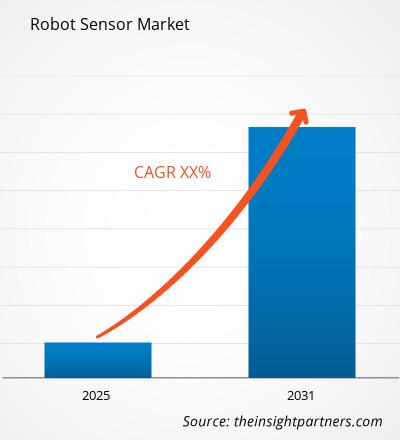
The robot sensor market is projected to grow from US$ 8.95 Billion in 2025 to US$ 23.51 Billion by 2034, registering a CAGR of 11.32% during 2026–2034. Demand is rising as robots require more accurate perception, force feedback, object recognition, collision avoidance, and environmental awareness across factories, warehouses, hospitals, farms, defense platforms, and domestic applications.
North America remains a high-value adoption region as manufacturers modernize plants, logistics operators automate fulfillment, and medical robotics developers integrate advanced perception stacks. The regional robot sensor market size is supported by installed automation capacity, skilled integrators, and rising edge AI deployment, with regional CAGR expected to remain in the 10.4–11.1% range through 2034.
Robot Sensor Market Assessment and Insights
- North America held an estimated 29–31% share in 2025 and is expected to grow at a CAGR of 10.4–11.1% between 2026–2034, supported by warehouse automation, reshoring, and medical robotics.
- US accounted for nearly 77–80% of North America in 2025, growing at 10.6–11.2% CAGR as robot density and factory AI vision investments expand.
- Europe represented 24–26% share in 2025 and is projected to grow at 9.8–10.6% CAGR, led by Germany, Italy, France, Spain, and the UK.
- Asia Pacific held 34–36% share in 2025 and is forecast to grow at 12.0–12.8% CAGR, with China, Japan, South Korea, and India leading volume deployment.
- Largest Segment: Vision sensors accounted for 32–35% market share in 2025 and are expected to grow at 10.8–11.6% CAGR because of inspection, bin picking, and guidance use cases.
- High Growth Segment: Force torque sensors held 13–16% share in 2025 and are forecast to grow at 12.5–13.4% CAGR as collaborative robots handle precision assembly and compliant motion.
- Key companies analyzed in detail: ams-OSRAM AG, ATI Industrial Automation, Inc., Balluff GmbH, Bionic Robotics GmbH, Baumer Holding AG, Carlo Gavazzi Holding AG, Cognex Corporation, CAPTRON Electronic GmbH, Datalogic S.p.A., and DAIHEN Corporation.
Source: The Insight Partners' analysis based on proprietary research, government publications, company annual reports, investor presentations, industry databases, and expert interviews.
Automation technology has progressed from a fixed movement approach to one involving adaptive robotic workcells, which use perception information. Perception such as vision, proximity, tactile, and force feedback, enables robots to understand variability in parts, re-route their movements, and adapt to non-deterministic objects. Thus, the robot sensor market growth would be related to quality control, flexible manufacturing systems, and safety for human-robot interaction and not just robot shipments.
In the forecasted period, the demand would move towards multi-sensor capability, embedded computing power and sensing systems for applications. The suppliers who can offer sensing systems along with calibration equipment, software and communication capabilities would be well placed. New geographies would contribute to the volume and developed geographies would look at higher value sensors that minimize downtimes and improve autonomous decision making.
Robot Sensor Market Report Scope
| Report Attribute | Details |
|---|---|
| Market size in 2025 | US$ 8.95 Billion |
| Market Size by 2034 | US$ 23.51 Billion |
| Global CAGR (2026 - 2034) | 11.32% |
| Historical Data | 2021-2024 |
| Forecast period | 2026-2034 |
Robot Sensor Market Analysis
Rising robot deployment in manufacturing, logistics, healthcare, agriculture, and defense is increasing demand for sensors that support perception, measurement, and real-time control. Industrial robots installed worldwide reached high deployment levels in 2024, and automation density continued to rise across major regions. This creates a broader installed base requiring vision, proximity, ultrasonic, laser range, tactile, and force feedback technologies.
The value chain includes semiconductor suppliers, optical component makers, sensor manufacturers, robot OEMs, system integrators, and end users. robot sensor market analysis indicates that buyers increasingly evaluate accuracy, ruggedness, latency, integration time, and lifecycle support together. Edge processing and IO-Link connectivity are becoming important differentiators because they reduce cabling complexity and enable predictive maintenance.
The competitive positioning will be influenced by the level of specialization in the companies' operations. While Cognex Corporation maintains its position as a leading company for machine vision and AI-enabled inspection, ATI Industrial Automation, Inc. will continue to lead in force torque and robotic tooling. Balluff GmbH, Baumer Holding AG, CAPTRON Electronic GmbH and Datalogic S.p.A will maintain their dominance in automation sensing, automation identifying, and detecting.
Companies will invest in AI vision platform, smart ultrasonic module, 3D perception systems, and smaller force feedback for cobots. Integrators are showing a preference for firms offering validated application libraries and faster commissioning software tools. In addition, the demand for sensor fusion is high since vision sensors, tactile, and distance sensors will enhance robots' autonomy.
● REPORT CUSTOMIZATION
Tailor This Report To Align With Your Specific Business Requirements
This report can be customized to align precisely with your business objectives, scope, and target markets. Customization options include tailored segmentation, geography, competitive analysis, and strategic insights to support informed decision-making.
Customize This Report →WHAT YOU CAN ADJUST
- ● Segmentations
- ● Geography
- ● Competitive Analysis
- ● Language Preferences
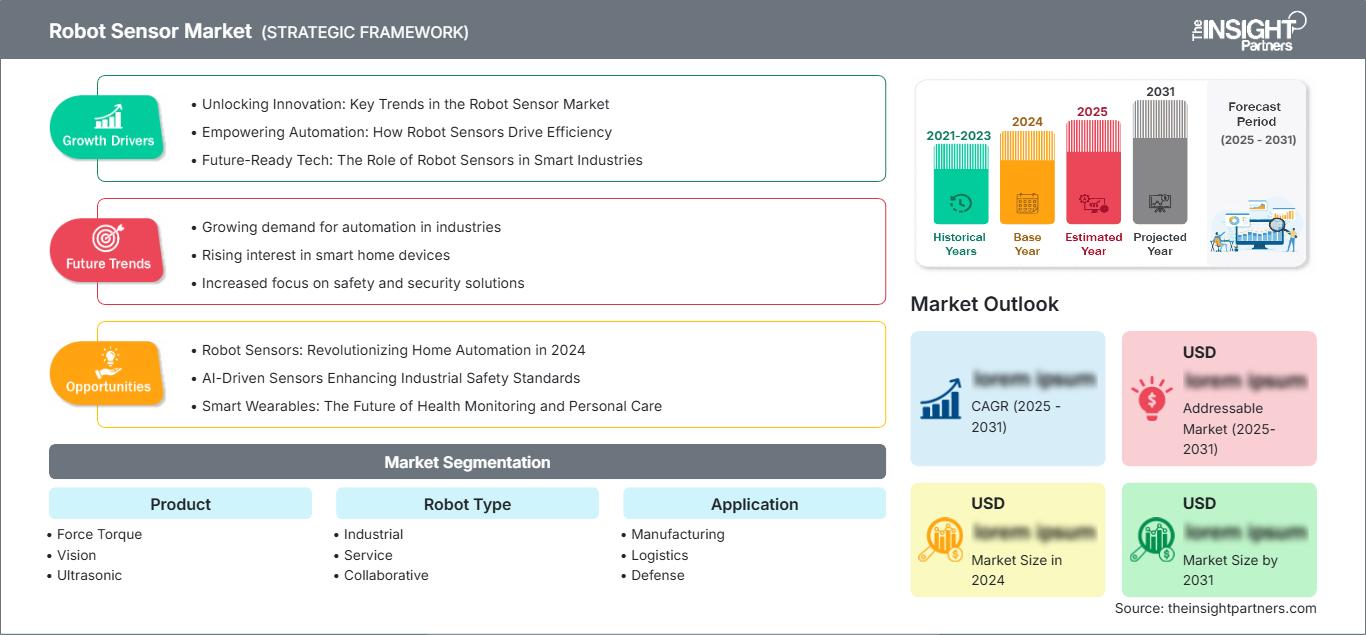
Robot Sensor Market: Strategic Insights
Regional Insights
North America robot sensor market
North America held an estimated 29–31% robot sensor market share in 2025, supported by automated warehousing, automotive manufacturing, electronics assembly, and medical robotics. The region benefits from strong system integration capabilities and high adoption of machine vision. Robot density improvements across the US and Canada strengthen demand for sensors that improve throughput and worker safety.
Regional CAGR is expected to remain in the 10.4–11.1% range during 2026–2034. Demand is concentrated in vision-guided robotics, autonomous mobile robots, collaborative applications, and precision force control. Manufacturers are prioritizing shorter commissioning cycles, while logistics companies require reliable sensors for parcel handling, navigation, barcode reading, and palletizing in high-speed environments.
U.S. robot sensor Market
The US represented around 77–80% of North America Robot Sensor market in 2025 and is expected to grow at a CAGR of 10.6–11.2% through 2034. Adoption is led by automotive, electronics, food processing, healthcare, and logistics users seeking higher throughput and consistent quality. Vision sensors are widely used for inspection and guidance, while force torque sensing supports collaborative assembly.
The company's presence in the US also supports domestic innovation. Cognex Corporation and ATI Industrial Automation, Inc. provide application-specific solutions for vision and force feedback, while global automation suppliers serve large manufacturing and warehouse users. The market is shifting from stand-alone sensing devices to connected perception systems that provide usable data for robotic control software.
Europe robot sensor Market
Europe held an estimated 24–26% share of the North America Robot Sensor market in 2025 and is expected to grow at 9.8–10.6% CAGR during 2026–2034. Germany remains the leading country because of its automotive, machinery, and electronics automation. Italy and France contribute through industrial machinery and packaging, while Spain and the UK show demand for warehouse, food, and medical automation.
European buyers place high importance on reliability, safety compliance, and interoperability. The region’s dense industrial base supports demand for proximity, vision, tactile, and laser range devices. Companies such as Balluff GmbH, Baumer Holding AG, CAPTRON Electronic GmbH, and Datalogic S.p.A. benefit from established automation networks and demand for sensors that withstand harsh factory environments.
APAC robot sensor arket Market
APAC accounted for approximately 34–36% share of the North America Robot Sensor market in 2025 and is expected to grow at 12.0–12.8% CAGR through 2034. China leads regional volume, followed by Japan, South Korea, India, and Australia. Electronics manufacturing, automotive automation, semiconductor handling, and warehouse robotics are the strongest demand areas.
Policy support for smart manufacturing and local robotics supply chains is accelerating adoption. China’s large industrial robot base creates scale demand for vision, proximity, and laser range devices, while Japan and South Korea emphasize precision and quality. India is an emerging growth market as industrial automation expands beyond automotive into electronics, pharmaceuticals, and logistics.
Middle East & Africa robot sensor Market
The Middle East & Africa North America Robot Sensor market is expected to grow at 8.7–9.5% CAGR during 2026–2034. Saudi Arabia and the UAE lead adoption through logistics automation, smart infrastructure, energy projects, and industrial diversification. South Africa remains the most established manufacturing automation base in the region.
Demand is still smaller than in North America, Europe, and APAC, but opportunity is rising where robots support dangerous inspection, oil and gas operations, warehousing, and infrastructure maintenance. Sensor suppliers can gain traction by offering rugged products, local integration partnerships, and support for mobile robots operating in dusty or high-temperature environments.
Segmentation Analysis
Product
Product is expected to grow at a CAGR of 11.0–11.8% during 2026–2034 as robots require multiple sensing layers for perception, navigation, measurement, and manipulation. The robot sensor market scope across product categories is expanding as users combine vision with proximity, tactile, laser range, ultrasonic, and force feedback to improve autonomy and process reliability.
- Force Torque sensors are gaining importance in collaborative assembly, polishing, grinding, and medical robotics where controlled contact, compliant motion, and accurate load feedback directly affect process safety and quality.
- Vision sensors remain the largest product family because robots need object detection, inspection, localization, barcode reading, and guidance capabilities across production lines, warehouses, and packaging environments.
- Ultrasonic sensors support distance measurement and obstacle detection in mobile robots and handling systems, especially where lighting conditions, dust, or transparent materials limit vision-only performance.
- Acoustical sensors are used in diagnostic, monitoring, and specialized detection applications where robots need sound-based feedback to identify abnormal machinery behavior or process condition changes.
- Tactile sensors add touch perception for gripping, manipulation, and human-robot interaction, helping robots handle fragile or irregular objects with lower damage risk.
- Laser Range sensors enable precise mapping, distance measurement, and navigation in autonomous mobile robots, warehouse platforms, and industrial inspection systems requiring repeatable spatial awareness.
- Proximity sensors provide essential object presence, collision avoidance, and positioning feedback, supporting reliable robot operation in compact cells and high-speed automation environments.
Robot Type
Robot Type is projected to grow at 10.9–11.7% CAGR during 2026–2034. Industrial robots account for the largest installed base, service robots expand sensing needs in public and professional spaces, and collaborative robots create premium demand for force, proximity, tactile, and vision devices that support safe shared workspaces.
- Industrial robots require rugged, high-speed sensors for welding, assembly, inspection, material handling, and machine tending, with buyers focused on uptime, precision, and integration with existing control systems.
- Service robots rely on sensors for navigation, obstacle avoidance, recognition, and environmental adaptation across healthcare, cleaning, delivery, inspection, hospitality, and public-facing applications.
- Collaborative robots use force, torque, tactile, proximity, and vision sensors to improve safety, hand guidance, flexible deployment, and precision tasks performed near human workers.
Application
According to the Robot Sensor Market Report, the Application segment is expected to grow at 11.2–12.0% CAGR through 2034 as robotics shifts from isolated production cells to broader operational workflows. Manufacturing remains the largest application, while logistics, medical, defense, agriculture, domestic, and entertainment uses diversify sensor requirements across mobility, manipulation, imaging, and safety functions.
- Manufacturing requires vision, proximity, force, and laser sensors for inspection, assembly, welding, painting, quality control, tool changing, and adaptive handling in flexible production environments.
- Logistics uses sensors for navigation, parcel identification, palletizing, obstacle avoidance, and warehouse automation, where throughput, accuracy, and system uptime are essential performance metrics.
- Defense applications need rugged sensors for unmanned systems, surveillance, explosive handling, inspection, and remote operations where reliability under harsh conditions is critical.
- Agriculture robots use vision, laser range, and tactile feedback for crop monitoring, harvesting, spraying, soil assessment, and autonomous navigation across uneven outdoor environments.
- Medical robots depend on precise force feedback, imaging, proximity, and tactile sensing for minimally invasive procedures, rehabilitation, laboratory automation, and patient-support applications.
- Domestic robots require compact and cost-efficient sensors for navigation, object avoidance, cleaning, monitoring, and interaction in homes with changing layouts and unpredictable obstacles.
- Entertainment robots use tactile, vision, proximity, and acoustic sensing to support interactive exhibits, education, amusement, and consumer engagement applications requiring responsive behavior.
Opportunity Snapshot
| Application | Revenue Contribution | Trend Tag | Adoption Stage |
| Manufacturing | High | Adaptive Cells | Mature |
| Logistics | High | AMR Navigation | Scaling |
| Defense | Medium | Rugged Autonomy | Scaling |
| Agriculture | Medium | Crop Robotics | Emerging |
| Medical | Medium | Precision Assist | Scaling |
| Domestic | Low | Home Mapping | Scaling |
| Entertainment | Low | Interactive Motion | Emerging |
Robot Sensor Market Growth Drivers and Impact Analysis
Expansion of vision-guided and adaptive robotics
In factories and warehouse systems, there is a shift from fixed automation to robotics capable of detecting, inspecting, picking, placing, and aligning components with minimum human interaction. This leads to an increase in the need for vision sensors, laser range finders, proximity sensors, and on-chip intelligence. This affects sectors like the electronics industry, the automobile industry, packaging, and logistics because of the variability in their products.
Growth in collaborative robot deployment
Collaborative robots rely on sensor technology, which increases the safety and efficiency of collaborative tasks. Force torque sensors, tactile sensors, proximity sensors, and vision sensors enable cobots to detect physical contact, control their grasp, and move along programmed paths or stop as necessary. The driver increases the use of cobots by small and medium-sized businesses requiring flexible automation without the need for huge safety enclosures.
Need for predictive maintenance and operational data
Robotics is now becoming part of the data networks of factories, thus creating a greater need for sensors beyond just control applications. The ability of sensors to provide condition-based monitoring, vibration detection, thermal feedback, and diagnostic information is vital for enabling the maintenance team to anticipate any breakdowns and avoid unscheduled downtime. In terms of this driver, there is a growing need for intelligent sensors with capabilities for digital communications and software.
Robot Sensor Market Future Trends
Sensor fusion for higher autonomy
robot sensor market trends indicate a shift from single-function devices toward sensor fusion architectures that combine vision, force, tactile, ultrasonic, and laser range data. Robots will use this combined input to interpret surroundings more accurately, especially in unstructured environments. Sensor fusion will be critical for mobile manipulation, autonomous forklifts, humanoid platforms, and medical support robots because these systems need reliable decisions under changing lighting, surface, and object conditions.
Edge AI embedded in sensing hardware
More sensors will use local computation to analyze data prior to transmitting information to controllers for the robots. Embedded artificial intelligence cuts down on latency and minimizes external computing power requirements. This is already being seen in visual systems using AI training and inspection platforms, and is expected to be adopted by tactile, acoustic, and monitoring sensors as well.
Robot Sensor Market Opportunities
Application-specific sensor packages for logistics automation
robot sensor market forecasts point to a strong opportunity in warehouses where autonomous mobile robots, robotic palletizers, and parcel sorting systems require dependable sensing packages. Suppliers can increase value by offering pre-integrated bundles combining vision, barcode reading, laser range, and proximity sensing. Logistics users prefer solutions that reduce deployment time and support high parcel variability. Partnerships with AMR makers and system integrators can accelerate adoption in fulfillment centers and third-party logistics networks.
Precision sensing for medical and laboratory robotics
Automation of the medical industry, laboratories, and life sciences holds a lot of value because there is a need for accuracy and controlled force. Force, torque and touch sensors have a variety of applications such as assisting surgery, rehabilitation, handling samples and automating tests. Suppliers who can meet all standards and requirements are entitled to high prices. Development of the technology will be driven by miniaturized form factors, sterilization capabilities and software verification.
Frequently Asked Questions

- Comprehensive Market Sizing and Forecast Analysis
- Detailed Segmentation Analysis
- In-Depth Market Dynamics Assessment
- Regional and Country-Level Insights
- Competitive Landscape and Company Benchmarking
- Strategic Business Intelligence
Recent Reports
Testimonials

The Insight Partners' SCADA System Market report is comprehensive, with valuable insights on current trends and future forecasts. The team was highly professional, responsive, and supportive throughout. We are very satisfied and highly recommend their services.
RAN KEDEM Partner, Reali Technologies LTDs
I requested a report on a very specific software market and the team produced the report in a few days. The information was very relevant and well presented. I then requested some changes and additions to the report. The team was again very responsive and I got the final report in less than a week.
JEAN-HERVE JENN Chairman, Future Analytica
We worked with The Insight Partners for an important market study and forecast. They gave us clear insights into opportunities and risks, which helped shape our plans. Their research was easy to use and based on solid data. It helped us make smart, confident decisions. We highly recommend them.
PIYUSH NAGPAL Sr. Vice President, High Beam Global
The Insight Partners delivered insightful, well-structured market research with strong domain expertise. Their team was professional and responsive throughout. The user-friendly website made accessing industry reports seamless. We highly recommend them for reliable, high-quality research services
YUKIHIKO ADACHI CEO, Deep Blue, LLC.
This is the first time I have purchased a market report from The Insight Partners.While I was unsure at first, I visited their web site and felt more comfortable to take the risk and purchase a market report.I am completely satisfied with the quality of the report and customer service. I had several questions and comments with the initial report, but after a couple of dialogs over email with their analyst I believe I have a report that I can use as input to our strategic planning process.Thank you so much for taking the extra time and making this a positive experience.I will definitely recommend your service to others and you will be my first call when we need further market data.
JOHN SUZUKI President and Chief Executive Officer, Board Director, BK Technologies
I wish to appreciate your support and the professionalism you displayed in the course of attending to my request for information regarding to infectious disease IVD market in Nigeria. I appreciate your patience, your guidance, and the fact that you were willing to offer a discount, which eventually made it possible for us to close a deal. I look forward to engaging The Insight Partners in the future, all thanks to the impression you have created in me as a result of this first encounter.
DR CHIJIOKE ONYIA MANAGING DIRECTOR, PineCrest Healthcare Ltd.Reason to Buy
- Informed Decision-Making
- Understanding Market Dynamics
- Competitive Analysis
- Identifying Emerging Markets
- Customer Insights
- Market Forecasts
- Risk Mitigation
- Boosting Operational Efficiency
- Strategic Planning
- Investment Justification
- Tracking Industry Innovations
- Aligning with Regulatory Trends





 Get Free Sample for