
Robot Teach Pendant Market Size, Share & Trends by 2034
Coverage: by Type (Electric Drive Robots, Hydraulic Drive Robots, Pneumatic Drive Robots); Application (Material Handling Operation, Welding Application, Painting Application, Others), and Geography (North America, Europe, Asia Pacific, and South and Central America)
- Status : Data Released
- Report Code : TIPRE00013546
- Category : Electronics and Semiconductor
- No. of Pages : 150
- Available Report Formats :


- Last update date : September 07, 2026


2025 Market Size
US$ 257.56 Mn
Base year value
2034 Forecast
US$ 414.86 Mn
Projected by 2034
CAGR 2026-2034
5.44 %
Growth rate
Addressable Market
US$ 3,049.31 Mn
(2026-2034)
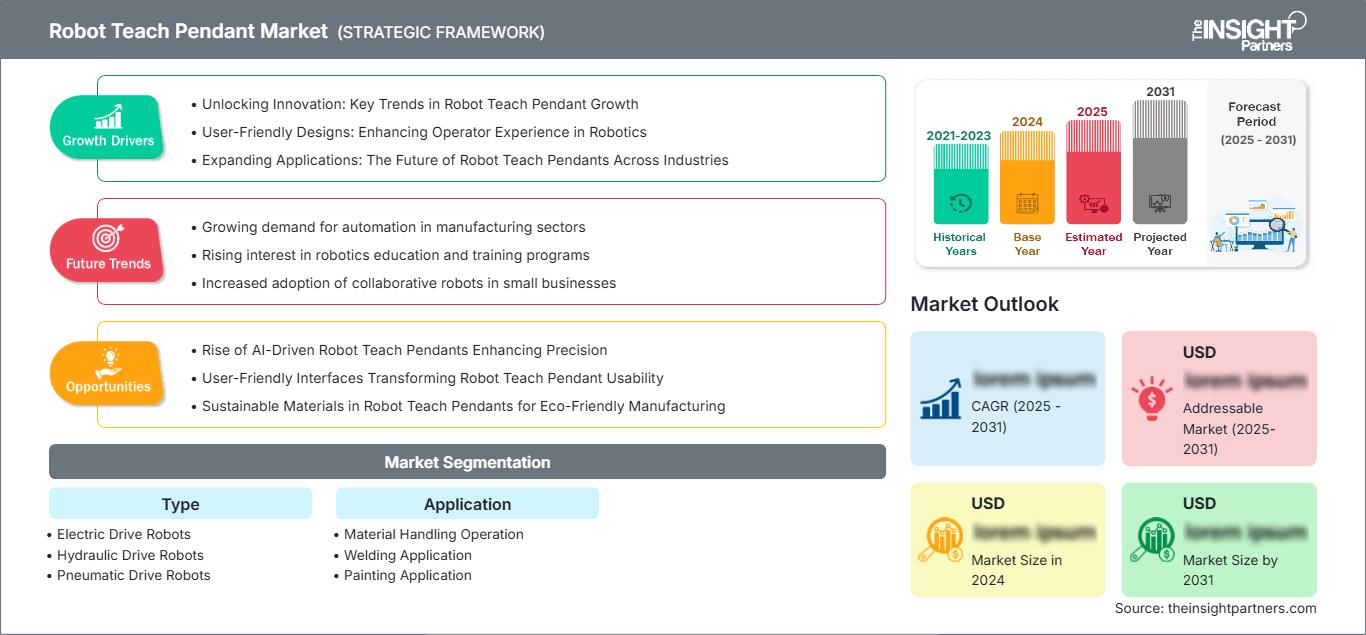
The robot teach pendant market is projected to grow from US$ 257.56 Million in 2025 to US$ 414.86 Million by 2034, registering a CAGR of 5.44% during 2026–2034. Demand is being supported by industrial robot programming, safer manual jogging, intuitive human-machine interfaces, and controller upgrades across automotive, electronics, metal fabrication, packaging, and general manufacturing facilities.
North America remains a stable adoption region as manufacturers modernize robot cells and retrain operators for flexible automation. The regional robot teach pendant market size is supported by automotive reshoring, collaborative robot deployment, and plant-level safety upgrades. The region is expected to grow at a CAGR of 4.8–5.4% during 2026–2034, with the US accounting for most installed demand.
Robot Teach Pendant Market Assessment and Insights
- North America held an estimated 12–14% share in 2025 and is expected to grow at a CAGR of 4.8–5.4% between 2026–2034, supported by robot controller replacement cycles, automotive automation, and operator training investments.
- US represented around 78–81% of North America in 2025 and is projected to grow at a CAGR of 4.9–5.5% during 2026–2034 as manufacturers expand robotic welding, handling, and machine tending.
- Europe accounted for 16–18% share in 2025 and is forecast to grow at a CAGR of 4.5–5.1% through 2034, led by Germany, Italy, France, Spain, and the UK.
- Asia Pacific held 61–64% share in 2025 and is expected to grow at a CAGR of 5.8–6.4% during 2026–2034, with China, Japan, South Korea, India, and Australia driving volume demand.
- Largest Segment: Electric drive robots accounted for 57–60% market share in 2025 and are expected to grow at a CAGR of 5.5–6.1% during 2026–2034 because of broad adoption in handling, assembly, welding, and packaging workcells.
- High Growth Segment: Material handling operation held 48–51% share in 2025 and is projected to grow at a CAGR of 5.9–6.5% during 2026–2034 as factories and warehouses automate loading, unloading, palletizing, and part transfer.
- Key companies analyzed in detail: ABB Ltd., Comau S.p.A., DENSO Products and Services Americas, Inc., FANUC Corporation, Festo SE & Co. KG, Intelitek, Inc., KUKA AG, Nachi Robotic Systems, Inc., OMRON Corporation, and Yaskawa America, Inc.
Source: The Insight Partners' analysis based on proprietary research, government publications, company annual reports, investor presentations, industry databases, and expert interviews.
The market has evolved from basic button-based programming units into ergonomic touchscreen interfaces that support guided operation, quick diagnostics, and safe motion control. robot teach pendant market growth is tied closely to robot controller upgrades because pendants must match each OEM’s software, safety logic, and motion environment. Manufacturers increasingly value easier programming, faster commissioning, and fewer operator errors.
Future demand will be shaped by connected factories, cobot adoption, and emerging manufacturing hubs requiring intuitive robot operation. Suppliers that combine durable hardware, safety-rated controls, simplified programming screens, and training support will remain preferred by integrators. Growth will be moderate but resilient because each new robot installation, retrofit, or controller migration typically requires a compatible pendant interface.
Robot Teach Pendant Market Report Scope
| Report Attribute | Details |
|---|---|
| Market size in 2025 | US$ 257.56 Million |
| Market Size by 2034 | US$ 414.86 Million |
| Global CAGR (2026 - 2034) | 5.44% |
| Historical Data | 2021-2024 |
| Forecast period | 2026-2034 |
Robot Teach Pendant Market Analysis
Industrial automation is the primary demand engine as factories deploy robots for welding, painting, palletizing, packaging, and material transfer. robot teach pendant market growth is also supported by the need to shorten programming time for operators who may not have advanced coding skills. Pendants translate robot motion into practical shop-floor instructions, making them essential for commissioning, debugging, maintenance, and safe manual intervention.
The ecosystem includes robot OEMs, controller suppliers, distributors, system integrators, training providers, and replacement-part channels. Robot teach pendant market analysis shows that demand is strongest where robot fleets are diverse and downtime is costly. The potential buyers weigh pendant weight, screen clarity, emergency stop function, glove capability, cable longevity, software compatibility, and serviceability before standardizing on the product in production.
Proprietary robot platforms play a major role in competition in the market. For example, ABB Ltd. keeps improving the FlexPendant interface for their controllers, FANUC Corporation introduces new lightweight ergonomic teach pendant models, KUKA AG offers smartPAD and smartPAD pro, and Yaskawa America, Inc. offers standard and Smart Pendant models. Comau S.p.A., DENSO Products and Services Americas, Inc., Nachi Robotic Systems, Inc., OMRON Corporation, Festo SE & Co. KG, and Intelitek, Inc. enable acceptance with automation offerings, training systems, and robot integration channels.
Investment is focused on touchscreen usability, wireless-ready workflows, simulation links, and simplified programming for small and midsize manufacturers. The robot teach pendant market is not only a hardware replacement category; it is becoming a productivity interface. Vendors with intuitive software, rugged industrial design, and serviceable components can defend value even as some programming shifts toward offline tools and tablet-style interfaces.
● REPORT CUSTOMIZATION
Tailor This Report To Align With Your Specific Business Requirements
This report can be customized to align precisely with your business objectives, scope, and target markets. Customization options include tailored segmentation, geography, competitive analysis, and strategic insights to support informed decision-making.
Customize This Report →WHAT YOU CAN ADJUST
- ● Segmentations
- ● Geography
- ● Competitive Analysis
- ● Language Preferences
Robot Teach Pendant Market: Strategic Insights
Regional Insights
North America robot teach pendant market
North America held about 12–14% robot teach pendant market share in 2025, with demand concentrated in automotive, aerospace, electronics, packaging, and metal fabrication. The region has mature robot installations, so replacement pendants and controller migrations are important revenue sources. Manufacturers require interfaces that help technicians teach positions, recover programs, and maintain safe manual motion during high-mix production.
The regional CAGR is expected to remain at 4.8–5.4% during 2026–2034. Growth is supported by reshoring, automation funding, and the wider use of collaborative robots in small and midsize plants. Demand also benefits from workforce training needs because intuitive pendants reduce the skill barrier for new robot operators and maintenance teams.
U.S. robot teach pendant Market
The US accounted for around 78–81% of North America in 2025 and is forecast to grow at a CAGR of 4.9–5.5% through 2034. Automotive, logistics equipment, fabricated metals, and electronics users remain core buyers. The robot teach pendant market benefits from the modernization of older robot cells, where users replace controllers and upgrade operator interfaces for safer and faster programming.
Company presence supports demand across the country. FANUC Corporation, ABB Ltd., Yaskawa America, Inc., OMRON Corporation, and Nachi Robotic Systems, Inc. serve large installed bases through direct sales, integrators, and service networks. US buyers increasingly prefer pendants that reduce training time, support diagnostics, and allow technicians to manage multiple robot routines with fewer manual errors.
Europe robot teach pendant Market
Europe held an estimated 16–18% share in 2025 and is expected to grow at a CAGR of 4.5–5.1% during 2026–2034. Germany is a major consumer due to the automation in the automobile, machinery, and metal industries. Italy provides solutions for robotic packaging and manufacturing operations, while France, Spain, and the United Kingdom make their contributions through the aerospace, food processing, logistics, and industrial modernization. The safety of the workers, interoperability, and ergonomics have become priorities for European consumers.
Among the major market players, one should name KUKA AG, ABB Ltd., Comau S.p.A., and OMRON Corporation. The European market is characterized by controller standards, safety-certified emergency stop, and multilingual interfaces necessary for the diverse workforce.
APAC robot teach pendant Market
APAC accounted for around 61–64% share in 2025 and is projected to grow at a CAGR of 5.8–6.4% through 2034. The top manufacturer is China due to the adoption of manufacturing automation, while Japan and South Korea lead in precise robotics. There are many growth prospects for India due to increased adoption of robots within electronics, automotive and general manufacturing sectors.
APAC leads due to high robot shipment volumes. These include FANUC Corporation, Yaskawa America, Inc., DENSO Products and Services Americas, Inc., Nachi Robotic Systems, Inc., and OMRON Corporation due to the good robot ecosystem in Asia. There is growing demand for smaller-sized, touchscreen-enabled and even wearable pendants to train factory workers easily.
Middle East & Africa robot teach pendant Market
The Middle East & Africa is expected to grow at a CAGR of 4.0–4.8% during 2026–2034. Saudi Arabia and the UAE lead demand through industrial diversification, logistics automation, and energy-related fabrication. South Africa remains the most established manufacturing automation base, especially in automotive, mining equipment, and metalworking applications.
Demand is smaller than in APAC, Europe, and North America, but robot adoption is expanding where automation improves reliability and safety. The robot teach pendant market can gain from training-led deployments because new users need simple interfaces for programming, jogging, and troubleshooting. Local support and rugged equipment will be decisive purchasing factors.
Segmentation Analysis
Type
Type is expected to grow at a CAGR of 5.2–5.8% during 2026–2034. The market scope across drive categories is influenced by the installed base of industrial robots, controller complexity, and programming requirements. Electric drive robots dominate because they are widely used across precision handling, welding, painting, packaging, assembly, and machine tending applications.
- Electric Drive Robots hold the leading position because they support precise motion, broad industrial deployment, and frequent programming needs across automotive, electronics, packaging, and general manufacturing robot cells.
- Hydraulic Drive Robots serve heavier-duty and specialized environments where high force or legacy systems remain useful, creating replacement pendant demand in select manufacturing and handling applications.
- Pneumatic Drive Robots are used in simpler pick-and-place and handling tasks where cost efficiency and repeatable motion matter, supporting modest demand for basic programming interfaces.
Application
According to the Robot Teach Pendant Market Report, the Application segment is projected to grow at a CAGR of 5.6–6.2% during 2026–2034 as robots are deployed in repetitive and operator-sensitive tasks. Material handling is the largest application because pendant-guided teaching is required for palletizing, loading, unloading, and transfer paths. Welding and painting also require precise path programming, parameter checks, and safe manual intervention.
- Material Handling Operation generates high demand because operators regularly teach pick points, pallet patterns, conveyor positions, and transfer paths in factories and warehouses with changing product flows.
- Welding Application requires pendant-based path teaching, torch orientation control, and program touch-ups, especially in automotive, fabrication, and heavy equipment production environments.
- Painting Application depends on accurate path programming and repeatable coating motion, making teach pendants important for finish quality, overspray reduction, and robotic cell commissioning.
Opportunity Snapshot
| Application | Revenue Contribution | Trend Tag | Adoption Stage |
| Material Handling Operation | High | Pallet Logic | Mature |
| Welding Application | Medium | Path Teaching | Mature |
| Painting Application | Medium | Coating Paths | Scaling |
Robot Teach Pendant Market Growth Drivers and Impact Analysis
Rising robot installations in manufacturing operations
Manufacturers are increasing their use of robots to improve repeatability, reduce production bottlenecks, and manage labor constraints. Every robot installation needs a practical programming and manual control interface, making teach pendants essential rather than optional. The impact is visible in welding, material handling, painting, and machine tending, where technicians must teach positions, test routines, and recover from faults. As robot fleets expand, replacement demand also grows because pendants experience wear from drops, cables, touchscreens, and harsh shop-floor conditions.
Shift toward intuitive human-machine interfaces
Operators increasingly expect touch-based, graphical, and guided programming interfaces instead of complex command-heavy systems. This shift increases demand for lightweight pendants with larger displays, glove-operable touchscreens, clear diagnostics, and ergonomic grips. The impact is strongest among small and midsize manufacturers that need automation but lack deep robotics programming teams. Easier pendants reduce training time, limit programming errors, and help maintenance workers restore operations faster after stoppages. OEMs that simplify pendant workflows can improve customer retention across controller generations.
Controller upgrades and safety compliance requirements
The development of new robot controllers will create the need for pendant enhancements because safety circuits, emergency stop features, enabling features, and interfaces are closely related. When companies replace their older controllers, they tend to standardize their new pendants for safety reasons and better diagnosis. The effect goes beyond new robots being bought but into the aftermarket because of the fleets that are already installed in factories. The manual jogging feature and emergency stop capability in a safe environment are important for production, integrators, and maintenance staff.
Robot Teach Pendant Market Future Trends
Tablet-style teach interfaces becoming standard
The robot teach pendant market trends show a clear movement toward tablet-style interfaces with larger touchscreens, simplified menus, visual programming, and faster screen response. The increasing tendency for touch operations is due to fewer training requirements and improved ease of navigating the device. This tendency will result in the desire for OEMs to link pendant screens to software simulations, controller diagnostics, and application templates. The interface will be industrial-rugged, but the user experience will continue to approach consumer interaction levels.
Greater integration with offline programming tools
In the future, pendants will be used more extensively in connection with offline simulations and digital commissioning. Rather than programming all of the paths at the robot, users will load or verify programs, after which the pendant will be used to do touch-ups, corrections, and troubleshooting. This will result in greater efficiency in facilities with a high number of products and constant changes in production lines.
Robot Teach Pendant Market Opportunities
Replacement demand from aging installed robot fleets
The Robot Teach Pendant market forecasts indicate a meaningful opportunity in replacement and retrofit demand. Robots work in many factories for extended durations, but the pendants may have wear-and-tear issues, problems with the cable, touchscreen and become obsolete. The suppliers may benefit from having a repairable design, certified replacement parts and supporting compatibility with old control systems. This aspect is important to consider in automotive, metalworking, packaging industries and educational labs.
Training-focused pendants for new automation users
New users of automation require easy-to-use programming software and systematic learning processes. This opportunity can be realized by vendors through the bundling of pendant systems with simulations, application guidance, and training on welding, manipulation, and painting. Intelitek, Inc. and other training ecosystem stakeholders will gain from this opportunity as technical institutes and manufacturing companies develop their robotics expertise. The development of such an opportunity is necessary due to market penetration.
Frequently Asked Questions

- Comprehensive Market Sizing and Forecast Analysis
- Detailed Segmentation Analysis
- In-Depth Market Dynamics Assessment
- Regional and Country-Level Insights
- Competitive Landscape and Company Benchmarking
- Strategic Business Intelligence
Recent Reports
Testimonials

The Insight Partners' SCADA System Market report is comprehensive, with valuable insights on current trends and future forecasts. The team was highly professional, responsive, and supportive throughout. We are very satisfied and highly recommend their services.
RAN KEDEM Partner, Reali Technologies LTDs
I requested a report on a very specific software market and the team produced the report in a few days. The information was very relevant and well presented. I then requested some changes and additions to the report. The team was again very responsive and I got the final report in less than a week.
JEAN-HERVE JENN Chairman, Future Analytica
We worked with The Insight Partners for an important market study and forecast. They gave us clear insights into opportunities and risks, which helped shape our plans. Their research was easy to use and based on solid data. It helped us make smart, confident decisions. We highly recommend them.
PIYUSH NAGPAL Sr. Vice President, High Beam Global
The Insight Partners delivered insightful, well-structured market research with strong domain expertise. Their team was professional and responsive throughout. The user-friendly website made accessing industry reports seamless. We highly recommend them for reliable, high-quality research services
YUKIHIKO ADACHI CEO, Deep Blue, LLC.
This is the first time I have purchased a market report from The Insight Partners.While I was unsure at first, I visited their web site and felt more comfortable to take the risk and purchase a market report.I am completely satisfied with the quality of the report and customer service. I had several questions and comments with the initial report, but after a couple of dialogs over email with their analyst I believe I have a report that I can use as input to our strategic planning process.Thank you so much for taking the extra time and making this a positive experience.I will definitely recommend your service to others and you will be my first call when we need further market data.
JOHN SUZUKI President and Chief Executive Officer, Board Director, BK Technologies
I wish to appreciate your support and the professionalism you displayed in the course of attending to my request for information regarding to infectious disease IVD market in Nigeria. I appreciate your patience, your guidance, and the fact that you were willing to offer a discount, which eventually made it possible for us to close a deal. I look forward to engaging The Insight Partners in the future, all thanks to the impression you have created in me as a result of this first encounter.
DR CHIJIOKE ONYIA MANAGING DIRECTOR, PineCrest Healthcare Ltd.Reason to Buy
- Informed Decision-Making
- Understanding Market Dynamics
- Competitive Analysis
- Identifying Emerging Markets
- Customer Insights
- Market Forecasts
- Risk Mitigation
- Boosting Operational Efficiency
- Strategic Planning
- Investment Justification
- Tracking Industry Innovations
- Aligning with Regulatory Trends





 Get Free Sample for