
Robotic Palletizer Market Demand, Share & Growth by 2034
Coverage: By Speed (Above 30 cycles per minute, 20-30 cycles per minute, 10-20 cycles per minute, Upto 10 cycles per minute); Industry Vertical (Food and Beverage, Pharmaceutical, Electronics and Semiconductor, Cement, Others) , and Geography (North America, Europe, Asia Pacific, and South and Central America)
- Status : Data Released
- Report Code : TIPRE00006992
- Category : Manufacturing and Construction
- No. of Pages : 150
- Available Report Formats :


- Last update date : September 07, 2026


2025 Market Size
US$ 2.85 Bn
Base year value
2034 Forecast
US$ 4.05 Bn
Projected by 2034
CAGR 2026-2034
3.98 %
Growth rate
Addressable Market
US$ 31.34 Bn
(2026-2034)
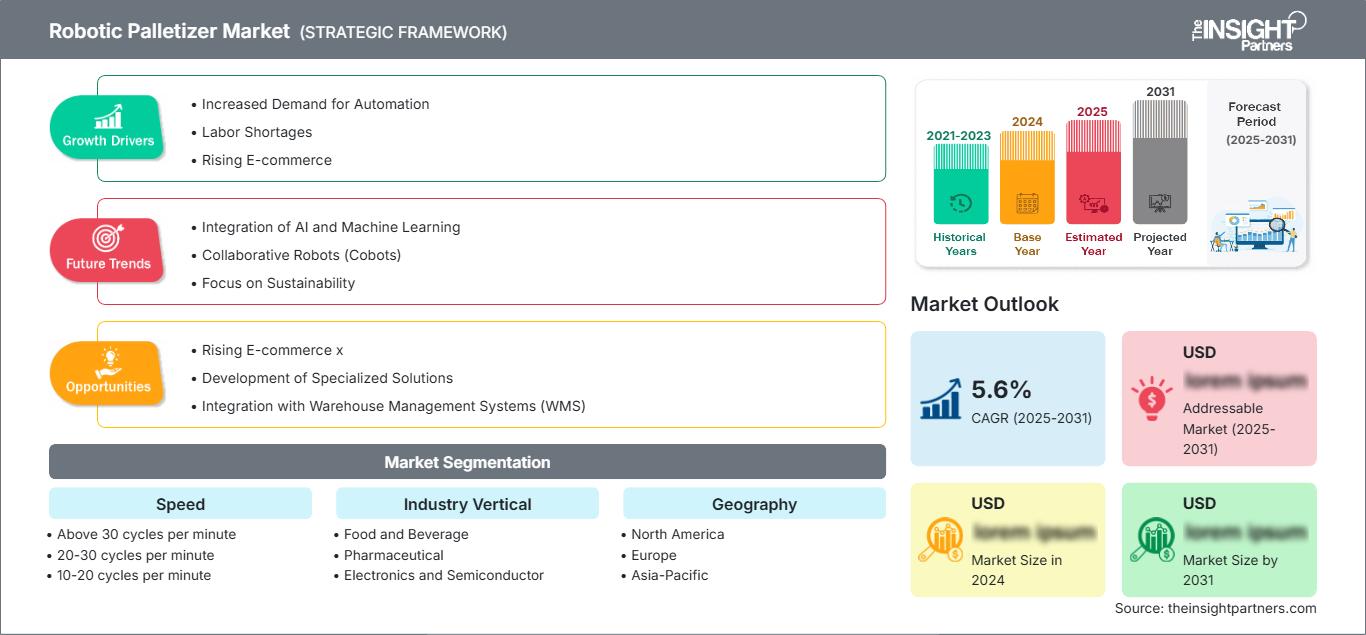
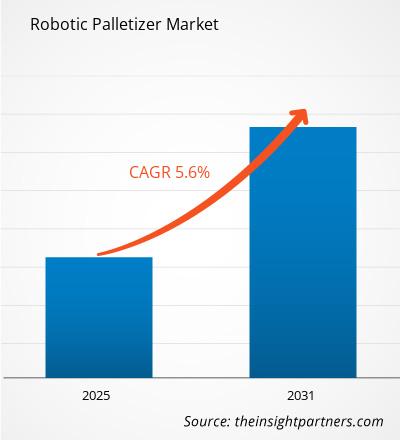
The global Robotic Palletizer market was valued at US$ 2.85 billion in 2025 and is expected to reach US$ 4.05 billion by 2034; it is estimated to record a CAGR of 3.98% during 2026-2034.
Robotic Palletizer Market Assessment and Insights
- North America held an estimated 27–30% share in 2025 and is expected to grow at a CAGR of 4.1–4.7% between 2026–2034, supported by automation investments in packaging, logistics, and food processing.
- US accounted for around 78–82% of North America in 2025 and is projected to grow at 4.2–4.8% CAGR as manufacturers prioritize safer end-of-line operations.
- Europe represented 24–27% share in 2025 and is forecast to grow at 3.9–4.5% CAGR, led by Germany, the UK, France, Italy, and Spain.
- Asia Pacific held 32–35% share in 2025 and is expected to grow at 5.0–5.7% CAGR, with China, Japan, South Korea, India, and Australia leading adoption.
- Largest Segment: Food and Beverage accounted for 39–43% market share in 2025 and is expected to grow at 4.6–5.2% CAGR because plants handle high volumes of cases, cartons, bags, and bottles.
- High Growth Segment: Above 30 cycles per minute held 20–23% share in 2025 and is projected to grow at 5.4–6.1% CAGR as high-speed packaging lines demand faster palletizing cells.
- Key companies analyzed in detail: ABB Ltd., American-Newlong, Inc., Brenton, LLC, Chantland MHS Co., Columbia Machine, Inc., FANUC Corporation, Fuji Yusoki Kogyo Co., Ltd., Kawasaki Heavy Industries, Ltd., KUKA AG, and Yaskawa Electric Corporation.
Source: The Insight Partners' analysis based on proprietary research, government publications, company annual reports, investor presentations, industry databases, and expert interviews.
Automation at the end of a line has moved from mechanical palletizers to robots that can deal with multiple products, rapid SKU changes, and small plant footprints. Improvements in end-of-line automation include advances in grippers, vision, lighter-weight robot arms, safety systems, and pattern programming, which will assist in reducing repetitive lifting and providing consistent production rates.
The future of robotic palletizers will see increased interest as new manufacturing centers upgrade their packaging lines and old facilities update their older machines. Key areas of investment will include modular cell design, conveyors, intelligent end-of-arm tools, and software for quick changeovers. Increasing regulatory pressure to keep workplaces safe and clean will also drive interest.
Robotic Palletizer Market Report Scope
| Report Attribute | Details |
|---|---|
| Market size in 2025 | US$ 2.85 Billion |
| Market Size by 2034 | US$ 4.05 Billion |
| Global CAGR (2026 - 2034) | 3.98% |
| Historical Data | 2021-2024 |
| Forecast period | 2026-2034 |
Robotic Palletizer Market Analysis
Robotic palletizer market growth is being shaped by manufacturers that need dependable throughput despite workforce shortages and SKU proliferation. Palletizing sits at a critical point between production and distribution, so downtime directly affects shipments. Demand is strongest where bags, boxes, cartons, pails, and cases must be stacked consistently for transport. The value chain includes robot OEMs, gripper suppliers, conveyor makers, safety-system providers, integrators, software vendors, and aftermarket service networks.
Robotic palletizer market analysis shows that buyers compare payload, reach, cycle rate, footprint, tooling versatility, programming simplicity, and maintenance access before selection. Bag systems for cement and food require strong arms and tough grippers. Pharmaceutical and electronics applications require clean handling, tracking, and soft stacking. The need for integrators is becoming more and more crucial as performance is affected by the way that packaging systems run upstream, pallet availability, safety, and warehouse interface design.
Global robot manufacturers and palletizing equipment specialists make up the competition. ABB Ltd., FANUC Corporation, Kawasaki Heavy Industries, Ltd., KUKA AG, and Yaskawa Electric Corporation offer versatile robot platforms, controllers, and servicing. Fuji Yusoki Kogyo Co., Ltd., Columbia Machine, Inc., American-Newlong, Inc., Brenton, LLC, and Chantland MHS Co. enhance the market offering application-specific palletizing systems, bag handling, case handling, and turnkey end-of-line systems.
The areas of investment are being directed towards high payload robots, collaborative palletizing cells, perception through AI and simulation-driven deployment. Manufacturers with shorter installation times and the ability to change patterns using recipes can protect their margins. The market is fragmented due to the need for customized setups by many clients, but OEM manufacturers with reliable robots and packaging know-how, and integrators will benefit.
● REPORT CUSTOMIZATION
Tailor This Report To Align With Your Specific Business Requirements
This report can be customized to align precisely with your business objectives, scope, and target markets. Customization options include tailored segmentation, geography, competitive analysis, and strategic insights to support informed decision-making.
Customize This Report →WHAT YOU CAN ADJUST
- ● Segmentations
- ● Geography
- ● Competitive Analysis
- ● Language Preferences
Robotic Palletizer Market: Strategic Insights
Regional Insights
North America robotic palletizer market
North America held an estimated 27–30% robotic palletizer market share in 2025. The region benefits from packaged food output, e-commerce distribution, and automation spending by manufacturers seeking safer material handling. Labor availability remains a structural pressure, especially for repetitive end-of-line lifting jobs that are physically demanding and difficult to staff.
The region is expected to grow at 4.1–4.7% CAGR during 2026–2034. Adoption is strongest in the US, Canada, and Mexico, where food and beverage, consumer goods, cement, and pharmaceutical plants require flexible palletizing cells. Demand is also supported by integrator networks that can retrofit robots into existing packaging halls.
U.S. robotic palletizer Market
The US represented around 78–82% of North America in 2025 and is expected to grow at 4.2–4.8% CAGR through 2034. Large packaged food, beverage, personal care, and logistics operators are key buyers because palletizing directly influences delivery schedules and workplace safety performance.
FANUC Corporation, ABB Ltd., Yaskawa Electric Corporation, Columbia Machine, Inc., American-Newlong, Inc., Brenton, LLC, and Chantland MHS Co. support domestic demand through robot platforms, specialty palletizers, system integration, and service operations. Users increasingly prefer compact cells with quick changeover tooling that can manage cases, trays, bags, and mixed pallet patterns.
Europe robotic palletizer Market
Europe accounted for about 24–27% share of the Robotic palletizer market in 2025 and is projected to grow at 3.9–4.5% CAGR during 2026–2034. Germany leads demand through machinery, food processing, chemicals, and packaging automation. The UK shows strong uptake in warehouse and consumer goods operations where labor and safety constraints support automation.
France, Italy, and Spain add demand from beverages, dairy, bakery, pharmaceuticals, and building materials. European buyers emphasize safety compliance, compact footprints, energy efficiency, and integration with existing lines. ABB Ltd., KUKA AG, FANUC Corporation, and Yaskawa Electric Corporation remain important participants because their robot platforms are widely supported by regional integrators.
APAC robotic palletizer Market
APAC held around 32–35% share in 2025 and is expected to grow at 5.0–5.7% CAGR through 2034. China leads regional demand because of large manufacturing output, packaging automation, and logistics modernization. Japan and South Korea contribute through advanced robotics ecosystems and high factory automation maturity.
India is emerging as a food, pharmaceutical, cement, and consumer goods producers automate end-of-line operations. Australia adds demand from beverage, packaged food, and warehouse applications, where labor costs remain high. Fuji Yusoki Kogyo Co., Ltd., Kawasaki Heavy Industries, Ltd., FANUC Corporation, and Yaskawa Electric Corporation benefit from strong regional robotics supply chains.
Middle East & Africa robotic palletizer Market
The Middle East & Africa Robotic palletizer market is expected to grow at 3.5–4.2% CAGR during 2026–2034. Saudi Arabia and the UAE lead demand through food processing, cement, chemicals, logistics, and industrial diversification projects. South Africa remains the most established automation base in the region.
Growth is smaller than in APAC, Europe, and North America, but opportunities exist in heavy bag palletizing, beverage lines, and distribution centers. Hot, dusty, or space-constrained facilities require robust designs, dependable grippers, and local maintenance support. Suppliers that partner with regional integrators can improve adoption.
Segmentation Analysis
Speed
Speed is expected to grow at a CAGR of 4.4–5.0% during 2026–2034. The robotic palletizer market scope across speed categories depends on line throughput, pack format, payload, and stacking complexity. High-speed operations favor robust robots, advanced tooling, and optimized motion planning, while lower-speed categories serve compact plants and budget-conscious users.
- Above 30 cycles per minute systems serve high-output beverage, food, and consumer goods lines where rapid case movement, precise gripping, and synchronized conveyor flow are essential.
- 20-30 cycles per minute systems suit mainstream packaging plants that require balanced speed, flexibility, and equipment cost for carton, tray, and bag palletizing.
- 10-20 cycles per minute systems support moderate production environments where reliability, easier programming, and lower integration complexity matter more than maximum throughput.
- Upto 10 cycles per minute systems address small plants, specialty products, and low-volume lines where automation reduces manual handling without requiring premium-speed equipment.
Industry Vertical
Industry Vertical is projected to grow at a CAGR of 4.5–5.1% during 2026–2034. Demand differs by packaging format, hygiene needs, product weight, and line continuity. Food and beverage remains the core installed base, while pharmaceuticals, electronics, and cement create specialized requirements for cleanliness, traceability, gentle handling, and heavy-load durability.
- Food and Beverage leads adoption because plants need continuous palletizing of cartons, trays, bags, and bottles while reducing manual lifting and improving hygiene.
- Pharmaceutical users prioritize clean operation, validated handling, traceability, and low product damage when automating cartons, cases, and secondary packaging flows.
- Electronics and Semiconductor facilities use palletizing automation for boxed components and finished goods where gentle handling and traceability protect high-value shipments.
- Cement plants require heavy-duty bag palletizing systems that withstand dust, high payloads, abrasive environments, and continuous production schedules.
Opportunity Snapshot
| Industry Vertical | Revenue Contribution | Trend Tag | Adoption Stage |
| Food and Beverage | High | Case Stacking | Mature |
| Pharmaceutical | Medium | Validated Handling | Scaling |
| Electronics and Semiconductor | Medium | Gentle Loads | Scaling |
| Cement | Medium | Heavy Bags | Mature |
Robotic Palletizer Market Growth Drivers and Impact Analysis
Persistent labor shortages in end-of-line operations
Manual palletizing involves strenuous work and repetition and is difficult to perform during extended periods, which makes it one of the first activities in warehouses and factories that has been automated. Automation through robotic cells minimizes reliance on manual labor while ensuring consistency in the performance of the task and safety. This driver affects sectors including food and beverages, cement, and consumer goods manufacturing, where there is a need to stack large, heavy boxes or bags.
Rising SKU complexity and packaging variability
The manufacturers have created more varied package sizes, promotional styles, and mixed case requirements, making the fixed palletizer less flexible. Robotic solutions have the capability to change patterns via software, exchange grippers, and handle varied case sizes with minimal changes to mechanics. This driver adds value to factories dealing with retailers, online sellers, and regional consumers who require customized packaging. The effect will be most noticeable in packaging facilities that require many changeovers, since robotic palletizers will enable them to maintain production levels without incurring the costs of hard automation.
Integration of vision, simulation, and smart tooling
Developments in 2D and 3D vision, simulation technology, and intelligent EOATs are helping to increase deployment confidence. Integration companies can check reach, cycle times, pallet setups, and collisions before deployment, while intelligent tools will ensure better gripping of cartons, bags, bundles, and layers. In this way, the risk of projects will be minimized for new buyers and experienced customers will have an easier time justifying their retrofit purchases in limited spaces. The result will be increased robot productivity and improved ROI.
Robotic Palletizer Market Future Trends
Growth of collaborative palletizing cells
Robotic palletizer market trends indicate rising use of collaborative and compact palletizing cells for small and midsize manufacturers. They reduce the cost of entry due to their small footprint, streamlined safety design, and programmed operation. They are ideal for moderate-speed systems where manpower savings take precedence over payload capacity. As collaborative cells mature, they will see greater application in bakery operations, specialty food businesses, contract packagers, and local manufacturers seeking automated solutions without the expense of retooling.
AI-assisted depalletizing and mixed-load handling
Futuristic solutions will see more convergence of palletization and depalletization operations with AI vision to detect variable loads, damages on cartons, and irregular pallet stacks. These systems will become significant in distribution centers and returns processing, as well as logistics, where loads are inconsistent. Improved perception capabilities will help robots handle mistakes in pallet presentation and decrease manual involvement. The move will compel suppliers to converge their camera, motion control, gripper, and analytics systems into a single handling solution.
Robotic Palletizer Market Opportunities
Retrofit packages for existing packaging lines
Robotic palletizer market Forecasts point to a meaningful opportunity in retrofit projects where plants want automation without rebuilding complete packaging halls. The available space on the factory floor, legacy conveyors, and packaging machinery are the major limiting factors for many plants, and thus modular palletizing systems can address the demand with their flexible feed solutions. The differentiation factor may come from pre-engineered modules, easy installation, and simulations for validating the design. It will be more appealing to food, beverages, pharmaceuticals, and consumer goods factories.
Heavy-duty bag palletizing in cement and materials
Heavy-duty palletizers that are used for cement, chemicals, fertilizers, pet food, and construction materials have the potential to thrive in an environment that is either dusty or rough due to the material being lifted from its bags. The buyers need reliable operation, good payload capacity, robustness of the gripper, and quality stacks because broken bags lead to wastage and accidents. Premium can be achieved through products that are dustproof, have bag flattening options, and local servicing.
Frequently Asked Questions

- Comprehensive Market Sizing and Forecast Analysis
- Detailed Segmentation Analysis
- In-Depth Market Dynamics Assessment
- Regional and Country-Level Insights
- Competitive Landscape and Company Benchmarking
- Strategic Business Intelligence
Recent Reports
Testimonials

The Insight Partners' SCADA System Market report is comprehensive, with valuable insights on current trends and future forecasts. The team was highly professional, responsive, and supportive throughout. We are very satisfied and highly recommend their services.
RAN KEDEM Partner, Reali Technologies LTDs
I requested a report on a very specific software market and the team produced the report in a few days. The information was very relevant and well presented. I then requested some changes and additions to the report. The team was again very responsive and I got the final report in less than a week.
JEAN-HERVE JENN Chairman, Future Analytica
We worked with The Insight Partners for an important market study and forecast. They gave us clear insights into opportunities and risks, which helped shape our plans. Their research was easy to use and based on solid data. It helped us make smart, confident decisions. We highly recommend them.
PIYUSH NAGPAL Sr. Vice President, High Beam Global
The Insight Partners delivered insightful, well-structured market research with strong domain expertise. Their team was professional and responsive throughout. The user-friendly website made accessing industry reports seamless. We highly recommend them for reliable, high-quality research services
YUKIHIKO ADACHI CEO, Deep Blue, LLC.
This is the first time I have purchased a market report from The Insight Partners.While I was unsure at first, I visited their web site and felt more comfortable to take the risk and purchase a market report.I am completely satisfied with the quality of the report and customer service. I had several questions and comments with the initial report, but after a couple of dialogs over email with their analyst I believe I have a report that I can use as input to our strategic planning process.Thank you so much for taking the extra time and making this a positive experience.I will definitely recommend your service to others and you will be my first call when we need further market data.
JOHN SUZUKI President and Chief Executive Officer, Board Director, BK Technologies
I wish to appreciate your support and the professionalism you displayed in the course of attending to my request for information regarding to infectious disease IVD market in Nigeria. I appreciate your patience, your guidance, and the fact that you were willing to offer a discount, which eventually made it possible for us to close a deal. I look forward to engaging The Insight Partners in the future, all thanks to the impression you have created in me as a result of this first encounter.
DR CHIJIOKE ONYIA MANAGING DIRECTOR, PineCrest Healthcare Ltd.Reason to Buy
- Informed Decision-Making
- Understanding Market Dynamics
- Competitive Analysis
- Identifying Emerging Markets
- Customer Insights
- Market Forecasts
- Risk Mitigation
- Boosting Operational Efficiency
- Strategic Planning
- Investment Justification
- Tracking Industry Innovations
- Aligning with Regulatory Trends





 Get Free Sample for