
Robotic Toys Market Size, Share & Demand by 2034
Coverage: By Functional Ability (Autonomous navigation, Environmental perception, Task perception, Task performance, Others); Educational Level (Higher Studies, Secondary Education, Elementary Education) , and Geography (North America, Europe, Asia Pacific, and South and Central America)
- Status : Data Released
- Report Code : TIPRE00021298
- Category : Electronics and Semiconductor
- No. of Pages : 150
- Available Report Formats :


- Last update date : September 07, 2026


2025 Market Size
US$ 3.3 Bn
Base year value
2034 Forecast
US$ 9.62 Bn
Projected by 2034
CAGR 2026-2034
12.64 %
Growth rate
Addressable Market
US$ 56.43 Bn
(2026-2034)
The robotic toys market is projected to grow from US$ 3.3 Billion in 2025 to US$ 9.62 Billion by 2034, registering a CAGR of 12.64% during 2026–2034. Demand is increasing as parents, schools, and hobby learners use programmable toys to combine entertainment, coding practice, STEM learning, and interactive play across household, classroom, and after-school environments.
North America's robotic toys market size is supported by high edtech spending, strong retail access, and early adoption of coding kits in classrooms. The region is expected to grow at a CAGR of 11.8–12.6% during 2026–2034 as districts, libraries, makerspaces, and families adopt robots that teach sequencing, sensors, problem-solving, and creative design.
Robotic Toys Market Assessment and Insights
- North America held an estimated 33–36% share in 2025 and is expected to grow at a CAGR of 11.8–12.6% between 2026–2034, supported by STEM curriculum adoption and strong household spending on connected learning toys.
- US accounted for around 79–82% of North America in 2025 and is projected to grow at 12.0–12.8% CAGR as schools and homes expand coding robot use.
- Europe represented 25–28% share in 2025 and is forecast to grow at 11.2–12.0% CAGR, led by the UK, Germany, France, Italy, and Spain.
- Asia Pacific held 29–32% share in 2025 and is expected to grow at 13.7–14.5% CAGR, with China, Japan, South Korea, India, and Australia leading adoption.
- Largest Segment: Task performance accounted for 34–37% market share in 2025 and is expected to grow at 12.2–13.0% CAGR because children engage strongly with robots that complete visible actions.
- High Growth Segment: Elementary education held 30–33% share in 2025 and is forecast to grow at 14.0–14.8% CAGR as schools introduce coding and robotics earlier.
- Key companies analyzed in detail: ArcBotics LLC, Dexter Industries, fischertechnik GmbH, Modular Robotics Incorporated, Parallax Inc., RAWrobotics, rero, RoboThink LLC, Robotical Ltd., and The LEGO Group.
Source: The Insight Partners' analysis based on proprietary research, government publications, company annual reports, investor presentations, industry databases, and expert interviews.
With time, robot toys have progressed from mere remote-controlled machines to highly interactive and programmable systems which can be taught using sensors and apps. Currently, the robotic toy market is catering to the needs of not only entertainment but also educational purposes through such robots that range from screen-less coding robot kits for pre-schoolers to kits for Python, electronics and robotics club kids.
Future needs of the market will include affordability, curriculum compliance, data security and easy adaptation by teachers. New markets are expected to increase sales volume due to the increased popularity of the STEM initiatives, while mature ones are going to prefer more robust learning kits and classroom solutions. Further investments will be directed towards robots that support AI interaction, different languages, modularity and home and school collaboration.
Robotic Toys Market Report Scope
| Report Attribute | Details |
|---|---|
| Market size in 2025 | US$ 3.3 Billion |
| Market Size by 2034 | US$ 9.62 Billion |
| Global CAGR (2026 - 2034) | 12.64% |
| Historical Data | 2021-2024 |
| Forecast period | 2026-2034 |
Robotic Toys Market Analysis
Robotic toys market growth is driven by the rising importance of STEM literacy, computational thinking, and hands-on learning. Parents increasingly prefer toys that combine creativity with skill development, while educators use robotics to demonstrate sequencing, loops, sensors, cause-and-effect logic, and engineering design. The value chain includes component suppliers, curriculum developers, app platforms, toy makers, education distributors, retailers, and training partners that support classroom integration.
Product success depends on durability, price, age fit, lesson availability, coding progression, and ease of setup. The robotic toys market analysis shows that schools value classroom packs, replacement parts, teacher guides, and standards-aligned activities, while households prioritize fun, safe operation, and repeat play value. Supply dynamics are influenced by sensors, microcontrollers, batteries, plastics, app updates, and seasonal retail demand.
The competition spans global toy manufacturers and robotic specialists. The LEGO Group enjoys high levels of brand loyalty and varied learning packages, whereas Robotical Ltd. presents Marty as a humanoid school robot that enables learning from screen-less challenges to programming using Python. On the other hand, Fischertechnik GmbH and Modular Robotics Incorporated focus on construction-based learning activities, whereas Parallax Inc., Dexter Industries, ArcBotics LLC, RAWrobotics, rero, and RoboThink LLC are engaged in coding and robotics education.
Current investment trends include connected platforms, free-of-charge learning portal subscriptions, modularity, and age-specific learning paths. Manufacturers able to facilitate teachers' preparations and lessen their time spent on it may increase their institutional market share. Still, when addressing consumers directly, they should be ready to compete with tablets, video games, and classic toys.
● REPORT CUSTOMIZATION
Tailor This Report To Align With Your Specific Business Requirements
This report can be customized to align precisely with your business objectives, scope, and target markets. Customization options include tailored segmentation, geography, competitive analysis, and strategic insights to support informed decision-making.
Customize This Report →WHAT YOU CAN ADJUST
- ● Segmentations
- ● Geography
- ● Competitive Analysis
- ● Language Preferences
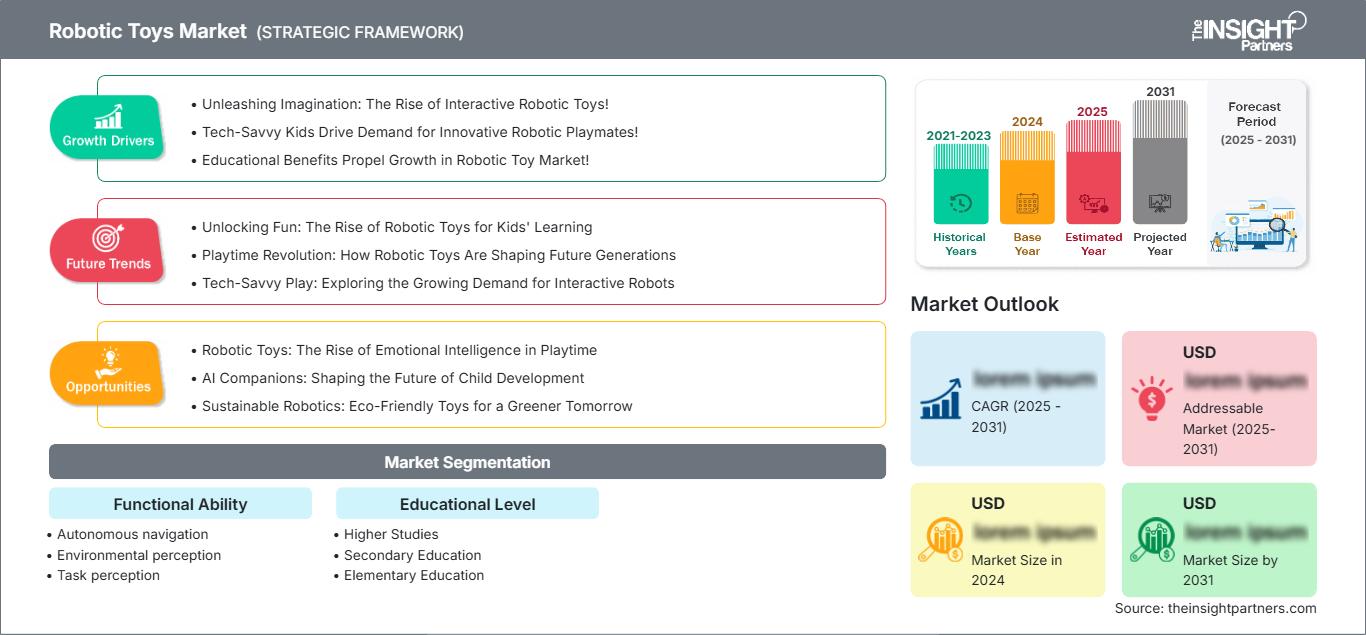
Robotic Toys Market: Strategic Insights
Regional Insights
North America Robotic Toys Market
North America held around 33–36% robotic toys market share in 2025, supported by strong school technology budgets, after-school robotics clubs, and broad retail availability. The region benefits from early coding education, maker communities, and parents willing to spend on products that combine learning with entertainment.
The region is expected to grow at 11.8–12.6% CAGR during 2026–2034. Demand is strongest in the US and Canada, where robotics kits are used in classrooms, competitions, libraries, and home enrichment. Buyers increasingly prefer products with structured lesson plans, reliable apps, and durable parts that can withstand repeated student use.
U.S. Robotic Toys Market
The US represented nearly 79–82% of North America in 2025 and is expected to grow at 12.0–12.8% CAGR through 2034. Adoption is supported by STEM clubs, computer science education, homeschooling, and retail demand for interactive learning products.
The LEGO Group, Parallax Inc., Modular Robotics Incorporated, Dexter Industries, ArcBotics LLC, and RoboThink LLC are visible through education channels, coding programs, and maker communities. Schools use programmable toys to strengthen problem-solving and teamwork, while families value robotics products that extend beyond one-time play through challenges, missions, and app updates.
Europe robotic toys Market
Europe accounted for an estimated 25–28% share in 2025 and is projected to grow at 11.2–12.0% CAGR during 2026–2034. The UK supports demand through classroom coding initiatives and robotics clubs, while Germany benefits from an engineering-oriented learning culture and suppliers such as fischertechnik GmbH.
France, Italy, and Spain add demand through school modernization, parent spending on educational toys, and growing interest in multilingual coding tools. European buyers emphasize safety, durability, repairability, and curriculum relevance. The LEGO Group, Robotical Ltd., fischertechnik GmbH, and rero benefit from regional education networks and demand for classroom-ready robotic systems.
APAC Robotic Toys Market
APAC held around 29–32% share in 2025 and is expected to grow at 13.7–14.5% CAGR through 2034. China leads demand through large student populations, competitive STEM education, and strong electronics manufacturing. Japan and South Korea contribute through technology-oriented consumers and robotics familiarity.
India is emerging as schools, coding academies, and urban households adopt interactive learning toys. Australia supports demand through STEM curriculum alignment and after-school programs. Regional growth depends on lower price points, localized content, parent awareness, and mobile-first apps that allow children to program robots using tablets and smartphones.
Middle East & Africa Robotic Toys Market
The Middle East & Africa is expected to grow at 9.0–9.8% CAGR during 2026–2034. Saudi Arabia and the UAE are driving demand via strategic education programs, international schools, and spending by families on high-quality education offerings. South Africa is currently the most advanced education technology market in the region.
There are still many areas to grow, but there is potential in robotics labs, private schools, and coding academies. Some of the issues suppliers need to consider include cost, training for teachers, multilingual products, and availability of spare parts. Classroom packages that deliver results will be more successful than novel robots with little reusability.
Segmentation Analysis
Functional Ability
Functional Ability is expected to grow at a CAGR of 12.3–13.1% during 2026–2034. The robotic toys market scope across functional ability is shaped by how children interact with movement, sensing, decision-making, and task completion. Products with visible actions and programmable feedback tend to produce stronger engagement than single-function toys.
- Autonomous navigation supports maze solving, route planning, obstacle avoidance, and exploration activities, making it important for robotics challenges, coding lessons, and interactive home play.
- Environmental perception uses sensors, cameras, color detection, and sound inputs to help children understand how robots interpret surroundings and respond to changing conditions.
- Task perception enables products to identify instructions, triggers, or programmed goals, supporting structured learning activities that connect commands with behavior and feedback.
- Task performance remains the most commercially important function because walking, grabbing, drawing, dancing, or moving objects creates visible outcomes that sustain engagement.
Educational Level
Educational Level is projected to grow at a CAGR of 12.8–13.6% during 2026–2034. Demand differs by learning stage, with elementary users needing simple blocks and tactile play, secondary students requiring deeper coding logic, and higher studies using expandable platforms for robotics concepts.
- Higher Studies users prefer expandable kits, Python support, sensors, electronics, and maker integration, allowing advanced learners to explore robotics, embedded systems, and engineering design.
- Secondary Education demand is supported by coding clubs, competitions, and project-based learning where students need programmable motion, sensors, and structured challenges.
- Elementary Education is expanding quickly because schools introduce computational thinking earlier through colorful robots, screen-free activities, block coding, and guided classroom missions.
Opportunity Snapshot
| Educational Level | Revenue Contribution | Trend Tag | Adoption Stage |
| Higher Studies | Medium | Python Labs | Scaling |
| Secondary Education | High | Coding Clubs | Mature |
| Elementary Education | High | Early Coding | Scaling |
Robotic Toys Market Growth Drivers and Impact Analysis
Rising emphasis on STEM learning through play
Both schools and parents are considering robotics as an applied means of learning about coding and engineering, among other problem-solving abilities. The use of robotic toys makes the invisible tangible since kids get to try out a set of commands, watch how the robot moves, and modify the commands immediately. This trend factor adds to engagement in class while at the same time offering hands-on learning opportunities to those kids who do not connect well with screen-based learning.
Expansion of app-connected and modular toy ecosystems
As technology advances, today’s robotic toys tend to integrate not only physical products but also mobile applications, cloud services, modular components, and instructional activities. As a result, the life cycle of the product gets extended due to the fact that users can gain access to new challenges, install additional sensors, or learn to program from basic instructions. This is reflected in increased user loyalty and educational applications, as teachers will be able to use the same set of components for more than one lesson.
Growing parent demand for educational screen alternatives
Parents are interested in digital literacy products; however, they are wary of children being exposed to passive screen time. The solution comes in the form of robotic toys that combine coding apps with real-world activities such as movement, construction, and experimentation. Although kids will be using tech, the result will be achieved through movement, sounds, lights, and accomplishment of tasks in the physical world. This driver boosts demand for toys that integrate touch play with learning. It is also an enabler of premium pricing where toys show educational progression, durability, and challenge at different ages.
Robotic Toys Market Future Trends
AI-assisted personalization in learning toys
Robotic toys market trends point toward adaptive products that adjust tasks, hints, and difficulty based on user progress. AI-assisted learning can help children move from basic sequencing to more complex logic without overwhelming them. This will be especially useful in classrooms where students have different skill levels. Future platforms may use local processing, privacy-safe analytics, and teacher dashboards to recommend activities, identify learning gaps, and keep engagement high while maintaining responsible data practices.
Hybrid classroom and home robotics ecosystems
Robotics learning will increasingly move between school and home through shared apps, cloud lesson libraries, and portable kits. A child may begin a classroom challenge, continue it at home, and return with improved code or a modified build. This trend creates an opportunity for brands that support subscriptions, parent dashboards, educator resources, and multilingual content. It also increases the strategic value of platforms that can serve formal curriculum needs while retaining playful appeal outside school.
Robotic Toys Market Opportunities
Classroom bundles for early coding adoption
Robotic toys market Forecasts indicate a strong opportunity in bundled classroom solutions for elementary education. Teachers’ guide, place to store the robot kits, charging ports, replacements, and lesson plans are some examples of the needs schools have, instead of retail kits to be bought one by one. Suppliers may take advantage of the budget of institutions by providing kits per grades which require little effort from teachers and allow them to facilitate standards-based education. This solution works well for schools teaching coding to younger kids via robotics.
Affordable robotics kits for emerging education markets
The developing world provides opportunities for cheaper sets that nevertheless teach about sensors, motors, logical thinking, and imaginative assembly. There is great price sensitivity, but demand is increasing thanks to private schools, programming academies, government STEM programs, and parental enrichment. Satisfying the need involves tailoring applications locally, avoiding reliance on costly tablets, and supplying components that are tough enough to be recycled. Alliances with educational nonprofits, distribution channels, and training agencies can increase market penetration while establishing brand trust for first-time robot consumers.
Frequently Asked Questions

- Comprehensive Market Sizing and Forecast Analysis
- Detailed Segmentation Analysis
- In-Depth Market Dynamics Assessment
- Regional and Country-Level Insights
- Competitive Landscape and Company Benchmarking
- Strategic Business Intelligence
Recent Reports
Testimonials

The Insight Partners' SCADA System Market report is comprehensive, with valuable insights on current trends and future forecasts. The team was highly professional, responsive, and supportive throughout. We are very satisfied and highly recommend their services.
RAN KEDEM Partner, Reali Technologies LTDs
I requested a report on a very specific software market and the team produced the report in a few days. The information was very relevant and well presented. I then requested some changes and additions to the report. The team was again very responsive and I got the final report in less than a week.
JEAN-HERVE JENN Chairman, Future Analytica
We worked with The Insight Partners for an important market study and forecast. They gave us clear insights into opportunities and risks, which helped shape our plans. Their research was easy to use and based on solid data. It helped us make smart, confident decisions. We highly recommend them.
PIYUSH NAGPAL Sr. Vice President, High Beam Global
The Insight Partners delivered insightful, well-structured market research with strong domain expertise. Their team was professional and responsive throughout. The user-friendly website made accessing industry reports seamless. We highly recommend them for reliable, high-quality research services
YUKIHIKO ADACHI CEO, Deep Blue, LLC.
This is the first time I have purchased a market report from The Insight Partners.While I was unsure at first, I visited their web site and felt more comfortable to take the risk and purchase a market report.I am completely satisfied with the quality of the report and customer service. I had several questions and comments with the initial report, but after a couple of dialogs over email with their analyst I believe I have a report that I can use as input to our strategic planning process.Thank you so much for taking the extra time and making this a positive experience.I will definitely recommend your service to others and you will be my first call when we need further market data.
JOHN SUZUKI President and Chief Executive Officer, Board Director, BK Technologies
I wish to appreciate your support and the professionalism you displayed in the course of attending to my request for information regarding to infectious disease IVD market in Nigeria. I appreciate your patience, your guidance, and the fact that you were willing to offer a discount, which eventually made it possible for us to close a deal. I look forward to engaging The Insight Partners in the future, all thanks to the impression you have created in me as a result of this first encounter.
DR CHIJIOKE ONYIA MANAGING DIRECTOR, PineCrest Healthcare Ltd.Reason to Buy
- Informed Decision-Making
- Understanding Market Dynamics
- Competitive Analysis
- Identifying Emerging Markets
- Customer Insights
- Market Forecasts
- Risk Mitigation
- Boosting Operational Efficiency
- Strategic Planning
- Investment Justification
- Tracking Industry Innovations
- Aligning with Regulatory Trends





 Get Free Sample for