
Robotic Vacuum Cleaners Market Trends, Size & Forecast by 2034
Coverage: by Type (Floor Vacuum Cleaner, Pool Vacuum Cleaner); Distribution Channel (Online, Offline) , and Geography (North America, Europe, Asia Pacific, and South and Central America)
- Status : Data Released
- Report Code : TIPRE00013163
- Category : Electronics and Semiconductor
- No. of Pages : 150
- Available Report Formats :


- Last update date : September 07, 2026


2025 Market Size
US$ 10.64 Bn
Base year value
2034 Forecast
US$ 32.06 Bn
Projected by 2034
CAGR 2026-2034
13.04 %
Growth rate
Addressable Market
US$ 185.73 Bn
(2026-2034)
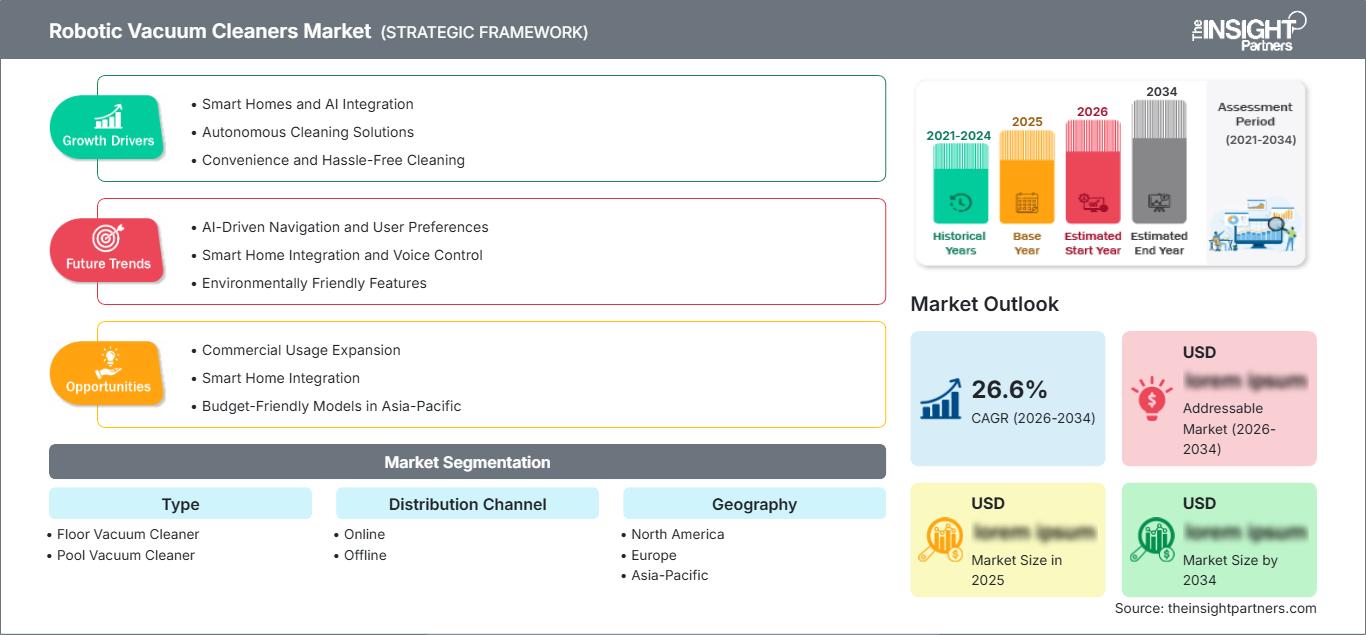
The robotic vacuum cleaners market was valued at US$ 10.64 Billion in 2025 and is projected to reach US$ 32.06 Billion by 2034, expanding at a CAGR of 13.04% during 2026–2034. The market is being reshaped by autonomous navigation, automated docking, AI-enabled obstacle recognition, integrated mopping, and connected-home interoperability. Product development is increasingly focused on reducing user intervention while improving cleaning consistency across hard floors, carpets, and mixed residential environments.
North America remains a structurally attractive market because of high smart-home adoption, strong purchasing power, replacement demand, and consumer preference for labor-saving appliances, which support continued penetration. Premium products with LiDAR navigation, self-emptying stations, mopping functionality, and pet-oriented cleaning capabilities are gaining relevance, while established appliance ecosystems are creating additional opportunities for connected floor-care solutions.
Robotic Vacuum Cleaners Market Assessment and Insights
- North America held an estimated 26–28% share in 2025 and is projected to grow at a CAGR of 13.2–13.8% between 2026–2034, supported by smart-home penetration, replacement demand, premium appliance adoption, and strong online retail infrastructure.
- US accounted for approximately 87–89% of North America's 2025 market and is expected to expand at a CAGR of 13.4–14.0% between 2026–2034, driven by connected-home adoption, premiumization, and demand for autonomous floor care.
- Europe represented approximately 19–21% share in 2025 and is forecast to grow at a CAGR of 12.0–12.8% between 2026–2034, with Germany, the UK, France, Italy, and Spain providing substantial demand through smart-appliance adoption and energy-conscious purchasing.
- Asia Pacific represented approximately 46–48% share in 2025 and is anticipated to grow at a CAGR of 13.8–14.6% between 2026–2034, led by China, Japan, South Korea, and India, where technology-oriented households support rapid adoption.
- Largest Segment: Floor Vacuum Cleaner category, estimated at a 68–72% market share in 2025 and projected to expand at a CAGR of 12.8–13.6% during 2026–2034, reflecting its broad residential applicability.
- High Growth Segment: Online distribution, estimated at a 55–60% market share in 2025 and projected to grow at a CAGR of 14.0–15.0% during 2026–2034, supported by product comparison, promotions, and direct-to-consumer strategies.
- Key companies analyzed in detail: Beijing Roborock Technology Co., Ltd.; Cecotec Innovaciones S.L.; Dyson Ltd; ECOVACS Robotics Co., Ltd.; Hayward Industries, Inc.; iRobot Corporation; Koninklijke Philips N.V.; Samsung Electronics Co., Ltd.; SharkNinja Operating LLC; YUJIN ROBOT Co., Ltd.
Source: The Insight Partners' analysis based on proprietary research, government publications, company annual reports, investor presentations, industry databases, and expert interviews.
The market has evolved from basic programmed floor-cleaning devices toward multifunctional domestic robotics integrating mapping, computer vision, LiDAR, automated charging, dust collection, and wet cleaning. Manufacturers increasingly combine hardware and software to improve navigation around furniture, cables, pets, and thresholds. Docking stations have also become more capable, incorporating dust emptying, mop washing, drying, and water management, raising average product value and reducing routine maintenance.
Looking forward, expansion is likely to extend beyond established smart-home markets into urban households across Asia, Latin America, the Middle East, and selected European markets. The Robotic Vacuum Cleaners Market Size assessment highlights that investment is moving toward artificial intelligence, edge processing, sensor fusion, battery efficiency, and multifunctional platforms. Regulatory attention to connected-device cybersecurity and consumer data protection will also influence product architecture, particularly as robotic cleaners become increasingly integrated into household digital ecosystems.
Robotic Vacuum Cleaners Market Report Scope
| Report Attribute | Details |
|---|---|
| Market size in 2025 | US$ 10.64 Billion |
| Market Size by 2034 | US$ 32.06 Billion |
| Global CAGR (2026 - 2034) | 13.04% |
| Historical Data | 2021-2024 |
| Forecast period | 2026-2034 |
Robotic Vacuum Cleaners Market Analysis
Demand is increasingly linked to time-saving household automation rather than simple vacuuming performance. Dual-income households, aging populations, pet ownership, and growing smart-home adoption create recurring use cases for autonomous cleaning. As consumers seek convenience and reduced household maintenance effort, robotic vacuum cleaners are becoming an integral part of connected home environments.
The ecosystem includes sensor suppliers, motors, batteries, processors, navigation software, brush and filtration systems, contract manufacturers, distributors, retailers, and after-sales service providers, according to the Robotic Vacuum Cleaners Market Report. Supply chains remain concentrated in Asia, while brands compete through global distribution and localized product portfolios. Integration of vacuuming and mopping has increased product complexity and raised the importance of reliable water management, brush design, obstacle detection, and dock hygiene.
When customers choose based on the experience of complete ownership and not merely suction performance, those companies with good software platforms and efficient service networks will find differentiation easier. Companies have started investing in areas like AI perception, automated docking, manufacturing capabilities, and distribution to cater to the growing trend of advanced and multifunctional cleaning robots.
The competitive pressure has started rising with more players coming together to serve the same segment of consumers as they start entering this business. Beijing Roborock Technology Co., Ltd. and ECOVACS Robotics Co., Ltd. focus on fast innovation cycles and multi-function platforms, while iRobot Corporation tries to revive its offerings with differentiation in navigation and floor care products. Samsung Electronics Co., Ltd. and Koninklijke Philips N.V. will benefit from their existing smart-home ecosystem, while Dyson Ltd and SharkNinja Operating LLC try to compete with engineering know-how and brand image.
● REPORT CUSTOMIZATION
Tailor This Report To Align With Your Specific Business Requirements
This report can be customized to align precisely with your business objectives, scope, and target markets. Customization options include tailored segmentation, geography, competitive analysis, and strategic insights to support informed decision-making.
Customize This Report →WHAT YOU CAN ADJUST
- ● Segmentations
- ● Geography
- ● Competitive Analysis
- ● Language Preferences
Robotic Vacuum Cleaners Market: Strategic Insights
Regional Insights
North America Robotic Vacuum Cleaners Market
North America accounted for approximately 26–28% of the Robotic Vacuum Cleaners Market share in 2025 and is projected to expand at a CAGR of 13.2–13.8% during 2026–2034. The US represents the dominant market because of its high household purchasing power, established smart-home infrastructure, and widespread familiarity with connected appliances, which support replacement and premium product adoption. Canada provides additional demand through urban households and a growing interest in automated domestic services.
Demand is increasingly influenced by multifunctionality, including vacuuming, mopping, self-emptying, and automated maintenance. Pet ownership and larger residential floor areas strengthen the value proposition of autonomous cleaning. Online retail remains strategically important because consumers can compare navigation technologies, dock configurations, warranty terms, and software capabilities before purchase. Manufacturers are also using subscription services, connected applications, and ecosystem compatibility to strengthen customer retention.
U.S. Robotic Vacuum Cleaners Market
The US represented approximately 87–89% of North America's 2025 Robotic Vacuum Cleaners Market and is expected to grow at a CAGR of 13.4–14.0% during 2026–2034. Premium autonomous cleaning is supported by smart-home compatibility, replacement cycles, strong e-commerce infrastructure, and consumer demand for products requiring limited manual intervention.
Application trends increasingly favor homes with pets, mixed flooring, and busy household schedules. Major brands, including iRobot Corporation, SharkNinja Operating LLC, Dyson Ltd, and Samsung Electronics Co., Ltd., compete through navigation, suction, mopping, and connected-home capabilities. Product differentiation is shifting toward obstacle recognition, automated dock functions, and software-assisted cleaning optimization. Competitive pricing from Asian manufacturers is also widening the range of available products.
Europe Robotic Vacuum Cleaners Market
Europe held approximately 19–21% share of the Robotic Vacuum Cleaners Market in 2025 and is projected to grow at a CAGR of 12.0–12.8% during 2026–2034. Germany is a leading market because of strong appliance purchasing capacity and engineering-oriented consumers. The UK also represents substantial demand, supported by online retail penetration and established adoption of connected domestic appliances.
Germany's market emphasizes high-quality engineering, energy efficiency, and multifunctional cleaning systems. Premium products with automated docks, mapping, and integrated mopping are increasingly relevant where consumers prioritize convenience and long service life. The UK benefits from extensive e-commerce availability and strong consumer awareness of smart-home products.
France, Italy, and Spain provide additional regional opportunities as robotic cleaning becomes more familiar and product portfolios broaden across price points. France and Italy show demand for compact and aesthetically integrated appliances, while Spain benefits from increasing smart-home adoption and online purchasing. Across Europe, privacy, cybersecurity, energy consumption, repairability, and product sustainability considerations can increasingly influence purchasing decisions.
APAC Robotic Vacuum Cleaners Market
Asia Pacific represented approximately 46–48% share of the Robotic Vacuum Cleaners Market in 2025 and is forecast to grow at a CAGR of 13.8–14.6% during 2026–2034. China remains the leading country, supported by domestic robotics manufacturers, advanced component ecosystems, rapid product iteration, and high consumer familiarity with smart appliances.
Japan and South Korea contribute through technology-oriented households and mature appliance markets, while India and Australia provide emerging opportunities. Urbanization, expanding digital commerce, rising disposable income, and smart-home initiatives support adoption. Local manufacturing capabilities and competitive product pricing also enable broader availability across price tiers.
Middle East & Africa Robotic Vacuum Cleaners Market
The Middle East and Africa Robotic Vacuum Cleaners Market is projected to grow at a CAGR of 11.0–12.0% during 2026–2034, supported by premium appliance demand in Saudi Arabia and the UAE and expanding smart-home awareness in South Africa and other urban markets.
Saudi Arabia and the UAE represent leading opportunities because of high-income consumers, new residential developments, and smart-home investment. South Africa provides a developing technology market, while the rest of MEA remains more fragmented. Energy-efficient appliances, connected-home infrastructure, urbanization, and expanding digital retail are likely to support gradual adoption.
Segmentation Analysis
Type
The Robotic Vacuum Cleaners Market Trends indicate that the Type segment is projected to expand at a CAGR of 12.8–13.6% during 2026–2034. Floor cleaning represents the principal application because robotic vacuuming is directly aligned with routine household maintenance. Pool cleaning remains more specialized, requiring different navigation, filtration, mobility, and environmental-resistance capabilities.
- Floor Vacuum Cleaner: Floor Vacuum Cleaner products address the largest residential use case and increasingly combine vacuuming, mopping, mapping, obstacle recognition, and automated docking. Their broad compatibility with household flooring supports continued market leadership.
- Pool Vacuum Cleaner: Pool Vacuum Cleaner systems serve a specialized cleaning requirement where autonomous movement, debris collection, water resistance, and pool-shaped navigation are critical. Adoption is linked to premium residential properties and automated pool-maintenance preferences.
Distribution Channel
The Robotic Vacuum Cleaners Market Forecast indicates that the Distribution Channel segment is expected to grow at a CAGR of 13.2–14.2% during 2026–2034. Online channels are becoming increasingly influential because consumers can compare technical specifications, reviews, software functionality, and promotional pricing before purchasing higher-value robotic appliances.
- Online: Online channels provide broad product visibility, direct brand access, review-driven purchasing, and frequent promotional activity. Their strategic importance increases as manufacturers develop direct-to-consumer models and use digital platforms for customer engagement.
- Offline: Offline channels remain relevant for premium appliances where consumers prefer physical demonstrations, retailer advice, installation support, and immediate product comparison. Specialty electronics and appliance stores remain important for higher-priced systems.
Opportunity Snapshot
| Distribution Channel | Revenue Contribution | Trend Tag | Adoption Stage |
| Online | High | Digital Retail | Scaling |
| Offline | Medium | Store Demonstration | Mature |
Robotic Vacuum Cleaners Market Growth Drivers and Impact Analysis
AI-Based Navigation and Object Recognition
The development of artificial intelligence will move robotic vacuums from being appliances that follow routes to becoming domestic robots able to understand their environment. Improved perception through camera technology, LiDAR, structured sensing, and machine learning will be useful in improving the detection of objects, map-making in rooms, obstacle avoidance, and optimal cleaning routes. All these will decrease the need for user involvement while increasing the practicality of autonomous operations. Perception of cables, furniture, pets, rugs, and floor transitions is especially crucial due to the possibility of clutter in the house disrupting cleaning processes. By integrating perception and efficient edge computing, vacuum manufacturers can develop their products without having to compete on high suction capabilities alone. The end result will be a shift towards more expensive systems, more differentiation in software, and continual chances for firmware improvement.
Multifunctional Vacuum-and-Mop Platforms
Integration of vacuuming and mopping is widening the application potential for floor care robots. More consumers seek a unit capable of handling all the dry debris removal, wet cleaning, and automatic cleaning tasks without requiring multiple units. More advanced docking stations are capable of washing and drying mopping devices, emptying dust bins, managing the water, and getting the robot ready for the next rounds. Such a design enhances convenience, but it also enables charging premium prices for the product. Differentiation in floor care robotics may come from features like floor recognition, carpet safety, stain removal, and adaptive cleaning intensity. The change in the product design also requires alterations in the supply chain as all the pumps, water tank, brushes, filters, sensors, and software are supposed to work as one system.
Smart-Home Ecosystem Integration
Connectivity with home automation platforms will be an important selling point since customers are beginning to automate the control of household appliances through apps and voice control devices. Connectivity with scheduling and instructions, status reporting, maintenance alerts, and remote controls can make robotic cleaners part of a larger home automation strategy. Smart home compatibility can minimize friction associated with having products from various vendors operating in the same home. Safety and privacy considerations can also become commercially important since these cleaners include cameras, microphones, maps, and household information. A vendor that establishes itself as offering transparency and reliable software support can win consumers' trust and lower barriers to entry. This means there are also cross-selling and service business opportunities associated with ecosystem integration and connectivity.
Robotic Vacuum Cleaners Market Future Trends
Greater Physical Autonomy
Systems of the future will probably go beyond navigation and start to become better at physically interacting with their environment. Vacuuming robots could possibly detect any temporary barriers and change the cleaning pattern, physically interact with some objects to pick them up and choose a particular cleaning mode without being given any instructions from the user. Development of small actuators, sensor fusion, on-board computing power, and machine-learning algorithms will help in that direction. On the side of product designers, attention will be paid to threshold cleaning, low clearance cleaning, edge cleaning, and floor transition robustness. Hence, the competitive criterion will no longer be the ability of a robot to navigate along a prescribed path but its ability to handle routine house exceptions on its own.
Convergence of Domestic Cleaning Robots
The differentiation between individual cleaning machines may become less prominent as producers assemble larger domestic robotics lines. The vacuum cleaners will use the same software platform, mapping information, charging system, and connectivity software as the window, swimming pool, lawnmower, and other types of robots for household services. Economies of scale in research, artificial intelligence, user interface design, and customer support will be achieved this way. Individual devices may no longer be chosen, but ecosystems purchased by consumers. Such a convergence pattern will also push producers to design similar navigation and safety systems for different categories of products. Such a market structure will benefit those companies that have general expertise in robotics, good distribution channels, and enough capital to sustain diverse production. Specialized companies will still be competitive because of better cleaning abilities, specific engineering, or unique software features.
Robotic Vacuum Cleaners Market Opportunities
Expansion into Emerging Urban Households
New urban markets present an avenue for extending robotic cleaning devices to nontraditional premium customers. Increased uptake of smartphones, growth in online shopping, income levels, and awareness of smart appliances can help lower adoption challenges. Producers can approach new markets using tiered product offerings, which will include basic navigation and automation functionalities but without expensive premium hardware. Other ways through which adoption can be enhanced include localized applications, region-specific service providers, flexible financing arrangements, and the provision of replacement parts. The Indian subcontinent, Southeast Asian, Latin American, and certain Middle Eastern markets are especially suited for this approach since the presence of densely populated urban centers and digitally savvy customers will enable the use of autonomous home appliances.
Premium Service and Software Monetization
Connected robotic cleaners create opportunities to expand revenue beyond the initial hardware transaction. Manufacturers can develop extended warranties, maintenance packages, replacement consumables, premium software functions, remote diagnostics, and ecosystem services around installed devices. Automated maintenance alerts can help brands sell filters, brushes, mop components, and other recurring consumables while improving product performance. Software updates can introduce new navigation features or cleaning routines without requiring hardware replacement, strengthening customer relationships and increasing perceived product longevity. For premium customers, service plans that combine maintenance and support can reduce ownership uncertainty. Companies with large installed bases can therefore create recurring revenue opportunities while collecting operational feedback that supports product development. Effective monetization will depend on transparent pricing, meaningful functionality, and strong privacy practices.
Frequently Asked Questions

- Comprehensive Market Sizing and Forecast Analysis
- Detailed Segmentation Analysis
- In-Depth Market Dynamics Assessment
- Regional and Country-Level Insights
- Competitive Landscape and Company Benchmarking
- Strategic Business Intelligence
Recent Reports
Testimonials

The Insight Partners provided valuable market intelligence that supported our global go-to-market strategy. Their team was professional, responsive, and attentive to our feedback, providing thoughtful analysis and helpful methodological clarifications throughout the project.
Junmo Kim Chief Financial Officer (CFO), Enertech Co., Ltd.
The Insight Partners' SCADA System Market report is comprehensive, with valuable insights on current trends and future forecasts. The team was highly professional, responsive, and supportive throughout. We are very satisfied and highly recommend their services.
RAN KEDEM Partner, Reali Technologies LTDs
I requested a report on a very specific software market and the team produced the report in a few days. The information was very relevant and well presented. I then requested some changes and additions to the report. The team was again very responsive and I got the final report in less than a week.
JEAN-HERVE JENN Chairman, Future Analytica
We worked with The Insight Partners for an important market study and forecast. They gave us clear insights into opportunities and risks, which helped shape our plans. Their research was easy to use and based on solid data. It helped us make smart, confident decisions. We highly recommend them.
PIYUSH NAGPAL Sr. Vice President, High Beam Global
The Insight Partners delivered insightful, well-structured market research with strong domain expertise. Their team was professional and responsive throughout. The user-friendly website made accessing industry reports seamless. We highly recommend them for reliable, high-quality research services
YUKIHIKO ADACHI CEO, Deep Blue, LLC.
This is the first time I have purchased a market report from The Insight Partners.While I was unsure at first, I visited their web site and felt more comfortable to take the risk and purchase a market report.I am completely satisfied with the quality of the report and customer service. I had several questions and comments with the initial report, but after a couple of dialogs over email with their analyst I believe I have a report that I can use as input to our strategic planning process.Thank you so much for taking the extra time and making this a positive experience.I will definitely recommend your service to others and you will be my first call when we need further market data.
JOHN SUZUKI President and Chief Executive Officer, Board Director, BK Technologies
I wish to appreciate your support and the professionalism you displayed in the course of attending to my request for information regarding to infectious disease IVD market in Nigeria. I appreciate your patience, your guidance, and the fact that you were willing to offer a discount, which eventually made it possible for us to close a deal. I look forward to engaging The Insight Partners in the future, all thanks to the impression you have created in me as a result of this first encounter.
DR CHIJIOKE ONYIA MANAGING DIRECTOR, PineCrest Healthcare Ltd.Reason to Buy
- Informed Decision-Making
- Understanding Market Dynamics
- Competitive Analysis
- Identifying Emerging Markets
- Customer Insights
- Market Forecasts
- Risk Mitigation
- Boosting Operational Efficiency
- Strategic Planning
- Investment Justification
- Tracking Industry Innovations
- Aligning with Regulatory Trends





 Get Free Sample for