
Rotavators Market Share, Growth & Demand by 2034
Coverage: By Blade Type (L Type, C Type); Tractor Type (Below 40 HP, 40 - 60 HP, Above 60 HP), and Geography (North America, Europe, Asia Pacific, and South and Central America)
- Status : Data Released
- Report Code : TIPRE00015353
- Category : Manufacturing and Construction
- No. of Pages : 150
- Available Report Formats :


- Last update date : September 18, 2026


2025 Market Size
US$ 2.74 Bn
Base year value
2034 Forecast
US$ 3.52 Bn
Projected by 2034
CAGR 2026-2034
2.80 %
Growth rate
Addressable Market
US$ 28.38 Bn
(2026-2034)
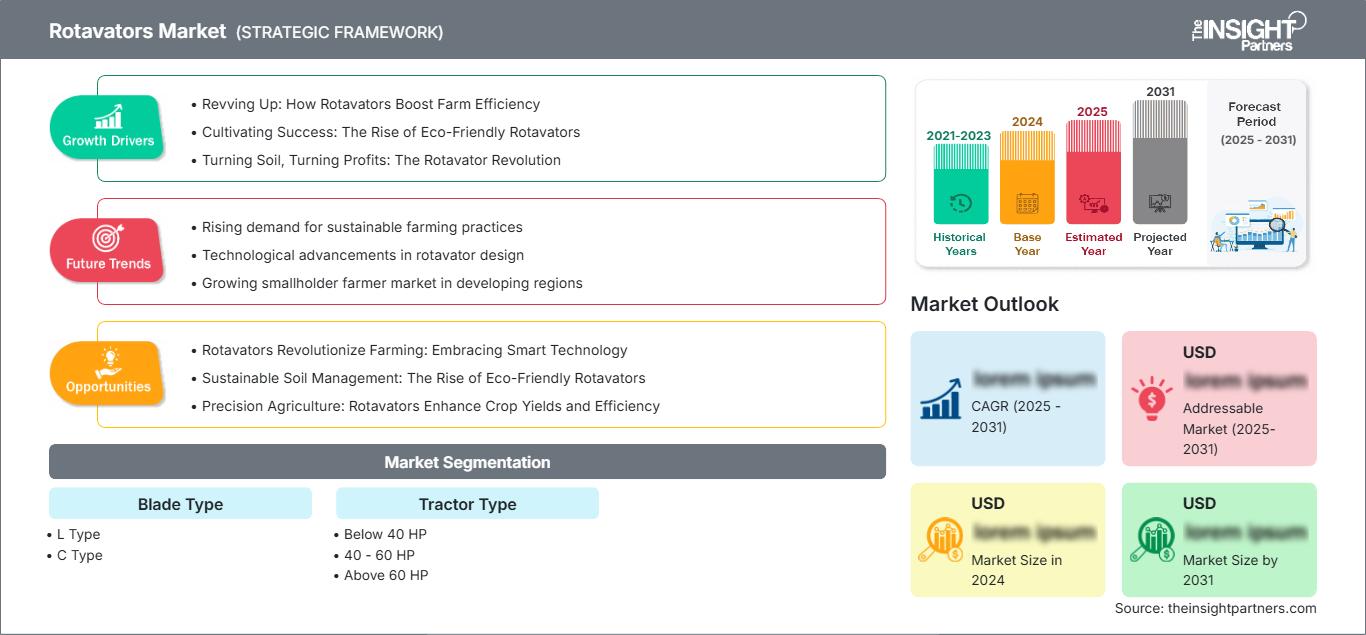
The rotavators market is valued at US$ 2.74 Billion in 2025 and is projected to reach US$ 3.52 Billion by 2034, registering a CAGR of 2.80% during 2026–2034. Demand is linked to mechanized seedbed preparation, residue incorporation, soil pulverization, and labor productivity. Purchasing decisions increasingly consider tractor compatibility, working width, blade configuration, durability, fuel efficiency, and suitability for varying soil conditions.
North America is expected to expand at a 2.2–2.8% CAGR between 2026–2034, supported by the replacement of aging tillage implements and demand for higher field productivity. Farm consolidation, contractor operations, and increasing adoption of medium and high-horsepower tractors provide a stable installed-equipment base for implement upgrades. The rotavators market size is also influenced by mechanization intensity and the availability of financing for agricultural equipment.
Rotavators Market Assessment and Insights
- North America: North America is estimated to hold a 19–23% share in 2025, growing at a 2.2–2.8% CAGR between 2026–2034, supported by mechanized field preparation, replacement demand, and contractor-led equipment utilization.
- US: The US is estimated to represent 82–86% of North American demand in 2025, expanding at a 2.3–2.9% CAGR between 2026–2034, supported by large farms and implement replacement.
- Europe: Europe is estimated to account for a 18–22% share in 2025, expanding at a 2.3–2.9% CAGR between 2026–2034, with Germany, France, Italy, Spain, and the UK supported by mechanized agriculture and equipment modernization.
- Asia Pacific: Asia Pacific is estimated to represent a 46–50% share in 2025, growing at a 3.2–3.8% CAGR between 2026–2034, led by India, China, Japan, South Korea, and Australia.
- Largest Segment: L Type blades are estimated to hold a 56–60% market share in 2025, expanding at a 2.9–3.5% CAGR between 2026–2034, supported by versatile soil preparation applications.
- High Growth Segment: 40 - 60 HP tractors are estimated to hold a 44–48% market share in 2025, growing at a 3.0–3.6% CAGR between 2026–2034, reflecting broad implement compatibility.
- Key companies analyzed in detail: AGCO Corporation, Fieldking, SHRACHI Group, Deere & Company, Great Plains Manufacturing, Inc., Kubota Corporation, KUHN NORTH AMERICA, INC., Mahindra & Mahindra Limited, Maschio Gaspardo S.p.A., and Wecan Global Co., Ltd.
Source: The Insight Partners' analysis based on proprietary research, government publications, company annual reports, investor presentations, industry databases, and expert interviews.
The technology profile is shifting from basic rotary soil preparation toward implements optimized for specific tractor power, soil texture, residue loads, and operating depth. Manufacturers increasingly differentiate through blade geometry, rotor design, gearbox configurations, depth control, reinforced frames, and adjustable working widths. The rotavators market is therefore becoming more application-specific, with equipment engineered to balance soil pulverization, traction requirements, fuel consumption, and field capacity.
Future demand should remain strongest across Asia Pacific while replacement and productivity upgrades sustain developed markets. Agricultural mechanization programs, rural financing, farm consolidation, and labor availability will influence purchasing decisions. Equipment suppliers are also expected to emphasize durable components and easier maintenance as farmers seek longer operating cycles. Precision agriculture adoption may further encourage compatibility between implements, tractors, and digital farm-management systems.
Rotavators Market Report Scope
| Report Attribute | Details |
|---|---|
| Market size in 2025 | US$ 2.74 Billion |
| Market Size by 2034 | US$ 3.52 Billion |
| Global CAGR (2026 - 2034) | 2.80% |
| Historical Data | 2021-2024 |
| Forecast period | 2026-2034 |
Rotavators Market Analysis
Demand for mechanized tillage remains closely associated with the need to complete field preparation within narrow planting windows. The rotavator market growth is supported by residue incorporation, seedbed preparation, clod breaking, and soil mixing across commercial and smallholder farming systems. The ecosystem includes implement manufacturers, tractor OEMs, dealers, component suppliers, agricultural contractors, financing institutions, rental operators, and farmers. Equipment demand, therefore, depends on both tractor availability and farm economics.
Factors influencing supply include steel costs, gearboxes, blades, bearings, power take-off systems, hydraulic systems, manufacturing capabilities, and dealer networks. Standardized models allow for mass production, but larger products have to be more application-specific. The importance of local manufacturing cannot be neglected in price-sensitive economies because the cost of transport may greatly impact equipment profitability. Equipment producers capable of providing wide compatibility with tractors and spare parts will facilitate adoption by decreasing the risk factor.
Competitors are diversified agricultural equipment manufacturers and implement makers. The companies such as AGCO Corporation and Deere & Company produce tillage equipment along with a wide range of tractors and precision agriculture products. Kubota Corporation is known for its compact and mid-range farming machinery. As for India, Mahindra & Mahindra Limited occupies an advantageous market position with respect to tractors and implements, while Maschio Gaspardo S.p.A. and KUHN NORTH AMERICA, INC. offer specialized tillage equipment for various farming needs.
Investment priorities are increasingly focused on durable designs, higher field capacity, and compatibility with tractors across multiple horsepower classes. Fieldking and SHRACHI Group compete through implementing specialization and regional agricultural-market reach, while Great Plains Manufacturing, Inc. and Wecan Global Co., Ltd. contribute additional product and manufacturing capacity. The Rotavators Market report highlights that strategic positioning is increasingly based on dealer reach, service support, replacement parts, customization, and the ability to align implements with evolving tractor power and farm operating models.
● REPORT CUSTOMIZATION
Tailor This Report To Align With Your Specific Business Requirements
This report can be customized to align precisely with your business objectives, scope, and target markets. Customization options include tailored segmentation, geography, competitive analysis, and strategic insights to support informed decision-making.
Customize This Report →WHAT YOU CAN ADJUST
- ● Segmentations
- ● Geography
- ● Competitive Analysis
- ● Language Preferences
Rotavators Market: Strategic Insights
Regional Insights
North America rotavators market
North America is estimated to hold a 19–23% of the Rotavators Market share in 2025 and is projected to expand at a 2.2–2.8% CAGR between 2026–2034. The US continues to be the key market, whereas Canada and Mexico help with the commercial agriculture, specialty crops, and equipment replacement. Big farms and contractors appreciate machinery capable of providing constant depth control and high field efficiency while avoiding idling during limited time windows for planting.
The area is equipped with matured tractor fleet and equipment supply network, making replacement and upgrading one of the key demand drivers. High-horsepower tractors allow wide and heavy implements to be used, whereas small operations still look for versatile machines. Deere & Company, AGCO Corporation, Great Plains Manufacturing, Inc., and KUHN NORTH AMERICA, INC. compete in related tillage segments. Demand will likely stay steady.
U.S. rotavators Market
The US represents approximately 82–86% of North American Rotavators Market demand in 2025 and is projected to grow at a 2.3–2.9% CAGR between 2026–2034. Commercial farms, specialty crop growers, and agricultural contractors are important adopters, and purchase decisions depend on the number of acres farmed, soil conditions, the power of the tractors, and cycles of replacements. Implementers with high capacity are important for farms that would like to have fewer field trips.
Companies such as Deere & Company, AGCO Corporation, Great Plains Manufacturing, Inc., and KUHN NORTH AMERICA, INC. manufacture a range of agricultural implements. Modern implements emphasize variable depth, strong cutting blades, robust gearboxes, and quick coupler attachments. Large farms are able to use wide implements because increased field capacity decreases operation time, while small farmers can afford more flexible implements.
Europe rotavators Market
Europe is estimated to account for a 18–22% share of the Rotavators Market in 2025 and is projected to grow at a 2.3–2.9% CAGR between 2026–2034. Germany continues to be a major market due to its complex agricultural machinery system and high degree of mechanization. Demand from France is based on extensive cultivation of arable crops. Italy and Spain are markets that provide for machinery needs in respect of specialized crops cultivation, horticulture and mixed farming. The UK provides for demand in respect of commercial farming and contracting.
The demand in Europe is becoming more dependent on soil management, equipment efficiency and cost management. Farming is assessing tillage equipment in respect of its working depth, soil disturbance, residue management and conservation practices. Maschio Gaspardo S.p.A., KUHN NORTH AMERICA, INC., AGCO Corporation and Deere & Company are players in the wider region's equipment market. Product development is increasingly moving towards implements that can adapt to different field conditions.
APAC rotavators Market
APAC is estimated to represent a 46–50% share in 2025 and is projected to grow at a 3.2–3.8% CAGR between 2026–2034. India is the leading regional market, followed by China, Japan, South Korea, and Australia. Rising mechanization, farm labor constraints, tractor adoption, and government-supported agricultural modernization are supporting equipment demand. India is particularly important because tractor-compatible rotavators are widely used for seedbed preparation and residue incorporation.
Local manufacturing and dealer networks remain important because farms vary considerably in size and purchasing power. Mahindra & Mahindra Limited, Fieldking, SHRACHI Group, Kubota Corporation, and Deere & Company serve different portions of the regional equipment ecosystem. Demand is likely to favor implements compatible with commonly used mid-range tractors, while larger commercial farms and contractors increasingly require higher-capacity models.
Middle East & Africa rotavators Market
The Middle East and Africa Rotavators Market demand is projected to expand at a 2.5–3.1% CAGR between 2026–2034. Saudi Arabia and the UAE are supported by agricultural modernization and investment in controlled or commercial farming, while South Africa has a comparatively developed mechanized farming base. The rest of the MEA demand remains fragmented and depends heavily on agricultural investment, financing, dealer coverage, and field conditions.
South Africa is the leading market in the region, supported by established commercial farming and machinery infrastructure. Water constraints can influence soil-management practices, while infrastructure development and food-security initiatives support mechanization. Suppliers with robust equipment, straightforward maintenance, and regional service capabilities are better positioned where operating conditions are demanding and replacement parts may require longer procurement cycles.
Segmentation Analysis
Blade Type
Blade Type selection affects soil cutting, residue mixing, pulverization, draft requirement, and operating performance under different moisture and soil conditions. The segment is projected to grow at a 2.8–3.4% CAGR between 2026–2034. L-type blades maintain a broad application base, while C Type blades remain relevant where specific soil penetration and residue-management characteristics are preferred.
- L Type: L Type blades provide a widely used configuration for general soil preparation, seedbed formation, and residue incorporation. Their versatility supports adoption across diverse crops, soil conditions, tractor categories, and regional farming systems.
- C Type: C Type blades are suited to applications requiring particular soil-cutting and mixing characteristics. Their use remains strategically relevant where farmers prioritize field finish, residue handling, and performance under defined soil conditions.
Tractor Type
Tractor Type determines implement width, working depth, rotor capacity, field productivity, and compatibility with available PTO power. The segment is expected to expand at a 2.9–3.5% CAGR between 2026–2034, with mid-range tractors representing an important balance between affordability, maneuverability, and implement capacity across diverse farms.
- Below 40 HP: Below 40 HP tractors support smaller farms, horticulture, specialty crops, and fragmented holdings. Compatible implements emphasize lower weight, maneuverability, moderate working widths, and manageable PTO requirements for cost-sensitive operators.
- 40 - 60 HP: 40 - 60 HP tractors provide a broad operating platform for common rotavator sizes. This category balances implement capacity and purchase economics, supporting small commercial farms, contractors, and diversified agricultural operations.
- Above 60 HP: Above 60 HP tractors enable heavier and wider implements for commercial farms and contractors. Higher available PTO power supports intensive tillage, greater field capacity, and operation in demanding soil or residue conditions.
Opportunity Snapshot
| Tractor Type | Revenue Contribution | Trend Tag | Adoption Stage |
| Below 40 HP | Medium | Compact Tillage | Mature |
| 40 - 60 HP | High | Midrange Power | Scaling |
| Above 60 HP | Medium | Heavy Tillage | Scaling |
Rotavators Market Growth Drivers and Impact Analysis
Rising Agricultural Mechanization and Labor Constraints
Availability of labor is a structural consideration that impacts the adoption of farm machinery, especially in situations where planting windows and time required for soil preparation are shrinking. Rotary tillers allow the farmer to undertake multiple soil preparation functions in fewer trips, thus helping the farmer finish work within a limited time. Commercial viability becomes pronounced in those areas that have labor migration, rising wage rates, or large farms. Consistency is improved since there is better control of the working depth and rotor speed as compared to soil preparation by hand. Manufacturers of these pieces of machinery can make use of this situation by developing machines suitable for their local tractor fleet sizes and farm sizes and not just one model. Finances through dealers, rentals, and custom hiring will reduce the cost of entry for the small farmer.
Expansion of Mid-Power Tractor Fleets
An increase in the number of medium-powered tractors automatically increases the range of customers who can be supplied with tillage tools that match the tractor in question. Tractors with 40-60 HP power are able to perform various jobs and, at the same time, have enough PTO power to operate typical rotary tillers. This makes them applicable for farms and agricultural contractors who need machinery for several types of crops. The significance of this issue goes further than mere sales since the farmers are likely to purchase additional machinery after buying tractors. This makes it possible to sell products in a certain range of working widths related to one power level of tractors. Also, manufacturers can increase their sales through offering financing and maintenance services together with standardized spare parts.
Growing Need for Faster Seedbed Preparation
Limited planting windows add to the economic importance of field capacity as late preparation may lead to delays in sowing and later crop processes. Rotary tillers are used as a one-trip solution for clod breaking, residue incorporation, and seedbed preparation; hence, they are suitable for places where fast preparation of soils is needed. The effects depend on crops grown, soil moisture, and residue management, but the aspect of productivity has become more important than cost in the choice of equipment. Higher capacity equipment becomes justified for farmers and contractors where a wider working width or better rotor design cuts down the number of trips to be made. Equipment manufacturers are addressing this issue by designing robust frames, better rotor designs, multi-speed gearboxes, and improved depth control.
Rotavators Market Future Trends
Greater Integration of Implement and Tractor Controls
The rotavators market trends are expected to move toward closer integration between implements and tractor control systems. Electronic tractor architectures can increasingly provide information about PTO operation, engine load, speed, fuel consumption, and implement settings, creating opportunities for more consistent tillage performance. Future systems may use automated depth adjustment and load-responsive operating strategies to maintain target soil conditions while reducing excessive tractor loading. Manufacturers can also develop digital interfaces that simplify setup and record operating parameters for different fields. Such integration could reduce operator dependence on manual adjustment and improve repeatability across multiple plots. The trend is particularly relevant to commercial farms and contractors managing several tractor-implement combinations. Standardized communication protocols and more accessible sensor technology should gradually make intelligent implementation functions available beyond premium machinery.
Low-Disturbance and Residue-Conscious Tillage Configurations
Future equipment developments will probably involve soil preparation that combines good seedbed quality with good retention of residue and less unnecessary soil manipulation. Today's farmers must deal with the problems of erosion, moisture conservation, soil structure, and crop residues while also having sufficient soil for seeding. In response to such needs, designs of rotary tillers can be improved by allowing adjustments in depth of work, particular blade shapes, rotor speeds, and shallower pass configurations. Equipment manufacturers may provide implements that can switch from conventional soil preparation to residue management through changeable components or adjustment settings. There may be a possibility of equipment that can be used for various soil preparation practices without separate equipment for each practice. The market impact will consist of a higher level of equipment differentiation based on results rather than working width and tractor power.
Rotavators Market Opportunities
Expansion Through Custom Hiring and Equipment Rental
The rotavators market forecasts indicate opportunities for manufacturers and dealers to expand through custom-hiring centers, rental networks, and contractor-based access models. These channels can reduce upfront capital requirements for small and fragmented farms while increasing utilization rates for implement owners. The model is particularly relevant in India and other agricultural economies where farmers may own tractors but use specialized implements only during specific cultivation periods. Suppliers can support this opportunity by designing machines for intensive seasonal use, simplified maintenance, rapid blade replacement, and readily available spare parts. Rental operators also benefit from equipment standardization because common models simplify servicing and fleet management. Manufacturers that establish partnerships with rural financiers, dealerships, cooperatives, and agricultural service providers can improve access without relying exclusively on individual equipment purchases.
Localized Manufacturing for Emerging Agricultural Markets
Emerging agricultural markets offer opportunities for localized production of implements tailored to regional tractor fleets, crops, soil conditions, and purchasing power. Local manufacturing can reduce transportation costs, shorten delivery times, and simplify access to replacement parts, while regional engineering can accommodate specific hitch standards and PTO requirements. India is especially relevant because a large installed tractor base supports demand for compatible implements across diverse farm sizes. Similar strategies can be applied in Southeast Asia, Africa, and Latin America through distributor partnerships and localized assembly. Suppliers should prioritize durable materials, simple service procedures, and flexible working widths when entering price-sensitive markets. Building regional component networks can also reduce supply-chain exposure and enable faster adaptation to changes in steel costs, tractor specifications, and customer requirements.
Frequently Asked Questions

- Comprehensive Market Sizing and Forecast Analysis
- Detailed Segmentation Analysis
- In-Depth Market Dynamics Assessment
- Regional and Country-Level Insights
- Competitive Landscape and Company Benchmarking
- Strategic Business Intelligence
Recent Reports
Testimonials

The Insight Partners' SCADA System Market report is comprehensive, with valuable insights on current trends and future forecasts. The team was highly professional, responsive, and supportive throughout. We are very satisfied and highly recommend their services.
RAN KEDEM Partner, Reali Technologies LTDs
I requested a report on a very specific software market and the team produced the report in a few days. The information was very relevant and well presented. I then requested some changes and additions to the report. The team was again very responsive and I got the final report in less than a week.
JEAN-HERVE JENN Chairman, Future Analytica
We worked with The Insight Partners for an important market study and forecast. They gave us clear insights into opportunities and risks, which helped shape our plans. Their research was easy to use and based on solid data. It helped us make smart, confident decisions. We highly recommend them.
PIYUSH NAGPAL Sr. Vice President, High Beam Global
The Insight Partners delivered insightful, well-structured market research with strong domain expertise. Their team was professional and responsive throughout. The user-friendly website made accessing industry reports seamless. We highly recommend them for reliable, high-quality research services
YUKIHIKO ADACHI CEO, Deep Blue, LLC.
This is the first time I have purchased a market report from The Insight Partners.While I was unsure at first, I visited their web site and felt more comfortable to take the risk and purchase a market report.I am completely satisfied with the quality of the report and customer service. I had several questions and comments with the initial report, but after a couple of dialogs over email with their analyst I believe I have a report that I can use as input to our strategic planning process.Thank you so much for taking the extra time and making this a positive experience.I will definitely recommend your service to others and you will be my first call when we need further market data.
JOHN SUZUKI President and Chief Executive Officer, Board Director, BK Technologies
I wish to appreciate your support and the professionalism you displayed in the course of attending to my request for information regarding to infectious disease IVD market in Nigeria. I appreciate your patience, your guidance, and the fact that you were willing to offer a discount, which eventually made it possible for us to close a deal. I look forward to engaging The Insight Partners in the future, all thanks to the impression you have created in me as a result of this first encounter.
DR CHIJIOKE ONYIA MANAGING DIRECTOR, PineCrest Healthcare Ltd.Reason to Buy
- Informed Decision-Making
- Understanding Market Dynamics
- Competitive Analysis
- Identifying Emerging Markets
- Customer Insights
- Market Forecasts
- Risk Mitigation
- Boosting Operational Efficiency
- Strategic Planning
- Investment Justification
- Tracking Industry Innovations
- Aligning with Regulatory Trends





 Get Free Sample for