
SCARA Robot Market Size, Trends & Growth by 2034
Coverage: by Payload Capacity (Up to 5.00 kg, 5.01-15.00 kg, More Than 15.00 kg); Application (Dispensing, Processing, Handling, Assembling and Disassembling, Welding and Soldering, Others); Industry Vertical (Automotive, Electrical and Electronics, Precision Engineering and Optics, Metals and Machinery, Food and Beverages, Others) , and Geography (North America, Europe, Asia Pacific, and South and Central America)
- Status : Data Released
- Report Code : TIPRE00007316
- Category : Electronics and Semiconductor
- No. of Pages : 150
- Available Report Formats :


- Last update date : September 21, 2026


2025 Market Size
US$ 4.68 Bn
Base year value
2034 Forecast
US$ 10.22 Bn
Projected by 2034
CAGR 2026-2034
9.08 %
Growth rate
Addressable Market
US$ 66.69 Bn
(2026-2034)
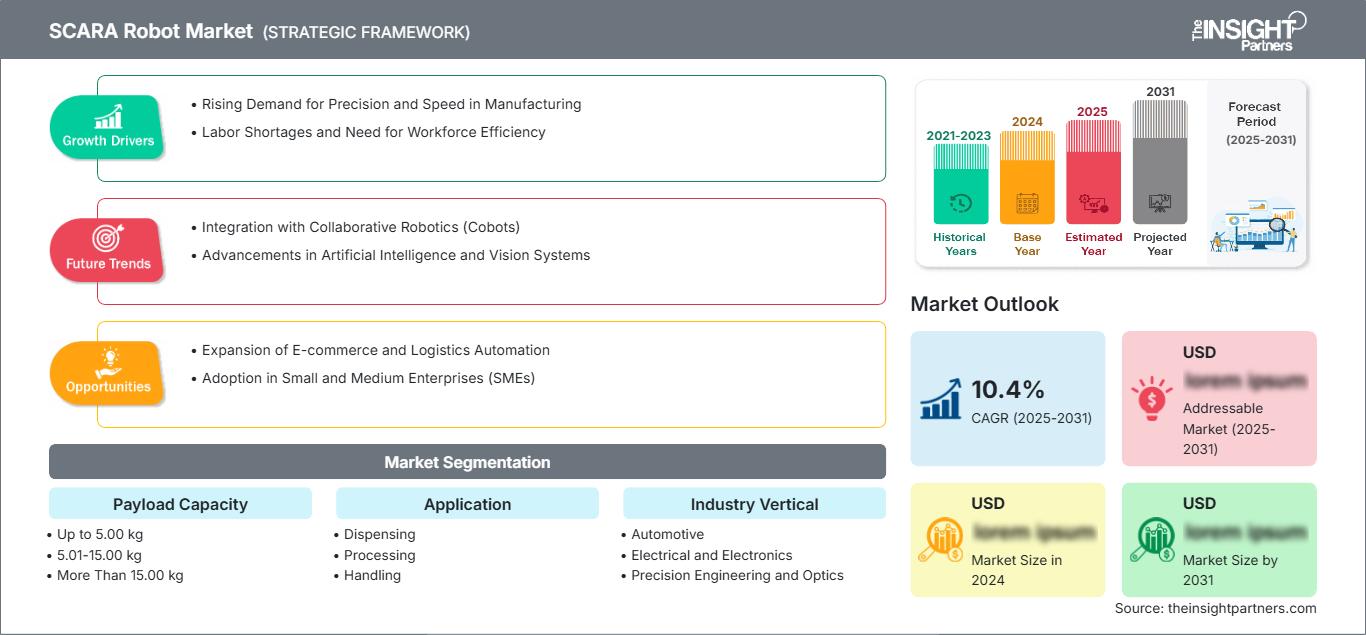
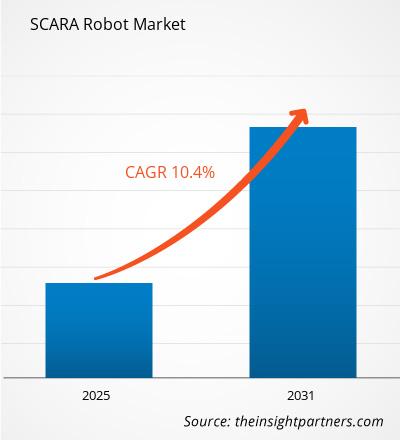
The SCARA robot market is projected to grow from US$ 4.68 Billion in 2025 to US$ 10.22 Billion by 2034, registering a CAGR of 9.08% during 2026–2034. Growth is being shaped by high-speed assembly automation, compact workcell design, labor constraints, and increasing demand for repeatable precision across electronics, automotive, food processing, and precision engineering production environments.
North America remains a strategic automation market as manufacturers deploy SCARA robots for electronics assembly, EV component handling, packaging, and medical device production. The SCARA robot market size outlook in the region is supported by reshoring, factory modernization, and shortages of skilled production labor, with regional demand expected to grow at a CAGR of 8.2–8.8% during 2026–2034.
SCARA Robot Market Assessment and Insights
- North America held 18–21% share in 2025 and is expected to grow at a CAGR of 8.2–8.8% during 2026–2034, supported by reshoring, EV production, packaging automation, and electronics assembly upgrades.
- US represented 78–82% of North America share in 2025 and is projected to grow at a CAGR of 8.1–8.7% from 2026–2034, driven by factory modernization and robotics integration.
- Europe accounted for 16–19% share in 2025 and is expected to grow at a CAGR of 7.5–8.2%, led by Germany, the UK, France, Italy, and Spain through automotive, machinery, and precision assembly demand.
- Asia Pacific captured 55–59% share in 2025 and is projected to grow at a CAGR of 9.8–10.6%, led by China, Japan, South Korea, India, and Australia as electronics and EV supply chains automate production.
- Largest Segment: Handling held 31–34% market share in 2025 and is expected to grow at a CAGR of 8.7–9.3%, reflecting widespread use in pick-and-place, loading, unloading, and packaging operations.
- High Growth Segment: Processing held 13–16% share in 2025 and is projected to grow at a CAGR of 10.0–10.8%, supported by precision dispensing, inspection, fastening, and semiconductor-adjacent applications.
- Key companies analyzed in detail: ABB Ltd., Comau S.p.A., DENSO Corporation, FANUC Corporation, Kawasaki Heavy Industries, Ltd., KUKA AG, Seiko Epson Corporation, Stäubli International AG, Shibaura Machine Co., Ltd., and Yamaha Motor Co., Ltd.
Source: The Insight Partners' analysis based on proprietary research, government publications, company annual reports, investor presentations, industry databases, and expert interviews.
Automated manufacturing has evolved from individual robotic systems to an interconnected network of flexible workstations where factors such as speed, repeatability, and space-saving installations are all important. The advantage that SCARA robots gain in this new context is that they enable the rapid movement in the horizontal direction while ensuring vertical stability with their four axes. This development is also possible through machine vision, simplified programming, integration of controllers, and the ability to connect to factory data.
Future investments will be geared towards manufacturing hubs in the Asia Pacific, as well as North America’s reshoring projects and Europe's high-mix environment. The emphasis for operators is on modular robots that can be integrated into the existing setup without extensive rearrangement of facilities. Safety regulations regarding worker protection, product traceability, and consistency in quality also drive the demand for automated processes in the manufacture of foods, pharmaceuticals, and medical devices.
SCARA Robot Market Report Scope
| Report Attribute | Details |
|---|---|
| Market size in 2025 | US$ 4.68 Billion |
| Market Size by 2034 | US$ 10.22 Billion |
| Global CAGR (2026 - 2034) | 9.08% |
| Historical Data | 2021-2024 |
| Forecast period | 2026-2034 |
SCARA Robot Market Analysis
SCARA robot market growth is supported by rising demand for compact automation in repetitive production tasks that need speed and repeatability. Electronics companies employ robots in the process of handling PCBs, assembling screws, connectors, and inspection transfer, whereas automakers utilize them in assembling batteries, sensors, and small components. Food and beverage businesses use SCARA robots because of their speed in performing pick and place operations, which helps to maintain packaging line uniformity.
The system comprises robot arms, controllers, end effectors, vision systems, safety devices, integrations, and maintenance services. Favorable supply chain dynamics are observed by suppliers who provide payload flexibility, shorter lead time, easy-to-use software, and network compatibility. Customers consider cost of ownership, footprint, and cycle time performance, along with pricing, when evaluating these products.
SCARA robot market analysis shows that competition is shaped by precision engineering, controller capability, and application support. Seiko Epson Corporation, Yamaha Motor Co., Ltd., DENSO Corporation, FANUC Corporation, and Shibaura Machine Co., Ltd. maintain strong positions in compact and mid-payload systems, while ABB Ltd., KUKA AG, Kawasaki Heavy Industries, Ltd., Stäubli International AG, and Comau S.p.A. strengthen customer access through broader robotics portfolios.
The investment patterns will be directed towards vision-enabled cells, software programming through AI, clean room options, and efficient robots for Asian production centers. Manufacturers are strategizing based on fast commissioning, simulation, and specific solutions for electronics, EV components, food packaging, and precision assembly applications. The industry, therefore, is moving away from robot sales to automation productivity results.
● REPORT CUSTOMIZATION
Tailor This Report To Align With Your Specific Business Requirements
This report can be customized to align precisely with your business objectives, scope, and target markets. Customization options include tailored segmentation, geography, competitive analysis, and strategic insights to support informed decision-making.
Customize This Report →WHAT YOU CAN ADJUST
- ● Segmentations
- ● Geography
- ● Competitive Analysis
- ● Language Preferences
SCARA Robot Market: Strategic Insights
Regional Insights
North America SCARA robot market
North America held 18–21% SCARA robot market share in 2025, supported by factory modernization across the US, Canada, and Mexico. The region benefits from semiconductor reshoring, EV supply chain expansion, medical device production, and packaging automation. SCARA robots are selected where compact footprints, fast cycles, and predictable repeatability improve labor productivity.
The regional market is expected to grow at a CAGR of 8.2–8.8% during 2026–2034. Demand is strongest in electronics assembly, appliance manufacturing, automotive components, and consumer goods packaging. Integrators are also using SCARA systems in mixed-product lines because they provide practical automation without the programming complexity of larger articulated robots.
U.S. SCARA robot Market
The US accounted for 78–82% of North America's share in 2025 and remains the region’s core demand center. Manufacturers are adopting SCARA robots for EV battery components, connectors, healthcare devices, small parts packaging, and electronics inspection. Vendor presence from FANUC Corporation, ABB Ltd., Epson, and Yamaha supports broader commercial availability.
The country is projected to grow at a CAGR of 8.1–8.7% through 2034. Adoption is strengthened by reshoring incentives, industrial labor shortages, and the need for flexible automation in high-mix production. Systems with integrated vision, compact controllers, and simple programming interfaces are gaining preference among mid-sized manufacturers.
Europe SCARA robot Market
Europe represented 16–19% share in 2025 and is expected to grow at a CAGR of 7.5–8.2% during 2026–2034. Germany leads due to automotive, machinery, and electrical equipment production, while the UK supports demand through packaging, pharmaceuticals, and electronics assembly. France, Italy, and Spain contribute through food processing, precision machinery, and supplier automation.
European manufacturers deploy SCARA robots to improve throughput in constrained factory spaces and meet stringent quality expectations. Demand is strongest where production lines require repeatability, low vibration, and rapid changeover. The region’s emphasis on energy efficiency and worker safety also supports the adoption of compact robotic systems in clean, enclosed, or collaborative workcell settings.
APAC SCARA robot Market
APAC captured 55–59% share in 2025 and is forecast to grow at a CAGR of 9.8–10.6% during 2026–2034. China is the leading country in electronics, batteries, semiconductors, and consumer device production, creating a large-scale demand for high-speed assembly automation.
Japan and South Korea remain technology-intensive markets with strong robot manufacturing ecosystems, while India is scaling automation through electronics manufacturing and automotive component programs. Australia contributes through food processing and specialized manufacturing. Regional growth is supported by dense supplier networks, government manufacturing initiatives, and declining payback periods for compact robotic cells.
Middle East & Africa SCARA robot Market
The Middle East & Africa market is expected to grow at a CAGR of 7.0–7.8% during 2026–2034. Saudi Arabia and the UAE lead adoption through industrial diversification, packaging automation, food processing, and electronics-related assembly investments.
South Africa contributes through automotive components, consumer goods packaging, and metals-linked manufacturing. The rest of MEA demand remains selective but is improving as industrial zones attract automated production projects. The leading country is Saudi Arabia, where manufacturing localization and logistics-linked industrial investment create demand for compact, repeatable robotic handling systems.
Segmentation Analysis
Payload Capacity
Payload Capacity is expected to grow at a CAGR of 8.8–9.4% during 2026–2034 as manufacturers select robots by payload, reach, speed, and end-effector weight. This SCARA robot market scope reflects the need to handle both lightweight electronics and heavier assemblies while maintaining repeatability in compact production cells.
- Up to 5.00 kg is widely used in electronics, medical devices, and precision assembly, where speed, small footprints, and delicate part handling are more important than lifting strength.
- 5.01-15.00 kg serves packaging, automotive components, and general assembly lines that require higher payload flexibility while preserving the cycle-time benefits of four-axis robot architecture.
- More than 15.00 kg supports heavier workpieces, palletizing, battery modules, and machinery components where manufacturers want SCARA speed but need added arm strength and rigidity.
Application
Application is expected to grow at a CAGR of 9.1–9.7% during 2026–2034 as users expand from basic material transfer into assembly, dispensing, welding, soldering, and processing tasks. Handling remains the largest activity because it applies across nearly every end-use industry and often provides the fastest automation payback.
- Dispensing benefits from precise path control for adhesives, sealants, lubricants, and micro-dosing tasks in electronics, automotive modules, and medical device production lines.
- Processing is gaining strategic importance as robots support inspection, fastening, polishing, and semiconductor-adjacent operations that require accuracy, cleanliness, and stable repeatability.
- Handling dominates adoption because pick-and-place, loading, unloading, sorting, and packaging applications are repetitive, labor-intensive, and suitable for compact SCARA workcells.
- Assembling and disassembling remain important in electronics, optics, and automotive components, where consistent insertion, screwdriving, and component placement improve yield and quality.
- Welding and Soldering are used selectively for small joints, electronics assemblies, and precision thermal processes where repeatable motion improves consistency and reduces operator variability.
Industry Vertical
Industry Vertical is expected to grow at a CAGR of 8.9–9.5% during 2026–2034 as adoption broadens from electronics into automotive, food, precision engineering, metals, and machinery. Electrical and electronics remain the anchor vertical because miniaturized components require high-speed, repeatable, and compact automation.
- Automotive demand is increasing through EV batteries, sensors, connectors, lighting systems, and small component assembly, where compact robots support high-volume subassembly production.
- Electrical and Electronics remains the leading vertical due to PCB handling, semiconductor packaging, connectors, switches, smartphones, and consumer electronics assembly.
- Precision Engineering and Optics uses SCARA robots for clean, accurate placement of delicate components where repeatability and low vibration are critical to quality.
- Metals and Machinery adoption is supported by small-part handling, machine tending, fastening, and transfer processes that improve throughput in constrained manufacturing cells.
- Food and Beverages uses SCARA robots for packaging, sorting, case loading, and hygienic handling, where speed and consistent movement reduce manual labor dependency.
Opportunity Snapshot
| Industry Vertical | Revenue Contribution | Trend Tag | Adoption Stage |
| Automotive | High | EV Modules | Scaling |
| Electrical and Electronics | High | Micro Assembly | Mature |
| Precision Engineering and Optics | Medium | Fine Placement | Scaling |
| Metals and Machinery | Medium | Machine Tending | Scaling |
| Food and Beverages | Medium | Fast Packaging | Scaling |
SCARA Robot Market Growth Drivers and Impact Analysis
Rising Need for Compact High-Speed Automation
SCARA robots are being chosen by manufacturers since several manufacturing operations require increased speed of work without any enlargement of the factory premises. The structure of such robots enables quick horizontal movement and strong vertical action, which makes them perfect for performing pick-and-place, assembly and packaging operations in confined cells. Such a driver is particularly relevant for electronics, medical equipment, and consumer goods manufacturing facilities, which have products of different formats. It also allows companies to respond to labor shortage issues.
Electronics and EV Supply Chain Expansion
Electronics, as well as electric vehicles, are bringing constant demand for precise automation systems. SCARA robots are employed in assembling connectors, sensors, battery components, printed circuit boards, and other small pieces requiring rapid and repetitive assembly. As companies move to localize their supply chains and increase manufacturing capacity, they will require robots capable of fast deployment on flexible lines. This trend affects the Asia Pacific region most intensely; however, North America and Europe also enjoy some advantages through reshoring as well as through semiconductor-related investments.
Lower Integration Barriers for Mid-Sized Manufacturers
SCARA usage is increasing due to the simplicity of the installation process by suppliers and integrators. Better controls, simulation tools, pre-fabricated end-of-arm tooling, and programming interfaces have made robots usable by medium-sized factories that formerly used manual processes. Simplified integration leads to shorter payback times, and it is possible to automate one cell at a time. This is very significant in food packaging, machinery, lab equipment, and electronics manufacturing. The outcome is a greater number of customers who regard robotic automation as a necessity.
SCARA Robot Market Future Trends
Vision-Guided SCARA Workcells
The SCARA robot market trends indicate increasing use of embedded vision, force feedback, and AI-assisted inspection in compact robotic cells. Vision guidance allows robots to identify orientation, detect defects, and adjust handling paths without fixed mechanical positioning. This trend will expand adoption in electronics, food packaging, medical devices, and precision components, where product variation is rising. Vendors that combine robot hardware, camera systems, and simplified calibration tools will gain an advantage because customers want faster commissioning and less dependence on specialist engineering support.
Cleanroom and Hygienic Robot Variants
The market for cleanroom and hygiene versions of SCARA robots is likely to grow as automation advances further into semiconductors, drugs, medical devices, and food production. In these applications, surfaces must be free from sharp edges and crevices that might generate particles and must withstand repeated washing. Manufacturers will need to offer more product lines featuring stainless steel enclosures, sealing, and application-specific grippers. This will boost high-end demand, since contamination control and documentation are more important than minimum cost.
SCARA Robot Market Opportunities
Automation Packages for Electronics SMEs
The SCARA robot market forecasts point to a strong opportunity in standardized automation packages for small and mid-sized electronics manufacturers. Many producers need robotic assembly, dispensing, testing, transfer, and inspection handling but lack large engineering teams. Vendors can address this gap with bundled robots, vision, grippers, safety, and software templates for common tasks. The opportunity is attractive because global electronics supply chains are diversifying, and smaller suppliers must meet tighter quality and delivery requirements to qualify for larger customer programs.
Retrofitting Manual Packaging Lines
Manual packaging lines in foods, consumer products, pharmaceuticals, and personal care provide a sensible avenue for growth. SCARA robots may be retrofitted to existing conveyor systems for tasks such as picking, sorting, loading, and secondary packaging without necessitating a complete overhaul of the line. Incremental implementation makes sense for those companies looking for improved efficiencies, but who cannot afford to spend capital on a whole line. The best opportunities exist where there is inconsistent availability of labor or changing formats of the products being produced.
Frequently Asked Questions

- Comprehensive Market Sizing and Forecast Analysis
- Detailed Segmentation Analysis
- In-Depth Market Dynamics Assessment
- Regional and Country-Level Insights
- Competitive Landscape and Company Benchmarking
- Strategic Business Intelligence
Recent Reports
Testimonials

The Insight Partners provided valuable market intelligence that supported our global go-to-market strategy. Their team was professional, responsive, and attentive to our feedback, providing thoughtful analysis and helpful methodological clarifications throughout the project.
Junmo Kim Chief Financial Officer (CFO), Enertech Co., Ltd.
The Insight Partners' SCADA System Market report is comprehensive, with valuable insights on current trends and future forecasts. The team was highly professional, responsive, and supportive throughout. We are very satisfied and highly recommend their services.
RAN KEDEM Partner, Reali Technologies LTDs
I requested a report on a very specific software market and the team produced the report in a few days. The information was very relevant and well presented. I then requested some changes and additions to the report. The team was again very responsive and I got the final report in less than a week.
JEAN-HERVE JENN Chairman, Future Analytica
We worked with The Insight Partners for an important market study and forecast. They gave us clear insights into opportunities and risks, which helped shape our plans. Their research was easy to use and based on solid data. It helped us make smart, confident decisions. We highly recommend them.
PIYUSH NAGPAL Sr. Vice President, High Beam Global
The Insight Partners delivered insightful, well-structured market research with strong domain expertise. Their team was professional and responsive throughout. The user-friendly website made accessing industry reports seamless. We highly recommend them for reliable, high-quality research services
YUKIHIKO ADACHI CEO, Deep Blue, LLC.
This is the first time I have purchased a market report from The Insight Partners.While I was unsure at first, I visited their web site and felt more comfortable to take the risk and purchase a market report.I am completely satisfied with the quality of the report and customer service. I had several questions and comments with the initial report, but after a couple of dialogs over email with their analyst I believe I have a report that I can use as input to our strategic planning process.Thank you so much for taking the extra time and making this a positive experience.I will definitely recommend your service to others and you will be my first call when we need further market data.
JOHN SUZUKI President and Chief Executive Officer, Board Director, BK Technologies
I wish to appreciate your support and the professionalism you displayed in the course of attending to my request for information regarding to infectious disease IVD market in Nigeria. I appreciate your patience, your guidance, and the fact that you were willing to offer a discount, which eventually made it possible for us to close a deal. I look forward to engaging The Insight Partners in the future, all thanks to the impression you have created in me as a result of this first encounter.
DR CHIJIOKE ONYIA MANAGING DIRECTOR, PineCrest Healthcare Ltd.Reason to Buy
- Informed Decision-Making
- Understanding Market Dynamics
- Competitive Analysis
- Identifying Emerging Markets
- Customer Insights
- Market Forecasts
- Risk Mitigation
- Boosting Operational Efficiency
- Strategic Planning
- Investment Justification
- Tracking Industry Innovations
- Aligning with Regulatory Trends





 Get Free Sample for