
Secure Multiparty Computation (SMPC) Market Demand, Trends & Forecast by 2034
Secure Multiparty Computation (SMPC) Market Size and Forecasts (2021–2034), Global and Regional Share, Trends, and Growth Opportunity Analysis Report Coverage : By Component (Solution, Services); Deployment (Cloud, On premises); Organization Size (Large Enterprises, SMEs); End Users (IT and Telecom, Healthcare, Manufacturing, Retail and E-commerce, Government, BFSI, Others)
- Status : Data Released
- Report Code : TIPRE00039615
- Category : Technology, Media and Telecommunications
- No. of Pages : 150
- Available Report Formats :


- Last update date : August 04, 2026


2025 Market Size
US$ 1.01 Bn
Base year value
2034 Forecast
US$ 2.43 Bn
Projected by 2034
CAGR 2026-2034
10.25 %
Growth rate
Addressable Market
US$ 15.28 Bn
(2026-2034)
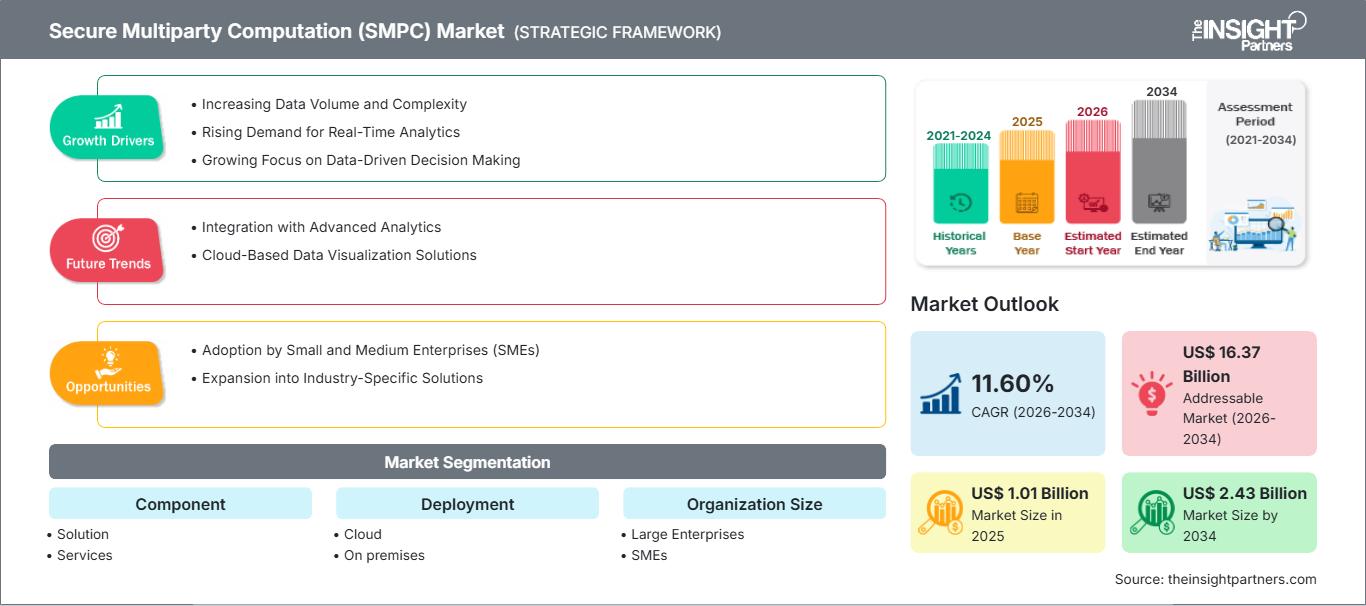
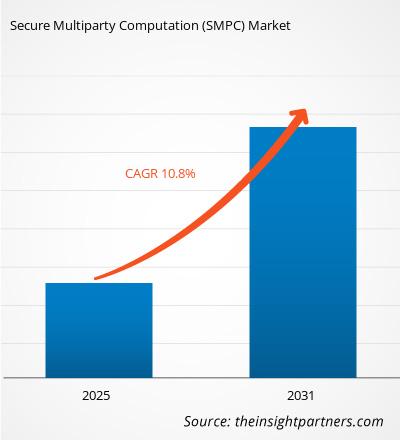
The Secure Multiparty Computation (SMPC) market was valued at US$ 1.01 billion in 2025 and is expected to reach US$ 2.43 billion by 2034; it is estimated to record a CAGR of 10.25% during 2026-2034.
Secure Multiparty Computation (SMPC) Market Assessment and Insights
- North America: Represented around 36–40% share in the market in 2025, with growth driven by stringent privacy regulations and widespread cloud adoption, and it is expected to expand at a CAGR between 10–12% during 2026–2034.
- US: Anchored market in North America, accounting for roughly 70–75% of regional spending in 2025, and is forecast to grow at a CAGR range of 10–12% from 2026 to 2034, supported by advanced cybersecurity ecosystems and active regulatory enforcement.
- Europe: Captured around 25–29% share of global revenue in 2025, led by the UK, Germany, and France, and to grow at a CAGR between 11–13% over 2026–2034 as GDPR‑driven privacy requirements and financial‑sector digitization fuel demand for secure multiparty computation solutions.
- Asia Pacific: Contributed about 22–26% of the global market revenue in 2025, with China, Japan, India, South Korea, and Australia driving adoption, and is likely to record a CAGR between 12–14% through 2034 on the back of rapid digital transformation and proactive cyber regulations.
- Largest Segment: The Cloud deployment segment is assessed to command around 45–50% market share in 2025 and to grow at a CAGR range of 11–13% between 2026–2034, reflecting enterprises’ preference for scalable, managed cryptographic services.
- High Growth Segment: The BFSI end‑user segment is expected to hold about 20–24% share in 2025 and to expand at a faster CAGR of 13–15% during 2026–2034 as financial institutions intensify secure analytics, fraud detection, and collaborative risk modeling.
- Key companies analyzed in detail: Microsoft Corporation, International Business Machines Corporation, Google LLC, Fireblocks Inc., Blockdaemon Inc., Penta Security Inc., Qredo Services Ltd., Zengo Ltd., Inpher Inc., and CYBAVO Pte. Ltd., which collectively provide cryptography‑driven infrastructure, MPC wallets, and privacy‑preserving analytics platforms.
Source: The Insight Partners' analysis based on proprietary research, government publications, company annual reports, investor presentations, industry databases, and expert interviews.
Privacy-preserving data collaboration technologies are driving changes in the evolution of secure multiparty computing solutions through continuous advancements in cryptography, confidential computing, and blockchain-based key management systems, becoming a part of enterprise production stacks. The shift in the production landscape is from experimental proofs-of-concept to real-world deployment use cases in such sectors as financial crime analysis, privacy-preserving AI, and cross-organizational healthcare research due to the adoption of cloud-based MPC solutions and hardware-based trusted execution environments with enhanced latency and scalability.
Moving forward, the sector will continue to benefit from an increase in the application scope in new geographical markets, namely the Asia Pacific and certain regions of the Middle East, which actively promote the development of secure digital identity and citizen data platforms. Strong tailwind for growth will come from increasing regulatory support, including the strengthening of GDPR legislation in Europe, new privacy regulations in North America, and key APAC countries.
Secure Multiparty Computation (SMPC) Market Report Scope
| Report Attribute | Details |
|---|---|
| Market size in 2025 | US$ 1.01 Billion |
| Market Size by 2034 | US$ 2.43 Billion |
| Global CAGR (2026 - 2034) | 10.25% |
| Historical Data | 2021-2024 |
| Forecast period | 2026-2034 |
Secure Multiparty Computation (SMPC) Market Analysis
The secure multiparty computation market growth is being propelled by the convergence of privacy regulations, cyber‑risk escalation, and the need for secure analytics across fragmented data silos. In BFSI and healthcare, institutions must compute across distributed records without exposing raw data, pushing MPC from academic prototypes into mission‑critical infrastructure operated on cloud platforms and hybrid environments that combine on‑premises data control with elastic compute.
An ecosystem in the value chain is created by cryptographic libraries, hardware acceleration, confidential cloud computing, and vertical solution vendors, enabling secure functions such as anti-money laundering analysis, and collaborative scientific research. Competition dynamics tend to favor platforms that provide managed MPC, key orchestration and APIs that enable embedding protocols into analytics and artificial intelligence workloads, making it easier for enterprises to implement while also maintaining compliance with data residency and sovereignty regulations.
On a competitive basis, the incumbent technology vendors like Microsoft and IBM integrate confidential computing, cryptographic keys and data platform functionality to solve enterprise-scale problems, while niche vendors like Fireblocks, Blockdaemon, Qredo, and CYBAVO offer MPC solutions for digital assets and transactions. New market entrants like Inpher and Penta Security deliver enhanced ML capabilities with a regional regulatory perspective, leading to differentiated portfolios through low-latency protocols, multi-cloud integration and industry-specific accelerators in financials, telecommunications and government sectors.
Trends in investments are toward modular and cloud-compatible MPC systems, with money being put into companies that work on solving problems of scalability and user experience in MPC, especially concerning developer tooling and integration with artificial intelligence. From a business strategy standpoint, companies consider MPC as one of the key building blocks for a privacy-enhancing technology stack that includes homomorphic encryption and differential privacy along with trusted hardware.
● REPORT CUSTOMIZATION
Tailor This Report To Align With Your Specific Business Requirements
This report can be customized to align precisely with your business objectives, scope, and target markets. Customization options include tailored segmentation, geography, competitive analysis, and strategic insights to support informed decision-making.
Customize This Report →WHAT YOU CAN ADJUST
- ● Segmentations
- ● Geography
- ● Competitive Analysis
- ● Language Preferences
Secure Multiparty Computation (SMPC) Market: Strategic Insights
Regional Insights
North America secure multiparty computation market
North America is recognized as the leading region for secure multiparty computation adoption, underpinned by mature cloud ecosystems, sophisticated cybersecurity strategies, and early enterprise experimentation with privacy‑preserving analytics. In 2025, the region is estimated to account for approximately 36–40% of global revenue, reflecting strong demand from financial institutions, healthcare networks, and technology platforms that process high‑value, sensitive data at scale.
Regulatory drivers, such as state‑level privacy statutes and sectoral rules governing financial and health information, encourage organizations to embed secure multiparty computation into risk models and collaborative data initiatives. Over 2026–2034, the North American secure multiparty computation market share is expected to increase steadily, with an anticipated regional CAGR of about 10–12%, as confidential computing, MPC‑based wallets, and secure data‑clean‑room services transition from pilots to standard components of enterprise data architectures.
U.S. secure multiparty computation market
The U.S. secure multiparty computation market represents the core of North American activity, likely contributing roughly 70–75% of regional revenue in 2025 as domestic financial services, large healthcare systems, and cloud hyperscalers intensify privacy‑focused innovation. Presence of leading vendors such as Microsoft, IBM, Google, Fireblocks, and Blockdaemon creates a robust ecosystem where MPC solutions are integrated with confidential computing services, AI platforms, and digital‑asset infrastructure.
Application trends in the U.S. encompass MPC in fraud detection, credit‑risk modeling, privacy‑preserving clinical research, and secure advertising measurement, facilitated by cloud‑hosted secure data‑clean rooms and hardware‑backed enclaves. Over 2026–2034, the U.S. secure multiparty computation market is expected to expand at around 10–12% CAGR, broadly aligned with the wider North American trajectory, as regulatory compliance pressures and board‑level focus on data ethics sustain long‑term investment.
Europe secure multiparty computation market
Europe’s secure multiparty computation market benefits from an advanced regulatory framework centered on GDPR and national data‑protection laws, which incentivize privacy‑by‑design architectures for cross‑border collaboration among enterprises and public institutions. In 2025, Europe is estimated to capture around 25–29% of global revenue, with leading participation from the UK, Germany, France, Italy, and Spain.
The UK and Germany together are likely to account for a major share of European demand, driven by financial‑services innovation and strong healthcare research ecosystems that increasingly rely on secure multiparty computation for federated analytics and AI training. France, Italy, and Spain contribute through investments in digital government, telecom modernization, and secure retail analytics, and the regional secure multiparty computation market is predicted to grow at roughly 11–13% CAGR from 2026 to 2034, with regulatory clarity and public‑sector projects reinforcing leadership.
APAC secure multiparty computation market
The APAC secure multiparty computation market is characterized by rapid digitalization, expanding telecom infrastructure, and government‑backed data‑protection regimes that encourage adoption of advanced cryptographic solutions. Regional revenue share in 2025 is expected to stand at about 22–26% of the global market, with China, Japan, South Korea, India, and Australia as primary growth engines.
China’s emphasis on secure data collaboration in e‑commerce and fintech, Japan’s Society 5.0 initiatives, South Korea’s personal information regulations, and India’s evolving digital privacy policies collectively drive demand for secure multiparty computation across industry verticals. APAC is projected to register a CAGR of approximately 12–14% over 2026–2034, making it one of the fastest‑growing regions as industrial policy, cyber‑resilience programs, and cloud adoption converge.
Middle East & Africa secure multiparty computation market
The Middle East & Africa’s secure multiparty computation market remains smaller than other regions but exhibits increasing momentum as countries invest in digital infrastructure and cybersecurity frameworks to underpin economic diversification. Saudi Arabia and the UAE lead regional adoption, leveraging MPC for secure financial services, government digital platforms, and energy‑sector analytics, while South Africa anchors demand in sub‑Saharan Africa through advanced banking and telecom sectors.
Regional initiatives around smart cities, national identity systems, and secure cross‑border payments provide fertile ground for secure multiparty computation solutions, especially as cloud data centers expand and local regulatory regimes mature. Overall, the Middle East & Africa secure multiparty computation market growth is expected to track a CAGR of around 10–12% from 2026 to 2034, supported by infrastructure investments and heightened awareness of data‑privacy risks.
Segmentation Analysis
Component
The Component segmentation of the market distinguishes between solutions and Services, reflecting how organizations procure and operate these capabilities. Overall, the Component segment is expected to grow at a CAGR of about 11–13% during 2026–2034, supported by rising demand for turnkey MPC platforms and specialized consulting for cryptographic integration across industries. Vendors increasingly bundle software toolkits with managed services to reduce deployment complexity and bridge skills gaps in advanced cryptography.
- Solution offerings encompass MPC engines, orchestration software, and APIs embedded in analytics, AI, and digital‑asset workflows, catering to enterprises that prefer standardized products while retaining some in‑house control.
- Services include design, integration, and ongoing operation of secure multiparty computation environments, enabling organizations to access cryptographic expertise, performance tuning, and compliance support without building large internal teams.
Deployment
In Deployment, the market scope spans Cloud and on-premises implementations, with hybrid approaches increasingly common in practice. The overall Deployment segment is anticipated to grow at around 11–13% CAGR between 2026 and 2034, as enterprises balance flexibility and regulatory requirements by combining scalable cloud MPC with local processing for sensitive workloads.
- Cloud deployment holds the larger share, enabled by confidential computing services and managed MPC that support cross‑party collaboration with strong encryption, attestation, and access controls integrated into leading cloud platforms.
- On-premises deployment serves organizations with strict data‑residency and security mandates, such as defense, critical infrastructure, and heavily regulated financial institutions, offering full hardware custody and tailored cryptographic configurations.
Organization Size
The Organization Size segmentation separates Large Enterprises and SMEs, capturing differing adoption pathways and resource profiles across the market. This segment is projected to register a CAGR of roughly 11–13% from 2026 to 2034, as large organizations institutionalize MPC for strategic analytics while smaller firms access simplified, consumption‑based offerings via the cloud.
- Large Enterprises lead current deployment, leveraging secure multiparty computation for complex, multi‑party analytics in finance, healthcare, telecom, and government, and integrating these capabilities into broader data governance and AI strategies.
- SMEs adopt MPC through packaged solutions and platform services, focusing on specific use cases such as secure data‑sharing with partners, regulatory compliance in niche markets, and enhanced customer‑data protection without heavy infrastructure investment.
End Users
The End Users segment defines how the secure multiparty computation market scope extends into IT and Telecom, Healthcare, Manufacturing, Retail and E‑commerce, Government, and BFSI. Collectively, this segment is forecast to grow at a CAGR in the range of 12–14% during 2026–2034, driven by sector‑specific regulatory pressures, digital transformation programs, and the need for secure cross‑institution analytics.
- IT and Telecom organizations deploy MPC to secure data flows across networks, multi‑tenant platforms, and edge environments, underpinning privacy‑preserving analytics and secure infrastructure‑sharing arrangements.
- Healthcare entities use secure multiparty computation to enable federated clinical studies, secure genomic research, and privacy‑preserving real‑world evidence generation, improving outcomes without compromising patient confidentiality.
- Manufacturing firms employ MPC for collaborative supply‑chain analytics and secure sharing of sensitive design and operational data among OEMs, suppliers, and logistics partners.
- Retail and E‑commerce platforms apply secure multiparty computation to privacy‑preserving advertising measurement, customer‑segment analysis, and secure sharing of transaction data across marketplaces, payment providers, and brands.
- Government agencies leverage MPC for secure citizen‑data aggregation, inter‑departmental analytics, and cross‑border security cooperation, aligning with public‑sector digital transformation agendas.
- BFSI institutions integrate MPC into fraud detection, risk modeling, and collaborative credit‑assessment frameworks, motivated by stringent confidentiality requirements and high exposure to cyber threats.
Opportunity Snapshot
| End Users | Revenue Contribution (High/Medium/Low) | Trend Tag | Adoption Stage (Emerging/Scaling/Mature) |
| IT and Telecom | Medium | Network Analytics | Scaling |
| Healthcare | High | Federated Trials | Scaling |
| Manufacturing | Medium | Supply Chain | Emerging |
| Retail and E‑commerce | Medium | Ad Tech Privacy | Scaling |
| Government | Medium | Citizen Data | Emerging |
| BFSI | High | Risk Modelling | Mature |
Secure Multiparty Computation (SMPC) Market Growth Drivers and Impact Analysis
Expansion of global data privacy and security regulations
Enforced rapidity in data privacy and security laws worldwide is one of the key motivating factors for adopting secure multiparty computation. Laws such as GDPR in Europe, California CCPA, health privacy laws like HIPAA, and the rising tide of privacy regulations in the Asia Pacific region compel companies to deploy privacy-by-design infrastructure that ensures strong protection of sensitive data. Multiparty computation helps firms perform computations on distributed datasets without revealing the underlying data in its raw form. In light of increased scrutiny by regulators over data transfers from one jurisdiction to another and algorithmic decision-making processes, MPC proves to be an essential tool in establishing data trust ecosystems.
Digitization of financial services and rise of digital assets
The increasing digitization of the financial industry and the rapid emergence of digital assets drive the growing need for multiparty computation (MPC) solutions. Financial organizations, such as banks, payment processors, and fintech companies, manage elaborate systems of high-stakes transactions where fraud prevention, risk assessment, and compliance reporting involve the use of MPC to conduct calculations on the basis of confidential financial data without exposing any particular positions. Moreover, MPC is crucial for key management and wallets, which are used by institutions to hold cryptocurrency and other tokenized financial instruments. There is a range of software products from Fireblocks and Blockdaemon that use multiparty control systems.
Growth of privacy‑preserving AI and data collaboration
The need for AI and analytics on distributed data sources, while maintaining privacy, is driving organizations towards secure MPC adoption in their machine learning operations. Hospitals, research centers, as well as corporations working in areas like retail and telecom, are already experimenting with federated learning and data clean rooms, which involve the use of cryptographic techniques to ensure the privacy of sensitive information. Using MPC, sometimes along with homomorphic encryption and TEEs, organizations can train and infer their models without disclosing the actual data. This will help improve the accuracy of models while being aligned with ethics and regulations associated with data usage. The growing adoption of privacy-preserving AI from the pilot projects stage to the mainstream one is likely to increase the demand for MPC technologies in the future.
Secure Multiparty Computation (SMPC) Market Future Trends
Integration of MPC with confidential cloud clean rooms
One prominent secure multiparty computation market trend is the integration of MPC engines with confidential cloud clean‑room services operated by major hyperscalers. Azure and similar platforms now provide enclave‑based environments where multiple organizations can contribute encrypted datasets for joint analytics, advertising measurement, and risk modeling without exposing raw data. Embedding MPC protocols into these services allows more complex computations and multi‑party scenarios, including cross‑industry collaborations that were previously infeasible due to legal and trust constraints. As clean‑room ecosystems mature, vendors will focus on performance optimization, standardized governance frameworks, and interoperability, supporting broader enterprise adoption.
Emergence of quantum‑resilient and hardware‑accelerated MPC
In addition to this, there are developments happening in the secure multi-party computation market for quantum resilient and hardware-accelerated methods to ensure that cryptography stays safe even in the future and becomes more efficient. The vendors and research organizations are working towards using post-quantum cryptography primitives in MPC frameworks to protect against any future risk associated with quantum computers. At the same time, special-purpose chips, secure enclaves and accelerators are being used within the cloud and on-premises systems to minimize the overhead associated with computation-intensive multiparty computations. This will help facilitate real-time or near-real-time applications like payment authorization, fraud scoring, and supply chain optimization.
Secure Multiparty Computation (SMPC) Market Opportunities
Scaling MPC across emerging economies and public‑sector programs
Secure multiparty computation market Forecasts indicate considerable opportunity in emerging economies where governments advance digital‑identity, e‑government, and smart‑city programs that depend on secure data collaboration. Countries in Asia Pacific, the Middle East, and parts of Africa are investing in cloud infrastructure, national data platforms, and cybersecurity strategies that create fertile ground for MPC‑enabled citizen‑data aggregation and cross‑agency analytics. Vendors that tailor solutions to local regulatory environments, language requirements, and public‑sector procurement models can capture significant long‑term contracts. Partnerships with systems integrators and telecom operators will be critical for scaling deployment across critical services such as healthcare, social protection, and transportation, reinforcing MPC’s role in inclusive digital transformation.
Vertical‑specific MPC solutions for regulated industries
Another key opportunity is in delivering vertical-specific solutions based on secure multiparty computation technology that is well-suited for highly regulated industries like BFSI, health care, and energy. Instead of general-purpose cryptographic frameworks, businesses need domain-specific systems that incorporate the principles of regulation, standardized data schemas, and pre-built use-cases like joint risk assessment, federated clinical trials, or grid optimization. Companies can distinguish themselves through the provision of reference architectures, compliance guidelines, and integration with industry standards to speed up implementation. The combination of MPC and analytics, AI, and reporting capabilities built for each vertical will bring steady income and enhanced customer engagement, creating a competitive advantage in the international marketplace.
Frequently Asked Questions

- Comprehensive Market Sizing and Forecast Analysis
- Detailed Segmentation Analysis
- In-Depth Market Dynamics Assessment
- Regional and Country-Level Insights
- Competitive Landscape and Company Benchmarking
- Strategic Business Intelligence
Recent Reports
Testimonials

The Insight Partners provided valuable market intelligence that supported our global go-to-market strategy. Their team was professional, responsive, and attentive to our feedback, providing thoughtful analysis and helpful methodological clarifications throughout the project.
Junmo Kim Chief Financial Officer (CFO), Enertech Co., Ltd.
The Insight Partners' SCADA System Market report is comprehensive, with valuable insights on current trends and future forecasts. The team was highly professional, responsive, and supportive throughout. We are very satisfied and highly recommend their services.
RAN KEDEM Partner, Reali Technologies LTDs
I requested a report on a very specific software market and the team produced the report in a few days. The information was very relevant and well presented. I then requested some changes and additions to the report. The team was again very responsive and I got the final report in less than a week.
JEAN-HERVE JENN Chairman, Future Analytica
We worked with The Insight Partners for an important market study and forecast. They gave us clear insights into opportunities and risks, which helped shape our plans. Their research was easy to use and based on solid data. It helped us make smart, confident decisions. We highly recommend them.
PIYUSH NAGPAL Sr. Vice President, High Beam Global
The Insight Partners delivered insightful, well-structured market research with strong domain expertise. Their team was professional and responsive throughout. The user-friendly website made accessing industry reports seamless. We highly recommend them for reliable, high-quality research services
YUKIHIKO ADACHI CEO, Deep Blue, LLC.
This is the first time I have purchased a market report from The Insight Partners.While I was unsure at first, I visited their web site and felt more comfortable to take the risk and purchase a market report.I am completely satisfied with the quality of the report and customer service. I had several questions and comments with the initial report, but after a couple of dialogs over email with their analyst I believe I have a report that I can use as input to our strategic planning process.Thank you so much for taking the extra time and making this a positive experience.I will definitely recommend your service to others and you will be my first call when we need further market data.
JOHN SUZUKI President and Chief Executive Officer, Board Director, BK Technologies
I wish to appreciate your support and the professionalism you displayed in the course of attending to my request for information regarding to infectious disease IVD market in Nigeria. I appreciate your patience, your guidance, and the fact that you were willing to offer a discount, which eventually made it possible for us to close a deal. I look forward to engaging The Insight Partners in the future, all thanks to the impression you have created in me as a result of this first encounter.
DR CHIJIOKE ONYIA MANAGING DIRECTOR, PineCrest Healthcare Ltd.Reason to Buy
- Informed Decision-Making
- Understanding Market Dynamics
- Competitive Analysis
- Identifying Emerging Markets
- Customer Insights
- Market Forecasts
- Risk Mitigation
- Boosting Operational Efficiency
- Strategic Planning
- Investment Justification
- Tracking Industry Innovations
- Aligning with Regulatory Trends





 Get Free Sample for