
Shipbuilding Market Demand, Trends & Forecast by 2034
Coverage: By Ship Type (Cargo, Vessel, Container, Tanker, Multi-Purpose Ship, Car and Passenger Ferry and Others), Process (Designing, Production Planning, Cutting and Processing, Assembling and Launching and Outfitting), End User (Commercial and Military) and Geography
- Status : Data Released
- Report Code : TIPTE100000716
- Category : Manufacturing and Construction
- No. of Pages : 150
- Available Report Formats :


- Last update date : July 15, 2026


2025 Market Size
US$ 163.71 Bn
Base year value
2034 Forecast
US$ 281.04 Bn
Projected by 2034
CAGR 2026-2034
6.19 %
Growth rate
Addressable Market
US$ 2,013.47 Bn
(2026-2034)
The Shipbuilding Market size had a value of US$ 163.71 Billion in 2025 and is expected to touch US$ 281.04 Billion in 2034; it is anticipated to have a CAGR of 6.19% during 2026-2034. The driving factors for the growth include fleet replacements, resilience of commercial shipping, modernization of defense forces, and preference for technologically advanced ships for emissions, safety, and efficiency reasons.
In North America, the Shipbuilding Market is driven by naval procurements, ferry replacements, offshore services, and yard improvements. North America is expected to grow at a 5.6–6.2% CAGR between 2026 and 2034. This will be driven by US defense ship projects, Canadian patrol vessels' modernization, and the need for Jones Act-qualified commercial assets.
Shipbuilding Market Assessment and Insights
- North America accounted for 18–20% Shipbuilding Market share in 2025 and is expected to grow at a 5.6–6.2% CAGR between 2026–2034, driven by naval recapitalization, offshore vessels, and specialized commercial construction.
- US represented 82–86% of North America in 2025 and is projected to grow at a 5.7–6.3% CAGR between 2026–2034, supported by Navy and coastwise programs.
- Europe held 16–18% share in 2025 and is forecast to grow at a 5.3–5.9% CAGR between 2026–2034, led by Italy, Germany, France, Spain, and the UK.
- Asia Pacific represented 55–59% share in 2025 and is expected to grow at a 6.5–7.1% CAGR between 2026–2034, led by China, South Korea, Japan, and India.
- Largest Segment Cargo held 30–34% market share in 2025 and is projected to grow at a 5.8–6.4% CAGR during 2026–2034 due to bulk and general cargo demand.
- High Growth Segment Military held 24–28% market share in 2025 and is forecast to grow at a 6.7–7.4% CAGR during 2026–2034 as governments renew surface fleets.
- Key companies analyzed in detail: Larsen & Toubro Limited, Mitsubishi Heavy Industries, Ltd., General Dynamics Corporation, BAE Systems plc, Japan Marine United Corporation, Imabari Shipbuilding Co., Ltd., Labuan Shipyard & Engineering Sdn. Bhd., Swiftships LLC, Damen Shipyards Group N.V., Sembcorp Industries Ltd., Cochin Shipyard Limited, China State Shipbuilding Corporation Limited, Fincantieri S.p.A., Dae Sun Shipbuilding & Engineering Co., Ltd., HD Hyundai Mipo Co., Ltd.
Source: The Insight Partners' analysis based on proprietary research, government publications, company annual reports, investor presentations, industry databases, and expert interviews.
Today's shipbuilding yards are moving from traditional construction methods to digital engineering, modular construction, robotic welding, and lifecycle data management. The dynamics of the Shipbuilding Market's growth are influenced by owners' desire to minimize construction risks amid increasing decarbonization demands. Fuel alternatives, optimization of the hull design, and supply chain localization have become the selection criteria, while capacity constraints in Asia are spurring regional manufacturing cooperation.
During the forecast period, the new demand drivers will include India, the Middle East, Southeast Asia, and selected African marine countries, due to their port development, naval protection, and offshore oil and gas industry. The regulatory drive for environmental efficiency and national fleets’ strategies should support investments in green propulsion, defense equipment, unmanned systems, and repair-related construction ecosystems.
Shipbuilding Market Report Scope
| Report Attribute | Details |
|---|---|
| Market size in 2025 | US$ 163.71 Billion |
| Market Size by 2034 | US$ 281.04 Billion |
| Global CAGR (2026 - 2034) | 6.19% |
| Historical Data | 2021-2024 |
| Forecast period | 2026-2034 |
Shipbuilding Market Analysis
Increasingly, demand is determined by the age of the fleets, rerouting of shipping lanes, and fuel-flexible ships. Seaborne shipping transports most of global merchandise trade, and longer voyages have been forcing ships to operate for more days, thus helping order replacements. These include steelworks, engine makers, naval integration firms, classification bodies, and port facilities that influence specifications.
The supply side still remains clustered with shipyards from Asia leading in the large commercial ships segment, while Europe and North America continue to lead in cruise, military, ferry, and specialized segments. Shipbuilding Market analysis suggests that factors such as berthing capacity, engine selection, and financial terms of the deal, along with vessel pricing, are as significant today.
The competitive landscape is dominated by China State Shipbuilding Corporation Limited, HD Hyundai Mipo Co., Ltd., Japan Marine United Corporation, Imabari Shipbuilding Co., Ltd., and Mitsubishi Heavy Industries, Ltd. in Asia, whereas in the case of naval and specialized programs, Fincantieri S.p.A., Damen Shipyards Group N.V., BAE Systems plc, General Dynamics Corporation, and Larsen & Toubro Limited are leading companies.
The focus of investments is shifting towards automated panel lines, digital twin technology, engineering of alternative-fuel solutions, and local-content cooperation. The players include Sembcorp Industries Ltd., Cochin Shipyard Limited, and Labuan Shipyard & Engineering Sdn. Bhd., Swiftships LLC, and Dae Sun Shipbuilding & Engineering Co., Ltd. have a positioning in the areas of repair, patrol, ferry, and commercial ship construction, respectively.
● REPORT CUSTOMIZATION
Tailor This Report To Align With Your Specific Business Requirements
This report can be customized to align precisely with your business objectives, scope, and target markets. Customization options include tailored segmentation, geography, competitive analysis, and strategic insights to support informed decision-making.
Customize This Report →WHAT YOU CAN ADJUST
- ● Segmentations
- ● Geography
- ● Competitive Analysis
- ● Language Preferences
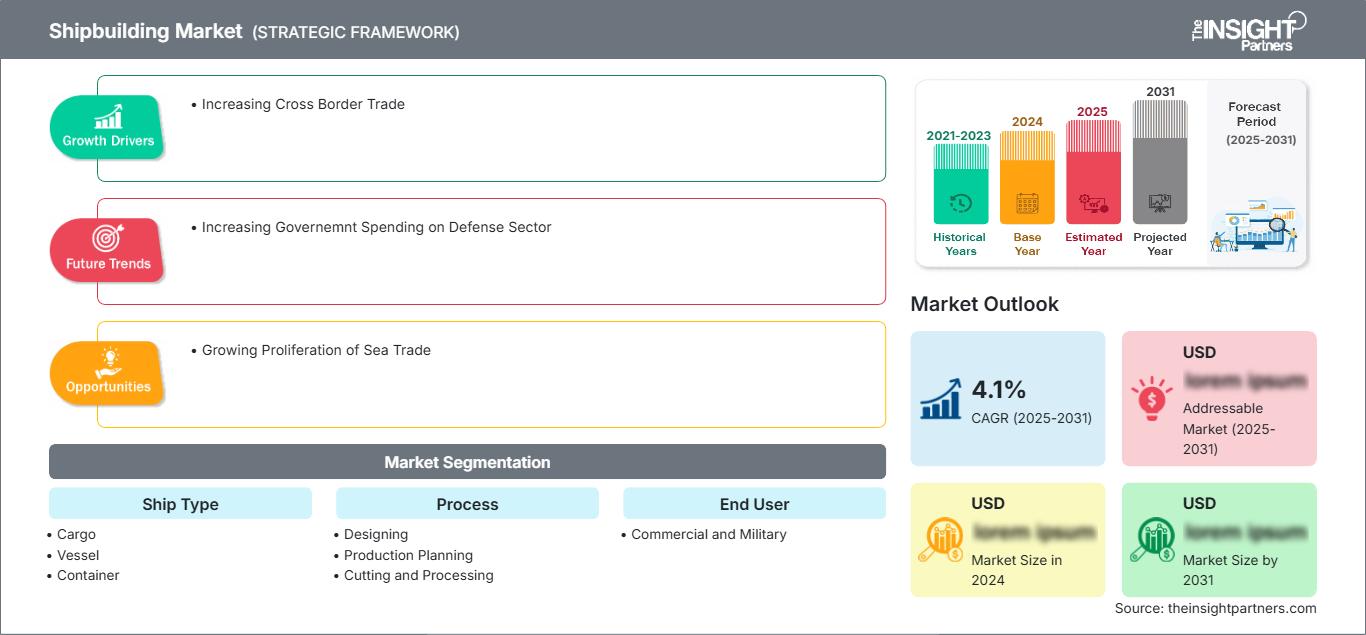
Shipbuilding Market: Strategic Insights
Regional Insights
North America Shipbuilding Market
The market share for North America was between 18–20% in the Shipbuilding Market in 2025 and is projected to grow at 5.6–6.2% during 2034. This region’s demand will be driven by factors such as U.S. navy shipbuilding, coast guard vessel renewal projects, inland river waterways, offshore support vessels, and ferries.
General Dynamics Corporation, Fincantieri S.p.A., through its U.S. division, Swiftships LLC, and BAE Systems plc contribute to the supply of defense and special purpose vessels. The commercial segment is smaller compared to Asia Pacific but is strategically important since offshore wind vessels, patrol vessels, and new construction or repairs involve customer proximity and compliance with regulations.
U.S. Shipbuilding Market
The USA accounted for 82-86% of North America’s share and was expected to experience a 5.7-6.3% CAGR for 2026-2034. The naval projects, the development of the industrial base, the amphibious and auxiliary vessels, and orders contribute to the commercial market, which is driven by coastal energy generation, ferrying vessels, barges, and offshore vessels.
As far as application trends are concerned, they include modular production, automation, and collaboration among suppliers to address labor shortages. General Dynamics Corporation and BAE Systems plc remain leading companies in the field of military vessel manufacturing, while Fincantieri S.p.A. and Swiftships LLC improve the specialty of their work.
Europe Shipbuilding Market
Market share in Europe is estimated at 16-18% and the CAGR for 2025-2034 is expected to be 5.3-5.9%. Leading players in the region include Italy, with its cruise, naval, and complex shipbuilding; Germany and the UK, with their expertise in naval, submarine, and specialized engineering; and France, Spain, and the Netherlands, with their ferry, naval, offshore, and repair-related capabilities.
Examples of companies that show Europe's preference for intensive designs over volume are Fincantieri S.p.A., Damen Shipyards Group N.V., and BAE Systems plc. Demand drivers include modernization of the naval fleet, energy security, upgrades to passenger vessels, and more efficient propulsion systems.
APAC Shipbuilding Market
APAC held a 55–59% market share in 2025 and is projected to grow at a CAGR of 6.5–7.1% between 2026 and 2034. China leads by the number of new orders and size of order book, South Korea specializes in building premium vessels, Japan prioritizes quality and efficiency, and India boosts government naval capabilities.
APAC firms such as China State Shipbuilding Corporation Limited, HD Hyundai Mipo Co., Ltd., Imabari Shipbuilding Co., Ltd., Japan Marine United Corporation, Mitsubishi Heavy Industries, Ltd., Cochin Shipyard Limited, and Larsen & Toubro Limited provide geographic coverage. There are several sustainable competitive advantages for the region, including policy inducements, export financing, skill clustering, and industry-port linkages.
Middle East & Africa Shipbuilding Market
The Middle East and Africa region is expected to experience a compound annual growth rate (CAGR) of 5.9–6.6% from 2026 to 2034. The driving factors behind this will be Saudi Arabia and the United Arab Emirates, with additional demands for repair, patrol, and port services coming from South Africa and the rest of MEA.
The yards in the region are moving away from a sole focus on repairs toward selective new-build capacity, specifically in offshore support vessels, patrol boats, ferries, and harbor craft. Strategic relationships with international shipbuilders facilitate the transfer of knowledge in design, project management, and system integration.
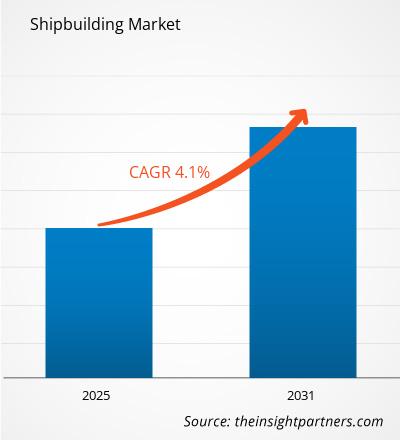
Segmentation Analysis
Ship Type
The Ship Type is forecast to achieve a CAGR of 6.0–6.6% for 2026-2034, driven by cargo efficiency, fuel flexibility, route reliability, and passenger safety. Different procurement cycles are observed in the Shipbuilding Market by type because high-volume commercial ships require freight calculations, while ferries and multipurpose ships require regional mobility and logistics solutions.
- Cargo vessels remain the largest category because dry bulk, breakbulk, and project cargo flows require versatile capacity, particularly for industrial inputs, construction materials, and energy transition equipment.
- Vessel demand covers broad marine platforms where customers prioritize mission adaptability, hull durability, and lifecycle service support across commercial, public, and specialized operating environments.
- Container ships are driven by fleet renewal, e-commerce trade lanes, and carrier focus on fuel-efficient capacity that reduces slot costs on long-haul routes.
- Tanker ordering is linked to energy trade shifts, refinery geography, and replacement of older tonnage with safer, more efficient hulls meeting stricter compliance expectations.
- Multi-Purpose Ship demand is supported by flexible cargo handling, smaller port access, and project logistics where operators need one vessel for varied freight profiles.
- Car and Passenger Ferry demand reflects urban mobility, island connectivity, tourism recovery, and public fleet decarbonization through hybrid, electric, and LNG-ready designs.
Process
Process will have an estimated growth rate of 5.9% to 6.5% CAGR between 2026 and 2034 through increased efficiency by shipyards through the use of digital planning, modular construction, improved cutting techniques, and concurrent outfitting. The level of process excellence is key in delivery, cost management, and quality control.
- Designing is becoming more data-driven as yards use digital twins, simulation, and class-rule integration to shorten engineering cycles and reduce late-stage design revisions.
- Production Planning determines yard productivity by aligning steel procurement, workforce scheduling, dock availability, and supplier delivery with vessel milestones and customer inspection requirements.
- Cutting and Processing supports precision fabrication through automated plate cutting, robotic welding preparation, and reduced rework, making it critical for cost and schedule discipline.
- Assembling and Launching remains the core yard execution stage, where modular blocks, crane capacity, dock utilization, and safety management directly affect delivery performance.
- Outfitting adds the highest systems complexity because propulsion, electrical, accommodation, navigation, and mission equipment must be integrated without compromising testing schedules.
End User
End User segment is projected to record a CAGR of 6.2% to 6.9% for the period 2026 to 2034. The requirements of commercial clients are based on the economics of operations, emissions, and flexibility of cargo, whereas the requirements of military clients revolve around survivability, mission systems, sovereign construction, and long-service support. There are vast differences in procurement visibility between these two groups.
- Commercial users represent the broader demand base, including shipping lines, ferry operators, offshore energy companies, and logistics owners seeking efficient vessels with predictable operating costs.
- Military users are strategically important because naval fleets require combat systems, secure supply chains, survivability standards, and multi-decade maintenance pathways that raise contract value.
Opportunity Snapshot
| Segment Name | Revenue Contribution | Trend Tag | Adoption Stage |
| Commercial | High | Fuel Ready | Mature |
| Military | Medium | Fleet Renewal | Scaling |
Shipbuilding Market Growth Drivers and Impact Analysis
Fleet Renewal for Efficiency and Compliance
Renewal of the fleet is the strongest driver of demand, since older ships incur high costs for fuel, maintenance, insurance, and regulatory compliance. Rules of the International Maritime Organization, carbon intensity indexing, and the push by charterers are prompting ship owners to place orders for vessels that can use less-polluting fuels or be retrofitted for that purpose. The shipyard sector is impacted by this driver through increasing engineering challenges faced by the yards. Shipyards with expertise in fuel system integration, class approval, and supplier relations can benefit from larger backlogs.
Naval Modernization and Maritime Security Budgets
Naval acquisitions are increasing due to the need to counter threats such as contested shipping lanes, submarines, coast guard needs, and the need to secure offshore installations. Unlike the commercial sector, defense procurement is usually characterized by lengthy lead times, local-content considerations, and complex combat-system integration. Consequently, there is plenty of business for shipyards with the necessary capabilities in terms of certifications, logistical capacity, and engineering skills. The effects are most evident in the United States, Europe, India, Japan, South Korea, and Australia, where fleet modernization is a key strategic issue.
Digital Shipyards and Modular Construction
Digital shipyard investment is improving throughput, quality, and predictability across design, cutting, assembly, and outfitting. Modular construction allows yards to build blocks in parallel, reduce dock congestion, and shorten vessel delivery windows. The impact is especially visible where skilled labor is scarce and orderbooks are long. Digital twins also improve design validation, owner review, supplier coordination, and maintenance handover. Shipyards adopting automation can improve bid confidence and reduce rework risk. This strengthens competitiveness for complex commercial vessels, ferries, and naval platforms requiring tight integration between hull, propulsion, and mission systems.
Shipbuilding Market Future Trends
Alternative-Fuel Ready Vessel Platforms
Shipbuilding Market trends will increasingly center on vessels designed for LNG, methanol, ammonia, hydrogen, battery-hybrid, or conversion-ready propulsion pathways. Owners are unlikely to select one universal fuel immediately, so yards must offer flexible tank layouts, safety systems, ventilation, and class-approved engineering that preserve future options. This trend shifts value from steel fabrication toward systems design and risk management. It also favors builders that maintain relationships with engine makers, fuel-system suppliers, classification societies, and ports. Over time, alternative-fuel readiness will become a baseline requirement in high-value tenders rather than a premium feature.
Unmanned and Autonomous Maritime Systems
Autonomous and remotely operated vessels are expected to move from demonstration programs toward niche operational deployment in surveillance, mine countermeasures, port services, hydrography, and offshore inspection. This trend will not replace large crewed ships in the near term, but it will reshape design requirements for command systems, sensors, redundancy, cybersecurity, and launch-and-recovery arrangements. Naval customers and offshore energy operators are likely early adopters because they value risk reduction and persistent monitoring. Shipyards that combine hull construction with electronics integration will be better positioned.
Shipbuilding Market Opportunities
Regional Yard Partnerships in Emerging Maritime Economies
Emerging maritime economies offer an opportunity for global shipbuilders to expand through joint ventures, technology licensing, workforce training, and modular block outsourcing. India, Saudi Arabia, the UAE, Indonesia, and selected African port economies are investing in naval capacity, coastal logistics, and offshore energy infrastructure. Local partnerships can reduce delivery risk, satisfy domestic content requirements, and create after-sales service revenue. The most attractive opportunities will combine government-backed demand with access to skilled labor and port-industrial zones. Shipbuilders that transfer processes without losing quality control can capture long-cycle regional growth.
Lifecycle Services Attached to Newbuild Contracts
Newbuild contracts increasingly create downstream revenue through maintenance, digital monitoring, refit planning, spare parts, and midlife modernization. This opportunity is strongest for naval vessels, ferries, offshore support vessels, and high-specification commercial ships where downtime is expensive and compliance requirements evolve. Builders can improve lifetime customer value by embedding diagnostics, documentation, and service agreements at delivery. Owners benefit from predictable maintenance pathways, while yards stabilize revenue beyond cyclical construction peaks. The model rewards companies with repair networks, engineering records, and trusted supplier relationships across propulsion, electronics, and safety systems.
Recent Developments
- June 2026: As India accelerates investments in coastal shipping, inland waterways and maritime connectivity, Mumbai-based ship-building, ship management and maritime safety company SHM Group (SHM) has launched Ocean Crewzer 8 (Y-410), a high-speed passenger vessel built entirely at its shipyard in Mumbai.
- June 2026: Gujarat has announced a shipbuilding subsidy of up to INR 50 crore for shipyards operating in the state, aimed at strengthening India’s maritime sector and encouraging domestic vessel construction. Under the scheme, shipyards can claim 8% of eligible costs or INR 50 crore, whichever is less, for building both small and large vessels.
- July 2025: the Ontario government is investing over US$ 90 million through the Ontario Shipbuilding Grant Program (OSGP) to increase capacity in the province’s shipbuilding industry as part of its plan to protect Ontario. The investment will help meet the growing demand for Ontario-made vessels, help Ontario shipbuilders support Canada’s National Shipbuilding Strategy and boost the economic competitiveness of Ontario’s shipbuilding and its supply chain while creating thousands of good-paying jobs across the marine sector. The investment is part of Ontario’s ongoing work to support national security and defence, as outlined in the framework for the Ontario Defence Industrial Strategy.
Frequently Asked Questions

- Comprehensive Market Sizing and Forecast Analysis
- Detailed Segmentation Analysis
- In-Depth Market Dynamics Assessment
- Regional and Country-Level Insights
- Competitive Landscape and Company Benchmarking
- Strategic Business Intelligence
Recent Reports
Testimonials

The Insight Partners provided valuable market intelligence that supported our global go-to-market strategy. Their team was professional, responsive, and attentive to our feedback, providing thoughtful analysis and helpful methodological clarifications throughout the project.
Junmo Kim Chief Financial Officer (CFO), Enertech Co., Ltd.
The Insight Partners' SCADA System Market report is comprehensive, with valuable insights on current trends and future forecasts. The team was highly professional, responsive, and supportive throughout. We are very satisfied and highly recommend their services.
RAN KEDEM Partner, Reali Technologies LTDs
I requested a report on a very specific software market and the team produced the report in a few days. The information was very relevant and well presented. I then requested some changes and additions to the report. The team was again very responsive and I got the final report in less than a week.
JEAN-HERVE JENN Chairman, Future Analytica
We worked with The Insight Partners for an important market study and forecast. They gave us clear insights into opportunities and risks, which helped shape our plans. Their research was easy to use and based on solid data. It helped us make smart, confident decisions. We highly recommend them.
PIYUSH NAGPAL Sr. Vice President, High Beam Global
The Insight Partners delivered insightful, well-structured market research with strong domain expertise. Their team was professional and responsive throughout. The user-friendly website made accessing industry reports seamless. We highly recommend them for reliable, high-quality research services
YUKIHIKO ADACHI CEO, Deep Blue, LLC.
This is the first time I have purchased a market report from The Insight Partners.While I was unsure at first, I visited their web site and felt more comfortable to take the risk and purchase a market report.I am completely satisfied with the quality of the report and customer service. I had several questions and comments with the initial report, but after a couple of dialogs over email with their analyst I believe I have a report that I can use as input to our strategic planning process.Thank you so much for taking the extra time and making this a positive experience.I will definitely recommend your service to others and you will be my first call when we need further market data.
JOHN SUZUKI President and Chief Executive Officer, Board Director, BK Technologies
I wish to appreciate your support and the professionalism you displayed in the course of attending to my request for information regarding to infectious disease IVD market in Nigeria. I appreciate your patience, your guidance, and the fact that you were willing to offer a discount, which eventually made it possible for us to close a deal. I look forward to engaging The Insight Partners in the future, all thanks to the impression you have created in me as a result of this first encounter.
DR CHIJIOKE ONYIA MANAGING DIRECTOR, PineCrest Healthcare Ltd.Reason to Buy
- Informed Decision-Making
- Understanding Market Dynamics
- Competitive Analysis
- Identifying Emerging Markets
- Customer Insights
- Market Forecasts
- Risk Mitigation
- Boosting Operational Efficiency
- Strategic Planning
- Investment Justification
- Tracking Industry Innovations
- Aligning with Regulatory Trends





 Get Free Sample for