
Silicon Anode Battery Market Key Players and Opportunities by 2034
Coverage: Capacity (< 1500 mAh, 1500 mAh- 2500 mAh, and > 2500 mAh); Application (Automotive, Consumer Electronics, Medical Devices, Energy & Power, Industrial, and Others); and Geography
- Status : Data Released
- Report Code : TIPRE00006795
- Category : Electronics and Semiconductor
- No. of Pages : 150
- Available Report Formats :


- Last update date : July 22, 2026


2025 Market Size
US$ 116.08 Mn
Base year value
2034 Forecast
US$ 1358.89 Mn
Projected by 2034
CAGR 2026-2034
31.5 %
Growth rate
Addressable Market
US$ 5,213.17 Mn
(2026-2034)
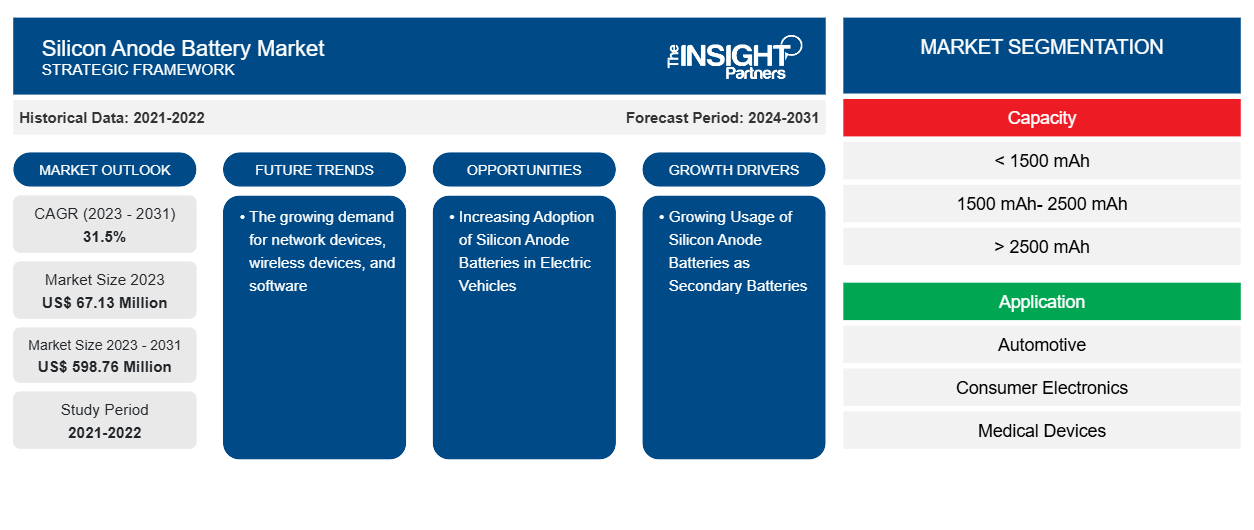
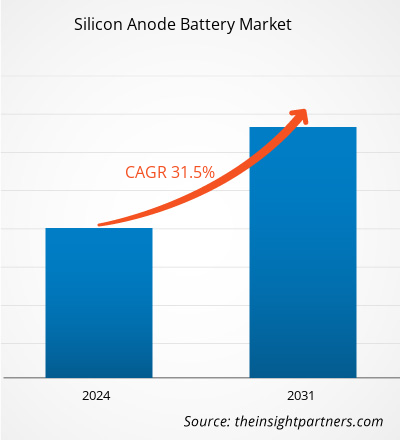
The Silicon Anode Battery Market is projected to expand from US$ 116.08 Million in 2025 to US$ 1358.89 Million by 2034, growing at a CAGR of 31.5% during 2026–2034. The market reflects rising adoption of silicon-rich anode chemistries across high-density lithium-ion batteries, supported by demand for faster charging, longer device runtime, and compact energy storage solutions in automotive, consumer electronics, medical devices, energy and power, and industrial applications.
North America is expected to record a 30–34% CAGR through 2034, driven by domestic battery supply-chain incentives, aerospace and defense demand, and early commercialization by U.S. silicon-anode specialists. The Silicon Anode Battery Market size in the region is also supported by electric mobility programs, advanced cell qualification, and higher average battery capacity requirements in premium vehicles, unmanned systems, and performance-oriented consumer electronics.
Silicon Anode Battery Market Assessment and Insights
- North America accounted for 26–30% share in 2025 and is projected to grow at a CAGR of 30–34% during 2026–2034, supported by U.S. cell innovation, defense sourcing, and EV battery localization.
- US represented 82–86% of North America in 2025 and is expected to grow at a CAGR of 31–35% during 2026–2034, led by advanced battery start-ups and aerospace customers.
- Europe held 18–22% share in 2025 and is forecast to grow at a CAGR of 27–31% during 2026–2034, with Germany, the UK, and France leading qualification programs.
- Asia Pacific captured 39–43% share in 2025 and is projected to grow at a CAGR of 32–36% during 2026–2034, led by China, Japan, and South Korea battery manufacturing ecosystems.
- Largest Segment Automotive held 42–46% market share in 2025 and is expected to grow at a CAGR of 32–36% during 2026–2034 as EV makers target higher energy density.
- High Growth Segment > 2500 mAh accounted for 30–34% market share in 2025 and is projected to grow at a CAGR of 34–38% during 2026–2034 as high-capacity cells move into mobility and industrial platforms.
- Key companies analyzed in detail: Amprius Technologies, Inc.; Daejoo Electronic Materials Co., Ltd.; Resonac Corporation; Huawei Technologies Co., Ltd.; Enovix Corporation; Nexeon Limited; Shin-Etsu Chemical Co., Ltd.; Sila Nanotechnologies Inc.; Targray Technology International Inc.; Group14 Technologies, Inc.; and Enevate Corporation.
Source: The Insight Partners' analysis based on proprietary research, government publications, company annual reports, investor presentations, industry databases, and expert interviews.
The commercialization of battery technology has progressed from laboratory silicon ideas to engineered silicon-carbon, silicon-oxide, and silicon-rich anodes that accommodate volume changes while increasing energy densities. The design of cells prioritizes drop-in compatibility with cylindrical and pouch designs due to conservative OEM qualification schedules. The material developers are working to scale porous carbon structures, nano-silicon powders, and binder formulations, whereas cell producers focus on validating cycle life, rapid charging, and safety before wide-spread usage in automobiles.
The investments are flowing towards geographies where battery manufacturing incentives, demand for electric vehicles, and intellectual property protection overlap. The North American region has gained importance through the sourcing mandate requirements, whereas the Asian-Pacific region continues to be the manufacturing base for anode materials and lithium-ion cells. The European region is focused on premium electric vehicle platforms, recycling legislation, and battery passport, creating the demand for validated traceable anode materials.
Silicon Anode Battery Market Report Scope
| Report Attribute | Details |
|---|---|
| Market size in 2025 | US$ 116.08 Million |
| Market Size by 2034 | US$ 1358.89 Million |
| Global CAGR (2026 - 2034) | 31.5% |
| Historical Data | 2021-2024 |
| Forecast period | 2026-2034 |
Silicon Anode Battery Market Analysis
The Silicon Anode Battery Market development relies upon sectors where energy density directly impacts the economic value of their products, ranging from EV range to drone flight time and medical equipment portability to premium electronics performance time. According to IEA, 1.2 TWh of EV battery production was achieved in 2025. Silicon solves several problems of graphite, yet its implementation depends on swelling resistance, electrolyte compatibility, and cycle-life performance.
The supply chain will be concentrated on high technology aspects, such as advanced materials, electrode manufacturing, and cells qualification. It is important for silicon vendors to demonstrate consistent particle structure, absence of impurities, and stability of integration with the existing slurries and coatings processes. While the automotive sector will validate materials for several years, consumer electronics will have quicker commercialization cycles. Therefore, there will be a staged growth of market where initial revenue will come from smaller cells prior to EV platforms' mass adoption.
The Silicon Anode Battery Market report portrays competition among cell providers, anode material providers, and battery technologies companies. Amprius Technologies, Inc. concentrates on silicon-rich cells, while Enovix Corporation specializes in architecture-driven performance. Group14 Technologies, Inc. and Sila Nanotechnologies Inc. concentrate on scalable silicon-carbon materials. Material knowledge has been deepened by Asian suppliers like Daejoo Electronic Materials Co., Ltd. and Shin-Etsu Chemical Co., Ltd.
Manufacturability, rather than capacity alone, is increasingly considered strategic. Companies which manage to obtain OEM design-ins, cell-form factor compatibility, and local production routes will be in a better position to translate technical qualifications into repeat business. Collaborations with battery companies, automotive suppliers, aerospace initiatives, and consumer electronics brands have become crucial as customers seek to benefit from performance improvements without disruptive changes in the factory and supply chain.
● REPORT CUSTOMIZATION
Tailor This Report To Align With Your Specific Business Requirements
This report can be customized to align precisely with your business objectives, scope, and target markets. Customization options include tailored segmentation, geography, competitive analysis, and strategic insights to support informed decision-making.
Customize This Report →WHAT YOU CAN ADJUST
- ● Segmentations
- ● Geography
- ● Competitive Analysis
- ● Language Preferences
Silicon Anode Battery Market: Strategic Insights
Regional Insights
North America Silicon Anode Battery Market
North America held 26–30% share in 2025 and is projected to grow at a CAGR of 30–34% during 2026–2034. The Silicon Anode Battery Market share in the region is supported by U.S. technology developers, defense procurement needs, and incentives that favor domestic cell and materials production. Aerospace, unmanned systems, and premium mobility applications are leading early qualification because they place high value on energy density.
Regional demand is influenced not only by the increased size of the battery pack, investments in the resilience of the grid system, and federal preferences regarding sourcing, but also by silicon-anode makers are favored geographically due to the presence of clients that value a reliable supply chain and validation of performance parameters. Yet, cost-effectiveness and scale are limiting factors for this process.
U.S. Silicon Anode Battery Market
The U.S. accounted for 82–86% of North America in 2025, and is predicted to have a CAGR of 31–35% over the period 2026–2034. This situation exists owing to the presence of a high density of silicon-anode manufacturers, defense applications, EV technology research projects, and venture capital funding for innovative materials development. Domestic supply routes are becoming more important as clients seek reliable sources that minimize the risk associated with foreign battery components.
Examples of such firms are Amprius Technologies, Inc., Sila Nanotechnologies Inc., Enovix Corporation, and Group14 Technologies, Inc. Demand exists for applications in aviation, defense electronics, wearable technologies, performance-driven consumer electronics, and premium EV projects. Qualification depth remains the main hurdle, but U.S. consumers are ready to spend more on higher energy density wherever weight savings become a necessity.
Europe Silicon Anode Battery Market
Europe held a share of 18-22% in 2025 and is projected to achieve a CAGR of 27-31% from 2026-2034. Germany is the leader within the region because of the superior engineering of EVs in addition to cell partnerships and material qualification. The United Kingdom brings in materials and research & development expertise, whereas France, Italy, and Spain gain from manufacturing of EVs, battery policy, and modernized grid storage.
The European customers value safety, lifecycles, and traceability within the supply chain. With battery passport legislation and recycling targets, the material providers will be encouraged to prove their low carbon intensity and provenance. Nexeon Limited's regional presence drives innovation. Meanwhile, automotive providers are evaluating silicon alloys that increase range without violating warranty commitments.
APAC Silicon Anode Battery Market
The APAC market was valued at a 39-43% market share in 2025 and is estimated to achieve a CAGR of 32-36% from 2026 to 2034. China dominates due to large cell manufacturing capacity, EV penetration, and material availability. Advanced chemical processes and separators in Japan and South Korea help in battery development for automobiles.
India and Australia are growing because of policy-driven energy storage, indigenous minerals, and the electrification of industries. Companies have an edge over others as the region has already been using lithium-ion technology but needs to carefully regulate silicon-anode growth. The strength of APAC is in converting materials innovations to manufacturing capacity.
Middle East & Africa Silicon Anode Battery Market
Middle East & Africa is expected to grow at a CAGR of 24–28% during 2026–2034, with Saudi Arabia leading early demand through industrial diversification, renewable-energy projects, and EV infrastructure planning. The UAE is building advanced mobility and logistics use cases, while South Africa supports storage demand linked to grid reliability.
Rest of MEA demand is comparatively early-stage, but telecom backup, mining electrification, and distributed storage create selective opportunities. Buyers prioritize durability in harsh climates and total cost of ownership. Silicon-anode batteries may gain traction where reduced weight, faster charging, and improved runtime offset higher initial costs in mission-critical applications.
Segmentation Analysis
Capacity
Capacity is projected to grow at a CAGR of 30–34% during 2026–2034 as suppliers tailor silicon-anode designs to different form factors. The Silicon Anode Battery Market scope is broadening from compact electronics to higher-capacity mobility and industrial cells, but each capacity band requires distinct electrode loading, thermal management, and cycle-life optimization.
- < 1500 mAh remains important for wearables, sensors, and medical patches where compact size and longer runtime matter more than total pack energy. It enables rapid commercialization through shorter qualification cycles.
- 1500 mAh- 2500 mAh serves smartphones, portable medical tools, and compact industrial electronics. Demand is stable because device makers seek battery-life gains without increasing enclosure size or redesigning charging systems.
- > 2500 mAh is strategically important for EV modules, drones, power tools, and industrial systems. Higher capacity supports premium applications where energy density, fast charging, and weight reduction are major purchasing criteria.
Application
Application is expected to grow at a CAGR of 31–35% during 2026–2034, supported by use cases that monetize higher energy density. Automotive demand provides scale, consumer electronics accelerate early adoption, medical devices require compact reliable power, energy and power applications value fast response, and industrial users prioritize uptime in mobile equipment.
- Automotive is the largest application as EV makers evaluate silicon-rich anodes to extend range, reduce pack weight, and improve fast-charging performance without redesigning full vehicle platforms.
- Consumer Electronics remains a near-term commercialization route because smartphones, wearables, laptops, and premium audio devices can absorb higher battery costs when runtime and compactness improve user experience.
- Medical Devices demand dependable compact cells for portable diagnostics, implant-adjacent tools, and connected monitoring equipment, where longer battery life can reduce charging frequency and support patient mobility.
- Energy & Power applications include stationary storage, renewable smoothing, and backup systems, although adoption depends on lifecycle cost, thermal stability, and proof of long-duration reliability.
- Industrial demand is growing in robotics, drones, logistics equipment, and field instruments where lighter batteries can improve operating time, payload capacity, and productivity across distributed worksites.
Opportunity Snapshot
| Application | Revenue Contribution | Trend Tag | Adoption Stage |
| Automotive | High | Fast Charging | Scaling |
| Consumer Electronics | Medium | Long Runtime | Scaling |
| Medical Devices | Medium | Portable Care | Emerging |
| Energy & Power | Low | Grid Storage | Emerging |
| Industrial | Medium | Mobile Robotics | Emerging |
Silicon Anode Battery Market Growth Drivers and Impact Analysis
Higher Energy Density Requirements in Electrified Mobility
Electric mobility is the most significant demand driver, as it requires greater range, fast charging, reduced battery weight, and battery pack size management. The International Energy Agency (IEA) estimated that the battery deployment in EVs amounted to 1.2 TWh in 2025; therefore, even the partial use of silicon could have an impact on materials' demand. Silicon anodes provide significantly higher theoretical capacity in comparison with graphite anodes; however, its commercial usage is possible only by managing the expansion process and cycle life. In Silicon Anode Battery Market, automotive projects proceed from the laboratory stage to platform-oriented testing.
Commercial Pull from Compact Consumer and Medical Devices
The application of consumer electronics and medical applications acts as a practical example of a bridge towards commercialization due to the use of small cells, short product cycles, and premium pricing to achieve long battery life. The need for wearables, mobile phones, connected diagnostics, and hand-held diagnostic equipment necessitates high energy density while maintaining small size. The use of silicon-based anodes will help extend battery life and reduce the number of charge cycles; however, reliability and cell swelling must be considered from a user safety perspective. This is another driver for revenue generation for suppliers prior to full-scale automotive adoption.
Supply-Chain Localization and Advanced Materials Investment
Governments and OEMs are prioritizing secure battery supply chains, creating demand for localized anode materials and qualified cell production. Policy incentives in North America, European traceability requirements, and Asia Pacific manufacturing scale are reshaping investment decisions. Silicon-anode suppliers that combine material performance with regional production options can reduce customer risk and improve procurement eligibility. The impact is strongest in defense, aerospace, EVs, and grid-adjacent storage, where buyers evaluate resilience alongside price. As capacity expands, strategic partnerships will determine which technologies move beyond pilot lines into repeatable, high-quality manufacturing.
Silicon Anode Battery Market Future Trends
Hybrid Silicon-Carbon Architectures Move into Mainstream Cell Formats
The most important Silicon Anode Battery Market trends will center on hybrid architectures that add silicon into graphite or carbon frameworks instead of relying only on pure silicon. This approach balances energy-density gains with manufacturability, cycle life, and cost. Producers are expected to refine porous carbon scaffolds, nano-silicon distribution, binders, and electrolyte additives so cells can use familiar coating and formation processes. As validation improves, hybrid anodes should expand from premium electronics and specialty mobility into larger EV and industrial packs, creating a smoother adoption curve for conservative OEM qualification teams.
Battery Qualification Becomes Data-Led and Application Specific
Future procurement will depend less on broad performance claims and more on application-specific evidence. Automotive customers will require long cycle-life data, abuse testing, warranty modeling, and scalable production controls. Medical and aerospace buyers will emphasize safety, traceability, and predictable degradation under demanding duty cycles. Digital battery passports, lifecycle reporting, and field-performance analytics are expected to become more influential in supplier selection. This shift favors companies that can integrate materials science, cell engineering, testing discipline, and manufacturing quality into a repeatable qualification package for each end-use environment.
Silicon Anode Battery Market Opportunities
Premium EV and Light Electric Vehicle Design-Ins
Premium EVs, light electric vehicles, and electric aviation platforms offer a near-term route for suppliers that can prove safety, fast charging, and durability. These customers accept higher cell costs when energy density improves range, payload, or charging convenience. Silicon Anode Battery Market Forecasts point to the strongest commercial upside where battery performance affects vehicle differentiation rather than only cost per kilowatt-hour. Suppliers should target co-development agreements, format-specific validation, and regional manufacturing partnerships that shorten OEM qualification timelines. Early design-ins can create recurring revenue because battery platforms often remain in production across multiple vehicle model years.
Specialty Cells for Defense, Aerospace, and Industrial Autonomy
Defense, aerospace, robotics, and industrial autonomy represent attractive niches because performance, reliability, and weight reduction can outweigh near-term cost premiums. Drones, soldier systems, satellites, inspection robots, and remote sensors benefit from longer runtime and reduced battery mass. Suppliers can differentiate by delivering ruggedized cells, secure sourcing, and validated performance across temperature extremes. This opportunity is especially relevant in North America and Europe, where procurement policies increasingly favor trusted supply chains. Companies that build application-specific packs and provide test data can capture higher margins before commodity-scale competition intensifies.
Recent Developments
- March 2026: Group14 Technologies announced that its newest silicon battery materials factory in Sangju, South Korea, has begun EV-scale production of its proprietary silicon battery material, SCC55. The state-of-the-art facility is designed to produce up to 2,000 metric tons annually, enabling 10 GWh of extreme-fast-charging battery capacity as production ramps. The Sangju factory operates alongside Group14’s existing commercial factory in Woodinville, Washington, with a second U.S. facility in Moses Lake, WA, nearing completion. The company’s silicon battery materials factories were designed to rapidly scale and easily “drop in” to commercial battery cell production lines. These factories are delivering to over 160 customers worldwide.
- February 2026: Amprius Technologies, Inc, a leader in next-generation lithium-ion batteries with its Silicon Anode Platform, announced a manufacturing partnership with Nanotech Energy (“Nanotech”), a U.S.-based energy company developing advanced lithium-ion batteries. This partnership secures a domestic production pathway for Amprius’ high-performance silicon battery cells.
- March 2025: Amprius Technologies, Inc., a leader in next-generation lithium-ion batteries with its Silicon Anode Platform, announced it has shipped its new 6.3Ah 21700 SiCore cell to a Fortune 500 company in the Light Electric Vehicle (LEV) sector for evaluation. The new cell sets a new standard in the industry for energy density in this widely used format.
Frequently Asked Questions

- Comprehensive Market Sizing and Forecast Analysis
- Detailed Segmentation Analysis
- In-Depth Market Dynamics Assessment
- Regional and Country-Level Insights
- Competitive Landscape and Company Benchmarking
- Strategic Business Intelligence
Recent Reports
Testimonials

The Insight Partners provided valuable market intelligence that supported our global go-to-market strategy. Their team was professional, responsive, and attentive to our feedback, providing thoughtful analysis and helpful methodological clarifications throughout the project.
Junmo Kim Chief Financial Officer (CFO), Enertech Co., Ltd.
The Insight Partners' SCADA System Market report is comprehensive, with valuable insights on current trends and future forecasts. The team was highly professional, responsive, and supportive throughout. We are very satisfied and highly recommend their services.
RAN KEDEM Partner, Reali Technologies LTDs
I requested a report on a very specific software market and the team produced the report in a few days. The information was very relevant and well presented. I then requested some changes and additions to the report. The team was again very responsive and I got the final report in less than a week.
JEAN-HERVE JENN Chairman, Future Analytica
We worked with The Insight Partners for an important market study and forecast. They gave us clear insights into opportunities and risks, which helped shape our plans. Their research was easy to use and based on solid data. It helped us make smart, confident decisions. We highly recommend them.
PIYUSH NAGPAL Sr. Vice President, High Beam Global
The Insight Partners delivered insightful, well-structured market research with strong domain expertise. Their team was professional and responsive throughout. The user-friendly website made accessing industry reports seamless. We highly recommend them for reliable, high-quality research services
YUKIHIKO ADACHI CEO, Deep Blue, LLC.
This is the first time I have purchased a market report from The Insight Partners.While I was unsure at first, I visited their web site and felt more comfortable to take the risk and purchase a market report.I am completely satisfied with the quality of the report and customer service. I had several questions and comments with the initial report, but after a couple of dialogs over email with their analyst I believe I have a report that I can use as input to our strategic planning process.Thank you so much for taking the extra time and making this a positive experience.I will definitely recommend your service to others and you will be my first call when we need further market data.
JOHN SUZUKI President and Chief Executive Officer, Board Director, BK Technologies
I wish to appreciate your support and the professionalism you displayed in the course of attending to my request for information regarding to infectious disease IVD market in Nigeria. I appreciate your patience, your guidance, and the fact that you were willing to offer a discount, which eventually made it possible for us to close a deal. I look forward to engaging The Insight Partners in the future, all thanks to the impression you have created in me as a result of this first encounter.
DR CHIJIOKE ONYIA MANAGING DIRECTOR, PineCrest Healthcare Ltd.Reason to Buy
- Informed Decision-Making
- Understanding Market Dynamics
- Competitive Analysis
- Identifying Emerging Markets
- Customer Insights
- Market Forecasts
- Risk Mitigation
- Boosting Operational Efficiency
- Strategic Planning
- Investment Justification
- Tracking Industry Innovations
- Aligning with Regulatory Trends






 Get Free Sample for