
Thin Film Micro Battery Market Trends, Demand & Growth by 2034
Coverage: by Rechargeability (Primary Battery, Secondary Battery); Component (Current Collectors, Electrodes, Substrates, Electrolytes, Others); Capacity (Below 10 mAh, Between 10 mAh and 100 mAh, Above 100 mAh); Application (Consumer Electronics, Wearable Devices, Smart Packaging, Smart Cards, Medical Devices, Wireless Sensor Nodes, Others) , and Geography (North America, Europe, Asia Pacific, and South and Central America)
- Status : Data Released
- Report Code : TIPRE00010783
- Category : Electronics and Semiconductor
- No. of Pages : 150
- Available Report Formats :


- Last update date : July 21, 2026


2025 Market Size
US$ 171.6 Mn
Base year value
2034 Forecast
US$ 461.25 Mn
Projected by 2034
CAGR 2026-2034
11.61 %
Growth rate
Addressable Market
US$ 2,783.55 Mn
(2026-2034)
The global Thin Film Micro Battery market was valued at US$ 171.6 million in 2025 and is expected to reach US$ 461.25 million by 2034; it is estimated to record a CAGR of 11.61% during 2026-2034.
Thin Film Micro Battery Market Assessment and Insights
- North America accounted for 34–37% Thin Film Micro Battery market share in 2025 and is projected to grow at 12.4–13.0% CAGR between 2026–2034, led by medical electronics, wearables, and secured identity applications.
- US represented 78–82% of North America in 2025 and is forecast to grow at 12.5–13.1% CAGR between 2026–2034.
- Europe held 22–25% share in 2025 and is expected to grow at 11.7–12.4% CAGR between 2026–2034, with Germany, France, and the UK leading adoption.
- Asia Pacific captured 30–33% share in 2025 and is projected to grow at 14.0–14.8% CAGR between 2026–2034, supported by China, Japan, South Korea, and India.
- Largest Segment Secondary Battery held 58–62% market share in 2025 and is expected to grow at 13.8–14.5% CAGR between 2026–2034.
- High Growth Segment Wearable Devices held 24–28% market share in 2025 and is projected to grow at 15.0–15.8% CAGR between 2026–2034.
- Key companies analyzed in detail: BrightVolt, Blue Spark Technologies, Front Edge Technology, Inc., Imprint Energy, Inc., Jenax Inc., ProLogium Technology Co., Ltd., Molex, LLC, Mouser Electronics, Inc., STMicroelectronics N.V., TDK Corporation
Source: The Insight Partners' analysis based on proprietary research, government publications, company annual reports, investor presentations, industry databases, and expert interviews.
Migration to more technologies is transforming the Thin Film Micro Battery industry from prototypes to micro-power platforms. Advancements in electrode deposition, polymer substrates, and solid electrolytes are enhancing cycle life and reliability, while roll-to-roll printing is reducing the production cost per unit for smart labels and low-power sensors. Technology production remains specialized because deposition uniformity, encapsulation, and moisture protection affect the reliability of batteries in medical applications, cards, and wearables.
The growth will be driven by the electronics assembly capacity in Asia, medtech innovations in North America, and environmental regulations in Europe. The interest from the policy makers in supply chain security, connected health care, and smart infrastructure stimulates the investments in thin, rechargeable, and printable batteries. Smaller circuit boards and greater demand for reliable embedded energy in electronic devices will favor suppliers with production capability.
Thin Film Micro Battery Market Report Scope
| Report Attribute | Details |
|---|---|
| Market size in 2025 | US$ 171.6 Million |
| Market Size by 2034 | US$ 461.25 Million |
| Global CAGR (2026 - 2034) | 11.61% |
| Historical Data | 2021-2024 |
| Forecast period | 2026-2034 |
Thin Film Micro Battery Market Analysis
Thin Film Micro Battery market growth is mainly spurred by connected devices that demand sub-millimeter power, long-term shelf stability, and safety of use close to the body or secure electronics. Wearable devices, wireless sensor nodes, and smart cards are increasingly demanding batteries that can be placed on curved or laminated surfaces. The supply side continues to be limited by purity of materials, quality of encapsulation, and yield control.
The value chain includes specialty chemicals, thin-film deposition equipment, flexible-substrate manufacturers, battery technology developers, and electronic systems integrators. The demand is high in markets where the value of power density, safety, and miniaturization outweighs that of commodity battery costs. Smart packaging and RFID applications offer volume potential, while medical devices and industrial sensors represent more profitable qualification markets.
Analysis of Thin Film Micro Battery indicates a competitive environment dominated by cell specialists and electronics ecosystem firms. Companies such as BrightVolt, Blue Spark Technologies, Front Edge Technology, Inc., Imprint Energy, Inc., and Jenax Inc. develop flexible and printed batteries, while other firms including STMicroelectronics N.V., TDK Corporation, Molex, LLC, and Mouser Electronics, Inc. provide channel support for commercialization.
The investments are now shifting toward rechargeable batteries, improved encapsulation quality, and specialized qualification. Positioning depends on collaborations with medtech, IoT, and secure card OEMs since sales follow design wins in several product cycles. Component vendors will help to boost development kits as well as customer traction through embedded electronics applications programs.
● REPORT CUSTOMIZATION
Tailor This Report To Align With Your Specific Business Requirements
This report can be customized to align precisely with your business objectives, scope, and target markets. Customization options include tailored segmentation, geography, competitive analysis, and strategic insights to support informed decision-making.
Customize This Report →WHAT YOU CAN ADJUST
- ● Segmentations
- ● Geography
- ● Competitive Analysis
- ● Language Preferences
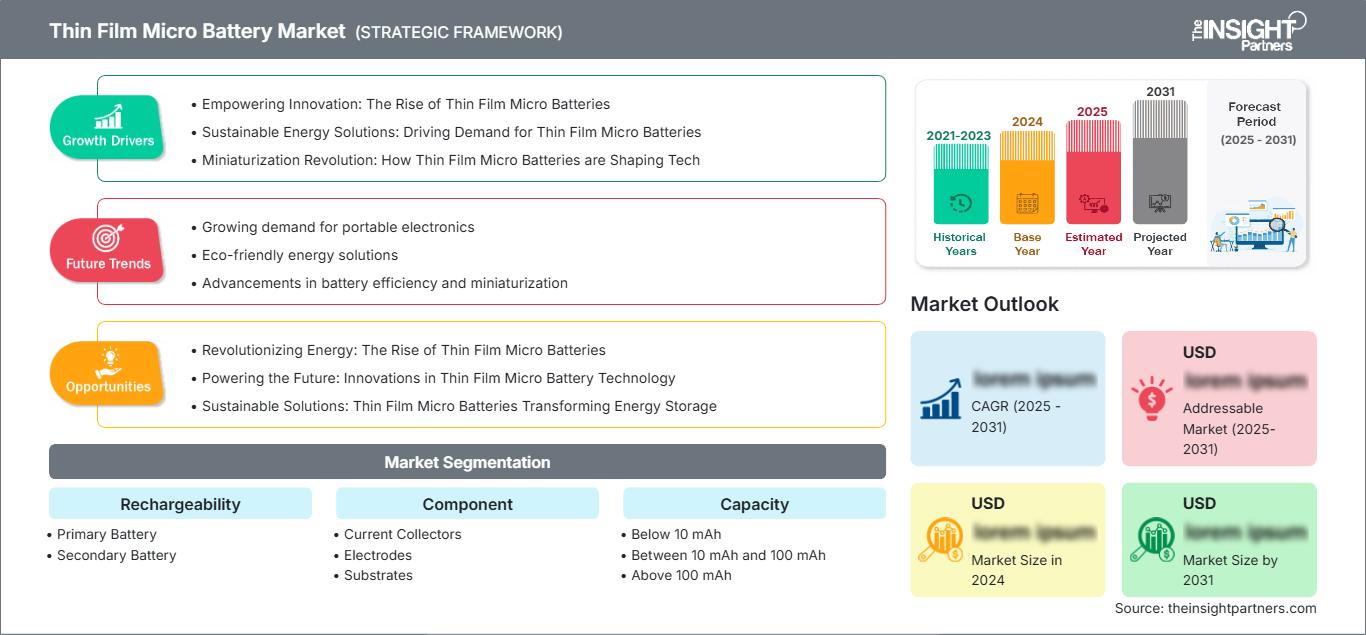
Thin Film Micro Battery Market: Strategic Insights
Regional Insights
North America Thin Film Micro Battery
North America accounted for a Thin Film Micro Battery market share of 34–37% in 2025, and is expected to register a CAGR of 12.4–13.0% over the period 2026-2034. North America's share in micro-battery market is aided by initiatives such as connected health care, defense electronics, and industrial IoT applications that require robust yet small-sized embedded batteries.
Government focus on semiconductor security, medical monitoring, and identity infrastructure enables prototyping and pilot manufacturing at home. The United States and Canada demonstrate use cases in patient patches, smart labels, and sensor networks. Growth in the region is further enabled by research activities at universities, venture capital-backed electronics companies, and original equipment manufacturers' preference for qualified suppliers.
U.S. Thin Film Micro Battery Market
The US accounted for 78-82% of the total Thin Film Micro Battery market in North America during 2025 and will continue to grow at a CAGR of 12.5-13.1% during 2026-2034. Factors driving demand include wearable medical devices, authentication cards, military sensors, and IoT edge modules. Local manufacturers and design centers help shorten the qualification process for high-reliability applications that use small batteries with low leakage and constant voltage.
BrightVolt, Blue Spark Technologies, Front Edge Technology, Inc., and Imprint Energy, Inc. provide an important expertise base for the nation, while distributors and components help the customers evaluate products. Applications include health patch, smart packaging pilots, wireless monitoring systems, and authentication cards for which small size offers differentiation opportunities.
Europe Thin Film Micro Battery Market
The Europe Thin Film Micro Battery market held 22-25% share in 2025 and is expected to grow at 11.7-12.4% CAGR between 2026 and 2034. Germany leads through industrial sensors, medical engineering, and automation. France has applications for security cards and health care connectivity, whereas the UK provides materials and wearables deployment.
Germany’s manufacturing industry requires wireless sensor nodes for preventive maintenance and factory monitoring. France, Italy, and Spain create demands from smart logistics, luxury packing, and healthcare electronics applications. Circular economy and battery safety concerns of the EU further incline the region towards material-saving solid-state solutions.
APAC Thin Film Micro Battery Market
In 2025, APAC secured 30–33% market share and is estimated to expand at 14.0–14.8% CAGR through 2026–2034 and is the fastest growing region. China excels in volume electronics, Japan aids in precision electronics, South Korea focuses on flexible electronics, India scales IoT rollouts, and Australia offers healthcare and mining sensors.
Industrial policies, exports of electronics and assembly of wearable electronics locally aid regional adoption. Demand is driven by smart factory initiatives, logistics tracking applications, and miniature consumer products. Suppliers with business connections in China, Japan, South Korea, and Taiwan can benefit from design wins where battery form factor and production economics matter.
Middle East & Africa Thin Film Micro Battery Market
The Middle East & Africa market holds lesser value but is poised for 10.5% to 11.2% CAGR growth from 2026 to 2034. The major markets driving the adoption of energy infrastructure and autonomous sensors are Saudi Arabia and the United Arab Emirates via smart infrastructure, asset tracking, and healthcare.
Industrial monitoring and mining safety applications from South Africa are also contributing to the adoption of energy infrastructure and autonomous sensors. Energy utilities and logistics form potential application areas for autonomous sensors, which run on small cells. Adoption will be slow due to low production of devices in the region, but imported smart cards, cold chain labels, and condition-monitoring systems will drive selective adoption.
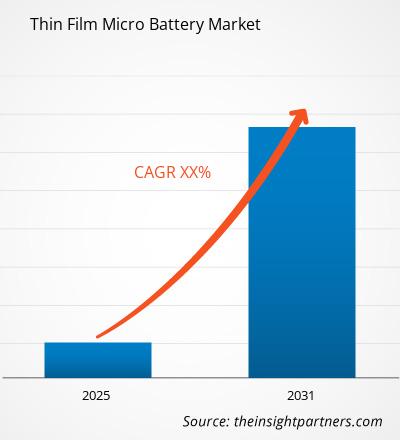
Segmentation Analysis
Rechargeability
Rechargeability is expected to grow at 13.2–13.9% CAGR during 2026–2034 as device makers balance shelf life, lifecycle cost, and replacement constraints. The Thin Film Micro Battery scope is strongest where rechargeability determines product architecture, especially wearables, medical patches, and autonomous sensing devices requiring repeatable low-power cycles.
- Primary Battery formats remain important in smart cards, labels, and single-use medical devices because long shelf life, thin construction, and predictable discharge matter more than recharge cycles.
- Secondary Battery formats dominate higher-value connected devices where rechargeable operation supports repeat usage, energy harvesting integration, and reduced replacement complexity in compact electronics.
Component
Component demand is projected to expand at 12.8–13.5% CAGR during 2026–2034. Performance depends on material interfaces, deposition quality, and encapsulation reliability. Current collectors, electrodes, substrates, and electrolytes each influence flexibility, energy density, cycle stability, and manufacturability across thin power sources.
- Current Collectors support efficient electron flow in ultra-thin cells, making conductivity, adhesion, and corrosion resistance essential for reliability in flexible and laminated devices.
- Electrodes define energy capacity and discharge characteristics, with advanced cathode and anode films enabling higher density while maintaining safe operation in compact electronics.
- Substrates influence flexibility, thickness, and integration routes, especially for smart packaging, wearable patches, and sensor labels that require mechanical stability.
- Electrolytes are central to safety and cycle life, with solid and polymer systems gaining attention as device makers reduce leakage and thermal risks.
Capacity
Capacity is forecast to grow at 12.9–13.6% CAGR during 2026–2034 as applications diversify from simple authentication to continuous sensing. Lower capacities fit thin cards and tags, while higher capacities support wearables and medical devices requiring longer duty cycles, wireless communication, and intermittent data transmission.
- Below 10 mAh batteries serve smart cards, RFID tags, and single-function sensors where thinness, low cost, and long standby performance outweigh sustained power delivery.
- Between 10 mAh and 100 mAh products address broader wearable, healthcare, and industrial sensor needs by balancing compact geometry with practical runtime and communication support.
- Above 100 mAh formats remain selective but strategically relevant for advanced wearables, medical monitors, and autonomous nodes requiring higher energy reserves in constrained spaces.
Application
Application is expected to grow at 13.4–14.1% CAGR during 2026–2034, led by devices that must combine sensing, communication, and comfort. Thin batteries are increasingly selected when product designers need embedded power without adding bulk, especially in healthcare, wearables, smart packaging, cards, and wireless sensor nodes.
- Consumer Electronics demand is linked to miniaturized accessories, remote controls, styluses, and connected peripherals where slim power modules support compact design and longer standby operation.
- Wearable Devices represent the fastest adoption area as smartwatches, patches, and fitness trackers need safe, flexible, rechargeable batteries that conform to compact product shapes.
- Smart Packaging uses thin cells for freshness indicators, logistics tracking, and anti-counterfeit labels, creating volume potential when printing, lamination, and cost targets align.
- Smart Cards require thin, reliable batteries for biometric authentication, secure access, and payment verification, where durability under bending and long shelf life are decisive.
- Medical Devices favor thin batteries for patches, hearing aids, biosensors, and monitoring devices, with safety, reliability, and patient comfort driving qualification decisions.
- Wireless Sensor Nodes depend on compact energy storage for industrial, environmental, and infrastructure monitoring, especially where replacement access is costly or physically difficult.
Opportunity Snapshot
| Application | Revenue Contribution | Trend Tag | Adoption Stage |
| Consumer Electronics | Medium | Compact Power | Scaling |
| Wearable Devices | High | Health Wearables | Scaling |
| Smart Packaging | Medium | Active Labels | Emerging |
| Smart Cards | Medium | Biometric Cards | Scaling |
| Medical Devices | High | Patient Patches | Scaling |
| Wireless Sensor Nodes | Medium | Edge Sensors | Emerging |
Thin Film Micro Battery Market Growth Drivers and Impact Analysis
Miniaturized Healthcare Devices Need Safer Embedded Power
Remote monitoring, biosensing, and patient-worn diagnostics are increasing demand for batteries that can operate safely close to skin or inside compact medical assemblies. Thin film formats support low leakage, stable voltage, and flexible shapes, which help device makers reduce housing size while maintaining reliability. The World Health Organization highlights rising chronic disease monitoring needs, and healthcare systems are shifting toward home-based care. This creates commercial pull for qualified micro-power sources in patches, hearing aids, and disposable diagnostic platforms.
IoT Sensor Deployment Expands Low-Power Battery Demand
Industrial and logistics operators are adding sensors to equipment, pallets, cold-chain assets, and infrastructure. These applications require batteries that are thin, dependable, and capable of supporting intermittent wireless communication over long periods. Thin Film Micro Battery systems are well matched to this duty profile because they can be integrated into labels, boards, or sealed sensor housings. Adoption improves maintenance visibility, reduces manual inspection, and supports predictive analytics, especially in environments where replacing conventional batteries is costly.
Secure Cards and Smart Packaging Create Volume Pathways
Biometric payment cards, access credentials, and active packaging need ultra-thin batteries that survive bending, lamination, and storage without performance loss. As authentication requirements increase, card issuers and packaging firms are evaluating embedded power to enable fingerprint sensors, freshness indicators, and tamper alerts. The market impact is significant because these uses can shift demand from low-volume specialty batteries toward repeatable production runs. Suppliers that meet cost, safety, and durability targets will be better positioned for large OEM programs.
Thin Film Micro Battery Market Future Trends
Energy Harvesting Integration Will Redefine Device Runtime
Thin Film Micro Battery market trends will increasingly center on hybrid architectures that pair microbatteries with ambient energy harvesting. Solar, thermal, vibration, and RF harvesting can extend runtime for sensors, labels, and wearables that operate intermittently. This direction changes supplier requirements because batteries must tolerate frequent shallow cycling, compact power management circuits, and variable charging profiles. Over time, device designers may specify batteries as part of a complete micro-power subsystem rather than a standalone component.
Flexible Solid-State Designs Will Move Toward Scaled Manufacturing
Flexible solid-state designs are expected to advance from pilot batches toward more repeatable manufacturing as materials, encapsulation, and substrate handling improve. The key trend is not only higher energy density, but also better mechanical durability under bending and lamination. This supports use in biometric cards, skin-worn medical patches, and curved consumer devices. Suppliers that demonstrate stable yields and predictable lifecycle performance will gain credibility with OEM qualification teams.
Thin Film Micro Battery Market Opportunities
Medical Wearables Offer Premium Design-In Opportunities
Medical wearables present attractive Thin Film Micro Battery Market Forecasts because device makers prioritize reliability, safety documentation, and patient comfort over the lowest battery price. Suppliers can create value by supporting early design engineering, validation data, and regulatory-ready documentation. Partnerships with biosensor developers, remote monitoring platforms, and contract manufacturers can turn qualification work into recurring revenue. The strongest opportunity lies in patches and compact monitors that need thin, rechargeable power without limiting device ergonomics.
Smart Packaging Can Unlock High-Volume Commercialization
Smart packaging offers a route to higher volumes if battery suppliers can meet cost, printability, safety, and shelf-life requirements. Food, pharmaceuticals, and luxury goods companies are evaluating active labels for freshness, traceability, authentication, and condition monitoring. Battery vendors should target packaging converters and NFC or RFID module partners rather than only finished-brand owners. Success will depend on scalable manufacturing, thin encapsulation, and compatibility with high-speed packaging lines.
Recent Developments
- November 2025: Swiss battery start-up BTRY AG has raised USD 5.7 million in an oversubscribed seed round. The funds will accelerate the industrialization of its ultra-thin solid-state batteries – a new category of energy storage combining fast charging, extreme temperature stability, and intrinsic safety in one of the world’s thinnest formats. They power next-generation devices such as connected labels, wireless sensors, and wearables — applications where conventional batteries could not fit or endure.
- November 2025: Corning Incorporated collaborated with Ensurge Micropower ASA. This collaboration aimed at co-development of micro-battery in applications for areas such as consumer electronics, are helping Corning bring its technologies to market.
Frequently Asked Questions

- Comprehensive Market Sizing and Forecast Analysis
- Detailed Segmentation Analysis
- In-Depth Market Dynamics Assessment
- Regional and Country-Level Insights
- Competitive Landscape and Company Benchmarking
- Strategic Business Intelligence
Recent Reports
Testimonials

The Insight Partners' SCADA System Market report is comprehensive, with valuable insights on current trends and future forecasts. The team was highly professional, responsive, and supportive throughout. We are very satisfied and highly recommend their services.
RAN KEDEM Partner, Reali Technologies LTDs
I requested a report on a very specific software market and the team produced the report in a few days. The information was very relevant and well presented. I then requested some changes and additions to the report. The team was again very responsive and I got the final report in less than a week.
JEAN-HERVE JENN Chairman, Future Analytica
We worked with The Insight Partners for an important market study and forecast. They gave us clear insights into opportunities and risks, which helped shape our plans. Their research was easy to use and based on solid data. It helped us make smart, confident decisions. We highly recommend them.
PIYUSH NAGPAL Sr. Vice President, High Beam Global
The Insight Partners delivered insightful, well-structured market research with strong domain expertise. Their team was professional and responsive throughout. The user-friendly website made accessing industry reports seamless. We highly recommend them for reliable, high-quality research services
YUKIHIKO ADACHI CEO, Deep Blue, LLC.
This is the first time I have purchased a market report from The Insight Partners.While I was unsure at first, I visited their web site and felt more comfortable to take the risk and purchase a market report.I am completely satisfied with the quality of the report and customer service. I had several questions and comments with the initial report, but after a couple of dialogs over email with their analyst I believe I have a report that I can use as input to our strategic planning process.Thank you so much for taking the extra time and making this a positive experience.I will definitely recommend your service to others and you will be my first call when we need further market data.
JOHN SUZUKI President and Chief Executive Officer, Board Director, BK Technologies
I wish to appreciate your support and the professionalism you displayed in the course of attending to my request for information regarding to infectious disease IVD market in Nigeria. I appreciate your patience, your guidance, and the fact that you were willing to offer a discount, which eventually made it possible for us to close a deal. I look forward to engaging The Insight Partners in the future, all thanks to the impression you have created in me as a result of this first encounter.
DR CHIJIOKE ONYIA MANAGING DIRECTOR, PineCrest Healthcare Ltd.Reason to Buy
- Informed Decision-Making
- Understanding Market Dynamics
- Competitive Analysis
- Identifying Emerging Markets
- Customer Insights
- Market Forecasts
- Risk Mitigation
- Boosting Operational Efficiency
- Strategic Planning
- Investment Justification
- Tracking Industry Innovations
- Aligning with Regulatory Trends





 Get Free Sample for