
Watch Battery Market Size, Demand & Growth by 2034
Coverage: By Type (LR (Alkaline), SR (Silver Oxide), CR (Lithium), Others); Application (Traditional Watch, Smartwatch, Others) , and Geography (North America, Europe, Asia Pacific, and South and Central America)
- Status : Data Released
- Report Code : TIPRE00021313
- Category : Electronics and Semiconductor
- No. of Pages : 150
- Available Report Formats :


- Last update date : September 28, 2026


2025 Market Size
US$ 2.1 Bn
Base year value
2034 Forecast
US$ 3.56 Bn
Projected by 2034
CAGR 2026-2034
6.02 %
Growth rate
Addressable Market
US$ 25.61 Bn
(2026-2034)
The watch battery market was valued at US$ 2.1 Billion in 2025 and is projected to reach US$ 3.56 Billion by 2034, registering a CAGR of 6.02% during 2026–2034. Expansion is supported by replacement demand for quartz watches, broader adoption of compact electronic timepieces, and increasing use of lithium coin cells in connected wearables. Battery performance, leakage resistance, miniaturization, and shelf life remain central purchasing criteria across consumer and specialist watch applications.
In North America, the watch battery market size is expected to expand at an estimated 5.5–6.5% CAGR during 2026–2034, supported by established replacement channels, premium watch ownership, and continued smartwatch penetration. The market size is also influenced by demand for reliable miniature cells across connected accessories, while stricter child-safety packaging expectations and retailer-led battery assortment expansion encourage manufacturers to improve product safety and merchandising.
Watch Battery Market Assessment and Insights
- North America: North America is estimated to represent 25–29% share in 2025 and grow at a 5.5–6.5% CAGR between 2026–2034, supported by replacement purchases, premium watches, and established specialty-battery distribution.
- US: The US accounts for approximately 20–23% share of North America in 2025 and is projected to expand at a 5.5–6.5% CAGR between 2026–2034, led by replacement and wearable applications.
- Europe: Europe represents approximately 24–28% share in 2025 and is expected to grow at a 4.5–5.5% CAGR between 2026–2034. Switzerland, Germany, France, Italy, and the UK sustain demand through watchmaking, replacement services, and premium timepieces.
- Asia Pacific: Asia Pacific holds approximately 30–34% share in 2025 and is forecast to grow at a 6.5–7.5% CAGR between 2026–2034, with China, Japan, South Korea, and India supported by manufacturing depth and wearable adoption.
- Largest Segment: Traditional Watch holds an estimated 67–71% market share in 2025, expanding at a 4.5–5.5% CAGR during 2026–2034, reflecting the installed base of quartz watches.
- High Growth Segment: Smartwatch represents approximately 29–33% market share in 2025 and is projected to grow at a 9.5–10.5% CAGR during 2026–2034, driven by higher electronic functionality.
- Key companies analyzed in detail: Camelion Battery Co., Ltd.; Duracell Inc.; EVE Energy Co., Ltd.; GP Batteries International Limited; Maxell, Ltd.; NANFU Battery Co., Ltd.; Panasonic Energy Europe N.V.; Renata SA; Sony Corporation; Toshiba Corporation.
Source: The Insight Partners' analysis based on proprietary research, government publications, company annual reports, investor presentations, industry databases, and expert interviews.
The watch battery market has evolved from predominantly low-drain silver oxide cells toward a more differentiated ecosystem encompassing alkaline, silver oxide, and lithium chemistries. In addition, manufacturers have started designing electrode material, seal, leak-proofness, and miniature sizes based on the required discharge characteristics. Environmental concerns and performance requirements are influencing the development of mercury-free silver oxide batteries and lithium coin cells.
The Watch Battery Market report indicates that, over the forecast period, production investment is expected to concentrate in Asia, while European and North American suppliers emphasize quality, safety, premium applications, and distribution capabilities. Regulations relating to hazardous materials, recycling, packaging, and child safety considerations will spur continuous redesign and investment for compliance. There will also be an increased collaboration between battery producers and watchmakers/wearable device makers that will optimize cell selection and ensure supply reliability.
Watch Battery Market Report Scope
| Report Attribute | Details |
|---|---|
| Market size in 2025 | US$ 2.1 Billion |
| Market Size by 2034 | US$ 3.56 Billion |
| Global CAGR (2026 - 2034) | 6.02% |
| Historical Data | 2021-2024 |
| Forecast period | 2026-2034 |
Watch Battery Market Analysis
The watch battery market growth is closely connected with the installed base of quartz watches and the replacement cycle for primary cells. Silver oxide batteries are significant due to the consistency of their voltage performance in terms of timekeeping accuracy, while lithium batteries offer greater voltage and extended usage for electronically demanding products like digital watches and multifunction wearables. The demand for these products is driven not only by the sale of new watches but also by replacement requirements due to the vast number of products already in use around the world.
Watch Battery Market forecast indicates that the value chain includes electrode and electrolyte suppliers, cell manufacturers, packagers, importers, distributors, watchmakers, service centers, and retailers. Supply will increasingly be influenced by automation in manufacturing processes, quality control, availability of raw materials, and efficiency of regional logistics operations. A supplier with an extensive catalog of products is able to satisfy different watch calibers and battery specifications, thus simplifying procurement for distributors and other partners.
In today's competition, reliability, consistency, and quality of product matter much more than capacity itself. Maxell, Renata SA, Panasonic Energy Europe N.V., Sony Corporation, and Toshiba Corporation compete in terms of engineering of miniature cells, product performance, and distribution channels. Duracell Inc. uses consumer brand recognition and availability of its products in stores as a competitive advantage, while GP Batteries International Limited, NANFU Battery Co., Ltd., Camelion Battery Co., Ltd., and EVE Energy Co., Ltd. increase their presence in the market through value and specialty batteries.
Investment is moving toward automated production systems, mercury-free battery formulations, enhanced safety packaging, and cells capable of supporting connected and feature-rich electronic devices. The watch battery market analysis therefore, increasingly considers both replacement volumes and ongoing technology migration across applications. As battery performance, environmental compliance, and device functionality become more important purchasing factors, suppliers are focusing on product innovation, manufacturing efficiency, and distribution reach to strengthen their competitive position.
● REPORT CUSTOMIZATION
Tailor This Report To Align With Your Specific Business Requirements
This report can be customized to align precisely with your business objectives, scope, and target markets. Customization options include tailored segmentation, geography, competitive analysis, and strategic insights to support informed decision-making.
Customize This Report →WHAT YOU CAN ADJUST
- ● Segmentations
- ● Geography
- ● Competitive Analysis
- ● Language Preferences
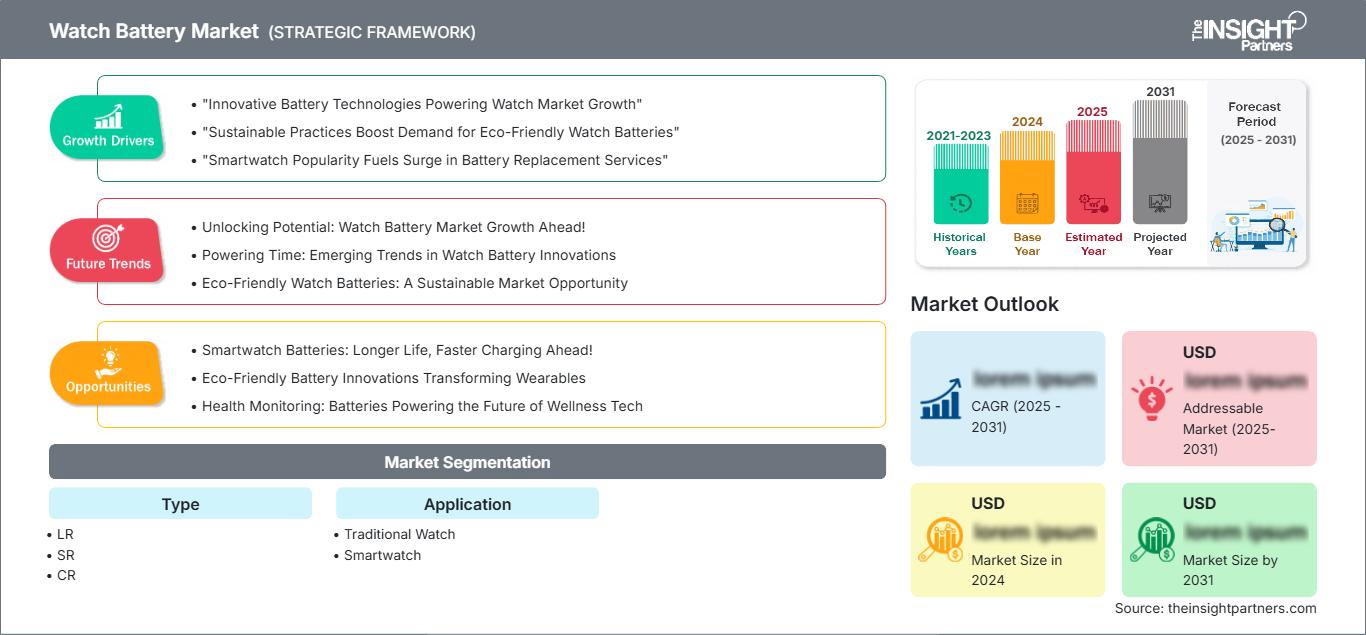
Watch Battery Market: Strategic Insights
Regional Insights
North America Watch Battery Market
North America is estimated at 25–29% share in 2025 and is projected to expand at a 5.5–6.5% CAGR during 2026–2034. The U.S. leads the region in terms of demand due to its sizable installed base of quartz watches, extensive specialty-retail coverage, and regular replacements. Canada participates with retail organizations and watch service channels. There is additional demand from high-end watches, which need reliable and non-leaky cells.
The region has an established market structure, so frequency of replacement and product availability become key issues instead of adoption rates. Retailers are becoming increasingly selective regarding brand names and compatible cells with child-proof packaging. The emergence of smartwatches opens up adjacent markets in miniature rechargeable solutions, while conventional primary cells are still used in many watches.
U.S. Watch Battery Market
The US represents approximately 20–23% of North America in 2025 and is forecast to grow at a 5.5–6.5% CAGR through 2034. The demand is spread out through traditional watch repair, department stores, specialty shops, Internet sales, and professional replacement service. Consumers care about the waterproofing abilities and the ability to store the batteries for a long time.
As far as applications go, there is an advantage for silver oxide batteries in analog watches, while lithium coin cells will have an edge in multifunctional electronic devices. There are several foreign manufacturers like Duracell Inc., Sony Corporation, Panasonic distribution, Maxell, Ltd., and others who are still on the market.
Europe Watch Battery Market
Europe is estimated to hold 24–28% share in 2025 and is expected to grow at a 4.5–5.5% CAGR through 2034. Switzerland continues to be the most prominent premium watch ecosystem, whereas Germany, France, Italy, Spain, and the United Kingdom provide significant replacement demand. Compliance and absence of mercury have a considerable impact on buying decisions.
The UK market is a mature replacement market, with replacement demand focused on jewelry shops, watch services, and online channels. Germany is characterized by high manufacturing skills and product compliance. France, Italy, and Spain are favored by established infrastructure for the selling and servicing of watches, with premium and fashion watches providing steady replacement demand. Switzerland is strategically important due to its focus on reliable mini-batteries for luxury watches.
APAC Watch Battery Market
APAC accounts for approximately 30–34% of the Watch Battery Market share in 2025 and is forecast to grow at a 6.5–7.5% CAGR through 2034. China dominates regionally by sheer manufacturing capacity, while Japan is key for precise batteries and high-end watches. South Korea, India, and Australia contribute to the demand via their electronics market, retail sector, and replacement needs.
Automation in industry, increasing usage of wearables, and electronics manufacturing in the region underpin demand. India provides especially good long-term replacement prospects with the development of organized retail and recycling mechanisms. China is the leading country due to the combined impact of its manufacturing and consumer base, while Japan enjoys superiority in precision miniature cells.
Middle East & Africa Watch Battery Market
Middle East & Africa Watch Battery Market is expected to expand at approximately 4.0–5.0% CAGR during 2026–2034, with Saudi Arabia and the UAE representing leading demand centers. Premium watches, tourism-based retail, and the distribution of electronics enable the replacement of batteries, while the market in South Africa is an example of a relatively well-developed after-sales route.
The Gulf markets have the advantage of premium watches and good retail infrastructure, while the African markets are fragmented. Success is determined by the development of distribution networks, the availability of products, and customer knowledge about how to replace the battery.
Segmentation Analysis
Type
Watch Battery Market trends indicate that Type is divided into LR, SR, and CR batteries. SR batteries remain particularly relevant to traditional quartz watches because stable discharge characteristics and compact dimensions support precision timekeeping. CR lithium cells benefit from higher voltage output and broader application compatibility across electronic devices, while LR cells remain important where low acquisition cost and basic power requirements dominate. The segment is projected to expand at a 5.5–6.5% CAGR during 2026–2034 as chemistry selection becomes increasingly application-specific and influenced by device performance requirements.
- LR: Alkaline button cells serve cost-sensitive applications requiring modest power. Their low price supports replacement demand, although premium watches generally favor chemistries with more stable discharge characteristics.
- SR: Silver oxide cells remain strategically important for analog and precision watches because stable voltage and compact construction support reliable timekeeping and established replacement practices.
- CR: Lithium cells address electronically intensive applications requiring higher voltage, long storage capability, and strong energy density, making them increasingly relevant to connected and multifunctional devices.
Application
Application comprises Traditional Watch and Smartwatch. Traditional watches continue to generate the majority of primary-cell replacement demand because of their large installed base and established service ecosystem. Smartwatch-related requirements are developing faster as wearable electronics add sensors, connectivity, displays, and processing functions. The application segment is expected to grow at a 6.0–7.0% CAGR during 2026–2034.
- Traditional Watch: The segment remains the principal demand base, supported by quartz watches across mass-market, fashion, premium, and luxury categories. Replacement services create recurring purchases through retail and professional channels.
- Smartwatch: Connected wearables require increasingly compact and efficient power solutions. Growth is linked to device miniaturization, sensor integration, longer operating expectations, and expansion of wearable electronics across consumer markets.
Opportunity Snapshot
| Application | Revenue Contribution | Trend Tag | Adoption Stage |
| Traditional Watch | High | Quartz Replacement | Mature |
| Smartwatch | Medium | Wearable Power | Scaling |
Watch Battery Market Growth Drivers and Impact Analysis
Replacement Demand from the Large Quartz Watch Installed Base
The installed base of quartz watches forms a steady basis for replacement due to the eventual need for servicing of primary cells, even in situations where there is rapid growth in watch ownership. This ensures steady aftermarket demand for batteries with regular sizes, particularly silver oxide batteries fitted in analog watches. Watch makers and jewelers have an impact on the purchase process, since professional servicing ensures that the risks of leaks, wrong polarity, and inappropriate chemistry are avoided. The business implication of this is that there will be a move towards reliable brands as opposed to purchases made on price grounds alone.
Miniaturization and Higher Electronic Functionality in Timepieces
Present-day watches are increasingly incorporating alarm, lighting, Bluetooth capability, sensors, displays, and other electronics. They influence the needs concerning discharge and generate the need for cells that provide suitable stability of voltage, energy, and pulse characteristics. Lithium coin cells are especially important when a small size and higher voltage are necessary. It is important not only from the point of view of chemistry but also from the point of view of the optimal sealing and construction of electrodes and internal resistance. With wearable devices becoming more and more miniature, the producers of batteries that have exacting production technologies can get valuable orders.
Environmental and Safety Requirements Reshape Battery Product Design
Compliance with environmental regulation and consumer safety considerations now plays a more critical role in mini battery manufacturing, packaging, labeling, and disposition. Non-mercury-containing formulations are a primary feature of the silver oxide cell, whereas child-proof packages are becoming more significant for the lithium coin battery. The European legislation on chemicals and batteries serves as a valuable guideline for manufacturers catering to several marketplaces and allowing them to use unified compliance procedures. While safety considerations may add additional costs for packaging and testing, they also offer a chance for differentiation for companies already possessing quality system certification. Disposal responsibilities impact distribution channels since manufacturers and importers may need to arrange some means of collection or reporting.
Watch Battery Market Future Trends
Expansion of Application-Specific Lithium Coin Cells
The upcoming developmental phase will place more importance on lithium coin cells with specific discharge curves rather than universal types of cells. Wearable devices and multifunctional watches may have different specifications for pulse, temperature behavior, and operation lifetime compared to ordinary watches with low drain consumption. Cell producers can introduce more cell varieties via optimal design of electrodes, internal resistance regulation, improved sealing, and increased accuracy in dimensioning. These measures may boost the technical significance of small cells despite identical physical parameters. This may also complicate the qualification process since the device manufacturers will test cells under conditions that mimic the real application environment in terms of temperature, vibrations, storage, and discharge.
Greater Integration of Safety and Circularity Features
The design of the battery is set to be progressively developed in consideration of safety and circularity aspects from the very start. Child-resistant packages, labels, mercury-free composition, less packaging materials, and better collection systems will feature more prominently among big markets. The manufacturers might even choose recycled materials when applicable in terms of performance. For watch batteries, however, circularity is rather problematic due to the small size of individual cells and dispersion among consumers. In this respect, retailers and watch service companies might play a key role in the process of collection. The suppliers able to ensure compliance of products as well as good reverse logistics will enjoy better relations with large distributors. Overall trend lies in the direction of miniature batteries, which will be assessed both in terms of performance and safety.
Watch Battery Market Opportunities
Premium Battery Supply for Luxury Watch Servicing
Servicing luxury watches provides a lucrative opportunity because customers value performance, waterproofness, authenticity, and proper installation above all else. There are opportunities for suppliers to earn money through offering premium quality silver oxide batteries, tracing capabilities, technical data, and service-based distribution of the battery. Switzerland, Germany, France, Japan, and North America are key ecosystems for implementing this strategy since there are specialty watchmakers and servicing channels that determine the choice of batteries. Manufacturers can form partnerships with distributors supplying to jewelry chains and watch technicians. Investing in anti-counterfeit packaging and electronic product identification can increase customer trust even further. The opportunity is thus less about growing sales on a massive scale and more about establishing high-value replacements with professionals.
Regionalization of Miniature Battery Manufacturing and Distribution
Opportunities to manufacture in Asia and stock and service regionally offer the potential to use the advantages of scale of Asian manufacturing, together with regional stocking and engineering services. Opportunities to shorten the reordering process would make it possible to avoid shortages of the standard battery sizes and let the distributors adjust their assortments according to regional watch usage. India and Southeast Asia become significant markets for this purpose because there is growth in electronics manufacturing and organized retailing, whereas North America and Europe would be good markets for higher-value replacement batteries. The company could take advantage of regional warehouses, distributor agreements, localized packaging, and applications support without setting up manufacturing facilities.
Frequently Asked Questions

- Comprehensive Market Sizing and Forecast Analysis
- Detailed Segmentation Analysis
- In-Depth Market Dynamics Assessment
- Regional and Country-Level Insights
- Competitive Landscape and Company Benchmarking
- Strategic Business Intelligence
Recent Reports
Testimonials

The Insight Partners' SCADA System Market report is comprehensive, with valuable insights on current trends and future forecasts. The team was highly professional, responsive, and supportive throughout. We are very satisfied and highly recommend their services.
RAN KEDEM Partner, Reali Technologies LTDs
I requested a report on a very specific software market and the team produced the report in a few days. The information was very relevant and well presented. I then requested some changes and additions to the report. The team was again very responsive and I got the final report in less than a week.
JEAN-HERVE JENN Chairman, Future Analytica
We worked with The Insight Partners for an important market study and forecast. They gave us clear insights into opportunities and risks, which helped shape our plans. Their research was easy to use and based on solid data. It helped us make smart, confident decisions. We highly recommend them.
PIYUSH NAGPAL Sr. Vice President, High Beam Global
The Insight Partners delivered insightful, well-structured market research with strong domain expertise. Their team was professional and responsive throughout. The user-friendly website made accessing industry reports seamless. We highly recommend them for reliable, high-quality research services
YUKIHIKO ADACHI CEO, Deep Blue, LLC.
This is the first time I have purchased a market report from The Insight Partners.While I was unsure at first, I visited their web site and felt more comfortable to take the risk and purchase a market report.I am completely satisfied with the quality of the report and customer service. I had several questions and comments with the initial report, but after a couple of dialogs over email with their analyst I believe I have a report that I can use as input to our strategic planning process.Thank you so much for taking the extra time and making this a positive experience.I will definitely recommend your service to others and you will be my first call when we need further market data.
JOHN SUZUKI President and Chief Executive Officer, Board Director, BK Technologies
I wish to appreciate your support and the professionalism you displayed in the course of attending to my request for information regarding to infectious disease IVD market in Nigeria. I appreciate your patience, your guidance, and the fact that you were willing to offer a discount, which eventually made it possible for us to close a deal. I look forward to engaging The Insight Partners in the future, all thanks to the impression you have created in me as a result of this first encounter.
DR CHIJIOKE ONYIA MANAGING DIRECTOR, PineCrest Healthcare Ltd.Reason to Buy
- Informed Decision-Making
- Understanding Market Dynamics
- Competitive Analysis
- Identifying Emerging Markets
- Customer Insights
- Market Forecasts
- Risk Mitigation
- Boosting Operational Efficiency
- Strategic Planning
- Investment Justification
- Tracking Industry Innovations
- Aligning with Regulatory Trends





 Get Free Sample for