
Sodium Ion Battery Market Share, Growth & Forecast by 2034
Coverage: By Type (Sodium-Sulfur Batteries, Sodium-Salt Batteries (Zebra Batteries), Sodium-Oxygen (Sodium Air) Batteries); End-User (Consumer Electronic Devices, Automobile and Transportation, Industrial, Aerospace and Defense, Others) , and Geography (North America, Europe, Asia Pacific, and South and Central America)
- Status : Data Released
- Report Code : TIPRE00026919
- Category : Electronics and Semiconductor
- No. of Pages : 150
- Available Report Formats :


- Last update date : October 30, 2026


2025 Market Size
US$ 659.95 Mn
Base year value
2034 Forecast
US$ 4,961.54 Mn
Projected by 2034
CAGR 2026-2034
25.13 %
Growth rate
Addressable Market
US$ 21,427.33 Mn
(2026-2034)
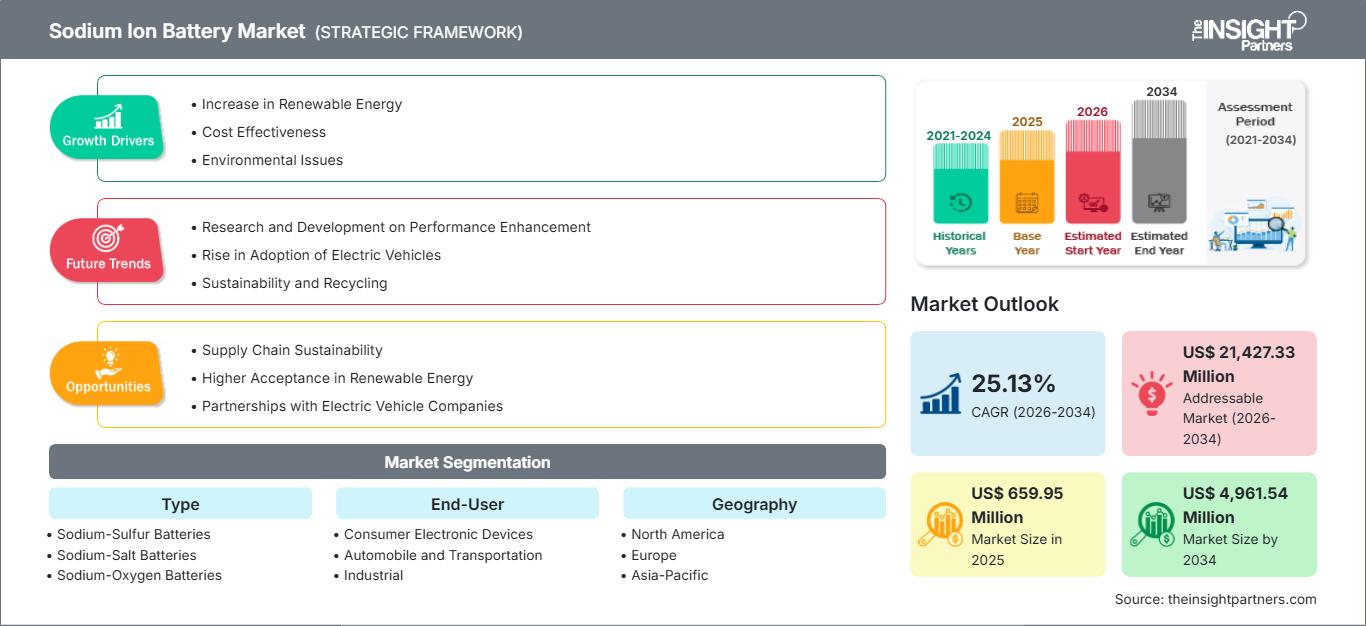
The Sodium-ion Battery Market size is undergoing a transition from technology development toward commercial deployment across mobility, stationary storage, and industrial applications. The market was valued at US$ 659.95 Million in 2025 and is projected to reach US$ 4,961.54 Million by 2034, expanding at a 25.13% CAGR from 2026 to 2034.
North America is developing around energy-storage diversification, localized battery manufacturing, and demand for chemistries that reduce dependence on lithium-based supply chains. The regional market is estimated to expand at approximately ~22% CAGR through 2034, supported by stationary storage projects, industrial applications, and continued investment in alternative battery technologies.
Sodium Ion Battery Market Assessment and Insights
Regional Outlook
- North America: ~17% of the global Sodium-ion Battery Market share in 2025 | ~22% CAGR through 2034. Market position: North America represents an emerging regional market supported by stationary storage investment, domestic battery manufacturing initiatives, and interest in supply-chain diversification. The US accounts for most regional demand.
- US: ~82% of North American market revenue in 2025 | ~22% CAGR through 2034. Market position: The US anchors North American commercialization through grid-storage projects, advanced battery research, and domestic manufacturing investment. Demand spans industrial storage, transportation, and applications where supply resilience and safety are important.
- Europe: ~20% of the global market in 2025 | ~24% CAGR through 2034. Market position: Europe combines established battery manufacturing capabilities with decarbonization policies and energy-storage requirements. Germany is the leading country in Europe, while the UK, France, Italy, and Spain contribute through storage, mobility, and industrial electrification.
- Asia Pacific: ~58% of the global market in 2025 | ~27% CAGR through 2034. Market position: Asia Pacific is the largest and fastest-growing region, led by China. Manufacturing scale, battery supply-chain depth, electric mobility, stationary storage deployment, and policy support are accelerating commercialization across China, Japan, South Korea, India, and Australia.
Segment Outlook
- Sodium-Sulfur Batteries: ~52% Share in 2025 | ~23% CAGR through 2034. Market position: Sodium-sulfur batteries retain a substantial position because of their established long-duration storage characteristics and installed applications. Their relevance remains strongest where large-scale stationary storage can justify system-level investment.
- Automobile and Transportation: ~31% Share in 2025 | ~28% CAGR through 2034. Market position: Automobile and transportation is positioned for the fastest expansion as sodium-ion chemistry moves into commercial vehicles, low-speed mobility, two-wheelers, and selected passenger-vehicle configurations where low-temperature performance and resource diversification are valuable.
Competitive Coverage
AGM Batteries Ltd., Aquion Energy, Faradion Limited, HiNa Battery Technology, Liaoning Hongcheng, Nrgtek Inc, NGK, Panasonic Corporation, Qintang New Energy, Zhejiang Lvming Energy (Durathon)
Methodology
The Insight Partners follows Data Collection & Secondary Research, Primary Research, Data Analysis, and Data Triangulation & Final Review to validate market estimates and insights.
Source: The Insight Partners' analysis based on proprietary research, government publications, company annual reports, investor presentations, industry databases, and expert interviews.
Sodium-ion batteries have advanced from laboratory testing to commercial product development through progress made in the areas of cathode materials, hard carbon anodes, cell design, chargeability, and cold temperature performance. The initial efforts in commercializing sodium-ion batteries have largely revolved around demonstration projects; however, recent efforts are increasingly becoming application-oriented such as vehicles and stationary storage applications. Compatibility with existing battery manufacturing operations can be used to develop sodium-ion batteries without necessitating entirely new manufacturing approaches when sufficient market predictability exists.
The future of the Sodium-ion Battery Market will be increasingly driven by manufacturing capabilities in Asia Pacific, energy storage deployments in Europe, and supply chain diversification in North America. China has established the most comprehensive industrial capacity, while the European and North American companies are developing opportunities that are application-specific. Battery safety regulations, local manufacturing regulations, critical mineral security, and renewable energy regulations can help accelerate the adoption process. However, energy density considerations are important compared to existing lithium ion chemistries.
Sodium Ion Battery Market Report Scope
| Report Attribute | Details |
|---|---|
| Market size in 2025 | US$ 659.95 Million |
| Market Size by 2034 | US$ 4,961.54 Million |
| Global CAGR (2026 - 2034) | 25.13% |
| Historical Data | 2021-2024 |
| Forecast period | 2026-2034 |
Sodium Ion Battery Market Analysis
The market trajectory of Sodium-ion Batteries is influenced by the availability of the resource, battery chemistry diversity, better cell performance, and increasing demand for energy storage and electrification of transport. The latter point becomes especially important for applications where the constraints on the energy density are not as strict as those in long-distance passenger cars. Stationary energy storage, commercial vehicles, low-speed transport and cold-weather environments can hence become avenues for faster commercial deployment. The ecosystem includes material manufacturers for cathode and anode materials, electrolytes producers, cells makers, battery packs makers, energy storage systems developers, automakers, and waste handling providers.
Increasing importance of supply chain dynamics is also emerging as players shift from small-scale pilot manufacturing to volume manufacturing. Large established battery companies can take advantage of their experience with battery-making processes, supply chains and manufacturing facilities, whereas specialized developers compete with their proprietary materials and cells. The resulting ecosystem will therefore be more vertically integrated, with the development firms collaborating with the vehicle manufacturers, energy storage systems developers, and industrial customers.
Sodium-ion Battery Market Analysis has revealed a competitive environment comprised of both technology-specific companies and large battery manufacturers. HiNa Battery Technology has made developments in the area of applications for commercial vehicles and energy storage, whereas Faradion has developed sodium-ion technology for transportation and stationary uses. NGK has extensive experience in sodium-sulfur systems, and Panasonic Corporation has wide production and research capabilities for batteries. The list of other companies includes AGM Batteries Ltd., Aquion Energy, Liaoning Hongcheng, Nrgtek Inc, Qintang New Energy, and Zhejiang Lvming Energy, who are active in technology development and application diversification.
The focus of investments in the Sodium-ion Battery Market has moved from the verification of basic chemistry to scaling manufacturing, localization of supply chain, safety certification, system integration, and application-specific optimization. Therefore, strategic positioning in such an environment cannot be based on cell-level performance alone. Companies should show bankability, manufacturing consistency, customer validation, and lifecycle economics. The competitive environment is thus expected to become more varied since the commercialization would target customers who prioritize low-temperature operation, resource availability, safety features, or long-duration energy storage over gravimetric energy density.
● REPORT CUSTOMIZATION
Tailor This Report To Align With Your Specific Business Requirements
This report can be customized to align precisely with your business objectives, scope, and target markets. Customization options include tailored segmentation, geography, competitive analysis, and strategic insights to support informed decision-making.
Customize This Report →WHAT YOU CAN ADJUST
- ● Segmentations
- ● Geography
- ● Competitive Analysis
- ● Language Preferences
Sodium Ion Battery Market: Strategic Insights
Regional Insights
North America Sodium-ion Battery Market
North America is developing as an important diversification market for sodium-based battery technologies, with the regional market estimated at approximately ~17% of global revenue in 2025 and projected to expand at ~22% CAGR through 2034. The US is the primary consumer owing to the size of its energy storage industry, manufacturing sector, research sector, and policies that stress domestic battery manufacturing. The sodium-ion technology is one that could be complementary to the lithium-ion technology for now.
Stationary storage is one application that would be useful here since sodium-ion technology could find uses in those cases where energy density is not an issue. Commercial transportation, backup power generation, and industrial use would all be additional applications. Canada would contribute to this endeavor through its development of clean energy and energy storage, whereas Mexico would see advantages in developing its automotive and industrial manufacturing sectors.
U.S. Sodium-ion Battery Market
The US accounts for approximately ~82% of North American Sodium-ion Battery Market revenue in 2025, with the country expected to expand at ~22% CAGR through 2034. The market is supported by the combination of grid modernization, battery-storage investment, industrial electrification, and interest in reducing exposure to concentrated critical-mineral supply chains. Energy-storage applications can provide a practical entry point because system-level energy density requirements are generally less demanding than those of long-range passenger vehicles.
The competitive landscape consists of battery suppliers, research organizations, battery packers, and existing players with wider battery offerings. Commercial transport and specialized mobility can also be pertinent when low temperatures, safety considerations, or system economics take precedence over energy density. Hence, the US market has a varied range of applications, although sustained acceptance will be contingent on competitive life cycle cost and domestic production capabilities.
Europe Sodium-ion Battery Market
Europe represented approximately ~20% of global Sodium-ion Battery Market revenue in 2025 and is projected to expand at ~24% CAGR through 2034. Germany is the market leader in Europe thanks to its automotive manufacturing industry, industrial batteries, and demand for stationary storage. The UK adds battery developments and grid flexibility needs, while France enjoys the advantage of its automotive and energy industries. Italy and Spain offer further potential thanks to renewable energy integration and storage.
The European trend towards adopting sodium-ion batteries will be driven by considerations of energy resilience and diversification of battery supply chains. Sodium-ion technology may become applicable for stationary storage as well as some types of mobility applications where energy density is less critical. However, commercial introduction will still be dependent on economic comparisons with lithium-ion batteries, localized production, certification, and the ability of manufacturers to produce high-quality batteries consistently.
The industrial ecology of Germany constitutes an especially crucial environment for commercialization because producers of batteries, producers of cars, energy storage developers, and engineering suppliers work in industrial networks that are tightly connected with one another. The same applies to the UK and France, which have positioned themselves in relation to technological development and energy system applications. Italy and Spain will be able to create demand through renewable power generation and balancing the grid.
APAC Sodium-ion Battery Market
According to the Sodium-ion Battery Market forecast, Asia Pacific is the largest regional market, accounting for approximately ~58% of global revenue in 2025, and is expected to expand at ~27% CAGR through 2034, making it the fastest-growing region. China is the leading country in Asia Pacific because of its manufacturing scale, battery supply chain, commercial deployment, and expanding sodium-ion production capabilities.
Japan and South Korea participate via high levels of expertise in battery design and manufacturing, while India is an emerging market for electric mobility, back-up systems, and stationary energy storage systems. Applications in Australia pertain to energy from renewable sources and remote power generation. Growth in the region will be facilitated by local manufacturing, energy security requirements, and implementation of sodium-ion batteries in select applications.
Middle East & Africa Sodium-ion Battery Market
The Middle East & Africa region is expected to expand at approximately ~21% CAGR through 2034. Saudi Arabia and the UAE are important markets because of investments in renewable energy, grid modernization, industrial diversification, and large-scale infrastructure. South Africa provides a separate opportunity through electricity-system modernization and distributed energy applications, while other MEA markets can benefit from sodium-ion systems in remote and backup applications.
Regional prospects are directly related to energy storage rather than mass-market passenger cars. Sodium-ion batteries could be used as an option for stationary applications where resources, environmental conditions, transportability, and economics are an issue. Finance, technical expertise in the area, and logistics will continue to play an important role in the rate of technology adoption.
Segmentation Analysis
Type
The Type segment is expected to expand at approximately ~23% CAGR from 2026 to 2034. Technology selection depends on operating temperature, energy density, safety, power requirements, cycle life, and intended application. Sodium-based chemistries differ substantially in system architecture, making application requirements central to commercial positioning. The Sodium-ion Battery Market scope therefore includes multiple sodium-based technology routes rather than a single cell architecture.
- Sodium-Sulfur Batteries: Sodium-sulfur technology has an established association with stationary energy storage and long-duration applications. Its strategic importance comes from high-temperature operation and large-scale energy-storage capability, although economics, competition from lithium-ion systems, and manufacturing considerations influence future deployment.
- Sodium-Salt Batteries: Sodium-salt configurations can address applications requiring safety, operating-temperature flexibility, and stationary or specialized power characteristics. Their development is relevant to customers seeking alternatives to conventional lithium-based systems while maintaining dependable performance under demanding operating environments.
- Sodium-Oxygen Batteries: Sodium-oxygen technology remains an emerging pathway with substantial research interest because of its theoretical energy-storage potential. Commercial adoption remains less mature than established sodium-based systems, leaving opportunities centered on materials research, cell engineering, and improvements in reversibility and cycle stability.
End-User
The End-User segment is projected to grow at approximately ~26% CAGR from 2026 to 2034. Adoption patterns differ according to energy-density requirements, operating environment, charging needs, safety requirements, and total cost of ownership. The strongest commercial pathways are expected where sodium-ion characteristics can directly solve application-level constraints.
- Consumer Electronic Devices: Consumer electronics represent a selective opportunity where compact form factors and cost requirements intersect with demand for safe and reliable rechargeable systems. Adoption will depend heavily on energy density, cycle performance, device architecture, and the ability to compete with highly optimized lithium-ion cells.
- Automobile and Transportation: Transportation is becoming an important commercialization pathway, particularly for commercial vehicles, short-range mobility, two-wheelers, and applications operating in colder climates. Sodium-ion batteries can provide useful low-temperature characteristics and resource diversification while reducing the need to maximize range in every vehicle category.
- Industrial: Industrial applications include backup systems, material-handling equipment, stationary storage, and specialized power systems. These uses can prioritize reliability, safety, operating-temperature flexibility, and lifecycle economics over maximum volumetric energy density, creating a broad addressable opportunity for sodium-based chemistry.
- Aerospace and Defense: Aerospace and defense applications require stringent reliability, environmental tolerance, safety, and performance validation. Sodium-ion technology remains selective in this segment, but specialized systems can create opportunities where low-temperature performance, supply-chain resilience, and safety characteristics have strategic importance.
- Others: Other applications can include remote power, telecommunications backup, microgrids, and specialized energy systems. These use cases can provide early commercialization opportunities because transportation logistics, operating temperature, and safety can matter as much as energy density.
Opportunity Snapshot
| End User | Revenue Contribution | Trend Tag | Adoption Stage |
|---|---|---|---|
| Consumer Electronic Devices | Medium | Compact Storage | Emerging |
| Automobile and Transportation | High | Fleet Electrification | Scaling |
| Industrial | High | Grid Storage | Scaling |
| Aerospace and Defense | Low | Mission Power | Emerging |
Sodium Ion Battery Market Growth Drivers and Impact Analysis
Energy-Storage Diversification and Grid Flexibility
The expansion of renewable generation is increasing the need for flexible storage resources capable of balancing variable electricity supply. Sodium-ion technology can participate in this transition because stationary applications are less constrained by the volumetric energy-density disadvantage relative to lithium-ion batteries. This creates opportunities for grid-scale storage, renewable-energy integration, backup power, and industrial systems. Commercial economics will depend on cell costs, cycle life, round-trip efficiency, project financing, and operating conditions rather than chemistry alone. As sodium-ion manufacturing scales, system integrators can evaluate it alongside lithium-ion and other storage technologies according to project-specific requirements. The resulting market structure is likely to emphasize technology matching, with sodium-ion systems gaining relevance where supply-chain resilience, safety, temperature performance, and long-duration operation provide measurable project benefits.
Battery Supply-Chain Diversification
Dependence on lithium and other battery materials has increased interest in alternative chemistries that use more widely available resources. Sodium-ion batteries can reduce exposure to lithium-specific supply constraints because sodium is abundant and widely distributed. This does not automatically guarantee lower system costs, since commercial economics still depend on manufacturing scale, cathode materials, hard carbon, electrolytes, processing, and yield. However, supply diversification has strategic value for battery manufacturers and energy-system developers seeking multiple chemistry pathways. The impact is especially relevant in regions attempting to build localized battery ecosystems. As manufacturers gain experience with sodium-based production, procurement strategies can evolve toward multi-chemistry portfolios, enabling companies to allocate different technologies to applications according to raw-material availability, performance requirements, and market economics.
Commercialization of Low-Temperature and Specialized Mobility
Sodium-ion batteries have demonstrated characteristics that can be valuable in low-temperature environments, creating opportunities in selected transportation categories. Cold-weather performance can affect vehicle usability, charging behavior, and available power, making chemistry selection more important for commercial fleets and regional mobility. The technology is particularly relevant where vehicles have predictable routes or moderate range requirements, including commercial vehicles, two-wheelers, and short-distance transportation. This application logic can reduce the importance of maximum energy density and place greater emphasis on charging performance, safety, operating temperature, and total ownership cost. Commercialization can therefore progress through targeted mobility segments before broader passenger-vehicle adoption. As manufacturers refine pack architecture and hybrid chemistry strategies, sodium-ion systems can also become part of multi-chemistry solutions rather than being treated solely as a direct replacement for lithium-ion batteries.
Sodium Ion Battery Market Future Trends
Multi-Chemistry Battery Platforms
The Sodium-ion Battery Market trends are increasingly moving toward multi-chemistry architectures rather than a single technology replacing all lithium-ion applications. Battery manufacturers can combine sodium-ion and lithium-ion cells or allocate different chemistries to different vehicle and storage requirements. This approach allows developers to balance energy density, low-temperature performance, cost, safety, charging capability, and resource availability. The strategic implication is that sodium-ion adoption may occur alongside lithium-ion rather than against it. Vehicle platforms with differentiated battery configurations could use sodium-based cells for applications where cold-weather performance or cost stability is more important, while higher-energy-density chemistries remain focused on long-range requirements. Similar segmentation can emerge in stationary storage, where project duration and operating conditions determine the preferred chemistry.
Industrial-Scale Manufacturing and Standardization
Sodium-ion commercialization is expected to increasingly depend on standardized cell formats, manufacturing yield, certification, and supply-chain coordination. Early-stage technology development emphasizes electrochemical performance, but large customers require predictable quality, safety validation, warranty support, and scalable production. Manufacturing compatibility with established battery processes can support faster industrialization when suppliers reach sufficient demand and technical maturity. Standardization can also reduce integration costs for pack manufacturers and system developers by enabling more consistent procurement. Over time, the market may therefore shift from technology demonstration toward operational benchmarking, lifecycle validation, and bankability. This transition will favor companies that can connect materials innovation with repeatable manufacturing and application-level performance.
Sodium Ion Battery Market Opportunities
Stationary Storage and Renewable Integration
Stationary energy storage represents a significant commercial opportunity because it places less emphasis on maximum vehicle range and allows sodium-ion systems to compete through safety, resource availability, temperature performance, and lifecycle economics. Developers can target renewable-energy projects, industrial backup, telecommunications, microgrids, and remote installations where operating conditions or logistics create specific requirements. The opportunity is particularly relevant in regions with rapidly expanding solar and wind generation, where storage is needed to shift electricity availability across different periods. Suppliers can strengthen their position by developing standardized containerized systems, monitoring platforms, and service agreements rather than selling cells alone. This creates additional value across engineering, procurement, integration, commissioning, and lifecycle management.
Commercial Mobility and Localized Battery Ecosystems
Commercial transportation provides another opportunity because fleet operators often prioritize operating cost, charging availability, reliability, and predictable duty cycles over maximum driving range. Sodium-ion batteries can be targeted toward commercial vehicles, short-haul fleets, two-wheelers, and selected low-speed mobility applications. Manufacturers can also establish localized ecosystems linking cell production, vehicle assembly, charging infrastructure, and after-sales service. This approach can reduce commercialization risk by matching battery specifications to defined operating patterns rather than broad consumer expectations. For emerging markets, localized sodium-ion production could also support energy-security objectives and reduce exposure to imported lithium-based materials. Partnerships between technology developers, vehicle manufacturers, fleet operators, and charging providers can accelerate validation and create repeatable deployment models.
Recent Developments
- November 2025: HiNa Battery Technology — HiNa Battery announced the transition of its sodium-ion technology into a commercial era, reporting that four sodium-ion product lines had entered mass-production and sales. The company highlighted applications spanning starter batteries, power batteries, and energy storage, reflecting a shift from pilot development toward broader commercial deployment and supply-chain integration.
- October 2025: NGK — NGK announced its decision to discontinue manufacturing and sales activities for NAS batteries, its sodium-sulfur battery technology, and to stop accepting new orders. The company cited slower-than-expected demand development for long-duration, large-capacity storage, material-cost pressures, and intensifying competition from lithium-ion batteries.
- April 2025: CATL — CATL unveiled its Naxtra sodium-ion battery, describing it as the world's first mass-produced sodium-ion battery. The launch included passenger-vehicle and heavy-duty truck applications and highlighted operation across extreme temperatures, signaling a move toward commercial-scale sodium-ion deployment in transportation.
Frequently Asked Questions

- Comprehensive Market Sizing and Forecast Analysis
- Detailed Segmentation Analysis
- In-Depth Market Dynamics Assessment
- Regional and Country-Level Insights
- Competitive Landscape and Company Benchmarking
- Strategic Business Intelligence
Recent Reports
Testimonials

The Insight Partners provided valuable market intelligence that supported our global go-to-market strategy. Their team was professional, responsive, and attentive to our feedback, providing thoughtful analysis and helpful methodological clarifications throughout the project.
Junmo Kim Chief Financial Officer (CFO), Enertech Co., Ltd.
The Insight Partners' SCADA System Market report is comprehensive, with valuable insights on current trends and future forecasts. The team was highly professional, responsive, and supportive throughout. We are very satisfied and highly recommend their services.
RAN KEDEM Partner, Reali Technologies LTDs
I requested a report on a very specific software market and the team produced the report in a few days. The information was very relevant and well presented. I then requested some changes and additions to the report. The team was again very responsive and I got the final report in less than a week.
JEAN-HERVE JENN Chairman, Future Analytica
We worked with The Insight Partners for an important market study and forecast. They gave us clear insights into opportunities and risks, which helped shape our plans. Their research was easy to use and based on solid data. It helped us make smart, confident decisions. We highly recommend them.
PIYUSH NAGPAL Sr. Vice President, High Beam Global
The Insight Partners delivered insightful, well-structured market research with strong domain expertise. Their team was professional and responsive throughout. The user-friendly website made accessing industry reports seamless. We highly recommend them for reliable, high-quality research services
YUKIHIKO ADACHI CEO, Deep Blue, LLC.
This is the first time I have purchased a market report from The Insight Partners.While I was unsure at first, I visited their web site and felt more comfortable to take the risk and purchase a market report.I am completely satisfied with the quality of the report and customer service. I had several questions and comments with the initial report, but after a couple of dialogs over email with their analyst I believe I have a report that I can use as input to our strategic planning process.Thank you so much for taking the extra time and making this a positive experience.I will definitely recommend your service to others and you will be my first call when we need further market data.
JOHN SUZUKI President and Chief Executive Officer, Board Director, BK Technologies
I wish to appreciate your support and the professionalism you displayed in the course of attending to my request for information regarding to infectious disease IVD market in Nigeria. I appreciate your patience, your guidance, and the fact that you were willing to offer a discount, which eventually made it possible for us to close a deal. I look forward to engaging The Insight Partners in the future, all thanks to the impression you have created in me as a result of this first encounter.
DR CHIJIOKE ONYIA MANAGING DIRECTOR, PineCrest Healthcare Ltd.Reason to Buy
- Informed Decision-Making
- Understanding Market Dynamics
- Competitive Analysis
- Identifying Emerging Markets
- Customer Insights
- Market Forecasts
- Risk Mitigation
- Boosting Operational Efficiency
- Strategic Planning
- Investment Justification
- Tracking Industry Innovations
- Aligning with Regulatory Trends





 Get Free Sample for