
Smart Ports Market Share, Demand & Growth by 2034
Coverage: by Component (Smart Port Infrastructure, Terminal Automation and Cargo Handling, Traffic Management System, Smart Safety and Security, Others); Technology (Blockchain, Internet of Things, Process Automation, Artificial Intelligence); Port Type (Seaport, Inland Port) , and Geography (North America, Europe, Asia Pacific, and South and Central America)
- Status : Data Released
- Report Code : TIPRE00008436
- Category : Electronics and Semiconductor
- No. of Pages : 150
- Available Report Formats :


- Last update date : August 26, 2026


2025 Market Size
US$ 4.27 Bn
Base year value
2034 Forecast
US$ 39.41 Bn
Projected by 2034
CAGR 2026-2034
28.01 %
Growth rate
Addressable Market
US$ 160.60 Bn
(2026-2034)
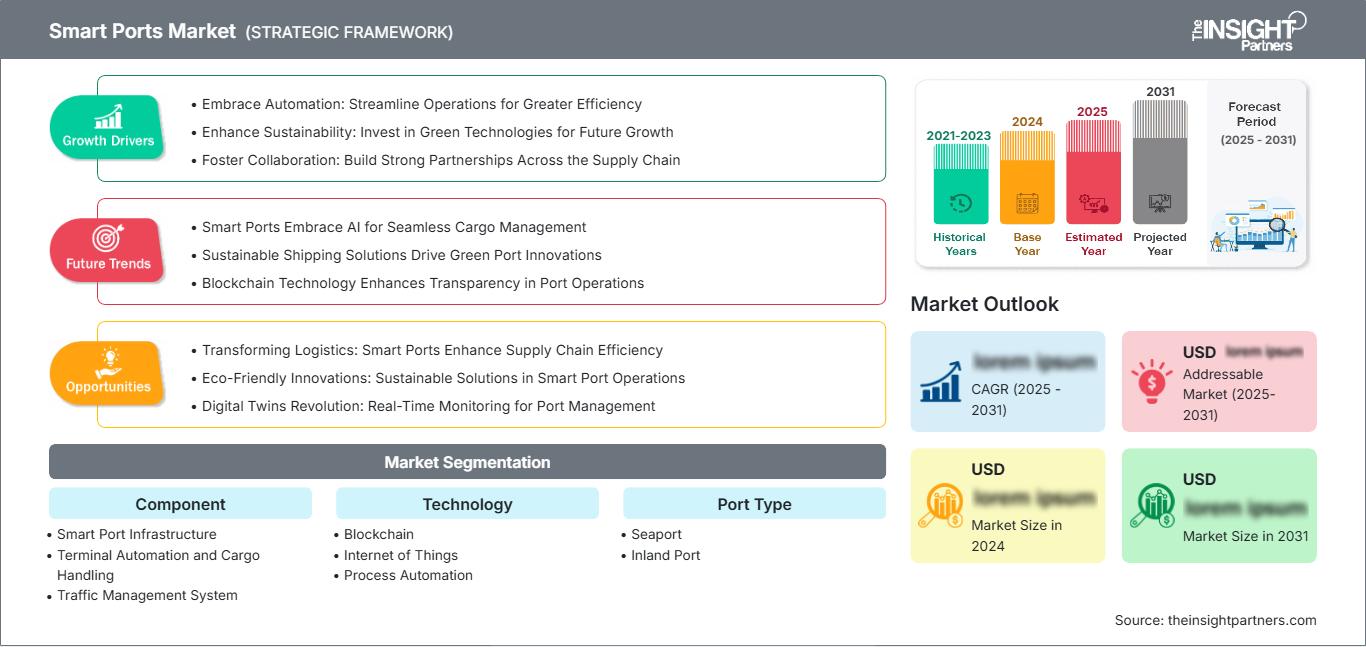
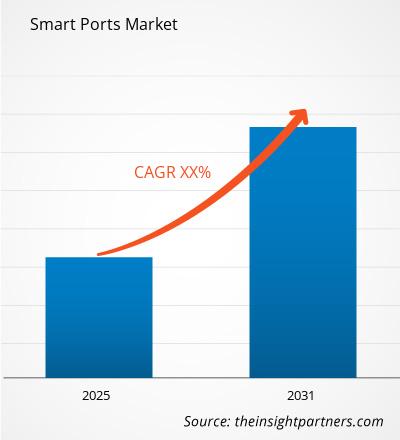
The global Smart Ports Market was valued at US$ 4.27 billion in 2025 and is projected to reach US$ 39.41 billion by 2034, registering a compound annual growth rate (CAGR) of 28.01% during the forecast period from 2026 to 2034. This market encompasses the digitalization and automation of port operations through advanced technologies, including IoT sensors, AI-driven analytics, blockchain for secure transactions, and process automation systems, all designed to enhance operational efficiency, safety, and sustainability in maritime logistics.
North America represents a significant portion of the Smart Ports Market size, with an estimated CAGR of 26.0-26.4% from 2026 to 2034 . Structural growth drivers in the region include substantial federal investment in port infrastructure modernization and the adoption of digital technologies to enhance supply chain resilience. The presence of major technology providers such as IBM Corporation and ABB Ltd., coupled with government-led initiatives to improve port security and cargo handling efficiency, further accelerates regional market expansion.
Smart Ports Market Assessment and Insights
- North America: North America captured 28-32% of the global Smart Ports market share in 2025, growing at a CAGR of 26.0-26.4% during 2026-2034. The market benefits from significant federal infrastructure funding and the presence of major technology providers driving digital transformation across key U.S. and Canadian ports .
- US: The US held 24-28% of the global Smart Ports market in 2025, growing at a CAGR of 26.2-26.6% during 2026-2034. The US accounted for approximately 78-82% of the North American market in 2025 . Robust investment in port automation and AI-driven logistics solutions drives market growth.
- Europe: Europe accounted for 24-28% of the global Smart Ports market in 2025, with a CAGR of 25.6-26.0% during 2026-2034. Leading countries include the Netherlands, Germany, and the UK, where advanced port digitalization, sustainability initiatives, and automation leadership are key adoption drivers .
- Asia Pacific: Asia Pacific held 30-34% of the global Smart Ports market in 2025 and is projected to grow at a CAGR of 30.6-31.0% during 2026-2034. China, Singapore, Japan, and South Korea are key markets, driven by expanding maritime trade, smart infrastructure investments, and rapid adoption of AI-driven port automation .
- Largest Segment: Terminal Automation and Cargo Handling represented the largest component segment, accounting for 38-42% market share in 2025, with a CAGR of 27.2-27.6% during 2026-2034. Increasing automation of container terminals and cargo handling operations drives segment growth.
- High Growth Segment: Smart Port Infrastructure is the high-growth segment, with a 29.2-29.6% CAGR during 2026-2034, holding 28-32% share in 2025. Significant investments in digital infrastructure and port modernization initiatives fuel segment expansion.
- Key companies analyzed in detail: ABB Ltd., Abu Dhabi Ports, Accenture plc, IBM Corporation, Ikusi, International Terminal Solutions Limited, Royal HaskoningDHV, Scientific Enterprises Ltd, Trelleborg Marine and Infrastructure, Wabtec Corporation.
Source: The Insight Partners' analysis based on proprietary research, government publications, company annual reports, investor presentations, industry databases, and expert interviews.
The smart ports market forecast indicates that the market has grown from a manually-driven process to an entirely digital and intelligent system that includes IoT, AI, blockchain, and process automation. Contemporary smart ports facilitate real-time decision making, predictions, and coordination among various players such as shipping firms, logistic companies, customs authorities, and port authorities. The production dynamics for smart ports include integrated solutions that incorporate hardware, software, and services with increasing emphasis on cybersecurity and interoperability.
The Smart Ports Market trends will be shaped by technological advancements in the international maritime industry, particularly with regard to sustainability and digitization of processes. Private 5G networks, digital twins, and automated terminal systems are changing the face of managing operations at ports in terms of cargo handling, vessel management, and energy consumption. Tailwinds in terms of regulations regarding emissions reductions and sustainability are motivating port authorities to invest in smart ports.
Smart Ports Market Report Scope
| Report Attribute | Details |
|---|---|
| Market size in 2025 | US$ 4.27 Billion |
| Market Size by 2034 | US$ 39.41 Billion |
| Global CAGR (2026 - 2034) | 28.01% |
| Historical Data | 2021-2024 |
| Forecast period | 2026-2034 |
Smart Ports Market Analysis
The Smart Ports market growth is primarily driven by the global expansion of maritime trade and the need for operational efficiency improvements. According to the International Maritime Organization (IMO), global maritime trade volumes continue to rise, creating pressure on ports to handle increasing cargo throughput while minimizing delays and environmental impact .
The value chain consists of technology vendors, system integrators, port authorities, terminals, and logistics service providers, where software and services vendors are gaining more significance with respect to data analysis and decision making through prediction.
Competition in the Smart Ports market is driven by the presence of well-known industrial automation companies and digital transformation services providers. IBM Corporation, Accenture plc, and ABB Ltd. are among the leading companies that have been making huge investments in the AI-powered ports management platform and IoT-based asset monitoring systems.
Partnerships with the port authorities and terminal operators as well as mergers and digital transformation initiatives are still considered major growth drivers for this market. The Smart Ports market has moderate consolidation and the five leading players, IBM, Accenture, ABB, Siemens, and GE Vernova account for a substantial portion of the market.
● REPORT CUSTOMIZATION
Tailor This Report To Align With Your Specific Business Requirements
This report can be customized to align precisely with your business objectives, scope, and target markets. Customization options include tailored segmentation, geography, competitive analysis, and strategic insights to support informed decision-making.
Customize This Report →WHAT YOU CAN ADJUST
- ● Segmentations
- ● Geography
- ● Competitive Analysis
- ● Language Preferences
Smart Ports Market: Strategic Insights
Regional Insights
North America Smart Ports Market
North America held 28-32% of the global Smart Ports market share in 2025 and is expected to grow at a CAGR of 26.0-26.4% through 2034. The regional market is marked by the extensive use of infrastructure in terms of the federal government’s investments and advanced technologies at the ports. The U.S. is the leader in the region, where ports like Los Angeles, Long Beach, and New York/New Jersey use AI-based logistics and terminal automation systems.
Structural forces that favor market growth include Infrastructure Investment and Jobs Act, which has allocated large amounts of money on port modernization, and the demand for supply chain resilience after the disruptions caused by the pandemic. Blockchain technology in customs documentation and IoT sensors in cargo tracking also contribute to market development.
U.S. Smart Ports Market
The U.S. market represents the largest in North America, accounting for 78-82% of the region's share, valued at 24-28% of the global market in 2025. The U.S. is growing at a CAGR of 26.2-26.6% between 2026 and 2034. Strong federal funding and a robust technology ecosystem underpin the market, with companies like IBM Corporation and Accenture plc maintaining significant presence.
Trends indicate growing adoption of AI-powered predictive analytics for vessel traffic management and integration of private 5G networks for real-time communication across port operations. The Port of Los Angeles and Port of Long Beach are leading the digital transformation initiative, implementing comprehensive smart port solutions to improve cargo throughput and reduce emissions.
Europe Smart Ports Market
Europe accounted for 24-28% of the global market share in 2025, with a projected CAGR of 25.6-26.0% during 2026-2034. The Netherlands, Germany, and the United Kingdom are leading country markets because of the digitization of the port and sustainability leadership. Other important markets include France, Italy, and Spain, and the development of these markets will be fostered by various European Union programs aimed at making ports more sustainable and digital.
Port of Rotterdam can be considered one of the leading ports in terms of the application of smart port innovations, such as digital twins, artificial intelligence, and digital documentation through blockchain. The European market can be considered advantageous due to high environmental standards, as well as the EU Green Deal.
APAC Smart Ports Market
APAC is the fastest-growing regional market, holding 30-34% of the global share in 2025, with a CAGR of 30.6-31.0% during 2026-2034. China, Singapore, Japan, South Korea, and India are key contributors. China dominates as both the largest container handling market and a major hub for smart port technology deployment.
Industrial and policy drivers include China's "Made in China 2025" initiative and Singapore's Smart Nation program, both of which promote technology adoption in maritime infrastructure. The rapid growth of intra-Asian trade and investment in new port facilities in Southeast Asia creates sustained demand for smart port technologies.
Middle East & Africa Smart Ports Market
The Middle East & Africa region shows promising growth potential with a projected CAGR of 27.5-27.9%. Key markets include the UAE, Saudi Arabia, and South Africa. The UAE and Saudi Arabia are investing heavily in smart port infrastructure as part of economic diversification strategies.
The region's energy and infrastructure context influences the market significantly. Economic diversification initiatives like Saudi Vision 2030 and UAE's smart city programs are driving investment in port digitalization and automation. Major infrastructure projects, including new ports and logistics hubs, create substantial opportunities for smart port technology deployment.
Segmentation Analysis
Component
Terminal Automation and Cargo Handling dominates the component segment, accounting for 38-42% of the global market share in 2025 with a CAGR of 27.2-27.6% through 2034. This segment includes automated container handling systems, gate automation solutions, and smart cargo-handling systems that form the core of smart port operations. The segment's leadership stems from the essential nature of automation in improving throughput and reducing operational costs.
- Smart Port Infrastructure: The high-growth segment, encompassing digital infrastructure, cybersecurity systems, and network connectivity solutions. Significant investments in port modernization and digitalization drive demand.
- Terminal Automation and Cargo Handling: The largest segment, including automated gate systems, container handling equipment, and cargo management software. Demand is driven by the need for increased efficiency and reduced labor costs.
- Traffic Management System: Includes vessel traffic management and port community systems. Growing adoption of real-time traffic monitoring and predictive analytics supports segment growth.
- Smart Safety and Security: Encompasses surveillance systems, cybersecurity solutions, and emergency response platforms. Increasing focus on port security and regulatory compliance drives adoption.
Technology
Internet of Things (IoT) represents the dominant technology segment, accounting for 32-36% with a CAGR of 27.5-27.9% through 2034. IoT sensors and connected devices form the foundational infrastructure for smart port operations, enabling real-time monitoring of assets, cargo, and environmental conditions. The segment benefits from declining sensor costs and increasing availability of low-power wide-area networks.
- Internet of Things: The largest technology segment, encompassing sensors, connected devices, and communication networks that form the foundation of smart port infrastructure.
- Blockchain: Growing rapidly, with CAGR of 30.5-30.9%, driven by demand for secure, transparent trade documentation and supply chain traceability.
- Process Automation: Significant segment, including automated terminal operations and intelligent control systems for cargo handling.
- Artificial Intelligence: Fastest-growing technology segment, with CAGR of 31.5-31.9%, driven by demand for predictive analytics, computer vision, and autonomous decision-making .
Port Type
Seaport represents the largest port type segment, accounting for 78-82% with a CAGR of 27.8-28.2% through 2034. Seaports handle the majority of global maritime trade and are the primary focus of smart port investments, with major container ports leading digital transformation initiatives.
- Seaport: The dominant segment, encompassing major container ports and bulk cargo terminals. Driven by global trade growth and need for operational efficiency.
- Inland Port: Growing rapidly, with CAGR of 29.5-29.9%, as intermodal logistics hubs increasingly adopt smart technologies for cargo consolidation and distribution.
Opportunity Snapshot
| Component | Revenue Contribution | Trend Tag | Adoption Stage |
|---|---|---|---|
| Terminal Automation and Cargo Handling | High | Autonomous Operations | Scaling |
| Smart Port Infrastructure | High | Digital Twin Integration | Emerging |
| Traffic Management System | Medium | Predictive Analytics | Scaling |
| Smart Safety and Security | Medium | Cyber-Resilience | Mature |
Smart Ports Market Growth Drivers and Impact Analysis
Global Maritime Trade Growth and Port Congestion
The sustained growth of global maritime trade is a primary driver for the Smart Ports market. The United Nations Conference on Trade and Development (UNCTAD) reports that seaborne trade volumes continue to expand, creating unprecedented pressure on existing port infrastructure to handle increasing cargo throughput. Port congestion has emerged as a critical challenge, with major container ports experiencing significant delays that disrupt global supply chains. Smart port technologies address these challenges by optimizing vessel traffic management, automating cargo handling, and enabling real-time visibility across logistics networks.
Digital Transformation and Industry 4.0 Adoption
The maritime industry is undergoing a fundamental digital transformation, driven by the adoption of Industry 4.0 principles and the proliferation of advanced technologies. Port authorities and terminal operators are investing in IoT sensors, AI analytics, blockchain platforms, and process automation systems to improve operational efficiency, reduce costs, and enhance decision-making capabilities. The integration of digital twin technology enables ports to simulate operations, optimize resource allocation, and predict maintenance needs, delivering measurable improvements in productivity and reliability.
Environmental Regulations and Sustainability Mandates
Increasing regulatory pressure and environmental sustainability goals are compelling ports to adopt smart technologies. The International Maritime Organization (IMO) has implemented stringent emissions reduction targets, including a 40% reduction in carbon intensity by 2030. Smart ports enable energy optimization, emissions monitoring, and integration with renewable energy sources, helping port authorities meet regulatory requirements while reducing operational costs. The growing emphasis on green port certification and sustainability reporting further accelerates technology adoption.
Smart Ports Market Future Trends
Digital Twin and Simulation-Based Operations
The adoption of digital twin technology represents a transformative trend shaping the Smart Ports market. Digital twins create virtual replicas of physical port infrastructure, enabling simulation of operational scenarios, predictive maintenance, and real-time optimization. Port authorities are increasingly using digital twins to model cargo flow, vessel movements, and energy consumption, supporting better decision-making and resource allocation. The integration of AI with digital twins enables autonomous operations and continuous improvement.
Autonomous and Remote-Controlled Terminal Operations
The trend toward autonomous and remote-controlled terminal operations is reshaping port logistics. Automated container handling equipment, remote-controlled cranes, and autonomous yard trucks are increasingly deployed in major container terminals. This trend reduces labor costs, improves safety, and enables 24/7 operations with minimal human intervention. The integration of AI-powered computer vision and sensor fusion technologies is enabling fully automated terminal operations, with leading ports implementing these solutions to maintain competitive advantage.
Smart Ports Market Opportunities
Emerging Market Port Modernization
The rapid modernization of port infrastructure in emerging economies presents significant opportunities for Smart Ports market forecasts. Countries in Southeast Asia, Latin America, and Africa are investing in new port facilities and upgrading existing ones with smart technologies. These investments are driven by growing trade volumes, economic development initiatives, and the need to compete with established global ports. Smart port solutions offer attractive returns through improved efficiency, reduced congestion, and enhanced trade facilitation.
Integration with Green Port Initiatives
The growing emphasis on sustainability and green port certification creates opportunities for Smart Ports providers to offer integrated environmental solutions. Smart port technologies can be combined with shore power systems, renewable energy integration, and emissions monitoring platforms to support comprehensive green port strategies. Port authorities seeking to achieve carbon reduction targets and sustainability certifications are increasingly seeking technology partners who can deliver both operational efficiency and environmental benefits.
Recent Developments
- June 2026: India’s land ports are undergoing a major transformation from traditional border checkpoints into digitally connected trade and logistics gateways, with the launch of the Land Port Management System (LPMS), branded as VINIMAY, by Union Home Minister Amit Shah. The platform marks one of the most significant digital upgrades undertaken across India’s land border infrastructure and comes at a time when cross-border trade through land ports has expanded dramatically from approximately INR 5,000 crore in 2014 to INR 83,000 crore today, representing a 16-fold increase. While the initiative is being positioned as part of India’s Smart Border strategy, its implications extend well beyond security. Industry observers believe VINIMAY has the potential to reshape cargo movement, trade facilitation and logistics efficiency across India’s international land borders.
- March 2026: The V.O. Chidambaranar Port Authority has achieved a major technological milestone by becoming the first port in India to launch the Digital Twin initiative for port management. The Port has marked a significant step toward smart, efficient, and technology-driven maritime management. The platform was inaugurated on 23.02.2026 by Sarbananda Sonowal, Hon’ble Union Minister of the Ministry of Ports, Shipping and Waterways, marking a significant milestone in the Port’s journey toward intelligent and technology-driven maritime management.
- March 2026: At MWC Barcelona 2026, Huawei and Shandong Port Group launched the Shandong Port Global Smart Port Showcase. Through close technical collaboration, the two parties have jointly developed an all-element intelligent scheduling solution, along with a smart production security solution powered by CV models.
Frequently Asked Questions

- Comprehensive Market Sizing and Forecast Analysis
- Detailed Segmentation Analysis
- In-Depth Market Dynamics Assessment
- Regional and Country-Level Insights
- Competitive Landscape and Company Benchmarking
- Strategic Business Intelligence
Recent Reports
Testimonials

The Insight Partners' SCADA System Market report is comprehensive, with valuable insights on current trends and future forecasts. The team was highly professional, responsive, and supportive throughout. We are very satisfied and highly recommend their services.
RAN KEDEM Partner, Reali Technologies LTDs
I requested a report on a very specific software market and the team produced the report in a few days. The information was very relevant and well presented. I then requested some changes and additions to the report. The team was again very responsive and I got the final report in less than a week.
JEAN-HERVE JENN Chairman, Future Analytica
We worked with The Insight Partners for an important market study and forecast. They gave us clear insights into opportunities and risks, which helped shape our plans. Their research was easy to use and based on solid data. It helped us make smart, confident decisions. We highly recommend them.
PIYUSH NAGPAL Sr. Vice President, High Beam Global
The Insight Partners delivered insightful, well-structured market research with strong domain expertise. Their team was professional and responsive throughout. The user-friendly website made accessing industry reports seamless. We highly recommend them for reliable, high-quality research services
YUKIHIKO ADACHI CEO, Deep Blue, LLC.
This is the first time I have purchased a market report from The Insight Partners.While I was unsure at first, I visited their web site and felt more comfortable to take the risk and purchase a market report.I am completely satisfied with the quality of the report and customer service. I had several questions and comments with the initial report, but after a couple of dialogs over email with their analyst I believe I have a report that I can use as input to our strategic planning process.Thank you so much for taking the extra time and making this a positive experience.I will definitely recommend your service to others and you will be my first call when we need further market data.
JOHN SUZUKI President and Chief Executive Officer, Board Director, BK Technologies
I wish to appreciate your support and the professionalism you displayed in the course of attending to my request for information regarding to infectious disease IVD market in Nigeria. I appreciate your patience, your guidance, and the fact that you were willing to offer a discount, which eventually made it possible for us to close a deal. I look forward to engaging The Insight Partners in the future, all thanks to the impression you have created in me as a result of this first encounter.
DR CHIJIOKE ONYIA MANAGING DIRECTOR, PineCrest Healthcare Ltd.Reason to Buy
- Informed Decision-Making
- Understanding Market Dynamics
- Competitive Analysis
- Identifying Emerging Markets
- Customer Insights
- Market Forecasts
- Risk Mitigation
- Boosting Operational Efficiency
- Strategic Planning
- Investment Justification
- Tracking Industry Innovations
- Aligning with Regulatory Trends





 Get Free Sample for