
Smart Toys Market Share, Demand & Growth by 2034
Coverage: by Type (Robots, Interactive Games, Educational Robots); Technology (Wi-Fi, Bluetooth, RFID or NFC); Distribution Channel (Online/Ecommerce Stores, Specialty Stores, Toy Shops); End-user (Toddlers, Pre-schoolers, School-going, Stripling); and Geography (North America, Europe, Asia Pacific, and South and Central America)
- Status : Data Released
- Report Code : TIPRE00008297
- Category : Electronics and Semiconductor
- No. of Pages : 150
- Available Report Formats :


- Last update date : August 27, 2026


2025 Market Size
US$ 15.6 Bn
Base year value
2034 Forecast
US$ 38.07 Bn
Projected by 2034
CAGR 2026-2034
10.42 %
Growth rate
Addressable Market
US$ 238.09 Bn
(2026-2034)
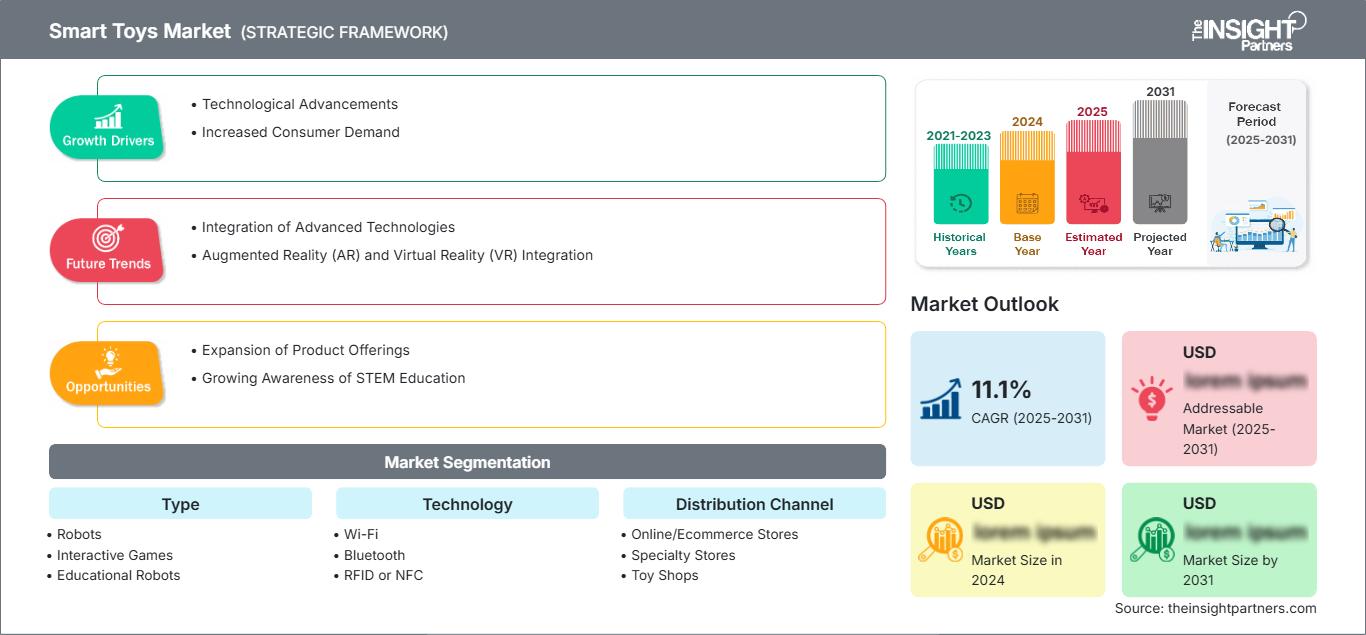
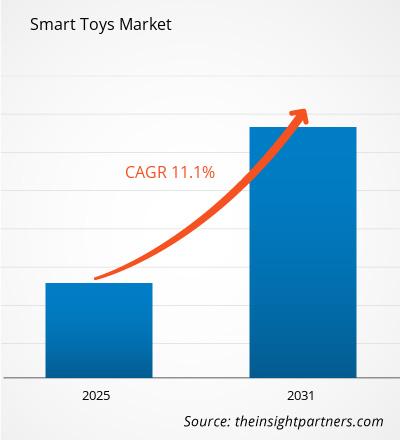
The global Smart Toy Market size was valued at US$ 15.6 billion in 2025 and is projected to reach US$ 38.07 billion by 2034, registering a compound annual growth rate (CAGR) of 10.42% from 2026 to 2034. This growth is underpinned by increasing integration of artificial intelligence, the Internet of Things, and connectivity features in children's playthings, transforming them from passive objects into interactive, adaptive learning companions.
North America accounts for a dominant share of the global market, estimated at 32-36% in 2025, with the region growing at a CAGR of 9-11% during the forecast period. The strong market position is driven by high consumer awareness regarding technology-led education, significant disposable incomes among parents, and the early adoption of connected devices in households. The presence of major toy manufacturers and a well-established digital infrastructure further bolster the region's market leadership in the smart toys sector.
Smart Toys Market Assessment and Insights
- North America holds the largest regional Smart Toy Market share, estimated between 32-36% in 2025, and is projected to grow at a CAGR of 9-11% from 2026 to 2034. The region's market is characterized by early adoption of AI and IoT-enabled toys and strong consumer spending on educational products.
- U.S. is the dominant country market within North America, accounting for approximately 85-90% of the regional share in 2025, with a growth rate of 9-11% during the forecast period. The U.S. market benefits from high disposable incomes, significant R&D investments, and a robust e-commerce ecosystem.
- Europe represents a substantial market, estimated to hold a 26-30% share in 2025, growing at a CAGR of 8-10% through 2034. Key countries such as the U.K., Germany, and France drive demand due to a strong emphasis on educational toys and stringent safety standards.
- Asia Pacific is projected to be the fastest-growing region, capturing a 25-29% market share in 2025 with a CAGR of 12-14%. Leading countries like China, Japan, and India contribute to growth through rising disposable incomes, a large child population, and increasing digitalization.
- Largest Segment by type, the Robots segment, held a significant share of 28-32% in 2025 and is expected to grow at a steady CAGR of 9-11% through 2034, driven by demand for interactive and programmable learning companions.
- High Growth Segment by end-user, the Pre-schoolers segment, is projected to grow at the fastest CAGR of 11-13% during 2026-2034, reflecting increasing parental focus on early childhood STEM education.
- Key companies analyzed in detail: Fat Brain Holdings LLC, Dream International, Hasbro Inc., Jakks Pacific, Konami Corporation, Leapfrog Entertainment, Smart Kids Toys, Smartivity, TOMY Company Ltd.
Source: The Insight Partners' analysis based on proprietary research, government publications, company annual reports, investor presentations, industry databases, and expert interviews.
The future of smart toys is changing through technology convergence, incorporating AI, machine learning and sensors to create a unique personal experience. Smart toys will continue becoming more capable of recognizing speech and images, allowing them to adapt to a child's development level to give them relevant content. The dynamics of production are being altered as more software platforms, companion apps, and cloud-based content delivery are incorporated into toys' life cycle.
Proactive growth drivers of the market include geographical expansion to emerging markets, especially in the Asia Pacific region, with urbanization and the growth of middle class offering many chances. Money is being invested in innovations of products that consider safety and privacy concerns as well as effectiveness of educational tools. Regulatory tailwinds like government programs for digital and STEM education are shaping a supportive environment for smart toy market growth.
Smart Toys Market Report Scope
| Report Attribute | Details |
|---|---|
| Market size in 2025 | US$ 15.6 Billion |
| Market Size by 2034 | US$ 38.07 Billion |
| Global CAGR (2026 - 2034) | 10.42% |
| Historical Data | 2021-2024 |
| Forecast period | 2026-2034 |
Smart Toys Market Analysis
The Smart Toy Market trends are facilitated due to the capability of these toys to deliver personalized, interactive learning activities for children and complement their traditional learning experience. Through IoT and artificial intelligence technology, these toys can interact with the child, learn at their own pace and deliver feedback that parents will find useful when trying to increase their children's problem-solving abilities. The value chain is getting increasingly complex, including the hardware makers, software makers, content providers, and cloud providers. The supply chain will be determined by the presence of sophisticated sensors, Wi-Fi, Bluetooth and other connectivity technologies, and semiconductors.
The market environment consists of toy giants as well as specialists who offer innovations. Among these players are Hasbro Inc., Jakks Pacific, and Konami Corporation which are developing smart and connected toys; Leapfrog Entertainment and Smartivity concentrate on educational material. The strategies being adopted by market participants include platform-based approaches, software development and cooperation with developers of educational material. Trends in investments are changing in the direction of privacy-focused designs and modular structures in order to cope with regulation and maintain the relevance of products in the long term. In addition to this, TOMY Company Ltd., Dream International, and Fat Brain Holdings LLC are consolidating their positions through product differentiation and expansion into new markets.
● REPORT CUSTOMIZATION
Tailor This Report To Align With Your Specific Business Requirements
This report can be customized to align precisely with your business objectives, scope, and target markets. Customization options include tailored segmentation, geography, competitive analysis, and strategic insights to support informed decision-making.
Customize This Report →WHAT YOU CAN ADJUST
- ● Segmentations
- ● Geography
- ● Competitive Analysis
- ● Language Preferences
Smart Toys Market: Strategic Insights
Regional Insights
North America Smart Toy Market
The Smart Toy Market forecast indicates that North America is the leading regional market, accounting for a share of approximately 32-36% of the market in 2025. It is projected to grow at a CAGR of 9-11% over the forecast period. The market is characterized by high consumer awareness, financial capability and usage of educational toys through the integration of Science Technology Engineering and Mathematics (STEM). The existence of established technology and toy companies ensures that there is constant innovation in AI and app-based toys. Busy parents within the region have become interested in finding toys that are not only engaging but also educative.
U.S. Smart Toy Market
According to the Smart Toy Market report, the U.S. dominates the North American market, holding roughly 85-90% of the region's share in 2025 and growing at a CAGR of 9-11%. The market has the advantages of a high disposable income level and a culture of adopting technological advancements during early learning. Leading companies like Hasbro and Leapfrog are highly centered on the U.S. market and produce products that adopt latest technologies like Artificial Intelligence and voice recognition. There is a high demand for the product due to the presence of deep e-commerce penetration and computational thinking abilities among the school-going kids.
Europe Smart Toy Market
Europe held a significant share of approximately 26-30% of the global market in 2025, with a projected CAGR of 8-10%. This area has the characteristic features of being highly education oriented in terms of integrity, safety, and sustainability. U.K. and Germany are the major markets for the countries. The market growth in Germany will be the highest due to the increasing demand for quality engineering and STEM-oriented products. The market growth in France and Italy is steady; the consumers favor toys that have a combination of traditional play along with controlled digital interaction. Data protection laws such as GDPR govern the design of the products.
APAC Smart Toy Market
The Asia Pacific region is projected to be the fastest-growing market, with a CAGR of 12-14% through 2034, capturing approximately 25-29% of the global share in 2025. China, Japan, and India are among the top contributors to the rise in numbers because of higher disposable income levels, larger number of children, and digital literacy. These opportunities are enhanced by the presence of an extensive manufacturing industry and robust e-commerce ecosystem. Digital learning and smart city projects have made the government encourage the use of smart toys. South Korea and Australia are also great opportunities due to higher levels of internet penetration and tech-savvy populace.
Middle East & Africa Smart Toy Market
The Middle East & Africa region is an emerging market for smart toys, projected to grow at a steady CAGR through 2034. Growth is being fueled by fast urbanization and infrastructure build-up especially among the Gulf Cooperation Council members such as Saudi Arabia and UAE. The latter two are making huge investments in digital revolution and education sector, hence, creating more demand for tech-based learning solutions. South Africa stands out as an important market in Africa due to a rising middle class population and growing penetration of smartphones.
Segmentation Analysis
Type
The Robots segment is a dominant force in the market, leveraging AI and sensor technologies to provide interactive and programmable experiences for children. This segment is projected to achieve a robust CAGR of 9-11% from 2026 to 2034. The growth is fueled by a surge in demand for STEM-focused toys that teach foundational coding and engineering concepts through play. Companies are innovating with humanoid robots and robotic pets that respond to voice commands and gestures, offering a blend of companionship and education.
- Robots: These smart toys offer features like voice recognition, gesture control, and AI-based interaction. They are popular for teaching programming and problem-solving, with strong demand in both educational and home settings.
- Interactive Games: This sub-segment includes connected board games and gaming systems that use tablets or smartphones to create dynamic, augmented play experiences. They appeal to school-going children and families seeking engaging group activities.
- Educational Robots: Designed specifically for learning, these toys often accompany curricula in coding, math, and science. They are increasingly used in preschools and elementary education, reflecting a focus on cognitive development.
Technology
The Technology segment is pivotal in enabling smart toy functionality. Connectivity and communication technologies are the backbone of the market, allowing for data exchange, remote control, and real-time feedback. The segment is experiencing rapid innovation as manufacturers integrate more advanced features to enhance interactivity and user engagement.
- Wi-Fi: Wi-Fi connectivity allows smart toys to access cloud-based content, receive software updates, and interact with other smart devices. This technology is essential for complex, AI-driven toys that require continuous internet access for personalization.
- Bluetooth: Bluetooth is widely used for local device-to-device communication, often linking smart toys to companion smartphone apps. It is favored for its low power consumption and is common in interactive games and wearable smart toys.
- RFID or NFC: These technologies are used for identification, authentication, and unlocking digital content within toys. RFID/NFC is popular in educational games that involve physical cards or figures to trigger digital responses on a connected device.
Distribution Channel
The distribution landscape for smart toys is evolving, with a significant shift towards digital channels. The ease of comparison and access to global brands makes online/e-commerce platforms a preferred choice for many parents, offering detailed product information and consumer reviews[citation:1].
- Online/E-commerce Stores: This channel is the largest and fastest-growing, offering extensive reach and convenience. Parental reliance on digital platforms for research and shopping makes this the most strategic channel for market penetration.
- Specialty Stores: These retailers focus on educational and premium toys, providing curated selections and expert advice. They cater to discerning parents seeking quality and educational value.
- Toy Shops: Traditional toy shops remain an important channel for physical inspection and immediate purchase. They are particularly relevant for seasonal gifting and impulse buys.
End-user
The End-user segmentation highlights the application of smart toys across different age groups, each with distinct needs and preferences. The focus on early childhood development is a strong growth driver.
- Toddlers: Smart toys for toddlers focus on basic sensory development, colors, and sounds. Products are designed to be durable, safe, and intuitive, often featuring simple interactive buttons and lights.
- Pre-schoolers: This group represents the fastest-growing end-user segment, driven by parental investment in cognitive and social development. Smart toys here often introduce letters, numbers, and basic problem-solving.
- School-going: For this age group, smart toys emphasize STEM education, coding, and complex interactive play. The focus is on enhancing academic skills and fostering creativity through technology.
- Stripling: Smart toys and gadgets for striplings (older children/teens) are more advanced, often blurring the line between toys and consumer electronics. They focus on programming, robotics, and augmented reality experiences.
Opportunity Snapshot
| End-user Segment | Revenue Contribution | Trend Tag | Adoption Stage |
|---|---|---|---|
| Toddlers | Medium | Sensory Play | Scaling |
| Pre-schoolers | High | STEM Learning | Scaling |
| School-going | High | Coding Skills | Mature |
| Stripling | Medium | AR/VR Integration | Emerging |
Smart Toys Market Growth Drivers and Impact Analysis
Increasing Demand for STEM and Educational Toys
The growing emphasis on early childhood education and the integration of STEM (Science, Technology, Engineering, and Mathematics) in curriculums is a primary driver for the market. Toy manufacturers are now being sought after by parents who wish for toys that do not only offer entertainment but help in developing their children intellectually and logically. Intelligent toys are just what the market needs because of their use of artificial intelligence and interaction. Developed countries have taken notice of this growing trend; however, emerging economies are catching up very fast due to their understanding of technology-based learning.
Rapid Advancements in AI and IoT Technologies
The implementation of modern technologies, especially Artificial Intelligence (AI) and the Internet of Things (IoT), has greatly increased the possibilities of smart toys. Thanks to them, smart toys can communicate bi-directionally, recognize spoken and visual information, as well as react to the child’s individual activity, providing unique and customized game experience. The ability to accumulate and process personal information enables smart toys to adjust themselves according to the child’s pace of learning, which makes them very useful as an educational tool. With the increase in availability and cost-effectiveness of such technologies, their implementation becomes widespread among various types of products.
Expansion of E-Commerce and Digital Retail Channels
The proliferation of online retail and e-commerce platforms is a significant driver for the smart toy market, as it provides unparalleled access to a global consumer base. Online channels offer detailed product descriptions, customer reviews, and price comparisons, which help consumers make informed choices, especially for technologically complex products. Direct-to-consumer strategies allow manufacturers to provide exclusive content and subscription-based services, boosting customer lifetime value. Easy return policies and doorstep delivery enhance convenience and adoption. This trend has been particularly impactful in regions with high digital literacy and a mature e-commerce infrastructure, making online stores the fastest-growing distribution channel.
Smart Toys Market Future Trends
Rise of Platform Ecosystems and Subscription Models
A key future trend is the shift from selling standalone smart toys to creating platform-based ecosystems and subscription services. Leading manufacturers are investing heavily in software platforms that enable recurring engagement through content updates, companion apps, and new game levels. This model extends the product's lifecycle beyond the initial purchase, generating ongoing revenue streams through subscription fees for premium content. It also fosters brand loyalty as users remain integrated within a specific ecosystem, making it challenging for competitors to replicate the user experience. This trend is expected to differentiate leading players and define the competitive landscape.
Focus on Privacy-by-Design and Ethical AI
With growing consumer and regulatory concerns over data privacy and security, the smart toy market is seeing a significant trend towards embedding "privacy-by-design" principles into product development. Manufacturers are proactively addressing concerns by minimizing data collection, ensuring secure transmission, and implementing robust security protocols for both hardware and software. Ethical AI practices are becoming a critical differentiator, with companies committing to transparency in how algorithms function and how data is used. This trend is not only a regulatory necessity but is also building consumer trust, especially among parents, and creating a competitive advantage for companies that prioritize safety and responsibility.
Smart Toys Market Opportunities
Developing Smart Toys for Children with Special Needs
There is a significant untapped opportunity in developing specialized smart toys for children with special needs, such as autism, ADHD, or speech impairments. These toys can be designed with therapeutic goals in mind, using AI to adapt to a child's specific behavioral patterns and provide sensory stimulation or communication aids. This market niche is underserved and presents a high-growth potential for companies that invest in research and collaboration with child development specialists. Products that offer measurable therapeutic outcomes can command premium pricing and build strong brand loyalty among parents and healthcare providers. This focus aligns with the broader trend of personalized and inclusive education.
Integrating Gamification and AI for Personalized Learning
Another promising opportunity lies in developing smart toys that combine AI with gamification to create personalized learning experiences. These toys can adapt difficulty levels, track a child's progress, and provide interactive challenges based on individual learning needs. By making education more engaging and responsive, such products can support skill development in areas such as problem-solving, language, mathematics, and creativity. This approach can appeal to parents and educational institutions seeking innovative tools that combine entertainment with measurable learning outcomes.
Recent Developments
- August 2026: Tuya Smart, a leading global AI cloud platform service provider, have announced a partnership with Advance, an international technology company specializing in innovative consumer electronics and AI-powered products, to co-develop and commercialize BUBU the Owl, a flagship AI-powered companion toy designed for children. This partnership marks one of the first deployments of Tuya's AI companion solution in Latin America, underscoring both companies' commitment to bringing physical AI into everyday family life.
- January 2026: Major technology companies made significant announcements on the first day of CES 2026, with chip makers and toy manufacturers showcasing new artificial intelligence and connected products. Nvidia, AMD and Intel all announced new chip and AI platform developments during the opening day of the consumer electronics show.
- January 2026: Olli, the first smart toy connectivity platform, announced HeyMates, a new line of AI-powered interactive figurines. Designed for kidults and collectors, HeyMates blend personality, humor, and nostalgia to deliver a uniquely warm and playful everyday companion.
Frequently Asked Questions

- Comprehensive Market Sizing and Forecast Analysis
- Detailed Segmentation Analysis
- In-Depth Market Dynamics Assessment
- Regional and Country-Level Insights
- Competitive Landscape and Company Benchmarking
- Strategic Business Intelligence
Recent Reports
Testimonials

The Insight Partners provided valuable market intelligence that supported our global go-to-market strategy. Their team was professional, responsive, and attentive to our feedback, providing thoughtful analysis and helpful methodological clarifications throughout the project.
Junmo Kim Chief Financial Officer (CFO), Enertech Co., Ltd.
The Insight Partners' SCADA System Market report is comprehensive, with valuable insights on current trends and future forecasts. The team was highly professional, responsive, and supportive throughout. We are very satisfied and highly recommend their services.
RAN KEDEM Partner, Reali Technologies LTDs
I requested a report on a very specific software market and the team produced the report in a few days. The information was very relevant and well presented. I then requested some changes and additions to the report. The team was again very responsive and I got the final report in less than a week.
JEAN-HERVE JENN Chairman, Future Analytica
We worked with The Insight Partners for an important market study and forecast. They gave us clear insights into opportunities and risks, which helped shape our plans. Their research was easy to use and based on solid data. It helped us make smart, confident decisions. We highly recommend them.
PIYUSH NAGPAL Sr. Vice President, High Beam Global
The Insight Partners delivered insightful, well-structured market research with strong domain expertise. Their team was professional and responsive throughout. The user-friendly website made accessing industry reports seamless. We highly recommend them for reliable, high-quality research services
YUKIHIKO ADACHI CEO, Deep Blue, LLC.
This is the first time I have purchased a market report from The Insight Partners.While I was unsure at first, I visited their web site and felt more comfortable to take the risk and purchase a market report.I am completely satisfied with the quality of the report and customer service. I had several questions and comments with the initial report, but after a couple of dialogs over email with their analyst I believe I have a report that I can use as input to our strategic planning process.Thank you so much for taking the extra time and making this a positive experience.I will definitely recommend your service to others and you will be my first call when we need further market data.
JOHN SUZUKI President and Chief Executive Officer, Board Director, BK Technologies
I wish to appreciate your support and the professionalism you displayed in the course of attending to my request for information regarding to infectious disease IVD market in Nigeria. I appreciate your patience, your guidance, and the fact that you were willing to offer a discount, which eventually made it possible for us to close a deal. I look forward to engaging The Insight Partners in the future, all thanks to the impression you have created in me as a result of this first encounter.
DR CHIJIOKE ONYIA MANAGING DIRECTOR, PineCrest Healthcare Ltd.Reason to Buy
- Informed Decision-Making
- Understanding Market Dynamics
- Competitive Analysis
- Identifying Emerging Markets
- Customer Insights
- Market Forecasts
- Risk Mitigation
- Boosting Operational Efficiency
- Strategic Planning
- Investment Justification
- Tracking Industry Innovations
- Aligning with Regulatory Trends





 Get Free Sample for