
Connected Toys Market Growth, Trends & Demand by 2034
Coverage: by Interacting Device (Smartphone-Connected Toys, APP-Connected Drones, Console-Connected Toys, Tablet-Connected Toys); Age Group (2-5 Years, 6-8 Years, 9-12 Years, Teenagers) , and Geography (North America, Europe, Asia Pacific, and South and Central America)
- Status : Data Released
- Report Code : TIPRE00012759
- Category : Electronics and Semiconductor
- No. of Pages : 150
- Available Report Formats :


- Last update date : July 28, 2026


2025 Market Size
US$ 14.94 Bn
Base year value
2034 Forecast
US$ 37.94 Bn
Projected by 2034
CAGR 2026-2034
12.35 %
Growth rate
Addressable Market
US$ 251.72 Bn
(2026-2034)
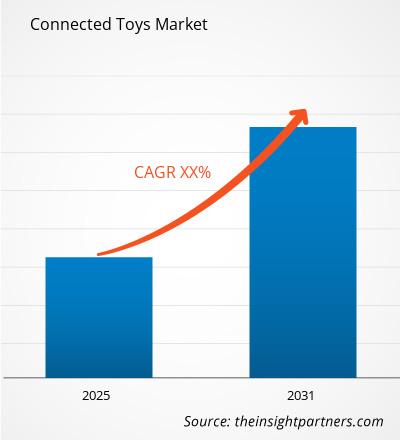
The Connected Toys Market size accounted for US$ 14.94 Billion and is forecasted to reach US$ 37.94 Billion by 2034, marking a CAGR of 12.35% during 2026-2034. The market is growing because app-based gaming, robotics, educational software, and devices-driven entertainment are altering children's toy interaction experiences in homes, schools, and activity-based learning settings.
In North America, the growth is projected to happen at a CAGR between 10.8% to 12.0%, owing to higher smartphone penetration, stem-focused parenting, school robotics clubs, and privacy-enabled designs of products. The market size in North America of the Connected Toys Market is supported by premium toys expenditure, retail presence, connected learning systems, and increasing tolerance for supervised apps play among parents.
Connected Toys Market Assessment and Insights
- North America held 34–38% share in 2025 and is growing at a CAGR of 10.8–12.0% during 2026–2034, supported by STEM learning demand, premium retail channels, and connected device maturity.
- US represented 76–80% of North America in 2025 and is growing at a CAGR of 11.0–12.2%, led by education robotics and app-integrated toys.
- Europe accounted for 24–28% share in 2025 and is advancing at a CAGR of 9.8–11.2%, with Germany, the UK, France, Italy, and Spain leading privacy-led adoption.
- Asia Pacific captured 26–30% share in 2025 and is expanding at a CAGR of 13.5–15.0%, led by China, Japan, South Korea, India, and Australia.
- Largest Segment Smartphone-Connected Toys held 38–42% market share in 2025 and are growing at a CAGR of 11.5–12.8%, supported by parent-owned smartphones and app-based play.
- High Growth Segment APP-Connected Drones held 14–18% market share in 2025 and are growing at a CAGR of 14.8–16.2%, driven by outdoor STEM play and camera-enabled interaction.
- Key companies analyzed in detail: Anki, Inc., Bandai Namco Entertainment Inc., K'NEX Industries, Inc., Konami Group Corporation, LEGO A/S, PlayFusion Ltd., geobra Brandstätter Stiftung & Co. KG, Sony Group Corporation, Sphero, Inc., and Wonder Workshop, Inc.
Source: The Insight Partners' analysis based on proprietary research, government publications, company annual reports, investor presentations, industry databases, and expert interviews.
Connective toys have transitioned from being novel gadgets to software-enabled learning platforms, robotic toys, and physical-digital fusion products. The Connected Toys Market shows progress in technologies such as Bluetooth technology, mobile apps, cloud-based content, sensors, batteries, and data security features. Manufacturing is still reliant on Asian electronic and toy-making facilities whereas the value generation is becoming increasingly software-driven and relies on safe design for children, content licensing, curriculum alignment, and robust hardware that can sustain repeated use in classrooms and at home.
The future demand will be driven by increasing digital literacy skills, coding classes in schools, supervised screen time programs, and increased data protection regulations. Manufacturers are anticipated to develop apps with secure architecture, modular products, multilingual content, and repairable solutions. Future geographic regions will generate volumes due to widespread adoption of smartphones whereas mature regions will focus on trusted brands, parental controls, and appropriate data management practices.
Connected Toys Market Report Scope
| Report Attribute | Details |
|---|---|
| Market size in 2025 | US$ 14.94 Billion |
| Market Size by 2034 | US$ 37.94 Billion |
| Global CAGR (2026 - 2034) | 12.35% |
| Historical Data | 2021-2024 |
| Forecast period | 2026-2034 |
Connected Toys Market Analysis
Connected Toys Market growth is enabled by parents and teachers looking for devices that are entertaining and can help their children develop specific skills. Robotics, coding building sets, app-controlled drones, and consoles are connected toys that foster problem-solving skills, sequencing skills, spatial learning, and collaboration among other abilities. GSMA reported there are 5.8 billion unique mobile subscribers as of 2025 with 71% penetration rate.
The dynamics of supply will rely on microcontrollers, sensors, connectivity solutions, batteries, plastic injection, content creation, and mobile software update processes. The toy brands will have to strike the right balance between short selling periods and long-lasting software support period. Data protection regulations like COPPA in the United States and GDPR-K in Europe increase costs due to the need for compliance, but at the same time, they provide differentiation for brands.
The Connected Toys Market report indicates that there is competition among toy experts, entertainment companies, robotics companies, and digital learning companies. Some of the major players are LEGO A/S and K’NEX Industries, Inc. which concentrate on construction-based learning, Sphero, Inc. and Wonder Workshop, Inc. which are into programmable robots while Bandai Namco Entertainment Inc., Konami Group Corporation and Sony Group Corporation provide connections between physical play and gaming platforms with their intellectual properties.
The strategic investment is shifting from one-time electronic capabilities towards reusable platforms, subscription-based content, classroom compatibility, and application safety. The example of companies providing robotics software, augmented reality and collectibles is Anki, Inc. and PlayFusion Ltd. Companies which have established brands, retail distribution, educator acceptance and post-launch software support are well suited for transforming connected capabilities into engaging ones.
● REPORT CUSTOMIZATION
Tailor This Report To Align With Your Specific Business Requirements
This report can be customized to align precisely with your business objectives, scope, and target markets. Customization options include tailored segmentation, geography, competitive analysis, and strategic insights to support informed decision-making.
Customize This Report →WHAT YOU CAN ADJUST
- ● Segmentations
- ● Geography
- ● Competitive Analysis
- ● Language Preferences
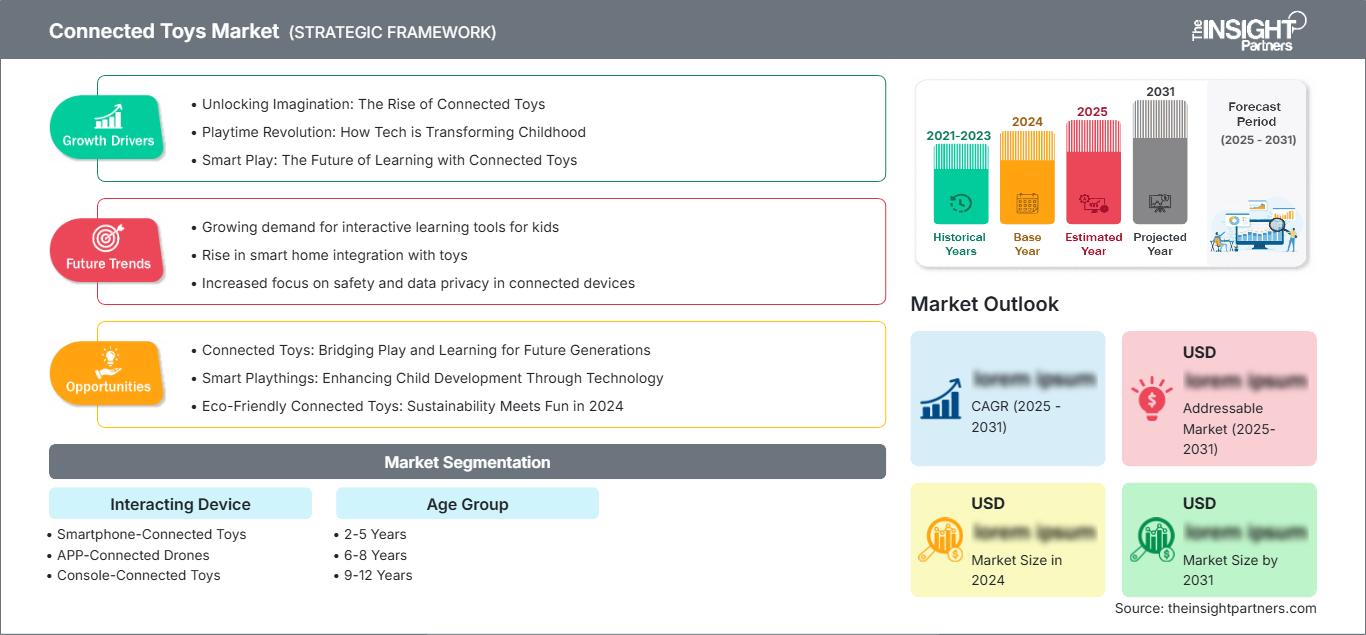
Connected Toys Market: Strategic Insights
Regional Insights
North America Connected Toys Market
North America held a 34–38% share in 2025 and is projected to grow at a CAGR of 10.8–12.0% through 2034. The Connected Toys Market share in the region is supported by high household broadband access, mature toy retailing, school robotics programs, and strong parental willingness to pay for supervised educational play.
US and Canadian buyers favor trusted brands, secure apps, and toys that connect physical activity with coding or storytelling. Retailers are expanding shelf space for programmable robots, app-controlled drones, and console-linked play. Compliance expectations around child data privacy raise development costs, yet they strengthen demand for transparent consent, limited data capture, and reliable software updates.
U.S. Connected Toys Market
The US represented 76–80% of North America in 2025 and is expected to grow at a CAGR of 11.0–12.2%. Demand is reinforced by STEM curricula, parent investment in learning toys, e-commerce visibility, and national retail chains. LEGO A/S, Sphero, Inc., Wonder Workshop, Inc., Sony Group Corporation, and Bandai Namco Entertainment Inc. maintain strong product or ecosystem visibility.
Application trends are shifting toward coding robots for classrooms, smartphone-connected toys for guided home learning, drones for outdoor skill development, and console-connected toys for franchise-based engagement. The Federal Trade Commission’s COPPA enforcement environment makes privacy-by-design commercially important. Brands that simplify parental permissions and reduce unnecessary data collection can improve trust and repeat purchases.
Europe Connected Toys Market
Europe held 24–28% share in 2025 and is forecast to grow at a CAGR of 9.8–11.2%. Germany leads regional demand through education technology adoption, engineering-oriented toys, and strong specialty retail. The UK supports online toy sales and classroom robotics, while France adds demand through family entertainment, licensing, and digital learning programs.
Italy and Spain are expanding gradually as affordability improves and retailers promote app-enabled toys during seasonal gifting periods. European families place high importance on privacy, durability, repairability, and content suitability. GDPR-based expectations create longer product planning cycles, but they also favor established vendors that can document consent controls, age gating, cybersecurity testing, and multilingual content governance.
APAC Connected Toys Market
Asia Pacific held 26–30% share in 2025 and is projected to grow at a CAGR of 13.5–15.0%. China leads through manufacturing scale, digital retail, and robotics learning demand. Japan and South Korea support premium entertainment-linked toys, while India and Australia add growth through education technology, smartphone adoption, and online marketplaces.
Policy support for digital learning, electronics manufacturing, and broadband expansion strengthens regional adoption. APAC also supplies components and final assembly, giving brands faster iteration cycles and cost flexibility. Localized apps, language support, battery safety, and reliable after-sales service remain essential for converting connected play interest into sustained market demand.
Middle East & Africa Connected Toys Market
Middle East & Africa is projected to grow at a CAGR of 10.5–12.0% as Saudi Arabia, the UAE, South Africa, and the rest of MEA invest in digital education, smart retail, and family entertainment. The UAE leads adoption through premium malls, tourism-led retail, and high smartphone penetration.
Energy diversification and smart-city programs create indirect demand for digital learning products that build coding and technology familiarity. South Africa contributes through organized retail and private education channels, while broader MEA remains price sensitive. Distributor financing, Arabic and local-language content, warranty support, and safer app onboarding are critical to scale.
Segmentation Analysis
Interacting Device
Interacting Device is expected to grow at a CAGR of 12.0–13.4% from 2026 to 2034 as the Connected Toys Market scope spans smartphone, drone, console, and tablet ecosystems. Buyers evaluate device compatibility, parental controls, app stability, battery performance, and learning outcomes before purchase. Interoperability with common household devices remains central to adoption.
- Smartphone-Connected Toys hold the strongest position because parents already use smartphones for setup, monitoring, updates, and guided play, making the category accessible across home learning and entertainment use cases.
- APP-Connected Drones attract children seeking active, outdoor, and camera-enabled experiences, while parents value their ability to introduce navigation, spatial awareness, basic physics, and responsible technology use.
- Console-Connected Toys benefit from gaming ecosystems, licensed characters, and family entertainment routines, allowing physical toys to extend digital storylines and deepen engagement with established franchises.
- Tablet-Connected Toys serve younger learners and classrooms where larger screens, touch interfaces, visual instructions, and shared activities make guided play easier for parents, teachers, and children.
Age Group
Age Group demand is forecast to grow at a CAGR of 11.8–13.0% during 2026–2034 as learning needs differ sharply by development stage. Younger children require safe interfaces and guided interaction, while older children and teenagers value coding depth, customization, challenges, and social play. Age-appropriate content design is therefore a major purchasing filter.
- 2-5 Years demand centers on simple voice, light, music, and touch interactions, with parents prioritizing safety, limited connectivity, durable materials, and early language or motor-skill reinforcement.
- 6-8 Years is a key adoption group for guided STEM play, coding robots, and tablet-linked activities because children can follow instructions while still needing parent or teacher supervision.
- 9-12 Years users seek more complex missions, drone control, programmable robots, and collectible digital-physical experiences that support independence, problem solving, and repeat engagement.
- Teenagers represent a smaller but strategically valuable group for advanced robotics, app customization, gaming-linked products, and maker-oriented toys that bridge entertainment with technical learning.
Opportunity Snapshot
| Age Group | Revenue Contribution | Trend Tag | Adoption Stage |
| 2-5 Years | Medium | Safe Play | Scaling |
| 6-8 Years | High | Coding Basics | Mature |
| 9-12 Years | High | STEM Missions | Scaling |
| Teenagers | Medium | Maker Robotics | Emerging |
Connected Toys Market Growth Drivers and Impact Analysis
STEM Learning Demand Expands Connected Play Adoption
There has been a greater use of connected toys by parents, schools, and after-school programs in helping children learn programming, sequencing, robotics, and problem solving skills before receiving any technical education. This can be attributed to the increase in popularity of programmable robot toys, apps for construction, and drones which help turn theories into practical exercises. Toys with an increasing difficulty level, educational tools for teachers, and measurable learning objectives could cost more than others. There would be repeated sales of the toys since children can go from block programming games to missions. Manufacturers who align toy manufacturing with curriculum terms can sell through consumers and institutions.
Smartphone Penetration Lowers Setup Barriers
Smartphones have increasingly become the default interface, repository, and distribution mechanism for connected toys. Increased mobile phone ownership reduces the reliance on dedicated devices, makes it easier to enter the market and enables companies to distribute mission updates, firmware updates, and parental control settings via existing app stores. According to data from GSMA on the 2025 mobile economy, there is high mobile penetration worldwide, which supports the potential use of mobile apps in play not limited only to premium households. The effect will be highest for smartphone-enabled toys since parents can monitor and control activation and extend their product life.
Privacy Compliance Becomes a Purchase Differentiator
Protection of child data is emerging as a market driver owing to the fact that connected toys use technologies such as microphones, cameras, account sign-up, or behavior-based data. Parents, educational institutions, and retail stores are increasingly looking for toys that collect minimal data, have a transparent system of data flow through clear consent procedures, and show where the data is stored or disposed. Although regulatory requirements such as COPPA and European privacy laws make toy development difficult, they reward toy vendors who are compliant with such laws. The impact on the market is moving away from feature-based to trust-based sales.
Connected Toys Market Future Trends
AI-Guided Adaptive Play Moves Into Mainstream Learning
Connected Toys Market trends will increasingly reflect adaptive play engines that adjust challenges, hints, and content pathways based on a child’s progress. Rather than offering fixed missions, future connected toys will use lightweight AI to personalize coding tasks, storytelling prompts, and robotics activities within parent-approved boundaries. This trend can improve repeat engagement because children receive new difficulty levels without buying a new device. It will also raise expectations for transparent algorithms, offline safeguards, and explainable parental controls. Vendors that combine adaptive software with durable hardware can improve lifetime value while addressing family concerns about excessive screen exposure.
Hybrid Physical-Digital Collectibles Gain Strategic Value
Toys associated with entertainment that are connected through this medium will transform into hybrid collectible toys whereby physical figures, cards, building blocks, and robots provide access to digital missions and game material. This model may allow for recurring usage, seasonal releases, and franchises without being completely dependent on the screen. Connected toys for consoles and collectible toys with apps are bound to gain from this trend as media companies strive to get more fan involvement. It is important to achieve the right balance in this case since families always want tangible play value even when there are changes in digital material.
Connected Toys Market Opportunities
School Robotics and Coding Programs
Schools represent a strong investment opportunity because teachers need age-appropriate tools that make coding, robotics, and engineering concepts tangible. Connected Toys Market Forecasts support demand for classroom-ready kits that include durable hardware, lesson plans, multilingual instructions, and simple device management. Vendors should prioritize bulk pricing, repair services, teacher training, and compatibility with tablets or Chromebooks. This opportunity is distinct from seasonal retail demand because education buyers value continuity, replacement parts, and measurable learning outcomes. Companies that build educator communities and assessment-linked content can create recurring institutional revenue beyond holiday-driven consumer sales.
Privacy-First Products for Premium Households
Luxury families will pay for interactive products that offer interaction with transparency with regards to data protection measures. This can be done by focusing on the use of local processing, less account-based, no unnecessary voice recording, and parental dashboards. The situation becomes particularly pertinent in North America and Europe, where increased regulation and media attention have turned children’s data protection into an important criterion for purchases. Retailers can help differentiate the products through labeling, compliance, and selective assortments. This would allow companies to convince parents about their safety products without diminishing the value of play.
Recent Developments
- May 2026: Sphero, Inc. highlighted Sphero BOLT 2.0 as part of the 2026 STEM robot wave, emphasizing Blockly and JavaScript support, a brighter LED matrix, stronger durability, and improved sensor range for coding education and repeat classroom use.
- January 2026: Lego has unveiled Smart Bricks - tech-filled versions of its small building blocks - which it says will bring sets to life with sound, light and reaction to movement.
- December 2025: Funskool announced its entry into the electronic toys category with the launch of a new range of products. The newly launched toys are priced from ₹1,249 onwards and will be available across a wide range of toy stores and e-commerce platforms.
Frequently Asked Questions

- Comprehensive Market Sizing and Forecast Analysis
- Detailed Segmentation Analysis
- In-Depth Market Dynamics Assessment
- Regional and Country-Level Insights
- Competitive Landscape and Company Benchmarking
- Strategic Business Intelligence
Recent Reports
Testimonials

The Insight Partners' SCADA System Market report is comprehensive, with valuable insights on current trends and future forecasts. The team was highly professional, responsive, and supportive throughout. We are very satisfied and highly recommend their services.
RAN KEDEM Partner, Reali Technologies LTDs
I requested a report on a very specific software market and the team produced the report in a few days. The information was very relevant and well presented. I then requested some changes and additions to the report. The team was again very responsive and I got the final report in less than a week.
JEAN-HERVE JENN Chairman, Future Analytica
We worked with The Insight Partners for an important market study and forecast. They gave us clear insights into opportunities and risks, which helped shape our plans. Their research was easy to use and based on solid data. It helped us make smart, confident decisions. We highly recommend them.
PIYUSH NAGPAL Sr. Vice President, High Beam Global
The Insight Partners delivered insightful, well-structured market research with strong domain expertise. Their team was professional and responsive throughout. The user-friendly website made accessing industry reports seamless. We highly recommend them for reliable, high-quality research services
YUKIHIKO ADACHI CEO, Deep Blue, LLC.
This is the first time I have purchased a market report from The Insight Partners.While I was unsure at first, I visited their web site and felt more comfortable to take the risk and purchase a market report.I am completely satisfied with the quality of the report and customer service. I had several questions and comments with the initial report, but after a couple of dialogs over email with their analyst I believe I have a report that I can use as input to our strategic planning process.Thank you so much for taking the extra time and making this a positive experience.I will definitely recommend your service to others and you will be my first call when we need further market data.
JOHN SUZUKI President and Chief Executive Officer, Board Director, BK Technologies
I wish to appreciate your support and the professionalism you displayed in the course of attending to my request for information regarding to infectious disease IVD market in Nigeria. I appreciate your patience, your guidance, and the fact that you were willing to offer a discount, which eventually made it possible for us to close a deal. I look forward to engaging The Insight Partners in the future, all thanks to the impression you have created in me as a result of this first encounter.
DR CHIJIOKE ONYIA MANAGING DIRECTOR, PineCrest Healthcare Ltd.Reason to Buy
- Informed Decision-Making
- Understanding Market Dynamics
- Competitive Analysis
- Identifying Emerging Markets
- Customer Insights
- Market Forecasts
- Risk Mitigation
- Boosting Operational Efficiency
- Strategic Planning
- Investment Justification
- Tracking Industry Innovations
- Aligning with Regulatory Trends





 Get Free Sample for