
Steel Fencing Market Share, Trends & Demand Outlook 2034
Coverage: By Product Type (Steel Palisade Fencing, Welded Wire or Mesh Fencing, Chain-Link Fencing, Ornamental or Decorative Steel Fencing, Security or Anti-Climb Fencing, Temporary Steel Fencing, and Others), Coating Or Finish (Galvanized, Powder-Coated, PVC-Coated, and Others), Application (Residential, Commercial, Industrial, Infrastructure, Agricultural, and Government or Public Sector), Distribution Channel (Direct Sales, Distributors or Dealers, Retail or Home Improvement, and Online Retail), and Geography (North America, Europe, Asia Pacific, the Middle East and Africa, and South and Central America)
- Status : Data Released
- Report Code : TIPRE00044093
- Category : Chemicals and Materials
- No. of Pages : 486
- Available Report Formats :


- Last update date : November 05, 2026


2025 Market Size
US$ 9,024.94 Mn
Base year value
2034 Forecast
US$ 14,873.76 Mn
Projected by 2034
CAGR 2026-2034
5.7 %
Growth rate
Addressable Market
US$ 108,268.25 Mn
(2026-2034)
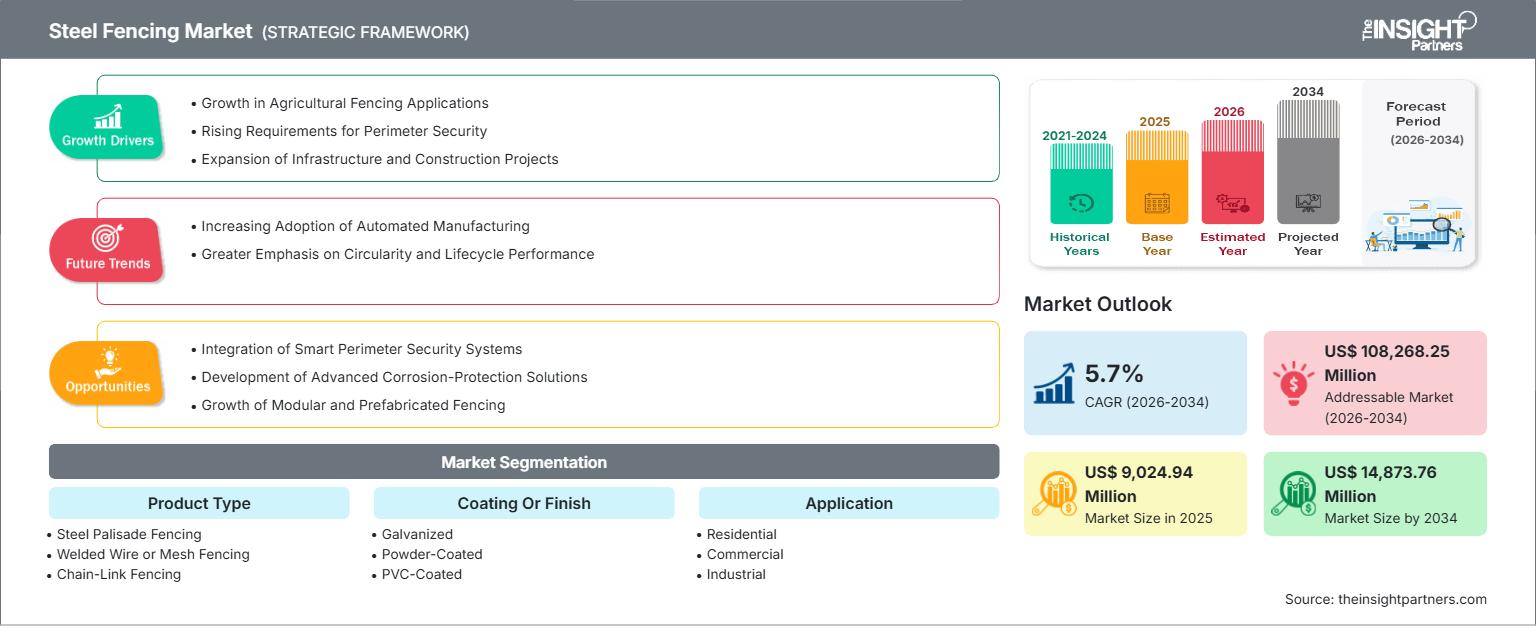
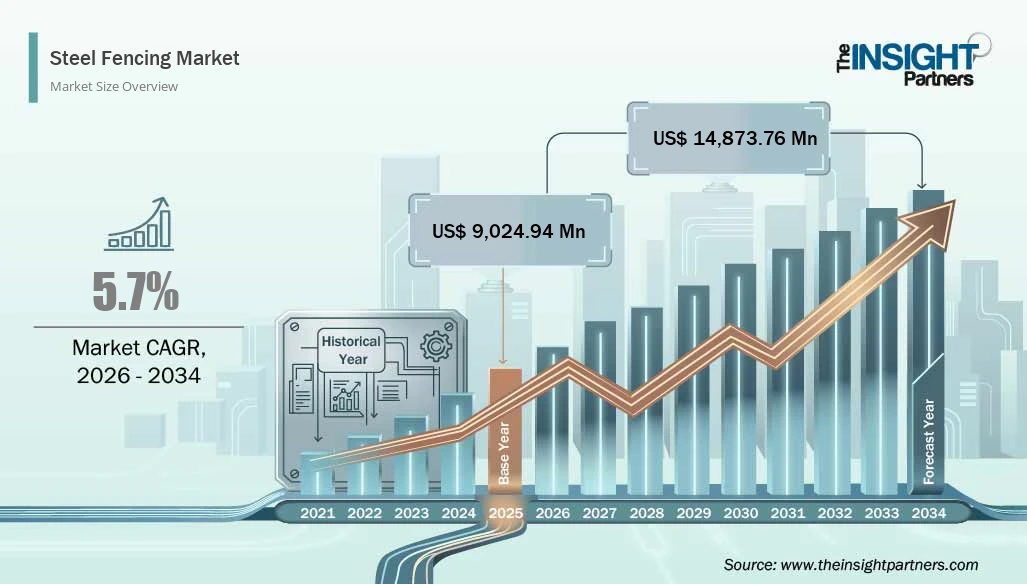
The steel fencing market size was valued at US$ 9,024.94 million in 2025 and is projected to reach US$ 14,873.76 million by 2034, registering a CAGR of 5.7% during 2026–2034. Expansion of residential construction, industrial facilities, logistics infrastructure, perimeter-security requirements, and public infrastructure is supporting demand. Increasing preference for durable, low-maintenance barriers is also encouraging substitution toward engineered steel fencing systems across commercial, industrial, agricultural, and infrastructure applications.
North America remains an important demand center, supported by residential replacement activity, commercial development, infrastructure spending, and heightened requirements for controlled-access sites. The region is expected to register a CAGR of ~5% through 2034. Demand is increasingly influenced by higher security specifications, corrosion-resistant finishes, modular installation, and the expansion of distribution networks serving contractors, builders, property owners, and institutional buyers.
Steel Fencing Market Assessment and Insights
Regional Outlook
- North America: ~25% of the global Steel Fencing Market share in 2025 | ~5% CAGR through 2034. Market position: North America holds a substantial position because of established fencing replacement demand, residential construction, commercial property development, and security requirements across industrial, institutional, and infrastructure sites.
- US: ~80% of North American market revenue in 2025 | ~5% CAGR through 2034. Market position: The US is the leading country in North America, supported by extensive residential fencing demand, commercial and industrial perimeter protection, infrastructure projects, and a developed contractor and home-improvement distribution ecosystem.
- Europe: ~30% of the global market in 2025 | ~4% CAGR through 2034. Market position: Europe represents a mature fencing market with strong replacement requirements, security applications, and architectural demand. Germany is the leading country in Europe, supported by industrial facilities, logistics sites, infrastructure, and established steel-processing capabilities.
- Asia Pacific: ~38% of the global market in 2025 | ~6% CAGR through 2034. Market position: Asia Pacific is the fastest-growing region, driven by urbanization, industrial construction, logistics expansion, infrastructure development, and manufacturing investment. China is the leading country in Asia Pacific, supported by its large industrial and construction base.
Segment Outlook
- Steel Palisade Fencing: ~22% Share in 2025 | ~5% CAGR through 2034. Market position: Steel palisade fencing leads product demand because its rigid construction, visible deterrence, and configurable height and security specifications make it suitable for industrial premises, utilities, public facilities, and other controlled-perimeter applications.
- Security or Anti-Climb Fencing: ~12% Share in 2025 | ~7% CAGR through 2034. Market position: Security or anti-climb fencing is gaining traction as buyers place greater emphasis on intrusion resistance at critical infrastructure, logistics, energy, transportation, and high-value industrial sites requiring enhanced perimeter protection.
Competitive Coverage
Feralpi Group, Betafence Group, Assa Abloy AB, ITOCHU Corporation, Jacksons Fencing, Zaun Ltd, Heras B.V., PICOT, AOS Stahl GmbH & Co. KG, Bekaert, Anping Xingyou Wire Mesh Products Co., Ltd, Zhonghua Palisade Fencing Manufacture Co, Shijiazhuang S D Company Ltd., TRESTLES a.s., CRH Plc, Iron World Manufacturing, LLC, Ametco Manufacturing, Fortress Building Products, Fastline Steel Services UK, Superior Fence and Rail. Inc.
Methodology
The Insight Partners follows Data Collection & Secondary Research, Primary Research, Data Analysis, and Data Triangulation & Final Review to validate market estimates and insights.
Source: The Insight Partners' analysis based on proprietary research, government publications, company annual reports, investor presentations, industry databases, and expert interviews.
Steel fencing products have developed from traditional perimeter barrier products into engineering fencing structures that are efficient in terms of construction, cost, and security performance. Technological development in wire forming, welding, coating, fabrication, modular panels, and automation of production has made possible various uses of steel fencing. Modern manufacturers produce steel fencing products of different designs depending on various needs of the terrain, security, architectural, and installation requirements. Economical aspects of production continue to be connected with the cost of steel, effectiveness of fabrication, coating, transportation, and other factors.
During the forecast period, there will be an expansion of the demand for fencing products among emerging centers of industry and infrastructure construction, logistics corridors, urban areas, and other locations where investment in industrial buildings and public assets could be used for perimeter security purposes. Procurement criteria and sustainability issues could favor more durable products. At the same time, regional manufacturers will develop their capacities for production and distribution of customized fencing products.
Steel Fencing Market Report Scope
| Report Attribute | Details |
|---|---|
| Market size in 2025 | US$ 9,024.94 Million |
| Market Size by 2034 | US$ 14,873.76 Million |
| Global CAGR (2026 - 2034) | 5.7% |
| Historical Data | 2021-2024 |
| Forecast period | 2026-2034 |
Steel Fencing Market Analysis
There is repetitive demand within the steel fencing industry arising from new construction and replacements. There is a general level of volume demand in residential use, while the other sectors including industrial, infrastructure, commercial, and government sectors have more specification-based demands. The supply chain begins with the steel providers and wire or section providers, fencing manufacturers, coaters, distributors, installers, and end users. The provision of the steel material and fabrication processes determine the product lead times, while coating process and finishing needs affect the product durability.
Fencing supply will be fragmented due to the existence of both standard types such as meshes and chain link fences and customized security fences. The big manufacturing companies may get an advantage due to integrated operations, diverse product lines, design capabilities, and relationships in distribution channels, while specialization may serve as competitive advantage of specialized companies. The replacement demand creates recurrent demand for installers and distributors due to corrosion and physical destruction among others.
Competition within the market of steel fencing exists among steel makers, fencing makers, security system makers, and building products makers. In Feralpi Group, there is integration between steel making and fencing and welded-mesh products, while Betafence Group and Heras B.V. concentrate on security perimeters. Bekaert invests in wire and mesh products, and Jacksons Fencing and Zaun Ltd specialize in fencing and security. CRH Plc has a position in North American fencing due to its building products range.
Investments are now focused more on efficient manufacture, sustainability, customization, and added-value perimeter solutions. As for Feralpi Group, for example, there have been large investments made into efficient steel manufacture and sustainable manufacture processes, while fencing ranges include such types of fencing as welded-wire and architectural systems. Positioning strategies are hence moving away from fencing commodities supply to material efficiency, security, corrosion resistance, design flexibility, and install services.
● REPORT CUSTOMIZATION
Tailor This Report To Align With Your Specific Business Requirements
This report can be customized to align precisely with your business objectives, scope, and target markets. Customization options include tailored segmentation, geography, competitive analysis, and strategic insights to support informed decision-making.
Customize This Report →WHAT YOU CAN ADJUST
- ● Segmentations
- ● Geography
- ● Competitive Analysis
- ● Language Preferences
Steel Fencing Market: Strategic Insights
Regional Insights
North America Steel Fencing Market
North America accounted for ~25% of the global steel fencing market in 2025 and is expected to register a CAGR of ~5% through 2034. The region benefits from an established installed base of residential, commercial, industrial, institutional, and agricultural fencing. Replacement requirements provide a recurring demand stream, while new logistics facilities, warehouses, utilities, transportation assets, and industrial developments create project-based demand for higher-strength perimeter systems.
The US is the major demand hub in the region due to the large-scale housing and commercial real estate transactions and also the advanced distribution of home improvement products. Demand in Canada comes from residential, agriculture, infrastructure, and industrial uses, while that of Mexico comes from manufacturing, logistics, and construction activities. The buyers have started considering the longevity, corrosion resistance, security performance, and maintenance of fencing materials apart from their cost.
U.S. Steel Fencing Market
The US represented ~80% of North American steel fencing market revenue in 2025 and is projected to grow at a CAGR of ~5% through 2034. Demand has been diverse in relation to residential properties, commercial properties, industrial properties, utilities, transportation facilities, agricultural lands, and public sector properties. Renewal of old fences and improvements on existing less secure fencing systems constitute ongoing demands aside from construction.
Companies and suppliers involved in this industry include CRH Plc, Fortress Building Products, Ametco Manufacturing, Iron World Manufacturing, LLC, and Superior Fence and Rail. Inc. These companies have been active in the production of fences for residential properties, commercial properties, architectural and security purposes. Industrial properties require access control and security whereas residential properties focus on durability and aesthetics and ease of installation.
Europe Steel Fencing Market
The Steel Fencing Market forecast shows that Europe represented ~30% of the market in 2025 and is expected to expand at a CAGR of ~4% through 2034. Germany is the leading country in Europe, supported by industrial manufacturing, logistics, infrastructure, commercial properties, and a strong engineering base. The UK remains significant because of residential, commercial, transport, utilities, and security applications, while France has demand across public infrastructure, agriculture, commercial facilities, and housing.
The construction sector, industry, architectural fencing, and steel processing in Italy offer opportunities for this sector. The Spanish market includes residential and commercial use, agriculture, and infrastructure needs. In the entire region, corrosion protection, longevity, efficiency of installation, and harmonization with architecture and landscaping have become more important to consumers. European manufacturers can also gain from the need for greener steel products and efficient production.
APAC Steel Fencing Market
Asia Pacific represented ~38% of the global steel fencing market in 2025 and is expected to grow at a CAGR of ~6% through 2034, making it the fastest-growing region. China is the leading country in Asia Pacific, reflecting its extensive construction, manufacturing, infrastructure, and logistics base. India is also gaining importance as industrial and urban development expands.
Japan and South Korea maintain demand from mature industrial, commercial, infrastructure, and residential applications, while Australia has substantial requirements across residential, agricultural, mining, and infrastructure sites. Regional growth is supported by industrial localization, warehouse development, transportation infrastructure, urban expansion, and government investment in physical assets. Local manufacturing capabilities and comparatively broad steel-processing ecosystems also facilitate customization and competitive supply.
Middle East & Africa Steel Fencing Market
The Middle East & Africa steel fencing market is expected to register a CAGR of ~5% through 2034. Saudi Arabia is the leading country in the Middle East & Africa region where evidence supports the strongest combination of infrastructure development, industrial investment, logistics expansion, and large-scale construction activity. The UAE also represents an important demand center because of commercial construction, logistics facilities, airports, utilities, and security-sensitive developments.
South Africa contributes through residential, commercial, mining, industrial, agricultural, and infrastructure applications. Rest of MEA demand remains closely linked to public infrastructure, energy projects, industrial facilities, and urban development. In the Gulf, perimeter security is particularly relevant for energy and industrial assets, while large construction programs create requirements for both permanent and temporary fencing. Steel fencing suppliers can therefore address a diverse mix of security, site-control, and property-boundary requirements.
Segmentation Analysis
Product Type
Product Type represents a core dimension of the steel fencing market because buyers select systems according to required security, visibility, durability, aesthetics, installation conditions, and budget. Demand increasingly favors products that balance physical protection with service life and installation efficiency. Security or anti-climb fencing is expected to record a CAGR of ~7% as critical infrastructure, logistics, industrial, and high-value facilities increase perimeter-security specifications.
- Steel Palisade Fencing: Rigid vertical steel profiles provide a visually prominent and difficult-to-penetrate perimeter, making the format relevant for industrial facilities, utilities, commercial premises, and controlled-access sites.
- Welded Wire or Mesh Fencing: Factory-welded panels provide consistent geometry and relatively efficient installation, supporting applications where visibility, rigidity, and a clean perimeter appearance are important.
- Chain-Link Fencing: Flexible mesh construction remains widely used where economical perimeter demarcation, rapid installation, and adaptability to different site configurations are prioritized.
- Ornamental or Decorative Steel Fencing: Decorative formats combine boundary control with architectural appearance, supporting residential, commercial, institutional, and landscape-oriented projects where aesthetics influence purchasing decisions.
- Security or Anti-Climb Fencing: Specialized designs emphasize intrusion resistance and restricted climbing access, making them suitable for critical infrastructure, transportation, utilities, prisons, and high-security industrial premises.
- Temporary Steel Fencing: Modular systems enable rapid deployment and relocation, particularly for construction sites, events, temporary works, controlled-access zones, and short-duration infrastructure projects.
- Others: Other steel fencing configurations address specialized site requirements where standard product formats do not provide the required combination of geometry, security, aesthetics, or installation characteristics.
Coating Or Finish
Coating Or Finish influences service life, appearance, corrosion protection, maintenance requirements, and total ownership cost. Buyers in exposed environments increasingly evaluate finishes according to climate, expected operating period, visual requirements, and maintenance accessibility. Powder-Coated fencing is expected to record a CAGR of ~6% as architectural and residential buyers seek durable finishes with greater color and appearance flexibility.
- Galvanized: Zinc protection provides a practical corrosion barrier and remains widely applicable where long service life and comparatively low maintenance are required.
- Powder-Coated: Powder finishes support color customization and provide an architectural appearance, making them relevant to residential, commercial, institutional, and design-sensitive projects.
- PVC-Coated: PVC coatings add a polymeric protective layer and can improve resistance to environmental exposure while offering additional surface and color characteristics.
- Others: Other finishes serve specialized corrosion, aesthetic, or performance requirements where conventional metallic or polymeric coatings are not the preferred specification.
Application
Application determines fencing specifications because security expectations, site exposure, traffic, aesthetics, ownership, and installation conditions differ substantially across end-use environments. Infrastructure is expected to record a CAGR of ~6% as transportation, utilities, logistics, public works, and other physical assets require controlled perimeters, asset protection, and site management during both construction and operation.
- Residential: Residential demand centers on property boundaries, privacy, security, appearance, and replacement, with buyers balancing durability against installation and lifecycle costs.
- Commercial: Commercial premises require perimeter definition, access control, appearance, and asset protection across offices, retail properties, warehouses, and mixed-use developments.
- Industrial: Industrial users prioritize robust barriers, controlled access, safety, and intrusion resistance around factories, processing facilities, storage yards, and equipment areas.
- Infrastructure: Infrastructure projects use fencing for asset protection, restricted access, safety, construction control, and long-term perimeter management around transport and utility facilities.
- Agricultural: Agricultural applications require durable boundary control across farms, livestock areas, storage facilities, and rural properties, often under demanding environmental and terrain conditions.
- Government or Public Sector: Public-sector buyers require dependable perimeter control around civic buildings, schools, public utilities, transport assets, and other facilities where security and access management are important.
Distribution Channel
Distribution Channel shapes purchasing accessibility, project support, product availability, and customer acquisition. Direct and specialist channels remain important for specification-intensive projects requiring engineering support and installation coordination, while digital and retail channels improve access to standardized products. Online Retail is expected to record a CAGR of ~6% as standardized fencing components become easier to compare, order, and deliver through digital channels.
- Direct Sales: Direct sales support larger projects where manufacturers coordinate specifications, volumes, delivery schedules, technical requirements, and installation-related services.
- Distributors or Dealers: Distributors and dealers provide regional inventory, contractor relationships, product selection, and localized service, making them important for fragmented project demand.
- Retail or Home Improvement: Retail channels serve residential and smaller commercial buyers seeking accessible products, standardized dimensions, installation accessories, and immediate availability.
- Online Retail: Online channels improve product discovery and purchasing convenience, particularly for standardized panels, gates, posts, accessories, and smaller project requirements.
Opportunity Snapshot
| Application | Revenue Contribution | Trend Tag | Adoption Stage |
| Residential | High | Property Security | Mature |
| Commercial | Medium | Access Control | Mature |
| Industrial | High | Site Protection | Mature |
| Infrastructure | High | Asset Perimeters | Scaling |
| Agricultural | Medium | Rural Boundaries | Mature |
| Government or Public Sector | Medium | Critical Sites | Scaling |
Steel Fencing Market Growth Drivers and Impact Analysis
Expansion of Industrial and Logistics Facilities Increases Perimeter Requirements
There is always a need for well-defined borders in industrial parks, warehouses, distribution centers, factories and logistics properties in order to regulate access, ensure protection of inventories, separate functional spaces, and regulate the movement of vehicles and pedestrians. This translates into the increased demand for rigid fences, security screens, gates, and other perimeter security systems whenever there is growth in such large facilities. There may be an increased demand for more secure fencing solutions in logistics properties in case valuable cargoes will be kept in these sites for a long period. In such circumstances, there is an increased need for fast-installation fencing systems with a proper structure that is compatible with access control systems.
Higher Security Requirements Strengthen Demand for Engineered Barriers
The security demands in terms of the fence are being increasingly differentiated by industry, infrastructure, energy, transport, and government properties. In many cases, standard fence boundary delineation may not suffice in light of intrusion prevention, climbing control, enhanced visibility, and/or electronic surveillance and access control systems integration that are required by buyers. This necessitates the demand for engineered steel fences with certain performance criteria rather than plain commodity fences. The response of manufacturers can be seen in the form of better fence panel design, anti-climbing design, strengthened posts, security gates, and systems capable of sensor/alarm integration. This leads to an increased value of the product as engineering, certification, installation services, and performance have their influence on buyers' decisions.
Construction and Infrastructure Investment Sustains Replacement and Project Demand
Construction activity creates direct demand for temporary site barriers and permanent perimeter systems, while infrastructure investment generates longer-term requirements around transportation, utilities, public facilities, and industrial assets. Fencing is often a relatively small component of total project expenditure but is operationally necessary for site safety, access management, asset protection, and boundary definition. This supports demand across different product configurations and purchasing channels. Infrastructure projects can also require customized specifications for terrain, security level, durability, and integration with gates or controlled-access systems. As a result, suppliers capable of meeting project schedules, maintaining consistent product quality, and coordinating with contractors can benefit from infrastructure-related demand even when broader construction cycles fluctuate.
Steel Fencing Market Future Trends
Integration of Physical Fencing With Intelligent Perimeter Security
The Steel Fencing Market trends show that future perimeter systems are likely to increasingly combine physical steel barriers with electronic detection, surveillance, access control, and alarm technologies. Rather than treating fencing as an isolated construction product, industrial and infrastructure buyers can increasingly evaluate the perimeter as an integrated security layer. This transition can encourage manufacturers to design fencing that accommodates sensors, cameras, cabling, controlled gates, and monitoring equipment without compromising structural performance. The opportunity is particularly relevant to critical infrastructure, logistics, energy, transportation, and high-value industrial sites. Over time, intelligent perimeter solutions may shift competition toward system integration, engineering capability, and after-sales support. Fencing producers that establish partnerships with security-technology providers could therefore expand their addressable value proposition beyond the physical barrier itself.
Greater Use of Lower-Impact Steel and Durable Finishing Systems
Sustainability considerations are likely to influence material procurement and product selection more strongly through 2034. Buyers with environmental targets may increasingly request steel products supported by recycled content, lower-emission production pathways, environmental documentation, or longer service lives. Longer-lasting coatings and corrosion-resistant finishes can complement this shift by reducing replacement frequency and maintenance requirements. The resulting trend favors suppliers able to document material characteristics and lifecycle performance while maintaining competitive project economics. Manufacturers with efficient steel-processing operations and established coating capabilities may be better positioned to meet procurement requirements that increasingly incorporate both environmental performance and durability.
Steel Fencing Market Opportunities
Localized Manufacturing for Fast-Growing Construction Corridors
Manufacturers can pursue localized production and distribution in regions where industrial construction, logistics development, and infrastructure investment are expanding faster than established supply networks. Local production can reduce transportation costs, shorten lead times, support customized dimensions, and improve responsiveness to contractor schedules. This approach is particularly relevant to markets where fencing specifications vary according to climate, security requirements, building standards, and project design. Partnerships with regional distributors or fabricators can provide another route to market without requiring fully integrated local operations. Suppliers should prioritize product configurations with repeatable demand while maintaining the ability to customize posts, panels, gates, coatings, and security features. Such localization can improve competitiveness against imported standardized products while strengthening customer relationships.
Premium Security Systems for Critical Infrastructure and Industrial Assets
Critical infrastructure and high-value industrial facilities provide an opportunity to move toward higher-value fencing systems rather than competing solely on standard products. Suppliers can develop integrated packages combining anti-climb panels, reinforced posts, secure gates, corrosion-resistant finishes, access-control compatibility, and installation support. Energy facilities, logistics hubs, transport assets, utilities, and sensitive public-sector sites are suitable targets because the cost of inadequate perimeter protection can exceed the initial fencing expenditure. A solutions-oriented approach can also create recurring opportunities through inspections, maintenance, modifications, and security upgrades. Companies with established engineering teams and project-management capabilities can use these strengths to differentiate from manufacturers focused primarily on commodity mesh and chain-link products.
Recent Developments
- May 2025: Feralpi Group — Feralpi Stahl inaugurated its new Rolling Mill B in Riesa, Germany, following an investment of more than €220 million. The facility uses a zero-direct-emission induction furnace system and enables continuous rolling through billet welding. The investment strengthens the group's steel-production capabilities and reflects the industry's movement toward more efficient and lower-emission manufacturing.
- February 2025: Feralpi Group — Feralpi Siderurgica secured a €170 million sustainability-linked loan supported by the SACE Archimede Guarantee. The financing was intended to support implementation of the company's business plan, including investments related to competitiveness, lower-emission steel production, and ESG performance.
Frequently Asked Questions

- Comprehensive Market Sizing and Forecast Analysis
- Detailed Segmentation Analysis
- In-Depth Market Dynamics Assessment
- Regional and Country-Level Insights
- Competitive Landscape and Company Benchmarking
- Strategic Business Intelligence
Recent Reports
Testimonials

The Insight Partners provided valuable market intelligence that supported our global go-to-market strategy. Their team was professional, responsive, and attentive to our feedback, providing thoughtful analysis and helpful methodological clarifications throughout the project.
Junmo Kim Chief Financial Officer (CFO), Enertech Co., Ltd.
The Insight Partners' SCADA System Market report is comprehensive, with valuable insights on current trends and future forecasts. The team was highly professional, responsive, and supportive throughout. We are very satisfied and highly recommend their services.
RAN KEDEM Partner, Reali Technologies LTDs
I requested a report on a very specific software market and the team produced the report in a few days. The information was very relevant and well presented. I then requested some changes and additions to the report. The team was again very responsive and I got the final report in less than a week.
JEAN-HERVE JENN Chairman, Future Analytica
We worked with The Insight Partners for an important market study and forecast. They gave us clear insights into opportunities and risks, which helped shape our plans. Their research was easy to use and based on solid data. It helped us make smart, confident decisions. We highly recommend them.
PIYUSH NAGPAL Sr. Vice President, High Beam Global
The Insight Partners delivered insightful, well-structured market research with strong domain expertise. Their team was professional and responsive throughout. The user-friendly website made accessing industry reports seamless. We highly recommend them for reliable, high-quality research services
YUKIHIKO ADACHI CEO, Deep Blue, LLC.
This is the first time I have purchased a market report from The Insight Partners.While I was unsure at first, I visited their web site and felt more comfortable to take the risk and purchase a market report.I am completely satisfied with the quality of the report and customer service. I had several questions and comments with the initial report, but after a couple of dialogs over email with their analyst I believe I have a report that I can use as input to our strategic planning process.Thank you so much for taking the extra time and making this a positive experience.I will definitely recommend your service to others and you will be my first call when we need further market data.
JOHN SUZUKI President and Chief Executive Officer, Board Director, BK Technologies
I wish to appreciate your support and the professionalism you displayed in the course of attending to my request for information regarding to infectious disease IVD market in Nigeria. I appreciate your patience, your guidance, and the fact that you were willing to offer a discount, which eventually made it possible for us to close a deal. I look forward to engaging The Insight Partners in the future, all thanks to the impression you have created in me as a result of this first encounter.
DR CHIJIOKE ONYIA MANAGING DIRECTOR, PineCrest Healthcare Ltd.Reason to Buy
- Informed Decision-Making
- Understanding Market Dynamics
- Competitive Analysis
- Identifying Emerging Markets
- Customer Insights
- Market Forecasts
- Risk Mitigation
- Boosting Operational Efficiency
- Strategic Planning
- Investment Justification
- Tracking Industry Innovations
- Aligning with Regulatory Trends





 Get Free Sample for