
Cementless Total Knee System Market Growth, Trends & Demand by 2034
Cementless Total Knee System Market Size and Forecasts (2021–2034), Global and Regional Share, Trends, and Growth Opportunity Analysis Report Coverage : by Component Type (Tibial Component and Femoral Component); End User (Hospitals, Orthopedic Centers, Other End Users); and Geography (North America, Europe, Asia Pacific, and South and Central America)
- Status : Data Released
- Report Code : TIPRE00040692
- Category : Life Sciences
- No. of Pages : 150
- Available Report Formats :


- Last update date : September 28, 2026


2025 Market Size
US$ 4.75 Bn
Base year value
2034 Forecast
US$ 7.22 Bn
Projected by 2034
CAGR 2026-2034
4.76 %
Growth rate
Addressable Market
US$ 54.33 Bn
(2026-2034)
The Cementless Total Knee System market was valued at US$ 4.75 billion in 2025 and is expected to reach US$ 7.22 billion by 2034; it is estimated to record a CAGR of 4.76% during 2026-2034.
Cementless Total Knee System Market Assessment and Insights
- North America: Accounted for a modelled 42–46% share in 2025 and is projected to record a CAGR between 5.2–5.8% during 2026–2034, supported by registry-backed adoption, robotic surgery penetration, and outpatient arthroplasty capacity.
- US: Represented 86–90% of North American revenue in 2025 and is anticipated to grow at a CAGR between 5.3–5.9% through 2034 as cementless procedural utilization broadens.
- Europe: Held a modelled 26–30% share in 2025 and is forecast to expand at a CAGR between 4.5–5.1% during 2026–2034, led by Germany, the UK, France, Italy, and Spain.
- Asia Pacific: Captured a modelled 19–23% share in 2025 and is expected to register a CAGR between 6.2–6.8% during 2026–2034, with Japan, China, Australia, South Korea, and India supporting adoption.
- Largest Segment: Hospitals represented a modelled 69–73% market share in 2025 and are projected to grow at a CAGR between 4.9–5.5% during 2026–2034.
- High Growth Segment: Orthopedic Centers held a modelled 21–25% market share in 2025 and are expected to record a CAGR between 6.3–6.9% during 2026–2034.
- Key companies analyzed in detail: Zimmer Biomet Holdings, Inc.; Stryker Corporation; DePuy Synthes, part of Johnson & Johnson MedTech; Smith & Nephew plc; Medtronic plc; Orthofix Medical Inc.; B. Braun Melsungen AG; restor3d, Inc.; Exactech, Inc.; and MicroPort Scientific Corporation.
Source: The Insight Partners' analysis based on proprietary research, government publications, company annual reports, investor presentations, industry databases, and expert interviews.
Cementless knee technology has evolved from the fixation-based technology with unreliable initial stability to the anatomical design and highly porous implants that promote bone growth within the device. Additive manufacturing has allowed pore structure control, complex peg shapes, and optimal load distribution. This has therefore led to the use of printing of titanium alloys, plasma spray coating, and machining and inspection of the parts. Robotic planning and balance platforms have enabled reliable positioning of the parts, whereas the use of modularity has ensured surgical adaptability between cement and cementless techniques.
Within the forecast period, the use of the technology is expected to expand from high-volume hospitals in the US market to orthopedics facilities in Europe and certain private healthcare institutions in Asia. Development efforts will be directed towards additive manufacturing, outpatient-friendly instrument kits, physician training, and post-market data. The regulatory approval process recognizing predicate technologies should facilitate platform growth; however, the manufacturers will need to demonstrate their product’s fixability. National arthroplasty registry data will become increasingly important in determining purchase decisions based on revision, implant survival rate, and patient selection.
Cementless Total Knee System Market Report Scope
| Report Attribute | Details |
|---|---|
| Market size in 2025 | US$ 4.75 Billion |
| Market Size by 2034 | US$ 7.22 Billion |
| Global CAGR (2026 - 2034) | 4.76% |
| Historical Data | 2021-2024 |
| Forecast period | 2026-2034 |
Cementless Total Knee System Market Analysis
The growth of the market for Cementless Total Knee System is influenced by the rising demand for knee reconstructive devices by more active, younger patients as well as growing physician confidence in current porous fixation technology. The demand is generated by orthopedic hospitals, specialists, surgeons, payers, and patients, while the supply chain comprises titanium suppliers, coating suppliers, additive manufacturers, implant manufacturers, distribution companies, robotic platform suppliers, and sterilization partners.
Economics of the supply chain rely not on the availability of bone cement, but rather on the capabilities of the manufacturing process. While electron-beam and laser-based manufacturing processes allow for more complicated porous geometries, they require process validation and tracing, as well as significant investment. Vertically integrated additive manufacturing allows for optimization of implant geometry, lead times, and instrument logistics.
Market analysis of the Cementless Total Knee System reveals that the competition is shifting to be more platform-based. Stryker Corporation associates Triathlon Cementless systems with Mako, whereas Zimmer Biomet Holdings, Inc. couples Persona porous components with ROSA. DePuy Synthes provides VELYS support to ATTUNE Cementless system, while Smith & Nephew plc offers CORI support to LEGION CONCELOC. This enhances the surgeon's experience and creates switching costs.
Investments in porous titanium components, innovative bearing surfaces, personalized alignment, sterile delivery, and reduction in instrumentation will define the future of the market. Exactech, Inc. and MicroPort Scientific Corporation invest in implant differentiation platforms, while restor3d, Inc. offers patient-specific planning and three-dimensional printing. Aesculap orthopedics portfolio of B. Braun Melsungen AG is one of the participants in the market. Medtronic plc and Orthofix Medical Inc. are not directly competitive with cementless knee solutions, but adjacent technology players in musculoskeletal technologies.
● REPORT CUSTOMIZATION
Tailor This Report To Align With Your Specific Business Requirements
This report can be customized to align precisely with your business objectives, scope, and target markets. Customization options include tailored segmentation, geography, competitive analysis, and strategic insights to support informed decision-making.
Customize This Report →WHAT YOU CAN ADJUST
- ● Segmentations
- ● Geography
- ● Competitive Analysis
- ● Language Preferences
Cementless Total Knee System Market: Strategic Insights
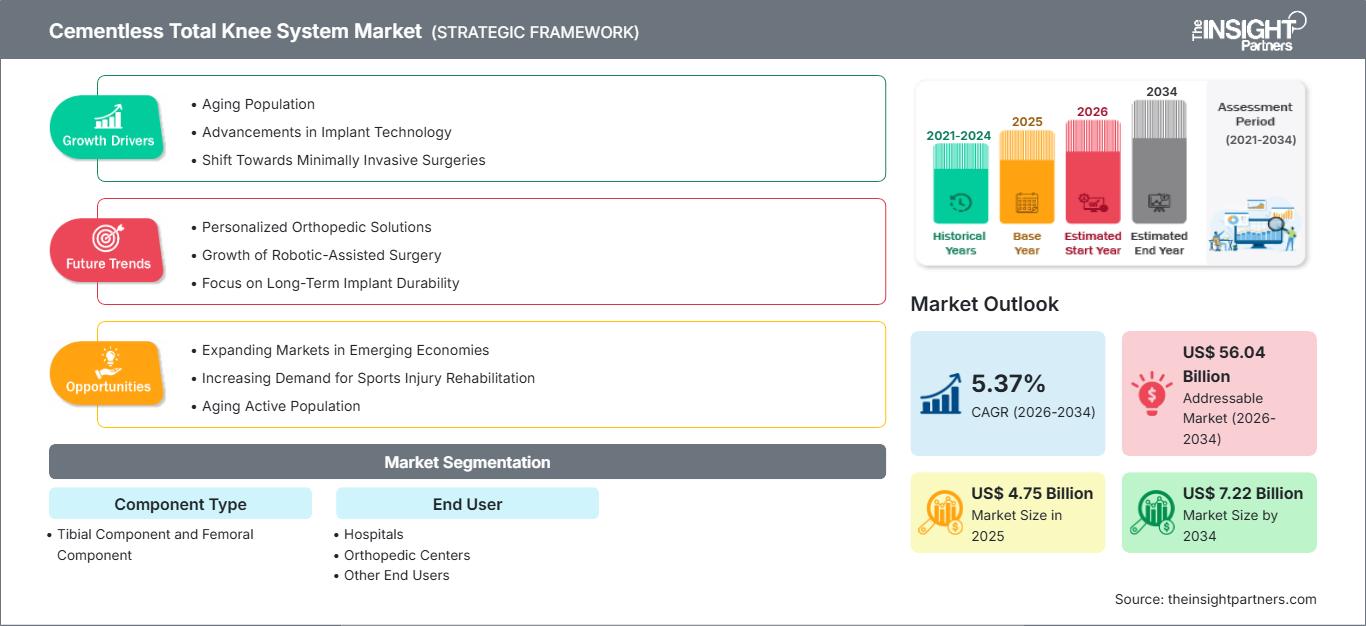
Regional Insights
North America Cementless Total Knee System Market
North America held an estimated 42–46% Cementless Total Knee System Market share in 2025 and is forecast to expand at a 5.2–5.8% CAGR through 2034. Cementless utilization rates increasing up to 19.0% in 2024 based on US registry data serve as an indicator of the degree of adoption. Young age of the patients, increased obesity rate, surgeons’ experience, and availability of porous implant surfaces further boost adoption in the area.
Canadian adoption is rather selective and depends on provincial procurement, hospital budget, and data from the registries. In Canada, robotic-assisted arthroplasty helps with accurate bone preparation and implant placement, and ambulatory surgery centers value efficient setup of the instruments and possibly shorter procedures. Commercial infrastructure ensures rapid training and assessment of the products. However, hospitals continue to examine implant costs, revision results, bone quality criteria, and other factors before adopting cementless technology.
U.S. Cementless Total Knee System Market
The US represented an estimated 86–90% of North American revenue in 2025 and is projected to grow at a 5.3–5.9% CAGR during 2026–2034. Registry analysis covering 1,178,783 primary procedures found 10.8% were cementless across the complete 2012–2024 dataset. Absolute one-year revision differences between cementless and cemented procedures were small, supporting continued but patient-selective adoption.
Stryker Corporation, Zimmer Biomet Holdings, Inc., DePuy Synthes, Smith & Nephew plc, Exactech, Inc., and restor3d, Inc. have products or pipelines of products in the USA that are pertinent to the topic. The usage trends pertain to younger patients with proper bone quality, high arthroplasty volumes, and hospitals using robots in pre-operative planning. With a trend towards out-patient procedures, there will be simplified trays and operating room turnover. Purchasing trends include registry-based survivorship data, additive manufacturing quality, alternatives to functional alignment, and implants storage requirements.
Europe Cementless Total Knee System Market
The Cementless Total Knee System Market forecast shows that Europe accounted for a modelled 26–30% share in 2025 and is expected to register a 4.5–5.1% CAGR through 2034. Germany dominates regional revenues due to high orthopedic procedures, specialist hospitals' capabilities, and the earliest availability of the latest implant systems. Evidence-based adoption is the norm, with national procurement systems giving much consideration to the revision rate, implant cost, and registry performance.
In the UK, there is a combination of the National Joint Registry and the use of biological fixation of selected patients. Germany enjoys well-known orthopedic device companies as well as reconstructive skills. France, Italy, and Spain are forecast to develop through reference centers, private hospital facilities, and physician training, despite reimbursement delays and tender cycles. European registry analysis shows improved performance of cementless implants, though varying implant selection, follow-up periods, and patient selection should be taken into account.
APAC Cementless Total Knee System Market
Asia Pacific held a modelled 19–23% share in 2025 and is projected to record a 6.2–6.8% CAGR during 2026–2034. Japan leads current regional adoption through mature orthopedic infrastructure and established implant reimbursement, while China offers the largest incremental procedure opportunity.
Australia contributes registry-based clinical evidence, whereas South Korea combines advanced hospitals with strong robotic-surgery adoption. India is expanding from a smaller base through private hospital investment and medical tourism. Local manufacturing policies, surgeon training, regulatory approvals, and implant affordability will determine how rapidly cementless systems move beyond premium urban centers.
Middle East & Africa Cementless Total Knee System Market
The Middle East & Africa market is forecast to expand at a modelled 4.7–5.3% CAGR through 2034. Saudi Arabia is expected to lead as hospital modernization and specialist orthopedic investment increase access to joint replacement. The UAE supports premium implant adoption through private healthcare and medical tourism.
South Africa remains the principal sub-Saharan market, supported by established private hospital networks. Elsewhere, limited reimbursement and trained-surgeon availability constrain uptake. Oil-supported infrastructure investment in Gulf countries can accelerate robotic platform purchases, but tender pricing, service coverage, and implant inventory remain decisive procurement considerations.

Segmentation Analysis
Component Type
The Component Type segment is projected to expand at a CAGR of 5.1–5.7% during 2026–2034. The Cementless Total Knee System Market scope includes tibial and femoral components designed to achieve immediate mechanical stability followed by biological fixation. Product development emphasizes porous architecture, anatomic coverage, fatigue resistance, and compatibility with multiple bearing philosophies. Platform suppliers increasingly coordinate femoral and tibial surfaces as complete cementless constructs.
- Tibial Component: Demand is supported by the importance of rotational stability, cortical coverage, and resistance to micromotion. Advanced trays use porous titanium, peripheral pegs, keels, or optional screws to promote primary and biological fixation.
- Femoral Component: Strategic importance is increasing as manufacturers develop porous or coated femoral options that complete fully cementless constructs, support bone conservation, and address surgeon demand for integrated fixation and kinematic consistency.
End User
The End User segment is anticipated to grow at a CAGR of 5.2–5.8% during 2026–2034. Adoption varies according to procedure volume, capital equipment, surgeon specialization, procurement autonomy, and postoperative care capability. Hospitals retain the largest installed base, while orthopedic centers benefit from focused pathways, faster operating-room turnover, and concentrated expertise. Growth will depend on reimbursement, ambulatory eligibility, and access to implant inventory.
- Hospitals: Hospitals remain the principal purchasers because they manage complex patients, maintain robotic and navigation infrastructure, support inpatient recovery, and possess multidisciplinary resources for primary and revision arthroplasty procedures.
- Orthopedic Centers: Specialized centers are strategically important for standardized pathways, surgeon-led implant selection, rapid rehabilitation, and same-day discharge. Their focused case mix supports training, workflow measurement, and controlled introduction of cementless technologies.
Opportunity Snapshot
| End User | Revenue Contribution (High/Medium/Low) | Trend Tag | Adoption Stage (Emerging/Scaling/Mature) |
| Hospitals | High | Robotic Integration | Mature |
| Orthopedic Centers | Medium | Outpatient TKA | Scaling |
| Other End Users | Low | Selective Access | Emerging |
Cementless Total Knee System Market Growth Drivers and Impact Analysis
Increasing Candidacy Among Younger and More Active Patients
The requirement for knee implants is increasingly shifting towards those patients requiring a longer life span of their implants. The cementless fixation allows a biological bond, which is meant to ensure independence from the cement layer. This solution is more preferable in clinical practice if the bone quality allows osseointegration. The commercial significance of this issue is the greatest in the offices, which deal with young patients, male patients, and certain people with high mechanical requirements. In response to this situation, manufacturers start offering components of larger sizes, improved porous surface, sturdier baseplates, and kinematic variations. Usage of cementless fixation will be selective as age cannot determine the applicability.
Expansion of Additive Manufacturing and Porous Fixation
Additive manufacturing enables implant producers to create interconnected pores, complex keel structures, and fixation geometries that conventional machining cannot efficiently reproduce. These capabilities support initial press-fit stability and bone ingrowth while allowing manufacturers to optimize stiffness, fatigue resistance, and load transfer. Commercially, the technology lowers barriers to differentiated component design but raises requirements for powder control, validation, inspection, and regulatory documentation. Stryker’s Tritanium, Zimmer Biomet’s OsseoTi, Smith & Nephew’s CONCELOC, and restor3d’s TIDAL technologies illustrate competing approaches to porous fixation. As manufacturing capacity expands, suppliers can develop more sizes and complete constructs. Competitive advantage will depend on reproducibility and clinical evidence, not solely on pore architecture or three-dimensional printing claims.
Integration with Robotic-Assisted Arthroplasty Workflows
Robotic-assisted systems strengthen cementless adoption by helping surgeons plan resections, evaluate soft-tissue balance, and execute component positioning within defined parameters. Cementless components rely on accurate bone preparation and stable seating, making workflow precision commercially relevant. Integrated portfolios also allow companies to combine implant revenue with capital equipment, service agreements, planning software, and disposable instruments. Hospitals may prefer a unified platform where robotics, implants, data capture, and training are supplied through one relationship. However, robotic ownership does not automatically justify cementless fixation, and manual workflows remain important. Vendors must demonstrate that integrated technology improves reproducibility without adding avoidable time, imaging expense, or procedural complexity to routine total knee arthroplasty.
Cementless Total Knee System Market Future Trends
Patient-Specific Porous Components Move Toward Commercial Scale
Cementless Total Knee System Market trends increasingly combine anatomic personalization with porous additive manufacturing. Patient-specific systems can adjust coverage, rotation, component dimensions, peg placement, and instrumentation to individual anatomy while preserving a biological fixation strategy. restor3d’s FDA-cleared iTotal Identity CR 3DP Porous system demonstrates this convergence and was scheduled for a limited US release in the third quarter of 2025. Future adoption will depend on manufacturing lead times, imaging workflows, reimbursement, and evidence that personalization improves outcomes or operating efficiency. Successful platforms may reduce inventory requirements through case-specific production, but suppliers must maintain dependable scheduling, sterile delivery, and contingency options for intraoperative changes.
Evidence Generation Shifts Toward Implant-Specific Performance
Future evaluation will move beyond broad comparisons of cemented and cementless fixation toward component-specific survivorship, patient selection, and failure mechanisms. Registry studies currently contain heterogeneous implants and relatively limited representation of modern cementless designs, reducing the certainty of class-wide conclusions. Upcoming evidence programs will connect implant identifiers, robotic planning data, patient-reported outcomes, revision causes, and longitudinal follow-up. Manufacturers with demonstrable performance in younger, obese, or high-activity cohorts may gain procurement advantages. Conversely, early signals concerning loosening, instability, infection, or periprosthetic fracture will receive greater scrutiny. Hospitals will increasingly require post-market transparency and independently interpretable evidence before converting substantial procedure volumes to cementless platforms.
Cementless Total Knee System Market Opportunities
Developing Outpatient-Optimized Implant and Instrument Packages
Orthopedic manufacturers can address ambulatory surgery centers with fewer trays, pre-sterilized instruments, simplified preparation steps, and flexible components suitable for cementless or cemented use. The opportunity extends beyond implant sales to inventory management, staff education, remote technical support, and procedure analytics. Orthopedic centers value predictable room turnover and limited storage, creating an opening for platforms that reduce sterilization burden without restricting surgical options. Suppliers should prioritize compact instrumentation, clear bone-quality decision protocols, and contingency components. Partnerships with high-volume outpatient surgeons can generate workflow evidence and accelerate adoption. Commercial success will require alignment with facility economics rather than relying solely on theoretical operating-time savings or premium implant positioning.
Building Regional Evidence and Training Networks in Asia Pacific
Manufacturers can invest in local surgeon education, reference centers, regulatory submissions, and post-market registries across Japan, China, India, South Korea, and Australia. Market development should distinguish mature reimbursement systems from price-sensitive private markets. Japan and Australia can support evidence generation, while China and India offer larger long-term procedural pools. Companies should adapt sizing, instrumentation, distribution, and service models to regional anatomy and hospital workflows. Joint programs with teaching hospitals can demonstrate patient selection and fixation techniques. Local additive manufacturing or finishing partnerships may reduce delivery times, but quality governance must remain consistent. A staged country strategy offers lower execution risk than simultaneous broad commercialization.
Recent Developments
- June 2025: Smith & Nephew plc introduced a medial stabilized insert for the LEGION Total Knee System. The insert supports both LEGION CONCELOC Cementless and cemented configurations and was made available on a limited basis in the US, with broader US commercialization planned later in 2025 and a Canadian introduction scheduled for 2026.
- April 2025: restor3d, Inc. received FDA 510(k) clearance for the iTotal Identity CR 3DP Porous Total Knee Replacement System. The patient-specific system combines personalized femoral, tibial, and patellar components with TIDAL porous technology and sterile single-use instruments. The company planned a limited market release during the third quarter of 2025.
- December 2024: Zimmer Biomet Holdings, Inc. received FDA 510(k) clearance for the Persona SoluTion PPS Femur, a porous-coated component for cementless fixation. Combined with the Persona OsseoTi tibia and patella, the system provides a fully cementless construct designed to reduce exposure to common metal sensitizers and bone cement.
Frequently Asked Questions

- Comprehensive Market Sizing and Forecast Analysis
- Detailed Segmentation Analysis
- In-Depth Market Dynamics Assessment
- Regional and Country-Level Insights
- Competitive Landscape and Company Benchmarking
- Strategic Business Intelligence
Recent Reports
Testimonials

The Insight Partners provided valuable market intelligence that supported our global go-to-market strategy. Their team was professional, responsive, and attentive to our feedback, providing thoughtful analysis and helpful methodological clarifications throughout the project.
Junmo Kim Chief Financial Officer (CFO), Enertech Co., Ltd.
The Insight Partners' SCADA System Market report is comprehensive, with valuable insights on current trends and future forecasts. The team was highly professional, responsive, and supportive throughout. We are very satisfied and highly recommend their services.
RAN KEDEM Partner, Reali Technologies LTDs
I requested a report on a very specific software market and the team produced the report in a few days. The information was very relevant and well presented. I then requested some changes and additions to the report. The team was again very responsive and I got the final report in less than a week.
JEAN-HERVE JENN Chairman, Future Analytica
We worked with The Insight Partners for an important market study and forecast. They gave us clear insights into opportunities and risks, which helped shape our plans. Their research was easy to use and based on solid data. It helped us make smart, confident decisions. We highly recommend them.
PIYUSH NAGPAL Sr. Vice President, High Beam Global
The Insight Partners delivered insightful, well-structured market research with strong domain expertise. Their team was professional and responsive throughout. The user-friendly website made accessing industry reports seamless. We highly recommend them for reliable, high-quality research services
YUKIHIKO ADACHI CEO, Deep Blue, LLC.
This is the first time I have purchased a market report from The Insight Partners.While I was unsure at first, I visited their web site and felt more comfortable to take the risk and purchase a market report.I am completely satisfied with the quality of the report and customer service. I had several questions and comments with the initial report, but after a couple of dialogs over email with their analyst I believe I have a report that I can use as input to our strategic planning process.Thank you so much for taking the extra time and making this a positive experience.I will definitely recommend your service to others and you will be my first call when we need further market data.
JOHN SUZUKI President and Chief Executive Officer, Board Director, BK Technologies
I wish to appreciate your support and the professionalism you displayed in the course of attending to my request for information regarding to infectious disease IVD market in Nigeria. I appreciate your patience, your guidance, and the fact that you were willing to offer a discount, which eventually made it possible for us to close a deal. I look forward to engaging The Insight Partners in the future, all thanks to the impression you have created in me as a result of this first encounter.
DR CHIJIOKE ONYIA MANAGING DIRECTOR, PineCrest Healthcare Ltd.Reason to Buy
- Informed Decision-Making
- Understanding Market Dynamics
- Competitive Analysis
- Identifying Emerging Markets
- Customer Insights
- Market Forecasts
- Risk Mitigation
- Boosting Operational Efficiency
- Strategic Planning
- Investment Justification
- Tracking Industry Innovations
- Aligning with Regulatory Trends





 Get Free Sample for