
Thermal Interface Pads and Material Market Size, Demand & Growth by 2034
Coverage: by Type (Thermal Grease, Phase Change Material, Thermal Pads, Others); Material Type (Gap Pads, Phase Change Material); Product (Thyristor, IGBT, Mosfet, Power Transistors); Application (Consumer Electronics, Telecom Equipment, Power Supply Units, Others) , and Geography (North America, Europe, Asia Pacific, and South and Central America)
- Status : Data Released
- Report Code : TIPRE00009908
- Category : Electronics and Semiconductor
- No. of Pages : 150
- Available Report Formats :


- Last update date : July 13, 2026


2025 Market Size
US$ 986.87 Mn
Base year value
2034 Forecast
US$ 1,691.82 Mn
Projected by 2034
CAGR 2026-2034
6.17 %
Growth rate
Addressable Market
US$ 12,125.18 Mn
(2026-2034)
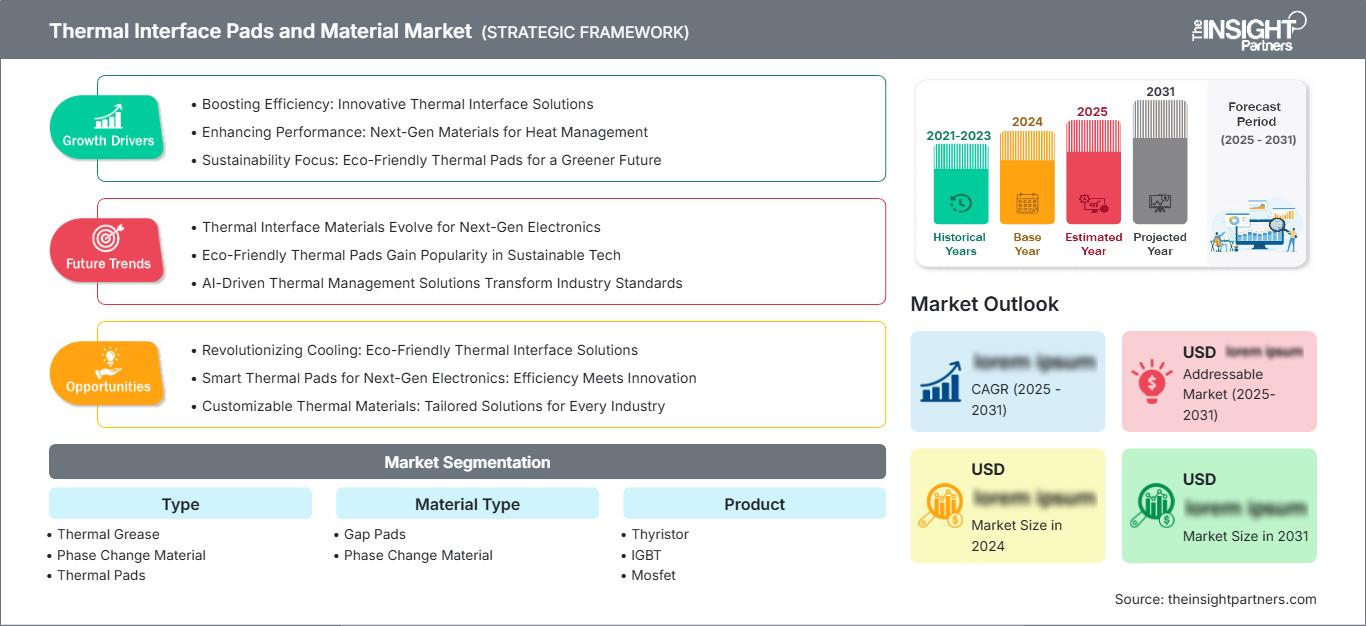
The Thermal Interface Pads and Material Market size was valued at US$ 986.87 Million in 2025 and is projected to reach US$ 1,691.82 Million by 2034; it is expected to register a CAGR of 6.17% from 2026 to 2034. Demand is driven by the increasing heat density of compact electronics, the rise in semiconductor power load, and the wider use of thermal pads, phase change materials, and grease in electronic assemblies.
North America Thermal Interface Pads and Material Market is estimated to record a CAGR of 5.7-6.2% during the period 2026-2034 due to technological progress in semiconductor packaging, defense electronics, cloud infrastructure, and high reliability power conversion systems. The local assembly of electronics, data center growth, and electrification projects are creating demand for conformable gap pads and phase change materials that provide thermal stability and reduced complexity and risk of assembly service.
Thermal Interface Pads and Material Market Assessment and Insights
- North America accounted for 28–31% of the Thermal Interface Pads and Material Market share in 2025 and is projected to grow at 5.7–6.2% CAGR between 2026–2034, led by server cooling, aerospace electronics, and domestic semiconductor capacity.
- The US represented 78–82% of North America in 2025 and is forecast to grow at 5.8–6.3% CAGR, supported by AI data centers and power electronics.
- Europe held 20–23% share in 2025 and is expected to grow at 5.3–5.8% CAGR, with Germany, the UK, France, Italy, and Spain driving automotive and industrial electronics demand.
- Asia Pacific captured 37–40% share in 2025 and is expected to grow at 6.7–7.2% CAGR, led by China, Japan, South Korea, India, and electronics manufacturing scale.
- Largest Segment: Thermal Pads held 41–45% market share in 2025 and are expected to grow at 6.0–6.5% CAGR, reflecting use in consumer electronics and telecom hardware.
- High Growth Segment: Phase Change Material held 18–22% of the Thermal Interface Pads and Material market share in 2025 and is projected to grow at 7.0–7.6% CAGR, driven by high-performance computing modules.
- Key companies analyzed in detail: 3M Company, Dow Inc., Fujipoly America Corporation, GrafTech International Ltd., Henkel AG & Co. KGaA, Honeywell International Inc., Laird Performance Materials, Parker-Hannifin Corporation, Stockwell Elastomerics, Inc., Boyd Corporation.
Source: The Insight Partners' analysis based on proprietary research, government publications, company annual reports, investor presentations, industry databases, and expert interviews.
The Thermal Interface Pads and Material Market has progressed away from basic silicone greases towards processing pads, graphite mixtures, and substances such as effect changing films that deal with minimal tolerance levels and higher watt densities. The processes nowadays have changed in such a way that more stress is put on properly controlled filler loading and lower levels of gas emission as well as using higher degree of automation in die-cutting technologies. These changes have been positively affecting the reliability of IGBT units, telecommunication base stations, power supply devices, and consumer gadgets and ensuring compatibility of production level with mass manufacturing (high-volume production).
Investment plans are expected to focus on the industries located in Asia Pacific, packaging of semiconductors in North America, and electric power production industries in Europe. Legislative issues focused on energy efficiency such as power distribution in data centers and reliability standards of electronics will support the development of the market.
Thermal Interface Pads and Material Market Report Scope
| Report Attribute | Details |
|---|---|
| Market size in 2025 | US$ 986.87 Million |
| Market Size by 2034 | US$ 1,691.82 Million |
| Global CAGR (2026 - 2034) | 6.17% |
| Historical Data | 2021-2024 |
| Forecast period | 2026-2034 |
Thermal Interface Pads and Material Market Analysis
The demand is driven by small-size electronics, higher current density, fast switching semiconductors, and requirement to maintain temperature levels while avoiding bulk cooling systems. The market growth of Thermal Interface Pads and Material is also driven by applications in telecommunications equipment, cloud computing racks, and power supplies where reliable heat conduction decreases the likelihood of failures and warranty claims.
The value chain participants include resin providers, suppliers of ceramic and carbon fillers, compounders, converters, module manufacturers, and teams responsible for OEM qualification processes. The supply conditions benefit manufacturers that provide high accuracy in terms of thickness, clean manufacturing process, and consistency of thermal impedance. Thermal Interface Pads and Material report concludes that reliability rather than conductive properties determines the supplier choice.
There is moderate consolidation within this competitive environment. Diversified material science players and specialized elastomer converters compete for market leadership. The Thermal Interface Pads and Material Market report focuses on key companies including 3M Company, Henkel AG & Co. KGaA, Dow Inc., Parker-Hannifin Corporation, Boyd Corporation, and Laird Performance Materials that competes via variety of formulations, global converting capabilities, and engineering support.
Investment is shifting towards greases that have low bleed, reworkable phase change materials, higher compliance gap pads, and materials that use graphite. Positioning will be achieved through validation of performance in power transistors, MOSFETs, thyristor packages, and IGBT modules. Thermal Interface Pads and Materials Trends indicate closer working relationships between material providers and electronics designers.
● REPORT CUSTOMIZATION
Tailor This Report To Align With Your Specific Business Requirements
This report can be customized to align precisely with your business objectives, scope, and target markets. Customization options include tailored segmentation, geography, competitive analysis, and strategic insights to support informed decision-making.
Customize This Report →WHAT YOU CAN ADJUST
- ● Segmentations
- ● Geography
- ● Competitive Analysis
- ● Language Preferences
Thermal Interface Pads and Material Market: Strategic Insights
Regional Insights
North America Thermal Interface Pads and Material
North America held 28–31% share in 2025 and is expected to record a 5.7–6.2% CAGR. Demands are centered around AI servers, aerospace electronics, medical equipment, and power conversion systems needing reliable thermal resistance. The market will profit from the engineering-driven qualification cycles and value-added assemblies as opposed to volume-oriented manufacturing alone.
Growth is facilitated by investment in semiconductor packaging, government-sponsored manufacturing programs, and cloud infrastructure growth. The North America Thermal Interface Pads and Material market forecast is further bolstered by supplier application labs that expedite the design validation of gap pads, phase change films, and greases that operate under tough conditions.
U.S. Thermal Interface Pads and Material Market
The US accounted for 78–82% of North America in 2025 and is forecast to grow at a 5.8–6.3% CAGR. Domestic demand is concentrated in data centers, defense electronics, semiconductor equipment, telecom networks, and high-reliability industrial controls that require qualified thermal stack materials.
Company presence is strong, with 3M Company, Honeywell International Inc., Parker-Hannifin Corporation, Stockwell Elastomerics, Inc., and Boyd Corporation supporting design-in activity. Application trends emphasize thermally conductive pads for power supply units, phase change material for processors, and greases for serviceable modules where field replacement remains important.
Europe Thermal Interface Pads and Material Market
Europe represented 20–23% share in 2025 and is projected to expand at a 5.3–5.8% CAGR. Germany remains the leading country, supported by automotive electronics, industrial drives, renewable power converters, and precision manufacturing ecosystems that require long-life thermal interface materials.
The UK market is shaped by aerospace, defense, data center, and electronics design activity. Demand favors certified, low-outgassing products and supplier documentation that supports regulated applications. Local engineering teams often specify materials early to reduce thermal risk before final electronics enclosure design.
France, Italy, and Spain contribute through rail electronics, telecom upgrades, energy infrastructure, and power supply manufacturing. The Thermal Interface Pads and Material size in these countries benefits from electrification projects and industrial automation, although procurement remains sensitive to qualification cost, lead time, and material availability.
APAC Thermal Interface Pads and Material Market
APAC held 37–40% share in 2025 and is expected to grow at a 6.7–7.2% CAGR, making it the leading region. China leads demand through electronics assembly, EV components, telecom equipment, and power supply manufacturing.
Japan and South Korea support advanced semiconductor packaging, memory devices, displays, and precision electronics where thermal performance is critical. India is scaling electronics manufacturing and telecom infrastructure, creating new demand for cost-effective pads and greases.
Australia contributes through energy storage, mining electronics, and infrastructure systems. Policy support for local manufacturing, renewable integration, and digital infrastructure strengthens regional adoption.
Middle East & Africa Thermal Interface Pads and Material Market
Middle East & Africa is projected to grow at a 4.6–5.1% CAGR, with Saudi Arabia leading regional demand through grid modernization, data centers, industrial automation, and energy infrastructure electronics.
The UAE supports demand through telecom, smart city systems, and high-availability data center projects. Thermal materials are increasingly specified in power supply units and communication equipment exposed to elevated ambient temperatures.
South Africa and Rest of MEA show selective adoption in mining electronics, renewable power converters, and industrial controls. Procurement is often project-based, favoring proven materials with reliable distribution and technical support.
Segmentation Analysis
Type
The Type segment is expected to grow at a 6.1–6.6% CAGR from 2026 to 2034. Selection depends on assembly method, bondline thickness, rework needs, and thermal cycling exposure. OEMs increasingly choose formats that balance conductivity with compression behavior, pump-out resistance, and repeatable dispensing or placement during automated manufacturing.
- Thermal Grease remains important for serviceable assemblies and uneven surfaces, offering low contact resistance and flexible application where rework, field maintenance, or adjustable bondline thickness is required.
- Phase Change Material is gaining strategic relevance in processors and power modules because it softens under operating heat, fills micro-voids, and reduces long-term thermal impedance.
- Thermal Pads dominate where clean handling, electrical insulation, controlled thickness, and assembly speed matter, especially in telecom equipment, consumer devices, and power supply units.
Material Type
The Material Type segment is projected to grow at a 6.3–6.8% CAGR from 2026 to 2034. Demand is influenced by interface gap, surface flatness, compression force, and operating temperature. Suppliers are improving ceramic filler dispersion, silicone matrices, graphite reinforcement, and phase transition behavior to meet tighter reliability specifications.
- Gap Pads address tolerance stack-up between heat sources and heat sinks, providing mechanical compliance, dielectric protection, and simplified assembly for dense electronics with uneven component heights.
- Phase Change Material serves high-performance modules where thermal resistance must decline during operation, supporting processors, power semiconductors, and compact assemblies that face repeated heat cycles.
Product
The Product segment in the Thermal Interface Pads and Material Market is expected to advance at a 5.9–6.4% CAGR from 2026 to 2034. Thermal interface demand is closely linked to semiconductor switching speed, current load, and packaging density. Products used in power conversion require materials that maintain thermal performance under pressure, vibration, and repeated temperature excursions.
- Thyristor applications require stable thermal paths in industrial drives, grid equipment, and controlled rectifiers, where long operating lives and predictable heat transfer outweigh frequent design changes.
- IGBT modules use pads, greases, and phase change materials to manage high heat flux in EV inverters, renewable converters, traction systems, and industrial motor drives.
- Mosfet applications favor thin, consistent interfaces for compact power electronics, chargers, adapters, and telecom boards where switching losses and enclosure limits create thermal constraints.
- Power Transistors rely on materials that reduce junction temperature variation, supporting reliability in power supplies, amplifiers, controls, and distributed electronics used across industrial systems.
Application
The Application segment in the Thermal Interface Pads and Material Market is projected to grow at a 6.2–6.7% CAGR from 2026 to 2034. Demand is concentrated in applications where device uptime, compact layouts, and operating efficiency are measurable business priorities. Thermal materials are increasingly reviewed during early design because late-stage heat mitigation raises cost and delays qualification.
- Consumer Electronics use pads and greases in smartphones, laptops, gaming systems, wearables, and home devices, where thinner designs increase heat concentration and reliability expectations.
- Telecom Equipment requires robust thermal paths in radios, base stations, routers, and optical modules that operate continuously under outdoor or high-density rack conditions.
- Power Supply Units depend on insulating pads and greases around MOSFETs, transformers, and rectifiers, improving efficiency and reducing component stress in compact power architectures.
Opportunity Snapshot
| Application | Revenue Contribution | Trend Tag | Adoption Stage |
| Consumer Electronics | High | Thin Devices | Mature |
| Telecom Equipment | Medium | 5G Radios | Scaling |
| Power Supply Units | Medium | Compact Power | Scaling |
Thermal Interface Pads and Material Market Growth Drivers and Impact Analysis
Rising Heat Density in Compact Electronics
Consumers' products, telecom cards, and embedded controllers are using faster processors, more memory, and high output power components in smaller enclosures. In the process, the heat flux increases, while there is less room for airflow and metal heat spreader area. The solution to these problems is the use of thermal pads and phase change materials to minimize the air gap and maintain the temperature of the component without extensive changes in mechanical design. The practical results are reduced product qualification time, less thermal throttling, and increased reliability in sustained operation.
Expansion of Data Centers and Power Electronics
AI workloads, cloud services, and industrial electrification are increasing demand for processors, power modules, and high-efficiency conversion systems. These applications require repeatable heat transfer between semiconductors, heat sinks, cold plates, and housings. Thermal Interface Pads and Material Market demand benefits because system designers need materials that withstand compression, vibration, and thermal cycling. The impact is visible in higher material value per assembly, stricter qualification requirements, and increased preference for suppliers that provide thermal modeling support alongside physical products.
Reliability Requirements in Telecom and Industrial Systems
Telecommunication devices, factory process controllers, and power supplies typically run continuously in outdoor cabinets, industrial environments, or high-density racks. Thermal variations, dust, vibrations, and maintenance issues make thermal failures more expensive. The use of pads, greases, and phase-change materials can stabilize the temperature at the junctions while minimizing stresses to solder joints and packages of semiconductors. The market implications would include increased usage of cut pads, proven dielectric strength, and long-lasting formulation.
Thermal Interface Pads and Material Market Future Trends
Shift Toward Hybrid and Graphite-Enhanced Interfaces
In the Thermal Interface Pads and Material Market trends, next generation designs are anticipated to blend ceramic filler materials, graphite configurations, silicone or non-silicone base compounds, and phase transformations to boost conductivity performance without compromising on compliance. Hybrid interfaces will be particularly useful when used in AI processors, IGBT assemblies, and small power supply units where there is variation in contact pressure. This could transform purchase considerations from a single figure of conductivity performance to full thermal impedance under application-based pressure.
Design-In Collaboration Across Electronics Supply Chains
Thermal material selection is moving earlier in the product development cycle as OEMs try to avoid late-stage redesigns. Engineering teams are increasingly sharing board layouts, heat maps, mechanical tolerances, and reliability targets with suppliers before final material selection. This will favor companies offering simulation data, prototype conversion, and global technical support. The Thermal Interface Pads and Material Market will therefore shift from transactional sales toward application-engineered partnerships where validated performance, documentation, and supply continuity carry strategic weight.
Thermal Interface Pads and Material Market Opportunities
Localized Converting for High-Mix Electronics Programs
Electronics manufacturers increasingly need cut-to-shape pads, kiss-cut sheets, clean packaging, and rapid prototype lots for multiple device programs. Localized converting creates an opportunity for material suppliers and channel partners to reduce lead times while supporting engineering changes. This is especially relevant in North America and Europe, where qualification documentation and traceability influence sourcing decisions. Companies that combine global formulations with regional converting can improve service levels, reduce inventory risk, and capture higher-margin design wins.
Advanced Materials for Power Semiconductor Modules
Power semiconductor modules used in EV charging, renewable inverters, industrial drives, and grid equipment face demanding temperature cycles and high current density. This creates investment opportunities in phase change materials, compliant gap pads, and high-performance greases optimized for IGBT, MOSFET, thyristor, and power transistor packages. Suppliers can differentiate by validating pump-out resistance, dielectric performance, and thermal aging. The opportunity is strongest where thermal reliability directly affects system uptime, warranty costs, and energy conversion efficiency.
Recent Developments
- In December 2024, Dow and Carbice have a groundbreaking partnership to offer advanced thermal interface materials for various industries, including mobility, industrial, consumer electronics, and semiconductors. Unveiled at The Battery Show North America in 2024, this partnershipopens in a new tab combines decades of Dow’s silicone expertise with aligned carbon nanotube (CNT) technology from Carbice. The collaboration supports innovation for diverse applications through thermal management solutions that are reliable, affordable, and customizable.
- In October 2024, Dow, (NYSE: DOW) and Carbice, a pioneer in carbon nanotube (CNT) technology, have announced a strategic, first-of-its-kind partnership to provide a multi-generational thermal interface material (TIM) product offering for high-performing electronics in the mobility, industrial, and consumer industries, as well as semiconductors. The collaboration, revealed this morning at The Battery Show North America, combines Dow's decades-long legacy in silicones with Carbice's patented CNT technology to offer novel thermal management products. This collaboration will meet the rising demand for reliability in the expanding thermal interface market with innovative pad solutions for e-mobility and electronics applications.
Frequently Asked Questions

- Comprehensive Market Sizing and Forecast Analysis
- Detailed Segmentation Analysis
- In-Depth Market Dynamics Assessment
- Regional and Country-Level Insights
- Competitive Landscape and Company Benchmarking
- Strategic Business Intelligence
Recent Reports
Testimonials

The Insight Partners' SCADA System Market report is comprehensive, with valuable insights on current trends and future forecasts. The team was highly professional, responsive, and supportive throughout. We are very satisfied and highly recommend their services.
RAN KEDEM Partner, Reali Technologies LTDs
I requested a report on a very specific software market and the team produced the report in a few days. The information was very relevant and well presented. I then requested some changes and additions to the report. The team was again very responsive and I got the final report in less than a week.
JEAN-HERVE JENN Chairman, Future Analytica
We worked with The Insight Partners for an important market study and forecast. They gave us clear insights into opportunities and risks, which helped shape our plans. Their research was easy to use and based on solid data. It helped us make smart, confident decisions. We highly recommend them.
PIYUSH NAGPAL Sr. Vice President, High Beam Global
The Insight Partners delivered insightful, well-structured market research with strong domain expertise. Their team was professional and responsive throughout. The user-friendly website made accessing industry reports seamless. We highly recommend them for reliable, high-quality research services
YUKIHIKO ADACHI CEO, Deep Blue, LLC.
This is the first time I have purchased a market report from The Insight Partners.While I was unsure at first, I visited their web site and felt more comfortable to take the risk and purchase a market report.I am completely satisfied with the quality of the report and customer service. I had several questions and comments with the initial report, but after a couple of dialogs over email with their analyst I believe I have a report that I can use as input to our strategic planning process.Thank you so much for taking the extra time and making this a positive experience.I will definitely recommend your service to others and you will be my first call when we need further market data.
JOHN SUZUKI President and Chief Executive Officer, Board Director, BK Technologies
I wish to appreciate your support and the professionalism you displayed in the course of attending to my request for information regarding to infectious disease IVD market in Nigeria. I appreciate your patience, your guidance, and the fact that you were willing to offer a discount, which eventually made it possible for us to close a deal. I look forward to engaging The Insight Partners in the future, all thanks to the impression you have created in me as a result of this first encounter.
DR CHIJIOKE ONYIA MANAGING DIRECTOR, PineCrest Healthcare Ltd.Reason to Buy
- Informed Decision-Making
- Understanding Market Dynamics
- Competitive Analysis
- Identifying Emerging Markets
- Customer Insights
- Market Forecasts
- Risk Mitigation
- Boosting Operational Efficiency
- Strategic Planning
- Investment Justification
- Tracking Industry Innovations
- Aligning with Regulatory Trends





 Get Free Sample for