
Tunnel Automation Market Trends, Share & Demand by 2034
Coverage: by Component (HVAC, Lighting & Power Supply, Signalization); Tunnel Type (Railway Tunnels and Highway and Roadway Tunnels); Offering (Hardware, Software, and Services), and Geography (North America, Europe, Asia Pacific, and South and Central America)
- Status : Data Released
- Report Code : TIPEL00002501
- Category : Electronics and Semiconductor
- No. of Pages : 150
- Available Report Formats :


- Last update date : October 30, 2026


2025 Market Size
US$ 5.19 Bn
Base year value
2034 Forecast
US$ 10.04 Bn
Projected by 2034
CAGR 2026-2034
7.61 %
Growth rate
Addressable Market
US$ 68.62 Bn
(2026-2034)
The global Tunnel Automation Market was valued at US$ 5.19 Billion in 2025 and is projected to reach US$ 10.04 Billion by 2034, expanding at a 7.61% CAGR from 2026 to 2034. The market encompasses automated technologies that monitor, control, and coordinate critical tunnel functions, including HVAC, lighting and power supply, signalization, and associated control infrastructure. Demand is supported by new tunnel construction, modernization of aging infrastructure, stricter safety requirements, and the integration of digital control systems across railway and highway environments.
North America represents a mature demand center for tunnel automation, supported by modernization of existing transportation assets, metropolitan rail expansion, and increasing requirements for centralized monitoring and emergency response. The regional Tunnel Automation Market Size is estimated to expand at ~6% CAGR through 2034, with investment increasingly directed toward replacing legacy controls, improving energy management, integrating intelligent detection, and maintaining operational continuity in heavily trafficked tunnels.
Tunnel Automation Market Assessment and Insights
Regional Outlook
- North America: ~24% of the global market in 2025 | ~6% CAGR through 2034. Market position: North America holds a substantial mature-market position, supported by established highway and rail tunnel infrastructure. Modernization of legacy automation, energy-efficient ventilation, centralized control, and safety upgrades sustain replacement and retrofit demand.
- US: ~78% of North American market revenue in 2025 | ~6% CAGR through 2034. Market position: The US represents the principal demand center within North America, reflecting extensive highway infrastructure, metropolitan rail systems, and requirements for automated ventilation, lighting, traffic management, and emergency-response functions.
- Europe: ~28% of the global market in 2025 | ~7% CAGR through 2034. Market position: Europe has a mature installed base and stringent tunnel safety requirements. Germany leads the European market, while the UK, France, Italy, and Spain contribute through rail expansion, road modernization, and upgrades of established tunnel systems.
- Asia Pacific: ~32% of the global market in 2025 | ~9% CAGR through 2034. Market position: Asia Pacific is the fastest-growing regional market, supported by extensive metro and highway construction. China leads the region, while Japan, South Korea, India, and Australia provide additional demand through modernization and infrastructure investment.
Segment Outlook
- Lighting & Power Supply: ~40% Share in 2025 | ~7% CAGR through 2034. Market position: This segment leads because dependable illumination and electrical distribution underpin safe tunnel operation and support ventilation, signaling, communications, surveillance, and emergency systems. Replacement of conventional lighting with controllable efficient systems reinforces demand.
- Software: ~24% Share in 2025 | ~10% CAGR through 2034. Market position: Software has the strongest growth outlook as operators move toward centralized supervision, real-time diagnostics, predictive maintenance, digital engineering, and integrated control. Open architectures increasingly allow multiple tunnel subsystems to exchange operational data.
Competitive Coverage
Johnson Controls International plc, Siemens AG, SICK AG, ABB Ltd., Koninklijke Philips N.V., Honeywell International Inc., Eaton Corporation plc, SWARCO AG, Agidens International NV, Advantech Co., Ltd., Kapsch TrafficCom AG, Indra Sistemas, S.A.
Methodology
The Insight Partners follows Data Collection & Secondary Research, Primary Research, Data Analysis, and Data Triangulation & Final Review to validate market estimates and insights.
Source: The Insight Partners' analysis based on proprietary research, government publications, company annual reports, investor presentations, industry databases, and expert interviews.
Control technology has advanced from simple automation of individual devices to a sophisticated system that can control functions such as ventilation, electrical distribution, lighting, signaling, and emergency management through a central architecture. These components include programmable controllers, supervisory controls, sensors, variable speed drives, and human machine interfaces. The development of these architectures is important in respect of retrofits since the owners aim at replacing the outdated control equipment while keeping the tunnel available for use. Modern control architectures have the features of redundancy, interoperability, remote diagnostics, and cybersecurity in addition to functional safety.
Moving into the future, spending is likely to move beyond new tunnels to the modernization of existing structures. In emerging Asian economies, the potential for investments exists since metro systems, expressways, and intercity rail lines continue to grow. The design of European tunnel projects is influenced by the factors of safety and interoperability, whereas those in North America tend to focus on rehabilitation. Regulations that promote emergency planning, energy efficiency, and resiliency should make tunnel owners incorporate automation early in the design process.
Tunnel Automation Market Report Scope
| Report Attribute | Details |
|---|---|
| Market size in 2025 | US$ 5.19 Billion |
| Market Size by 2034 | US$ 10.04 Billion |
| Global CAGR (2026 - 2034) | 7.61% |
| Historical Data | 2021-2024 |
| Forecast period | 2026-2034 |
Tunnel Automation Market Analysis
Tunnel Automation Market growth will be driven by the increasing necessity of coordinating multiple safety-critical systems in a variable traffic, environmental and emergency situation. The market drivers include transportation authorities, tunnel owners, railway operators, engineering contractors, and infrastructure builders. System integrators integrate controllers, drives, sensors, lighting systems, signals, power systems, and supervision systems in a single system environment. Retrofits generate an additional source of demand since existing tunnels are often retrofitted in a phased way without interrupting their operations, which calls for modularity and backward compatible equipment.
Tunnel Automation Market supply includes several industrial automation equipment producers, electricity systems builders, lighting companies, sensors makers, and transportation systems providers. Hardware is still crucial since controllers, drives, power systems, lighting equipment, and field equipment build the physical layer of the operation. Software and engineering services have an increasing strategic significance due to growing complexity of integration. Companies able to offer automation solutions, safety systems, diagnostic features, and life cycle support can cover a wider scope of projects. Specialized suppliers still play an important role when tunnel owners require high-performing sensors or specific traffic equipment.
There is diversity of automation players and transportation technology vendors within the competitive arena of the Tunnel Automation Market Report. Siemens AG provides industrial automation and digital tunnel solutions, and ABB Ltd. is engaged in control, electrification, drives, and ventilation solutions. Building and industrial control solutions from Johnson Controls International plc and Honeywell International Inc. should be supplemented by sensing and detection systems by SICK AG. SWARCO AG, Kapsch TrafficCom AG, and Indra Sistemas, S.A. help strengthen the transportation management competences of the ecosystem. Koninklijke Philips N.V., Eaton Corporation plc, Agidens International NV, and Advantech Co., Ltd. provide lighting, power, integration, and industrial computing competences.
Priorities of investment shift towards platform development instead of equipment acquisition. Operators take into consideration lifecycle costs, compatibility, security issues, remote maintenance, and energy efficiency in addition to initial cost of equipment when evaluating solutions. Therefore, strategic positioning of vendors will be determined by their ability to integrate diverse subsystems, and preserve functional safety during this process. Companies with big installed base of equipment can benefit from their modernization with implementation of the more recent controls, analytics and services.
● REPORT CUSTOMIZATION
Tailor This Report To Align With Your Specific Business Requirements
This report can be customized to align precisely with your business objectives, scope, and target markets. Customization options include tailored segmentation, geography, competitive analysis, and strategic insights to support informed decision-making.
Customize This Report →WHAT YOU CAN ADJUST
- ● Segmentations
- ● Geography
- ● Competitive Analysis
- ● Language Preferences
Tunnel Automation Market: Strategic Insights
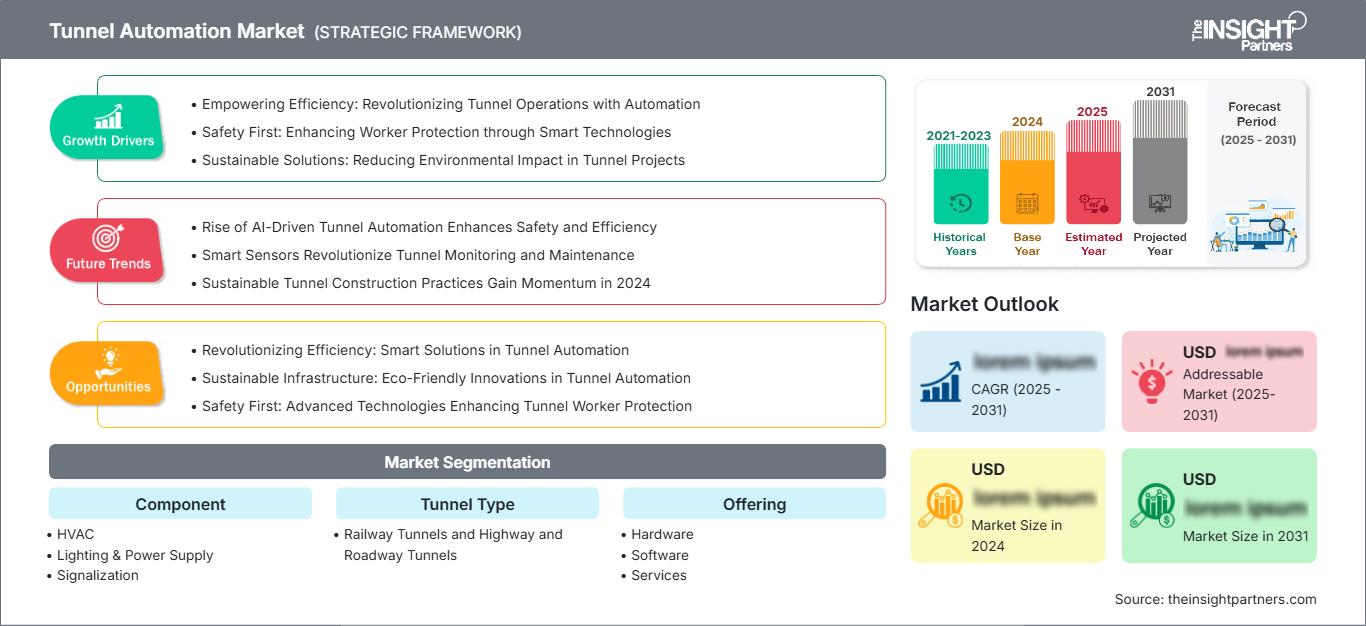
Regional Insights
North America Tunnel Automation Market
North America has a mature installed base of highway and railway tunnels, making modernization an important source of demand alongside new infrastructure. The regional Tunnel Automation Market Share is estimated to expand at ~6% CAGR through 2034. Operators increasingly prioritize replacement of obsolete programmable controls, integration of centralized supervisory systems, automated ventilation, and improved emergency coordination. Energy management is also gaining relevance because ventilation and lighting can represent substantial operating loads in continuously used tunnels.
The largest market is represented by the US, while the contribution of Canada comes from its metro trains, roads, and modernization efforts. The importance of interoperability becomes ever more significant, as the tunnel owners have to manage the equipment supplied by the various generations of manufacturers. The digital supervision helps decrease reliance on local action, thus making fault detection easier, while redundancy of the control systems helps preserve essential functions in case of the equipment failure.
U.S. Tunnel Automation Market
North America is estimated to generate ~78% of revenues from its market in the US in 2025, and is expected to register growth at ~6% CAGR until 2034. The demand drivers include highway tunnels, transit systems, and select rail infrastructure. Larger urban centers require robust solutions for ventilation, lighting, traffic signals, surveillance systems integration, and incident management in case of tunnel closure impacting transportation services.
US is home to some of the major industrial automation and transportation technology vendors, and engineering contractors for custom projects. Retrofits play a critical role as they entail modernization even as tunnels operate. Therefore, operators seek phased implementation, redundancy, remote monitoring capabilities, and controllers which can be integrated with legacy systems. Growing focus on cybersecurity has increased interest in segregation of OT networks and IT networks, creating need for secure communication channels and remote access.
Europe Tunnel Automation Market
In 2025, the share of Europe was ~28% of the global market and the region is forecasted to grow at ~7% CAGR over 2026-2034. The region benefits from the presence of significant road and railway tunnels infrastructure and high-level safety standards. In Europe, Germany is the leader due to significant development of transport infrastructure, including rail and road network, and industrial activity. The UK has urban railway and road tunnel projects, France has transport infrastructure needs, which include metropolitan and intercity infrastructure.
There are strong demands in Germany and France for reliable signaling systems, power supply systems, ventilation systems, and centralized supervision. The Italian market has significant tunnels infrastructure related to mountain regions and significant road infrastructure, which requires the modernization and automation projects oriented on the increase of the safety level. The Spanish market is also active in relation to development of transport infrastructure and automation projects. In all considered markets, the projects include cybersecurity, functional safety, energy consumption and interoperability at the stage of design of the system architecture.
Other aspects of European standards which push the process of standardizing technologies and managing safety are the following. Railway tunnel construction projects require coordination between infrastructure needs, energy, signaling and operations. Road tunnels, in their turn, need to have incident-responsive and safe operation control systems. Under such circumstances, companies which already possess the corresponding engineering skills and experience become advantageous.
APAC Tunnel Automation Market
APAC accounted for ~32% of the global market in 2025 and is expected to grow at ~9% CAGR through 2034, making it the fastest-growing regional market. China is the leading country in Asia Pacific, supported by extensive high-speed rail, urban metro, expressway, and underground infrastructure development. Japan and South Korea contribute through technologically mature rail and metropolitan systems, while India is generating additional demand from expanding metro and highway tunnel projects.
China's infrastructure scale supports demand for integrated signaling, power, ventilation, and monitoring. India is increasingly adopting automated ventilation, electrical control, and safety systems in major road and metro tunnels. Australia contributes through road infrastructure and modernization projects. Across APAC, expanding urbanization, freight movement, and intercity connectivity are increasing the need for automated infrastructure capable of operating reliably under high traffic loads.
Middle East & Africa Tunnel Automation Market
Middle East and Africa demand is estimated to expand at ~8% CAGR through 2034. Saudi Arabia is the leading country in the Middle East & Africa market where tunnel infrastructure investment is supported by large transportation, urban development, and mobility programs. The UAE also generates demand through major road, metro, and urban infrastructure projects, while South Africa contributes through established transport infrastructure and modernization requirements.
Energy efficiency and operational resilience are important purchasing considerations because tunnel ventilation, cooling, and lighting can impose substantial electrical loads. New urban developments in Gulf markets create opportunities for integrated automation from project inception, whereas established assets in South Africa and other markets support retrofit demand. Rest of MEA markets remain more project-specific, with opportunities concentrated around major transport corridors and urban infrastructure programs.
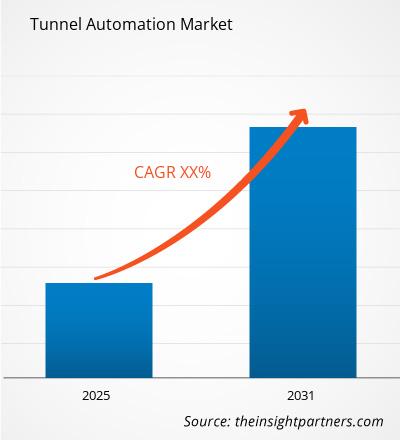
Segmentation Analysis
Component
Component solutions form the physical operating foundation of tunnel automation. The segment in the Tunnel Automation Market is expected to expand at ~7% CAGR from 2026 to 2034, supported by new installations and replacement of aging equipment. Demand is shaped by the need to maintain reliable environmental conditions, electrical continuity, visibility, and traffic control. Integration between field devices and centralized control platforms is increasingly important because component performance directly affects the reliability of automated responses during incidents.
- HVAC: HVAC systems regulate airflow, temperature, and smoke movement and remain strategically important for tunnel safety. Demand is influenced by ventilation requirements, energy optimization, fire-response procedures, and the integration of variable-speed equipment with automated control systems.
- Lighting & Power Supply: Lighting and power supply provide essential operating continuity and visibility. Demand increasingly favors controllable, efficient systems that can coordinate illumination with operating conditions while maintaining dependable electrical distribution for safety-critical equipment.
- Signalization: Signalization supports traffic guidance, operational control, and incident management. Its strategic importance increases as tunnels become more connected to broader intelligent transportation systems and require automated responses to congestion, hazards, closures, and emergency events.
Tunnel Type
Tunnel Type segment in the Tunnel Automation Market is expected to grow at ~8% CAGR through 2034, with requirements differing according to transportation mode and operating environment. Railway projects typically involve integration with electrification, signaling, passenger safety, and control infrastructure, while road tunnels emphasize traffic flow, ventilation, incident detection, and emergency response. Increasingly, both categories require centralized monitoring and resilient communications.
- Railway Tunnels: Railway tunnels require coordinated automation across signaling, power, ventilation, communications, and safety infrastructure. Expansion of metro, high-speed rail, and electrified corridors supports demand for integrated control systems capable of maintaining operational continuity.
- Highway and Roadway Tunnels: Highway and roadway tunnels depend heavily on automated ventilation, lighting, traffic signaling, surveillance, and emergency management. Increasing traffic volumes and modernization of older road corridors strengthen demand for centralized supervision and intelligent incident response.
Offering
Offering segment in the Tunnel Automation Market is expected to expand at ~9% CAGR through 2034 as tunnel owners increasingly procure integrated technology packages rather than standalone equipment. Hardware establishes the field infrastructure, software connects operational data and control functions, and services support engineering, commissioning, modernization, maintenance, and lifecycle optimization. Recurring service requirements can become increasingly important as automation architectures grow more complex.
- Hardware: Hardware includes controllers, drives, electrical equipment, lighting infrastructure, and field devices. It remains essential for new tunnel construction and replacement cycles, while compatibility with established infrastructure influences retrofit procurement decisions.
- Software: Software supports supervisory control, visualization, diagnostics, data management, and increasingly predictive functions. Its strategic importance is rising as operators seek centralized control, interoperability, remote monitoring, and better use of operational data.
- Services: Services cover engineering, integration, commissioning, maintenance, modernization, and technical support. Their importance increases where tunnel operators need phased upgrades, long-term reliability, cybersecurity management, and specialist expertise without prolonged tunnel closures.
Opportunity Snapshot
| Tunnel Type | Revenue Contribution | Trend Tag | Adoption Stage |
|---|---|---|---|
| Railway Tunnels | Medium | Rail Expansion | Scaling |
| Highway and Roadway Tunnels | High | Traffic Safety | Mature |
Tunnel Automation Market Growth Drivers and Impact Analysis
Modernization of Aging Tunnel Control Infrastructure
A significant demand mechanism is the replacement of aging controllers, electrical systems, lighting controls, and supervisory platforms that no longer provide the availability, diagnostics, or interoperability expected by modern tunnel operators. Modernization is more complex than component replacement because tunnel systems are interdependent and often remain operational during construction. This encourages phased migration, redundant architectures, and engineering services that can maintain critical functions while new technology is commissioned. The Tunnel Automation Market impact extends beyond hardware because each modernization project can create demand for software integration, communications, cybersecurity, testing, and lifecycle support. Vendors able to migrate legacy infrastructure without extensive operational disruption can therefore participate across multiple layers of the project rather than relying on individual equipment sales.
Stricter Safety and Emergency Management Requirements
Tunnel environments concentrate transportation users and critical infrastructure within constrained spaces, making rapid detection and coordinated emergency response central to system design. Automated ventilation, lighting, signalization, communications, and monitoring can operate as a coordinated response rather than independent functions. This creates demand for control architectures capable of processing sensor inputs and executing predefined responses while preserving manual intervention when required. Safety requirements also influence procurement specifications, commissioning procedures, redundancy, and maintenance. The resulting market impact is a greater emphasis on integrated automation rather than isolated field equipment. Projects increasingly evaluate how different subsystems interact during fire, congestion, equipment failure, or evacuation scenarios, increasing the value of system engineering and validation services.
Energy Optimization Across High-Load Tunnel Systems
Ventilation, lighting, power distribution, and auxiliary equipment can create significant operating loads, particularly in long or heavily trafficked tunnels. Automation enables operators to adjust equipment operation according to traffic conditions, air-quality measurements, environmental conditions, and operating states rather than maintaining maximum output continuously. Variable-speed drives, controllable lighting, centralized energy monitoring, and automated scheduling can therefore become integral parts of modernization programs. The commercial effect is a shift from purchasing equipment solely on technical specifications toward evaluating lifecycle energy performance. Suppliers that combine control hardware with monitoring and optimization capabilities can address both safety and operating-cost objectives, strengthening the role of automation in refurbishment decisions.
Tunnel Automation Market Future Trends
Digital Twins and Virtual Commissioning for Tunnel Lifecycle Management
Digital engineering is expected to become more embedded in tunnel automation as owners seek to reduce commissioning risk and manage complex interfaces before equipment is installed. Digital twins can represent equipment relationships, control logic, operating states, and maintenance information, allowing project teams to test scenarios before live commissioning. Virtual commissioning can also help identify control conflicts between ventilation, lighting, signaling, and emergency functions before they affect tunnel operations. Over time, digital representations may support modernization by allowing operators to evaluate proposed changes against existing infrastructure. The resulting trend is toward lifecycle-oriented automation platforms in which engineering information remains useful after construction and becomes part of ongoing asset management rather than being discarded after commissioning.
AI-Assisted Monitoring and Predictive Tunnel Operations
Artificial intelligence in the Tunnel Automation Market Trends is likely to extend tunnel automation from rule-based responses toward systems that identify anomalies and support predictive decisions. Sensor streams from ventilation, electrical equipment, traffic systems, and environmental monitoring can provide inputs for condition assessment and incident detection. AI-assisted video and sensor analytics may help distinguish normal operating conditions from stalled vehicles, unusual congestion, equipment degradation, or other anomalies. The technology is unlikely to eliminate human oversight because tunnel systems remain safety-critical, but it can improve the speed and quality of operator decisions. Over the forecast period, the principal opportunity will be integrating analytics with validated control environments while maintaining cybersecurity, traceability, and appropriate human intervention.
Tunnel Automation Market Opportunities
Integrated Retrofit Platforms for Legacy Tunnels
A substantial commercial opportunity exists in modular retrofit platforms designed specifically for tunnels where complete system replacement is impractical. Owners can benefit from controllers, communications gateways, supervisory software, and field equipment that integrate with selected legacy assets while progressively introducing newer functions. Such solutions can reduce operational disruption and spread capital expenditure across multiple project phases. Suppliers can differentiate through migration engineering, standardized interfaces, cybersecurity upgrades, remote diagnostics, and long-term service agreements. The Tunnel Automation Market Forecast opportunity is particularly relevant in mature markets with large installed tunnel bases, but it can also apply to rapidly expanding transportation systems where first-generation automation installations need to be upgraded as traffic and operational requirements evolve.
Localized Automation Ecosystems in Emerging Infrastructure Markets
Emerging infrastructure markets offer opportunities for companies that combine global automation technology with local engineering, commissioning, manufacturing, and service capabilities. Localization can improve responsiveness, reduce dependence on distant technical resources, and align solutions with local infrastructure specifications and procurement practices. India, Southeast Asia, selected Middle Eastern economies, and other infrastructure-intensive markets provide opportunities across highway and railway tunnel projects. Partnerships between automation suppliers, engineering contractors, transportation authorities, and local system integrators can create broader project coverage. Commercial models that include engineering support, training, spare-parts management, and lifecycle maintenance may be particularly valuable where tunnel operators are expanding technical capabilities alongside infrastructure capacity.
Recent Developments
- October 2025: Topcon Positioning Systems and Amberg Technologies today announce the companies are entering into a collaboration agreement and are launching fully integrated solutions for rail and tunnel applications. The interoperability of hardware and software platforms is designed to allow professionals to seamlessly combine technologies from both companies to enhance workflow efficiency and accuracy. The announcement was made at INTERGEO 2025, the world’s leading trade fair for geodesy, geoinformation and land management, held October 7-9, in Frankfurt, Germany.
- August 2025: The international traffic technology group SWARCO has acquired 100% of the renowned company Heusch/Boesefeldt GmbH, a leading provider of software solutions for highway and tunnel management systems as well as innovative traffic management, effective 19 August 2025.
- January 2025: Witt India, a premier manufacturer specializing in tunnel ventilation systems, has partnered with ABB India to set new standards in tunnel ventilation technology. By integrating advanced smoke extraction motors into key projects across the country, this collaboration plays a crucial role in improving safety and operational efficiency, ensuring that commuters travel through India’s tunnels with greater confidence and security.
Frequently Asked Questions

- Comprehensive Market Sizing and Forecast Analysis
- Detailed Segmentation Analysis
- In-Depth Market Dynamics Assessment
- Regional and Country-Level Insights
- Competitive Landscape and Company Benchmarking
- Strategic Business Intelligence
Recent Reports
Testimonials

The Insight Partners provided valuable market intelligence that supported our global go-to-market strategy. Their team was professional, responsive, and attentive to our feedback, providing thoughtful analysis and helpful methodological clarifications throughout the project.
Junmo Kim Chief Financial Officer (CFO), Enertech Co., Ltd.
The Insight Partners' SCADA System Market report is comprehensive, with valuable insights on current trends and future forecasts. The team was highly professional, responsive, and supportive throughout. We are very satisfied and highly recommend their services.
RAN KEDEM Partner, Reali Technologies LTDs
I requested a report on a very specific software market and the team produced the report in a few days. The information was very relevant and well presented. I then requested some changes and additions to the report. The team was again very responsive and I got the final report in less than a week.
JEAN-HERVE JENN Chairman, Future Analytica
We worked with The Insight Partners for an important market study and forecast. They gave us clear insights into opportunities and risks, which helped shape our plans. Their research was easy to use and based on solid data. It helped us make smart, confident decisions. We highly recommend them.
PIYUSH NAGPAL Sr. Vice President, High Beam Global
The Insight Partners delivered insightful, well-structured market research with strong domain expertise. Their team was professional and responsive throughout. The user-friendly website made accessing industry reports seamless. We highly recommend them for reliable, high-quality research services
YUKIHIKO ADACHI CEO, Deep Blue, LLC.
This is the first time I have purchased a market report from The Insight Partners.While I was unsure at first, I visited their web site and felt more comfortable to take the risk and purchase a market report.I am completely satisfied with the quality of the report and customer service. I had several questions and comments with the initial report, but after a couple of dialogs over email with their analyst I believe I have a report that I can use as input to our strategic planning process.Thank you so much for taking the extra time and making this a positive experience.I will definitely recommend your service to others and you will be my first call when we need further market data.
JOHN SUZUKI President and Chief Executive Officer, Board Director, BK Technologies
I wish to appreciate your support and the professionalism you displayed in the course of attending to my request for information regarding to infectious disease IVD market in Nigeria. I appreciate your patience, your guidance, and the fact that you were willing to offer a discount, which eventually made it possible for us to close a deal. I look forward to engaging The Insight Partners in the future, all thanks to the impression you have created in me as a result of this first encounter.
DR CHIJIOKE ONYIA MANAGING DIRECTOR, PineCrest Healthcare Ltd.Reason to Buy
- Informed Decision-Making
- Understanding Market Dynamics
- Competitive Analysis
- Identifying Emerging Markets
- Customer Insights
- Market Forecasts
- Risk Mitigation
- Boosting Operational Efficiency
- Strategic Planning
- Investment Justification
- Tracking Industry Innovations
- Aligning with Regulatory Trends





 Get Free Sample for