
UV Disinfection Equipment Market Share, Growth & Demand by 2034
Coverage: By Component (UV Lamps, Reactor Chambers, Quartz Sleeves, Control Units, and Others), Power Rating (Low, High, and Medium), Application (Water Disinfection, Air Disinfection, and Surface Disinfection), End User (Residential, Commercial, Industrial, and Municipal), and Geography (North America, Europe, Asia Pacific, and South and Central America)
- Status : Data Released
- Report Code : TIPRE00015724
- Category : Electronics and Semiconductor
- No. of Pages : 150
- Available Report Formats :


- Last update date : September 15, 2026


2025 Market Size
US$ 4.12 Bn
Base year value
2034 Forecast
US$ 12.37 Bn
Projected by 2034
CAGR 2026-2034
12.99 %
Growth rate
Addressable Market
US$ 71.73 Bn
(2026-2034)
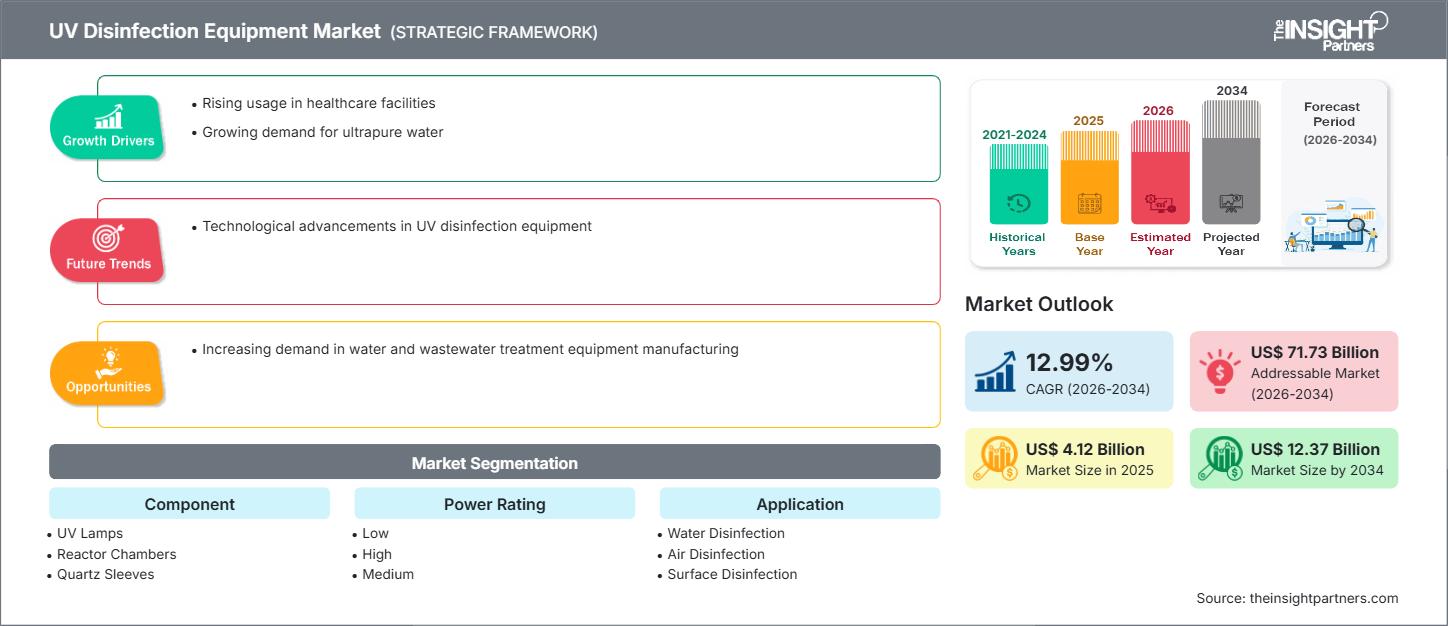
The UV disinfection equipment market was valued at US$ 4.12 Billion in 2025 and is projected to reach US$ 12.37 Billion by 2034, expanding at a CAGR of 12.99% during 2026–2034. Growth reflects wider deployment of ultraviolet systems across water, air, and surface treatment, supported by rising sanitation requirements, water reuse initiatives, and preference for chemical-free microbial control in regulated operating environments.
In North America, the UV disinfection equipment market size is expected to expand at an estimated 10.5–12.5% CAGR through 2034. Replacement of aging treatment assets, wastewater reuse projects, tighter microbial-control requirements, and demand for lower-chemical treatment are creating a durable investment base across municipal, commercial, and industrial facilities.
UV Disinfection Equipment Market Assessment and Insights
- North America: North America is projected to hold a 34–38% share in 2025 and expand at a 10.5–12.5% CAGR between 2026–2034, supported by municipal replacement cycles, reuse projects, and industrial compliance requirements.
- US: The US is estimated to account for 60–65% of North America in 2025, growing at a 10.5–12.5% CAGR between 2026–2034 as utilities modernize disinfection infrastructure.
- Europe: Europe is estimated at a 27–31% share in 2025 and a 10.0–12.0% CAGR between 2026–2034, with Germany, the UK, France, Italy, and Spain supported by wastewater reuse and environmental compliance.
- Asia Pacific: Asia Pacific is estimated at a 24–28% share in 2025 and a 14.0–16.0% CAGR between 2026–2034, led by China, Japan, South Korea, India, and Australia through industrialization and water-security investment.
- Largest Segment: Water Disinfection is estimated at a 52–56% market share in 2025 and a 12.5–13.5% CAGR during 2026–2034, reflecting broad municipal and industrial deployment.
- High Growth Segment: Surface Disinfection is estimated at an 18–22% market share in 2025 and a 14.0–16.0% CAGR during 2026–2034, supported by healthcare and controlled-environment applications.
- Key companies analyzed in detail: Xylem Inc.; Trojan Technologies Group ULC; Halma plc; Kuraray Co., Ltd.; Atlantic Ultraviolet Corporation; Advanced UV, Inc.; American Ultraviolet, Inc.; Atlantium Technologies Ltd.; Dr. Hönle AG; Evergreen UV LLC.
Source: The Insight Partners' analysis based on proprietary research, government publications, company annual reports, investor presentations, industry databases, and expert interviews.
There has been a trend of moving away from standard lamps and reactors towards validated and sensor-equipped devices that control the UV dose based on flow rate, transmittance, and operating conditions. Low-pressure amalgam lamps, better electronic ballasts, quartz sleeve design, and smart controls are increasing efficiencies and decreasing maintenance needs. Manufacturing methods have moved towards modular platforms that can be used in municipal, industrial, and decentralized plants.
In the future, capital investment will shift towards water reuse technologies, decentralized treatment, and digitally monitored facilities in developing nations. A regulatory focus on pathogen removal and minimization of chemical byproducts encourages adoption, and wastewater quality requirements promote tertiary treatment. Technology providers are also developing retrofit solutions that allow retention of reactor technology while improving lamp, control, sensor, and power electronics technologies.
UV Disinfection Equipment Market Report Scope
| Report Attribute | Details |
|---|---|
| Market size in 2025 | US$ 4.12 Billion |
| Market Size by 2034 | US$ 12.37 Billion |
| Global CAGR (2026 - 2034) | 12.99% |
| Historical Data | 2021-2024 |
| Forecast period | 2026-2034 |
UV Disinfection Equipment Market Analysis
The demand will be driven by the need for a solution that controls microorganisms without leaving chemical residues behind. Municipal water supply companies will continue to be a key customer because UV technology can handle chlorine-resistant microorganisms within multi-barrier treatment systems. The industrial customers who use process water in their production processes include those producing foods and beverages, drugs, electronic goods, and aquaculture; hence, the continuous demand for the equipment.
Supply dynamics increasingly favor suppliers able to integrate hydraulic design, UV-dose validation, monitoring, and lifecycle services. Lamp availability, quartz quality, electronics reliability, and replacement schedules influence the total cost of ownership. Equipment makers therefore compete on energy consumption, footprint, serviceability, and automation rather than reactor hardware alone. Retrofitting is particularly important where utilities seek higher treatment capacity without replacing complete treatment trains, according to the UV Disinfection Equipment Market report.
Competitive positioning encompasses the benefits of installed-base advantage and application specificity. Xylem Inc. and Trojan Technologies Group ULC benefit from substantial municipal and industrial lineups; meanwhile, Halma plc competes via specialist UV and environmental technologies. Atlantium Technologies Ltd. stands out by virtue of its hydraulic and optical engineering knowledge, while Atlantic Ultraviolet Corporation, Advanced UV, Inc., American Ultraviolet, Inc., and Evergreen UV LLC offer application-specific products for the commercial and industrial market.
Strategy increasingly favors investment in smart controls, energy-saving lamp designs, after-market services, and application-specific validation. Kuraray Co., Ltd. supplies relevant water-treatment materials and purification technologies, whereas Dr. Hönle AG supplies knowledge in UV technology. Competition will thus increasingly extend beyond product equipment to include performance, retrofit economics, monitoring, and service.
● REPORT CUSTOMIZATION
Tailor This Report To Align With Your Specific Business Requirements
This report can be customized to align precisely with your business objectives, scope, and target markets. Customization options include tailored segmentation, geography, competitive analysis, and strategic insights to support informed decision-making.
Customize This Report →WHAT YOU CAN ADJUST
- ● Segmentations
- ● Geography
- ● Competitive Analysis
- ● Language Preferences
UV Disinfection Equipment Market: Strategic Insights
Regional Insights
North America UV disinfection equipment market
North America is estimated to represent 34–38% of the global UV disinfection equipment market in 2025, with a 10.5–12.5% CAGR through 2034. The US remains the principal demand center because municipal utilities are upgrading aging treatment assets and expanding wastewater reuse. There is a creation of demand due to drinking water upgrades, decentralization, and industrial applications for water quality. According to EPA guidelines, the use of ultraviolet disinfection is one of the proven methods of microbial disinfection in the appropriate treatment process trains.
There is a growing number of industrial applications in the food processing, beverage production, aquaculture, and pharmaceutical sectors, where chemical-free or residual-free treatments become significant. The retrofitting provides another business opportunity because the systems can be upgraded with new lamps, ballasts, sensors, and controls without changing the reactor assembly. The energy efficiency is still very critical since utilities assess the UV systems based on the dose, efficiency, maintenance, and energy usage.
U.S. UV disinfection equipment market
The US is estimated to represent 60–65% of North America's 2025 UV disinfection equipment market and is expected to expand at a 10.5–12.5% CAGR through 2034. Demand is concentrated in municipal wastewater, drinking water, reuse, industrial process water, and recreational water applications. Xylem Inc., Trojan Technologies Group ULC, American Ultraviolet, Inc., and other suppliers maintain broad application coverage.
The need for regulatory compliance and aging infrastructure provides a case for installation and retrofitting. UV technology is especially pertinent in cases where there is a desire to control microorganisms without chemical handling or the formation of disinfection by-products. Large-scale wastewater projects integrate UV with filtration and biological processes, while small-scale projects rely on more compact systems. In the US market, validation procedures, engineering standards, and procurement systems minimize adoption risks.
Europe UV disinfection equipment market
Europe is estimated at 27–31% of the global UV disinfection equipment market in 2025 and is projected to grow at a 10.0–12.0% CAGR through 2034. Germany is a leading country, supported by advanced municipal treatment, industrial water recycling, and strong engineering capabilities. The UK, France, Italy, and Spain contribute through wastewater modernization, water scarcity responses, and reuse initiatives.
In the UK, utility modernization and treatment technology upgrades driven by compliance are key features, while UV is increasingly seen as an option in advanced treatment of wastewater reuse systems. Germany has a robust municipal infrastructure, combined with the need for process water treatment in manufacturing and food industry applications. Water scarcity and circular water concepts drive developments in France, Italy, and Spain, where the reuse of wastewater will lessen the demand on freshwater resources.
APAC UV disinfection equipment market
APAC is estimated to hold a 24–28% of the UV disinfection equipment market share in 2025 and is expected to record a 14.0–16.0% CAGR through 2034. China leads regional demand through municipal expansion and industrial wastewater treatment, while Japan and South Korea emphasize advanced process control. India is expanding treatment capacity, and Australia remains focused on water security and reuse.
Industrial production, urbanization, and water-stress management are broadening the addressable base. Food processing, electronics, pharmaceuticals, aquaculture, and municipal reuse are important applications. Policy initiatives encouraging wastewater treatment and safer water supplies further support investment, while compact systems are increasingly suited to decentralized installations where conventional infrastructure is limited.
Middle East & Africa UV disinfection equipment market
The Middle East and Africa UV disinfection equipment market demand is expected to grow at a 9.0–11.0% CAGR through 2034, led by Saudi Arabia and the UAE. Desalination, water reuse, and industrial water treatment create strong technical requirements, while South Africa represents an important market for municipal and industrial wastewater applications.
Saudi Arabia and the UAE emphasize water-security infrastructure, desalination integration, and reuse, creating opportunities for UV as a polishing or multibarrier technology. South Africa faces municipal treatment and water-quality challenges, while the rest of MEA presents decentralized opportunities. Energy efficiency, compact equipment, and limited chemical logistics can influence purchasing decisions in remote and infrastructure-constrained installations.
Segmentation Analysis
Component
Component selection influences delivered UV dose, operating reliability, maintenance requirements, and lifecycle cost. The segment is expected to expand at an 11.8–12.8% CAGR during 2026–2034 as operators replace lamps, sleeves, controls, and reactor components to improve existing installations, according to the UV Disinfection Equipment Market forecast.
- UV Lamps: UV lamps remain the principal energy-conversion element, with replacement demand supported by operating-hour requirements and efficiency improvements. Low-pressure amalgam designs are increasingly important where energy performance and extended service intervals influence purchasing decisions.
- Reactor Chambers: Reactor chambers determine hydraulic residence, UV distribution, and system footprint. Demand favors optimized geometries that maintain validated dose delivery across variable flow conditions while simplifying installation, inspection, and cleaning requirements.
- Quartz Sleeves: Quartz sleeves protect lamps while allowing UV transmission. Their strategic importance rises where fouling, scaling, or water chemistry increases maintenance frequency, making sleeve durability and optical performance important lifecycle considerations.
- Control Units: Control units increasingly integrate UV sensors, flow measurement, alarms, and automated lamp regulation. Their importance is increasing as utilities seek continuous verification, energy optimization, remote monitoring, and more predictable operating performance.
Power Rating
Power Rating determines equipment capacity, energy consumption, and suitability for different flow and treatment loads. The segment is projected to grow at a 12.2–13.2% CAGR through 2034 as customers prioritize right-sized systems and controllable energy use across applications in the UV Disinfection Equipment Market.
- Low: Low-power systems serve compact installations and decentralized treatment points where limited flow and smaller footprints are priorities. Demand is supported by residential, commercial, and small industrial applications requiring simple microbial control.
- High: High-power systems address large municipal and industrial flows, requiring robust reactors, multiple lamps, advanced controls, and validated dose management. Their strategic role is strongest in high-capacity treatment and wastewater reuse projects.
- Medium: Medium-power systems occupy a flexible position between decentralized and large-scale installations. Their broad applicability supports demand across commercial buildings, process water, recreational facilities, and mid-sized municipal treatment assets.
Application
Application determines system configuration, validation requirements, and purchasing criteria. The segment is expected to record a 12.5–13.5% CAGR through 2034, with water treatment remaining the principal revenue base while air and surface applications broaden adoption across the UV Disinfection Equipment Market.
- Water Disinfection: Water disinfection remains the largest application because municipal, industrial, and reuse facilities require reliable microbial control. UV is commonly integrated after filtration or biological treatment where water quality supports effective dose delivery.
- Air Disinfection: Air disinfection is gaining relevance in controlled indoor environments, particularly where airborne microbial management complements ventilation. Demand is shaped by healthcare, commercial, institutional, and industrial hygiene requirements.
- Surface Disinfection: Surface disinfection is expanding across healthcare, laboratories, food processing, and controlled environments. Equipment selection emphasizes exposure geometry, dose consistency, safety interlocks, and automation rather than simple lamp output.
End User
End-user purchasing patterns differ according to regulatory exposure, flow requirements, operating expertise, and capital availability. The segment is projected to grow at a 12.8–13.8% CAGR through 2034, supported by infrastructure modernization and decentralized deployment across the UV Disinfection Equipment Market.
- Residential: Residential demand centers on point-of-use and point-of-entry systems where compactness, low maintenance, and automatic operation are essential. Adoption is strongest where households seek supplemental microbial control for drinking and utility water.
- Commercial: Commercial users include hospitality, offices, recreational facilities, healthcare buildings, and institutional properties. Purchasing decisions increasingly consider footprint, operating simplicity, service intervals, and integration with building water systems.
- Industrial: Industrial users require application-specific systems for process water, wastewater, aquaculture, food, beverage, and pharmaceutical operations. Reliability, validation, automation, and lifecycle service typically carry greater weight than initial equipment cost.
- Municipal: Municipal users represent a major installed base, with demand tied to drinking-water treatment, wastewater disinfection, reuse, and infrastructure renewal. Procurement typically emphasizes validation, energy performance, maintainability, and long operating life.
Opportunity Snapshot
| End User | Revenue Contribution (High/Medium/Low) | Trend Tag (MAX 2 words, specific) | Adoption Stage (Emerging/Scaling/Mature) |
| Residential | Medium | Point-of-Entry | Scaling |
| Commercial | Medium | Building Hygiene | Scaling |
| Industrial | High | Process Reuse | Mature |
| Municipal | High | Water Reuse | Mature |
UV Disinfection Equipment Market Growth Drivers and Impact Analysis
Expansion of Water Reuse and Advanced Wastewater Treatment
Growing investment in wastewater reuse is expanding the addressable market beyond conventional drinking-water disinfection. UV is increasingly positioned as a polishing or tertiary treatment step because it can provide microbial inactivation without creating a persistent chemical residual. This is important for facilities seeking treated effluent suitable for industrial reuse, irrigation, or other controlled applications. EPA materials continue to recognize UV as an established treatment technology, while research into alternative disinfectants and UV combinations reflects efforts to improve energy and cost performance. As reuse projects move from pilots to permanent infrastructure, equipment demand is likely to favor systems with validated dose delivery, automated controls, and retrofit compatibility. The resulting impact extends to replacement lamps, sensors, controls, reactor upgrades, commissioning, and long-term maintenance services, according to the UV Disinfection Equipment Market report.
Preference for Chemical-Free Microbial Control
The avoidance of chemicals in terms of their storage, handling, transport, and residuals is adding value to the use of UV in specific applications. Treatment solutions are being evaluated in terms of total operational risks, and not only disinfection capabilities. UV can be included in multiple barrier treatment processes in cases where chlorinating bacteria are a problem, or in cases where the presence of chemical residuals may become problematic in subsequent steps of the process. This opens up the market for applications in drinking water, wastewater treatment, food and beverage processing, aquaculture, and certain building water systems. The effect on business is not confined to new installations. It includes the possibility to retrofit existing equipment with more effective lamps, electronic ballasts, sensors, and control systems.
Digital Dose Management and Energy Optimization
Monitoring technologies are altering the way in which UV equipment is specified, controlled and maintained. The sensors are able to monitor parameters like UV intensity, flow, transmittance, condition of lamps and number of operating hours to enable the control systems to modify the production of the treatment based on the current conditions. This not only helps in the efficient use of energy but also ensures that microbial performance is met. Large water utility companies will also benefit from this because they will be able to gather operational data. Equipment manufacturers are thus equipping their products with intelligent controls, remote diagnostics and predictive maintenance functions. The effect of this on the market is that the market will gradually move from standalone reactors to treatment platforms in which the hardware, software, services and analytics are packaged together.
UV Disinfection Equipment Market Future Trends
Shift Toward Intelligent, Adaptive UV Treatment
Future systems will trend towards adaptive operation, where the performance of the lamps is continuously adjusted based on the hydraulic and water quality characteristics. Instead of running the equipment at a static power level, intelligent controls would ensure that the dose delivered is balanced by the flow, UV transmittance, lamp state, and the need for treatment. This would help in avoiding excess energy usage and ensuring consistency of treatment when operating under varying conditions. The connected equipment will start building up operation history to help in predicting maintenance requirements, remote troubleshooting, and comparing the performance of equipment. Buyers of municipal and industrial applications will probably prefer the platforms that can be integrated into a wider range of supervisory control systems rather than individual control cabinets.
Expansion of Compact and Modular Treatment Platforms
Modular UV system designs are bound to increase their importance as treatment needs become increasingly fragmented. Smaller towns, factories, commercial buildings, decentralized reclamation initiatives, and remote locations usually do not find it economically feasible to construct large centralized treatment plants. Compact reactors offer an opportunity for scalable microbial control while minimizing space and installation complexities. Equipment vendors are forecast to develop common platforms for reactors and controls while configuring different numbers of lamps, sensors, power packs, and communication ports. Such an initiative will facilitate faster deployment and facilitate replacing old equipment. Modular design will also allow capacity expansion over time as water demand grows.
UV Disinfection Equipment Market Opportunities
Retrofit Programs for Aging Treatment Assets
There is considerable commercial potential in retrofitting existing UV systems rather than opting for total replacement installations. Existing utilities and industries can sometimes salvage their reactor housings, hydraulics, and electricity supply lines while installing new lamps, ballasts, sleeves, sensors, and controllers. A retrofit program will help in minimizing installation disruption as well as reducing installation duration relative to the total reconstruction of the system. Suppliers with high levels of existing installations have an advantage in the sense that they can integrate knowledge of equipment with condition evaluation and maintenance agreements. Investments should be made in systems that can accommodate efficient lamps, digitized controls, diagnostics, and hydraulics. There is also commercial potential in small cities that require additional capacity yet lack adequate capital budgets.
Integrated Solutions for Water-Scarce Industrial Regions
Industrial areas suffering from water shortages present an opportunity for UV manufacturers to develop disinfection systems in tandem with water treatment systems for reuse. Industries such as food processing, pharmaceuticals, electronics, mining, and aquaculture require water that meets the right quality standards without necessarily withdrawing freshwater. UV light could be used in a combination of other treatments, including filtration, membranes, oxidation, and biological treatments. UV manufacturers are hence in a position to add value by providing systems rather than just reactors, especially if the customers do not have expertise in treating water. The greatest opportunity for these industries will come from rapidly industrializing areas of the Asia Pacific and the water-scarce Middle East regions, where infrastructure development creates room for new treatments.
Frequently Asked Questions

- Comprehensive Market Sizing and Forecast Analysis
- Detailed Segmentation Analysis
- In-Depth Market Dynamics Assessment
- Regional and Country-Level Insights
- Competitive Landscape and Company Benchmarking
- Strategic Business Intelligence
Recent Reports
Testimonials

The Insight Partners provided valuable market intelligence that supported our global go-to-market strategy. Their team was professional, responsive, and attentive to our feedback, providing thoughtful analysis and helpful methodological clarifications throughout the project.
Junmo Kim Chief Financial Officer (CFO), Enertech Co., Ltd.
The Insight Partners' SCADA System Market report is comprehensive, with valuable insights on current trends and future forecasts. The team was highly professional, responsive, and supportive throughout. We are very satisfied and highly recommend their services.
RAN KEDEM Partner, Reali Technologies LTDs
I requested a report on a very specific software market and the team produced the report in a few days. The information was very relevant and well presented. I then requested some changes and additions to the report. The team was again very responsive and I got the final report in less than a week.
JEAN-HERVE JENN Chairman, Future Analytica
We worked with The Insight Partners for an important market study and forecast. They gave us clear insights into opportunities and risks, which helped shape our plans. Their research was easy to use and based on solid data. It helped us make smart, confident decisions. We highly recommend them.
PIYUSH NAGPAL Sr. Vice President, High Beam Global
The Insight Partners delivered insightful, well-structured market research with strong domain expertise. Their team was professional and responsive throughout. The user-friendly website made accessing industry reports seamless. We highly recommend them for reliable, high-quality research services
YUKIHIKO ADACHI CEO, Deep Blue, LLC.
This is the first time I have purchased a market report from The Insight Partners.While I was unsure at first, I visited their web site and felt more comfortable to take the risk and purchase a market report.I am completely satisfied with the quality of the report and customer service. I had several questions and comments with the initial report, but after a couple of dialogs over email with their analyst I believe I have a report that I can use as input to our strategic planning process.Thank you so much for taking the extra time and making this a positive experience.I will definitely recommend your service to others and you will be my first call when we need further market data.
JOHN SUZUKI President and Chief Executive Officer, Board Director, BK Technologies
I wish to appreciate your support and the professionalism you displayed in the course of attending to my request for information regarding to infectious disease IVD market in Nigeria. I appreciate your patience, your guidance, and the fact that you were willing to offer a discount, which eventually made it possible for us to close a deal. I look forward to engaging The Insight Partners in the future, all thanks to the impression you have created in me as a result of this first encounter.
DR CHIJIOKE ONYIA MANAGING DIRECTOR, PineCrest Healthcare Ltd.Reason to Buy
- Informed Decision-Making
- Understanding Market Dynamics
- Competitive Analysis
- Identifying Emerging Markets
- Customer Insights
- Market Forecasts
- Risk Mitigation
- Boosting Operational Efficiency
- Strategic Planning
- Investment Justification
- Tracking Industry Innovations
- Aligning with Regulatory Trends






 Get Free Sample for