
Bit Error Rate Testers Market Growth, Trends & Forecast by 2034
Coverage: By Type (Product Type (Functional BERT, Traditional BERT), Bit Rate (33 to 64 Gbaud, 65 to 128 Gbaud, 10 to 32 Gbaud, 129 to 256 Gbaud, Above 256 Gbaud, below 10 Gbaud), Protocol (High-Speed Ethernet, PCIe, DDR Memory, USB, DisplayPort, SATA/SAS, Thunderbolt, MIPI, Others), Industry (Data Centers, Telecommunications, Aerospace and Defense, Automotive, Industrial Automation, Others), and Geography)
- Status : Published
- Report Code : TIPRE00008261
- Category : Electronics and Semiconductor
- No. of Pages : 689
- Available Report Formats :


- Last update date : September 28, 2026


2025 Market Size
US$ 280.39 Mn
Base year value
2034 Forecast
US$ 483.06 Mn
Projected by 2034
CAGR 2026-2034
6.2 %
Growth rate
Addressable Market
US$ 3,450.27 Mn
(2026-2034)
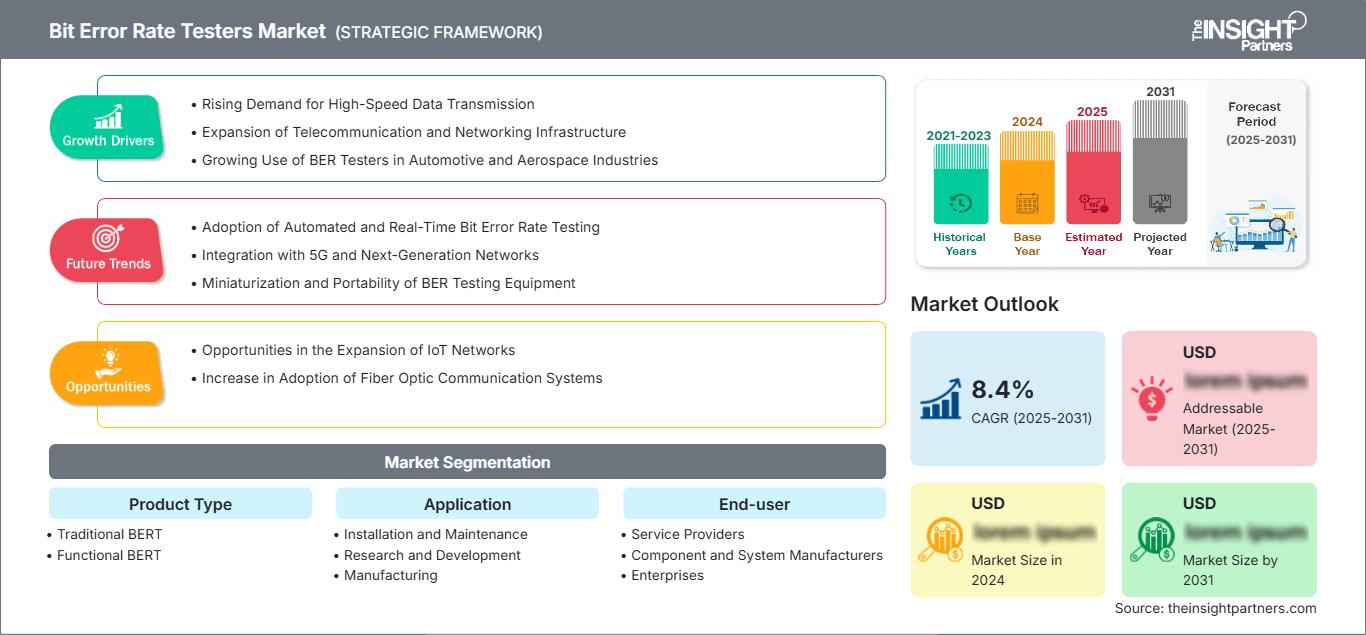
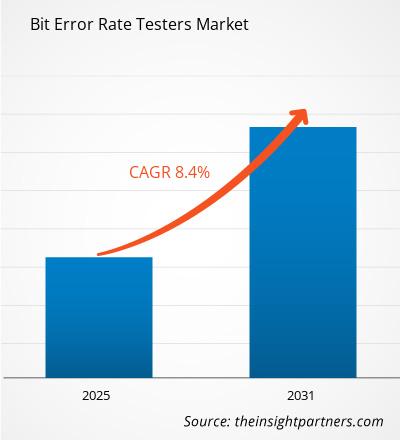
Bit Error Rate Testers Market is valued at US$ 280.39 Million in 2025 and is projected to reach US$ 483.06 Million by 2034, expanding at a CAGR of 6.2% during 2026–2034. The market encompasses functional and traditional testing architectures across multiple bit-rate ranges, protocols, and end-use industries. Demand is shaped by increasingly complex high-speed interfaces, tighter signal-integrity requirements, accelerated semiconductor validation cycles, and the continuing migration toward higher-bandwidth computing and communications infrastructure.
North America is expected to maintain a strong position, supported by dense semiconductor, cloud-computing, telecommunications, and aerospace ecosystems. The regional outlook indicates a 5.2–6.3% CAGR, with investment concentrated on high-speed interconnect validation, AI data-center infrastructure, PCIe compliance, and advanced Ethernet development. Established engineering capabilities, early adoption of emerging interface standards, and proximity to major equipment designers provide structural support for sustained testing-equipment demand.
Bit Error Rate Testers Market Assessment and Insights
- North America maintains a leading position, supported by advanced semiconductor and data-center ecosystems, with a 18–23% share in 2025 and a 5.2–6.3% CAGR between 2026–2034.
- US represents the dominant North American market, benefiting from hyperscale computing and semiconductor investment, with 80–84% of regional demand in 2025 and a 5.6–6.2% CAGR between 2026–2034.
- Europe captures a 21–25% share in 2025 and is expected to expand at a 4.6–5.2% CAGR, led by Germany, the UK, France, Italy, and Spain across automotive, industrial, aerospace, and communications applications.
- Asia Pacific accounts for a 46–49% share in 2025 and is projected to record a 6.8–7.5% CAGR, led by China, Japan, South Korea, India, and Australia as semiconductor, electronics, and telecom manufacturing capacity expands.
- Largest Segment Traditional BERT holds a 58–62% market share in 2025, supported by established laboratory and compliance workflows, with a 5.5–5.8% CAGR through 2034.
- High Growth Segment Functional BERT represents a 59–63% market share in 2025 and is projected to grow at a 6.4–7.1% CAGR through 2034 as integrated validation gains adoption.
- Key companies analyzed in detail: Keysight Technologies, Inc.; Anritsu Corporation; EXFO Inc.; Luceo Instruments UG; SHF Communication Technologies AG; VIAVI Solutions Inc.; Rohde & Schwarz GmbH & Co. KG; GAO Tek Inc.; Quantifi Photonics Limited; Semight Instruments Co., Ltd.
Source: The Insight Partners' analysis based on proprietary research, government publications, company annual reports, investor presentations, industry databases, and expert interviews.
While the technology platform is transitioning from stand-alone patterning and error detection to one that is integrated with high-speed stimulation, receiver characterization, jitter injection, equalization, automation, and protocol-based compliance, there is also a need for more instrumentation due to high-order modulation and challenging electrical channels. There have been dynamics in production as well, with manufacturers looking to get re-usable hardware, software upgrade, multi-lane testing, and automation.
In the future, investments will increase and extend into emerging manufacturing centers in Asia as well as engineering centers in Europe. The standardization process for technologies like PCIe, Ethernet, USB, and electrical interface standards will create recurring validation needs, and investments in digital infrastructure and semiconductor manufacturing capacity will drive up demand. Regulations and interoperability requirements will encourage the adoption of equipment that can conduct repeatable tests.
Bit Error Rate Testers Market Report Scope
| Report Attribute | Details |
|---|---|
| Market size in 2025 | US$ 280.39 Million |
| Market Size by 2034 | US$ 483.06 Million |
| Global CAGR (2026 - 2034) | 6.2% |
| Historical Data | 2021-2024 |
| Forecast period | 2026-2034 |
Bit Error Rate Testers Market Analysis
Demand will be driven by the requirement to measure the integrity of the transmission as the data rates become faster and the channel margins get smaller. This market includes participants from semiconductor chip vendors, interconnect vendors, equipment vendors, data centers, laboratories, and test house service providers. Suppliers will compete on fidelity of signals, supported protocols, automation, channel density, and upgradability.
The shift towards PAM4 and higher electrical lane rates makes stress generation, characterization of the receiver, jitter tolerance, and error measurement more important. As a result, the data center and telecom applications will start testing at an early stage in their development cycle, and automotive and aerospace designs will concentrate on repeatability and qualification. This trend will make the Bit Error Rate Testers Market a beneficiary of validation equipment use beyond traditional telecom labs.
It has become necessary for competitive differentiation to include the integration of hardware, software, fixturing, automation, and application-compliant software suites. Keysight Technologies, Inc. stresses the use of high-speed, modular BERT systems, while Anritsu Corporation concentrates greatly on multi-protocol signal quality analysis. EXFO Inc. and VIAVI Solutions Inc. take care of optical and network testing needs, and Rohde & Schwarz GmbH & Co. KG incorporates test processes into wider measurement environments.
There is also increased spending on high-speed interfaces and AI infrastructure technologies. SHF Communication Technologies AG and Quantifi Photonics Limited offer specialist skills in high-speed electrical and optical testing, whereas Luceo Instruments UG, Semight Instruments Co., Ltd., and GAO Tek Inc. widen specialist and value-focused services. It has become crucial for strategic positioning to include interoperability, application software, upgradeability, and capability for multi-standard support from one platform.
● REPORT CUSTOMIZATION
Tailor This Report To Align With Your Specific Business Requirements
This report can be customized to align precisely with your business objectives, scope, and target markets. Customization options include tailored segmentation, geography, competitive analysis, and strategic insights to support informed decision-making.
Customize This Report →WHAT YOU CAN ADJUST
- ● Segmentations
- ● Geography
- ● Competitive Analysis
- ● Language Preferences
Bit Error Rate Testers Market: Strategic Insights
Regional Insights
North America Bit Error Rate Testers Market
North America holds a 18–23% share of the global market in 2025 and is projected to expand at a 5.2–6.3% CAGR through 2034. The US dominates regional demand because hyperscale data centers, semiconductor developers, communications equipment companies, and defense programs require increasingly rigorous receiver and transmitter validation. Canada contributes through telecommunications, photonics, and research institutions.
Early adoption of fast speed standards and large investments in computing infrastructure powered by artificial intelligence ensure regional purchasing. High demands are seen in the laboratory verification process, testing, optical interconnects, and server interface testing. Additionally, the concentration of equipment designers and the advanced semiconductor industry ensures repeatable updates from interfaces at 64 GT/s to 128 GT/s and above.
U.S. Bit Error Rate Testers Market Market
The US accounts for 80–84% of North American demand in 2025 and is expected to grow at a 5.6–6.2% CAGR through 2034. Its market position reflects substantial semiconductor, hyperscale, cloud, telecommunications, and defense activity. Major suppliers maintain strong presence through application-specific BERT systems, compliance software, and modular instruments.
The trends in application area are becoming more and more connected with PCIe, Ethernet, USB, fast memories, and new AI interconnects. The engineers prefer to use the automation of characterization to decrease the time of test setup and achieve better repeatability from one generation to another. For defense and aerospace projects, there is an additional need for environmental validation.
Europe Bit Error Rate Testers Market Market
Europe represents a 21–25% share in 2025 and is projected to grow at a 4.6–5.2% CAGR through 2034. Germany is the leading country, supported by automotive electronics, industrial automation, semiconductor engineering, and communications equipment. The UK remains important for photonics, telecom research, defense electronics, and advanced computing, while France combines aerospace, defense, and telecommunications demand.
Italy and Spain participate through automotive electronics, industrial systems, telecommunications infrastructure, and research institutes. European consumers focus on the traceability, interoperability, reliability, and compliance aspects in general. Regional requirements are covered by spending on digital infrastructure, electric vehicles, advanced manufacturing, and defense technology modernization. Consequently, the market continues to be diverse in terms of laboratory development, qualification, production assistance, and field network testing.
APAC Bit Error Rate Testers Market Market
APAC holds a 46–49% share in 2025 and is expected to grow at a 6.8–7.5% CAGR through 2034. China leads regional demand, followed by Japan and South Korea, with India and Australia adding expanding application bases. Semiconductor manufacturing, consumer electronics, optical communications, and telecommunications infrastructure underpin equipment purchases.
Industrial policy supporting electronics manufacturing and semiconductor localization strengthens demand for validation systems. China emphasizes high-volume electronics and communications, Japan emphasizes precision engineering, South Korea focuses on memory and advanced electronics, India is expanding semiconductor and telecom capabilities, and Australia contributes through research and communications programs.
Middle East & Africa Bit Error Rate Testers Market Market
Middle East and Africa demand is developing from a smaller base, with Saudi Arabia and the UAE leading regional adoption and South Africa representing a key African market. The region is projected to expand at a 5.0–5.8% CAGR through 2034 as data centers, telecom modernization, and digital infrastructure increase testing requirements.
While Saudi Arabia and the UAE focus on investments in digital infrastructure and high bandwidth communications, South Africa’s focus is on supporting demand with telecom and enterprise networks. However, the wider MEA region is still being influenced by energy communications, government connectivity initiatives, and data centers, with procurement trending toward portable and multi-purpose equipment.
Segmentation Analysis
Product Type
Product Type is divided between Functional BERT and Traditional BERT, with the overall segment expected to expand at a 6.1–6.8% CAGR during 2026–2034. Traditional platforms retain broad laboratory acceptance, while functional architectures gain traction where integrated protocol behavior, automation, and application-level validation reduce test complexity.
- Functional BERT: Integrated functionality supports protocol-aware validation, automated workflows, and system-level characterization. Demand is strongest where engineering teams need faster transition from device setup to repeatable functional testing.
- Traditional BERT: Established pattern-generator and error-detector architectures remain important for laboratory characterization, compliance, and controlled receiver testing. Their modularity and familiarity support continued replacement and upgrade demand.
Bit Rate
Bit Rate is segmented into 33 to 64 Gbaud, 65 to 128 Gbaud, 10 to 32 Gbaud, 129 to 256 Gbaud, Above 256 Gbaud, below 10 Gbaud, with the segment expected to grow at a 6.4–7.2% CAGR. Higher-rate categories gain strategic importance as AI infrastructure and advanced interconnect standards increase electrical signaling requirements.
- 33 to 64 Gbaud: This range remains important for established high-speed interfaces and receiver compliance programs, balancing broad installed-base compatibility with rising performance requirements.
- 65 to 128 Gbaud: Adoption is strengthened by advanced Ethernet, PCIe, and AI-related interconnect development, making this range increasingly important for next-generation server and networking validation.
- 10 to 32 Gbaud: Mature telecommunications, industrial, and legacy high-speed applications sustain demand, particularly where existing equipment requires lifecycle support and cost-efficient replacement.
- 129 to 256 Gbaud: Emerging high-rate systems create specialized demand for precise signal generation, error analysis, and channel-stress capabilities, particularly in advanced data-center and optical development.
- Above 256 Gbaud: This category is strategically positioned for future electrical and optical interfaces, with demand concentrated among advanced research, hyperscale, and component-development programs.
- below 10 Gbaud: Established lower-speed applications continue to require dependable and economical testing for legacy equipment, industrial electronics, embedded systems, and specialized communication interfaces.
Protocol
Protocol comprises High-Speed Ethernet, PCIe, DDR Memory, USB, DisplayPort, SATA/SAS, Thunderbolt, MIPI, Others, and is expected to advance at a 6.5–7.3% CAGR. Protocol complexity is increasing the value of automated compliance and multi-standard platforms capable of handling diverse electrical and logical-layer requirements.
- High-Speed Ethernet: High-capacity networking and AI data-center architectures sustain strong testing requirements across electrical, optical, and interoperability environments.
- PCIe: Successive generations require increasingly sophisticated receiver stress, calibration, and compliance testing, supporting demand from servers, accelerators, storage, and automotive systems.
- DDR Memory: Memory-interface validation depends on precise timing, signal integrity, and repeatable stress conditions as bandwidth and density increase.
- USB: Expanding USB performance and interoperability requirements support testing across controllers, hubs, cables, docking products, and consumer electronics.
- DisplayPort: High-resolution displays and higher refresh rates sustain demand for reliable transmitter and receiver validation across consumer and professional devices.
- SATA/SAS: Established storage interfaces continue generating replacement and qualification requirements despite gradual migration toward newer interconnect architectures.
- Thunderbolt: High-bandwidth peripheral connectivity supports specialized compliance and interoperability testing across computers, storage, displays, and docking ecosystems.
- MIPI: Mobile, automotive, and embedded applications create recurring demand for specialized validation as camera, display, and processor interfaces become faster and more complex.
Industry
Industry includes Data Centers, Telecommunications, Aerospace and Defense, Automotive, Industrial Automation, Others, with the segment projected to grow at a 6.3–7.1% CAGR. Data centers represent the strongest strategic demand center, while automotive and industrial applications broaden the addressable customer base.
- Data Centers: AI clusters, high-speed Ethernet, PCIe, and optical interconnects require rigorous validation to manage signal-integrity, latency, interoperability, and reliability risks.
- Telecommunications: Network modernization and higher-capacity optical transport support laboratory, manufacturing, deployment, and service-level testing requirements.
- Aerospace and Defense: Mission-critical communications require controlled, repeatable testing under stringent qualification and reliability procedures, supporting specialized instrument demand.
- Automotive: Increasing electronic content, advanced driver systems, and high-speed in-vehicle networks expand requirements for reliable interface validation.
- Industrial Automation: Connected machinery, robotics, and industrial Ethernet systems create demand for dependable testing across increasingly distributed digital architectures.
Opportunity Snapshot
| Industry | Revenue Contribution | Trend Tag | Adoption Stage |
| Data Centers | High | AI Interconnects | Scaling |
| Telecommunications | High | Network Upgrade | Mature |
| Aerospace and Defense | Medium | Mission Links | Mature |
| Automotive | Medium | Vehicle Networks | Scaling |
| Industrial Automation | Medium | Industrial Ethernet | Scaling |
| Others | Low | Embedded Systems | Emerging |
Bit Error Rate Testers Market Growth Drivers and Impact Analysis
AI Data Centers Are Raising Interconnect Validation Complexity
AI infrastructure is adding new link performance requirements, including increased link count and link speed requirements within the server, accelerator cluster, and data center fabric. Higher lane speeds, PAM signaling technology, tighter channel margins, and multivendor interoperability all add difficulty to receiver characterization compared with traditional validation processes. In doing so, this adds significant value to test equipment that provides high-quality pattern generation and error analysis, along with jitter insertion and automated calibration. The financial impact of this is most pronounced for companies capable of supporting existing interfaces and upcoming standards without replacing all of their hardware. Data centers and equipment vendors also require repeatable test capability across development cycles. As a result, test equipment becomes more involved in the design process.
Faster Interface Standards Are Shortening Test-Equipment Upgrade Cycles
This rapid cycle of development for high-speed interfaces creates a need for test tools that will be able to handle future generations via software upgrades, firmware upgrades, or even hardware add-ons. With the arrival of PCIe 7.0, advanced Ethernet, USB, and next-generation accelerators interconnects, more stringent demands will be placed on stimulus quality and receiver analysis capabilities. The lifecycle cost of test equipment is becoming an increasingly critical factor in purchases, rather than just the price of the tool. It will allow you to preserve your investment and yet gain additional protocol support, speed capability, or improved automation capability. This is changing the competition among suppliers since product architecture, software roadmaps, and applications support have now become important purchasing considerations.
Automated Compliance Testing Is Improving Engineering Productivity
Engineering groups are putting increasing focus on automation of test sequencing, calibration, logging of measurement results, and compliance reporting as validation processes become more complex with increased numbers of test lanes and device combinations. Manual processes result in variability across different users and prolong the process of recreating tricky signal integrity scenarios. Automated processes simplify set up and ensure consistency of the measurements across engineering organizations, factories, and certification labs. The problem is particularly important for situations where multiple interfaces need to be tested with the same instrument. Software then becomes an important part of the purchase decision process along with signal integrity and maximum data rate.
Bit Error Rate Testers Market Future Trends
Software-Defined Testing Will Become a Larger Differentiator
The future systems will increasingly use software-based test layers, which will help to change the test routines, stress levels, protocol coverage and reporting without changing the hardware itself. The artificial intelligence system may help to detect anomaly categories, optimize the calibration procedure and detect the patterns of error. Cloud connections of workflows will help to provide the possibility of centralized management of tests conducted in different laboratories. This way of testing will move competition from the highest possible parameters of the instrument to flexibility and workflow management. Suppliers will need to have open interface and automation frameworks, which will allow customers to use the equipment in the wider validation process. The most successful solutions will be the combination of high-speed physical layer instrumentation and software capable of evolution in the same way as standards do.
Multi-Protocol Platforms Will Expand Across Development Environments
This trend is expected to drive greater adoption of multi-protocol test system. Rather than having dedicated equipment for each interface, one may save on hardware but change the application software, fixtures, and test scenarios. In that respect, this trend is especially beneficial for companies with multiple product generations or different product divisions where different validation is required. For future testing equipment, flexible channel architecture, broad modulation support, high-speed processing and fast configuration switching will be more emphasized. In addition, standardization of interfaces between BERT, oscilloscope, analyzer, and device control systems will facilitate their interoperability. Overall, this kind of convergence may help eliminate duplicated capital investment and increase adoption of advanced test platforms for semiconductor, electronics, communications, and automotive projects.
Bit Error Rate Testers Market Opportunities
Targeting Emerging High-Rate Interconnect Qualification
Investment in new standards-based qualification processes offers the greatest potential where such requirements are imposed prior to wide commercial availability in new interconnect classes. Suppliers can provide receiver stress modules, pattern generators that run at very fast rates, software, and automation systems for testing at interfaces that extend beyond current speed classes. Visibility early in the standards-based process will be important for learning about upcoming testing procedures and requirements. Collaboration with semiconductor suppliers, connector makers, optical component suppliers, and system providers can help with verification prior to widespread commercial availability. This type of investment does not necessarily need to be done in terms of whole instruments since fixtures, software, calibrations, and module upgrades offer recurrent revenue streams.
Expanding Portable and Production-Oriented Validation
The second opportunity relates to applying advanced lab tools for use on manufacturing lines, in the field, and in distributed design labs. With increasing availability of high-speed networks, there is a growing need for quicker fault isolation and acceptance testing without moving laboratory equipment. Systems that integrate BERT functionality with either optical, Ethernet, or protocol analysis tools would solve this problem. There is also value in having automatic pass/fail test sequences, scripting capability, and centralization of test results in manufacturing firms. This opportunity could be exploited by suppliers through development of compact instrumentation, modular field equipment, control software, and services. Such demand will be greatest in areas where volumes are large and downtime expensive.
Recent Developments
- May 2026: Keysight Technologies, Inc. expanded its PCIe 7.0 testing portfolio with a receiver test application addressing validation at 128 GT/s. The solution combines the M8050A BERT family with the M8042A pattern generator and M8043A error analyzer, while accompanying software automates receiver stress calibration and supports next-generation AI, compute, and data-center applications.
- June 2026: ANRITSU Corporation announces a new PCI Express Gen 7.0 (PCIe Gen 7.0) receiver test solution for the Signal Quality Analyzer-R MP1900A, compliant with the Base Specification and supporting next-generation high-speed interfaces with transmission rates up to 128 GT/s. This solution generates stressed-test signals with added noise and jitter and automates both test-signal calibration and jitter-tolerance measurement using real-time oscilloscopes from partner companies. These functions significantly reduce engineers’ workloads due to increasingly complex test conditions, while facilitating signal quality evaluation that meets compliance requirements right from the first design stages.
- January 2025: Keysight Technologies, Inc. and Point2 Technology announced a strategic collaboration to validate next-generation, multi-terabit interconnects designed to eliminate scale-up connectivity bottlenecks in artificial intelligence (AI) and machine learning (ML) data centers. Using Keysight’s high-speed digital test solutions, including the M8050A High-Performance Bit Error Ratio Tester (BERT) and DCA-X Sampling Oscilloscopes, the companies are validating Point2’s power-efficient e-Tube interconnect technology to meet the stringent performance and reliability requirements of hyperscaler AI infrastructure.
Frequently Asked Questions

- Comprehensive Market Sizing and Forecast Analysis
- Detailed Segmentation Analysis
- In-Depth Market Dynamics Assessment
- Regional and Country-Level Insights
- Competitive Landscape and Company Benchmarking
- Strategic Business Intelligence
Recent Reports
Testimonials

The Insight Partners' SCADA System Market report is comprehensive, with valuable insights on current trends and future forecasts. The team was highly professional, responsive, and supportive throughout. We are very satisfied and highly recommend their services.
RAN KEDEM Partner, Reali Technologies LTDs
I requested a report on a very specific software market and the team produced the report in a few days. The information was very relevant and well presented. I then requested some changes and additions to the report. The team was again very responsive and I got the final report in less than a week.
JEAN-HERVE JENN Chairman, Future Analytica
We worked with The Insight Partners for an important market study and forecast. They gave us clear insights into opportunities and risks, which helped shape our plans. Their research was easy to use and based on solid data. It helped us make smart, confident decisions. We highly recommend them.
PIYUSH NAGPAL Sr. Vice President, High Beam Global
The Insight Partners delivered insightful, well-structured market research with strong domain expertise. Their team was professional and responsive throughout. The user-friendly website made accessing industry reports seamless. We highly recommend them for reliable, high-quality research services
YUKIHIKO ADACHI CEO, Deep Blue, LLC.
This is the first time I have purchased a market report from The Insight Partners.While I was unsure at first, I visited their web site and felt more comfortable to take the risk and purchase a market report.I am completely satisfied with the quality of the report and customer service. I had several questions and comments with the initial report, but after a couple of dialogs over email with their analyst I believe I have a report that I can use as input to our strategic planning process.Thank you so much for taking the extra time and making this a positive experience.I will definitely recommend your service to others and you will be my first call when we need further market data.
JOHN SUZUKI President and Chief Executive Officer, Board Director, BK Technologies
I wish to appreciate your support and the professionalism you displayed in the course of attending to my request for information regarding to infectious disease IVD market in Nigeria. I appreciate your patience, your guidance, and the fact that you were willing to offer a discount, which eventually made it possible for us to close a deal. I look forward to engaging The Insight Partners in the future, all thanks to the impression you have created in me as a result of this first encounter.
DR CHIJIOKE ONYIA MANAGING DIRECTOR, PineCrest Healthcare Ltd.Reason to Buy
- Informed Decision-Making
- Understanding Market Dynamics
- Competitive Analysis
- Identifying Emerging Markets
- Customer Insights
- Market Forecasts
- Risk Mitigation
- Boosting Operational Efficiency
- Strategic Planning
- Investment Justification
- Tracking Industry Innovations
- Aligning with Regulatory Trends





 Get Free Sample for