
Submarine Communication Cable Market Trends, Share & Demand by 2034
Coverage: By Voltage (Medium Voltage (MV), High Voltage (HV), Extra High Voltage (EHV)), Insulation Type (Cross-Linked Polyethylene (XLPE), Ethylene Propylene Rubber (EPR), Mass Impregnated Paper (MI), Polyethylene (PE), Polypropylene Laminated Paper (PPLP), Others), Conductor Type (Copper, Aluminum, Others), End Users (Telecommunications, Oil and Gas, Power Utilities and Grid Operators, Renewable Energy Developers, Government and Defense, Others), and Geography (North America, Europe, Asia Pacific, Middle East & Africa, and South & Central America)
- Status : Published
- Report Code : TIPRE00044082
- Category : Electronics and Semiconductor
- No. of Pages : 251
- Available Report Formats :


- Last update date : October 07, 2026


2025 Market Size
US$ 12.9 Bn
Base year value
2034 Forecast
US$ 28.8 Bn
Projected by 2034
CAGR 2026-2034
9.3 %
Growth rate
Addressable Market
US$ 185.92 Bn
(2026-2034)
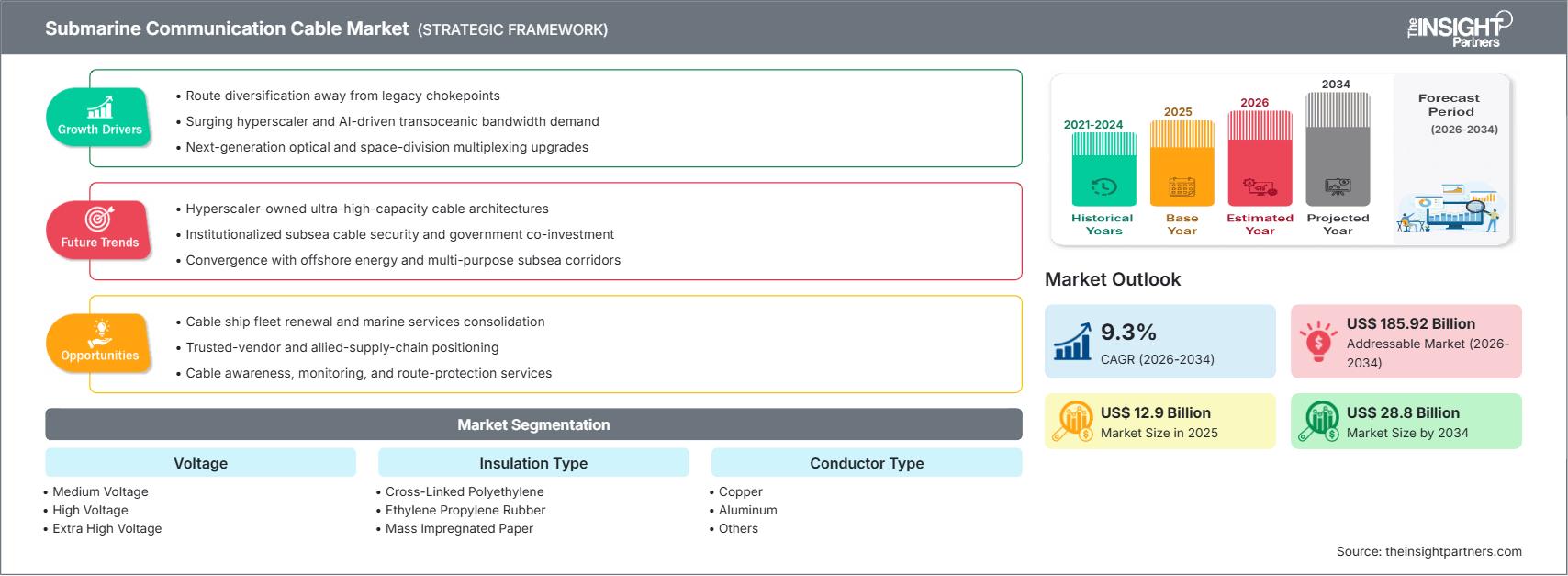
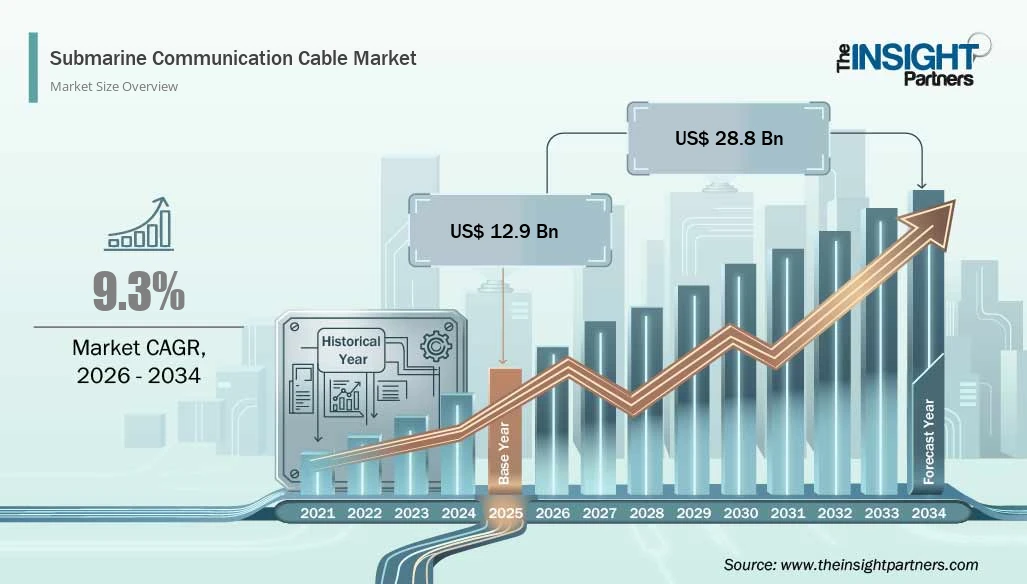
The Submarine Communication Cable Market was valued at US$ 12.9 Billion in 2025 and is projected to reach US$ 28.8 Billion by 2034, expanding at a CAGR of 9.3% over the forecast period. The market encompasses underwater fiber-optic cables that transmit data across oceans and seas, enabling international telecommunications, internet connectivity, and data center interconnections. These cables form the backbone of global digital infrastructure, supporting bandwidth growth, cloud services, and cross-border data exchange across telecommunications, government and defense, and energy applications worldwide.
North America Submarine Communication Cable Market size is expected to expand at a CAGR of 8.0% during 2026–2034, supported by data center connectivity, cloud infrastructure, and telecommunications demand across the US and Canada. Demand is reinforced by bandwidth growth, international data traffic, and procurement preferences for reliable, high-capacity submarine cable solutions in communications applications.
Submarine Communication Cable Market Assessment and Insights
- North America held 22.39% share in 2025 and is growing at a CAGR of 8.0% during 2026–2034, led by data center connectivity, cloud infrastructure, and telecommunications demand across the US and Canada.
- US represented 82–85% of North American revenue in 2025 and is growing at a CAGR of 8.2–8.5% during 2026–2034.
- Europe accounted for 28.45% share in 2025 and is growing at a CAGR of 9.4% during 2026–2034, led by Germany, the UK, France, Italy, and Spain.
- Asia Pacific held 39.11% share in 2025 and is growing at a CAGR of 10.5% during 2026–2034, led by China, India, Japan, South Korea, and Australia.
- Fastest Growing Segment Extra High Voltage (EHV) is growing at a CAGR of 10.4% during 2026–2034.
- Largest Insulation Type Cross-Linked Polyethylene (XLPE) held 66.41% market share in 2025.
- Key companies analyzed in detail: SubCom, LLC; NEC Corp; Hengtong Group Co., Ltd.; Jiangsu Zhongtian Technology Co Ltd.; Prysmian SpA; Nexans SA; Tratos Cavi SpA; Alcatel Submarine Networks; HMN Technologies Co., Ltd.; Xtera; Fujikura Ltd.; Sumitomo Electric Industries Ltd.
Source: The Insight Partners' analysis based on proprietary research, government publications, company annual reports, investor presentations, industry databases, and expert interviews.
Submarine communication cable technology has evolved from basic fiber-optic designs toward advanced systems with higher capacity, improved reliability, and enhanced cable protection for demanding deep-sea environments. Production dynamics now emphasize optical fiber performance, cable durability, and factory-tested performance across varying water depths and operating conditions. Submarine Communication Cable Market demand is also shaped by telecommunications operators and data center providers that align cable solutions with capacity requirements, route needs, and operational priorities in global communications applications.
Investments are moving towards Asia Pacific, Europe, and North America, where the bandwidth expansion, cloud services, and international traffic demand more sophisticated submarine cable systems with better capacity and reliability. Regulatory compliance with telecom regulations and international treaties facilitates the implementation of cable projects. The customers seek solutions that integrate the performance, capacity, and cable project with reliable technical support.
Submarine Communication Cable Market Report Scope
| Report Attribute | Details |
|---|---|
| Market size in 2025 | US$ 12.9 Billion |
| Market Size by 2034 | US$ 28.8 Billion |
| Global CAGR (2026 - 2034) | 9.3% |
| Historical Data | 2021-2024 |
| Forecast period | 2026-2034 |
Submarine Communication Cable Market Analysis
Submarine Communication Cable Market growth is driven by bandwidth growth, data center connectivity, cloud infrastructure, and international data traffic. The value chain includes optical fiber suppliers, cable manufacturers, installation contractors, and telecommunications operators. Supply dynamics are shaped by fiber availability, manufacturing capacity, and telecommunications investment cycles. Submarine Communication Cable Market analysis indicates that Extra High Voltage cables represent the fastest-growing segment through power requirements while XLPE insulation dominates through established performance. Service capability is decisive because project support, installation expertise, and supply chain reliability affect project success and network performance.
The competition consists of experts in telecommunication cables and technology firms. The competition includes SubCom, LLC, Alcatel Submarine Networks, NEC Corp, Prysmian SpA, Nexans SA, Hengtong Group Co., Ltd., Jiangsu Zhongtian Technology Co Ltd., HMN Technologies Co., Ltd., Tratos Cavi SpA, Xtera, Fujikura Ltd., and Sumitomo Electric Industries Ltd. The trends in investment go towards higher capacities and reliability and deeper water capability. SubCom and Alcatel Submarine Networks dominate due to wide range of cable products and experience in projects, while Prysmian and Nexans are gaining advantage of their expertise in cable production.
The regional rivalry is also being affected by the emergence of hyperscaler network investments and the creation of direct international connectivity routes. Internet service providers, content providers, telecommunications providers, and consortia have been making more investments in exclusive and shared Submarine Communication Cable infrastructure to provide high-capacity and low-latency connections between their key data centers and exchange points. It is forcing cable manufacturers to innovate and develop solutions that can handle higher fiber counts, capacity, and longer distances. Meanwhile, route diversification is becoming a very critical aspect because network providers are seeking ways to minimize their reliance on conventional choke points.
The area of technology is impacting competitiveness even further due to advancements in optical transmission, space division multiplexing, repeaters, and intelligent monitoring of networks. Manufacturers are now more concerned with increasing the efficiency of fiber utilization, expanding system capacity, and fault detection and maintenance. Digital monitoring and predictive maintenance solutions are facilitating submarine network management during its life cycle. The growing complexity of newly installed systems means that companies which offer end-to-end solutions will have an edge over other players in the market.
● REPORT CUSTOMIZATION
Tailor This Report To Align With Your Specific Business Requirements
This report can be customized to align precisely with your business objectives, scope, and target markets. Customization options include tailored segmentation, geography, competitive analysis, and strategic insights to support informed decision-making.
Customize This Report →WHAT YOU CAN ADJUST
- ● Segmentations
- ● Geography
- ● Competitive Analysis
- ● Language Preferences
Submarine Communication Cable Market: Strategic Insights
Regional Insights
North America Submarine Communication Cable Market
North America accounted for 22.39% of Submarine Communication Cable Market share in 2025 and is projected to grow at a CAGR of 8.0% during 2026–2034. Demand is supported by data center connectivity, cloud infrastructure, telecommunications demand, and international data traffic across the US and Canada. The region's digital infrastructure and technology adoption drive consistent cable demand. SubCom, LLC, Alcatel Submarine Networks, NEC Corp, Prysmian SpA, and Nexans SA support installed bases across telecommunications networks and data center infrastructure in the US and Canada.
U.S. Submarine Communication Cable Market
The U.S. represented 82–85% of North American revenue in 2025 and is forecast to grow at a CAGR of 8.2–8.5% during 2026–2034. Application demand is concentrated in international connectivity, data center interconnections, and cloud infrastructure. Company presence is reinforced by SubCom, LLC, Alcatel Submarine Networks, NEC Corp, Prysmian SpA, and Nexans SA. Buyers prioritize cable capacity, reliability, project support, and quality assurance, plus project management that reduces installation risk and improves confidence in cable performance.
Europe Submarine Communication Cable Market
Europe held 28.45% share in 2025 and is expected to grow at a CAGR of 9.4% during 2026–2034. Germany leads through telecommunications infrastructure and connectivity demand, while the UK supports demand from data center and cloud applications. France, Italy, and Spain add demand through international connectivity and network infrastructure. Telecommunications standards and digital infrastructure priorities favor suppliers with documented performance and capability. Alcatel Submarine Networks, Prysmian SpA, Nexans SA, and SubCom, LLC remain visible across telecommunications and connectivity projects.
APAC Submarine Communication Cable Market
Asia Pacific accounted for 39.11% share in 2025 and is projected to grow at a CAGR of 10.5% during 2026–2034. China leads through telecommunications infrastructure and manufacturing capacity, while India expands through connectivity investment and digital infrastructure growth. Japan and South Korea prioritize advanced cable technology for international connectivity, while Australia adds telecommunications and data center infrastructure. Policy support for digital infrastructure and connectivity strengthen Submarine Communication Cable Market adoption where cable performance and supply capacity carry significant value.
Middle East & Africa Submarine Communication Cable Market
The Middle East & Africa market is projected to grow at a CAGR of 7.0% during 2026–2034. Saudi Arabia leads through telecommunications and digital infrastructure development, while the UAE adds connectivity and data center projects. South Africa and Rest of MEA rely on telecommunications and connectivity infrastructure. Digital infrastructure investment and connectivity development create demand for submarine cable solutions. Suppliers succeed when they combine product quality, project support, and regional expertise.
Segmentation Analysis
Voltage
Voltage is projected to grow at a CAGR of 9.2–9.8% during 2026–2034. Submarine Communication Cable Market scope covers Medium Voltage (MV), High Voltage (HV), and Extra High Voltage (EHV). Selection depends on power requirements and cable design needs. Extra High Voltage represents the fastest-growing segment through advanced cable applications.
- Medium Voltage (MV) cables serve lower power communication applications.
- High Voltage (HV) cables address main power requirements for communication systems.
- Extra High Voltage (EHV) cables enable high-power, long-distance communication applications.
Insulation Type
Insulation Type is forecast to grow at a CAGR of 9.0–9.6% during 2026–2034. Cross-Linked Polyethylene, Ethylene Propylene Rubber, Mass Impregnated Paper, Polyethylene, Polypropylene Laminated Paper, and Others address diverse requirements. Cross-Linked Polyethylene leads with the highest market share.
- Cross-Linked Polyethylene (XLPE) provides reliable, high-performance insulation with the largest market share.
- Ethylene Propylene Rubber (EPR) offers flexible, durable insulation for specific applications.
- Mass Impregnated Paper (MI) provides established insulation for traditional applications.
- Polyethylene (PE) offers cost-effective insulation for certain applications.
- Polypropylene Laminated Paper (PPLP) delivers enhanced performance for specialized applications.
Conductor Type
Conductor Type is expected to grow at a CAGR of 9.0–9.6% during 2026–2034. Copper, Aluminum, and Others address conductivity and weight requirements.
- Copper conductors provide superior conductivity for cable applications.
- Aluminum conductors offer lightweight, cost-effective alternatives.
End Users
End Users is projected to grow at a CAGR of 9.2–9.8% during 2026–2034. Telecommunications, Oil and Gas, Power Utilities and Grid Operators, Renewable Energy Developers, Government and Defense, and Others represent key end-user sectors.
- Telecommunications remains the largest end-user for international data connectivity.
- Government and Defense applications include secure communications and infrastructure.
- Oil and Gas applications require cables for offshore operations.
- Power Utilities and Grid Operators use cables for specific applications.
- Renewable Energy Developers include communication requirements for offshore projects.
Opportunity Snapshot
| End Users | Revenue Contribution | Trend Tag | Adoption Stage |
| Telecommunications | High | Data Connectivity | Mature |
| Oil and Gas | Medium | Offshore Comms | Mature |
| Power Utilities and Grid Operators | Medium | Grid Comms | Mature |
| Renewable Energy Developers | Medium | Offshore Comms | Scaling |
| Government and Defense | High | Secure Comms | Mature |
Submarine Communication Cable Market Growth Drivers and Impact Analysis
Bandwidth Growth and Data Traffic Drive Cable Demand
Increases in bandwidth and international data traffic are driving substantial demand for submarine communication cables to build additional capacity and connect regions via global communication networks. With the exponential growth of cloud computing, video streaming, AI technologies, and distributed data centers, there is a growing need for efficient and reliable international transmission systems. Indeed, each new submarine communication system employs the most sophisticated optical fiber technology capable of handling large volumes of data. The consequence of increased data consumption is growing investments by telecom companies, hyperscalers, and consortia in new routes and networks.
Cloud Infrastructure and Data Center Connectivity Create Requirements
Growth in cloud infrastructure and international data center connectivity is driving increased demand for submarine communication cables that connect geographically distant data centers, cloud zones, and digital hubs. With the increasing growth in hyperscale data centers, there is an increase in the need for international connectivity that is secure, has low latency, and high bandwidth capabilities. Cloud providers and digital infrastructure companies are investing in submarine cable projects to help enhance their network capability, redundancy, and data transfer between them. Growth in the deployment of cloud infrastructure and data center networks will therefore continue to drive submarine cable projects. This is beneficial to suppliers capable of providing high-capacity submarine communication cables.
International Telecommunications and Connectivity Drive Cable Growth
The growing demand for international telecommunications and connectivity in the global market is driving increased demand for submarine communication cables that facilitate cross-border data transmission and networking. Increased use of digital communication, cloud computing, enterprise software, and international data transmission is creating a greater need for reliable connections between countries and regions. Telecom companies are installing new submarine cable networks and upgrading their existing networks to increase capacity and enhance international links. Increased international data transfer is driving ongoing investments in submarine networks. Hence, there is consistent demand for high-capacity submarine communication cables to enable international telecommunications and connectivity networks.
Submarine Communication Cable Market Future Trends
Higher Capacity Cables Enable Bandwidth Growth
The Submarine Communication Cable market trends are becoming focused on high-capacity cables that have been designed to cater to growing demands for bandwidth and growing traffic data. In addition, the next generation of cables will incorporate both the use of more fibers and optical transmission techniques in order to increase data capacity and improve the efficiency of networks. This will be driven by the increasing demand from cloud computing services, data center requirements, artificial intelligence, and international telecommunications companies. This trend is crucial at this time as the world’s consumption of data keeps growing and there is need to develop an infrastructure to meet these changing demands.
Enhanced Cable Protection and Monitoring Enable Reliability
It is increasingly clear that advanced monitoring systems and enhanced cable protection are crucial to improving reliability, resilience, and risk management for submarine communication cables. The next generation of cable systems is expected to integrate more advanced monitoring systems, which will enhance real-time visibility into the condition of cables and the environment, as well as the likelihood of faults. This will facilitate more rapid identification of faults and the effective planning and implementation of maintenance activities. Concerns about accidents, environmental hazards, and threats to infrastructure partly drive the increased emphasis on protecting and monitoring submarine cables. Manufacturers with advanced technologies for cable protection and reliable monitoring are likely to establish credibility with operators.
Submarine Communication Cable Market Opportunities
High-Capacity Cables for Data Center Interconnection
Submarine Communication Cable Market Forecasts indicate strong investment in designing high-capacity cables that help establish data center interconnections and efficient cross-border connectivity. With the growth in the construction of hyperscale and regional data centers, there is an increasing need to build submarine networks that can link cloud regions and data center clusters. Scalable network capacity is required to support the growing volume of traffic while offering low latency and network redundancy. There is significant potential for cable manufacturers to capitalize on this market, given the optical transmission technologies and network architectures they can offer.
Secure Communication Cables for Government and Defense Applications
Submarine communication cables for governmental and military use offer an opportunity to create secure links that can withstand the rigors of reliable communication. Governmental institutions and military organizations need highly resilient communication networks with strong protection against damage or threats. Suppliers of communication networks with experience in developing secure cables, maintaining their resilience, monitoring, and implementing specific projects in this area are best positioned to meet the needs of this growing market niche. The most important opportunities in this context are strategic international links and vital infrastructure, where reliability and continuity are key factors.
Recent Developments
- July 2026: NEC Corporation (NEC; TSE: 6701) has signed a supply contract with a consortium of companies, including Lightstorm, Microsoft, Singtel, and Tata Communications, for the India-Southeast Asia (I-2SEA) submarine cable system connecting India, Malaysia, and Singapore. By supplying this submarine cable system, NEC will help strengthen the digital infrastructure between India and Southeast Asia.
- Alcatel Submarine Networks (ASN) and OMS Group announced they have signed a major contract with Intra-Asia Marine Networks Co., Ltd. (I-AM NW), the new company formed by NTT Data Group Company, Sumitomo Corporation, and JA Mitsui Leasing, Ltd to supply and install the Intra-Asia Marine (I-AM) Cable system. The large-scale submarine communication cable system will connect Japan, Malaysia, and Singapore, with additional connectivity to Korea, the Philippines, and Taiwan. The system is designed to support the region’s growing demand for secure, high-speed connectivity and to strengthen network resilience through diversified routes, including multiple landing stations in Japan.: Alcatel Submarine Networks (ASN) and OMS Group announced they have signed a major contract with Intra-Asia Marine Networks Co., Ltd. (I-AM NW), the new company formed by NTT Data Group Company, Sumitomo Corporation, and JA Mitsui Leasing, Ltd to supply and install the Intra-Asia Marine (I-AM) Cable system. The large-scale submarine communication cable system will connect Japan, Malaysia, and Singapore, with additional connectivity to Korea, the Philippines, and Taiwan. The system is designed to support the region’s growing demand for secure, high-speed connectivity and to strengthen network resilience through diversified routes, including multiple landing stations in Japan.
- c: SubCom, one of the region’s largest employers, is expanding its manufacturing headquarters in town and adding jobs to increase production of subsea cable systems distributed globally. The 100 Piscataqua Drive facility currently churns out 58,000 kilometers of cable per year, according to the company. By the end of the year, as the phased expansion ramps up, SubCom hopes to produce roughly 77,000 kilometers annually, with the ultimate goal of 100,000 kilometers of cable a year.
Frequently Asked Questions

- Comprehensive Market Sizing and Forecast Analysis
- Detailed Segmentation Analysis
- In-Depth Market Dynamics Assessment
- Regional and Country-Level Insights
- Competitive Landscape and Company Benchmarking
- Strategic Business Intelligence
Recent Reports
Testimonials

The Insight Partners' SCADA System Market report is comprehensive, with valuable insights on current trends and future forecasts. The team was highly professional, responsive, and supportive throughout. We are very satisfied and highly recommend their services.
RAN KEDEM Partner, Reali Technologies LTDs
I requested a report on a very specific software market and the team produced the report in a few days. The information was very relevant and well presented. I then requested some changes and additions to the report. The team was again very responsive and I got the final report in less than a week.
JEAN-HERVE JENN Chairman, Future Analytica
We worked with The Insight Partners for an important market study and forecast. They gave us clear insights into opportunities and risks, which helped shape our plans. Their research was easy to use and based on solid data. It helped us make smart, confident decisions. We highly recommend them.
PIYUSH NAGPAL Sr. Vice President, High Beam Global
The Insight Partners delivered insightful, well-structured market research with strong domain expertise. Their team was professional and responsive throughout. The user-friendly website made accessing industry reports seamless. We highly recommend them for reliable, high-quality research services
YUKIHIKO ADACHI CEO, Deep Blue, LLC.
This is the first time I have purchased a market report from The Insight Partners.While I was unsure at first, I visited their web site and felt more comfortable to take the risk and purchase a market report.I am completely satisfied with the quality of the report and customer service. I had several questions and comments with the initial report, but after a couple of dialogs over email with their analyst I believe I have a report that I can use as input to our strategic planning process.Thank you so much for taking the extra time and making this a positive experience.I will definitely recommend your service to others and you will be my first call when we need further market data.
JOHN SUZUKI President and Chief Executive Officer, Board Director, BK Technologies
I wish to appreciate your support and the professionalism you displayed in the course of attending to my request for information regarding to infectious disease IVD market in Nigeria. I appreciate your patience, your guidance, and the fact that you were willing to offer a discount, which eventually made it possible for us to close a deal. I look forward to engaging The Insight Partners in the future, all thanks to the impression you have created in me as a result of this first encounter.
DR CHIJIOKE ONYIA MANAGING DIRECTOR, PineCrest Healthcare Ltd.Reason to Buy
- Informed Decision-Making
- Understanding Market Dynamics
- Competitive Analysis
- Identifying Emerging Markets
- Customer Insights
- Market Forecasts
- Risk Mitigation
- Boosting Operational Efficiency
- Strategic Planning
- Investment Justification
- Tracking Industry Innovations
- Aligning with Regulatory Trends





 Get Free Sample for