
Electronically Commutated (EC) Fan Market Growth, Trends & Demand by 2034
Coverage: By Product Type (EC Centrifugal Fans and EC Axial Fans), EC Centrifugal Fan Size (451 to 560 mm, 356 to 450 mm, 561 to 710 mm, and 280 to 355 mm), EC Axial Fan Size (801 to 1000 mm, 631 to 800 mm, 400 to 630 mm, 1001 to 1250 mm, and 1251 to 1500 mm), End User Industry (HVAC and Commercial Buildings, Data Centers, Industrial Manufacturing, Refrigeration and Cold Chain, Energy and Utilities, Transportation, Agriculture and Controlled Environment Agriculture, and Others)
- Status : Published
- Report Code : TIPRE00044068
- Category : Electronics and Semiconductor
- No. of Pages : 341
- Available Report Formats :


- Last update date : September 28, 2026


2025 Market Size
US$ 2.94 Bn
Base year value
2034 Forecast
US$ 4.71 Bn
Projected by 2034
CAGR 2026-2034
5.4 %
Growth rate
Addressable Market
US$ 34.74 Bn
(2026-2034)
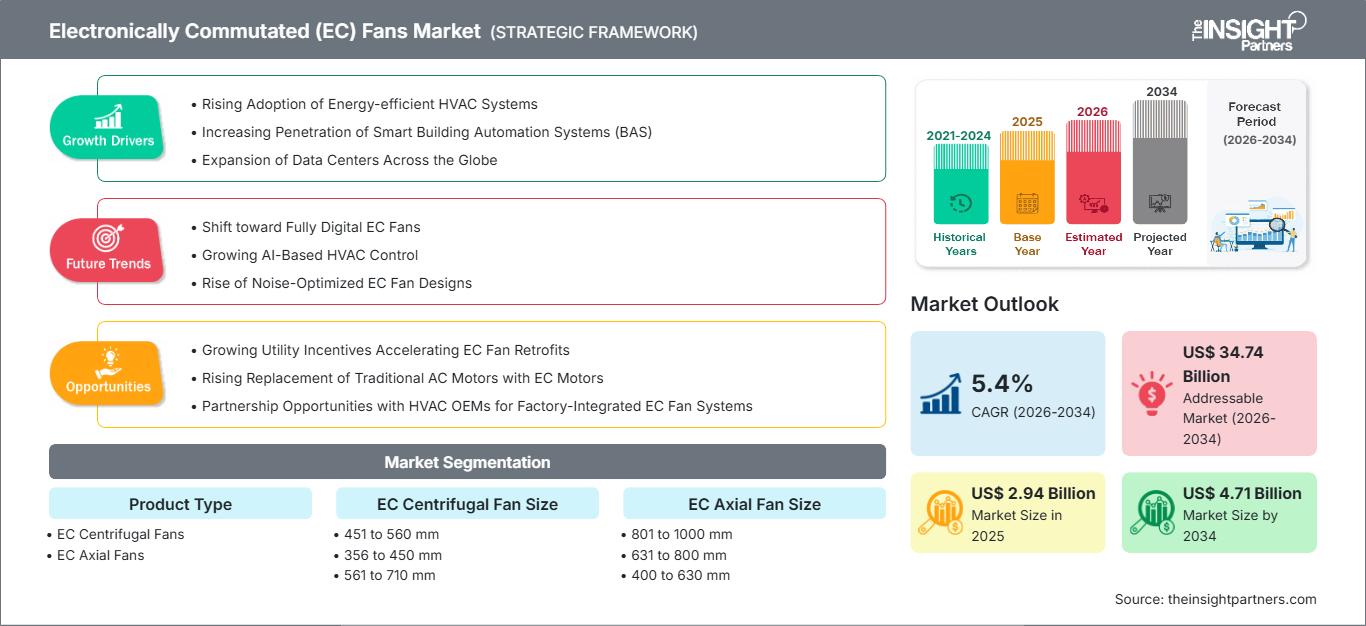
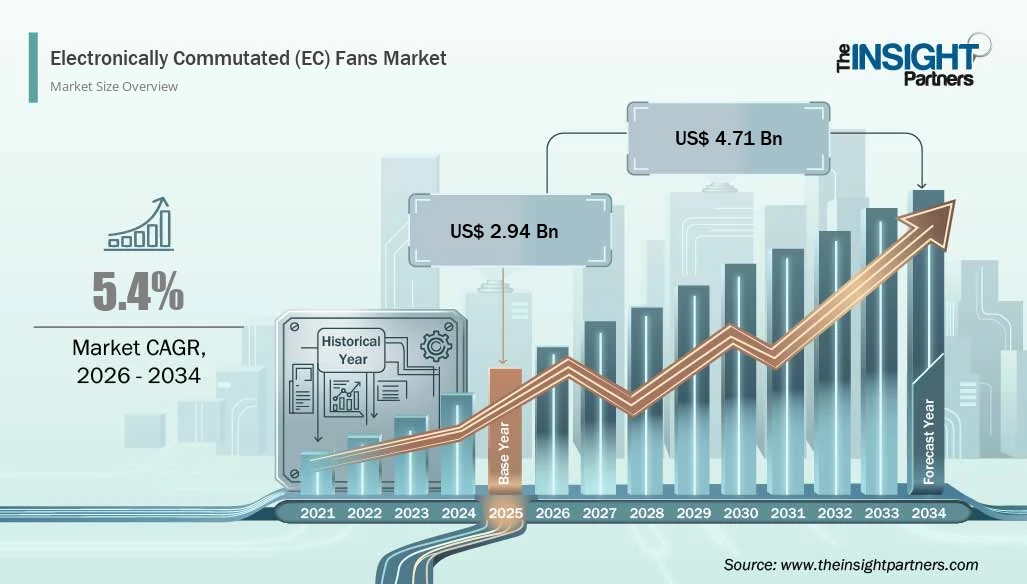
The Electronically Commutated (EC) Fan Market is expected to reach US$ 4.71 Billion by 2034 from US$ 2.94 Billion in 2025. The market is anticipated to register a CAGR of 5.4% during 2026–2034. Demand is supported by regulated energy performance, variable-speed airflow control, and wider deployment in HVAC, refrigeration, data centers, industrial ventilation, and precision cooling equipment.
North America remains a technically advanced demand center, with Electronically Commutated (EC) Fan Market size supported by commercial building retrofits, high-efficiency air handling units, and rapid data center cooling investment. The region is modelled to expand at a CAGR of 5.7% during 2026–2034, driven by lifecycle energy savings, utility incentive programs, and adoption of digitally monitored fan systems.
Electronically Commutated (EC) Fan Market Assessment and Insights
- North America accounted for 19.50% share in 2025 and is expected to grow at a CAGR of 5.7% during 2026–2034, supported by retrofit HVAC demand, data center construction, and institutional efficiency policies.
- US represented 61.25% of North America in 2025 and is expected to expand at a CAGR of 6.3% during 2026–2034.
- Europe held 22.41% share in 2025 and is forecast to grow at a CAGR of 4.5% during 2026–2034, led by Germany, the UK, France, Italy, and Spain.
- Asia Pacific captured 45.01% share in 2025 and is expected to grow at a CAGR of 6.1% during 2026–2034, with China, Japan, South Korea, India, and Australia driving adoption.
- Largest Segment EC Centrifugal Fans held 64.63% market share in 2025 and are expected to grow at a CAGR of 5.1% during 2026–2034.
- High Growth Segment Data Centers held 22.96% market share in 2025 and are expected to grow at a CAGR of 6.7% during 2026–2034.
- Key companies analyzed in detail: ebm-papst GmbH & Co. KG, ZIEHL-ABEGG SE, Rosenberger Hochfrequenztechnik GmbH & Co. KG, Systemair AB, Delta Electronics, Inc., Twin City Fan Companies, Ltd., Multi-Wing Group A/S, FläktGroup Holding GmbH, Continental Fan Manufacturing Inc., and Regal Rexnord Corporation.
Source: The Insight Partners' analysis based on proprietary research, government publications, company annual reports, investor presentations, industry databases, and expert interviews.
The move in technological terms has steered the Electronically Commutated (EC) Fan market away from being fixed speed fans replacements and towards intelligent air flow systems. Factors such as brushless permanent magnet motors, electronics, Modbus, variable speed and better impeller design are the new measures of competitiveness. Manufacturing considerations have become increasingly dependent on the reliability of electronics, the quality of motor laminations, aerodynamic testing, availability of rare earth magnets and geographical production flexibility.
Future demand can be expected to diversify into areas of hotspots within data centers, cold chains, controlled environment agriculture and industrial facilities that seek energy savings. The regulatory winds blowing from building efficiency standards, EU Ecodesign requirements and equipment life cycle cost analysis will drive adoption of EC fans. Suppliers with proven performance metrics and service networks will increase their share in emerging markets.
Electronically Commutated (EC) Fan Market Report Scope
| Report Attribute | Details |
|---|---|
| Market size in 2025 | US$ 2.94 Billion |
| Market Size by 2034 | US$ 4.71 Billion |
| Global CAGR (2026 - 2034) | 5.4% |
| Historical Data | 2021-2024 |
| Forecast period | 2026-2034 |
Electronically Commutated (EC) Fan Market Analysis
Demands revolve around EC fans' ability to reduce electricity usage while operating at part-load conditions and allowing for fine tuning of airflow. Growth in the Electronically Commutated (EC) Fan Market is the highest in those instances when fans run all the time and include commercial air handling, refrigeration cabinet, data center, and industrial exhaust systems. The ecosystem includes motor design, electronics, impellers, housing, control systems, sensors, systems integrators, OEM suppliers, and maintenance companies.
Factors affecting supply still involve availability of components, design of power electronics, and certification needs. Companies need to find a good compromise between acoustic performance, static pressure, ingresses, thermal management, and communication protocol. Consumers prefer total cost of ownership, which means that energy savings, predictive maintenance, and reduced service frequency allow for a premium positioning compared to traditional AC fan assemblies.
The competitive environment includes both world-class companies and system suppliers with strong expertise in specific applications. ebm-papst GmbH & Co. KG and ZIEHL-ABEGG SE provide high-performance fan platforms, whereas Delta Electronics, Inc. offers power electronics knowledge and data center products. Systemair AB, FläktGroup Holding GmbH, Twin City Fan Companies, Ltd., and Continental Fan Manufacturing Inc. compete on air movement systems and channels.
Trends in investments point to digitalized airflow, connection to controls, and ready-to-go EC centrifugal models. Analysis of the Electronically Commutated (EC) Fan Market reveals that competitive positioning becomes more and more dependent on certified efficiency, reduced lead times, acoustic performance, and application engineering. Multi-Wing Group A/S, Regal Rexnord Corporation, and Rosenberger Hochfrequenztechnik GmbH & Co. KG contribute to adjacent solutions in impellers, motors, connections, and assemblies.
● REPORT CUSTOMIZATION
Tailor This Report To Align With Your Specific Business Requirements
This report can be customized to align precisely with your business objectives, scope, and target markets. Customization options include tailored segmentation, geography, competitive analysis, and strategic insights to support informed decision-making.
Customize This Report →WHAT YOU CAN ADJUST
- ● Segmentations
- ● Geography
- ● Competitive Analysis
- ● Language Preferences
Electronically Commutated (EC) Fan Market: Strategic Insights
Regional Insights
North America Electronically Commutated (EC) Fan Market
North America accounted for 19.50% share in 2025 and is expected to grow at a CAGR of 5.7% during 2026–2034. Electronically Commutated (EC) Fan Market share in the region is supported by replacement of constant-speed HVAC fans, building automation upgrades, and data center cooling projects requiring controllable airflow.
Demand is strongest in the US, with Canada contributing through commercial retrofits, cold storage, and institutional buildings. Energy intensity in buildings remains a policy focus because global energy agencies identify buildings as a major final energy consumer. EC adoption therefore aligns with utility cost reduction, refrigerant transition planning, and facility decarbonization programs.
U.S. Electronically Commutated (EC) Fan Market Market
The US represented 61.25% of North America in 2025 and is expected to expand at a CAGR of 6.3% during 2026–2034. Demand is driven by hyperscale data centers, commercial HVAC retrofits, food retail refrigeration, industrial ventilation, and energy performance contracting across schools, hospitals, and office portfolios.
Company presence includes ebm-papst GmbH & Co. KG, ZIEHL-ABEGG SE, Twin City Fan Companies, Ltd., Continental Fan Manufacturing Inc., Delta Electronics, Inc., and Regal Rexnord Corporation. Application trends favor EC centrifugal fans in air handling units and EC axial fans in heat rejection, electronics cooling, agriculture ventilation, and modular thermal management.
Europe Electronically Commutated (EC) Fan Market Market
Europe held 22.41% share in 2025 and is expected to grow at a CAGR of 4.5% during 2026–2034. Germany is the leading country due to fan manufacturing depth, HVAC engineering, industrial automation, and strict energy performance expectations. The UK benefits from commercial building upgrades and data center capacity expansion.
France, Italy, and Spain contribute through food retail refrigeration, hospitality, industrial ventilation, and public building renovation. European buyers emphasize documented efficiency, low acoustic output, compliance with Ecodesign requirements, and long operating life. This creates opportunities for EC fan suppliers with test data, software-enabled selection tools, and reliable aftersales support.
APAC Electronically Commutated (EC) Fan Market Market
APAC captured 45.01% share in 2025 and is expected to grow at a CAGR of 6.1% during 2026–2034. China is the leading country, followed by Japan, South Korea, India, and Australia. Growth is supported by electronics manufacturing, cold chain expansion, commercial construction, and localized HVAC component production.
Japan and South Korea add demand through semiconductor, display, and precision equipment cooling. India’s commercial buildings, metro systems, and data centers create rising retrofit potential, while Australia supports adoption through building performance standards and controlled-environment agriculture investments.
Middle East & Africa Electronically Commutated (EC) Fan Market Market
Middle East & Africa is expected to grow at a CAGR of 3.1% during 2026–2034. Saudi Arabia is the leading country, followed by the UAE, South Africa, and Rest of MEA. Demand is associated with district cooling, data centers, airports, hospitals, and energy-intensive commercial buildings.
Adoption remains project-led because first-cost sensitivity is high, but electricity tariffs, sustainability targets, and extreme ambient temperatures strengthen the case for EC technology. Suppliers with local distributors, commissioning support, and ruggedized fans for heat, dust, and continuous operation can improve conversion.
Segmentation Analysis
Product Type
Product Type is expected to grow at a CAGR of 5.1% during 2026–2034. The Electronically Commutated (EC) Fan Market scope across centrifugal and axial designs reflects different pressure, airflow, and installation requirements. Centrifugal fans, with 64.63% share in 2025, dominate air handling and ducted systems, while axial fans are essential for heat rejection, electronics cooling, agriculture, and high-volume ventilation.
- EC Centrifugal Fans lead demand because they deliver higher static pressure, compact integration, and controllable airflow for air handling units, commercial HVAC retrofits, and data center cooling systems.
- EC Axial Fans remain strategically important in condensers, unit coolers, electronics enclosures, agriculture buildings, and transport systems where high airflow and lower pressure operation are required.
EC Centrifugal Fan Size
EC Centrifugal Fan Size is expected to grow at a CAGR of 5.1–5.7% during 2026–2034. Medium and larger diameters are specified according to pressure rise, cabinet geometry, airflow demand, and acoustic targets. Retrofit demand favors sizes that fit existing air handling footprints, while new equipment uses optimized impeller-motor combinations for higher efficiency.
- 451 to 560 mm sizes occupy a strong position in commercial air handling units, balancing airflow, pressure capability, acoustic performance, and ease of integration in retrofit projects.
- 356 to 450 mm sizes support compact HVAC cabinets, refrigeration systems, and modular cooling equipment where space constraints and controllable airflow remain primary selection factors.
- 561 to 710 mm sizes serve larger air handling, industrial process ventilation, and data hall applications requiring higher volume delivery with dependable pressure performance.
- 280 to 355 mm sizes address smaller equipment, fan arrays, terminal units, and electronics cooling assemblies where compact design and efficient speed modulation are important.
EC Axial Fan Size
EC Axial Fan Size is expected to grow at a CAGR of 5.6–6.2% during 2026–2034. Demand varies by condenser capacity, heat exchanger design, enclosure cooling, and agricultural ventilation load. Larger axial fans gain relevance where lower specific fan power, reduced noise, and variable-speed control improve lifecycle economics in continuous-duty settings.
- 801 to 1000 mm sizes are important in condensers, dry coolers, and data center heat rejection systems that need scalable airflow and improved full-season energy performance.
- 631 to 800 mm sizes support commercial refrigeration, rooftop units, and industrial cooling equipment where airflow density and manageable installation weight are valued.
- 400 to 630 mm sizes serve equipment cabinets, compact condensers, telecom shelters, and agricultural ventilation systems requiring moderate airflow and efficient speed control.
- 1001 to 1250 mm sizes address large heat exchangers, process cooling, and controlled environment applications where lower fan speed can reduce acoustic output.
- 1251 to 1500 mm sizes are used in high-volume ventilation, tunnel support equipment, agriculture houses, and large industrial cooling systems requiring robust mechanical design.
End User Industry
End User Industry is expected to grow at a CAGR of 6.7% during 2026–2034. HVAC and commercial buildings remain the largest base, while data centers, with 22.96% share in 2025, deliver the highest growth. Refrigeration, industry, transportation, utilities, and controlled environment agriculture use EC fans to reduce energy, regulate airflow, and support remote monitoring.
- HVAC and Commercial Buildings remain the largest installed base because building owners can reduce fan energy, improve comfort control, and integrate airflow data into management systems.
- Data Centers present the highest-growth demand as operators require precise airflow, redundancy, lower power usage effectiveness, and reliable cooling across racks, rooms, and heat rejection systems.
- Industrial Manufacturing adopts EC fans for process ventilation, machine cooling, dust extraction, and electronics protection where uptime and speed control improve operating reliability.
- Refrigeration and Cold Chain uses EC technology in unit coolers, condensers, and cabinets to reduce electricity use, manage temperature stability, and support food retail efficiency targets.
- Energy and Utilities applications include turbine enclosures, battery energy storage systems, substations, and control rooms where continuous airflow and equipment protection are essential.
- Transportation demand comes from rail, buses, marine systems, and infrastructure ventilation where compact motors, lower noise, and variable airflow support passenger comfort.
- Agriculture and Controlled Environment Agriculture uses EC fans in greenhouses, livestock buildings, vertical farms, and storage facilities to regulate humidity, temperature, and air exchange more efficiently.
Opportunity Snapshot
| End User Industry | Revenue Contribution | Trend Tag | Adoption Stage |
| HVAC and Commercial Buildings | High | Retrofit AHUs | Mature |
| Data Centers | High | Rack Cooling | Scaling |
| Industrial Manufacturing | Medium | Process Air | Scaling |
| Refrigeration and Cold Chain | Medium | Cold Storage | Scaling |
| Energy and Utilities | Medium | BESS Cooling | Emerging |
| Transportation | Low | Rail HVAC | Scaling |
| Agriculture and Controlled Environment Agriculture | Medium | Greenhouse Air | Emerging |
| Others | Low | Specialty OEM | Emerging |
Electronically Commutated (EC) Fan Market Growth Drivers and Impact Analysis
Energy Efficiency Regulation Accelerates EC Fan Replacement
The owners of the buildings, manufacturers of the products, and companies involved in refrigeration applications are opting to replace AC fan systems due to the fact that the regulatory requirements and the energy objectives of companies will now measure the efficiency of the equipment over its lifecycle. This is because the EC fans will be able to save energy by making use of the feature of being able to control speeds as well as increasing efficiency of the motor, especially when it comes to part-load conditions.
Data Center Cooling Requirements Intensify Airflow Precision
The expansion of data centers is resulting in a need for fans which can vary their airflow rates rapidly while maintaining a consistent temperature level and being able to interface with building management systems and rack-level controls. EC centrifugal and axial fans can operate at various speeds, provide redundancy and monitoring capability in computer room air handlers, rear-door heat exchangers, liquid cooling support systems and outdoor heat rejection units. The implications for the market include increased specification value, qualification-based purchasing as well as demand for communication-enabled, power quality-controlled and thermally tested fans.
Cold Chain and Food Retail Seek Lower Operating Costs
Pressure is on refrigeration and cold chain operators to minimize electrical consumption while ensuring temperature uniformity of their products. EC fans allow evaporators, condensers, display cases, and storerooms to vary their flow rate according to the actual loading conditions rather than working continuously at one speed. Benefits include minimizing losses of compressor interaction, reducing noise in retail environments, enhanced defrosting capability, and increased operational visibility. The demand for such fans is highest in environments where the combination of energy management and quality standards of products is a necessity.
Electronically Commutated (EC) Fan Market Future Trends
Connected EC Fans Become Building Intelligence Nodes
Trends in Electronically Commutated (EC) Fan Market will definitely be heading towards the connected fan modules which will relay information regarding their speed, power, alarm status, operating hours, and temperature levels to the supervisory control systems. Future applications will involve utilizing fan information in order to enhance airflow, foresee any problems involving bearing or electronics of the fan and balancing the flow of air across fan arrays. The fans will thus become an efficient tool through which one can measure efficiency.
Low-Noise, High-Diameter Designs Gain Specification Priority
Future product development will emphasize larger diameters, aeroacoustic blade profiles, winglet geometry, and lower rotational speeds to reduce sound while maintaining airflow. This trend matters as heat pumps, mixed-use buildings, urban cold stores, rooftop units, and controlled-environment agriculture sites face tighter noise acceptance thresholds. EC motors support this shift because variable-speed control allows equipment to operate quietly during low-load periods. Manufacturers able to combine acoustic testing, efficient impellers, and compact electronics will gain advantage in comfort-sensitive applications.
Electronically Commutated (EC) Fan Market Opportunities
Retrofit Programs for Commercial Air Handling Units
Commercial retrofit programs offer practical conversion opportunities because many buildings still operate belt-driven or fixed-speed fans with weak part-load efficiency. Strong Electronically Commutated (EC) Fan Market Forecasts are linked to packaged EC plug fan replacements, prewired controls, and commissioning support that shorten downtime. Suppliers can target offices, hospitals, schools, hotels, and public buildings by quantifying payback through energy savings, reduced maintenance, fan array redundancy, and building automation compatibility. Partnerships with energy service companies can convert fragmented upgrades into repeatable programs.
Localized Supply for Data Center and Cold Chain OEMs
Regional assembly and application engineering can help suppliers serve OEMs that need shorter lead times, documentation, and fast customization. Data center cooling vendors, refrigerated equipment manufacturers, and heat pump producers increasingly require reliable EC fan supply near production locations. Companies can invest in regional inventories, test labs, and modular electronics platforms to win approved-vendor status. This opportunity is strongest where customers value predictable delivery, validated efficiency, local service, and configuration flexibility more than lowest upfront price.
Recent Developments
- July 2026: SUNON has launched a new Green EC fan series designed to meet the European Union's incoming ErP 2026 energy efficiency standards, targeting thermal management for AI data centres and high-density computing environments. The Kaohsiung-based manufacturer's new lineup integrates Modbus-RTU communication and pulse-width modulation speed control, allowing host systems to adjust fan speeds dynamically based on real-time thermal loads rather than running at fixed speeds regardless of actual cooling demand.
- February 2026: At AHR Expo, Infinitum introduced its new EC Fan Systems—a high-efficiency, fully integrated solution combining the fan, motor, and variable frequency drive (VFD) for HVAC, industrial, and mission-critical applications.
- July 2025: ebm-papst GmbH & Co. KG stated at its annual press conference that it invested more than 100 million euros in global locations and 140 million euros in research and development for fiscal 2024/25, while emphasizing data center cooling demand and intelligent air technology as growth priorities.
Frequently Asked Questions

- Comprehensive Market Sizing and Forecast Analysis
- Detailed Segmentation Analysis
- In-Depth Market Dynamics Assessment
- Regional and Country-Level Insights
- Competitive Landscape and Company Benchmarking
- Strategic Business Intelligence
Recent Reports
Testimonials

The Insight Partners' SCADA System Market report is comprehensive, with valuable insights on current trends and future forecasts. The team was highly professional, responsive, and supportive throughout. We are very satisfied and highly recommend their services.
RAN KEDEM Partner, Reali Technologies LTDs
I requested a report on a very specific software market and the team produced the report in a few days. The information was very relevant and well presented. I then requested some changes and additions to the report. The team was again very responsive and I got the final report in less than a week.
JEAN-HERVE JENN Chairman, Future Analytica
We worked with The Insight Partners for an important market study and forecast. They gave us clear insights into opportunities and risks, which helped shape our plans. Their research was easy to use and based on solid data. It helped us make smart, confident decisions. We highly recommend them.
PIYUSH NAGPAL Sr. Vice President, High Beam Global
The Insight Partners delivered insightful, well-structured market research with strong domain expertise. Their team was professional and responsive throughout. The user-friendly website made accessing industry reports seamless. We highly recommend them for reliable, high-quality research services
YUKIHIKO ADACHI CEO, Deep Blue, LLC.
This is the first time I have purchased a market report from The Insight Partners.While I was unsure at first, I visited their web site and felt more comfortable to take the risk and purchase a market report.I am completely satisfied with the quality of the report and customer service. I had several questions and comments with the initial report, but after a couple of dialogs over email with their analyst I believe I have a report that I can use as input to our strategic planning process.Thank you so much for taking the extra time and making this a positive experience.I will definitely recommend your service to others and you will be my first call when we need further market data.
JOHN SUZUKI President and Chief Executive Officer, Board Director, BK Technologies
I wish to appreciate your support and the professionalism you displayed in the course of attending to my request for information regarding to infectious disease IVD market in Nigeria. I appreciate your patience, your guidance, and the fact that you were willing to offer a discount, which eventually made it possible for us to close a deal. I look forward to engaging The Insight Partners in the future, all thanks to the impression you have created in me as a result of this first encounter.
DR CHIJIOKE ONYIA MANAGING DIRECTOR, PineCrest Healthcare Ltd.Reason to Buy
- Informed Decision-Making
- Understanding Market Dynamics
- Competitive Analysis
- Identifying Emerging Markets
- Customer Insights
- Market Forecasts
- Risk Mitigation
- Boosting Operational Efficiency
- Strategic Planning
- Investment Justification
- Tracking Industry Innovations
- Aligning with Regulatory Trends





 Get Free Sample for