
Warehouse Robotics Market Growth, Trends & Forecast by 2034
Coverage: By System Type (Knapp Open Shuttle, Locus Robotics System, Fetch Robotics Freight, Scallog System, Swisslog CarryPick); Robot Type (Mobile Robots, Cartesian Robots, Articulated Robots, SCARA Robots, Parallel Robots, Others); Component (Hardware, Software, Service); End user (E Commerce, Pharmaceutical, Automotive, Food and Beverages, Electrical and Electronics, Others) , and Geography (North America, Europe, Asia Pacific, and South and Central America)
- Status : Data Released
- Report Code : TIPEL00002154
- Category : Electronics and Semiconductor
- No. of Pages : 150
- Available Report Formats :


- Last update date : September 28, 2026


2025 Market Size
US$ 8.06 Bn
Base year value
2034 Forecast
US$ 30.27 Bn
Projected by 2034
CAGR 2026-2034
15.83 %
Growth rate
Addressable Market
US$ 162.37 Bn
(2026-2034)
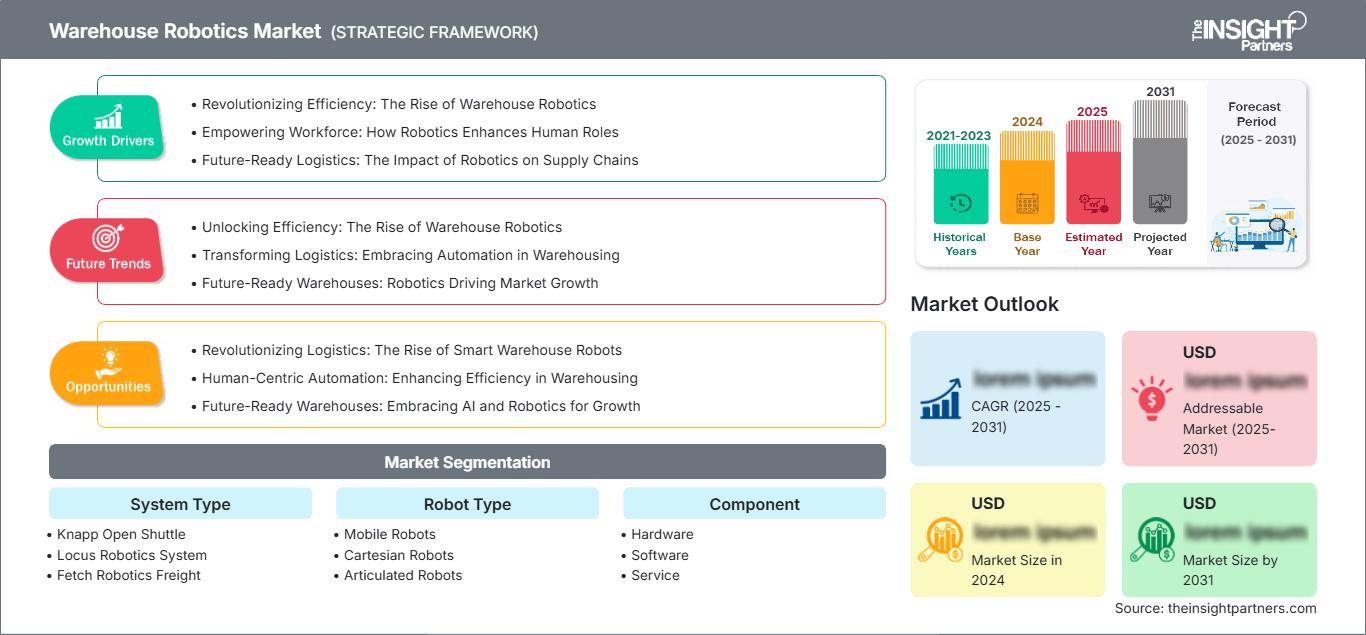
The warehouse robotics market was valued at US$ 8.06 Billion in 2025 and is projected to reach US$ 30.27 Billion by 2034, expanding at a CAGR of 15.83% during 2026–2034. The market encompasses robotic systems, software, and services used to automate material movement, storage, picking, sorting, replenishment, and fulfillment activities across modern warehouses and distribution centers.
North America is expected to maintain a strong growth trajectory, with an estimated CAGR of 14–17% during 2026–2034. Rising fulfillment labor costs, persistent workforce constraints, expansion of same-day delivery networks, and increasing adoption of flexible automation are supporting investment. The warehouse robotics market size is also benefiting from greater use of cloud-based orchestration, autonomous mobile robots, machine vision, and data-driven warehouse execution systems.
Warehouse Robotics Market Assessment and Insights
- North America: North America is expected to account for 34–38% share in 2025 and expand at a CAGR of 14–17% between 2026–2034, supported by e-commerce fulfillment, labor economics, and established automation infrastructure.
- US: The US is estimated to represent 76–80% of North America's 2025 market and grow at a CAGR of 14–17% during 2026–2034, led by fulfillment and third-party logistics investment.
- Europe: Europe is projected to hold 25–29% share in 2025 and grow at a CAGR of 13–16% during 2026–2034, with Germany, the UK, France, Italy, and the Netherlands supporting automation adoption.
- Asia Pacific: Asia Pacific is estimated at 27–31% share in 2025 and is projected to grow at a CAGR of 17–20%, led by China, Japan, South Korea, and India as manufacturing and logistics automation expand.
- Largest Segment: Mobile Robots are estimated to hold a 38–42% market share in 2025 and grow at a CAGR of 17–19% during 2026–2034, reflecting flexible deployment.
- High Growth Segment: Software is estimated to represent a 20–24% share in 2025 and grow at a CAGR of 18–21%, supported by orchestration, analytics, and fleet optimization.
- Key companies analyzed in detail: ABB Ltd.; FANUC Corporation; KUKA AG; ATS Corporation; Honeywell International Inc.; OMRON Corporation; Yaskawa Electric Corporation; Fetch Robotics, Inc.; IAM Robotics; Amazon.com, Inc. through Amazon Robotics; and additional specialist automation providers.
Source: The Insight Partners' analysis based on proprietary research, government publications, company annual reports, investor presentations, industry databases, and expert interviews.
Warehouse automation has shifted from fixed conveyor-centric architectures toward interconnected robotic ecosystems combining autonomous mobility, machine vision, artificial intelligence, sensors, and execution software. The warehouse robotics market is increasingly shaped by modular systems that can be deployed around existing infrastructure, allowing operators to expand capacity without completely rebuilding facilities. Improvements in navigation, gripping, fleet coordination, and software interoperability are also widening use cases across fulfillment.
The warehouse robotics market report indicates that, looking ahead, investment is moving toward scalable automation that can accommodate volatile order profiles, smaller delivery windows, and changing facility layouts. Regulatory attention to workplace safety, energy efficiency, and human-machine collaboration is reinforcing demand for systems that reduce repetitive physical tasks while retaining human oversight. Emerging logistics hubs in Asia Pacific and selected European markets are likely to attract additional automation investment as fulfillment networks become more distributed.
Warehouse Robotics Market Report Scope
| Report Attribute | Details |
|---|---|
| Market size in 2025 | US$ 8.06 Billion |
| Market Size by 2034 | US$ 30.27 Billion |
| Global CAGR (2026 - 2034) | 15.83% |
| Historical Data | 2021-2024 |
| Forecast period | 2026-2034 |
Warehouse Robotics Market Analysis
The warehouse robotics market growth is being supported by e-commerce volumes, omnichannel fulfillment, labor availability challenges, and the need to improve throughput without proportional increases in workforce. The ecosystem includes manufacturers of robots, suppliers of components, providers of warehouse management and execution software, systems integrators, logistics providers, and end-users. The demand is becoming more and more focused on systems that are able to work with already installed conveyors, storage systems, enterprise software, and order management systems.
The supply environment is changing as robotics companies standardize their hardware offerings and start focusing more on software, perception, navigation, analytics, and fleet coordination. Mobile robots fit well into the brownfield warehouses because of the ability to be deployed gradually. That is why hardware vendors start working closely with software vendors and systems integrators in order to reduce the time needed for implementation.
The warehouse robotics market analysis indicates intensifying competition between established industrial automation companies and specialist robotics developers. ABB Ltd., FANUC Corporation, KUKA AG, ATS Corporation, OMRON Corporation, and Yaskawa Electric Corporation offer industrial robot capabilities, whereas Honeywell International Inc. offers a combination of hardware for automation and warehouse execution. Amazon Robotics, Fetch Robotics, and IAM Robotics improve the ecosystem by providing fulfillment-based robotic systems as well as application-oriented technology.
The areas of investment have started shifting towards autonomy, interoperability, artificial intelligence, and fast deployment. The positioning strategy too has been changing from focusing on the sale of individual robots to offering solutions that can coordinate the operations of fleets of robots, along with software and sensors as well as warehousing processes. Partnering has become important in view of the need for integration with various legacy systems.
● REPORT CUSTOMIZATION
Tailor This Report To Align With Your Specific Business Requirements
This report can be customized to align precisely with your business objectives, scope, and target markets. Customization options include tailored segmentation, geography, competitive analysis, and strategic insights to support informed decision-making.
Customize This Report →WHAT YOU CAN ADJUST
- ● Segmentations
- ● Geography
- ● Competitive Analysis
- ● Language Preferences
Warehouse Robotics Market: Strategic Insights
Regional Insights
North America warehouse robotics market
North America is estimated to command 34–38% share in 2025 and expand at a CAGR of 14–17% during 2026–2034. The US controls regional demands due to the fact that large fulfillment centers require high efficiency, flexibility of picking, and automation of movement. Canada, too, provides its share in terms of modernization of distribution operations, food logistics, and automation in retail.
Regional trends are driven by the factors of labor cost, delivery time requirements, and investments from third-party logistics companies. Cloud-based warehouse execution systems, autonomous mobile robots, robotic picking, and inventory intelligence are becoming complementary solutions rather than stand-alone implementations.
U.S. warehouse robotics Market
The US is estimated to represent 76–80% of North America's 2025 Warehouse Robotics Market and is projected to grow at a CAGR of 14–17%. Demand is concentrated among e-commerce operators, retailers, parcel networks, and third-party logistics providers seeking higher productivity and more predictable fulfillment capacity.
The competitive environment includes Amazon Robotics, Honeywell International Inc., ABB Ltd., FANUC Corporation, and other automation suppliers. Applications are expanding beyond transport toward picking, replenishment, sorting, and inventory verification. Subscription-oriented automation and software-led deployments are also improving accessibility for mid-sized operators that previously viewed robotics as capital-intensive infrastructure.
Europe warehouse robotics Market
Europe is estimated to hold 25–29% of the Warehouse Robotics Market share in 2025 and grow at a CAGR of 13–16%. Germany stands as the leader, thanks to its manufacturing capability, logistical density, and automation readiness. The UK and France are other important fulfillment destinations, while Italy and Spain are becoming progressively more warehouse-ready.
The UK is taking advantage of e-commerce fulfillment, the need for labor productivity, and automated distribution centers. Germany continues to be technologically intense due to the capabilities developed by its automotive, industrial, and logistics firms in relation to robots. France is progressing towards fulfillment automation on the basis of retailing and third-party logistics.
APAC warehouse robotics Market
APAC is estimated at 27–31% share of the Warehouse Robotics Market in 2025 and is projected to grow at a CAGR of 17–20%, making it the fastest-growing major region. China is at the forefront of regional implementation, with Japan, South Korea, India, and Australia following closely behind. Density of manufacturing and the use of e-commerce drive the widespread implementation.
China derives an advantage from the implementation of industrial automation on a mass scale and smart logistics systems. Japan and South Korea focus on precision automation and labor productivity, whereas India focuses on automation of its fulfillment facilities amid the growth of e-commerce activities.
Middle East & Africa warehouse robotics Market
Middle East and Africa Warehouse Robotics Market is projected to expand at a CAGR of 11–14% during 2026–2034. Both Saudi Arabia and the UAE are early adopters in the region, thanks to diversification of logistics, major distribution initiatives, and smart cities. South Africa is an important market in Africa due to its logistics and distribution infrastructure.
Logistics development in Saudi Arabia is being done as part of the diversification of the economy, while the UAE enjoys the presence of significant ports and airports as well as fulfillment centers. South Africa is using warehouse automation in order to boost its logistics and distribution process.
Segmentation Analysis
System Type
Warehouse Robotics Market forecast indicates that the System Type segment is projected to grow at a CAGR of 14–17% during 2026–2034. Integrated systems increasingly combine robotic transport, storage, picking, and orchestration software. Operators favor architectures that can connect with existing warehouse management platforms while supporting phased deployment and operational scalability.
- Knapp Open Shuttle: Supports goods-to-person workflows and automated storage environments where high throughput and repeatable tote movement are priorities. Its modular architecture aligns with facilities seeking scalable automated material handling.
- Locus Robotics System: Uses autonomous mobile robots to assist human picking operations. Its collaborative approach is strategically important for facilities requiring flexible automation without extensive structural modification.
- Fetch Robotics Freight: Addresses autonomous material movement within industrial and warehouse environments. The system is relevant where operators need flexible transport between workstations, storage zones, and production interfaces.
- Scallog System: Supports goods-to-person fulfillment through mobile robotic storage and retrieval. Its value proposition centers on warehouse density, ergonomic workflows, and adaptability to changing inventory requirements.
- Swisslog CarryPick: Combines mobile robots with automated storage concepts. It is strategically relevant to distribution centers seeking high-density storage and flexible goods-to-person fulfillment.
Robot Type
Warehouse Robotics Market trends indicate that the Robot Type segment is expected to expand at a CAGR of 15–18% through 2034. Mobile platforms are gaining importance because they can navigate dynamic facilities, while articulated, Cartesian, SCARA, and parallel robots continue serving specialized handling and picking requirements.
- Mobile Robots: Enable flexible movement of goods and inventory across changing layouts. Their comparatively modular deployment makes them strategically important for brownfield facilities and rapidly evolving fulfillment operations.
- Cartesian Robots: Provide predictable linear movement and precise positioning. They remain useful in structured applications requiring repeatable handling, particularly where fixed work envelopes and standardized loads improve operational efficiency.
- Articulated Robots: Offer multiple axes and broad motion flexibility for palletizing, depalletizing, and complex handling. Their established industrial ecosystem supports integration into high-throughput warehouse workflows.
- SCARA Robots: Deliver fast, repeatable horizontal movement for lightweight picking and assembly-related tasks. They are relevant where speed, precision, compact installation, and controlled workspaces are required.
- Parallel Robots: Provide high-speed handling for selected lightweight goods. Their importance is strongest in sorting, picking, and packaging applications where cycle time and precision materially influence throughput.
Component
The Component segment is forecast to grow at a CAGR of 16–19% during 2026–2034. Hardware remains essential, but software and services are gaining strategic importance as operators demand interoperability, predictive intelligence, remote monitoring, fleet optimization, and lifecycle support.
- Hardware: Includes robots, sensors, controllers, drives, vision systems, and related physical infrastructure. Hardware investment remains fundamental to capacity expansion and automation of material movement and handling.
- Software: Coordinates fleets, workflows, data, routing, and warehouse execution. Its strategic importance is increasing as operators seek interoperability, real-time optimization, and better utilization of heterogeneous robotic assets.
- Service: Covers integration, maintenance, upgrades, training, and technical support. Service models reduce implementation risk and help operators sustain performance as robotic fleets become larger and more complex.
End user
The End user segment is expected to grow at a CAGR of 15–18% during 2026–2034. E-commerce remains a major adoption center, while pharmaceuticals, automotive, food and beverages, and electrical and electronics increasingly deploy robotics for controlled handling and productivity.
- E Commerce: Requires rapid picking, sorting, replenishment, and order consolidation. Robotics helps operators manage SKU proliferation and shorter fulfillment windows while supporting scalable peak-season capacity.
- Pharmaceutical: Benefits from traceability, controlled handling, accuracy, and repeatability. Automation supports distribution environments where inventory integrity and precise movement are critical operational requirements.
- Automotive: Uses robotics for component movement, sequencing, kitting, and production logistics. Integration with manufacturing systems supports synchronized material flow and reduces manual transport activities.
- Food and Beverages: Requires efficient handling of diverse products, packaging formats, and temperature-sensitive inventory. Robotics can improve consistency while reducing repetitive manual handling in distribution operations.
- Electrical and Electronics: Features a high SKU variety and frequent handling requirements. Robotics supports precision movement, kitting, sorting, and inventory workflows where accuracy and traceability are strategically important.
Opportunity Snapshot
| End user | Revenue Contribution | Trend Tag | Adoption Stage |
| E Commerce | High | Fast Fulfillment | Scaling |
| Pharmaceutical | Medium | Traceable Handling | Scaling |
| Automotive | Medium | Line Supply | Mature |
| Food and Beverages | Medium | Cold Logistics | Scaling |
| Electrical and Electronics | Medium | SKU Precision | Scaling |
Warehouse Robotics Market Growth Drivers and Impact Analysis
Rising fulfillment complexity is increasing the value of flexible automation
As e-commerce and omnichannel fulfillment systems emerge, there will be more SKUs, less volume per order, and smaller windows for fulfilling orders. This makes static automation systems less flexible when conditions within the warehouse change. Robotic platforms that are dynamic will be able to direct resources where bottlenecks occur, increasing efficiency in the process. The most notable impact is seen in warehouses that service multiple channels using the same stock in the warehouse. As operators gauge automation by throughput, order accuracy, labor efficiency, and peak performance rather than counting robots, robotics becomes an even more compelling value proposition. The business impact goes further still in terms of system design, integration, and services since the customer demands flexibility in addressing changing warehouse dynamics without rebuilding.
Workforce constraints are strengthening the business case for robotic material movement
The labor market remains a concern for warehouse operations due to the issues of labor availability, increasing wages, high worker turnover rates, and physical activity. Robots will help to cut down the number of repetitive motions performed by humans, allowing people to focus on the work that involves exceptions, management, quality checks, and complicated picking. Hence, the best use cases for robotics in warehouses can be found in situations when robots work alongside workers rather than replace them. In some cases, collaborative operations may improve ergonomics as well by decreasing the need for walking, lifting, and transporting things. The financial implications of robotics for warehouse operators depend on usage levels, operating hours, frequency of performing certain activities, and integration costs. Thus, robot providers stress productivity and flexibility.
AI-enabled orchestration is expanding automation beyond individual robotic tasks
The value of robotics is increasingly measured by the efficacy of the interaction between the fleet and the warehouse management system, inventories, employees, and physical facilities. AI-driven orchestration would help with efficient routing, allocation of tasks, traffic control, exception handling, and efficient use of equipment. With the help of machine vision and sensor fusion, robots can also work in less structured environments than those allowed by the conventional fixed automation approach. Such a transformation means that a new competitive landscape is created due to the intelligence provided through software being the differentiator for various types of robots. The operators now have the ability to orchestrate heterogeneous fleets instead of having just one hardware platform.
Warehouse Robotics Market Future Trends
Physical AI will increase autonomous decision-making in warehouse environments
Physical AI promises to transform warehouse robotics from systems that operate on fixed navigational and task directives into robots that can make sense of their surroundings and determine how to act based on them. Robotics will be increasingly dependent on vision, force feedback, language interaction, simulation tools, and fleet information as they get used to handling more complex workflows. Physical AI promises to enable robotics to work better in environments where automation with its rigid approach does not work well due to variation. In the long run, physical AI may even empower operators to program robot behavior using higher-level commands instead of programming.
Multi-robot orchestration will become a core architecture for scalable warehouses
Future operations will use combinations of technologies such as mobile robots, robotic arms, automated storage, conveyors, drones, and software agents rather than depending solely on one type of robot. The orchestration system will manage all these resources using common goals such as completing an order, inventory availability, decongestion, and power savings. This method may increase the chances of having a resilient system since individual robots can be shifted in case of any change in the load or unavailability of equipment. Open interfaces and standard data formats will become more relevant. It will also favor companies that are able to incorporate third-party equipment and legacy systems. With increasing heterogeneity of fleets, software layers will constitute more of the automation value.
Warehouse Robotics Market Opportunities
Retrofit automation can unlock large brownfield warehouse demand
The opportunity here lies in the renovation of existing warehouses rather than building an entirely new warehouse that can be completely automated. The use of mobile robots, vision systems, software overlay, and modular picking technology can all be incorporated into an existing facility without necessarily replacing all conveyors, racks, and workstations. In this way, the process will be less disruptive, and an operator can concentrate on the exact pain points that they face. The vendors can come up with packages that can be used as plug-and-play solutions to improve picking, replenishing, transporting, and checking the inventory. The opportunity is especially applicable to retailers and third-party logistics companies operating in dispersed geographic regions and varying infrastructures.
Robotics-as-a-service can broaden adoption among mid-sized operators
Flexibility of financing and automated subscriptions could solve the issues of financing that prevent small and medium-sized warehouses from adopting robots. In a robot-as-a-service approach, customers could pay for equipment, software, maintenance, and services through monthly payments rather than making upfront payments for those services. The technology obsolescence risk could also be solved with such an approach, since the systems could be constantly improved. At the same time, vendors would have the ability to form longer-term relationships with customers and get the relevant data to provide better service. Adoption of robots will depend on clear performance indicators, flexible contracts, integrations, and maintenance cost predictability. Providers that combine financing and quick deployment with scalability of the robot fleet could win over clients that need automation but cannot afford the traditional capital-intensive architecture of the systems.
Frequently Asked Questions

- Comprehensive Market Sizing and Forecast Analysis
- Detailed Segmentation Analysis
- In-Depth Market Dynamics Assessment
- Regional and Country-Level Insights
- Competitive Landscape and Company Benchmarking
- Strategic Business Intelligence
Recent Reports
Testimonials

The Insight Partners provided valuable market intelligence that supported our global go-to-market strategy. Their team was professional, responsive, and attentive to our feedback, providing thoughtful analysis and helpful methodological clarifications throughout the project.
Junmo Kim Chief Financial Officer (CFO), Enertech Co., Ltd.
The Insight Partners' SCADA System Market report is comprehensive, with valuable insights on current trends and future forecasts. The team was highly professional, responsive, and supportive throughout. We are very satisfied and highly recommend their services.
RAN KEDEM Partner, Reali Technologies LTDs
I requested a report on a very specific software market and the team produced the report in a few days. The information was very relevant and well presented. I then requested some changes and additions to the report. The team was again very responsive and I got the final report in less than a week.
JEAN-HERVE JENN Chairman, Future Analytica
We worked with The Insight Partners for an important market study and forecast. They gave us clear insights into opportunities and risks, which helped shape our plans. Their research was easy to use and based on solid data. It helped us make smart, confident decisions. We highly recommend them.
PIYUSH NAGPAL Sr. Vice President, High Beam Global
The Insight Partners delivered insightful, well-structured market research with strong domain expertise. Their team was professional and responsive throughout. The user-friendly website made accessing industry reports seamless. We highly recommend them for reliable, high-quality research services
YUKIHIKO ADACHI CEO, Deep Blue, LLC.
This is the first time I have purchased a market report from The Insight Partners.While I was unsure at first, I visited their web site and felt more comfortable to take the risk and purchase a market report.I am completely satisfied with the quality of the report and customer service. I had several questions and comments with the initial report, but after a couple of dialogs over email with their analyst I believe I have a report that I can use as input to our strategic planning process.Thank you so much for taking the extra time and making this a positive experience.I will definitely recommend your service to others and you will be my first call when we need further market data.
JOHN SUZUKI President and Chief Executive Officer, Board Director, BK Technologies
I wish to appreciate your support and the professionalism you displayed in the course of attending to my request for information regarding to infectious disease IVD market in Nigeria. I appreciate your patience, your guidance, and the fact that you were willing to offer a discount, which eventually made it possible for us to close a deal. I look forward to engaging The Insight Partners in the future, all thanks to the impression you have created in me as a result of this first encounter.
DR CHIJIOKE ONYIA MANAGING DIRECTOR, PineCrest Healthcare Ltd.Reason to Buy
- Informed Decision-Making
- Understanding Market Dynamics
- Competitive Analysis
- Identifying Emerging Markets
- Customer Insights
- Market Forecasts
- Risk Mitigation
- Boosting Operational Efficiency
- Strategic Planning
- Investment Justification
- Tracking Industry Innovations
- Aligning with Regulatory Trends





 Get Free Sample for