
Wearable Biometric Monitor Market Trends, Demand & Growth by 2034
Coverage: By Product (Smartwatches, Fitness Bands, Smart Clothing), Component (Hardware and Software), Connectivity (Bluetooth Low Energy (BLE) and NFC and Cellular), End-Use Industry (Consumer Electronics, Healthcare Providers, Sports and Fitness Centers), and Geography (North America, Europe, Asia Pacific, the Middle East and Africa, and South and Central America)
- Status : Upcoming
- Report Code : TIPRE00043091
- Category : Life Sciences
- No. of Pages : 150
- Available Report Formats :


- Last update date : March 05, 2026


2025 Market Size
US$ 12.45 Bn
Base year value
2034 Forecast
US$ 26.54 Bn
Projected by 2034
CAGR 2026-2034
8.8 %
Growth rate
Addressable Market
US$ 174.91 Bn
(2026-2034)
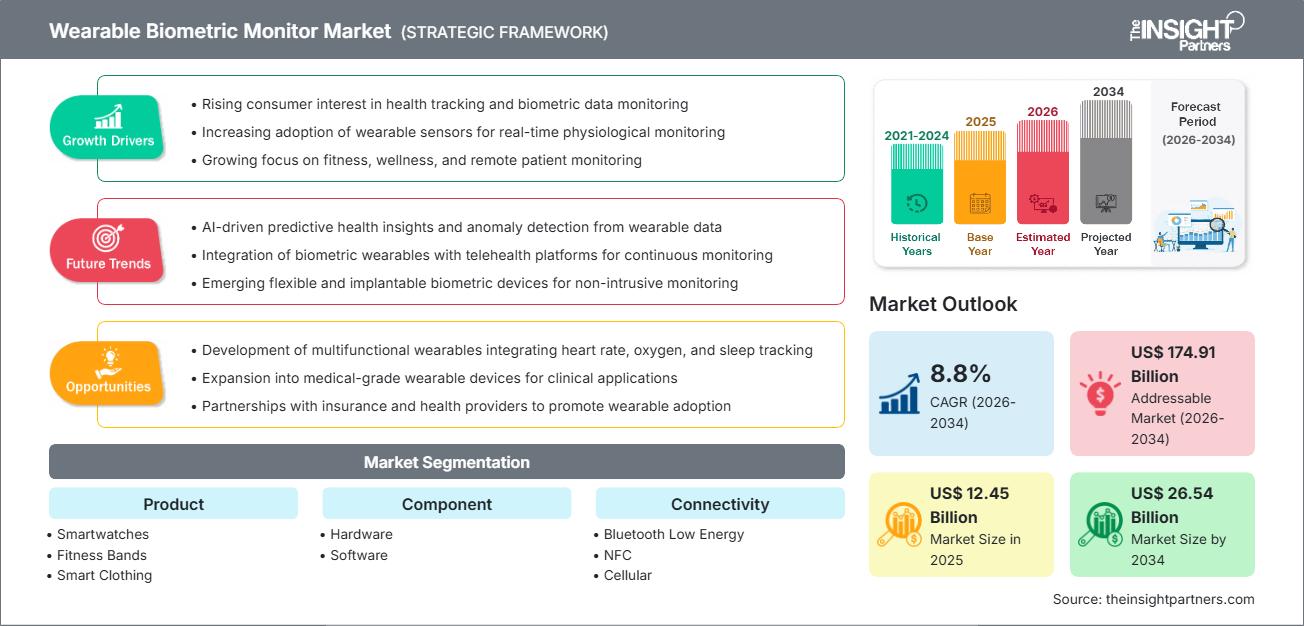
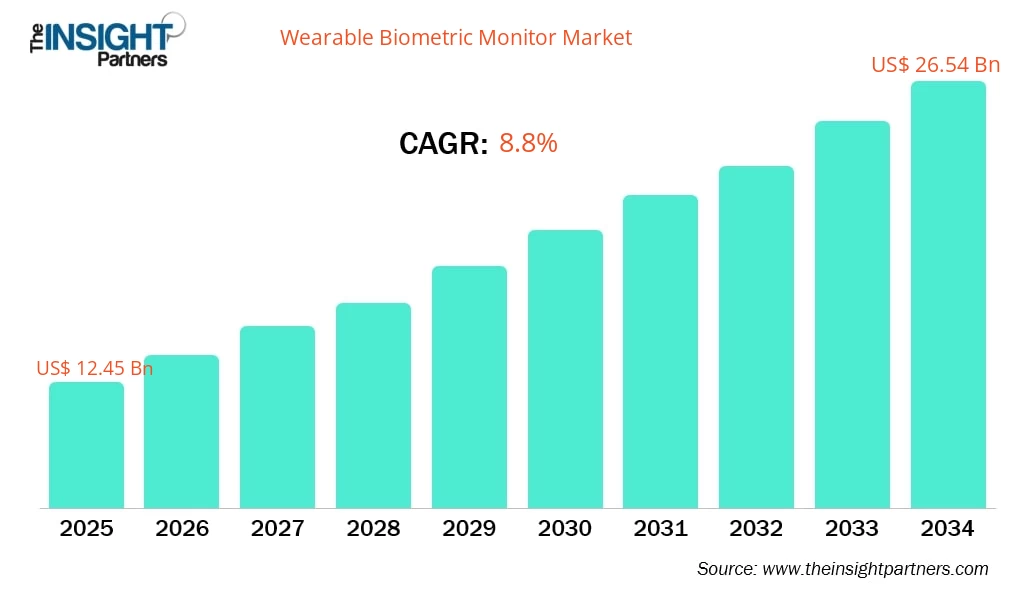
The wearable biometric monitor market size is expected to reach US$ 26.54 billion by 2034 from US$ 12.45 billion in 2025. The market is anticipated to register a CAGR of 8.8% during 2026–2034.
Wearable Biometric Monitor Market Analysis
The wearable biometric monitor market is expected to continue its rapid growth, driven by increasing health awareness, a rise in the prevalence of lifestyle-related or chronic diseases, and the integration of AI-driven biosensors. In consequence, the demand for remote patient monitoring, fitness tracking, and personalized wellness continues to drive the market. Sensor miniaturization and improvements in data analytics have been improving device capabilities and consumer adoption.
Wearable Biometric Monitor Market Overview
Wearable biometric monitors are wearable devices on the body; they measure, on a continuous basis, certain physiological data such as heart rate, respiration rate, temperature, and blood oxygen level. These devices are utilized in both consumer wellness and clinical health monitoring. The market encompasses smartwatches, fitness bands, smart Clothing, and patches and caters to sports and healthcare, while also being used for chronic disease management.
Market Research Highlights
- Global market for Wearable Biometric Monitor was valued at US$ 12.45 Billion in 2025
- Annual market size is expected to reach US$ 26.54 Billion by 2034
- Total addressable market (TAM) during 2026-2034 is projected to reach approximately US$ 174.91 Billion
- Market is anticipated to register a CAGR of 8.8% during the forecast period
- The United States represents a key market, supported by Rising consumer interest in health tracking and biometric data monitoring, Increasing adoption of wearable sensors for real-time physiological monitoring, Growing focus on fitness, wellness, and remote patient monitoring, as well as evolving industry dynamics
- Market analysis covers North America, Europe, Asia-Pacific, South and Central America, Middle East and Africa, with growth evaluated across the forecast period
- Market opportunities such as Development of multifunctional wearables integrating heart rate, oxygen, and sleep tracking, Expansion into medical-grade wearable devices for clinical applications, Partnerships with insurance and health providers to promote wearable adoption are expected to influence market dynamics and addressable market
- Report profiles industry participants, including Apple Inc., Fitbit Inc. (Google), Garmin Ltd., Huawei Technologies Co., Ltd., Samsung Electronics Co., Ltd., Whoop Inc., Biostrap, Oura Health Oy, Hexoskin (Carr? Technologies Inc.), Valencell Inc., while analyzing competitive strategies and innovation developments
-
Source: The Insight Partners' analysis based on proprietary research, government publications, company annual reports, investor presentations, industry databases, and expert interviews.
● REPORT CUSTOMIZATION
Tailor This Report To Align With Your Specific Business Requirements
This report can be customized to align precisely with your business objectives, scope, and target markets. Customization options include tailored segmentation, geography, competitive analysis, and strategic insights to support informed decision-making.
Customize This Report →WHAT YOU CAN ADJUST
- ● Segmentations
- ● Geography
- ● Competitive Analysis
- ● Language Preferences
Wearable Biometric Monitor Market: Strategic Insights
-
Get Top Key Market Trends of this report.This FREE sample will include data analysis, ranging from market trends to estimates and forecasts.
Wearable Biometric Monitor Market Drivers and Opportunities
Market Drivers:
- Increasing prevalence of chronic diseases that need continuous monitoring: The need to monitor diabetes and cardiovascular diseases, among others, remotely and continuously increases the demand for wearable devices.
- Growing demand for tracking fitness and wellness among consumers: Increasing consumer demand for fitness and wellness tracking-for instance, consumer interest in personalized health data, activity tracking, and self-monitoring-drives the mass market adoption of biometric wearables.
- Improvements in sensor precision and miniaturization: Technology continuously improves to create more compact, comfortable, and accurate sensors, which upgrade the overall capability of a device and improve user experience.
- Integration with smartphones and health apps: Seamless connectivity and data visualization through popular mobile platforms make the devices highly accessible and easy to use.
Market Opportunities:
- Growth in emerging markets: Rising health awareness is leading to the expansion in emerging markets. Increasing disposable incomes and a growing consciousness towards preventive health in regions such as the Asia Pacific will see this market recording rapid adoption.
- Integration with telehealth platforms and electronic health records: Connecting wearable data directly to clinical systems enables remote patient management and enhances clinical decision-making.
- Development of AI-powered analytics for personalized health insights: The use of machine learning to interpret complex biometric data allows for predictive alerts and highly customized wellness advice, moving beyond simple tracking.
Wearable Biometric Monitor Market Report Segmentation Analysis
The wearable biometric monitor market share is analyzed across various segments to provide a clearer understanding of its structure, growth potential, and emerging trends. Below is the standard segmentation approach used in most industry reports:
By Product:
- Smartwatches: Smartwatches represent the leading segment, as they can offer a combination of lifestyle features with hardy, multi-parameter biometric monitoring.
- Fitness Bands: The fitness bands will still be a strong segment owing to their affordability, focused activity tracking features, and high market penetration.
- Smart Clothing: Smart Clothing is an emerging segment that offers continuous and non-invasive data collection through integrated, fabric-based sensors for fitness and clinical use.
By Component:
- Hardware: The Hardware segment consists of sensors, processors, and connectivity modules that provide the essential physical base for all data collection and transmission.
- Software: The Software segment covers the analytics platforms and health tracking applications necessary for data interpretation, user interface, and health insights.
By Connectivity:
- Bluetooth Low Energy (BLE): BLE is the most mature and prevalent application implemented in consumer devices for efficient, low-power data transfer to smartphones.
- NFC and Cellular: NFC and Cellular connectivity are growing in clinical and secure applications, enabling standalone device operation and reliable, high-security data transmission for patient monitoring.
By End-Use Industry:
- Consumer Electronics
- Healthcare Providers
- Sports and Fitness Centers. Each sector has specific wearable biometric monitor requirements. It influences data management and analysis.
By Geography:
- North America
- Europe
- Asia Pacific
- South & Central America
- Middle East & Africa
The wearable biometric monitor market in the Asia Pacific is expected to witness the fastest growth during the forecast period, driven by rapid healthcare digitalization and rising consumer awareness.
Wearable Biometric Monitor Market Report Scope
| Report Attribute | Details |
|---|---|
| Market size in 2025 | US$ 12.45 Billion |
| Market Size by 2034 | US$ 26.54 Billion |
| Global CAGR (2026 - 2034) | 8.8% |
| Historical Data | 2021-2024 |
| Forecast period | 2026-2034 |
| Segments Covered |
By Product
|
| Regions and Countries Covered |
North America
|
| Market leaders and key company profiles |
|
Wearable Biometric Monitor Market Players Density: Understanding Its Impact on Business Dynamics
The Wearable Biometric Monitor Market is growing rapidly, driven by increasing end-user demand due to factors such as evolving consumer preferences, technological advancements, and greater awareness of the product's benefits. As demand rises, businesses are expanding their offerings, innovating to meet consumer needs, and capitalizing on emerging trends, which further fuels market growth.
Wearable Biometric Monitor Market Share Analysis by Geography
Asia Pacific is expected to grow fastest in the coming years. Emerging markets in South & Central America, the Middle East, and Africa also have many untapped opportunities for wearable biometric monitor providers to expand.
The wearable biometric monitor market shows a different growth trajectory in each region due to factors such as healthcare infrastructure, regulatory environment, digital health adoption, and consumer behavior. Below is a summary of market share and trends by region:
North America
- Market Share: Holds the largest market share due to advanced healthcare infrastructure and early adoption.
- Key Drivers:
- High demand for Remote Patient Monitoring (RPM) solutions
- Widespread consumer adoption of fitness trackers and smartwatches
- Integration of AI in diagnostics and health coaching
- Trends: Shift toward FDA-cleared and clinically validated wearables for chronic condition management and personalized care delivery.
Europe
- Market Share: Significant due to public healthcare systems and strict data governance policies drive a significant share.
- Key Drivers:
- GDPR compliance and high consumer confidence in data security
- National Health Service (NHS) digitization projects and similar initiatives
- Growing need for efficiency in multi-specialty practices and public health systems
- Trends: Increasing use of interoperable wearable platforms to support cross-border health data exchange and unified care delivery, especially for aging populations.
Asia Pacific
- Market Share: Fastest-growing region owing to rapid healthcare digitization and expanding medical tourism.
- Key Drivers:
- Government-supported health IT initiatives and public health campaigns
- Surge in private healthcare providers and fitness consciousness
- Rising patient volumes and urban healthcare demand
- Trends: Adoption of cost-effective, localized wearables for common chronic diseases and integration with regional telemedicine platforms.
South and Central America
- Market Share: Emerging market with growing digital health adoption.
- Key Drivers:
- Public-private health partnerships to bridge healthcare gaps
- Need for administrative efficiency in underfunded systems.
- Expansion of private clinics and specialist centers
- Trends: Cloud-based, cost-effective wearable solutions are gaining traction, especially among small-to-medium healthcare providers and wellness programs.
Middle East and Africa
- Market Share: Developing market with strong growth potential due to rising healthcare investments.
- Key Drivers:
- National e-health strategies and smart city initiatives
- Healthcare infrastructure expansion and diversification
- Rising demand for medical practice automation
- Trends: Implementation of wearables in integrated care models, often as part of broader health information systems, driven by government health visions.
Wearable Biometric Monitor Market Players Density: Understanding Its Impact on Business Dynamics
High Market Density and Competition
The market is highly competitive with major players such as Apple, Fitbit (Google), Garmin, Huawei, Samsung, Whoop, Biostrap, Oura, Hexoskin, and Valencell. Regional and niche players such as Hexoskin and Oura also contribute to the crowded market landscape.
This competitive environment pushes vendors to differentiate through:
- Innovation in sensor accuracy and reliability for continuous health data.
- Sleek design and enhanced user comfort, suitable for 24/7 wearability.
- Seamless integration with major smartphone operating systems and health apps.
- Development of clinically validated features for medical and wellness applications.
Opportunities and Strategic Moves
- Partner with healthcare providers and digital platforms to support remote patient monitoring and clinical trials.
- Incorporate AI/ML integration for predictive health analytics, personalized coaching, and early risk detection.
Major Companies Operating in the Wearable Biometric Monitor Market Are:
- Apple Inc.
- Fitbit Inc. (Google)
- Garmin Ltd.
- Huawei Technologies Co., Ltd.
- Samsung Electronics Co., Ltd.
- Whoop Inc.
- Biostrap
- Oura Health Oy
- Hexoskin (Carré Technologies Inc.)
- Valencell Inc.
Disclaimer: The companies listed above are not ranked in any particular order.
Wearable Biometric Monitor Market News and Recent Developments
- Apple Inc. introduced the M5 chip and Apple Watch Series 11 with advanced health features - Apple launched its new M5 chips, which enhanced AI across all its devices, including wearables. The Apple Watch Series 11, accompanying the iPhone 17, came with greater health tracking and deeper integration with Apple Health to enable real-time biometric monitoring and predictive wellness insight.
- Fitbit (Google) unveiled Charge 6 and Pixel Watch 3 with enhanced health tracking - Fitbit introduced Charge 6 and Pixel Watch 3, offering improved heart rate accuracy, GPS, and integration with Google Maps and Wallet. The company also expanded Fitbit Premium, providing personalized health insights and guided wellness programs to new users.
Wearable Biometric Monitor Market Report Coverage and Deliverables
The "Wearable Biometric Monitor Market Size and Forecast (2021–2034)" report provides a detailed analysis of the market covering below areas:
- Wearable Biometric Monitor Market size and forecast at global, regional, and country levels for all the key market segments covered under the scope
- Wearable Biometric Monitor Market trends, as well as market dynamics such as drivers, restraints, and key opportunities
- Detailed PEST and SWOT analysis
- Wearable Biometric Monitor Market analysis covering key market trends, global and regional framework, major players, regulations, and recent market developments
- Industry landscape and competition analysis covering market concentration, heat map analysis, prominent players, and recent developments in the Wearable Biometric Monitor Market
- Detailed company profiles
Frequently Asked Questions

- Comprehensive Market Sizing and Forecast Analysis
- Detailed Segmentation Analysis
- In-Depth Market Dynamics Assessment
- Regional and Country-Level Insights
- Competitive Landscape and Company Benchmarking
- Strategic Business Intelligence
Recent Reports
Testimonials

The Insight Partners provided valuable market intelligence that supported our global go-to-market strategy. Their team was professional, responsive, and attentive to our feedback, providing thoughtful analysis and helpful methodological clarifications throughout the project.
Junmo Kim Chief Financial Officer (CFO), Enertech Co., Ltd.
The Insight Partners' SCADA System Market report is comprehensive, with valuable insights on current trends and future forecasts. The team was highly professional, responsive, and supportive throughout. We are very satisfied and highly recommend their services.
RAN KEDEM Partner, Reali Technologies LTDs
I requested a report on a very specific software market and the team produced the report in a few days. The information was very relevant and well presented. I then requested some changes and additions to the report. The team was again very responsive and I got the final report in less than a week.
JEAN-HERVE JENN Chairman, Future Analytica
We worked with The Insight Partners for an important market study and forecast. They gave us clear insights into opportunities and risks, which helped shape our plans. Their research was easy to use and based on solid data. It helped us make smart, confident decisions. We highly recommend them.
PIYUSH NAGPAL Sr. Vice President, High Beam Global
The Insight Partners delivered insightful, well-structured market research with strong domain expertise. Their team was professional and responsive throughout. The user-friendly website made accessing industry reports seamless. We highly recommend them for reliable, high-quality research services
YUKIHIKO ADACHI CEO, Deep Blue, LLC.
This is the first time I have purchased a market report from The Insight Partners.While I was unsure at first, I visited their web site and felt more comfortable to take the risk and purchase a market report.I am completely satisfied with the quality of the report and customer service. I had several questions and comments with the initial report, but after a couple of dialogs over email with their analyst I believe I have a report that I can use as input to our strategic planning process.Thank you so much for taking the extra time and making this a positive experience.I will definitely recommend your service to others and you will be my first call when we need further market data.
JOHN SUZUKI President and Chief Executive Officer, Board Director, BK Technologies
I wish to appreciate your support and the professionalism you displayed in the course of attending to my request for information regarding to infectious disease IVD market in Nigeria. I appreciate your patience, your guidance, and the fact that you were willing to offer a discount, which eventually made it possible for us to close a deal. I look forward to engaging The Insight Partners in the future, all thanks to the impression you have created in me as a result of this first encounter.
DR CHIJIOKE ONYIA MANAGING DIRECTOR, PineCrest Healthcare Ltd.Reason to Buy
- Informed Decision-Making
- Understanding Market Dynamics
- Competitive Analysis
- Identifying Emerging Markets
- Customer Insights
- Market Forecasts
- Risk Mitigation
- Boosting Operational Efficiency
- Strategic Planning
- Investment Justification
- Tracking Industry Innovations
- Aligning with Regulatory Trends





 Get Free Sample for