
Well Completion Equipment and Services Market Growth, Trends & Forecast by 2034
Coverage: By Location (Onshore and Offshore), Type (Equipment and Services), Well Type (Conventional and Unconventional), Well Completion Type (Open Hole, Cased Hole and Others), Equipment Type (Packers, Sand Control Tools, Multistage Completion Tools, Liner Hanger Systems, Control Valves, and Others), Services Type (Completion Design and Engineering, Completion Execution Services, Well Intervention or Re-completion Services, and Others), and Geography (North America, Europe, Asia Pacific, Middle East and Africa, and South and Central America)
- Status : Published
- Report Code : TIPRE00006906
- Category : Energy and Power
- No. of Pages : 406
- Available Report Formats :


- Last update date : August 17, 2026


2025 Market Size
US$ 20.18 Bn
Base year value
2034 Forecast
US$ 33.47 Bn
Projected by 2034
CAGR 2026-2034
5.78 %
Growth rate
Addressable Market
US$ 243.08 Bn
(2026-2034)
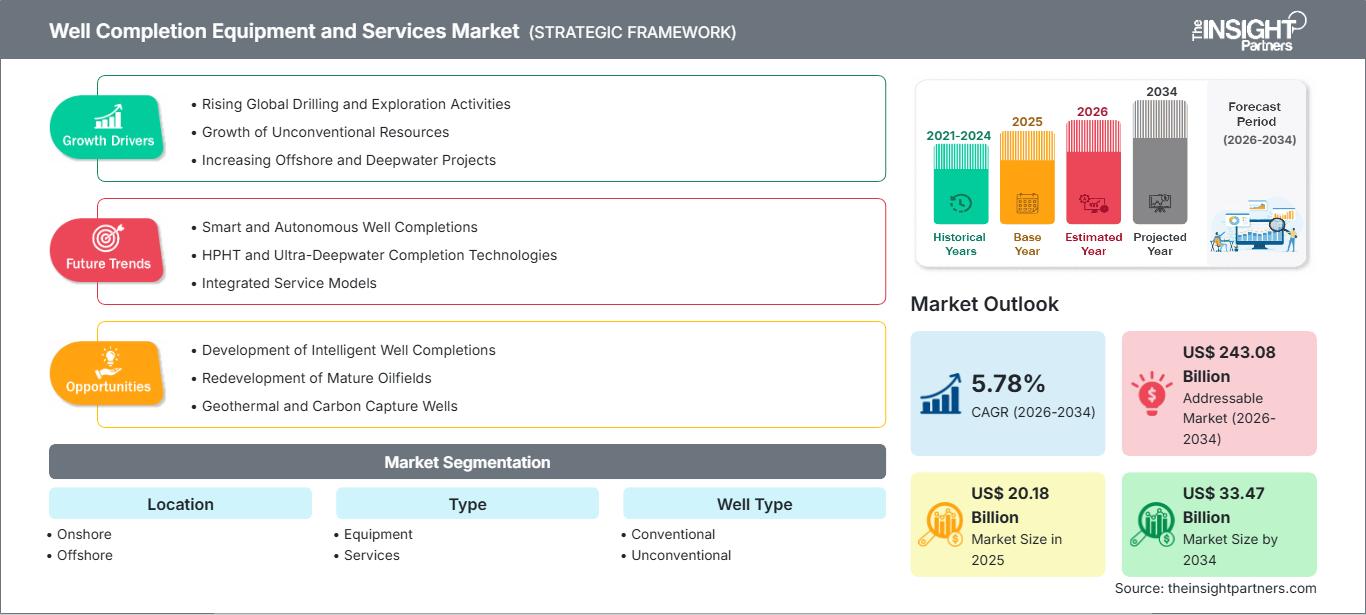
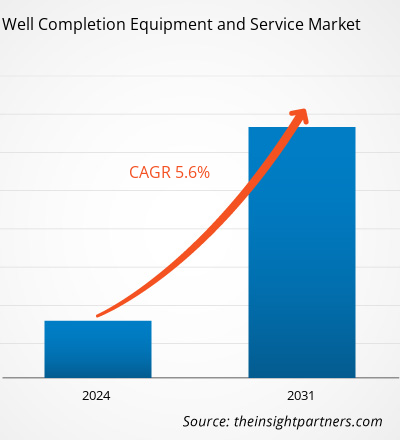
The Well Completion Equipment and Services Market is projected to grow from US$ 20.18 Billion in 2025 to US$ 33.47 Billion by 2034, registering a CAGR of 5.78% during 2026–2034. The market reflects sustained upstream spending on reservoir contact, zonal isolation, sand control, intelligent completions, and intervention-ready well designs as operators prioritize production reliability across conventional, unconventional, onshore, and offshore assets.
North America continues to act as a key market region, the growth of the Well Completion Equipment and Services Market here being driven by increased shale productivity, longer lateral wells, and redeployment efforts for oil fields in the Gulf of Mexico that were previously neglected. The region is forecast to grow at a 5.29% CAGR up to 2034, mainly as operators adopt multistage completions, electric downhole controls, and low-intervention designs to compensate for a restricted number of rigs and to safeguard production from established wells..
Well Completion Equipment and Services Market Assessment and Insights
- North America accounted for 34.66% share in 2025 and is expected to grow at a CAGR of 5.29% between 2026–2034, supported by shale refracs, Gulf of Mexico tiebacks, and completion intensity per well.
- US represented 80.02% of North America in 2025 and is forecast to expand at a CAGR of 5.31% between 2026–2034, led by Permian and Haynesville activity.
- Europe held 10.15% share in 2025 and is projected to grow at a CAGR of 5.41% between 2026–2034, with Norway, the UK, and Germany leading offshore redevelopment and mature-field intervention.
- Asia Pacific captured 25.12% share in 2025 and is set to grow at a CAGR of 6.45% between 2026–2034, driven by China, India, Australia, and Southeast Asian offshore gas projects.
- Largest Segment Onshore held 73.89% market share in 2025 and is expected to grow at a CAGR of 5.55% between 2026–2034 as operators outsource complex execution.
- High Growth Segment Services held 46.04% market share in 2025 and are projected to grow at a CAGR of 6.18% between 2026–2034, supported by shale and tight-gas development.
- Key companies analyzed in detail: Baker Hughes Company, Novomet Group, SLB Limited, NOV Inc., Weatherford International plc, American Completion Tools, Inc., Halliburton Company, Welltec A/S, RPC, Inc., Nine Energy Service, Inc., Superior Energy Services, Inc., and OEG Energy Group Limited.
Source: The Insight Partners' analysis based on proprietary research, government publications, company annual reports, investor presentations, industry databases, and expert interviews.
The technological changes are pushing the Well Completion Equipment and Services Market from separate hardware orders to an entire production system integrating packers, liner hangers valves sand control, frac stages, sensors, and intervention planning. Drilling fewer and more valuable wells by operators is pushing up completion spend per well. Demand for the engineered solutions that minimize well workovers and enhance the well reserves is rising due to longer laterals, deeper reservoirs, high-pressure environments, and offshore subsea tiebacks.
The Well Completion Equipment and Services Market is anticipated to gain advantages of gas security infrastructure investments, offshore brownfield life extension, and unconventional resource development outside North America from now on.
Asian Pacific and Middle East are getting more attention as national oil companies are investing heavily in local production. Adoption of monitored completions, electric controls, and service models that enhance operational transparency is getting a boost from the regulations related to methane, water handling, and well integrity..
Well Completion Equipment and Services Market Report Scope
| Report Attribute | Details |
|---|---|
| Market size in 2025 | US$ 20.18 Billion |
| Market Size by 2034 | US$ 33.47 Billion |
| Global CAGR (2026 - 2034) | 5.78% |
| Historical Data | 2021-2024 |
| Forecast period | 2026-2034 |
Well Completion Equipment and Services Market Analysis
Development in The Well Completion Equipment and Services Market is partly driven by a need to convert inventory of drilled wells into producing wells which generate cash as fast as possible and with minimum risk of lifecycle. The production operators are focused on completion intensity, stage optimization, sand control reliability, and well intervention readiness as the reservoir complexity increases. The greatest demand is expected where every incremental barrel or gas molecule depends on precise zonal access and sustained flow assurance.
Sources of the supply are impacted through such factors as metallurgy, availability of elastomer, availability of electronics, pressure components, and experienced field crews. The supply chain consists of manufacturers of the equipment, completion engineers, pressure pumping services providers, wireline services, suppliers of digital monitoring equipment, and various types of intervention specialists. As research and analysis results of "Well Completion Equipment and Services Market report", one way that the providers differentiate themselves is by forming different kinds of bundling services to cover and support full cycle - design, deployment, and post-completion monitoring and performance - and to make operators accountable.
Top players by share of the market include SLB Limited, Halliburton Company, Baker Hughes Company, Weatherford International plc, and NOV INC. Then again, Novomet Group, Welltec A/S, American Completion Tools, Inc. RPC Inc. Nine Energy Service, Inc. Superior Energy Services, Inc. and OEG Energy Group Limited focus only on certain market sectors and So serve more niche segments. The factors on which companies are differentiating themselves are getting increasingly related to digital controls, the quality of execution in the field, inventory availability, and field-tested robustness in high-pressure and offshore environments.
Funding is mostly going in electrically driven completion tools, continuously monitoring reservoirs at high precision levels, designing completion systems to need minimal downhole interventions, and combining packages of offshore solutions. Major service providers are integrating the technology in pressure completion tools with production systems and data analytics solutions. Meanwhile, regional service providers are competing mainly based on how fast they are and their local geological expertise. Despite the companies' spending is relatively conservative, the Well Completion Equipment and Services Market gets investments at the locations where reliability directly affects the recovery rates, the length between outages, and the lifespan of assets..
● REPORT CUSTOMIZATION
Tailor This Report To Align With Your Specific Business Requirements
This report can be customized to align precisely with your business objectives, scope, and target markets. Customization options include tailored segmentation, geography, competitive analysis, and strategic insights to support informed decision-making.
Customize This Report →WHAT YOU CAN ADJUST
- ● Segmentations
- ● Geography
- ● Competitive Analysis
- ● Language Preferences
Well Completion Equipment and Services Market: Strategic Insights
Regional Insights
North America Well Completion Equipment and Services Market
North America held 34.66% of 2025 revenue, giving the Well Completion Equipment and Services Market share its strongest regional base. The region is expected to grow at a 5.29% CAGR during 2026–2034, supported by Permian productivity, Haynesville gas development, Canadian liquids-rich plays, and Gulf of Mexico subsea tiebacks.
Spending on completing wells is increasingly being channeled towards pressured tools, refracturing works, electric valves, frac diagnostics, and intervention-light designs. EIA data indicating an unprecedented Lower 48 output even though there were fewer than normal drill rigs indicates support for a permanent shift towards achieving greater efficiency from each well. This trend is Most of all beneficial to suppliers who can offer integrated services combining downhole equipment, field operations, and digital monitoring.
U.S. Well Completion Equipment and Services Market
The U.S. accounted for 80.02% of North America in 2025 and is projected to grow at a 5.31% CAGR between 2026–2034. Operators are emphasizing longer laterals, zipper frac execution, plug-and-perf efficiency, sand management, and artificial lift compatibility across the Permian, Eagle Ford, Bakken, Marcellus, and Haynesville basins.
The company's footprint spans wide, Halliburton Company, SLB Limited, Baker Hughes Company, Weatherford International plc NOV Inc. RPC Inc. Nine Energy Service, Inc. and Superior Energy Services, Inc. supplying their clients with completion tools, pressure pumping, intervention, and rental equipment. The demand is shifting towards electric safety valves, frac automation, downhole sensing, and the development of swift re-completion strategies..
Europe Well Completion Equipment and Services Market
Europe represented 10.15% share in 2025 and is expected to expand at a 5.41% CAGR through 2034. Norway remains the leading country because offshore redevelopment, subsea tiebacks, and extended-reach wells require premium completions. The UK focuses on late-life North Sea productivity, Germany supports selective gas and geothermal-adjacent expertise, while France, Italy, and Spain create demand through service bases, engineering support, and Mediterranean energy infrastructure.
While the volume of demand in Europe is not as high as that in North America technically the requirements are more intensive. The operators focus on corrosion resistance, sand control, smart flow control, and intervention planning to comply with the environmental and decommissioning regulations which are very tough. The availability of offshore wind-port logistics, subsea engineering skills and data from mature fields also contribute to a lower number of uncertainties of redevelopment campaigns for completion teams..
APAC Well Completion Equipment and Services Market
Asia Pacific held 25.12% share in 2025 and is projected to grow at a 6.45% CAGR during 2026–2034. China is the leading country, supported by shale gas, tight gas, offshore oil, and state-backed energy security programs. India, Japan, South Korea, and Australia add demand through offshore gas, LNG-linked fields, and mature basin optimization.
Industrial drivers include domestic manufacturing, petrochemical feedstock needs, and offshore construction capacity. Policy support for gas as a transition fuel encourages investment in sand control, liner hanger systems, and completion execution services. Regional buyers increasingly seek localized supply chains that reduce lead times and improve service continuity.
Middle East & Africa Well Completion Equipment and Services Market
Middle East & Africa is expected to grow at a 6.02% CAGR during 2026–2034, with Saudi Arabia leading demand. Saudi gas projects, UAE offshore expansions, South African exploration, and Rest of MEA infrastructure upgrades support completion spending across high-rate gas, carbonate reservoirs, and brownfield redevelopment.
Energy security and reservoir complexity shape procurement priorities. Operators emphasize HPHT packers, corrosion-resistant valves, expandable sand control, and field services that can operate reliably in remote deserts and offshore hubs. Infrastructure-led gas monetization creates steady opportunities for integrated equipment and service providers.
Segmentation Analysis
Location
Location, Onshore is forecast to grow at a 5.55% CAGR during 2026–2034. The Well Completion Equipment and Services Market scope across onshore and offshore projects reflects different operating economics: onshore wells favor speed, repeatability, and cost control, while offshore wells require premium reliability, remote monitoring, and intervention avoidance because workover costs are materially higher.
- Onshore demand is led by shale, tight gas, and mature field re-completion programs where operators require rapid deployment, high stage counts, water management compatibility, and reliable field service execution.
- Offshore completions prioritize subsea reliability, sand control, corrosion resistance, intelligent valves, and long design lives, as intervention costs are high and production uptime is central to field economics.
Type
Type, Equipment is expected to grow at a 5.42% CAGR during 2026–2034. Services lead revenue because engineering, execution, intervention, and re-completion determine whether hardware delivers reservoir value. Equipment demand remains resilient as high-pressure wells, multizone completions, and offshore tiebacks require reliable mechanical systems and application-specific designs.
- Equipment demand is anchored by packers, valves, liner hangers, sand control tools, and multistage systems that must withstand pressure, temperature, corrosion, and production cycling.
- Services remain strategically important because completion design, field execution, diagnostics, and intervention planning directly influence time to production, recovery efficiency, and lifecycle well integrity.
Well Type
Well Type, Conventional is projected to grow at a 5.21% CAGR during 2026–2034. Conventional wells continue to support stable demand in the Middle East and offshore basins, while unconventional wells require more stages, higher proppant intensity, and advanced diagnostics. This mix keeps completion intensity elevated even when rig counts fluctuate.
- Conventional wells sustain demand for cased-hole systems, packers, liner hangers, and sand control where operators focus on reliability, reservoir pressure management, and mature-field recovery.
- Unconventional wells require multistage tools, frac sleeves, plug-and-perf services, diagnostics, and high-efficiency execution to improve contact across long laterals and tight formations.
Well Completion Type
Well Completion Type, Cased Hole is anticipated to grow at a 4.95% CAGR during 2026–2034. Cased-hole completions remain widely adopted because they offer control, isolation, and intervention flexibility. Open-hole systems retain importance in horizontal and carbonate reservoirs where operators seek simplified architecture, improved reservoir exposure, and reduced casing costs.
- Open Hole systems are used where reservoir exposure, reduced casing complexity, and selective isolation support productivity, especially in horizontal wells and carbonate formations.
- Cased Hole completions dominate controlled production environments because they enable zonal isolation, perforation flexibility, pressure management, and easier intervention across complex reservoirs.
Equipment Type
Equipment Type, Packers is forecast to grow at a 5.71% CAGR during 2026–2034. Demand is strongest for systems that improve zonal integrity, sand management, flow control, and multistage efficiency. Premium materials, qualification testing, and compatibility with sensors or electric controls are becoming procurement priorities in deep, hot, sour, and offshore wells.
- Packers support zonal isolation, pressure control, and intervention readiness across producing and injection wells, making reliability and elastomer performance critical purchasing criteria.
- Sand Control Tools are essential in unconsolidated reservoirs and offshore wells, where screen performance, gravel packing quality, and erosion control protect production uptime.
- Multistage Completion Tools improve reservoir contact in horizontal wells by enabling efficient stimulation, selective treatment, and stage optimization across long lateral sections.
- Liner Hanger Systems provide structural support and sealing integrity in extended-reach, deepwater, and high-pressure wells where casing loads and reliability requirements are elevated.
- Control Valves enable production allocation, water management, and zonal optimization, particularly in intelligent completions that require remote operation and reservoir surveillance.
Services Type
Services Type, Completion Execution Services is expected to grow at a 6.39% CAGR during 2026–2034. Service demand is supported by the need for integrated design, reliable field execution, and production restoration. Operators increasingly value providers that can connect reservoir interpretation, equipment selection, logistics, deployment, and intervention into one accountable workflow.
- Completion Design and Engineering converts reservoir data into completion architecture, helping operators balance productivity, risk, cost, intervention access, and regulatory well-integrity expectations.
- Completion Execution Services cover field deployment, pressure testing, stimulation support, and operational coordination, where execution quality directly affects production timing and safety.
- Well Intervention or Re-completion Services restore production, isolate water or gas breakthrough, replace failed components, and adapt mature wells to changing reservoir conditions.
Opportunity Snapshot
| Equipment Type | Revenue Contribution | Trend Tag | Adoption Stage |
| Packers | High | Zonal Isolation | Mature |
| Sand Control Tools | High | Sand Integrity | Scaling |
| Multistage Completion Tools | High | Long Laterals | Scaling |
| Liner Hanger Systems | Medium | Deep Wells | Mature |
| Control Valves | Medium | Smart Flow | Scaling |
| Others | Low | Specialty Tools | Emerging |
Well Completion Equipment and Services Market Growth Drivers and Impact Analysis
Rising Completion Intensity per Productive Well
Operators are turning their attention to fewer but more productive wells, which naturally makes the value of each completion package increase. Longer horizontally drilled sections, tighter spacing of the drilling holes (clusters), higher volumes of proppant (a material used to prop open fractures), and more selective control of the flow are factors that will demand multistage completion tools packers valves, and engineering services. This is a Mainly strong indicator of changes in North America, where production levels continue to remain reasonably high though low drilling numbers, a fact that demonstrates the significant role completion efficiency plays as a productivity instrument.The consequence to the business world is a changing approach from buying the number of tools based mainly on the quantity of volume to purchasing the tools based on their performance that will give the users confidence and reduce down-time, and this will, of course, advantage those firms who can show that their tools are reliable and their operations can be repeated across a number of development pads.
Offshore Redevelopment and Subsea Reliability Needs
Offshore operators are trying to extend field life by using subsea tiebacks, infill drilling, and through the redevelopment of old fields. Since offshore interventions are expensive and depend heavily on the weather, well completion systems should function efficiently over extended periods despite harsh conditions like high pressure corrosion sand production, and limited monitoring from a distance.\nAs a result, it's more and more common to use intelligent valves, sand management systems, high-quality packers, and completion services that guarantee a smooth and fast workflow. The effect can be seen most clearly in the Gulf of Mexico, \nNorth Sea Brazil West Africa, and Australia, where oil companies frequently choose completion suppliers that they believe will ensure the lifetime of their assets rather than lowest initial equipment.
Gas Security and Unconventional Resource Development
Energy security measures worldwide have been promoting domestic gas production in different countries like the US China India, Saudi Arabia, and the UAE. Tight gas, shale gas, and sour gas can only be efficiently produced when accurate fracturing methods, zonal isolation techniques, corrosive materials, and intervention plans are applied. The IEA energy investment analysis indicates that there is still a strong focus around the world on secure fuel supply, which in effect allows continuation of upstream expenditures with capital discipline being strictly preserved. The result of this situation for the market has been unconventional completions companies getting access to a Really larger client pool and in particular to the development projects initiated by national oil companies and large independent operators, which demand development models that have proved effective and can sustain the right balance between production expansion, water management, and oversight of emissions.
Well Completion Equipment and Services Market Future Trends
Electric and Digitally Controlled Completions
Technological advances and market changes are driving developments in Well Completion Equipment and Services that include electric downhole actuators, real-time position sensing, and reservoir intelligence. These technologies eliminate the need for complex hydraulic lines and make production response quicker. Electrol valves, such as safeties and intervals, plus electronically monitored completions, would assist the production process with a more accurate production allocation, water-cut management, and a considerable reduction in high-cost interventions. The technology will probably be accepted first by those who operate offshore, unconventional high-value, and extended-reach wells where additional reserves can justify a higher initial system investment and compliance effort through the years..
Lower-Emission Completion Execution Models
Electric fleets will be used together with computer-controlled pressure pumping systems in the completion process. Less flaring will also be done through improved procedures, as well as the installation of lower-leakage valves, and better water handling systems. Companies that are subject to methane regulations and investor pressure will more than ever look to their completion vendors based on these three parameters: emissions level, safety record, and the openness of operations. Such a pattern favors a few select service businesses that can actually back up claims with proof of fuel usage reduction, shorter well site stays, and measurement implementation throughout the operation. Also, it encourages engineering of equipment that preserves the structure of the well even during multiple stimulation and production phases.
Well Completion Equipment and Services Market Opportunities
Integrated Re-completion Programs for Mature Fields
Besides having a mature field, service providers can also take advantage by blending diagnostics, mechanical isolation, selective stimulation, artificial lift compatibility, and intervention planning, which leads to the best results. There's always a temptation by producers to just re-complete a well rather than drill a new one, mainly because they have the infrastructure and new drilling is not cost-effective at all. This also means they are not risking a drilling operation. Providers can achieve steady revenue streams by designing programs on a large basin scale that will reveal underperforming zones, control water breakthrough situations, and bring back or resume production with the least change to the landscape. Besides, this opportunity is even more important where brownfields are still the main source of supply and national portfolios in North America, the North Sea, Middle East and some portions of Asia-Pacific regions are dependent on brownfield assets.
Localized Supply Chains for Emerging Basins
Emerging oil and gas basins in Asia-Pacific countries, Middle East, Africa and Latin America need dependable completion equipment, but they usually deal with long delivery cycles from abroad, customs delays, and limited number of qualified services. Equipment producers and service companies can invest in regional assembly, repair centers, training facilities, and collaborative ventures with local businesses which can help them reduce lead times Much. Such a move can Yes lead to tangible outcomes, since nowadays, oil and gas companies in the field tend to contract with vendors who have not only the means, but also the willingness, to deliver their work continuously, legally and technically supporting the oil and gas wells in question. Having a capable local workforce, at the same time, means complying with local content requirements without affecting quality or well control.
Recent Developments
- June 2026: Weatherford International plc and NCS Multistage Holdings, Inc. announced that Weatherford has entered into a definitive agreement to acquire NCS Multistage. Under the terms of the agreement, NCS Multistage stockholders have an election to receive either Weatherford common stock or a combination of Weatherford common stock and cash. On a blended basis, this is expected to be the equivalent of 0.463 shares of Weatherford common stock for each NCS Multistage share, with up to 19.99% of this payable in cash. Annual cost synergies are expected to be at least $15 million and be realized within 18 months of closing. The deal is expected to be immediately accretive to adjusted Free Cash Flow per share. NCS Multistage brings a complementary technology portfolio aimed at supporting the optimization of oil and gas well completions and field development strategies. Its solutions are designed to enhance reliability and performance in complex well environments and are widely recognized for engineering rigor and capital-efficient deployment.
- May 2026: Baker Hughes announced a major contract extension with Petrobras to provide integrated solutions for well construction across Brazil’s Santos Basin. Baker Hughes will expand the company’s comprehensive well construction operations in several of the basin’s oilfields. The company’s advanced portfolio – including the AutoTrak rotary steerable system, cutting-edge logging-while-drilling tools, and Dynamus extended-life drill bits – will be deployed across the construction portfolio of deepwater wells, enabling efficient access to subsurface reservoirs and supporting the ongoing development of Brazil's pre-salt oil & gas resources.
- September 2025: SLB Limited — SLB was awarded a major completions contract by Petrobras for up to 35 ultra-deepwater wells offshore Brazil, including electric completions and digital solutions for Atapu and Sépia fields. The work is scheduled to begin in mid-2026 and reinforces demand for real-time intelligence in complex offshore reservoirs.
Frequently Asked Questions

- Comprehensive Market Sizing and Forecast Analysis
- Detailed Segmentation Analysis
- In-Depth Market Dynamics Assessment
- Regional and Country-Level Insights
- Competitive Landscape and Company Benchmarking
- Strategic Business Intelligence
Recent Reports
Testimonials

The Insight Partners' SCADA System Market report is comprehensive, with valuable insights on current trends and future forecasts. The team was highly professional, responsive, and supportive throughout. We are very satisfied and highly recommend their services.
RAN KEDEM Partner, Reali Technologies LTDs
I requested a report on a very specific software market and the team produced the report in a few days. The information was very relevant and well presented. I then requested some changes and additions to the report. The team was again very responsive and I got the final report in less than a week.
JEAN-HERVE JENN Chairman, Future Analytica
We worked with The Insight Partners for an important market study and forecast. They gave us clear insights into opportunities and risks, which helped shape our plans. Their research was easy to use and based on solid data. It helped us make smart, confident decisions. We highly recommend them.
PIYUSH NAGPAL Sr. Vice President, High Beam Global
The Insight Partners delivered insightful, well-structured market research with strong domain expertise. Their team was professional and responsive throughout. The user-friendly website made accessing industry reports seamless. We highly recommend them for reliable, high-quality research services
YUKIHIKO ADACHI CEO, Deep Blue, LLC.
This is the first time I have purchased a market report from The Insight Partners.While I was unsure at first, I visited their web site and felt more comfortable to take the risk and purchase a market report.I am completely satisfied with the quality of the report and customer service. I had several questions and comments with the initial report, but after a couple of dialogs over email with their analyst I believe I have a report that I can use as input to our strategic planning process.Thank you so much for taking the extra time and making this a positive experience.I will definitely recommend your service to others and you will be my first call when we need further market data.
JOHN SUZUKI President and Chief Executive Officer, Board Director, BK Technologies
I wish to appreciate your support and the professionalism you displayed in the course of attending to my request for information regarding to infectious disease IVD market in Nigeria. I appreciate your patience, your guidance, and the fact that you were willing to offer a discount, which eventually made it possible for us to close a deal. I look forward to engaging The Insight Partners in the future, all thanks to the impression you have created in me as a result of this first encounter.
DR CHIJIOKE ONYIA MANAGING DIRECTOR, PineCrest Healthcare Ltd.Reason to Buy
- Informed Decision-Making
- Understanding Market Dynamics
- Competitive Analysis
- Identifying Emerging Markets
- Customer Insights
- Market Forecasts
- Risk Mitigation
- Boosting Operational Efficiency
- Strategic Planning
- Investment Justification
- Tracking Industry Innovations
- Aligning with Regulatory Trends





 Get Free Sample for