
Wrapping Machine Market Trends, Size & Forecast by 2034
Coverage: By Type (Stretch, Shrink, and Others), Operation (Automatic and Semi-Automatic), End-user (Food and Beverages, Chemicals, Pharmaceuticals, Personal Care, and Others), and Geography (North America, Europe, Asia Pacific, and South and Central America)
- Status : Data Released
- Report Code : TIPRE00008045
- Category : Manufacturing and Construction
- No. of Pages : 150
- Available Report Formats :


- Last update date : September 30, 2026


2025 Market Size
US$ 2.95 Bn
Base year value
2034 Forecast
US$ 5.34 Bn
Projected by 2034
CAGR 2026-2034
6.83 %
Growth rate
Addressable Market
US$ 37.48 Bn
(2026-2034)
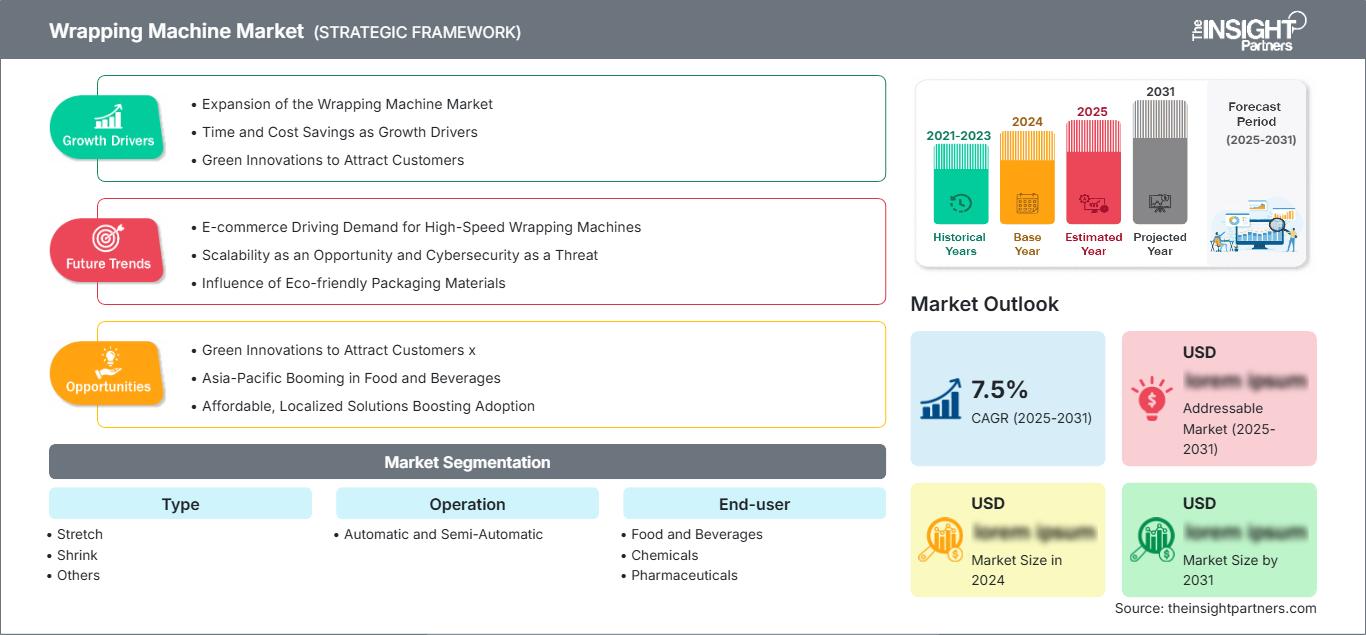
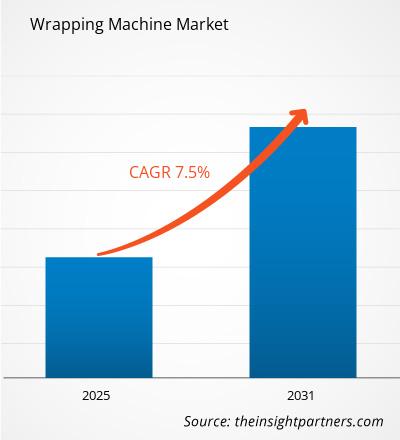
The wrapping machine market size is valued at US$ 2.95 Billion in 2025 and is projected to reach US$ 5.34 Billion by 2034, expanding at a CAGR of 6.83% during 2026–2034. Demand is supported by rising packaged-goods volumes, distribution-center modernization, and the need to secure palletized and unitized products during storage and transportation. Equipment suppliers are increasingly combining wrapping performance with automation, film optimization, controls, and production-line integration.
Across North America, the wrapping machine market is estimated to expand at approximately 3.0–3.8% CAGR between 2026 and 2034. The regional wrapping machine size is supported by mature warehousing infrastructure, high labor costs, and continued investment in automated fulfillment operations. Food and beverage distribution, consumer packaged goods, pharmaceuticals, and industrial logistics remain important application pools, while film reduction and load-stability requirements encourage replacement of older equipment.
Wrapping Machine Market Assessment and Insights
- North America: North America is expected to hold a 22–24% wrapping machine market share in 2025 and grow at a 3.0–3.8% CAGR between 2026–2034, supported by automated distribution centers, established packaging operations, and demand for labor-efficient pallet stabilization.
- US: The US represents approximately 73–75% of North American revenue in 2025 and is expected to expand at a 3.1–3.6% CAGR between 2026–2034, led by logistics and food distribution.
- Europe: Europe is estimated at a 23–25% share in 2025 and a 3.8–4.5% CAGR during 2026–2034. Germany, the UK, France, Italy, and Spain provide the principal industrial and consumer-packaging demand base.
- Asia Pacific: Asia Pacific is estimated at a 36–39% share in 2025 and a 5.7–6.3% CAGR through 2034, with China, India, Japan, South Korea, and Australia shaping demand through manufacturing expansion and logistics investment.
- Largest Segment: Stretch equipment is estimated to represent a 40–43% share in 2025 and expand at a 6.9–7.4% CAGR during 2026–2034, reflecting broad pallet and load-stabilization applications.
- High Growth Segment: Automatic operation is estimated to account for a 44–47% share in 2025 and register a 7.2–7.8% CAGR between 2026–2034 as warehouses prioritize throughput and reduced manual handling.
- Key companies analyzed in detail: Aetnagroup S.p.A.; American Packaging Machinery; Brenton, LLC; Coesia S.p.A.; Orion Packaging Systems LLC; I.M.A. Industria Macchine Automatiche S.p.A.; Lantech; M.J. Maillis S.A.; Syntegon Technology GmbH; Texwrap Packaging Systems LLC; ProMach, Inc.; Krones AG.
Source: The Insight Partners' analysis based on proprietary research, government publications, company annual reports, investor presentations, industry databases, and expert interviews.
The trend has been away from standalone wrapping systems towards packaging cells that integrate conveyors, pallet handling, sensors, film-delivery systems, and control systems of production. Stretch systems will continue to be important for load securing purposes, while shrink technologies will continue to have relevance in product presentation, bundling, and security applications. Equipment development will focus on controlled film application, reduction in film consumption, uptime improvement, remote diagnostics, and integration of downstream warehousing systems. All these developments are likely to enhance the prospects for the growth of the wrapping machines market.
During the forecast period, investment is likely to shift towards emerging manufacturing economies while replacement and modernization activities will dominate the mature markets. Opportunities exist in countries such as India, Southeast Asia, Mexico, and some Middle Eastern countries because of growth in food processing, organized retail, export-oriented manufacturing, and warehousing infrastructure. Policies for environmental protection are also driving equipment with features such as lighter film usage, recyclable polyethylene-based materials, energy efficiency, and reduced packaging consumption. Manufacturers capable of integrating automation technology with material-efficiency features will benefit from customer assessment based on total operating cost rather than purchase cost only.
Wrapping Machine Market Report Scope
| Report Attribute | Details |
|---|---|
| Market size in 2025 | US$ 2.95 Billion |
| Market Size by 2034 | US$ 5.34 Billion |
| Global CAGR (2026 - 2034) | 6.83% |
| Historical Data | 2021-2024 |
| Forecast period | 2026-2034 |
Wrapping Machine Market Analysis
Market expansion of wrapping machines is highly dependent on palletized distribution, food packaging, consumer goods manufacturing, and warehouse throughput. The value chain of wrapping machines is composed of machinery makers, film suppliers, automation integrators, conveyors makers, palletizers makers, distributors, and service companies. Hence, the demand is driven not only by equipment replacement but also by capacity expansion of factories and logistics network reconfiguration. Growing labor restrictions add up to the attractiveness of automated wrapping systems.
Supply conditions are characterized by availability of components, servo drives, program controls, sensors, film feeders, and customization possibilities. Companies compete on such parameters as productivity, consumption of film, load securing, set-up time, and integration. Major clients tend to buy standardized equipment that can be implemented in multiple locations, whereas small firms still stick to semiautomatic solutions owing to their lower cost. Hence, after-sales service and parts supply are still vital buying factors.
The wrapping machine market report suggests that the market is characterized by fragmentation due to the coexistence of specialized manufacturers of stretch wrappers and packaging equipment companies. The following companies have considerable significance for wrapping processes: Aetnagroup S.p.A., Orion Packaging Systems LLC, Lantech, and Texwrap Packaging Systems LLC. Coesia S.p.A., I.M.A. Industria Macchine Automatiche S.p.A., and Syntegon Technology GmbH represent their participation through packaging automation products. The list can be completed by such players as Brenton, LLC and American Packaging Machinery, providing equipment and integration solutions, and M.J. Maillis S.A., ProMach, Inc., and Krones AG.
Key investment trends in the wrapping machine market include automation, digital monitoring, modular equipment, and film management related to sustainability issues. The product activity of Lantech provides an example of how automated integration in warehouses is becoming a trend, while packaging equipment companies implement lifecycle services and manufacturing architectures. Thus, the competitive positioning strategy goes beyond machine speed and focuses on actual film consumption, uptime, visibility, maintenance, and compatibility with material handling systems.
● REPORT CUSTOMIZATION
Tailor This Report To Align With Your Specific Business Requirements
This report can be customized to align precisely with your business objectives, scope, and target markets. Customization options include tailored segmentation, geography, competitive analysis, and strategic insights to support informed decision-making.
Customize This Report →WHAT YOU CAN ADJUST
- ● Segmentations
- ● Geography
- ● Competitive Analysis
- ● Language Preferences
Wrapping Machine Market: Strategic Insights
Regional Insights
North America wrapping machine market
North America is estimated to account for 22–24% of global revenue in 2025, with regional growth projected at a 3.0–3.8% CAGR through 2034. Strengths of the area include advanced distribution network, high degree of warehouse automation, and extensive manufacture of food products, beverages, pharmaceuticals, and consumer goods. The needs arise in high capacity areas where constant pallet containment and minimized operator involvement impact cost of handling.
The wrapping machine market forecast reveals that the US is the leading national market, whereas Canada and Mexico contribute additional demand for wrapping machines through food processing, manufacturing, exporting, and distribution. The replacement market is strong as users tend to replace their conventional wrappers with automatic film control, upgraded sensors, and conveying/palletizing equipment integration. The need for sustainability also stimulates film reduction and accuracy of wrapping pattern. The suppliers possessing strong service network and aftermarket capabilities are strategically positioned.
U.S. wrapping machine market
The US is estimated to represent 73–75% of North American revenue in 2025 and is projected to grow at a 3.1–3.6% CAGR through 2034. Large distribution centers, grocery distribution networks, beverages, and industries provide demand. Increasingly, priorities for applications involve automated pallet handling, constant containment force, minimal plastic film consumption, and compatibility with warehousing control systems.
The major companies have application and services capability throughout the United States to support not only new installation but also replacement installations. Demand is especially applicable in food and beverage industry, pharmaceuticals, personal care industry, and third-party logistics industries, where uniformity in packaging is an issue for subsequent handling. Higher labor cost motivates automation machinery, however, semi-automation is still significant for small companies.
Europe wrapping machine market
Europe is estimated to hold a 23–25% share in 2025 and is projected to expand at a 3.8–4.5% CAGR through 2034. The German market is the leading industrial base, where machinery production is highly advanced and there are also food, beverages, chemicals, and pharmaceuticals markets in the country. The UK is still significant due to its distribution networks and consumer goods logistics needs. The French and Italian markets have high demands for food processing and industrial packaging while Spain is characterized by high food exports and growing logistic facilities. The sustainability regulations and packaging material efficiency are key factors in purchases in the region.
The Germans require high-level automation, precision controls and integration with production lines; the Italians unite packaging machinery production capabilities and export-oriented equipment demand. The French and Spanish customers are becoming more interested in effective food and consumer goods distribution while the British one pay more attention to warehouse effectiveness and labor efficiency. In addition, the Europeans also consider energy efficiency of machines, film optimization, recyclability and traceability of the purchased equipment.
APAC wrapping machine market
APAC is estimated to represent 36–39% of global revenue in 2025 and is projected to grow at a 5.7–6.3% CAGR through 2034. China is at the forefront in terms of demand, followed by Japan, South Korea, India, and Australia. Growth in manufacturing, food processing, exports, organized retailing, and warehousing is driving the demand for wrapping machinery.
China has a combination of size and industrial production, whereas India can provide significant incremental demand from food processing, consumer goods, and logistics upgrade. Japan and South Korea stress automation and precision in their demand. Australia is driven by food and beverages, agriculture, and logistics. Regional policies encouraging manufacturing, infrastructure, and logistics upgrades should help drive demand for equipment, with India being among the fast growing country markets.
Middle East & Africa wrapping machine market
The Middle East and Africa wrapping machine market is projected to expand at a 4.6–5.3% CAGR through 2034. Saudi Arabia and the UAE lead regional investment through food processing, logistics, manufacturing diversification, and large distribution facilities. South Africa remains the principal sub-Saharan market because of its established consumer-goods and industrial base.
Energy, infrastructure, and diversification initiatives affect machinery investment in the region. Gulf states have increased their logistical and production capabilities, requiring systems for automated pallet movement and packaging. South Africa has replacement and modernization investments in place, whereas the rest of the MEA region is price sensitive and relies heavily on distribution channels. The availability of modular machines, services, and low material usage addresses varying levels of investment in these markets.
Segmentation Analysis
Type
The Type segment in the wrapping machine market is expected to expand at a 6.7–7.2% CAGR during 2026–2034. Stretch equipment remains the principal demand base because it stabilizes palletized loads efficiently and supports distribution-intensive operations. Shrink machinery remains important for bundled products, presentation-oriented packaging, and applications requiring a tight protective layer.
- Stretch: Stretch systems hold the strongest market position because they serve pallets, cartons, and irregular loads across manufacturing and logistics. Demand favors pre-stretch control, automatic film cutting, containment consistency, and lower film consumption.
- Shrink: Shrink equipment remains strategically relevant where tight product conformity, bundling, presentation, and protection are priorities. Food, beverages, personal care, and selected industrial applications provide recurring demand for shrink-based packaging.
- Others: Other configurations address specialized wrapping requirements and customized packaging formats. Their strategic role is linked to niche applications where conventional stretch or shrink systems cannot efficiently accommodate product geometry.
Operation
The Operation segment is projected to grow at a 6.9–7.5% CAGR from 2026 to 2034. Automation is gaining importance as facilities seek higher throughput, predictable wrapping quality, lower manual intervention, and better integration with material-handling equipment.
- Automatic: Automatic systems are increasingly selected by high-volume facilities because they support continuous operation, consistent film application, reduced operator involvement, and integration with conveyors, palletizers, robotics, and warehouse-management workflows.
- Semi-Automatic: Semi-automatic machines remain important for smaller plants and mixed-volume operations. Their comparatively lower capital requirement and operational flexibility make them suitable where complete line automation is not yet economically justified.
End-user
The End-user segment in the wrapping machine market is expected to grow at a 6.6–7.1% CAGR during 2026–2034. Packaging-intensive industries continue adopting equipment that protects finished goods, supports distribution efficiency, and accommodates increasing production complexity.
- Food and Beverages: Food and beverage producers require dependable load stabilization across high-volume distribution networks. Packaging consistency, hygiene considerations, throughput, and material optimization make wrapping equipment strategically important.
- Chemicals: Chemical manufacturers prioritize secure containment, handling stability, and reliable packaging of drums, containers, and packaged industrial materials. Equipment selection often emphasizes controlled wrapping and operational safety.
- Pharmaceuticals: Pharmaceutical logistics requires consistent packaging integrity and controlled handling. Wrapping equipment supports secondary distribution by stabilizing loads while integrating with increasingly automated production and warehouse environments.
- Personal Care: Personal-care manufacturers benefit from wrapping systems that accommodate varied product formats and high SKU counts. Flexible automation can reduce changeover losses while maintaining presentation and distribution protection.
- Others: Other industries use wrapping machinery for industrial, agricultural, consumer, and logistics applications. Adoption depends on load characteristics, production volumes, labor availability, and requirements for transport stability.
Opportunity Snapshot
| End-user | Revenue Contribution | Trend Tag | Adoption Stage |
| Food and Beverages | High | Pallet Automation | Mature |
| Chemicals | Medium | Load Containment | Scaling |
| Pharmaceuticals | Medium | Secure Logistics | Scaling |
| Personal Care | Medium | Flexible Automation | Scaling |
| Others | Low | Mixed-Load Handling | Emerging |
Wrapping Machine Market Growth Drivers and Impact Analysis
Expansion of Automated Warehousing and Distribution Centers
The expansion of automated warehouses is changing the role of wrapping equipment from a labor-intensive finishing step into a connected material-handling function. High-throughput facilities increasingly require wrappers to communicate with conveyors, palletizers, autonomous mobile robots, and warehouse-control systems. This integration can reduce manual pallet movement, improve cycle consistency, and create more predictable downstream handling. The impact is particularly significant for grocery, beverage, consumer goods, and third-party logistics operations where pallet volumes are high and labor availability can fluctuate. Automated systems also generate operating data that can be used to monitor film consumption, equipment utilization, and maintenance requirements. As warehouse operators prioritize throughput and standardized processes, equipment suppliers with integration capabilities can capture replacement demand alongside new-facility investment, strengthening the long-term economics of automated wrapping solutions.
Pressure to Reduce Packaging Material Consumption
Material-efficiency requirements in the wrapping machine market are becoming a direct equipment-selection criterion as manufacturers seek to reduce packaging costs and environmental impacts simultaneously. Modern wrappers can control film delivery, pre-stretch levels, wrapping patterns, and containment force more precisely than older systems. Better control allows users to maintain load stability while avoiding unnecessary film application, particularly across standardized pallet configurations. This creates a measurable operating benefit because packaging material represents a recurring cost throughout the machine lifecycle. The effect is especially relevant for large food, beverage, consumer-goods, and logistics operators handling thousands of pallets daily. Equipment manufacturers are consequently emphasizing controlled film usage, programmable recipes, and process monitoring. As sustainability targets become more operationally specific, machinery capable of documenting material reductions should gain an advantage over equipment competing primarily on purchase price.
Growth of Packaged Food and Consumer Goods Distribution
Expansion of packaged-food and consumer-goods distribution is creating sustained demand for reliable secondary and tertiary packaging equipment. Urbanization, organized retail, e-commerce fulfillment, and longer distribution networks increase the number of handling stages experienced by finished products before reaching customers. Stable palletization helps reduce shifting, damage, and rework during these movements. Food and beverage operations are particularly important because high production volumes require consistent wrapping cycles and rapid changeovers. Consumer-goods manufacturers also face increasingly diverse SKU portfolios, making flexible equipment valuable across multiple product configurations. The resulting demand is not limited to new production plants. Existing facilities are upgrading machines to improve throughput, reduce operator dependency, and connect wrapping stations with palletizing and warehouse systems. This replacement cycle provides a durable source of equipment demand across mature and emerging markets.
Wrapping Machine Market Future Trends
Connected Wrapping Cells and Predictive Performance Management
wrapping machine market trends are increasingly moving toward connected wrapping cells that collect operating information and communicate with broader factory systems. Future installations are likely to incorporate machine-condition monitoring, recipe management, remote diagnostics, automated fault alerts, and performance dashboards as standard capabilities rather than premium additions. Such systems can help manufacturers identify recurring film breaks, abnormal cycle times, component wear, and deviations in containment force before they become costly production interruptions. Integration with manufacturing-execution platforms can also improve traceability by linking packaging parameters with production batches. Over time, predictive analytics may support maintenance scheduling based on actual operating conditions rather than fixed intervals. The commercial effect will extend beyond machine sales because suppliers can build recurring service relationships around monitoring, optimization, software updates, and lifecycle support, while users gain greater visibility into total equipment productivity.
Adaptive Film Management and Lower-Carbon Packaging Operations
Future equipment development is expected to place greater emphasis on adaptive film management, particularly as converters and brand owners pursue downgauging without compromising pallet stability. Wrappers will increasingly adjust film delivery and application parameters according to load dimensions, weight distribution, corner geometry, and transport requirements. This approach can support more consistent use of recyclable polyethylene-based films and reduce unnecessary material application. Energy management is another emerging priority, with machine architectures designed to reduce idle consumption and optimize motor operation during variable production schedules. Software-based recipes should allow facilities to compare material consumption across products and identify opportunities for process improvement. These capabilities could become particularly important in Europe and other markets where packaging policy increasingly emphasizes resource efficiency. Equipment suppliers that combine adaptive controls with measurable material savings are likely to differentiate through lifecycle performance rather than nominal machine specifications.
Wrapping Machine Market Opportunities
Automation Packages for Mid-Sized Manufacturers
A significant opportunity exists in modular automation packages designed for mid-sized manufacturers that cannot justify full robotic packaging lines. These customers often operate semi-automatic equipment but face rising labor costs, inconsistent throughput, or difficulty maintaining uniform wrapping quality. Suppliers can address the gap with scalable systems that automate film cutting, pallet detection, wrapping cycles, and conveyor transfer while preserving relatively simple operating interfaces. Modular architecture allows customers to add automation progressively as volumes increase, reducing initial capital risk. The opportunity is especially relevant in India, Southeast Asia, Mexico, Eastern Europe, and selected Middle Eastern markets where manufacturing capacity is expanding but automation maturity varies considerably. Vendors that combine affordable automation with local installation, training, spare-parts availability, and financing support can build long-term customer relationships. This approach also creates a pathway from semi-automatic installations toward fully integrated packaging cells.
Integrated Solutions for Emerging Logistics Hubs
Emerging logistics hubs provide another opportunity as governments and private investors expand warehousing, export manufacturing, and distribution infrastructure. New facilities increasingly seek standardized equipment that can be replicated across multiple locations, creating potential for suppliers offering modular wrapping platforms with common controls and service procedures. India, Mexico, Southeast Asia, Saudi Arabia, and the UAE are particularly relevant because manufacturing diversification and logistics investment are increasing the need for dependable pallet-handling processes. Suppliers can strengthen their position by partnering with system integrators, warehouse developers, and local distributors rather than relying solely on direct machine sales. Offering commissioning support, operator training, spare-parts programs, and remote technical assistance can reduce adoption barriers. The strongest opportunity lies in projects where wrapping is designed as part of an integrated material-flow architecture rather than purchased as an isolated packaging-machine component.
Frequently Asked Questions

- Comprehensive Market Sizing and Forecast Analysis
- Detailed Segmentation Analysis
- In-Depth Market Dynamics Assessment
- Regional and Country-Level Insights
- Competitive Landscape and Company Benchmarking
- Strategic Business Intelligence
Recent Reports
Testimonials

The Insight Partners' SCADA System Market report is comprehensive, with valuable insights on current trends and future forecasts. The team was highly professional, responsive, and supportive throughout. We are very satisfied and highly recommend their services.
RAN KEDEM Partner, Reali Technologies LTDs
I requested a report on a very specific software market and the team produced the report in a few days. The information was very relevant and well presented. I then requested some changes and additions to the report. The team was again very responsive and I got the final report in less than a week.
JEAN-HERVE JENN Chairman, Future Analytica
We worked with The Insight Partners for an important market study and forecast. They gave us clear insights into opportunities and risks, which helped shape our plans. Their research was easy to use and based on solid data. It helped us make smart, confident decisions. We highly recommend them.
PIYUSH NAGPAL Sr. Vice President, High Beam Global
The Insight Partners delivered insightful, well-structured market research with strong domain expertise. Their team was professional and responsive throughout. The user-friendly website made accessing industry reports seamless. We highly recommend them for reliable, high-quality research services
YUKIHIKO ADACHI CEO, Deep Blue, LLC.
This is the first time I have purchased a market report from The Insight Partners.While I was unsure at first, I visited their web site and felt more comfortable to take the risk and purchase a market report.I am completely satisfied with the quality of the report and customer service. I had several questions and comments with the initial report, but after a couple of dialogs over email with their analyst I believe I have a report that I can use as input to our strategic planning process.Thank you so much for taking the extra time and making this a positive experience.I will definitely recommend your service to others and you will be my first call when we need further market data.
JOHN SUZUKI President and Chief Executive Officer, Board Director, BK Technologies
I wish to appreciate your support and the professionalism you displayed in the course of attending to my request for information regarding to infectious disease IVD market in Nigeria. I appreciate your patience, your guidance, and the fact that you were willing to offer a discount, which eventually made it possible for us to close a deal. I look forward to engaging The Insight Partners in the future, all thanks to the impression you have created in me as a result of this first encounter.
DR CHIJIOKE ONYIA MANAGING DIRECTOR, PineCrest Healthcare Ltd.Reason to Buy
- Informed Decision-Making
- Understanding Market Dynamics
- Competitive Analysis
- Identifying Emerging Markets
- Customer Insights
- Market Forecasts
- Risk Mitigation
- Boosting Operational Efficiency
- Strategic Planning
- Investment Justification
- Tracking Industry Innovations
- Aligning with Regulatory Trends





 Get Free Sample for