
Automotive Steering Angle Sensor Market Size, Share & Growth by 2034
Coverage: By Sensor Type (Health Monitoring Systems, Torque Sensors, Intelligent Multi-functional Sensor Systems, Position Sensors/Angle Sensors, and Other Sensor Types), Vehicle Type (Passenger Cars, Light Commercial Vehicles, and Heavy Commercial Vehicles), Technology (Contacting and Magnetic), and Geography
- Status : Data Released
- Report Code : TIPRE00010260
- Category : Automotive and Transportation
- No. of Pages : 150
- Available Report Formats :


- Last update date : May 22, 2026


2025 Market Size
US$ 1.37 Bn
Base year value
2034 Forecast
US$ 2.76 Bn
Projected by 2034
CAGR 2026-2034
8.09 %
Growth rate
Addressable Market
US$ 18.56 Bn
(2026-2034)
The global automotive steering angle sensor market size is projected to reach US$ 2.76 billion by 2034 from US$ 1.37 billion in 2025. The market is anticipated to register a CAGR of 8.09% during the forecast period 2026–2034.
Key market dynamics include the rising global demand for vehicle safety systems, escalating integration of advanced driver assistance systems (ADAS), and rigorous government mandates for electronic stability control (ESC). Additionally, the market is expected to benefit from the ongoing transition toward electric power steering (EPS), the rapid expansion of the electric vehicle (EV), and advancements in steer-by-wire technologies that require high-precision sensor redundancy.
Automotive Steering Angle Sensor Market Analysis
The automotive steering angle sensor market analysis shows a shift toward high-reliability perception systems as manufacturers prioritize active safety and autonomous navigation. The market trends indicate a move from basic standalone components to integrated sensor arrays that offer multi-functional data points. Strategic opportunities are emerging in the software-defined vehicle space, where steering data is used for real-time diagnostics and predictive maintenance. The market expansion depends on the ability to manage high development costs and complex calibration requirements for advanced sensing nodes. Competitive differentiation now stands out depending on the integration of artificial intelligence for signal processing and the achievement of high ASIL D functional safety ratings. This approach helps Tier-1 suppliers maintain long-term contracts with major original equipment manufacturers (OEMs).
Automotive Steering Angle Sensor Market Overview
Automotive sensors have evolved from auxiliary parts to core components of modern vehicle intelligence. The market includes intelligent multi-functional systems, precise torque sensors, and sophisticated health monitoring units. Both established automotive electronics giants and emerging semiconductor firms compete in this market, using technologies such as magnetic field sensing and contacting resistive methods. Growing demand for automated parking and lane-keep assistance among safety-conscious consumers in Europe and North America has increased the popularity of steering sensors as vital safety infrastructure. Asia-Pacific leads in revenue due to its status as a global automotive production powerhouse, while North America is advancing in high-end ADAS adoption and autonomous testing. The US market represents a highly developed landscape, characterized by the rapid adoption of sophisticated safety technologies and autonomous vehicle testing. Growth is driven by federal regulations prioritizing occupant protection and a strong domestic shift toward electric power steering. High demand for premium SUVs and EVs sustains innovation in precision sensing.
Market Assessment and Insights
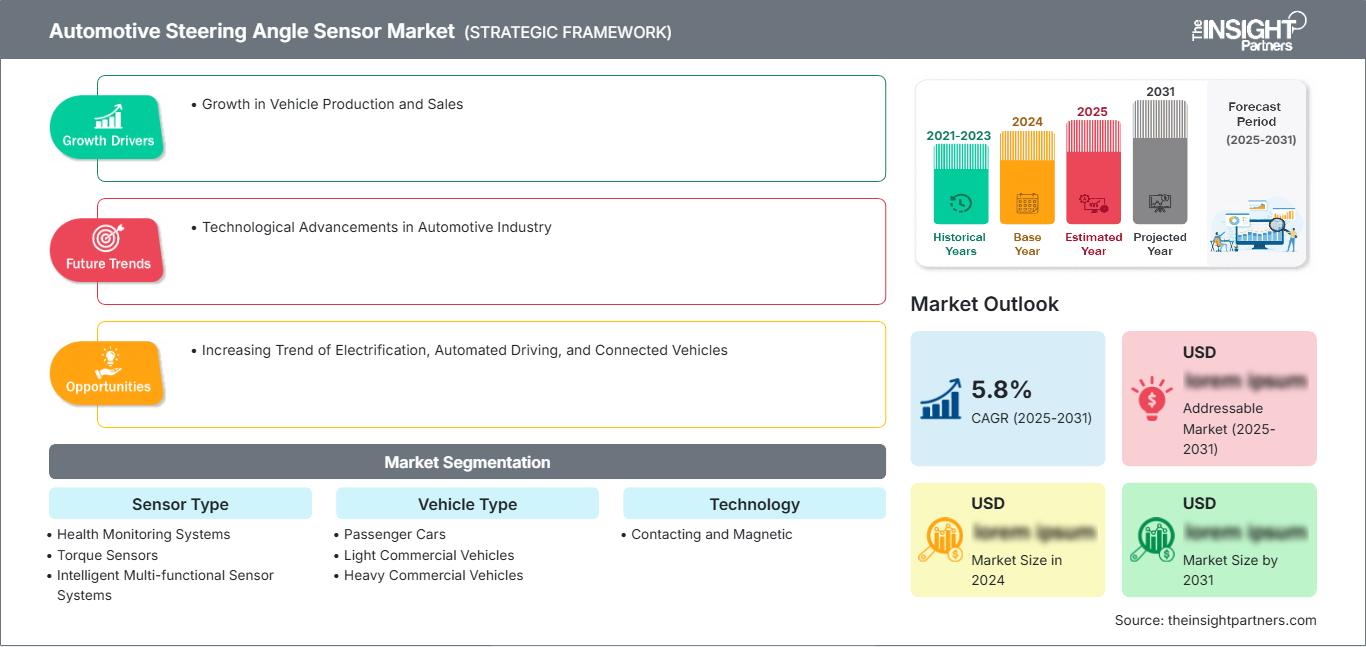
- Global market for Automotive Steering Angle Sensor was valued at US$ 1.37 Billion in 2025
- Annual market size is expected to reach US$ 2.76 Billion by 2034
- Total addressable market (TAM) during 2026-2034 is projected to reach approximately US$ 18.56 Billion
- Market is anticipated to register a CAGR of 8.09% during the forecast period
- The United States represents a key market, supported by Growth in Vehicle Production and Sales, as well as evolving industry dynamics
- Market analysis covers North America, Europe, Asia-Pacific, South and Central America, Middle East and Africa, with growth evaluated across the forecast period
- Market opportunities such as Increasing Trend of Electrification, Automated Driving, and Connected Vehicles are expected to influence market dynamics and addressable market
- Report profiles industry participants, including Robert Bosch GmbH, Continental AG, DENSO Corporation, HELLA GmbH & Co. KgaA, NXP Semiconductor, while analyzing competitive strategies and innovation developments
-
Source: The Insight Partners' analysis based on proprietary research, government publications, company annual reports, investor presentations, industry databases, and expert interviews.
● REPORT CUSTOMIZATION
Tailor This Report To Align With Your Specific Business Requirements
This report can be customized to align precisely with your business objectives, scope, and target markets. Customization options include tailored segmentation, geography, competitive analysis, and strategic insights to support informed decision-making.
Customize This Report →WHAT YOU CAN ADJUST
- ● Segmentations
- ● Geography
- ● Competitive Analysis
- ● Language Preferences
Automotive Steering Angle Sensor Market: Strategic Insights
-
Get Top Key Market Trends of this report.This FREE sample will include data analysis, ranging from market trends to estimates and forecasts.
Automotive Steering Angle Sensor Market Drivers and Opportunities
Market Drivers:
- Broad Automotive Industry Shift Toward EPS: The replacement of hydraulic systems with electric power steering has fundamentally increased the necessity for high-accuracy electronic angle and torque feedback.
- Increasing Complexity of ADAS: Modern safety features like lane departure warning and adaptive cruise control require constant and precise steering input data to maintain vehicle trajectory.
- Stringent Global Safety Mandates: Regulations such as Euro NCAP 2026 and US automatic emergency braking requirements are raising the baseline for sensor accuracy and system redundancy.
Market Opportunities:
- Expansion into Steer-by-Wire Technology: As mechanical steering columns are removed in futuristic vehicle designs, the demand for high-redundancy digital sensors will increase significantly.
- Growth in Connected and Software-Defined Vehicles: Integrating steering sensors with IoT platforms allows for remote monitoring, feature activation, and insurance-linked data services.
- Development of In-Cabin Monitoring: Opportunities are rising to combine steering behavior data with interior sensors to detect driver drowsiness or distraction.
Automotive Steering Angle Sensor Market Report Segmentation Analysis
The Automotive Steering Angle Sensor Market share is analyzed across various segments to provide a clearer understanding of its structure, growth potential, and emerging trends. Below is the standard segmentation approach used in industry reports:
By Sensor Type:
- Health Monitoring Systems: A specialized segment focused on tracking the condition of the steering system to prevent mechanical failures.
- Torque Sensors: Often integrated with angle sensors, these are vital for measuring the physical force applied to the steering wheel in EPS systems.
- Intelligent Multi-functional Sensor Systems: Advanced modules that combine multiple sensing parameters into a single unit for improved efficiency.
- Position Sensors/Angle Sensors: The primary segment responsible for detecting the rotational position of the steering wheel.
- Other Sensor Types: Includes specialized speed and pressure sensors related to the steering assembly.
By Vehicle Type:
- Passenger Cars: The dominant segment, driven by high production volumes and the mainstreaming of safety features in consumer vehicles.
- Light Commercial Vehicles: A segment showing steady growth due to increased safety awareness in logistics and delivery.
- Heavy Commercial Vehicles: Holds a smaller share but requires highly durable sensors capable of operating in extreme industrial environments.
By Technology:
- Magnetic: The fastest-growing technology, including Hall-effect and AMR/GMR sensors, favored for their contactless design and long operational life.
- Contacting: A traditional technology using physical resistive elements, primarily used in cost-sensitive applications or older vehicle platforms.
By Geography:
- North America
- Europe
- Asia Pacific
- South & Central America
- Middle East & Africa
Automotive Steering Angle Sensor Market Report Scope
| Report Attribute | Details |
|---|---|
| Market size in 2025 | US$ 1.37 Billion |
| Market Size by 2034 | US$ 2.76 Billion |
| Global CAGR (2026 - 2034) | 8.09% |
| Historical Data | 2021-2024 |
| Forecast period | 2026-2034 |
| Segments Covered |
By Sensor Type
|
| Regions and Countries Covered |
North America
|
| Market leaders and key company profiles |
|
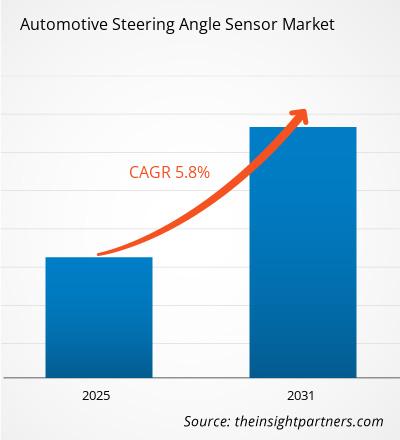
Automotive Steering Angle Sensor Market Players Density: Understanding Its Impact on Business Dynamics
The Automotive Steering Angle Sensor Market is growing rapidly, driven by increasing end-user demand due to factors such as evolving consumer preferences, technological advancements, and greater awareness of the product's benefits. As demand rises, businesses are expanding their offerings, innovating to meet consumer needs, and capitalizing on emerging trends, which further fuels market growth.
Automotive Steering Angle Sensor Market Share Analysis by Geography
Asia-Pacific is expected to grow fastest in the coming years. Emerging markets in South & Central America, the Middle East, and Africa also have many untapped opportunities for sensor manufacturers and automotive electronic suppliers to expand.
The automotive steering angle sensor market is undergoing a significant transformation, moving from a standard mechanical component to a high-value digital safety node. Growth is driven by the rising adoption of electric power steering (EPS), a surge in autonomous vehicle development, and the expansion of the high-end electric vehicle sector. Below is a summary of market share and trends by region:
North America
- Market Share: A technologically advanced segment, early adoption of Level 3 autonomous features, and a well-established ecosystem of Tier-1 suppliers.
- Key Drivers:
- Strong penetration of electric vehicles and high consumer demand for connected and semi-autonomous features.
- Well-established automotive OEM and Tier-1 supplier ecosystem focused on early ADAS adoption.
- Mature regulatory environment emphasizing vehicle safety and emissions reduction.
- Trends: High sensor density per vehicle and the successful adoption of ASIL D-compliant architectures to support the growing autonomous testing landscape.
Europe
- Market Share: Holds a substantial share, anchored by high safety standards and the presence of luxury automotive brands in Germany and France.
- Key Drivers:
- Stringent safety and environmental regulations requiring tire pressure monitoring and driver alerting systems.
- European OEMs' focus on premium safety and efficient electronic steering architectures.
- Robust focus on reducing road fatalities and achieving aggressive carbon emission targets.
- Trends: A strategic shift toward prioritizing high-margin, intelligent multi-functional sensors. There is also an increasing focus on integrated health monitoring sensors to meet the demands of premium European consumers.
Asia-Pacific
- Market Share: The global powerhouse, with China acting as the largest producer and consumer of automotive sensors.
- Key Drivers:
- Massive vehicle production hubs in China, Japan, and India are seeking cost-effective and reliable EPS solutions.
- Rapid urbanization and rising disposable incomes are leading to a preference for modern, feature-rich passenger vehicles.
- Trends: Heavy reliance on e-commerce for aftermarket parts and a focus on magnetic position sensors to support the massive domestic electric vehicle manufacturing pipelines.
South and Central America
- Market Share: Emerging market with a growing manufacturing in countries like Brazil and Chile.
- Key Drivers:
- Modernization of small-scale assembly plants into commercial-grade automotive production facilities.
- Increasing awareness of the safety benefits of electronic stability control in urban centers.
- Rising interest in international safety standards among middle-to-high income segments.
- Trends: Growth of localized supply chains and the introduction of entry-level EPS systems to differentiate from the dominant mechanical steering market.
Middle East and Africa
- Market Share: Developing market with potential rooted in heavy machinery and regional fleet expansion.
- Key Drivers:
- Traditional presence of heavy-duty vehicles in regional industrial and logistics.
- High demand for robust, shelf-stable electronic components suited for arid climates.
- Strategic investments in infrastructure to improve local technology adoption.
- Trends: Implementation of modern digital sensors to formalize the informal vehicle repair market, coupled with a focus on high-durability angle sensors for the commercial segment.
High Market Density and Competition
Competition is intensifying due to the presence of established leaders such as Robert Bosch GmbH, Continental AG, and ZF Friedrichshafen AG. Regional innovators and semiconductor experts like Infineon Technologies, NXP Semiconductors, and Melexis NV also contribute to a diverse and rapidly expanding market landscape.
This competitive environment pushes vendors to differentiate through:
- Innovation in Accuracy and Miniaturization: Developers are focused on creating smaller, more precise sensors that can be easily integrated into modern compact steering modules.
- Strategic Partnerships: Collaborations between sensor manufacturers and software companies to develop next-generation perception platforms for autonomous driving.
- Supply Chain Vertical Integration: Managing the entire lifecycle from raw materials like specialized magnets to the final electronic control unit integration.
Opportunities and Strategic Moves
- Partner with high-end automotive OEMs and EV startups to tap into the surging demand for steer-by-wire and autonomous driving platforms in Asia-Pacific and North American markets.
- Incorporate sustainable manufacturing practices and rare-earth-free magnetic designs to appeal to environmentally conscious regulators and consumers seeking ethical automotive alternatives.
Major Companies operating in the Automotive Steering Angle Sensor Market are:
- Robert Bosch GmbH
- Continental AG
- DENSO Corporation
- HELLA GmbH & Co. KgaA
- NXP Semiconductor
Disclaimer: The companies listed above are not ranked in any particular order.
Automotive Steering Angle Sensor Market News and Recent Developments
- In October 2025, Nexteer Automotive announced its Direct Drive Hand Wheel Actuator (DD-HWA) as the company's latest advancement in Steer-by-Wire (SbW) technologies. DD-HWA establishes a new benchmark for steering feel, system integration, and vehicle design flexibility, enabling automakers to deliver next-generation driving experiences across software-defined vehicles and all levels of assisted and automated driving. DD-HWA is compatible with both 12V and 48V vehicle architectures, supporting integration across traditional, hybrid, and electrified platforms globally.
- In August 2025, the international automotive supplier FORVIA HELLA started series production with the latest generation of steering sensor technology for another renowned Chinese automotive manufacturer, a key technology for fully electric steer-by-wire systems. At the beginning of the year, the first two series projects for steer-by-wire steering sensors were successfully launched with premium manufacturers in Germany and China. Development and series production take place within FORVIA HELLA’s electronics production network in Germany and China.
Automotive Steering Angle Sensor Market Report Coverage and Deliverables
The Automotive Steering Angle Sensor Market Size and Forecast (2021–2034) report provides a detailed analysis of the market covering below areas:
- Automotive Steering Angle Sensor Market size and forecast at global, regional, and country levels for all the key market segments covered under the scope
- Automotive Steering Angle Sensor Market trends, as well as market dynamics such as drivers, restraints, and key opportunities
- Detailed PEST and SWOT analysis
- Automotive Steering Angle Sensor Market analysis covering key market trends, global and regional framework, major players, regulations, and recent market developments
- Industry landscape and competition analysis covering market concentration, heat map analysis, prominent players, and recent developments in the Automotive Steering Angle Sensor Market.
- Detailed company profiles
Frequently Asked Questions

- Comprehensive Market Sizing and Forecast Analysis
- Detailed Segmentation Analysis
- In-Depth Market Dynamics Assessment
- Regional and Country-Level Insights
- Competitive Landscape and Company Benchmarking
- Strategic Business Intelligence
Recent Reports
Testimonials

The Insight Partners' SCADA System Market report is comprehensive, with valuable insights on current trends and future forecasts. The team was highly professional, responsive, and supportive throughout. We are very satisfied and highly recommend their services.
RAN KEDEM Partner, Reali Technologies LTDs
I requested a report on a very specific software market and the team produced the report in a few days. The information was very relevant and well presented. I then requested some changes and additions to the report. The team was again very responsive and I got the final report in less than a week.
JEAN-HERVE JENN Chairman, Future Analytica
We worked with The Insight Partners for an important market study and forecast. They gave us clear insights into opportunities and risks, which helped shape our plans. Their research was easy to use and based on solid data. It helped us make smart, confident decisions. We highly recommend them.
PIYUSH NAGPAL Sr. Vice President, High Beam Global
The Insight Partners delivered insightful, well-structured market research with strong domain expertise. Their team was professional and responsive throughout. The user-friendly website made accessing industry reports seamless. We highly recommend them for reliable, high-quality research services
YUKIHIKO ADACHI CEO, Deep Blue, LLC.
This is the first time I have purchased a market report from The Insight Partners.While I was unsure at first, I visited their web site and felt more comfortable to take the risk and purchase a market report.I am completely satisfied with the quality of the report and customer service. I had several questions and comments with the initial report, but after a couple of dialogs over email with their analyst I believe I have a report that I can use as input to our strategic planning process.Thank you so much for taking the extra time and making this a positive experience.I will definitely recommend your service to others and you will be my first call when we need further market data.
JOHN SUZUKI President and Chief Executive Officer, Board Director, BK Technologies
I wish to appreciate your support and the professionalism you displayed in the course of attending to my request for information regarding to infectious disease IVD market in Nigeria. I appreciate your patience, your guidance, and the fact that you were willing to offer a discount, which eventually made it possible for us to close a deal. I look forward to engaging The Insight Partners in the future, all thanks to the impression you have created in me as a result of this first encounter.
DR CHIJIOKE ONYIA MANAGING DIRECTOR, PineCrest Healthcare Ltd.Reason to Buy
- Informed Decision-Making
- Understanding Market Dynamics
- Competitive Analysis
- Identifying Emerging Markets
- Customer Insights
- Market Forecasts
- Risk Mitigation
- Boosting Operational Efficiency
- Strategic Planning
- Investment Justification
- Tracking Industry Innovations
- Aligning with Regulatory Trends





 Get Free Sample for