
Cardiac Monitoring Devices Market Size, Share and Forecast to 2034
Coverage: By Type (Cardiovascular Devices, Multi-Parameter ECG Monitors, Patient Monitoring Devices, Ambulatory Cardiac Monitoring, and Cardiac Monitors), Product Type (Portable Monitor, Smart Wearable Monitor, and Standard Monitor), Application (Coronary Heart Diseases, Sudden Cardiac Arrest, Stroke, Arrhythmia, Congenital Heart Diseases, Heart Failure, Pulmonary Hypertension, Heart Function (HF/LVEDP), Pulmonary Artery Pressure (PA), and Others), and End User (Hospitals, Ambulatory Surgery Centers, Cardiac Centers, Home Care, Clinics, and Others)
- Status : Data Released
- Report Code : TIPRE00017793
- Category : Life Sciences
- No. of Pages : 150
- Available Report Formats :


- Last update date : September 08, 2026


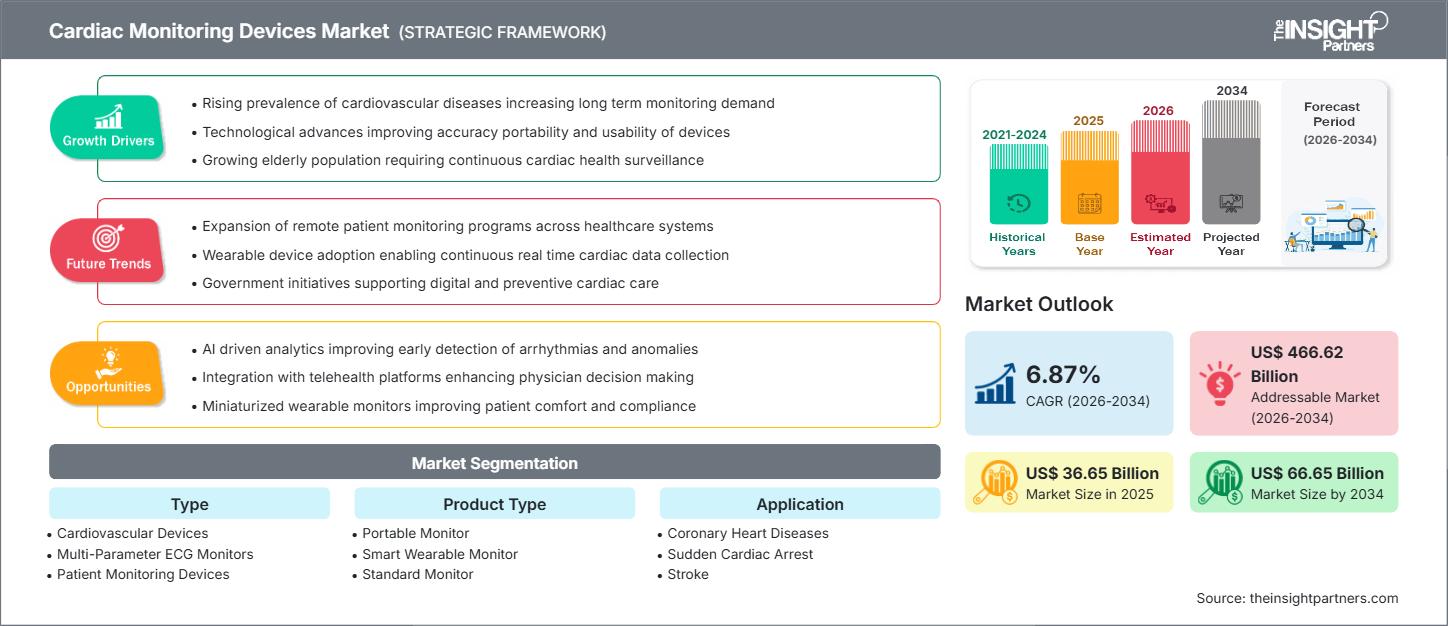
2025 Market Size
US$ 36.65 Bn
Base year value
2034 Forecast
US$ 66.65 Bn
Projected by 2034
CAGR 2026-2034
6.87 %
Growth rate
Addressable Market
US$ 466.62 Bn
(2026-2034)
The Cardiac Monitoring Devices Market is projected to expand from US$ 36.65 Billion in 2025 to US$ 66.65 Billion by 2034, registering a CAGR of 6.87% during 2026–2034. Demand is being shaped by increasing cardiovascular disease detection, wider use of continuous electrocardiographic surveillance, growing adoption of wearable monitors, and the integration of connected monitoring into hospital, ambulatory, and home-based care pathways.
North America remains the most commercially established region, with an estimated CAGR of 6.2–6.8% through 2034. The Cardiac Monitoring Devices Market size benefits from strong reimbursement for ambulatory monitoring, established clinical infrastructure, and extensive adoption of telemetry and remote cardiac diagnostic services. In the US, cardiovascular disease affected 127.9 million adults during 2017–2020, reinforcing the clinical need for scalable monitoring capacity.
Cardiac Monitoring Devices Market Assessment and Insights
- North America: The region held a 38–42% share in 2025 and is expected to grow at a CAGR of 6.2–6.8% during 2026–2034, supported by reimbursement coverage, connected hospital systems, and ambulatory ECG utilization.
- US: The country represented 82–86% of North American revenue in 2025 and is projected to register a CAGR of 6.3–6.9% during 2026–2034.
- Europe: Europe accounted for a 26–30% share in 2025 and is expected to expand at a CAGR of 5.8–6.4% during 2026–2034, led by Germany, the UK, France, Italy, and Spain.
- Asia Pacific: Asia Pacific held a 21–25% share in 2025 and is forecast to grow at a CAGR of 7.8–8.6% during 2026–2034, with China, Japan, India, South Korea, and Australia driving adoption.
- Largest Segment: Patient Monitoring Devices captured a 30–34% market share in 2025 and is projected to expand at a CAGR of 6.4–7.0% during 2026–2034.
- High Growth Segment: Smart Wearable Monitor represented a 24–28% market share in 2025 and is forecast to grow at a CAGR of 8.6–9.4% during 2026–2034.
- Key companies analyzed in detail: Abbott Laboratories, Koninklijke Philips N.V., GE HealthCare Technologies Inc., Medtronic plc, Boston Scientific Corporation, Baxter International Inc., iRhythm Technologies, Inc., BIOTRONIK SE & Co. KG, Nihon Kohden Corporation, and Hill-Rom Holdings, Inc.
Source: The Insight Partners' analysis based on proprietary research, government publications, company annual reports, investor presentations, industry databases, and expert interviews.
Cardiac monitoring has changed from stationary electrocardiographs and short-term Holter monitoring to wireless telemetry, wearable patches, implantable monitors, and cloud-based diagnosis services. Trends within production are more geared towards using low power sensors, smaller electronics, biocompatible materials, algorithm support, and secure platforms for data. The vendors have also started moving from the sale of individual equipment towards subscription-based services involving equipment delivery, data analysis, technician analysis, report generation, and interface with hospital management systems.
Going forward, innovations will focus on the development of healthcare networks in the Asia Pacific, Middle East, and Latin American regions, as increased capacity for cardiology in these regions will result in the need for portable cardiac monitoring devices. The regulatory approval of sensor-enabled digital health technology products is increasing the opportunities for wearable products that can be used continuously or sporadically for cardiac monitoring. The FDA has an online resource on authorized wearable and at-home sensor-based medical devices.
Cardiac Monitoring Devices Market Report Scope
| Report Attribute | Details |
|---|---|
| Market size in 2025 | US$ 36.65 Billion |
| Market Size by 2034 | US$ 66.65 Billion |
| Global CAGR (2026 - 2034) | 6.87% |
| Historical Data | 2021-2024 |
| Forecast period | 2026-2034 |
Cardiac Monitoring Devices Market Analysis
Market growth of Cardiac Monitoring Devices is driven by the ongoing global burden of cardiovascular disease. According to WHO estimates, cardiovascular diseases caused 19.8 million deaths in 2022, accounting for about 32% of all deaths globally, while heart attack and stroke accounted for 85% of cardiovascular disease-related fatalities. Therefore, demand ranges from emergency monitoring to longitudinal arrhythmia detection, discharge monitoring, and heart failure management.
Value Chain involves suppliers of semiconductors and sensors, contract manufacturers, medical device manufacturers, software providers, diagnostic services providers, hospitals, cardiology practices, pharmacies, payers, and home-care networks. Differentiation of supply is based on signal quality, battery life, electrode performance, patient compliance, report generation, interoperability, cybersecurity, and insurance coverage. Companies need to find a balance between component supply and the growing complexity of software validation and post-market surveillance.
Cardiac Monitoring Devices Market Analysis reveals that competition occurs in hospital monitoring, ambulatory diagnostics, implantable monitoring, and consumer adjacent medical wearables. Koninklijke Philips N.V., GE HealthCare Technologies Inc., Baxter International Inc., and Nihon Kohden Corporation have their niche in centralized hospital monitoring, while Abbott Laboratories, Medtronic plc, Boston Scientific Corporation, and BIOTRONIK SE & Co. KG operate in implantable and remote monitoring markets.
Increasingly, strategic positioning of companies relies on proprietary data sets, artificial intelligence capacity, and supporting infrastructure. According to iRhythm Technologies, Inc., its ambulatory solutions include a wire-free 14-day biosensor combined with cloud analytics; the company created over 12 million patient reports. Investment, therefore, is going toward platforms able to convert extended physiological recording into prioritized, clinician-reviewed insights instead of providing commoditized devices.
● REPORT CUSTOMIZATION
Tailor This Report To Align With Your Specific Business Requirements
This report can be customized to align precisely with your business objectives, scope, and target markets. Customization options include tailored segmentation, geography, competitive analysis, and strategic insights to support informed decision-making.
Customize This Report →WHAT YOU CAN ADJUST
- ● Segmentations
- ● Geography
- ● Competitive Analysis
- ● Language Preferences
Cardiac Monitoring Devices Market: Strategic Insights
Regional Insights
North America Cardiac Monitoring Devices Market
North America held an estimated 38–42% Cardiac Monitoring Devices Market share in 2025 and is projected to expand at a CAGR of 6.2–6.8% during 2026–2034. The presence of high spending on cardiology care, well-established reimbursement mechanisms, integrated delivery systems, and the prevalence of mobile telemetry systems ensures the maturity of the market. The region also enjoys advantages of rigorous clinical testing and a concentration of monitoring systems providers.
Market expansion will extend from acute-care telemetry to post-discharge monitoring and even home monitoring. Constraints on hospital capacity will allow the emergence of centralized monitoring centers able to review more hospitals, while ambulatory patches will provide for arrhythmia monitoring that shorter tests do not capture. Purchase considerations now include factors such as alarm specificity, connectivity with electronic health records, support services, cybersecurity, and overall diagnostic turnaround time, not just price of the hardware.
U.S. Cardiac Monitoring Devices Market
The US represented 82–86% of North American revenue in 2025 and is forecast to grow at a CAGR of 6.3–6.9% through 2034. Cardiovascular disease accounted for 941,652 US deaths in 2022, and direct and indirect cardiovascular costs reached US$ 417.9 billion during 2020–2021. These conditions sustain demand for inpatient and ambulatory surveillance.
Abbott Laboratories, Koninklijke Philips N.V., GE Healthcare Technologies Inc., Medtronic plc, Boston Scientific Corporation, Baxter International Inc., and iRhythm Technologies Inc. have strong business presence in the country. Clinical applications are evolving towards longer arrhythmia screening, mobile cardiac telemetry, implantable monitoring systems, and heart failure follow-ups. Payer documentation, diagnosis yield, compliance, and reporting time frame continue to be key purchase determinants.
Europe Cardiac Monitoring Devices Market
Europe accounted for a 26–30% share in 2025 and is projected to register a CAGR of 5.8–6.4% during 2026–2034. Germany takes the lead in regional demand owing to their hospital base and cardiology facilities. In procurement, emphasis is laid on interoperability in telemetry, reusable bedside units, data security, and monitors that are capable of monitoring aging populations in both inpatient and outpatient settings.
There are increased developments in digital cardiac pathways in the UK through public health care schemes and community diagnostics. Germany also has the advantage of having sophisticated electrophysiology capabilities and excellent medical technology distribution. Remote patient management is being increased in France while there is an opportunity in Italy and Spain through hospitals' modernization and telemedicine initiatives.
APAC Cardiac Monitoring Devices Market
Asia Pacific held a 21–25% share in 2025 and is expected to record a CAGR of 7.8–8.6% during 2026–2034. China leads regional revenue, while Japan maintains sophisticated ambulatory monitoring demand. India is expanding private cardiology capacity, and South Korea and Australia support connected-care adoption.
Policy support for digital health, hospital investment, local electronics manufacturing, and expanding insurance coverage strengthen accessibility. Japan’s PMDA-approved introduction of a 14-day continuous ECG system demonstrates increasing regulatory acceptance of extended patch monitoring.
Middle East & Africa Cardiac Monitoring Devices Market
The Middle East and Africa market is forecast to expand at a CAGR of 5.6–6.4% during 2026–2034. Saudi Arabia leads through hospital investment and digital health programs, while the UAE supports connected specialty care and medical technology adoption.
South Africa remains the principal sub-Saharan market, although affordability and specialist availability constrain utilization. Across the rest of MEA, energy reliability, broadband access, service coverage, consumable availability, and clinical training influence procurement. Portable monitors provide practical advantages where fixed monitoring infrastructure remains limited.
Segmentation Analysis
Type
Type is projected to register a CAGR of 6.5–7.1% during 2026–2034. The Cardiac Monitoring Devices Market scope across this segment encompasses acute-care surveillance, ambulatory diagnostics, multiparameter observation, and continuous rhythm assessment. Purchasing priorities vary by care environment, but clinical accuracy, alarm management, compatibility, portability, and workflow integration consistently shape device selection.
- Cardiovascular Devices: These devices serve broad diagnostic and therapeutic pathways, creating stable institutional demand and opportunities for vendors combining monitoring hardware with cardiology software, remote connectivity, and longitudinal patient records.
- Multi-Parameter ECG Monitors: Multi-parameter systems are strategically important in critical care because they combine cardiac waveforms with oxygenation, respiration, pressure, and temperature measurements within centralized clinical surveillance workflows.
- Patient Monitoring Devices: This category remains the largest segment, supported by intensive care, emergency, perioperative, step-down, and general-ward requirements for scalable physiological observation and alarm-based intervention.
- Ambulatory Cardiac Monitoring: Ambulatory systems address intermittent symptoms outside hospitals, with patches and mobile telemetry improving monitoring duration, patient mobility, diagnostic yield, and continuity between cardiologists and diagnostic service providers.
- Cardiac Monitors: Dedicated monitors retain importance in cardiology departments, electrophysiology practices, recovery environments, and specialty clinics requiring reliable rhythm visualization, event capture, and clinically interpretable ECG data.
Product Type
Product Type is expected to advance at a CAGR of 6.9–7.5% during 2026–2034. Product development is shifting toward lightweight monitors, simplified patient setup, wireless transfer, and algorithm-assisted review. Standard systems remain essential for hospitals, while portable and wearable models extend observation into ambulatory and home settings.
- Portable Monitor: Portable monitors support bedside transfers, emergency response, outpatient testing, and temporary observation, offering institutions flexible capacity without requiring permanent monitoring installations in every treatment area.
- Smart Wearable Monitor: Wearable monitors form the high-growth segment because adhesive patches and connected sensors enable prolonged data collection, improve patient mobility, and support decentralized cardiac diagnostic services.
- Standard Monitor: Standard monitors maintain a mature installed base in hospitals and cardiac centers where continuous power, centralized networking, reusable accessories, and integration with clinical alarm systems remain essential.
Application
Application is projected to expand at a CAGR of 6.6–7.2% during 2026–2034. Arrhythmia monitoring represents a central use case, but vendors are broadening capabilities toward ischemic events, heart failure, pulmonary pressures, and functional assessment. Multimodal sensing may progressively connect rhythm data with mechanical and hemodynamic indicators.
- Coronary Heart Diseases: Continuous observation supports ischemia recognition, post-procedure surveillance, rehabilitation, and medication assessment for patients whose changing symptoms require timely rhythm and physiological evaluation.
- Sudden Cardiac Arrest: Monitoring enables early recognition of dangerous rhythm deterioration in high-risk environments, supporting escalation protocols, defibrillation readiness, and clinically coordinated emergency response.
- Stroke: Cardiac monitoring assists clinicians in identifying atrial fibrillation and other rhythm abnormalities that may explain cryptogenic stroke and influence anticoagulation or secondary prevention strategies.
- Arrhythmia: Arrhythmia remains a core application because intermittent events frequently require extended recording, algorithmic classification, technician review, and specialist interpretation before appropriate treatment can be selected.
- Congenital Heart Diseases: Monitoring supports follow-up for patients with structural abnormalities, especially after corrective procedures or when rhythm disturbances and functional deterioration require continued clinical observation.
- Heart Failure: Connected monitoring can complement symptom and weight assessment with rhythm and physiological data, supporting earlier clinical review when decompensation risk begins to increase.
- Pulmonary Hypertension: Specialized monitoring assists longitudinal evaluation of cardiopulmonary stress, treatment response, heart rate behavior, and functional changes in patients requiring coordinated specialty management.
- Heart Function: Multimodal devices are broadening assessment beyond electrical activity by incorporating pulse, mechanical motion, and other physiological signals that may improve understanding of cardiac performance.
- Pulmonary Artery Pressure: Pressure-related monitoring has strategic value in advanced heart failure management, where timely identification of hemodynamic deterioration can guide medication adjustments and reduce avoidable hospitalization.
End User
End User is forecast to grow at a CAGR of 6.7–7.3% during 2026–2034. Hospitals remain principal purchasers, but diagnostic activity is dispersing into cardiac centers, clinics, ambulatory facilities, and homes. Vendors require differentiated service, training, logistics, reimbursement, and reporting models across these settings.
- Hospitals: Hospitals generate high revenue contribution through bedside monitors, telemetry networks, emergency surveillance, perioperative systems, consumables, maintenance contracts, and enterprise software integration.
- Ambulatory Surgery Centers: These facilities require compact, reliable monitoring for preoperative assessment, procedural observation, and recovery, emphasizing rapid setup, portability, workflow simplicity, and efficient patient turnover.
- Cardiac Centers: Specialized centers create demand for advanced ECG interpretation, prolonged ambulatory monitoring, electrophysiology support, and integrated diagnostic records across complex cardiovascular pathways.
- Home Care: Home care is scaling as wearable patches, mobile connectivity, remote review, and simplified application enable monitoring without requiring prolonged hospital presence.
- Clinics: Clinics use standard and portable systems for screening, symptomatic evaluation, follow-up, and referral decisions, favoring accessible devices with straightforward reporting and limited infrastructure requirements.
Opportunity Snapshot
| End User | Revenue Contribution | Trend Tag | Adoption Stage |
| Hospitals | High | Smart Telemetry | Mature |
| Ambulatory Surgery Centers | Medium | Mobile Recovery | Scaling |
| Cardiac Centers | High | Rhythm Analytics | Mature |
| Home Care | Medium | Patch Monitoring | Scaling |
| Clinics | Medium | Connected ECG | Scaling |
Cardiac Monitoring Devices Market Growth Drivers and Impact Analysis
Growing Cardiovascular Disease Burden
Heart disease continues to be the number one cause of death worldwide, providing a constant need for early detection, monitoring, and follow-up. Over seventy-five percent of cardiovascular deaths take place in developing countries, suggesting an immense gap in monitoring needs beyond the boundaries of existing medical equipment markets. This influence touches upon areas like acute coronary syndrome, stroke analysis, arrhythmia diagnosis, heart failure, and postprocedure monitoring. As cardiological services are being developed by healthcare organizations, portable and scalable equipment that provides actionable reports allows for a reduction in reliance on specialized doctors.
Shift Toward Extended Ambulatory ECG Monitoring
Extended ambulatory monitoring is gaining clinical relevance because intermittent arrhythmias may not occur during short Holter examinations. A 2025 retrospective analysis involving more than 1.1 million patients found that 64% of actionable arrhythmias among daily-symptom patients were not detected within the first 48 hours. This evidence supports longer wear periods, particularly when symptoms provide an unreliable basis for selecting test duration. Commercial impact includes higher demand for adhesive patches, technician-supported reporting, cloud analytics, and home delivery workflows. Success depends on patient adherence, skin comfort, signal integrity, payer coverage, and the speed at which clinicians receive validated results.
Expansion of Connected Hospital Monitoring
Data from hospital monitoring is now being aggregated for intensive care, emergency, step-down, and general units. Connectivity allows telemetry to be centralized to enable monitoring of a greater number of patients by both stationary technicians and mobile clinicians, yet alarm load is still an operational bottleneck. According to Philips, clinicians could receive up to 350 alarms per patient per day, demonstrating the importance of analytics which filter out unnecessary alarms. Scalability, therefore, becomes a priority for enterprises when making purchases and includes such components as telemetry, central stations, retrospective capabilities, mobility, and network security.
Cardiac Monitoring Devices Market Future Trends
Multimodal Wearables for Hemodynamic Insight
Cardiac Monitoring Devices market Trends will progressively shift from using single-channel ECG to use multi-channel ECG and sensing. In July 2025, CardioTag obtained FDA approval to record ECG, photoplethysmogram, and seismocardiogram as well as heart and pulse rate. These types of platforms would enable better data to be fed into algorithmic models for evaluation of cardiac timing, cardiac mechanics, hemodynamic state and pressure changes. Implementation would be driven by prospective validation, interpretable outputs, payment and incorporation into clinical pathways. Manufacturers need to ensure that analytics used in such systems are modular in order to enable new measurements without replacing existing wearables and processes.
Service Platforms Built Around Curated Cardiac Data
The competition will focus more on curated physiological data sets and reproducible clinical services than on the specifications of the sensors themselves. The platform will comprise patient registration, device management, continuous monitoring, algorithmic filtering, technician assessment, reporting for physicians, billing assistance, and longitudinal consolidation. The use of large annotated data sets can enhance the process of event categorization and risk prediction; however, regulatory bodies will demand controlled software updates and validation for different population groups. Commercial benefit will be accrued by those companies that show high performance of their diagnostic tools, reporting accuracy, and repeat test rate reduction.
Cardiac Monitoring Devices Market Opportunities
Localized Ambulatory Monitoring Networks in Asia Pacific
Investors can build country-specific ambulatory monitoring networks combining approved wearable devices, domestic logistics, local-language patient support, qualified cardiac technicians, and cardiologist reporting. Japan provides the most direct path because extended patch monitoring has become commercially available through PMDA-approved analysis technology, while China and India offer bigger and longer-term patient samples. Commercial products must take into account the local cost structure, physician referral system, data residency requirements, and device returns. Collaboration with proven distributors and cardiac hospitals lowers market entry risk. Local manufacturing of components for services and reuse of these components will improve affordability where imported monitoring services are too expensive.
Hospital-to-Home Cardiac Surveillance Programs
Monitoring of health systems can develop for specific patients following hospitalization for heart failure, intervention in the heart, examination for strokes, or arrhythmias. Funding should concentrate on the development of interoperable wearable monitoring solutions, escalation process, assessment by nursing/technicians, and result measurement. The goal is not continuous monitoring of all discharged patients but rather monitoring only where there is a risk, where physiology might change or arrhythmias occur. Contracting can include all aspects of devices, analytics, logistics, technical support, and reports in an episodic contract. Those providers who can demonstrate reductions in repeat testing or diagnostic resolution will fare better in negotiating funding.
Recent Developments
- August 2026: iRhythm Technologies, Inc. announced an agreement to acquire VitalConnect, expanding its cardiac monitoring platform across ambulatory, inpatient, and hospital-to-home settings. The transaction is intended to combine iRhythm’s ambulatory cardiac monitoring capabilities with VitalConnect’s continuous remote monitoring technology, creating a broader surveillance offering across multiple care environments.
- September 2025: Koninklijke Philips N.V. introduced a smart telemetry platform featuring the Telemetry Monitor 5500. The platform supports continuous enterprise connectivity, centralized monitoring, retrospective operational insights, mobile clinician workflows, and scalable telemetry capacity intended to help healthcare organizations address alarm management, staffing constraints, and fluctuating requirements for monitored beds.
- May 2025: iRhythm Technologies, Inc. commercially launched its Zio ECG Recording and Analysis System in Japan. The PMDA-approved service provides uninterrupted ECG monitoring for up to 14 days and combines a prescription wearable patch with artificial intelligence-supported analysis, expanding access to extended arrhythmia detection beyond conventional 24–48-hour Holter monitoring.
Frequently Asked Questions

- Comprehensive Market Sizing and Forecast Analysis
- Detailed Segmentation Analysis
- In-Depth Market Dynamics Assessment
- Regional and Country-Level Insights
- Competitive Landscape and Company Benchmarking
- Strategic Business Intelligence
Recent Reports
Testimonials

The Insight Partners' SCADA System Market report is comprehensive, with valuable insights on current trends and future forecasts. The team was highly professional, responsive, and supportive throughout. We are very satisfied and highly recommend their services.
RAN KEDEM Partner, Reali Technologies LTDs
I requested a report on a very specific software market and the team produced the report in a few days. The information was very relevant and well presented. I then requested some changes and additions to the report. The team was again very responsive and I got the final report in less than a week.
JEAN-HERVE JENN Chairman, Future Analytica
We worked with The Insight Partners for an important market study and forecast. They gave us clear insights into opportunities and risks, which helped shape our plans. Their research was easy to use and based on solid data. It helped us make smart, confident decisions. We highly recommend them.
PIYUSH NAGPAL Sr. Vice President, High Beam Global
The Insight Partners delivered insightful, well-structured market research with strong domain expertise. Their team was professional and responsive throughout. The user-friendly website made accessing industry reports seamless. We highly recommend them for reliable, high-quality research services
YUKIHIKO ADACHI CEO, Deep Blue, LLC.
This is the first time I have purchased a market report from The Insight Partners.While I was unsure at first, I visited their web site and felt more comfortable to take the risk and purchase a market report.I am completely satisfied with the quality of the report and customer service. I had several questions and comments with the initial report, but after a couple of dialogs over email with their analyst I believe I have a report that I can use as input to our strategic planning process.Thank you so much for taking the extra time and making this a positive experience.I will definitely recommend your service to others and you will be my first call when we need further market data.
JOHN SUZUKI President and Chief Executive Officer, Board Director, BK Technologies
I wish to appreciate your support and the professionalism you displayed in the course of attending to my request for information regarding to infectious disease IVD market in Nigeria. I appreciate your patience, your guidance, and the fact that you were willing to offer a discount, which eventually made it possible for us to close a deal. I look forward to engaging The Insight Partners in the future, all thanks to the impression you have created in me as a result of this first encounter.
DR CHIJIOKE ONYIA MANAGING DIRECTOR, PineCrest Healthcare Ltd.Reason to Buy
- Informed Decision-Making
- Understanding Market Dynamics
- Competitive Analysis
- Identifying Emerging Markets
- Customer Insights
- Market Forecasts
- Risk Mitigation
- Boosting Operational Efficiency
- Strategic Planning
- Investment Justification
- Tracking Industry Innovations
- Aligning with Regulatory Trends





 Get Free Sample for