
Cervical Dysplasia Market Size, Trends & Demand by 2034
Coverage: by Type (Test, Devices); End User (Hospitals, Diagnostic Centers, Private Gynecologists' Offices, Research and Academic Institutes, Ambulatory Surgical Centers), and Geography (North America, Europe, Asia Pacific, and South and Central America)
- Status : Data Released
- Report Code : TIPRE00004955
- Category : Life Sciences
- No. of Pages : 150
- Available Report Formats :


- Last update date : November 02, 2026


2025 Market Size
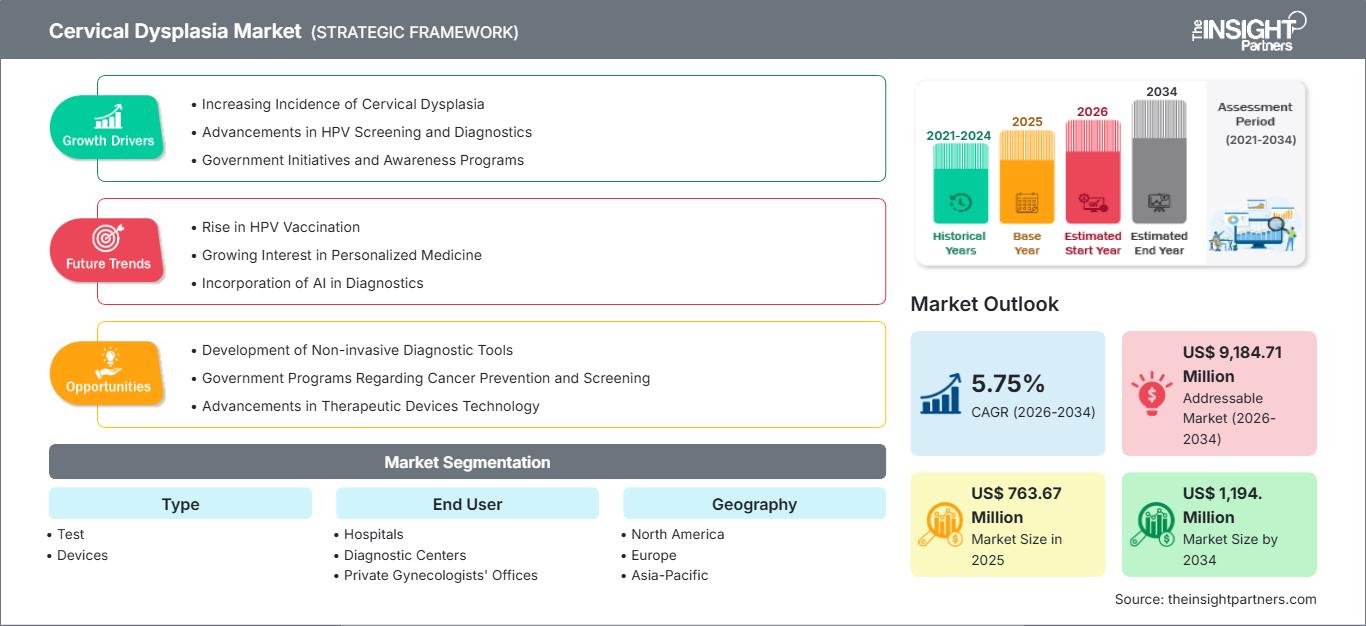
US$ 763.67 Mn
Base year value
2034 Forecast
US$ 1,194 Mn
Projected by 2034
CAGR 2026-2034
5.09 %
Growth rate
Addressable Market
US$ 8,882.14 Mn
(2026-2034)
The Cervical Dysplasia Market was valued at US$ 763.67 Million in 2025 and is expected to reach US$ 1,194 Million by 2034. Based on the relationship between the supplied base-year and forecast values, the market is projected to register a CAGR of 5.09% during 2026–2034. Expansion is supported by wider HPV-based screening, improved identification of precancerous cervical lesions, and growing adoption of molecular triage and digital cytology workflows.
North America remains the principal commercial region, with an estimated CAGR of ~5% through 2034. The Cervical Dysplasia Market size in the region benefits from organized screening infrastructure, accessible colposcopy services, established reimbursement pathways, and laboratories equipped for molecular HPV testing. Adoption of self-collection, automated slide preparation, digital cytology, and biomarker-based triage is also improving screening participation and diagnostic workflow efficiency.
Cervical Dysplasia Market Assessment and Insights
Regional Outlook
- North America: ~38% of the global market in 2025 | ~5% CAGR through 2034. Market position: North America leads due to structured screening, high molecular-testing penetration, established laboratory networks, and investment in digital cytology, HPV genotyping, and risk-based patient management.
- US: ~87% of North American market revenue in 2025 | ~5% CAGR through 2034. Market position: The US dominates North America through broad diagnostic access, strong manufacturer presence, guideline-driven screening, reimbursement coverage, and adoption of AI-assisted cytology and self-collected HPV sampling.
- Europe: ~29% of the global market in 2025 | ~5% CAGR through 2034. Market position: Europe represents a mature screening environment. Germany leads the region, while the UK, France, Italy, and Spain maintain substantial demand through national programs and laboratory modernization.
- Asia Pacific: ~24% of the global market in 2025 | ~7% CAGR through 2034. Market position: Asia Pacific is the fastest-growing region as China, Japan, India, South Korea, and Australia expand HPV testing, screening coverage, domestic manufacturing, and digital diagnostic capacity.
Segment Outlook
- Type: ~72% Share in 2025 | ~5% CAGR through 2034. Market position: Type leads because tests generate recurring demand across screening, diagnosis, triage, surveillance, and post-treatment follow-up, while devices are purchased on longer capital replacement cycles.
- End User: ~100% Share in 2025 | ~5% CAGR through 2034. Market position: End-user demand expands as hospitals, diagnostic centers, gynecology practices, academic institutes, and ambulatory facilities adopt differentiated testing and lesion-management workflows.
Competitive Coverage
F. Hoffmann-La Roche Ltd, QIAGEN N.V., Becton, Dickinson and Company, OncoHealth Corporation, Quest Diagnostics Incorporated, Hologic, Inc., Abbott Laboratories, Getwell, Polaris Pharmaceuticals, Inc., ViciniVax
Methodology
The Insight Partners follows Data Collection & Secondary Research, Primary Research, Data Analysis, and Data Triangulation & Final Review to validate market estimates and insights.
Source: The Insight Partners' analysis based on proprietary research, government publications, company annual reports, investor presentations, industry databases, and expert interviews.
The management of cervical dysplasia has evolved from an approach focused on morphologic cytology to an integrative approach that includes high-risk HPV testing, genotyping, liquid-based cytology, biomarker-based triage, colposcopy, and histopathology. Laboratory consolidation has driven interest in high throughput molecular testing, while smaller laboratories are turning to reference laboratories. The industry is thus developing tests that work across multiple collection mediums, automation, and laboratory informatics systems. Automated digital slide scanning and AI-assisted reviews are starting to automate repetitive screening tasks and assist cytologists in focusing on clinically significant cells.
Investment in the future should focus on underserved screening populations, decentralization of specimen collection and triage methods. The region of Asia Pacific and some other emerging health care systems offer chances of development because of low coverage rates but a vast addressable market. Testing based on self-sampling, national elimination campaigns and acquisition of portable test devices would increase accessibility. Successful marketing of commercial products will depend on the combination of screening with confirmatory diagnostics and referral to treatment.
Cervical Dysplasia Market Report Scope
| Report Attribute | Details |
|---|---|
| Market size in 2025 | US$ 763.67 Million |
| Market Size by 2034 | US$ 1,194 Million |
| Global CAGR (2026 - 2034) | 5.09% |
| Historical Data | 2021-2024 |
| Forecast period | 2026-2034 |
Cervical Dysplasia Market Analysis
Increased uptake of screenings, high prevalence of high-risk HPV infections, and the necessity for the detection of cervical intraepithelial neoplasia prior to invasive cancer are key drivers behind the development of Cervical Dysplasia Market. The demand covers the use of the product for primary screening, reflex testing, lesion verification, and post-treatment surveillance. Molecular labs, cytology labs, gynecologists, colposcopists, pathologists, payers, and public health organizations constitute an ecosystem where the quality of the sample and completeness of referrals have direct impact on the clinical value.
The supply side is moving toward integration. Collection devices, reagents, analyzers, image capture and analysis systems, colposcopes, biopsy and treatment instruments should be compatible within the entire workflow. Sales of reagents are predictable due to their repeat purchase nature, while the demand for the devices depends on the number of installed instruments, their usage, maintenance and replacement.
The Cervical Dysplasia Market Report Competitive Landscape shows competitive dynamics among large diagnostic companies and smaller firms with molecular risk stratification, machine learning-based imaging interpretation, and therapeutic strategies. Companies with well-established diagnostic and/or services offerings include F. Hoffmann-La Roche Ltd, QIAGEN N.V., Hologic, Inc., Becton, Dickinson and Company, Abbott Laboratories, and Quest Diagnostics Incorporated. Oncology-related, development, or immunology know-how is provided by OncoHealth Corporation, Getwell, Polaris Pharmaceuticals, Inc., and ViciniVax.
Present investments are made in sampling of oneself, risk assessment using one’s genetic profile, methylation signatures, digital cytology, and automation. The business strategy has become more dependent on clinical validation, regulatory clearance, device availability, and the fact that the technology does not unnecessarily refer women but does not miss any serious pathology. Partnerships between test manufacturers, laboratories, hospitals, and screening facilities may facilitate commercialization and continuity from diagnosis to treatment.
● REPORT CUSTOMIZATION
Tailor This Report To Align With Your Specific Business Requirements
This report can be customized to align precisely with your business objectives, scope, and target markets. Customization options include tailored segmentation, geography, competitive analysis, and strategic insights to support informed decision-making.
Customize This Report →WHAT YOU CAN ADJUST
- ● Segmentations
- ● Geography
- ● Competitive Analysis
- ● Language Preferences
Cervical Dysplasia Market: Strategic Insights
Regional Insights
North America Cervical Dysplasia Market
The North American market share accounted for ~38% of total worldwide revenue in 2025 and is expected to grow at a CAGR of ~5% during the forecast period until 2034. The North American Cervical Dysplasia market share is characterized by well-developed cytology infrastructure, extensive molecular tests availability, effective specialist referral networks, and routine use of risk-based management tools.
In future, growth of the market would depend on reaching out to underscreened people rather than increasing the testing frequency among regularly screened people. Sample collection for HPV testing, centralized testing facilities, mobile testing centers and interoperable reminders would be helpful in achieving higher engagement. Organized procurement in Canada by provinces would take care of Canadian market, while Mexico would provide good long-term growth prospects.
U.S. Cervical Dysplasia Market
The US accounted for around ~87% of North American revenue in 2025 and is expected to record a CAGR of ~5% through 2034. Its position is supported by large reference laboratories, hospital-based pathology departments, obstetrics and gynecology networks, and access to molecular platforms. Quest Diagnostics Incorporated, Hologic, Inc., F. Hoffmann-La Roche Ltd, Becton, Dickinson and Company, QIAGEN N.V., and Abbott Laboratories participate across testing, instruments, sample preparation, and diagnostic services.
Adoption of clinical use is trending towards HPV-based testing, genotype-based triage, double staining methods, and digital enhancement of cytology. Application possibilities are greatest in screening people who are disadvantaged in terms of geography, economics, and process. Competitiveness will be driven by ease of collection, speed of results, laboratory automation, and connectivity of positive results, follow-up colposcopy, and biopsy evaluation.
Europe Cervical Dysplasia Market
Europe accounted for around ~29% of the revenue share in 2025 and is expected to witness a CAGR of ~5% till 2034. Organized screening, population registry, government procurement, and transition from cytology pathway to HPV primary test drive the demand. The largest country in Europe is Germany owing to its large diagnostic base, lab infrastructure, expertise availability, and the use of molecular platforms.
In the UK, the presence of a national screening program with centralized quality control makes the need for high throughput tests and triaging. France is benefited by the presence of an expanding organized screening program coupled with a large number of laboratories. In Italy, the decentralization of the healthcare system leads to regional disparity, but the modernization of molecular diagnostics and referrals drives the demand.
Spain is ramping up HPV-based screening uptake, whereas labs in the region are testing out digital pathology solutions to address limitations in personnel and enhance remote cooperation. Regulatory compliance, cost per screened woman, interoperability, and evidence for safe interval stretching have considerable importance in European purchasing considerations. The mature screening market in the region limits the growth in volumes, but replacement of traditional cytology workflows, introduction of self-sampling, and better triaging of HPV-positive patients provide sustainable business opportunities.
APAC Cervical Dysplasia Market
Asia Pacific accounted for nearly ~24% of global revenue in 2025 and is projected to register a CAGR of ~7% through 2034, making it the fastest-growing region. China is the leading country in Asia Pacific because of its population scale, diagnostic manufacturing base, expanding hospital capacity, and screening initiatives. Japan and Australia maintain mature testing systems, while South Korea benefits from advanced digital and molecular infrastructure.
There are great opportunities in the future due to the existence of public screening programs, private diagnostic centers, and portable testing methods that can be used in different environments. The development of the region can only be achieved when there are affordable tests, production of those in the region, trained specialists, and connection of screening and treatment.
Middle East & Africa Cervical Dysplasia Market
The Middle East & Africa market is expected to expand at a CAGR of ~6% through 2034. Saudi Arabia is positioned as the leading country in the Middle East & Africa due to healthcare investment, hospital capacity, and procurement of advanced laboratory systems. The UAE supports private diagnostic adoption, while South Africa represents a key screening and reference-laboratory market.
For the remaining part of MEA, the growth will face barriers in terms of inadequate access to labs, inadequate specialization capacity, and lack of follow-up after detecting any abnormality. Infrastructure support in primary health facilities, sample transportation, mobile colposcopy, and decentralized testing would make the program efficient. Cheap HPV test and screen-and-treat approach would play a crucial role in regions where clinic visits are difficult.
Segmentation Analysis
Type
The Type segment is projected to grow at a CAGR of ~5% during 2026–2034. The Cervical Dysplasia Market scope within this segment covers tests and devices used for screening, triage, diagnosis, visualization, tissue sampling, and lesion management. Tests lead with approximately ~72% of 2025 revenue because they are consumed repeatedly across large screening populations. Devices remain strategically important as automation, digital imaging, and portable visualization expand diagnostic capacity.
- Test: Testing demand spans HPV DNA or RNA assays, cytology, genotyping, biomarker triage, and histopathology. Recurring testing volumes, guideline-based screening, and repeat surveillance make this sub-segment the market’s principal revenue engine.
- Devices: Devices include cytology processors, molecular analyzers, colposcopes, imaging systems, biopsy equipment, and lesion-treatment platforms. Demand is influenced by laboratory modernization, installed-base replacement, utilization rates, and decentralization of screening services.
End User
The End User segment is forecast to record a CAGR of ~5% during 2026–2034. Demand is distributed among facilities with different testing volumes, capital budgets, referral roles, and clinical capabilities. Hospitals and diagnostic centers manage most complex or high-throughput workflows, whereas private gynecology offices and ambulatory centers improve access. Research institutes support validation of biomarkers, AI systems, and therapeutic candidates.
- Hospitals: Hospitals combine screening, colposcopy, biopsy, pathology, and treatment referral. Their multidisciplinary infrastructure makes them important purchasers of advanced platforms and essential destinations for patients with high-grade or clinically complex lesions.
- Diagnostic Centers: Diagnostic centers support centralized molecular testing and cytology at scale. Automation, standardized quality control, efficient logistics, and rapid turnaround strengthen their role as screening programs move toward high-volume HPV-based workflows.
- Private Gynecologists' Offices: Private offices represent accessible points for routine screening, sample collection, counseling, and follow-up. Adoption depends on reimbursement, referral partnerships, compact equipment, and integration with external laboratories.
- Research and Academic Institutes: Academic institutions evaluate novel biomarkers, digital algorithms, therapeutic vaccines, and risk-stratification approaches. Their studies influence clinical evidence, regulatory submissions, guideline evolution, and future commercial adoption.
- Ambulatory Surgical Centers: These centers support outpatient biopsy, excisional treatment, and follow-up procedures. Their importance rises as healthcare systems shift suitable interventions from hospitals toward lower-cost, scheduled ambulatory settings.
Opportunity Snapshot
| End Users | Revenue Contribution | Trend Tag | Adoption Stage |
| Hospitals | High | Integrated Care | Mature |
| Diagnostic Centers | High | Lab Automation | Scaling |
| Private Gynecologists' Offices | Medium | Office Sampling | Scaling |
| Research and Academic Institutes | Low | Biomarker Validation | Emerging |
| Ambulatory Surgical Centers | Medium | Outpatient Treatment | Scaling |
Cervical Dysplasia Market Growth Drivers and Impact Analysis
Transition Toward HPV-Based Screening
Primary HPV testing identifies patients at elevated risk before visible cellular abnormalities necessarily emerge, enabling screening programs to apply risk-based triage rather than relying only on morphology. This transition expands demand for molecular assays, automated extraction systems, collection media, and genotype-specific interpretation. It also increases the importance of cytology, dual-stain testing, methylation markers, or colposcopy as reflex procedures for HPV-positive results. Commercial impact extends beyond test-kit volume because laboratories require validated workflows, quality controls, software integration, and trained personnel. Vendors offering platforms that accommodate clinician-collected and self-collected samples can address both established screening channels and populations that avoid conventional pelvic examinations.
Expansion of Organized Screening and Follow-Up Programs
National and regional cervical cancer elimination strategies create demand when screening invitations are connected to registries, laboratory capacity, referral protocols, and treatment availability. Organized programs generate more predictable procurement than opportunistic screening and help laboratories plan instruments, reagents, staffing, and logistics. Their market impact is strongest when public agencies establish target populations, testing intervals, quality standards, and recall systems. For suppliers, winning program access requires affordable per-patient economics, dependable distribution, training support, and evidence across diverse collection environments. Program effectiveness also depends on closing the follow-up gap after abnormal findings, supporting demand for colposcopy, biopsy, pathology, and outpatient treatment devices.
Automation and Digitalization of Cytology Workflows
Cytology laboratories face repetitive review workloads, variable access to trained personnel, and pressure to maintain diagnostic quality while processing large case volumes. Automated slide preparation, digital imaging, AI-assisted cell selection, and remote case review can improve workflow consistency and direct expert attention toward suspicious specimens. The impact is particularly relevant to consolidated laboratories serving multiple hospitals or geographic areas. Digital systems also create opportunities for centralized quality assurance, consultation, and workforce balancing. Adoption, however, depends on regulatory authorization, image storage, cybersecurity, integration with laboratory systems, and measurable productivity gains. Suppliers must therefore combine hardware, algorithms, service, training, and workflow redesign.
Cervical Dysplasia Market Future Trends
Risk-Stratified Molecular Triage
Cervical Dysplasia Market trends are moving beyond binary HPV-positive or HPV-negative reporting toward finer risk stratification. Extended genotyping, host-cell methylation, viral activity markers, and combinations of molecular and cytological evidence can help determine whether a patient requires immediate colposcopy, shorter surveillance, or routine recall. Through 2034, laboratories are expected to favor triage approaches that reduce avoidable procedures while retaining sensitivity for high-grade lesions. Adoption will depend on prospective evidence, compatibility with primary screening platforms, reimbursement, and clear clinical algorithms. Successful products will convert complex molecular outputs into practical decisions and demonstrate value across different prevalence levels and healthcare resources.
Connected Self-Sampling and Decentralized Screening
Self-sampling is expected to evolve from a collection alternative into a connected screening model combining digital invitations, kit distribution, laboratory processing, result communication, and referral navigation. This could extend coverage among patients who face travel barriers, discomfort, limited appointment availability, or cultural concerns. The commercial opportunity is not confined to collection kits. It includes logistics, specimen tracking, compatible assays, patient engagement software, and navigation services. Programs will need safeguards for sample adequacy, privacy, positive-result follow-up, and equitable access. Vendors able to support an end-to-end pathway can compete on completed diagnoses rather than tests dispatched.
Cervical Dysplasia Market Opportunities
Build Scalable Screening Networks in Underserved Regions
Emerging markets offer investment potential where screening coverage, molecular laboratory access, and colposcopy availability remain uneven. Cervical Dysplasia Market Forecasts support a network model that combines community collection, regional laboratories, referral centers, and portable diagnostic equipment. Companies can pursue partnerships with public health agencies, hospital groups, nongovernmental organizations, and local distributors to align testing capacity with confirmatory care. Localization of reagent production, technician training, maintenance, and sample transport can lower operating barriers. Investors should prioritize systems that function with constrained infrastructure and report measurable patient completion across screening, triage, and treatment rather than focusing solely on installed instruments.
Develop Integrated Diagnostic and Patient-Navigation Platforms
Fragmentation between screening, positive-result notification, colposcopy, biopsy, and surveillance creates avoidable patient loss and limits the clinical value of diagnostic technology. Providers and vendors can address this gap through platforms linking laboratory results with appointment scheduling, risk-based recommendations, reminders, and referral tracking. Commercial models may combine assay supply, software, workflow analytics, and managed services. Diagnostic centers can use these capabilities to deepen relationships with hospitals and gynecology practices, while manufacturers can differentiate otherwise comparable assays through connectivity. Investment should focus on interoperable systems that protect patient data and demonstrate improved completion of recommended follow-up.
Recent Developments
- May 2026: World Health Organization and molecular diagnostics stakeholders — WHO issued updated guidance on HPV DNA genotyping for cervical precancer screening, covering no genotyping, limited genotyping, and extended genotyping approaches. The recommendations strengthen the clinical framework for genotype-informed risk stratification and create a clearer adoption pathway for companies supplying compatible assays and automated molecular platforms. November 2025: Hologic, Inc. — Hologic announced expanded CE marking for the Genius Digital Diagnostics System, enabling European laboratories to image and review both cell and tissue specimens. The expanded capability allows laboratories to connect digital cervical cytology screening with biopsy review on a broader platform, potentially improving workflow consolidation and remote pathology collaboration.
- September 2024: F. Hoffmann-La Roche Ltd — Roche announced that WHO had included dual-stain cytology in its cervical cancer prevention guidance. Its CINtec PLUS Cytology test detects p16 and Ki-67 biomarkers in the same cell to support triage of HPV-positive patients, helping clinicians distinguish elevated-risk cases requiring colposcopy from lower-risk patients suitable for later retesting.
Frequently Asked Questions

- Comprehensive Market Sizing and Forecast Analysis
- Detailed Segmentation Analysis
- In-Depth Market Dynamics Assessment
- Regional and Country-Level Insights
- Competitive Landscape and Company Benchmarking
- Strategic Business Intelligence
Recent Reports
Testimonials

The Insight Partners provided valuable market intelligence that supported our global go-to-market strategy. Their team was professional, responsive, and attentive to our feedback, providing thoughtful analysis and helpful methodological clarifications throughout the project.
Junmo Kim Chief Financial Officer (CFO), Enertech Co., Ltd.
The Insight Partners' SCADA System Market report is comprehensive, with valuable insights on current trends and future forecasts. The team was highly professional, responsive, and supportive throughout. We are very satisfied and highly recommend their services.
RAN KEDEM Partner, Reali Technologies LTDs
I requested a report on a very specific software market and the team produced the report in a few days. The information was very relevant and well presented. I then requested some changes and additions to the report. The team was again very responsive and I got the final report in less than a week.
JEAN-HERVE JENN Chairman, Future Analytica
We worked with The Insight Partners for an important market study and forecast. They gave us clear insights into opportunities and risks, which helped shape our plans. Their research was easy to use and based on solid data. It helped us make smart, confident decisions. We highly recommend them.
PIYUSH NAGPAL Sr. Vice President, High Beam Global
The Insight Partners delivered insightful, well-structured market research with strong domain expertise. Their team was professional and responsive throughout. The user-friendly website made accessing industry reports seamless. We highly recommend them for reliable, high-quality research services
YUKIHIKO ADACHI CEO, Deep Blue, LLC.
This is the first time I have purchased a market report from The Insight Partners.While I was unsure at first, I visited their web site and felt more comfortable to take the risk and purchase a market report.I am completely satisfied with the quality of the report and customer service. I had several questions and comments with the initial report, but after a couple of dialogs over email with their analyst I believe I have a report that I can use as input to our strategic planning process.Thank you so much for taking the extra time and making this a positive experience.I will definitely recommend your service to others and you will be my first call when we need further market data.
JOHN SUZUKI President and Chief Executive Officer, Board Director, BK Technologies
I wish to appreciate your support and the professionalism you displayed in the course of attending to my request for information regarding to infectious disease IVD market in Nigeria. I appreciate your patience, your guidance, and the fact that you were willing to offer a discount, which eventually made it possible for us to close a deal. I look forward to engaging The Insight Partners in the future, all thanks to the impression you have created in me as a result of this first encounter.
DR CHIJIOKE ONYIA MANAGING DIRECTOR, PineCrest Healthcare Ltd.Reason to Buy
- Informed Decision-Making
- Understanding Market Dynamics
- Competitive Analysis
- Identifying Emerging Markets
- Customer Insights
- Market Forecasts
- Risk Mitigation
- Boosting Operational Efficiency
- Strategic Planning
- Investment Justification
- Tracking Industry Innovations
- Aligning with Regulatory Trends





 Get Free Sample for