
Clean Room Pass Box Market Size, Growth & Demand by 2034
Coverage: By Product Type (Wall-mounted, Floor-standing); End-User (Hospital, Clinic, Other), and Geography (North America, Europe, Asia Pacific, and South and Central America)
- Status : Data Released
- Report Code : TIPRE00015552
- Category : Life Sciences
- No. of Pages : 150
- Available Report Formats :


- Last update date : November 09, 2026


2025 Market Size
US$ 980.84 Mn
Base year value
2034 Forecast
US$ 1,667.22 Mn
Projected by 2034
CAGR 2026-2034
6.07 %
Growth rate
Addressable Market
US$ 11,989.99 Mn
(2026-2034)
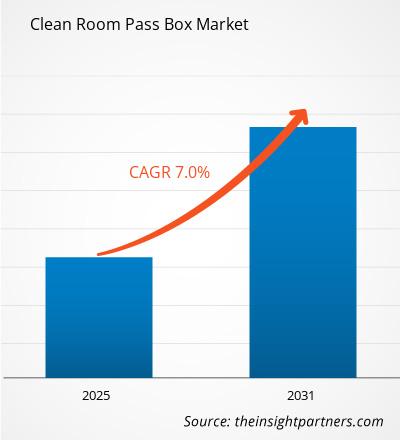
The Clean Room Pass Box Market was valued at US$ 980.84 Million in 2025 and is projected to reach US$ 1,667.22 Million by 2034, registering a CAGR of 6.07% during 2026–2034. Expansion is supported by stricter contamination-control practices, rising investment in controlled healthcare environments, and replacement of basic transfer hatches with interlocked, filtered, and easier-to-clean systems. Procurement is increasingly shaped by cleanability, material compatibility, airflow performance, validation requirements, and integration with facility pressure-control strategies.
Across North America, the Clean Room Pass Box Market size is expected to advance at a modeled CAGR of ~5% through 2034. Demand is anchored by hospital sterile-compounding facilities, centralized pharmacies, diagnostic laboratories, and healthcare renovation projects. Buyers are prioritizing stainless-steel construction, electromagnetic interlocks, HEPA-filtered airflow, and configurations compatible with facility contamination-control procedures. Cleanroom classifications and maintenance requirements are also influenced by ISO standards and sterile-compounding practices.
Clean Room Pass Box Market Assessment and Insights
Regional Outlook
- North America: ~38% of the global Clean Room Pass Box Market share in 2025 | ~5% CAGR through 2034. Market position: North America holds the leading modeled position, supported by established hospital infrastructure, sterile-compounding requirements, sophisticated infection-prevention programs, and frequent modernization of controlled pharmacies and laboratories.
- US: ~78% of North American market revenue in 2025 | ~5% CAGR through 2034. Market position: The US leads North America through its extensive hospital network, technology-oriented procurement structure, cleanroom renovation activity, and demand for validated material-transfer equipment in pharmacy, laboratory, and clinical applications.
- Europe: ~29% of the global market in 2025 | ~5% CAGR through 2034. Market position: Europe represents a mature market where Germany, the UK, France, Italy, and Spain sustain demand through hospital upgrades, regulatory compliance, pharmaceutical care infrastructure, and replacement of aging transfer systems.
- Asia Pacific: ~25% of the global market in 2025 | ~8% CAGR through 2034. Market position: Asia Pacific is the fastest-growing region as China, Japan, India, South Korea, and Australia expand healthcare capacity, localized equipment production, clinical laboratories, and contamination-controlled facilities.
Segment Outlook
- Wall-mounted: ~64% Share in 2025 | ~6% CAGR through 2034. Market position: Wall-mounted systems lead because they conserve floor area, integrate efficiently into cleanroom partitions, and suit routine movement of instruments, samples, medicines, and small material containers.
- Clinic: ~36% Share in 2025 | ~7% CAGR through 2034. Market position: Clinic applications offer the higher growth outlook as specialty treatment centers, ambulatory facilities, diagnostic clinics, and outpatient compounding areas invest in compact contamination-control infrastructure.
Competitive Coverage
Felcon Ltd., Esco Micro Pte. Ltd., Ortner Reinraumtechnik GmbH, Clean Air Products, Franz Ziel GmbH, LeoCon Group GmbH, Acmas Technologies Pvt. Ltd., AES Clean Technology, Inc., Easypharma S.r.l., BIOBASE Group
Methodology
The Insight Partners follows Data Collection & Secondary Research, Primary Research, Data Analysis, and Data Triangulation & Final Review to validate market estimates and insights.
Source: The Insight Partners' analysis based on proprietary research, government publications, company annual reports, investor presentations, industry databases, and expert interviews.
Cleanroom transfer chambers have been transformed from mechanically interlocked stainless-steel enclosures into configurable devices using electronic controls, HEPA filters, air showers, alarms, indicators, and smooth interior finishes. The dynamics of production have increasingly favored modular construction since the equipment requires installation within active hospital zones. As such, manufacturers will continue competing in customization with regard to dimensions, door position, fire-rating, filtration ability, corrosion resistance, and documentations. Wall and free-standing units cater for varied weights, paneling materials, workflows, and handling needs.
Until 2034, funding will be concentrated on new health care systems, specialty hospitals, regional diagnostic centers, and facilities that are modernizing their sterile processing rooms. The regulatory focus on infection control and sustainable facilities operations will prompt development of products that are easier to decontaminate, monitor, validate, and maintain. There will be growth in Asia Pacific countries and selected countries in the Middle East due to hospital construction and local manufacture, while developed countries will generate replacement needs based on digital interlocking, filtration capability, servicing, and wall compatibility.
Clean Room Pass Box Market Report Scope
| Report Attribute | Details |
|---|---|
| Market size in 2025 | US$ 980.84 Million |
| Market Size by 2034 | US$ 1,667.22 Million |
| Global CAGR (2026 - 2034) | 6.07% |
| Historical Data | 2021-2024 |
| Forecast period | 2026-2034 |
Clean Room Pass Box Market Analysis
The Clean Room Pass Box Market growth reflects the need to transfer medicines, instruments, samples, waste containers, and consumables without increasing personnel movement between controlled zones. Lower traffic helps facilities preserve pressure relationships and reduce opportunities for particulate or microbial transfer. Within the value chain, stainless-steel suppliers, filtration specialists, sensor vendors, interlock manufacturers, cleanroom contractors, distributors, validation providers, and facility engineers collectively determine system performance. Pass boxes can support contamination-control procedures by preventing both doors from opening simultaneously and by separating material movement from personnel circulation.
The supply consists of firms that produce standardized equipment and firms providing project-oriented dimensions, airflow, doors, controls, and wall interfaces. Although the standard equipment is quick to deliver and easy to purchase, customized solutions will be necessary for non-standard loads, special room classification, insufficient installation area, or special cleaning solutions.
The research of the Clean Room Pass Box Market shows that the competitive situation is fragmented and, sometimes, documents regarding compliance, customization, installation, and maintenance can matter as much as the price of the chamber. Such firms as Felcon Ltd., Esco Micro Pte. Ltd., Clean Air Products, and BIOBASE Group provide either standardized or customizable equipment, whereas Ortner Reinraumtechnik GmbH, Franz Ziel GmbH, AES Clean Technology, Inc., and Easypharma S.r.l. take part in bigger projects of cleanrooms and controlled environments.
Nowadays, the tendency to modular engineering, manufacturing in factories, utility efficiency, and modular cleanroom design prevails. For example, AES Clean Technology's off-site manufacturing of vertical utility modules demonstrates such a trend as faster implementation and adaptability of the infrastructure. Those suppliers that integrate their pass boxes with walls, doors, HVAC control, and validation have more influence on the project than those that sell just the equipment.
● REPORT CUSTOMIZATION
Tailor This Report To Align With Your Specific Business Requirements
This report can be customized to align precisely with your business objectives, scope, and target markets. Customization options include tailored segmentation, geography, competitive analysis, and strategic insights to support informed decision-making.
Customize This Report →WHAT YOU CAN ADJUST
- ● Segmentations
- ● Geography
- ● Competitive Analysis
- ● Language Preferences
Clean Room Pass Box Market: Strategic Insights

Regional Insights
North America Clean Room Pass Box Market
North America accounted for an estimated ~38% of global revenue in 2025 and is projected to expand at a modeled CAGR of ~5% through 2034. The Clean Room Pass Box Market share reflects the region’s installed base of hospitals, sterile-compounding pharmacies, diagnostic laboratories, and advanced treatment facilities. Routine renovation of pharmacy and laboratory spaces supports recurring demand for wall-mounted transfer equipment, while larger facilities use floor-standing systems for carts, bulk materials, and high-volume workflows.
Purchase considerations include the need for proven filter technology, cleanability, reliable locking, and fit within the existing environmental systems. Growth is relatively modest in comparison to its maturity, although replacement cycles create solid income sources. Hospitals are increasingly turning to electronically interlocked and monitored hatches rather than manual ones. Suppliers also gain through demand for fire-, lead-, HEPA-filtered, and welded units.
U.S. Clean Room Pass Box Market
The US represented approximately ~78% of North American market revenue in 2025 and is anticipated to register a modeled CAGR of ~5% through 2034. The regional leadership of this product is tied to the size of the hospital infrastructure, capital spending on the development of pharmacies and laboratories, as well as manufacturers of cleanroom equipment and engineering companies. Areas of application include sterile drug manufacturing processes, pathology procedures, hospital laboratories, isolation support, and transfer zones for controlled clinical rooms.
Local manufacturers provide wall-mount, floor-mount, fully welded, HEPA filtered, fire resistant, and special pass-through units. Such wide range of products allows one to choose a system that suits walls of building, weight, air flow needs, and fire regulations. Renovation is an important market for this product since pass boxes will help cut down unnecessary entrance into the controlled room without the need to change the entire workflow.
Europe Clean Room Pass Box Market
Europe held an estimated ~29% of global revenue in 2025 and is forecast to grow at a modeled CAGR of ~5% through 2034. The area has both an advanced hospital system and cleanroom engineering. The leading country in Europe in terms of cleanroom, containment, and aseptic processing equipment manufacturers as well as investments in health care and pharmaceutical infrastructure is Germany. The companies Ortner Reinraumtechnik GmbH and Franz Ziel GmbH show the engineering focus of the area on controlled transfer, decontamination, containment, and configurable facility systems.
The demand comes from hospital pharmacies, research laboratories, and infrastructure upgrade in the UK. France creates the demand for cleanroom technologies via hospital upgrade and specialized treatment centers, and Italy has both demand from healthcare providers and local manufacturers of modular cleanrooms and equipment.
Hygiene, energy efficiency, validation compatibility, minimal maintenance interlocking systems, and machines that fit in with modular partitions are among the important criteria that European customers look for. The need for replacement will probably favor stainless-steel enclosures featuring curved interiors, door status indicators, electronic controls, and adjustable filters. Growth is stable and not fast since the large nations have adequate infrastructure for controlled environments, but regulatory pressure and replacement keep sales going.
APAC Clean Room Pass Box Market
Asia Pacific represented approximately ~25% of global revenue in 2025 and is projected to record the fastest regional CAGR of ~8% through 2034. China has been identified as the top country in Asia Pacific based on huge equipment manufacturing, building of hospitals, and the growing number of controlled labs. Japan and South Korea have played significant roles due to their high-tech healthcare facilities, whereas India has taken advantage of hospital expansion and local manufacturing of cleanroom equipment.
The demand for Australia comes from modern hospitals, research centers, and clinics. The regional growth is enhanced by local production, relatively cheaper manufacturing, quality demands, and investments in specialty care. Availability of suppliers is helping in accessing electronic interlocks, HEPA filters, stainless steel buildings, and specific chamber sizes.
Middle East & Africa Clean Room Pass Box Market
The Middle East & Africa market is projected to expand at a modeled CAGR of ~7% through 2034. Saudi Arabia is assessed as the leading country in the Middle East & Africa, supported by hospital development, healthcare localization, and investment in specialized medical infrastructure. The UAE provides demand through private hospitals, medical hubs, laboratories, and premium healthcare projects requiring internationally aligned contamination-control systems.
South Africa is the primary established market in Sub-Saharan Africa, but RoMEA will remain a project-based market. The procurement process will be driven by factors such as availability of equipment from outside sources, capabilities of distributors, maintenance availability, and resilience to local conditions. Filters that operate in an energy-efficient manner, components that can be easily serviced, and modularity should become important.
Segmentation Analysis
Product Type
The Product Type category defines how equipment is incorporated into the facility, what loads it can accommodate, and how it affects workflow design. The Clean Room Pass Box Market scope covers Wall-mounted and Floor-standing systems, maintaining the supplied taxonomy. Adoption depends on available floor area, wall load capacity, transfer frequency, item dimensions, and cleaning procedures. Wall-mounted systems are projected to record a modeled CAGR of ~6% during 2026–2034, supported by their suitability for routine hospital and clinic transfers.
- Wall-mounted: These systems support frequent transfer of medicines, samples, tools, and compact containers while conserving usable floor space. Their integration into cleanroom partitions makes them appropriate for pharmacies, laboratories, diagnostic rooms, and treatment-area support workflows.
- Floor-standing: Floor-standing units accommodate larger containers, trolleys, equipment, and bulk supplies that cannot pass safely through compact wall chambers. Demand is concentrated in high-throughput facilities requiring ergonomic loading, durable construction, and controlled movement of heavier materials.
End-User
The End-User category captures differences in facility scale, procurement budgets, transfer frequency, and contamination-control complexity. Hospitals account for the more established demand base because multiple controlled departments can require dedicated material-transfer points. Clinics represent a growing opportunity as outpatient procedures, specialty care, diagnostics, and localized sterile preparation expand. The Clinic sub-segment is projected to register a modeled CAGR of ~7% during 2026–2034, reflecting adoption of compact cleanroom and controlled-workspace infrastructure.
- Hospital: Hospitals require pass boxes across sterile pharmacies, laboratories, surgical-support areas, controlled storage rooms, isolation-related workflows, and specialized treatment departments. Procurement typically favors validated performance, durable materials, service availability, and compatibility with wider facility-control systems.
- Clinic: Clinics generally favor compact, cost-conscious equipment that can be installed within constrained layouts. Demand is emerging from diagnostic centers, ambulatory treatment facilities, fertility clinics, specialty practices, and outpatient sites strengthening separation between controlled and uncontrolled work areas.
Opportunity Snapshot
| End Users | Revenue Contribution | Trend Tag | Adoption Stage |
| Hospital | High | Sterile Workflow | Mature |
| Clinic | Medium | Outpatient Control | Scaling |
Clean Room Pass Box Market Growth Drivers and Impact Analysis
Stricter Contamination-Control Requirements in Healthcare Facilities
Healthcare providers are strengthening procedures that separate controlled and uncontrolled areas because failures in infection prevention can affect patients, staff, samples, medicines, and clinical operations. The pass box facilitates the achievement of this goal by ensuring movement of materials in the absence of people moving across the barriers. While interlocking doors reduce exposure simultaneously, filtered designs provide extra safety when adjacent areas have varying cleanroom standards. Commercially, the significance goes beyond construction of new hospitals, as older pharmacies, labs, operating suites, and diagnosis areas also need to be retrofitted or re-equipment. The WHO guidelines stress implementation at a facility level of sustainable infection prevention measures.
Expansion of Sterile Compounding and Diagnostic Infrastructure
There is an increasing use of controlled pharmacies, diagnostic laboratories, and preparation areas due to the complicated and decentralized nature of treatment paths in hospitals. Each of the controlled areas has the potential to generate material transfers of ingredients, drugs, samples, tools, clothing, and waste. Pass boxes minimize the frequency at which there would be a need to open doors. This is critical for areas in which the pharmacy isolator, biosafety cabinet, and cleanroom function as a layer of contamination control. Manufacturers may cater to such demand through compact wall-mounted equipment for routine materials or floor-standing units for carts or large quantities of materials.
Replacement of Basic Hatches with Validated Transfer Systems
Legacy transfer hatches may lack electronic interlocks, status indicators, alarms, active filtration, coved interiors, or materials suited to repeated disinfectant exposure. Hospitals renovating controlled spaces are therefore replacing basic units with systems offering more predictable operation and improved documentation. This generates demand even in mature markets where cleanroom penetration is already high. Replacement projects also allow buyers to address changed workflow volumes, revised wall layouts, and heavier transfer loads. Manufacturers benefit when they provide configurable dimensions, stainless-steel grades, filtration options, and service access without requiring extensive structural alteration. Product portfolios now include fully welded, HEPA-filtered, fire-rated, lead-lined, and vertical-door configurations, demonstrating how specialized requirements are broadening equipment value.
Clean Room Pass Box Market Future Trends
Connected Controls and Transfer-Cycle Traceability
Clean Room Pass Box Market trends will increasingly center on electronic control, event recording, alarm management, and integration with facility-monitoring platforms. Future systems are expected to document door status, transfer duration, cleaning cycles, filter conditions, and operating faults, helping hospitals investigate deviations and demonstrate procedural control. Touchless access, programmable logic, differential-pressure sensing, and remote service diagnostics can reduce dependence on manual checks. Adoption will initially favor large hospitals and technically advanced clinical facilities because integration requires compatible building systems and trained maintenance teams. Over time, standardized controllers and lower sensor costs should bring traceability features into mid-range products, shifting competition from basic hardware durability toward data availability, cybersecurity, usability, and lifecycle support.
Modular and Off-Site-Manufactured Cleanroom Integration
Pass boxes will increasingly be specified as integrated elements of modular walls, utility systems, doors, and airflow strategies rather than purchased after cleanroom construction. Off-site manufacturing can improve dimensional accuracy, reduce work inside active hospitals, and shorten renovation schedules. Manufacturers may develop pre-engineered wall modules containing transfer chambers, utility connections, control wiring, and service access. This approach is particularly relevant to clinics and regional hospitals that need scalable controlled areas without lengthy conventional construction. AES Clean Technology’s modular utility developments demonstrate the wider industry movement toward adaptable, rapidly installed cleanroom infrastructure. Suppliers able to coordinate pass-box design with partition thickness, pressure zoning, fire ratings, and commissioning requirements should gain specification-stage influence.
Clean Room Pass Box Market Opportunities
Compact Systems for Specialty and Outpatient Clinics
Specialty clinics offer an actionable opportunity for manufacturers to design smaller, standardized systems requiring limited structural modification. Clean Room Pass Box Market Forecasts indicate that clinic demand can outpace mature hospital demand as ambulatory procedures, diagnostics, fertility services, infusion facilities, and outpatient preparation areas expand. Suppliers can address this opportunity through compact wall-mounted models, simplified electronic interlocks, clear status indicators, and maintenance packages suited to facilities without dedicated cleanroom engineers. Distributor training and preconfigured installation kits could reduce project complexity. Commercial success will depend on balancing contamination-control performance with manageable acquisition, validation, and servicing costs rather than transferring hospital-scale specifications directly into smaller facilities.
Retrofit Packages for Aging Hospital Infrastructure
Existing hospitals contain substantial numbers of laboratories, pharmacies, and controlled rooms that cannot be closed for prolonged reconstruction. Retrofit-focused products can therefore create recurring revenue through replacement frames, adaptable flanges, compact filtration modules, upgraded door controls, and installation methods designed around short shutdown windows. Vendors should map the installed base, partner with cleanroom contractors, and offer condition assessments that identify worn seals, obsolete interlocks, damaged surfaces, or inadequate chamber dimensions. Service contracts covering filter replacement, interlock testing, calibration, and documentation can convert one-time equipment sales into longer customer relationships. The opportunity is strongest where hospitals must improve contamination control while preserving existing walls, utilities, and operational workflows.
Recent Developments
- April 2025: AES Clean Technology, Inc. – The company launched Omni ASCENT at INTERPHEX 2025. The off-site-manufactured vertical utility system enables utilities to be positioned more flexibly within cleanrooms and arrives assembled for rapid installation. Although designed for broader cleanroom integration, the development supports modular facility layouts in which pass boxes and controlled material-transfer points can be coordinated earlier in project design.
- April 2025: AGMM TECH – The company presented specialized cleanroom pass-box and pass-trolley solutions for controlled material transfer. Its published configuration framework highlighted interlocked doors, stainless-steel surfaces, HEPA or ULPA filtration, UV-C options, differential-pressure indicators, and air-shower functions. The development reflects growing supplier emphasis on application-specific transfer systems for pharmaceutical, biotechnology, healthcare, and other contamination-controlled environments.
- September 2024: Franz Ziel GmbH – The company began construction of Plant 5 at its Billerbeck site in Germany to increase capacity for advanced cleanroom and aseptic-processing technologies. The expansion strengthened its ability to serve pharmaceutical customers globally and supported closer coordination with the Körber Pharma ecosystem. Additional capacity can improve project execution for customized containment, transfer, and controlled-environment solutions.
Frequently Asked Questions

- Comprehensive Market Sizing and Forecast Analysis
- Detailed Segmentation Analysis
- In-Depth Market Dynamics Assessment
- Regional and Country-Level Insights
- Competitive Landscape and Company Benchmarking
- Strategic Business Intelligence
Recent Reports
Testimonials

The Insight Partners provided valuable market intelligence that supported our global go-to-market strategy. Their team was professional, responsive, and attentive to our feedback, providing thoughtful analysis and helpful methodological clarifications throughout the project.
Junmo Kim Chief Financial Officer (CFO), Enertech Co., Ltd.
The Insight Partners' SCADA System Market report is comprehensive, with valuable insights on current trends and future forecasts. The team was highly professional, responsive, and supportive throughout. We are very satisfied and highly recommend their services.
RAN KEDEM Partner, Reali Technologies LTDs
I requested a report on a very specific software market and the team produced the report in a few days. The information was very relevant and well presented. I then requested some changes and additions to the report. The team was again very responsive and I got the final report in less than a week.
JEAN-HERVE JENN Chairman, Future Analytica
We worked with The Insight Partners for an important market study and forecast. They gave us clear insights into opportunities and risks, which helped shape our plans. Their research was easy to use and based on solid data. It helped us make smart, confident decisions. We highly recommend them.
PIYUSH NAGPAL Sr. Vice President, High Beam Global
The Insight Partners delivered insightful, well-structured market research with strong domain expertise. Their team was professional and responsive throughout. The user-friendly website made accessing industry reports seamless. We highly recommend them for reliable, high-quality research services
YUKIHIKO ADACHI CEO, Deep Blue, LLC.
This is the first time I have purchased a market report from The Insight Partners.While I was unsure at first, I visited their web site and felt more comfortable to take the risk and purchase a market report.I am completely satisfied with the quality of the report and customer service. I had several questions and comments with the initial report, but after a couple of dialogs over email with their analyst I believe I have a report that I can use as input to our strategic planning process.Thank you so much for taking the extra time and making this a positive experience.I will definitely recommend your service to others and you will be my first call when we need further market data.
JOHN SUZUKI President and Chief Executive Officer, Board Director, BK Technologies
I wish to appreciate your support and the professionalism you displayed in the course of attending to my request for information regarding to infectious disease IVD market in Nigeria. I appreciate your patience, your guidance, and the fact that you were willing to offer a discount, which eventually made it possible for us to close a deal. I look forward to engaging The Insight Partners in the future, all thanks to the impression you have created in me as a result of this first encounter.
DR CHIJIOKE ONYIA MANAGING DIRECTOR, PineCrest Healthcare Ltd.Reason to Buy
- Informed Decision-Making
- Understanding Market Dynamics
- Competitive Analysis
- Identifying Emerging Markets
- Customer Insights
- Market Forecasts
- Risk Mitigation
- Boosting Operational Efficiency
- Strategic Planning
- Investment Justification
- Tracking Industry Innovations
- Aligning with Regulatory Trends





 Get Free Sample for